Compliance automation is software that continuously collects evidence, tests controls, and flags gaps against a regulatory framework, instead of a team reconstructing everything by hand once a year before an audit. Applied to GDPR, that means running a structured GDPR compliance checklist as a living, monitored process — lawful basis, data mapping, breach response, international transfers, and the rest — rather than a document someone fills out once and files away. This guide explains what compliance automation actually does, walks through a full GDPR compliance checklist with an honest note on what a tool can automate and what still needs a person, and shows where a compliance audit still belongs even if you're already running automation.
The short version: Compliance automation connects to your systems, runs continuous checks against a framework's requirements, and keeps evidence audit-ready year-round. For GDPR specifically, it's genuinely strong at data discovery, continuous monitoring, and evidence collection — and it can't determine your lawful basis, write your privacy notices, run a Data Protection Impact Assessment, or decide whether you need a Data Protection Officer. Those are judgment calls a person still has to make.
What Is Compliance Automation?
Compliance automation is the use of software to perform the ongoing, repetitive work of staying compliant with a regulatory or security framework: connecting to cloud accounts, HR systems, and code repositories; running scheduled checks against specific control requirements; collecting screenshots, logs, and configuration exports as evidence; and flagging drift the moment a setting falls out of line with what a framework requires. The global compliance software market was valued at $35.8 billion in 2025 and is projected to reach $39.3 billion in 2026, growing to $78.9 billion by 2033 at a 10.5% CAGR, according to Grand View Research — a market that exists because manual, point-in-time compliance work doesn't scale against how often modern infrastructure actually changes.
The category covers a range of products: dedicated GRC (governance, risk, and compliance) platforms that map evidence across dozens of frameworks at once, narrower tools built around a single framework, and modules bolted onto broader security or ITSM suites. What they share is the same core loop — discover, monitor, evidence, alert — applied continuously instead of during a scramble the month before an audit. For a broader look at how that loop works across frameworks beyond GDPR, see our full guide to compliance automation; the rest of this article stays focused on applying it to GDPR specifically.
How Compliance Automation Works
Most compliance automation platforms run the same four-stage cycle underneath very different interfaces:
Discovery and data mapping — connecting to cloud infrastructure, SaaS apps, and identity providers to build an inventory of what data exists, where it lives, and who can access it.
Continuous control monitoring — running scheduled, automated tests against specific requirements (encryption enabled, MFA enforced, access reviewed on schedule) rather than checking once a year.
Evidence collection — capturing timestamped screenshots, logs, and configuration exports on a rolling basis, so nothing has to be reconstructed under audit deadline pressure.
Alerting and remediation workflow — flagging drift the moment a control fails, then routing it to the person who owns the fix, often expressed as policy as code so the check itself lives in version control alongside the infrastructure it governs.
Compliance Automation vs. Manual GDPR Compliance
Before the checklist, it's worth being clear about what actually changes when a company adopts compliance automation versus running GDPR compliance by spreadsheet and calendar reminders:
Manual complianceCompliance automationEvidence collectionScreenshots and exports gathered manually, usually right before an auditCaptured continuously and timestamped as controls runControl monitoringPoint-in-time review, typically annualScheduled checks running hourly to daily against live systemsDrift detectionDiscovered when something breaks or an auditor flags itAlerted the moment a control falls out of complianceLegal judgment (lawful basis, DPIAs, breach notices)Human, same as automatedHuman — no platform performs this for youAudit prep timeWeeks of reconstruction before the audit windowDays, since evidence already exists on a rolling basisCost profileLower software spend, higher internal labor costRecurring subscription cost, lower internal labor for evidence workCompliance Automation vs. Manual GDPR Compliance
The GDPR Compliance Checklist: What's Automatable and What Isn't
Here is a full GDPR compliance checklist, mapped to the specific GDPR articles behind each requirement, with an honest read on how much of each step a compliance automation platform can actually take off your plate.
#Checklist itemGDPR basisAutomatable?1Determine your lawful basis for each processing activity (consent, contract, legal obligation, legitimate interest, etc.)Article 6No2Map and classify all personal data you hold — build your Record of Processing ActivitiesArticle 30Yes3Decide whether you're required to appoint a Data Protection OfficerArticle 37No4Implement and continuously monitor technical & organizational security measures (encryption, access control, MFA)Article 32Partial5Run a Data Protection Impact Assessment for high-risk processingArticle 35Partial6Maintain an accurate, current privacy notice describing what you collect and whyArticles 13–14No7Build and test a data breach response plan, including 72-hour notificationArticles 33–34Partial8Determine if you need an EU or UK representativeArticle 27No9Vet and continuously monitor processors and cross-border data transfersArticle 28, Articles 44–49Partial10Continuously monitor your overall compliance posture and re-certify controlsOngoing accountability, Article 5(2)YesThe GDPR Compliance Checklist
Out of ten checklist items, two are fully automatable, five are partial (automation handles the monitoring and evidence half; a person still makes the underlying call), and three are not automatable at all — they require legal or organizational judgment no platform performs for you. That ratio is the honest answer to "how much of GDPR can I automate," and it's a more useful number than a vendor's blanket "automates most of the work" claim.
A few items are worth expanding on, since they're where teams most often assume automation covers more than it does:
Appointing a DPO (item 3)Under GDPR Article 37, a DPO is mandatory if you're a public authority, if your core activities involve large-scale, regular, and systematic monitoring of individuals, or if your core activities involve large-scale processing of special-category data. No compliance platform can determine whether your specific business model crosses that "large scale, core activity" threshold — that's a legal reading of your own operations.
Breach notification (item 7)Automation is genuinely useful for the monitoring half — detecting an incident and triggering an alert. But the clock that matters is regulatory: under GDPR, once you become aware of a breach, you generally have to notify your supervisory authority within 72 hours, per UK ICO guidance interpreting the same 72-hour rule that applies across the EU. Deciding whether a given incident meets the notification threshold, and drafting what actually gets reported, stays a human call every time.
International transfers (item 9)Continuous vendor monitoring is automatable; deciding whether a transfer mechanism (Standard Contractual Clauses, an adequacy decision, or hosting data inside the EU in the first place) is legally sufficient is not. Teams that solve this by keeping data in EU-based infrastructure from the start sidestep a chunk of this problem — see our guide to choosing an EU cloud provider for what that looks like architecturally, and our guide to third-party and vendor risk for the ongoing processor-monitoring side of Article 28.
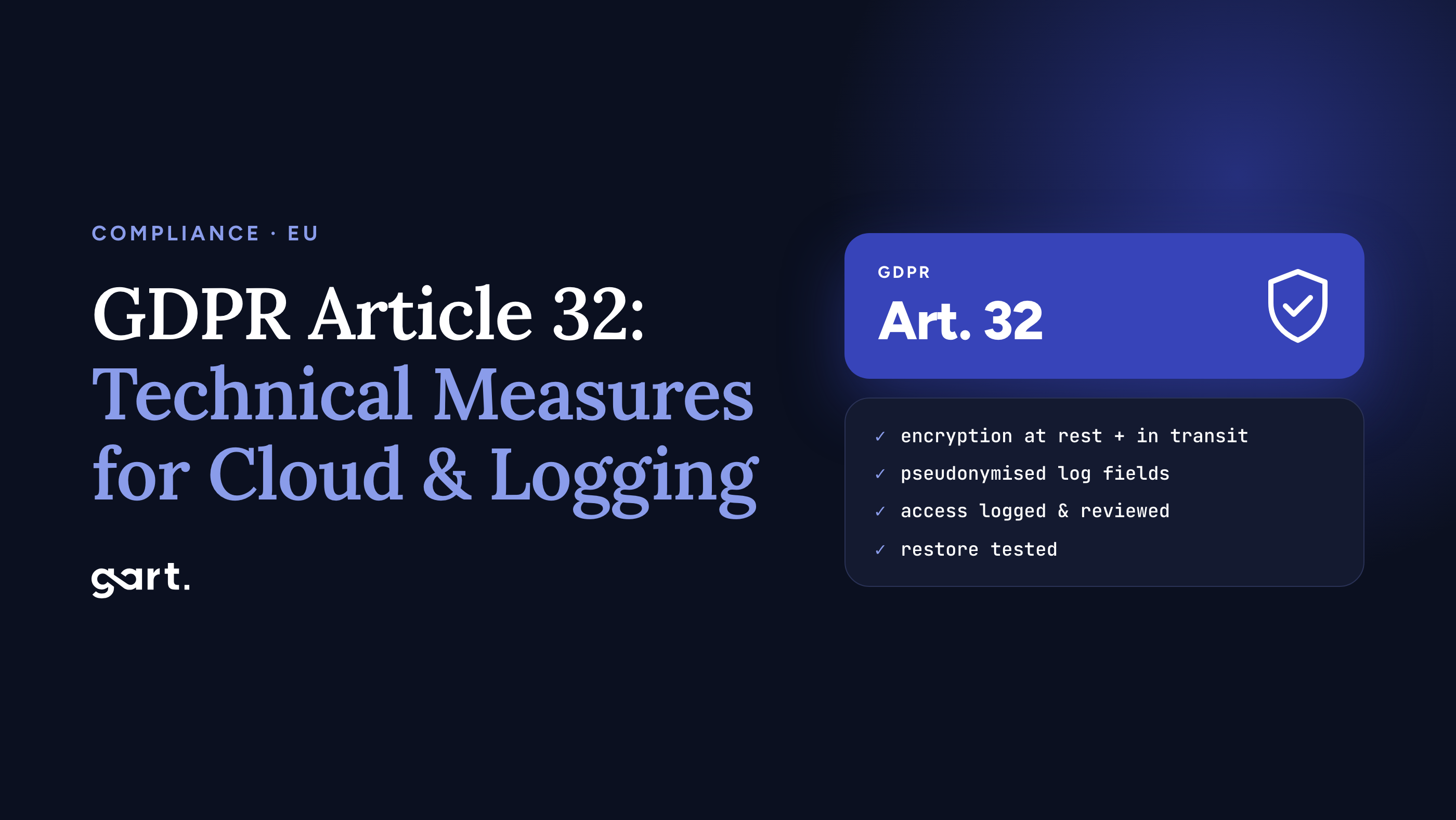
Per the CMS GDPR Enforcement Tracker Report 2026, the three most common violation types behind those 2,685 fines are insufficient legal basis for processing, non-compliance with data processing principles, and inadequate technical security measures — items 1, 6, and 4 on the checklist above, none of which a monitoring platform fully closes on its own.
What GDPR Compliance Automation Can't Do for You
A compliance automation platform is an evidence and workflow tool: it connects to your systems, runs checks, and organizes what an auditor or supervisory authority will ask for. It doesn't determine your lawful basis, doesn't write your privacy notices, doesn't run the risk analysis inside a DPIA, and doesn't fix a misconfigured access control or an unencrypted database it flagged — someone still has to do the remediation work. A green dashboard means evidence was collected on schedule; it doesn't mean the underlying data-processing decisions or infrastructure are sound. Teams that adopt automation expecting it to close their GDPR gaps for them are usually the ones surprised by a finding during an actual compliance audit or regulator inquiry.
That's the gap between what a monitoring dashboard shows and what a hands-on assessment actually verifies. Teams already running continuous checks alongside frameworks like ISO 27001 or preparing for SOC 2 tend to treat GDPR the same way — automation for the continuous evidence layer, a real technical review for the parts a dashboard can't see, and EU-facing teams increasingly pair GDPR work with NIS2 readiness since both regulations now draw on overlapping security-control evidence.
Case study - ISO 27001 compliance readiness for Spiral Technology
Gart's infrastructure and compliance audit work supported Spiral Technology's path to ISO 27001 compliance, closing the information-security management gaps the standard requires across the client's cloud environment — the same category of hands-on remediation work that sits underneath GDPR's Article 32 security requirements, regardless of which automation platform is monitoring the controls. Read the full case study
Three Ways to Approach GDPR Compliance Automation
Most companies land on one of three setups, depending on how much technical GDPR risk they're actually carrying:
ApproachWhat it coversBest fitAutomation platform onlyContinuous monitoring and evidence collection; legal judgment and remediation stay entirely in-houseTeams with an in-house privacy counsel or DPO who can own the non-automatable stepsAutomation + periodic auditContinuous monitoring day-to-day, plus a fixed-scope technical review on a schedule (e.g., annually) to verify the infrastructure behind the evidence actually holds upMost mid-sized companies — catches the gap between "evidence collected" and "infrastructure sound"Automation + continuous audit-and-monitoring partnerPlatform handles evidence; a technical partner runs ongoing security and infrastructure review, remediates findings, and keeps controls current as systems changeRegulated or fast-changing environments where infrastructure drift between audits is a real riskThree Ways to Approach GDPR Compliance Automation
Many of these steps can be automated. We compared the best GDPR compliance software by what each tool actually covers.
Common Mistakes in GDPR Compliance Automation
Assuming the platform covers everything. A green dashboard reflects evidence collection, not a legal determination that your lawful basis or DPIAs are correct.
Treating the DPIA as a form to fill in. A Data Protection Impact Assessment is a risk analysis, not a checkbox — templating it without genuine analysis defeats its purpose and won't hold up under regulator scrutiny.
Skipping the underlying infrastructure review. Automation monitors the controls you've told it to monitor; it doesn't discover the misconfigured database or unencrypted backup nobody connected it to.
Confusing "automated" with "no one's job." Every automatable checklist item still needs an owner who reviews the alerts and acts on them — automation reduces manual effort, not accountability.
Automation Handles the Evidence. We Handle the Gaps It Can't See.
If you're running (or evaluating) a GDPR compliance automation platform, Gart's IT audit and security teams do the hands-on work no dashboard performs: verifying the infrastructure behind your evidence, closing the gaps a compliance audit would flag, and keeping controls current as your systems change.
Fixed-fee compliance audit against GDPR, ISO 27001, SOC 2, HIPAA, and PCI DSS
Security and infrastructure audit for the technical controls automation can't verify
Continuous IT monitoring alongside your automation platform of choice
Remediation delivery for the gaps an audit actually finds
Book a Compliance Audit
Roman Burdiuzha
Co-founder & CTO, Gart Solutions · Cloud Architecture Expert
Roman has 15+ years of experience in DevOps and cloud architecture, with prior leadership roles at SoftServe and lifecell Ukraine. He co-founded Gart Solutions, where he leads cloud transformation and infrastructure modernization engagements across Europe and North America. In one recent client engagement, Gart reduced infrastructure waste by 38% through consolidating idle resources and introducing usage-aware automation. Read more on Startup Weekly.
ISO 27001 vs SOC 2 usually gets answered as "it depends on your customers" — SOC 2 for the US, ISO 27001 for everyone else — and that's true as far as it goes. But the question engineering leaders actually need answered is narrower: which specific access controls will an auditor test, and can one control set satisfy both? The short version: roughly 70–80% of the access-control work overlaps, but each framework wants that work documented differently. If you're mapping this out before an audit, Gart Solutions' compliance audit team can tell you in one session exactly which gaps are framework-specific and which are shared.
Every engineering leader who has been asked "are you SOC 2 or ISO 27001 compliant?" by a prospect's security team knows the question is really a proxy for something else: can we trust who has access to our data, and can you prove it? Both frameworks answer that question, but they test it through different lenses — one through a period-of-time attestation, the other through a certified management system. Understanding exactly where they overlap and where they diverge is what keeps a compliance program from turning into two parallel, redundant projects.
ISO 27001 vs SOC 2 at a Glance
Before the detail, here's the comparison in one table — the version most people searching "ISO 27001 vs SOC 2" actually want first:
DimensionISO 27001SOC 2What you getA certificate confirming your ISMS conforms to ISO/IEC 27001:2022An auditor's attestation report on your controls (Type I or Type II)Issued byAccredited certification body (e.g., BSI, LRQA, DEKRA)Licensed CPA firm, per AICPA standardsGeographyRecognized globally; strongest in EU, UK, APAC, Middle EastDe facto standard for U.S. and North American buyersStructure93 Annex A controls across 4 themes, scoped via a Statement of Applicability5 Trust Services Categories; only Security (the Common Criteria) is mandatoryAssessment stylePoint-in-time conformance audit against the management systemType I = point-in-time design check; Type II = 6–12 months of operating evidenceValidity3 years, with annual surveillance audits in betweenTypically re-issued every 12 monthsReport visibilityPublic-facing certificate (a logo you can display)Confidential report shared under NDA with customers/prospectsISO 27001 vs SOC 2
What Is ISO 27001?
ISO/IEC 27001 is an international standard, maintained jointly by ISO and the IEC, that specifies the requirements for building, operating, and continually improving an Information Security Management System — the documented, risk-based process an organization uses to manage information security on an ongoing basis, not a one-time checklist. Certification confirms that your ISMS conforms to the standard: you've identified your information security risks, selected and implemented controls to address them (drawn from Annex A's 93 controls, organized into Organizational, People, Physical, and Technological themes), documented why each applicable control exists in a Statement of Applicability, and committed to reviewing the whole system on a fixed cadence.
A first-time certification runs through a two-stage external audit — Stage 1 checks your documentation is complete, Stage 2 tests whether the ISMS is actually operating as designed — after which the certificate is valid for three years, with annual surveillance audits in between to confirm the system is still functioning. Unlike SOC 2, ISO 27001 doesn't lock you into one country's audit standard: the same certification is recognized by procurement teams and regulators across the EU, UK, Middle East, and Asia-Pacific, which is why it tends to matter more the further your customer base sits from North America.
What Is SOC 2?
SOC 2 (System and Organization Controls 2) is an attestation framework defined by the AICPA's Trust Services Criteria and delivered by a licensed CPA firm, not a certification body. Rather than certifying a management system, a SOC 2 report is the auditor's own opinion — did the organization's controls exist, and did they operate effectively, against whichever of the five Trust Services Categories the company chose to scope in: Security (mandatory for every report, also called the "Common Criteria"), Availability, Processing Integrity, Confidentiality, and Privacy.
There are two report types, and mixing them up is the single most common SOC 2 misunderstanding: a Type I report is a snapshot — it confirms controls are designed appropriately as of one date — while a Type II report is what most enterprise buyers actually require, confirming those same controls operated effectively across an observation window, typically six to twelve months. Because SOC 2 tests operating effectiveness over time rather than certifying a management system, the report itself carries no multi-year validity — it's reissued roughly annually, and a lapsed report is treated by most procurement teams as equivalent to no report at all. Our step-by-step SOC 2 preparation guide walks through the full audit-readiness process if you're just starting that path, and our breakdown of why SOC 2 audits fail covers the evidence gaps that most often derail a Type II window.
ISO 27001 vs. SOC 2: What Each One Actually Certifies
The single most useful thing to internalize before comparing individual controls: SOC 2 is an attestation, and ISO 27001 is a certification. A SOC 2 report is an independent auditor's opinion, issued after they test whether your controls operated effectively over a defined period (typically 6–12 months for a Type II report). An ISO 27001 certificate, by contrast, confirms that your Information Security Management System (ISMS) — the documented, risk-based process for managing security on an ongoing basis — conforms to the official ISO/IEC 27001:2022 standard, re-verified through annual surveillance audits and a full recertification every three years.
That distinction cascades into everything else. SOC 2 asks, "did your access controls actually work, consistently, over the last year?" ISO 27001 asks, "do you have a management system that identifies access-related risks, treats them, and reviews the treatment on a schedule?" A company can pass one and fail the other for reasons that have nothing to do with the strength of its actual access controls — usually because the documentation trail doesn't tie back to a Statement of Applicability or risk treatment plan the way ISO auditors expect.
If you're earlier in the decision and haven't picked a framework yet, our dedicated guides go deeper on each: preparing for a SOC 2 audit and why ISO 27001 matters for growing companies. This article assumes you already know you need one or both, and want the access-control specifics.
Access Control Requirements Side by Side
SOC 2's access-control requirements live almost entirely in CC6 (Logical and Physical Access Controls), one of the nine Common Criteria every SOC 2 report must address regardless of which Trust Services Categories you scope in. ISO 27001's equivalent requirements are spread across Annex A.5 (Organizational Controls) and Annex A.8 (Technological Controls), per the AICPA's Trust Services Criteria and the 2022 revision of the ISO standard, respectively. Here's how the two map onto each other in practice:
RequirementSOC 2 (CC6)ISO 27001:2022 (Annex A)Governing clauseCC6.1–CC6.8, Logical and Physical Access ControlsA.5.15–A.5.18 (access control, identity management, access rights), A.8.2–A.8.5 (privileged access, restriction, authentication)Multi-factor authenticationExpected wherever risk warrants it; tested as an operating control over the report periodRequired under A.8.5 (secure authentication) as part of the ISMS-documented policyLeast privilege / RBACCC6.3 — access restricted based on job role and functionA.5.15, A.5.18 — access rights granted per documented access control policyAccess reviewsTested as operating effectively across the audit period (evidence of periodic review required)Required on a defined schedule, tied back to the risk treatment plan and management reviewJoiner-Mover-Leaver processCC6.2 — provisioning and deprovisioning of credentialsA.5.16, A.5.18 — identity lifecycle management under the ISMSPrivileged access managementCovered within CC6.1/CC6.3 as elevated-risk accessA.8.2 — dedicated control for privileged access rightsEvidence styleOperating-effectiveness evidence sampled across a 6–12 month periodPoint-in-time conformance to the ISMS, verified via annual surveillance auditsAccess Control Requirements Side by Side
What SOC 2 Actually Requires for Access Controls
SOC 2's CC6 criteria are deliberately outcome-focused rather than prescriptive — the standard doesn't mandate a specific tool or exact review cadence, but auditors will expect to see evidence that access is provisioned based on role, reviewed periodically, and revoked promptly when someone changes roles or leaves. In practice, that means an auditor sampling your environment over the report period wants to see: registered and authorized user accounts before credentials are issued (CC6.2), access removed within a reasonable window of offboarding, and network segmentation or encryption protecting data in transit and at rest for anything access-controlled (CC6.6–CC6.7).
The practical trap teams fall into is treating CC6 as a one-time configuration exercise rather than an operating control. Because SOC 2 Type II tests effectiveness over months, not a single snapshot, an access review policy that exists on paper but wasn't actually run in month four of the audit period will fail the test even if the policy document itself looks perfect.
What ISO 27001 Actually Requires for Access Controls
ISO 27001's access control requirements ask for the same underlying discipline — least privilege, MFA, timely deprovisioning — but wrap it in a formal management system. A.5.15 requires a documented access control policy; A.5.16 and A.5.18 require identity and access-rights processes that tie back to defined roles; A.8.2 singles out privileged access as needing dedicated controls; and A.8.5 requires secure authentication mechanisms appropriate to the risk. The distinguishing requirement, per the official ISO/IEC 27001:2022 standard, is that every one of these controls must trace back to your organization's risk assessment, appear (or be justifiably excluded) in your Statement of Applicability, and get revisited during scheduled management reviews.
This is where the "ISO 27001 is more work" reputation comes from — not because the individual technical controls are harder to implement, but because the standard requires you to show why each control exists in relation to a specific identified risk, not just that the control is switched on. NIST's own access control catalog, SP 800-53 Revision 5, documents a similar principle in its AC control family: access controls are only as strong as the governance process that assigns and reviews them, regardless of which standard is doing the certifying.
The Access Controls You Actually Need, Regardless of Framework
Strip away the audit terminology and both frameworks are testing the same underlying security hygiene. If you build these seven controls properly, you've satisfied roughly 70–80% of the access-control requirements for either standard — the remaining work is documentation and evidence, not new technical controls:
Multi-factor authentication everywhere it matters — every admin console, VPN, production system, and identity provider login, not just customer-facing accounts.
Role-based access control built on least privilege — permissions assigned to roles, not individuals, with no standing access to production beyond what a role genuinely requires. Our deep-dive on RBAC in CI/CD pipelines covers this at the deployment-pipeline layer specifically.
A documented Joiner-Mover-Leaver process — access granted on day one, adjusted automatically on role changes, and revoked same-day on offboarding, with an audit trail proving it happened.
Scheduled access reviews — quarterly at minimum for privileged accounts, with sign-off from the resource owner, not just IT.
Privileged access management (PAM) — a separate, more tightly monitored tier for admin and root-level credentials, ideally with just-in-time elevation instead of standing privilege.
Centralized access logging and monitoring — every authentication and authorization event captured somewhere an auditor (and your own incident responders) can actually query it.
Encryption tied to access boundaries — data at rest and in transit protected in a way that reinforces, rather than substitutes for, the access control layer.
None of this is exotic — it's the same discipline good DevSecOps practice already asks for. Our guide to DevSecOps covers how to bake these controls into delivery pipelines rather than bolting them on before an audit.
Building One Control Set for Both Frameworks
Because the technical overlap is so high, the efficient path for most companies pursuing both certifications isn't building two access control programs — it's building one and mapping it to two sets of evidence requirements. A single access review process can satisfy SOC 2's operating-effectiveness test and ISO 27001's scheduled-review requirement, provided you keep the documentation trail both auditors need:
Write one access control policy, but explicitly reference both the SOC 2 Trust Services Criteria and your ISO 27001 Statement of Applicability inside it, so either auditor can trace the same document to their standard.
Automate provisioning and deprovisioning through your identity provider rather than ticket-based manual processes — this is the single highest-leverage control for passing both CC6.2 and A.5.16 cleanly. Practices like policy as code let you enforce and evidence this automatically rather than after the fact.
Run access reviews on a fixed quarterly cadence and retain the sign-off records — SOC 2 auditors will sample across the report period, ISO auditors will check the schedule was actually followed.
Tie every control back to a documented risk, even the ones you're implementing "because SOC 2 asked for it" — this single habit is what makes the same control set defensible under ISO 27001's ISMS requirements without extra work later.
Centralize evidence collection — screenshots, logs, and approval records stored once, tagged against both frameworks' control IDs, rather than gathered separately for each audit cycle.
Companies expanding into the EU should also factor in NIS2, which leans on many of the same access-control fundamentals for organizations providing digital infrastructure or services in scope — another reason to build the control set once, well, rather than framework-by-framework.
Cost Comparison: What Each Framework Actually Costs in 2027
Cost is the question most competing comparisons answer vaguely — actual pricing depends heavily on company size, scope, and how mature your controls already are going in. Based on typical first-year totals reported across accredited certification bodies and audit firms in 2026 (audit fees plus reasonable implementation/prep cost, before any GRC tooling subscription), here's a realistic range by company size:
Company sizeISO 27001 (first-year, implementation + certification audit)SOC 2 Type II (first-year, prep + audit)Startup / SMB (<50 employees)$25,000 – $60,000$20,000 – $45,000Mid-market (50–250 employees)$45,000 – $100,000$35,000 – $75,000Enterprise (250+ employees)$80,000 – $200,000+$65,000 – $150,000+Cost Comparison: What Each Framework Actually Costs in 2026
Two cost dynamics are worth planning around rather than being surprised by. First, ISO 27001's first-year cost usually runs somewhat higher than SOC 2's at a comparable company size, mostly because building a complete ISMS and Statement of Applicability from scratch is more upfront documentation work than scoping and preparing for an attestation — but ISO's costs flatten out more in years two and three, since only lighter surveillance audits are due until the three-year recertification. Second, SOC 2 doesn't have that grace period: because a Type II report is refreshed roughly annually, its cost repeats at close to full weight every year, which narrows the multi-year cost gap between the two frameworks more than a first-year comparison alone suggests.
Timeline: How Long Each Certification Actually Takes
Framework / report typeTypical timelineSOC 2 Type I4–8 weeks prep, then a point-in-time audit — fastest path to a first reportSOC 2 Type II4–8 weeks prep + a 6–12 month observation window before the report is issuedISO 27001 (first certification)3–6 months to build the ISMS, then a two-stage audit — 6–12 months total is typical end to endISO 27001 (ongoing)Annual surveillance audits (lighter scope) + full recertification every 3 yearsTimeline: How Long Each Certification Actually Takes
The practical read: if a deal is closing in the next quarter and the prospect needs proof of security controls fast, a SOC 2 Type I report is the quickest credible artifact you can produce. If the requirement is a multi-year commitment or an international contract, budgeting for ISO 27001's longer runway up front avoids a scramble later — sequencing is covered in more depth in our guide to why ISO 27001 matters for growing companies.
Which Framework Should You Choose?
The honest answer is "it depends who's asking" — use these four signals, in order, to make the call:
Your customer base is mostly U.S.-based
Start with SOC 2. It's the default expectation in American enterprise procurement, and Type I gives you a credible artifact within weeks.
You sell into the EU, UK, or APAC
Prioritize ISO 27001. It's the internationally portable certification those buyers recognize immediately, and it often satisfies procurement checklists SOC 2 alone won't clear.
You're pre-revenue or very early-stage
A SOC 2 Type I report is usually the fastest, cheapest way to unblock your first few enterprise deals without committing to a multi-year ISMS build.
You're regulated, or in a data-sensitive industry
Consider both from the start — healthcare, fintech, and public-sector-adjacent vendors are increasingly asked for ISO 27001 and SOC 2 as separate, non-substitutable requirements.
What Changed for ISO 27001 and SOC 2 in 2026
Two dated facts matter for anyone comparing these frameworks right now, and neither shows up in most existing "ISO 27001 vs SOC 2" comparisons written before this year:
The ISO 27001:2022 transition deadline has closed. Per the International Accreditation Forum's three-year transition rule, every organization holding an ISO 27001 certificate had until 31 October 2025 to move from the 2013 revision to ISO/IEC 27001:2022, confirmed by accredited certification bodies including LRQA. That means every currently valid ISO 27001 certificate in the market is on the 2022 revision — if a vendor shows you documentation still referencing the 2013 control set, either it has lapsed or it's out of date, which is worth checking directly in vendor due diligence.
SOC 2 didn't get a new official version, but audits got heavier. The AICPA hasn't issued a full new revision of the Trust Services Criteria for 2026, but auditors are applying existing guidance more strictly — particularly around documenting how risk assessment informs control design, and scrutinizing subservice-organization and vendor dependencies more closely inside the report itself. The practical effect for anyone preparing a report this year: budget more time for vendor and subprocessor documentation than a first-time SOC 2 program would have needed a few years ago.
Common Mistakes When Choosing Between ISO 27001 and SOC 2
Picking based on which one a competitor has. The right first framework follows your actual customer base and deal pipeline, not industry habit.
Assuming one substitutes for the other. Enterprise security teams frequently ask for both, especially once a vendor sells across regions — neither framework is a universal replacement for the other in a buyer's eyes.
Underestimating SOC 2 Type II's observation window. Teams that start evidence collection late in the window often discover gaps with no time left to remediate before the report is due.
Treating ISO 27001 as a one-time project. The certificate lapses without annual surveillance audits and a full recertification every three years — it's a maintained system, not a one-off deliverable.
Building two separate control programs. Given 60–80% overlap, running ISO 27001 and SOC 2 as unrelated projects duplicates most of the actual engineering work for no real benefit.
Confusing the framework decision with the tooling decision. GRC platforms automate evidence collection for whichever framework you've already chosen — they don't choose the framework, your risk assessment and customer base do.
Which Framework Should You Get First?
If most of your customers and prospects are US-based, SOC 2 Type II is usually the faster path to closing enterprise deals — it's the report US security teams ask for by default, and it can typically be completed in a shorter timeline than a first-time ISO certification. If you're selling into the EU, UK, or other international markets, ISO 27001 tends to carry more weight, partly because it's a recognizable international certification rather than a US-specific attestation format, and partly because it dovetails with regional requirements like NIS2 for in-scope organizations.
Many growth-stage companies that serve both markets end up pursuing both within 12–18 months of each other. The sequencing advice we give most often: build the access control program to ISO 27001's documentation standard from the start — Statement of Applicability, risk treatment plan, management review cadence — even if SOC 2 is your first audit. It's far less costly to over-document once than to retrofit ISO-grade documentation onto a SOC 2 program that was built to a lighter evidentiary bar. Our infrastructure audit process walks through exactly where most companies' current documentation falls short of that standard before either audit begins.
Gart field example: For an augmented-reality platform client pursuing ISO 27001 certification, our compliance team worked through 55 pending tasks across cloud security, infrastructure security, and code security in a four-month engagement. Read the full ISO 27001 compliance case study.
Gart Solutions
One Access Control Framework, Mapped to Every Audit You Need
Gart Solutions designs and audits access control programs that satisfy SOC 2, ISO 27001, and adjacent frameworks like NIS2 from a single, well-documented control set — so your team implements once and evidences twice, instead of building parallel compliance programs. Our infrastructure and DevSecOps teams handle everything from RBAC and MFA rollout to ISMS documentation and audit-ready evidence collection.
Compliance Audits
Security Audits
DevSecOps Consulting
Infrastructure Audits
IAM & Access Control Design
8.2
avg. MTTR reduction (×)
40+
compliance & security audits delivered
50+
engineers across compliance & DevSecOps teams
Get a compliance gap assessment →
You might also like:
IT Audit Services — Gart Solutions
Compliance Monitoring: What It Is and How to Automate It
PCI DSS Audit Preparation: A Step-by-Step Compliance Guide
HIPAA Audit: A Guide to Protecting Patient Data and Compliance
NIS2 Compliance: Services That Will Help You Be Ready
Roman Burdiuzha
Co-founder & CTO, Gart Solutions · Cloud Architecture Expert
Roman has 15+ years of experience in DevOps and cloud architecture, with prior leadership roles at SoftServe and lifecell Ukraine. He co-founded Gart Solutions, where he leads cloud transformation and infrastructure modernization engagements across Europe and North America. In one recent client engagement, Gart reduced infrastructure waste by 38% through consolidating idle resources and introducing usage-aware automation. Read more on Startup Weekly.
If you run or host an online casino, sportsbook, or iGaming platform serving European players, two EU laws now define whether your infrastructure is legally defensible: the GDPR and the NIS2 Directive. They are not optional add-ons to a licensing checklist. GDPR and NIS2 compliance for casino hosting means your data centre, cloud provider, and application architecture all have to satisfy data protection law and cybersecurity risk-management law at the same time — and the two frameworks don't always pull in the same direction.
Most operators discover this the hard way: a GDPR data-retention policy that says "delete what you don't need" collides with a NIS2 logging requirement that says "keep evidence for forensics." This guide breaks down exactly where GDPR and NIS2 apply to casino hosting, who is actually in scope (the operator, the hosting provider, or both), what technical controls satisfy both regulators, and how Gart's compliance and infrastructure engineering practice helps gaming platforms get audit-ready without slowing down releases.
Why GDPR and NIS2 Both Govern Casino Hosting
Online casino and sportsbook platforms sit at the intersection of two regulatory concerns that European lawmakers deliberately separated into two directives: protecting the personal data of individuals (GDPR) and protecting the network and information systems that critical digital services depend on (NIS2). A casino platform processes both — KYC documents, payment details, gameplay and betting history, and responsible-gambling behavioural data — on infrastructure that, by its nature as always-on, real-money, high-availability digital infrastructure, looks a lot like the kind of service NIS2 was written to protect.
The practical result is that a casino hosting stack is rarely evaluated against just one framework. Regulators, payment processors, and licensing bodies increasingly expect operators to demonstrate both data protection compliance and cybersecurity risk management maturity, and to be able to prove it with evidence, not policy documents.
🎯 The key distinction operators missGDPR protects people — it applies the moment you process the personal data of anyone in the EU, regardless of your size or sector. NIS2 protects infrastructure — it applies based on your sector, size, and role in the digital supply chain. A small casino operator might not trigger NIS2 directly, but the cloud provider, data centre, or content delivery network hosting that casino almost certainly does, because cloud computing, data centre, and CDN services are named explicitly in NIS2 Annex I as "digital infrastructure."
Does NIS2 Apply to Online Casinos? Scope for Operators and Hosting Providers
The NIS2 Directive (EU) 2022/2555 does not list "gambling" or "gaming" as one of its named sectors in Annex I or Annex II. That leads a lot of operators to conclude, incorrectly, that NIS2 doesn't concern them. In practice, casino and iGaming businesses are pulled into scope through two separate paths.
Path 1: The casino operator as a digital service provider
If your platform functions as an online marketplace, offers social or community features, or otherwise resembles the "digital provider" categories in NIS2 Annex II, you may be classified as an important entity in your own right, subject to the size thresholds (roughly 50+ employees or €10M+ turnover for medium enterprises, 250+ employees or €50M+ turnover for large ones).
Path 2: Your hosting provider as critical digital infrastructure
This is the path that matters for almost every casino platform, regardless of size. NIS2 Annex I explicitly names cloud computing service providers, data centre service providers, and content delivery network providers as "digital infrastructure" — a highly critical sector subject to the strictest obligations. If your casino platform runs on a qualifying EU cloud or data centre provider, that provider is contractually and legally obligated to run NIS2-grade risk management, incident reporting, and supply-chain security — and those obligations flow down to you through the hosting agreement, whether or not your own company is separately in scope.
Several EU member states have already transposed NIS2 into national law with gambling-specific relevance. Italy's Legislative Decree No. 138/2024 (effective 18 October 2024) expanded cybersecurity obligations with a structured registration and compliance timeline. Malta — home to a large share of EU-licensed gambling operators — enacted Legal Notice 71 of 2025, replacing its previous NIS1 regime with self-registration through the Critical Infrastructure Protection Department and a dedicated national CSIRT. As DLA Piper's analysis of NIS2 and gambling puts it, gambling operators and their suppliers "must promptly assess their eligibility under the Directive" rather than assume the absence of an explicit sector listing means the absence of obligations.
📋 What this means in practiceBefore you can answer "are we NIS2 compliant," you need a scoping exercise across three questions:
(1) does our own platform meet an Annex II digital-provider definition,(2) is our hosting/cloud/CDN provider an Annex I essential entity, and (3) does our national gambling regulator layer additional cybersecurity conditions onto our licence, independent of NIS2 itself. Gart's infrastructure assessment is typically where this scoping starts.
GDPR Requirements for Casino and iGaming Platforms
Unlike NIS2, there's no ambiguity about GDPR's applicability: if your platform processes the personal data of anyone in the EU — players, affiliates, employees — GDPR applies, regardless of where your company or servers are based. For casino hosting specifically, four requirements come up repeatedly in regulatory guidance and enforcement actions.
A Data Protection Officer is effectively mandatory
Gambling operators typically carry out large-scale, systematic monitoring of individuals (fraud detection, responsible-gambling monitoring, behavioural profiling) and process special-category data for anti-money-laundering purposes. Both conditions independently trigger the GDPR Article 37 requirement to appoint a Data Protection Officer.
DPIAs for profiling and AML/CFT processing
Two categories of processing that are core to how casino platforms operate require a Data Protection Impact Assessment as a matter of course: systems that identify excessive or at-risk gambling behaviour, and systems that support anti-money-laundering and counter-terrorist-financing (AML/CFT) checks. Both involve profiling with potentially significant effects on the individual — precisely the trigger GDPR Article 35 is built around.
Consent, cookies, and marketing
GDPR Article 7 requires that consent for gambling marketing — emails, SMS, targeted advertising, retargeting pixels — be freely given, specific, informed, and as easy to withdraw as it was to give. Cookie consent banners that pre-tick marketing categories, or that make declining harder to find than accepting, are a recurring enforcement target across EU data protection authorities.
Data residency and international transfers
Many casino platforms run analytics, fraud-scoring, or customer-support tooling on US-based SaaS vendors. Since the invalidation of Privacy Shield (Schrems II), transfers of EU player data to the US require Standard Contractual Clauses plus a documented transfer impact assessment — not just a checkbox in a vendor's terms of service. This is one of the more concrete reasons operators are re-evaluating EU-based hosting and digital sovereignty rather than defaulting to US hyperscalers.
France's gambling regulator (ANJ) and data protection authority (CNIL) jointly published a 59-page GDPR compliance guide for licensed gambling operators in May 2026, addressing exactly this intersection of licensing obligations and data protection law — a strong signal that regulators are converging on sector-specific GDPR guidance rather than leaving operators to interpret general-purpose text.
Where GDPR and NIS2 Overlap — and Where They Pull Apart
The two frameworks reinforce each other on security fundamentals — encryption, access control, incident response — but they diverge sharply on data retention, and that divergence is exactly where casino hosting architectures get into trouble.
DimensionGDPR positionNIS2 positionData retentionStorage limitation principle — keep personal data only as long as necessary for the stated purposeEncourages retaining logs, audit trails, and forensic evidence long enough to detect and investigate incidentsPrimary objectiveProtect the rights and freedoms of individuals whose data is processedProtect the availability, integrity, and confidentiality of network and information systemsWho it applies toAny controller/processor handling EU personal data, regardless of sectorEntities in named sectors (Annex I/II) above size thresholds — including hosting/cloud/CDN providersBreach/incident reporting72 hours to the supervisory authority; affected individuals notified if high risk24-hour early warning, 72-hour detailed report, final report within one month to the national CSIRTGovernanceData Protection Officer oversight; accountability principle (Article 5(2))Management-body approval and oversight of cybersecurity measures; personal liability for gross negligenceWhere GDPR and NIS2 Overlap — and Where They Pull Apart
The practical fix is architectural, not political: separate personal data from security telemetry at the schema level. Audit logs, IDS/IPS alerts, and access logs used for NIS2 incident forensics should be pseudonymised and retained under a security-specific retention schedule, distinct from the player-data retention schedule your GDPR Record of Processing Activities defines. Trying to run one retention policy for both purposes is the single most common source of audit friction Gart sees in iGaming infrastructure reviews.
Choosing GDPR- and NIS2-Ready Hosting Infrastructure
Where you host a casino platform is no longer a pure cost-and-latency decision — it's a compliance decision with legal consequences. Three factors determine whether a hosting environment actually helps you meet GDPR and NIS2 obligations, or quietly works against you.
EU data residency and sub-processor transparency
Hosting player data on EU soil, with an EU-based cloud provider that publishes a complete, current sub-processor list, removes an entire category of GDPR international-transfer risk. Operators are increasingly comparing providers like Hetzner and IONOS specifically on data-sovereignty grounds — see Gart's Hetzner vs. IONOS comparison for how these EU-native providers differ on compliance-relevant criteria like data centre location, certification scope, and contractual DPAs.
Provider-level NIS2 posture
Ask any hosting or cloud provider directly: are you classified as an essential entity under NIS2 in your jurisdiction of establishment, and can you share your incident-reporting SLAs and supply-chain security attestations? A provider that can't answer this clearly is a supply-chain risk you're inheriting without visibility into it — and NIS2 explicitly makes supply-chain security a first-class obligation for entities in scope.
Architecture that supports both regimes at once
Network segmentation that isolates wallet, KYC, and payment services from public-facing game clients serves GDPR's data-minimization-by-design principle and NIS2's risk-management requirements simultaneously — a single architectural decision satisfying two regulators. Gart's DevOps practices for iGaming, casinos, and sports betting platforms cover this kind of compliance-aware Kubernetes and network design in more depth.
Technical Controls That Satisfy Both Regulations
Rather than building two parallel compliance programs, most of the technical work overlaps. The table below maps common infrastructure controls to the specific GDPR and NIS2 obligations they help satisfy.
ControlSatisfies GDPR by...Satisfies NIS2 by...Encryption at rest and in transitMeeting Article 32 "appropriate technical measures" for security of processingMeeting the baseline cryptography requirement under Article 21 risk-management measuresRole-based access control (RBAC)Enforcing data minimization and the "need to know" principle for staff access to player dataSupporting access-control policy requirements under Article 21(2)(i)Immutable audit loggingDemonstrating accountability (Article 5(2)) — who accessed what data, whenProviding the forensic evidence trail required for incident investigation and reportingNetwork segmentation / Kubernetes NetworkPolicyReducing the blast radius of a breach involving payment or KYC dataLimiting lateral movement — a named risk-management measure under Article 21Vulnerability management & patching cadencePreventing the kind of unpatched-system breach that triggers Article 33 notificationMeeting the explicit vulnerability-handling requirement in Article 21(2)(e)Vendor / sub-processor due diligenceSatisfying Article 28 processor obligations and transfer impact assessmentsMeeting the supply-chain security requirement in Article 21(2)(d)Automated compliance-as-code (OPA/Gatekeeper)Preventing configuration drift that could expose personal data by accidentProviding continuous evidence of risk-management measures for auditsTechnical Controls That Satisfy Both Regulations
Incident Response and Breach Notification Timelines
One of the most common operational failures Gart sees during compliance reviews isn't a missing control it's a missing playbook that tells the on-call engineer which clock is ticking. GDPR and NIS2 run on different notification timelines, to different authorities, and a casino platform breach can trigger both at once.
MilestoneGDPR (Article 33/34)NIS2 (Article 23)Who you notifyNational data protection supervisory authority; affected individuals if high riskNational CSIRT or competent cybersecurity authorityFirst notificationWithout undue delay, within 72 hours of becoming awareEarly warning within 24 hours of becoming awareDetailed reportIncluded in the initial 72-hour notification (nature, scope, likely consequences)Incident notification within 72 hours, updating the initial assessmentFinal reportNot separately mandated, but documentation must be maintained under Article 33(5)Final report within one month of the incident notificationTrigger thresholdA breach likely to result in a risk to individuals' rights and freedomsAn incident with a "significant impact" on service provisionIncident Response and Breach Notification Timelines
Building one incident response runbook that maps a single security event to both timelines — rather than maintaining separate GDPR and NIS2 procedures that different teams own — is the difference between a controlled disclosure and a missed deadline discovered during an audit.
Penalties, Enforcement, and Personal Liability
The financial exposure under both regimes is large enough to change board-level risk appetite, and neither framework limits itself to fining the company.
GDPR: up to €20 million or 4% of total worldwide annual turnover for the most serious infringements — unlawful processing, breach of data subject rights, or unauthorized international transfers — whichever amount is higher.
NIS2 essential entities (including in-scope cloud, data centre, and CDN providers): up to €10 million or 2% of global annual turnover, whichever is higher.
NIS2 important entities: up to €7 million or 1.4% of global annual turnover, whichever is higher, with fines doubling for a repeat offence within three years.
NIS2 also introduces something GDPR enforcement rarely reaches for in practice: personal liability. Article 32(6) empowers national authorities to hold management bodies accountable for gross negligence, including administrative fines against individual executives and, for essential entities, temporary bans from management functions. Combined with the ENISA guidance on NIS2 implementation, this makes cybersecurity governance a board-level obligation, not a delegated IT function — a shift that gambling operators, with their traditionally licensing-focused compliance functions, are still adjusting to.
⚖️ Licence risk compounds financial riskFor a casino platform, a GDPR or NIS2 enforcement action rarely stays contained to the fine itself. Regulators such as the Malta Gaming Authority can treat a data protection or cybersecurity failure as evidence of inadequate operational controls under the gaming licence itself — turning a compliance fine into a licence review.
Compliance Checklist for Casino Hosting
AreaActionPriorityScopingDetermine whether your platform and/or your hosting provider fall under NIS2 Annex I or II🔴 CriticalGDPR governanceAppoint a DPO and complete DPIAs for problem-gambling detection and AML/CFT profiling🔴 CriticalHostingConfirm EU data residency and request your provider's NIS2 classification and sub-processor list🔴 CriticalIncident responseBuild one runbook covering both the GDPR 72-hour and NIS2 24/72-hour/1-month timelines🔴 CriticalArchitectureSegment wallet, KYC, and payment services from public-facing game clients🟠 HighData lifecycleSeparate personal-data retention schedules from security-log retention schedules🟠 HighConsent managementAudit cookie banners and marketing consent flows for pre-ticked boxes or dark patterns🟠 HighSupply chainExtend NIS2 supply-chain security assessments to payment, KYC, and analytics vendors🟡 MediumGovernanceBrief the management body on NIS2 personal-liability exposure and require sign-off on the risk register🟡 MediumCompliance Checklist for Casino Hosting
Case Study: Regulatory-Ready Infrastructure for a Sportsbook Platform
One of Gart's iGaming engagements involved migrating a US-facing sportsbook to AWS while meeting state-by-state data residency rules — a compliance problem with the same shape as GDPR/NIS2 data-residency requirements in the EU. The team designed a multi-region architecture with jurisdiction-specific VPCs and data controls enforced through Service Control Policies, paired with an Infrastructure-as-Code approach covering 100% of production resources, so every environment change was auditable by design rather than by afterthought.
Results: deployment time dropped from 4 hours to 22 minutes, feature delivery sped up by 60%, and the platform improved performance by 30–40% — all while making regulatory infrastructure reviews a matter of pulling Terraform state and Git history, not reconstructing what changed from memory.
Read the full case study: AWS Migration & Infrastructure Localization for Sportsbook Platform
Compliance-Ready Infrastructure for iGaming
If you need help mapping GDPR and NIS2 obligations to your hosting setup, our compliance consulting team can run a gap assessment and build the remediation plan.
Need casino hosting that passes a GDPR and NIS2 audit — not just a licensing check?
Gart designs and operates infrastructure for casino, sportsbook, and iGaming platforms with data protection and cybersecurity risk management built in from the architecture up — EU data residency, segmented environments, immutable audit trails, and incident-response runbooks that satisfy both regulators.
NIS2 Compliance & Gap Assessment
GDPR-Ready Infrastructure Design
EU Data Residency & Sovereign Cloud
DevSecOps & Compliance-as-Code
IT Infrastructure Assessment
Incident Response & Monitoring
iGaming & Casino DevOps
Talk to a compliance specialist
Explore our NIS2 compliance services →
You might also like
Strengthen Your Information Security with NIS2 Compliance Solutions
Digital Sovereignty of Europe: Choosing the EU Cloud Provider
DevOps Practices in iGaming, Casinos, and Sports Betting Companies
What Is DevSecOps? Integrating Security into Your DevOps Pipeline
Free NIS2 Compliance Checklist (PDF Guide)
Roman Burdiuzha
Co-founder & CTO, Gart Solutions · Cloud Architecture Expert
Roman has 15+ years of experience in DevOps and cloud architecture, with prior leadership roles at SoftServe and lifecell Ukraine. He co-founded Gart Solutions, where he leads cloud transformation and infrastructure modernization engagements across Europe and North America. In one recent client engagement, Gart reduced infrastructure waste by 38% through consolidating idle resources and introducing usage-aware automation. Read more on Startup Weekly.