Technology is expensive. Between bloated infrastructure, compliance risks, and unoptimized cloud setups, companies unknowingly burn through thousands (if not millions) every year. But here's the kicker: you don’t have to. That’s where smart IT consulting steps in.
Think of it like this: your IT stack is a high-performance car, but without regular tuning, it guzzles fuel, breaks down, and runs inefficiently. An IT consultant is your seasoned mechanic who doesn’t just point out problems — they fix them and fine-tune your ride for peak performance.
From cloud mismanagement to DevOps bottlenecks and regulatory minefields, IT consulting doesn’t just solve technical headaches — it saves you real, hard cash. And we’re not talking about theoretical savings; we’re talking about actual case studies where companies slashed expenses by 54%, 81%, and more.
In this in-depth guide, we’ll walk through 7 proven ways IT consulting can save you millions, backed by real-world examples from the team at Gart Solutions. Let’s dive into money-saving magic.
1. Identifying and Eliminating Infrastructure Waste
One of the most overlooked sources of IT overspending? Wasted infrastructure. Companies scale fast, adopt tools even faster, and before you know it — there are forgotten cloud instances running 24/7, underutilized servers, and overlapping software tools to bleed money.
This is where a full IT infrastructure audit shines. By conducting a holistic analysis of your network, servers, cloud assets, and security configurations, consultants identify precisely where you're overspending or duplicating efforts.
Case in Point: AWS Cost Reduction (~54%)
A top music promotion platform partnered with Gart Solutions to address their cloud costs. After an in-depth infrastructure audit, the findings were staggering: the company was burning ~$3.7K monthly on AWS. Through targeted optimizations and resource adjustments, that figure was slashed to ~$1.7K — an annual savings of nearly $20K.
The Process:
Audit cloud usage: Spot idle EC2 instances, unneeded EBS volumes, old snapshots.
Review licensing and SaaS subscriptions.
Benchmark infrastructure usage vs. business needs.
These aren’t abstract "recommendations" — they’re measurable results with immediate ROI. Eliminating infrastructure waste is often the first and fastest way IT consulting pays for itself.
2. Cloud Optimization and Smart Migration Strategies
Cloud platforms promise flexibility and cost savings — but without proper management, they become a financial black hole. Many companies jump into AWS, Azure, or GCP without a game plan. The result? Oversized instances, unnecessary services, and sky-high monthly bills. That’s where cloud consulting comes in.
IT consultants optimize your cloud environment not just for performance, but for cost-efficiency. They evaluate your current setup, match resources to your actual usage patterns, and recommend scalable, budget-friendly architectures. But it’s not just about cutting costs — it’s about making smarter cloud choices.
Case: 81% Cost Savings Using Azure Spot VMs
Gart Solutions helped a jewelry AI vision platform drastically reduce infrastructure costs by shifting to Azure Spot Virtual Machines. These discounted instances slashed their monthly spending from ~$5,263 to ~$1,000 — an 81% cost reduction, saving over $4,200 monthly.
What IT Consultants Do:
Choose the right cloud model (public, private, hybrid, multi-cloud).
Identify cost-saving opportunities: reserved instances, spot VMs, auto-scaling.
Re-architect for elasticity, so you're only paying for what you need.
Implement monitoring tools (e.g., CloudWatch, Grafana) for visibility.
When executed right, cloud optimization transforms your IT budget. Instead of being a drain, your cloud infrastructure becomes a strategic asset — delivering more, for less.
3. Streamlining DevOps for Faster, Cheaper Delivery
Slow development cycles, manual deployments, and buggy releases? That’s not just an operational headache — it’s a massive cost center. Every delay and failure burns resources and stalls revenue. This is where DevOps consulting becomes a game changer.
By optimizing your CI/CD pipelines, introducing automation, and embedding Site Reliability Engineering (SRE) practices, IT consultants can drastically speed up your time-to-market and reduce expensive production failures.
Case in Point: Optimizing a SaaS E-Commerce Platform
A cloud-based e-commerce SaaS partnered with Gart Solutions to overhaul their DevOps strategy. The result? Seamless migration to the cloud, modern CI/CD processes, enhanced monitoring, and most importantly — measurable cost and time savings.
Key Deliverables:
CI/CD pipeline design and optimization.
Infrastructure as Code (Terraform, Ansible).
Kubernetes cluster setup for scalability.
DevOps culture building (yes, that’s a thing).
The takeaway? Faster delivery = lower labor costs + quicker revenue. Streamlining DevOps isn't just about agility — it’s about profitability.
4. Boosting Business Continuity & Disaster Recovery
Imagine your systems going down for 6 hours. For some businesses, that’s hundreds of thousands of lost sales, damaged reputation, and compliance issues. Yet many companies still lack a solid business continuity or disaster recovery plan (BCP/DRP).
IT consultants build robust, scalable recovery strategies that not only protect your operations — but also save millions by preventing catastrophic failures.
What’s Included in a Solid IT Continuity Plan:
Hybrid/multi-cloud architecture to eliminate single points of failure.
Disaster recovery strategies with RTO/RPO targets.
Automated backup and restore systems.
Regular testing and failover simulations.
The cost of not having these in place is far greater than the investment. Proactive planning keeps you running, even when unexpected hits.
5. Ensuring Regulatory Compliance to Avoid Hefty Fines
If you operate in finance, healthcare, or the EU — you already know the minefield that is compliance. Fines for violating GDPR, ISO, or NIS2 can reach millions. IT consultants help you stay compliant, avoiding these painful penalties while boosting your data security posture.
Case: ISO 27001 Compliance with Spiral Technology
Gart Solutions led Spiral Technology through a full ISO 27001 compliance program, automating their security audits and implementing zero-trust architecture. The result? Zero audit findings — and full regulatory peace of mind.
What IT Consultants Deliver:
NIS2 & GDPR readiness audits.
Security architecture (zero-trust frameworks).
Incident response planning and simulation.
Documentation and compliance reporting.
Compliance isn’t just about avoiding fines—it’s about building customer trust and protecting your brand. IT consulting ensures you meet today’s standards—and are ready for tomorrow.
6. Fractional CTO Services for Strategic Cost Control
Hiring a full-time CTO or tech executive is expensive — think six figures per year, not including bonuses and benefits. For startups and growing businesses, that’s often out of reach. But the need for strategic technology leadership is still critical. That’s where Fractional CTO services come into play.
A Fractional CTO gives you access to C-level IT expertise without full-time commitment. Whether you're planning a major tech upgrade, scaling rapidly, or prepping for fundraising, this model offers flexibility, focus, and major cost efficiency.
Key Benefits of a Fractional CTO:
Strategic tech leadership on demand.
Vendor & tech stack evaluation to avoid wasteful investments.
IT budgeting & investment planning tailored to business goals.
Due diligence for M&A and investor presentations.
Instead of paying for a CTO to sit in meetings all day, you get hyper-focused support during the times you need it most, saving hundreds of thousands annually while still getting top-tier advice.
Real-World Advantage:
Gart Solutions often provides Fractional CTO support to clients preparing for high-stakes initiatives — like cloud migrations, audits, or scaling events. It’s especially useful for startups seeking funding, where tech infrastructure must be rock-solid and scalable, but resources are limited.
Bottom line? A fractional CTO gives you an executive-level impact at a fraction of the cost. It’s smart, strategic, and scalable.
7. Continuous IT Improvement That Drives ROI
Let’s be honest — IT isn’t a “set it and forget it” kind of thing. Technology evolves constantly. If you’re not improving, you’re falling behind. Many companies fall into the trap of doing a one-time upgrade and calling it a day. But smart businesses know: continuous improvement = continuous savings.
IT consultants help implement a managed advisory model, meaning you get ongoing support, insights, and optimization, not just a one-time fix.
Case: Cloud-Based E-Commerce SaaS
Gart Solutions didn’t just help with cloud migration. They built a framework for continuous improvement, including monthly KPI monitoring, cost-performance dashboards, and quarterly innovation reviews. The result? Long-term operational efficiency and scalable growth.
What Continuous Improvement Includes:
Monthly IT performance & cost reviews.
Regular tech-stack modernization planning.
Monitoring and observability enhancements.
Proactive issue resolution and scalability assessments.
This approach isn’t just about fixing problems. It’s about preventing them from becoming expensive. Over time, the compound savings and performance boosts have become massive ROI driver.
Bonus: The Gart Solutions Difference
You’ve seen the strategies. You’ve seen the results. But what sets out a great IT consulting firm apart?
Gart Solutions isn’t just another advisory firm. They have engineering in their DNA. That means they don’t just tell you what to do — they build it, automate it, and run it alongside you.
What Makes Gart Unique:
Execution depth: Hands-on delivery, not just PowerPoint slides.
Engineering-first team: Deep DevOps and cloud-native expertise.
Flexible models: Project-based, fractional, or full-cycle.
Transparent ROI tracking: Every dollar spent is linked to outcome.
Global mindset: Cross-border expertise and EU data compliance ready.
Whether you’re optimizing AWS, navigating compliance, or planning your digital transformation, Gart’s team brings real, measurable value every step of the way.
IT-ConsultingDownload
Conclusion
Saving millions with IT consulting isn’t a pipe dream. It’s happening right now — across industries, across borders, for companies big and small. From cutting AWS costs by 54% to streamlining DevOps and preparing for ISO audits, smart IT strategies aren’t just technical wins — they’re financial game-changers.
The key? Working with consultants who combine strategy with execution. Whether you're scaling a startup, optimizing a SaaS platform, or going global — IT consulting could be your secret weapon.
So, what is the first step? Start with an IT audit. Uncover hidden inefficiencies, shore up your infrastructure, and begin your journey toward smarter, leaner, and more profitable operations.
Don’t let tech bloat, compliance risks, or outdated systems drain your budget.
The savings are real — and they’re waiting for you.
The NIS2 (Network and Information Security Directive) is a comprehensive directive that mandates organizations to implement robust security measures and document compliance to protect critical assets and ensure community continuity.
For organizations subject to NIS2 requirements, CISOs, and IT security officers must ensure robust internal compliance preparedness.
Why NIS2 Compliance Matters
NIS2 aims to enhance the overall level of cybersecurity in the EU by:
Improving the resilience of critical infrastructure.
Enhancing the security of network and information systems.
Ensuring rapid response to and recovery from cyber incidents.
For organizations subject to NIS2 requirements, compliance is not just a legal obligation but a vital component of risk management and operational continuity. Failing to comply can result in significant financial penalties, reputational damage, and operational disruptions.
Who is affected by NIS2?
NIS2 affects all big organizations that work in the European Union and are considered important to society. This includes organizations that:
Have 50 or more employees, or
Make over €10 million in revenue each year
NIS2 puts these organizations into two groups:
Essential organizations - These are very important sectors like energy, healthcare, transportation, and water supply.
Important organizations - These are sectors like manufacturing, food production, waste management, and postal services.
So in simple terms, if your fairly large organization operates in the EU and provides crucial services or products to society, then NIS2 applies to you. The directive aims to ensure these vital entities have strong cybersecurity measures in place.
The penalties for not following NIS2 rules are different depending on whether an organization is labeled as "essential" or "important".
For essential organizations:
They can be fined up to €10 million, or
They can be fined at least 2% of their total worldwide revenue from the previous year, whichever amount is higher.
For important organizations:
They can be fined up to €7 million, or
They can be fined at least 1.4% of their total worldwide revenue from the previous year, whichever amount is higher.
Gart’s NIS2 Solution
Gart offers a solution that simplifies the complexity of NIS2 compliance. The solution provides a systematic approach tailored to your ongoing operations and compliance efforts. By adopting Gart’s solution, you gain access to:
A systematic compliance framework for analyzing and documenting the security of critical assets.
Assurance of effective compliance work throughout your organization, aligned with good security practices and NIS2 requirements by applying ISO/EIC 27001/2 security principles.
Use of questionnaires to review the directive's requirements and ensure all documentation requirements are met, preparing you for audits.
Clear guidance on how to register significant security incidents with CSIRT, ensuring a proactive approach.
Read more: Gart’s Expertise in ISO 27001 Compliance Empowers Spiral Technology for Seamless Audits and Cloud Migration
How Does Gart Solution Support NIS2 Compliance?
NIS2 Requirement 1: Have policies for analyzing risks and information security
Gart can find and evaluate all assets, systems, weaknesses, and cyber/operational risks in critical infrastructure environments. It uses this detailed visibility to automatically create and enforce network security policies that reduce exposure to those identified risks.
In simple terms, Gart's solution allows organizations to:
Discover all their critical assets, systems, and potential vulnerabilities
Assess the cyber and operational risks in their environments
Automatically define security policies to protect against those risks
Enforce those security policies across their networks
NIS2 Requirement 2: Dealing with Security Incidents
Gart Solutions constantly keeps watch over all critical infrastructure systems for any signs of potential threats, both known and new. It analyzes all security alerts in detail to prioritize the most important issues. Gart also integrates with existing security tools like SIEM and SOAR to extend an organization's security processes across all of its critical systems.
In simpler terms, Gart's solution allows organizations to:
Continuously monitor all their vital systems and networks
Quickly detect any potential cyber threats, even new unidentified ones
Understand the context and importance of every security alert
Work seamlessly with their existing security tools and workflows
Expand their incident response capabilities to cover all critical infrastructure
NIS2 Requirement 3: Managing Crises
Gart provides:
A complete, up-to-date list of all critical systems
Logging of all changes and unusual activity in assets and networks
Ability to create and enforce security policies to separate networks and control access
Ready integration with backup and recovery tools
All of these capabilities from Gart help organizations improve their overall crisis management and ensure the continuity of essential operations.
In simpler terms, Gart's solution allows organizations to:
Know exactly what critical assets they have at all times
Track all activity so they can investigate incidents
Lock down systems by enforcing strict security controls
Quickly backup and restore systems if needed
NIS2 Requirement 4: Security of Networks and Information Systems
By utilizing Gart's capabilities, customers can effectively:
Identify vulnerabilities and insecure configurations in their critical networks and systems
Assess and manage the cyber risks to their operational environments
Allow remote access for personnel to do their work securely
In simple terms, Gart helps organizations implement robust security measures for their networks and information systems as required by NIS2. This includes finding and fixing vulnerabilities, evaluating risks, and controlling access - all crucial for securing vital operational technology.
NIS2 Requirement 5: Basic Cybersecurity Practices and Training
Gart's solution helps organizations:
Identify areas where they need to improve their basic cybersecurity habits and procedures based on risk assessments.
Ensure all personnel, whether employees or vendors, follow proper access controls, password management, and other essential cybersecurity practices.
Use the recommendations to develop training programs to raise cybersecurity awareness and skills.
NIS2 Requirement 6: Policies and Procedures for Data Encryption
Gart provides:
1) Encryption of all user data, critical system data, and other sensitive information in compliance with NIS2, GDPR, and other regulations.
2) Alerts when sensitive data like personal health records is being processed in a way that violates security policies or could lead to a data breach.
Here's a rewording in simple language:
NIS2 Requirement 7: Using Multi-Factor Authentication and Secure Communications
Gart helps organizations:
- Enforce strong access controls like multi-factor authentication across their workforce and supply chain vendors/partners
- Allow only authorized and verified personnel to access critical systems remotely or on-site
- Ensure all communications to operational technology are fully secured
- Meet audit requirements by recording all access sessions
Get a sample of IT Audit
Sign up now
Get on email
Loading...
Thank you!
You have successfully joined our subscriber list.
Key Features:
Mapping of Critical Assets
We will create an overview of the various types of critical assets within your value chain and document their security levels.
Risk Assessment of Critical Assets, Systems, and Processes
We will conduct a risk assessment based on the current threat landscape, the assets' placement within the value chain, and their potential societal consequences.
GAP Analysis
We will obtain a clear overview of your current compliance level and implementation, identifying the essential control objectives required for NIS2.
Automated Processes
We will automate control follow-ups and communication with internal stakeholders to ensure all relevant tasks are carried out correctly and on time.
Compliance Control and Scope of SoA
We will begin with an initial compliance review, prioritize, and scope the Statement of Applicability (SoA) based on NIS2 requirements.
Create Awareness and Communicate Directly with Stakeholders
We will create awareness and directly communicate with stakeholders to keep everyone informed about policy and procedural changes, ensuring everyone understands their role.
Overview of Reporting to CSIRT
We will establish a process for reporting significant incidents and threats to the organization or its supply chain to CSIRT, protecting critical assets quickly and efficiently.
Ongoing Auditing
We will document internal compliance with NIS2 via dedicated management controls and functionality for auditing critical suppliers.
About the NIS2 Directive or NIS2 framework
The NIS 2 Directive, also referred to as the NIS2 framework, is a European Union regulation aimed at enhancing cybersecurity across the bloc. Here's a breakdown of the key points:
Goals:
Improve overall cybersecurity posture in the EU.
Strengthen existing cybersecurity measures in critical sectors.
Ensure a consistent approach to cybersecurity risk management across member states.
Key Features:
Broader Scope: NIS2 applies to a wider range of sectors compared to the previous NIS Directive. This includes essential services (energy, transport, water, etc.) and important entities in sectors like waste management, postal services, manufacturing, and more.
Enhanced Risk Management: Organizations must implement robust cybersecurity measures to manage risks to their network and information systems. This includes measures to prevent incidents, minimize their impact, and report them effectively.
Incident Reporting: Entities are required to report significant incidents to relevant authorities. This allows for faster response and improved coordination across member states.
Supply Chain Security: The directive emphasizes the importance of supply chain security. Organizations need to consider the cybersecurity risks associated with their suppliers and vendors.
Cooperation and Information Sharing: Increased cooperation and information sharing among member states and relevant authorities are crucial aspects of NIS2.
Current Status:
Adopted in December 2022 and came into effect in January 2023.
EU member states have until October 17, 2024 to transpose the NIS2 Directive into national law.
By April 17, 2025, member states need to establish a list of essential entities falling under the directive.
NIS2-Compliance-Checklist-A-Comprehensive-Guide-to-Audit_Free-PDFDownload
Conclusion
The European Union's Network and Information Security Directive, known as NIS2, sets stringent requirements for organizations to safeguard their critical assets and ensure the continuity of essential services.
Gart is here to guide you through every step of the process, providing the expertise, tools, and support you need to achieve and maintain compliance. With our systematic approach, you can focus on your core business operations, confident that your information security is in capable hands.
Are you ready to simplify your NIS2 compliance journey? Contact Gart today to learn more about how we can help you strengthen your information security and achieve regulatory compliance with ease.
Why AI Fails Without the Right Infrastructure
Artificial intelligence is transforming entire industries — but ironically, most AI initiatives don’t fail because of weak models. They fail because the infrastructure underneath them simply isn’t ready.
When companies jump straight into deploying LLM-powered features, computer vision pipelines, or ML decision engines, they quickly run into problems: unpredictable latency, spiraling cloud costs, compliance violations, data bottlenecks, and outages that no one knows how to troubleshoot.
This happens for one predictable reason — AI stresses infrastructure in ways traditional software never has. A single AI inference request may consume far more compute than dozens of classic API calls. Sensitive data may need to move through new pipelines. Models require versioning, isolation, and rollback strategies. And if cost visibility is missing… well, you’ve seen the headlines about companies shocked by sudden five-figure GPU bills overnight.
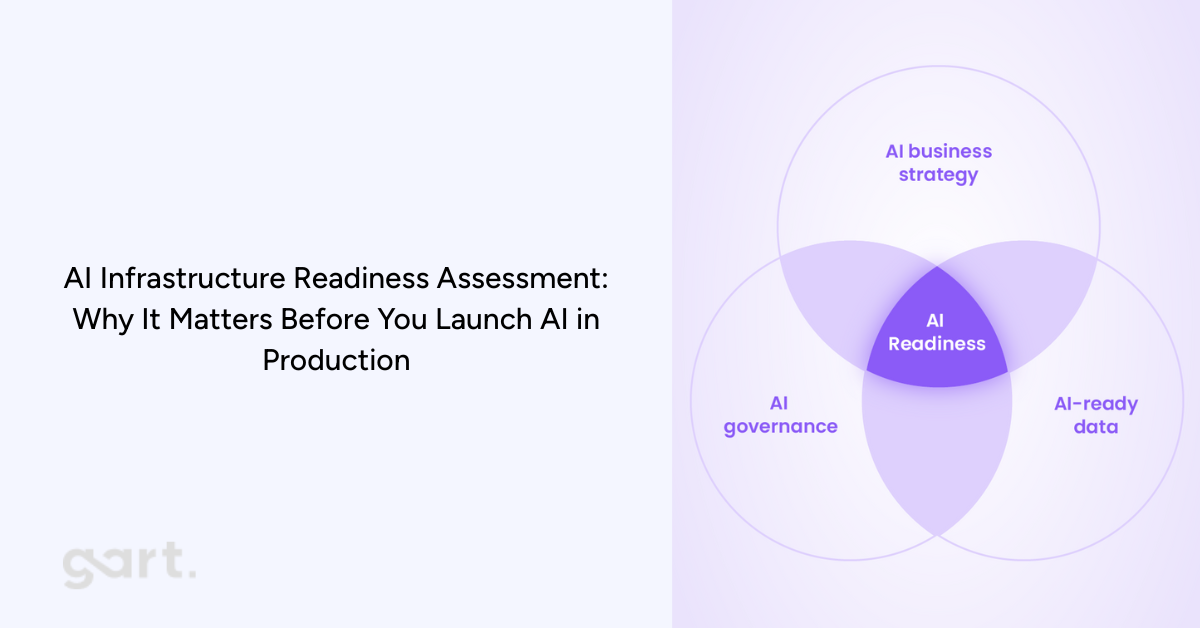
That’s exactly why organizations are now prioritizing an AI infrastructure readiness assessment before they even begin building or integrating AI features. According to the brochure provided (p.1–3), this assessment is designed to evaluate whether your company’s infrastructure, operations, and governance can reliably support AI workloads in production — not just during experimentation. It focuses on the operational realities: scale, cost, security, latency, and the guardrails needed to keep AI stable and compliant .
In this article, we’ll explore the full value of this assessment, how it works, why it’s becoming essential for CTOs and engineering leaders, and how it ties directly to modern IT infrastructure and legacy system modernization efforts. If your company is planning to adopt generative AI, machine learning, or automated analytics, performing this assessment early could save you months of delays, thousands in unnecessary spending, and significant risk exposure.
2. What Is an AI Infrastructure Readiness Assessment?
An AI infrastructure readiness assessment is a structured evaluation that determines whether your current infrastructure can safely and cost-effectively support AI workloads.
2.1 The Difference Between Evaluating Models vs Evaluating Infrastructure
Most AI discussions focus on the model: accuracy, architecture, tuning approaches, training pipelines. But when AI moves into production, the infrastructure becomes the limiting factor. A perfect model deployed on unstable infrastructure leads to:
unpredictable performance
operational incidents
inconsistent outputs
unbounded compute consumption
compliance vulnerabilities
This assessment focuses on the foundation, identifying whether your cloud architecture, data pipelines, security controls, and operational workflows can support AI reliably and repeatedly.
2.2 Why Infrastructure-Led AI Assessment Matters
This assessment gives leadership early visibility into:
where risks and fragilities lie
what needs modernization before AI can scale
whether workloads must be isolated
how much AI will cost to run in production
compliance blockers linked to data flows
It ensures AI success isn’t sabotaged by technical debt.
3. Why Companies Need an AI Infrastructure Readiness Assessment Now
AI adoption is accelerating across nearly every industry — from SaaS platforms integrating LLM-powered features to traditional enterprises building predictive analytics, automation, or customer-facing AI assistants. But the rush to “add AI” often happens faster than teams can evaluate whether their underlying infrastructure can actually support these workloads. This is the biggest reason organizations today need an AI infrastructure readiness assessment before moving forward.
Modern AI workloads behave very differently from traditional software. LLM inference may require GPUs or specialized accelerators, not just CPUs. Data pipelines must be reproducible, regulated, and auditable. Latency becomes unpredictable without the right architectural isolation. Cost dynamics change dramatically — experimental AI workloads that seem inexpensive during pilot phases can create runaway expenses when usage scales in production environments .
Another reason companies need this assessment now is compliance. Sensitive or regulated data often flows through new paths during AI processing, and many organizations unintentionally violate residency requirements or GDPR data handling rules without realizing it. The assessment identifies these risks early (p.8), preventing costly future corrections or audit failures .
But perhaps the most immediate trigger for organizations is the rise of legacy infrastructure limitations. Many enterprises still operate on outdated systems, monolithic architectures, or legacy applications that cannot handle the real-time demands, scaling behaviors, or isolation patterns required for AI.
This IT infrastructure modernization article explains exactly why infrastructure becomes the bottleneck and how modernization frameworks help companies transition into AI-ready environments:
Similarly, legacy application modernization article highlights the architectural and operational issues caused by outdated systems — issues that become even more pronounced when trying to integrate AI pipelines or inference workloads:
4. Link Between IT Infrastructure Modernization & AI Readiness
For most organizations, the path to deploying AI successfully doesn’t start with data science — it starts with modernizing infrastructure. Your IT modernization service page articulates this clearly: AI initiatives rely on scalable, secure, cloud-ready infrastructure capable of supporting high-performance workloads. Without this foundation, production AI becomes nearly impossible.
4.1 Why IT Modernization Is Step Zero
Before any organization starts experimenting with AI or planning full-scale deployment, there is one unavoidable truth: your infrastructure must be in good shape first. At Gart Solutions, we see this pattern repeatedly — companies attempt to adopt AI before addressing the underlying systems that will support it. The result? Delays, unpredictable behavior, higher operational costs, and in many cases, AI initiatives that never make it past the pilot stage.
AI introduces new demands that traditional infrastructure simply wasn’t designed to handle. Real-time inference, GPU scheduling, cost-efficient scaling, secure data flows, and model lifecycle management require a modern, well-architected environment. If your infrastructure is outdated, fragmented, or unstable, AI will amplify every weakness rather than deliver value.
This is why IT modernization becomes Step Zero in any AI strategy.
Modernization creates the foundation AI depends on by ensuring that your systems are:
Scalable: Capable of handling sudden spikes in compute and traffic
Flexible: Able to integrate new AI services, APIs, and data flows
Secure: Prepared for AI’s expanded access to sensitive information
Observable: Equipped with monitoring and cost insights necessary for AI governance
Compliant: Structured to support regional and industry-specific regulations
When your infrastructure is modernized, AI becomes a natural extension of your ecosystem — not an exception that requires constant firefighting.
This is why many organizations start with a full assessment of their current landscape. Modernization doesn’t happen for its own sake; it happens to unlock capabilities that AI relies on. Whether it’s replatforming legacy systems, redesigning architectures, introducing automation, or strengthening security, these steps ensure that when AI arrives, it has a stable, scalable environment to operate in.
Simply put:If the foundation is weak, AI will expose it. If the foundation is strong, AI will elevate it.
4.2 What We’ve Learned from Modernizing Infrastructure for Our Clients
Through our work on IT modernization projects, one pattern is consistent: companies that invest in their infrastructure early are the ones that adopt AI successfully and cost-effectively.
Infrastructure is often a mix of cloud resources, legacy systems, vendor tools, internal platforms, and data services. Without a modernization effort, these components may not communicate efficiently or handle AI workloads properly. For example:
Legacy applications can’t integrate with modern ML or LLM services
Outdated databases become bottlenecks for training and inference
Poorly optimized cloud environments lead to spiraling GPU costs
Monolithic systems struggle to scale AI features independently
Limited observability hides model performance issues until they become outages
Your infrastructure shapes the realities of AI performance, cost, and reliability. Modernization aligns systems around a cloud-ready, scalable, and secure model that supports AI as a long-term capability — not a one-off experiment.
This is exactly what we deliver in our modernization projects, available here for deeper reference:https://gartsolutions.com/it-infrastructure-modernization/
4.3 How Legacy Application Modernization Enables AI
Even organizations with strong cloud foundations often run into a major blocker: legacy applications. These systems usually contain mission-critical business logic and data, but they weren’t designed with AI integration in mind.
Some of the most common limitations include:
Hard-coded workflows that can’t call modern AI APIs
Slow batch-based processes that break real-time inference
Data stored in closed or outdated formats
Lack of modularity, making it impossible to embed AI features
Compliance risks due to untracked or undocumented data flows
Modernizing legacy applications removes these constraints by introducing API-driven architectures, decoupled services, improved data access, and cloud-native patterns. Suddenly, AI can plug into business processes seamlessly.
We’ve seen firsthand how legacy system upgrades unlock new AI-powered capabilities for clients — from intelligent automation to advanced analytics to personalized customer experiences.More here: https://gartsolutions.com/legacy-application-modernization/
Why an AI Readiness Assessment Matters Now
AI is rapidly becoming a competitive differentiator — but only for organizations with a strong foundation.
Take the assessment: https://tally.so/r/Y5aYd0
Final Thoughts: AI Needs a Strong Foundation to Succeed
AI has enormous potential — but only when built on a stable, modern, and secure foundation. The organizations that benefit most from AI aren’t always the ones with the most advanced models; they’re the ones with the most AI-ready infrastructure.
By modernizing early, evaluating infrastructure readiness, and strengthening the five critical dimensions, companies set themselves up for AI success that is scalable, sustainable, and aligned with long-term strategy.
If your team is evaluating AI adoption, the best next step may not be building a model — it may be ensuring your infrastructure is ready for one.
Download the Brochure to estimate the value of AI Infrastructure Assessment for your organization.
Contact Us if you need a support.
AI-Infrastructure-and-Readiness-AssessmentDownload