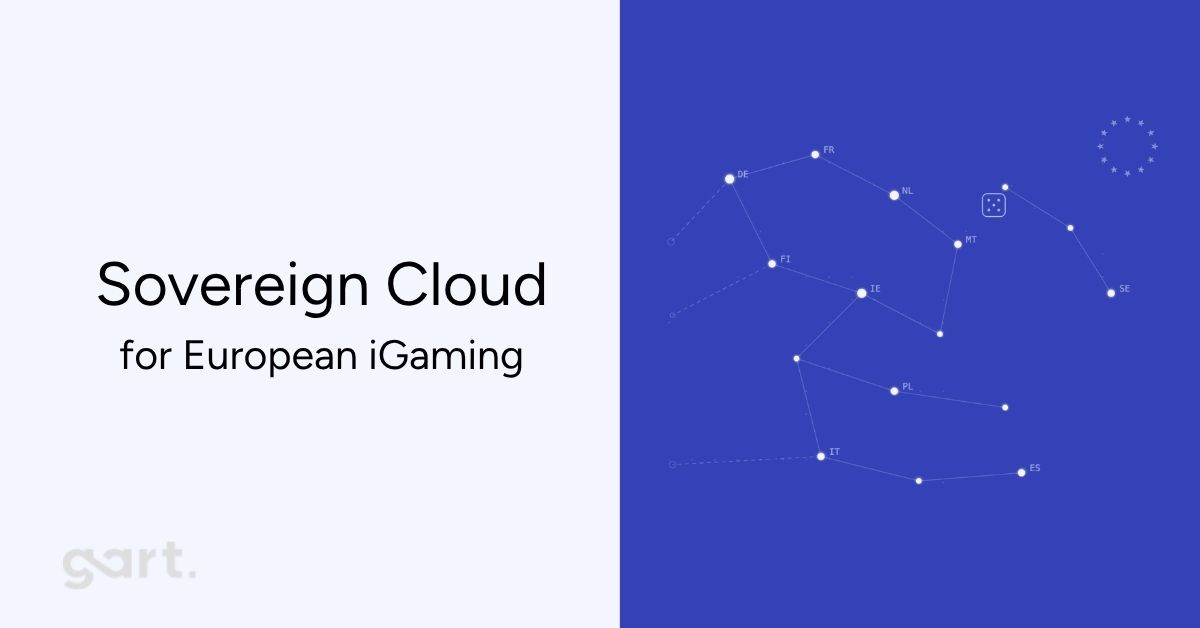
Choosing among sovereign cloud providers for European iGaming is no longer a compliance afterthought — it's a licensing decision. Between GDPR's restrictions on cross-border transfers, the EU Data Act's new switching rules, and gaming regulators from Malta to the Netherlands asking pointed questions about who can access your player data, "we host on a major US hyperscaler" is an answer that now invites follow-up questions from auditors, banks, and licensing boards alike.
This guide breaks down what "sovereign cloud" actually means for a casino, sportsbook, or platform provider, which EU-based providers are realistically built for iGaming's latency and compliance demands, and how operators can migrate without the downtime that terrifies every CTO during a live betting window. It draws on Gart's work architecting cloud migrations for regulated gaming platforms, including a sportsbook infrastructure localization project and multiple EU sovereign cloud transitions.
Why Sovereignty Suddenly Matters for European iGaming
Three forces converged in the last two years to push sovereign cloud providers for European iGaming from a nice-to-have onto the licensing checklist. First, Schrems II and its aftershocks made it clear that a data processing agreement alone doesn't shield an operator from liability when player data crosses into a jurisdiction subject to foreign surveillance law — even if the servers themselves sit inside the EU. Second, the EU Data Act and NIS2 directive added concrete technical obligations around data portability, incident reporting, and third-country government access requests. Third, gaming regulators themselves — the Malta Gaming Authority, the UK Gambling Commission, and the Dutch Kansspelautoriteit (KSA) among them — have sharpened their expectations around where regulatory data physically lives and who can be compelled to hand it over.
None of this means iGaming operators are legally forced onto EU-owned infrastructure. But it does mean the operators who choose sovereign or EU-native providers spend far less time defending their architecture to auditors, banking partners, and licensing boards — and that operational advantage compounds every renewal cycle.
What "Sovereign Cloud" Actually Means (and Doesn't)
"Sovereign cloud" gets used loosely, so it's worth being precise. A genuinely sovereign cloud provider gives an operator four guarantees that a standard "EU region on a US hyperscaler" does not fully deliver:
Jurisdictional ownership: The company operating the infrastructure is headquartered and legally domiciled in the EU/EEA, not merely operating a regional data center on behalf of a foreign parent.
Operational control: Support staff, administrators, and engineers with access to the underlying infrastructure are based in the EU and subject to EU law — not remotely administered from a jurisdiction with conflicting legal obligations.
Data-in-transit and at-rest locality: Player data, replication traffic, and backups stay within EU borders by design, not by configuration toggle that can be silently changed.
Legal insulation from third-country access laws: The provider is not compelled, under something like the US CLOUD Act, to hand data to a foreign government even when that data sits on EU soil.
This is distinct from the broader European movement toward digital sovereignty as a compliance baseline, which our complete guide to EU digital sovereignty and cloud provider selection covers in depth across industries. Initiatives like Gaia-X are attempting to formalize sovereign cloud standards at the European level, though adoption remains uneven across providers.
⚠️ A common misconception
Selecting the "eu-west-1" or "Frankfurt" region on a US hyperscaler is not the same as sovereign cloud. The data may sit in the EU, but the parent entity remains subject to US jurisdiction and disclosure orders, meaning the legal protection that sovereignty is meant to provide is partial at best.
The Regulatory Forces Pushing iGaming Toward EU-Sovereign Infrastructure
GDPR and the Schrems II aftermath
GDPR does not, on its own, mandate that iGaming operators store data exclusively on EU soil. What it does mandate is that any transfer of personal data to a third country goes through a lawful transfer mechanism, and that the operator's Record of Processing Activities documents exactly where data resides and why. Following the Schrems II ruling, Standard Contractual Clauses alone are no longer considered sufficient protection where the receiving jurisdiction has broad government surveillance powers — operators are expected to layer in supplementary technical measures or avoid the exposure altogether by choosing a provider that isn't subject to those laws in the first place.
The EU Data Act's cloud-switching rules
The EU Data Act, applying since September 2025, requires cloud providers to support switching between services and to implement safeguards against unlawful third-country government access to non-personal data stored in the EU. From January 2027, providers will also be barred from charging data egress fees — directly lowering the cost of moving an iGaming platform off a provider that no longer fits its compliance posture. For operators currently locked into a hyperscaler by egress economics, this is a genuine strategic opening.
Gaming-specific regulatory expectations
The Malta Gaming Authority doesn't mandate in-country servers, but its technical guidelines expect an ISO/IEC 27001-aligned Information Security Management System, a documented replication procedure for regulatory data (player details, financial transactions, game-play records), and unhindered audit access for MGA officials. The UK Gambling Commission has worked with the ICO specifically on GDPR's intersection with gambling data — including the tension between data minimization and anti-fraud/problem-gambling monitoring obligations, a balance the Commission addresses directly in its GDPR guidance. Several US state gaming commissions go further, requiring hard data residency within state borders — a pattern Gart has implemented directly, detailed in the sportsbook case study below.
🎲 What the Malta Gaming Authority actually checks
Per MGA guidance on cloud computing, regulators expect a fully-documented procedure allowing officials immediate access to a replication server holding regulatory data, plus continuous ISMS compliance for the term of the license — not a one-time audit. Cloud sovereignty makes this considerably easier to demonstrate than a multi-jurisdiction hyperscaler contract with layered subprocessors.
Comparing the Leading Sovereign Cloud Providers for European iGaming
Not every EU cloud provider is built for iGaming's specific demands: sub-50ms latency for live odds, DDoS resilience during peak betting windows, and burst capacity for major sporting events. Here's how the main sovereign and EU-native options stack up.
ProviderHQ / JurisdictionEU RegionsiGaming FitOVHcloudFrance (publicly listed, EU-owned)France, Germany, Poland, UK, moreStrong DDoS protection built-in (Anti-DDoS), high-bandwidth bare metal — a proven fit for sportsbook workloads; see our OVHcloud migration guideHetznerGermany, privately heldGermany, FinlandBest price-performance in the segment; Gart has migrated multiple iGaming clients — see why operators are migrating to HetznerScalewayFrance (Iliad Group)Paris, Amsterdam, WarsawStrong Kubernetes-native tooling, good fit for containerized platforms; compared in Scaleway vs. OVHcloudSTACKITGermany (Schwarz Group)GermanyEnterprise-grade scalability, strict national compliance focus; newer to the market with a smaller iGaming track recordT-Systems / Open Telekom CloudGermany (Deutsche Telekom)Germany, EU-wideEU-personnel-managed operations, GDPR/NIS2-by-design; favored by operators needing deep enterprise support contractsIONOSGermany (United Internet)Germany, other EUCost-competitive managed hosting; weighed directly against Hetzner in our head-to-head comparisonComparing the Leading Sovereign Cloud Providers for European iGaming
Every provider above satisfies the jurisdictional-ownership test. What separates them for iGaming specifically is DDoS mitigation maturity, network peering quality with European ISPs (which drives real-world latency during live events), and how much of the compliance tooling (audit logging, ISMS documentation, replication server support) comes pre-built versus something your team has to engineer from scratch. Gart's OVH vs. AWS decision breakdown goes deeper on the trade-offs behind one of the most common comparisons operators run before committing.
What a Sovereign iGaming Architecture Actually Looks Like
Sovereignty isn't a checkbox you tick with a vendor contract — it has to be enforced in the architecture itself, or a single misconfigured region setting can quietly violate it. Gart builds jurisdiction-bound clusters: for each licensed market, the app layer, transaction services, and databases run on dedicated infrastructure scoped to that market's required region, with replication limited to what's lawfully permitted.
Enforcing region locks at the infrastructure level
Rather than trusting engineers to remember not to spin up resources in the wrong region, Gart enforces data residency as policy — rejected at deploy time, not caught in a quarterly audit.
Isolating regulatory data from general application data
Player KYC documents, financial transaction records, and game-play logs — the exact categories the MGA calls out — sit in their own isolated data stores with restricted access and immutable audit logging, separate from general application data and analytics pipelines. This mirrors the DevOps and namespace-isolation patterns Gart applies across iGaming DevOps engagements more broadly, and it's the detail auditors check first.
🔐 Why this matters at renewal time
When a regulator asks "show me exactly where this player's transaction history has ever been replicated," the answer needs to be a policy query, not a week of engineers tracing infrastructure history. Sovereignty enforced as code turns that into a five-minute exercise.
Sovereign Cloud vs. Hyperscaler: Cost, Latency, and Compliance Trade-offs
FactorEU Sovereign ProviderUS Hyperscaler (EU Region)Legal exposureNot subject to CLOUD Act-style foreign disclosure ordersParent entity can be compelled regardless of server locationCompute pricingTypically 30–50% lower for equivalent bare-metal/VM capacityPremium pricing offset by breadth of managed servicesEgress costsGenerally lower; EU Data Act phases out switching charges by 2027Historically high egress fees, a lock-in mechanismManaged service breadthNarrower; more DIY engineering for advanced servicesExtremely broad — AI, analytics, serverless ecosystemsRegulatory narrativeSimple, defensible answer to "who can access this data"Requires layered legal arguments (SCCs, TIAs, encryption)Global multi-region reachEU-focused; limited outside EuropeGlobal footprint, useful for operators expanding beyond the EUSovereign Cloud vs. Hyperscaler: Cost, Latency, and Compliance Trade-offs
Most Gart clients don't land on a pure either/or answer. A common pattern: regulatory data and player-facing services for EU-licensed markets run on a sovereign provider, while a hyperscaler handles non-regulated workloads — marketing analytics, internal tooling, or expansion into non-EU jurisdictions where sovereignty isn't the deciding factor. That split works only if the platform engineering underneath is built to run consistently across both environments rather than duplicated by hand.
Migrating to a Sovereign EU Cloud Without Downtime
The operators who delay a sovereign cloud move usually aren't disagreeing with the logic — they're afraid of the migration itself. For a live betting platform, "we'll schedule a maintenance window" isn't a real option during football season. Gart's migration pattern for iGaming clients follows a dual-write approach: both the legacy and target environments receive writes during a validation period, reads cut over first, and the writer cutover only happens after checksums confirm parity across both systems.
Parallel environment build-out: The sovereign environment (OVHcloud, Hetzner, Scaleway, or similar) is stood up alongside the existing platform, with infrastructure fully codified in Terraform from day one.
Data replication and validation: Regulatory data replicates continuously; automated checksum comparisons run against both environments before any traffic shifts.
Read traffic cutover: Read-only traffic (odds display, account balances) moves first, with instant rollback if latency or error rates degrade.
Write traffic cutover: Wallet and transaction writes cut over last, validated against the read-cutover learnings.
Decommission with an audit trail: The legacy environment is retained briefly for rollback insurance, then decommissioned with a documented data-destruction record for the regulator.
This is the same pattern Gart used when moving operators off AWS and Azure onto EU sovereign providers, and it applies equally whether the destination is a German, French, or pan-European sovereign environment.
Case Study: Infrastructure Localization for a Sportsbook Platform
One of Gart's most instructive engagements involved a sportsbook platform facing a mirror-image problem to European sovereignty: state-by-state data residency requirements across US gaming jurisdictions, where a single region was not sufficient to satisfy every state regulator simultaneously. The same architectural discipline — jurisdiction-bound clusters, region-lock policies enforced at deploy time, and automated compliance reporting — applies directly to EU sovereignty requirements.
What Gart delivered:
Multi-region architecture with jurisdiction-specific data residency controls enforced via policy, not convention
30–40% overall performance improvement measured across p50 and p99 latency
Compliance reporting pipelines delivering automated evidence to regulators on schedule
Zero-downtime cutover using the dual-write migration pattern described above
Read the full case study: AWS Migration & Infrastructure Localization for Sportsbook PlatformA related engagement, digital transformation for a European betting provider, is covered in this case study on DevOps in gambling.
Checklist: Evaluating a Sovereign Cloud Provider for Your License
CategoryWhat to verifyPriorityJurisdictionProvider's parent entity is legally domiciled in the EU/EEA, not just its data centers🔴 CriticalData residencyReplication and backup targets are contractually and technically locked to the EU🔴 CriticalRegulatory accessDocumented, tested procedure for granting your regulator (MGA, KSA, UKGC) audit access to replication servers🔴 CriticalDDoS resilienceProvider has proven mitigation capacity for the traffic spikes major sporting events generate🟠 HighCertificationsISO/IEC 27001 alignment; SOC 2 where relevant to payment processing partners🟠 HighEgress economicsUnderstand current egress pricing and how the EU Data Act's 2027 fee ban will change your exit costs🟡 MediumManaged services gapIdentify which hyperscaler-only services you'd need to rebuild in-house, and budget engineering time accordingly🟡 MediumChecklist: Evaluating a Sovereign Cloud Provider for Your License
Gart's Digital Sovereignty Readiness & EU Cloud Assessment Guide walks through this evaluation in a downloadable framework, if you'd rather run it as a structured internal exercise before engaging a provider.
Sovereign Cloud for iGaming
Ready to move your iGaming platform onto sovereign EU infrastructure — without a single missed bet?
Gart has architected sovereign and jurisdiction-localized infrastructure for casino, sportsbook, and betting platforms, including zero-downtime migrations and MGA/UKGC-ready compliance automation. We design the architecture, execute the migration, and stay on as your infrastructure partner.
Sovereign Cloud Migration (OVHcloud, Hetzner, Scaleway)
Data Residency & Compliance Architecture
Zero-Downtime Cloud Migration
Kubernetes & Multi-Region Design
DevSecOps & Policy-as-Code
SRE & Incident Response for iGaming
Talk to a cloud sovereignty specialist
Explore our cloud consulting services →
Fedir Kompaniiets
Co-founder & CEO, Gart Solutions · Cloud Architect & DevOps Consultant
Fedir is a technology enthusiast with over a decade of diverse industry experience. He co-founded Gart Solutions to address complex tech challenges related to Digital Transformation, helping businesses focus on what matters most — scaling. Fedir is committed to driving sustainable IT transformation, helping SMBs innovate, plan future growth, and navigate the "tech madness" through expert DevOps and Cloud managed services. Connect on LinkedIn.
On the morning of July 19, 2024, three of Australia's largest betting operators went dark within minutes of each other: Tabcorp, Sportsbet, and Ladbrokes. None of them had pushed a bad deploy. None of them had a security breach. The cause sat entirely outside their own codebases. It was a security vendor's routine update to software running on millions of machines they didn't write a line of code for.
We've already written about this shape of problem once, in our breakdown of Final Fantasy XIV's 2021 login crisis. In that case, the real constraint was a global chip shortage that Square Enix had no control over. This is the same category of failure, but faster, more sudden, and arguably more dangerous. It was a single vendor's mistake, pushed automatically, with zero warning and zero opportunity to test it first.
TL;DR
•
CrowdStrike, July 2024: a flawed security update bricked 8.5 million Windows machines worldwide in under 90 minutes. That included the systems behind Tabcorp, Sportsbet, and Ladbrokes simultaneously.
•
AWS, October 2025: an internal DNS race condition inside DynamoDB took down a wide swath of the internet for hours. That included Fortnite and Roblox, alongside Disney+, Reddit, and a Premier League broadcast.
•
The fix being fast didn't make recovery fast. CrowdStrike reverted its bad update in 78 minutes. But every machine that already crashed needed a person, physically, to boot into Safe Mode and delete a file by hand.
•
The shared lesson: you can't patch your way out of a dependency you don't control. You can only decide, in advance, how much blast radius one vendor's bad day is allowed to have.
8.5M
Windows devices crashed worldwide
78 min
to revert the update — recovery still took days
$5.4B+
estimated direct cost to Fortune 500 firms
The bookmakers: CrowdStrike takes down three operators at once
At 04:09 UTC on July 19, 2024, CrowdStrike pushed a routine configuration update, a "Channel File." It went to every Windows machine running its Falcon security sensor. The update was meant to improve detection of a specific attack technique. Instead, it contained a mismatch. The update assumed a data structure with 21 fields, but the actual content shipped with only 20. That single discrepancy triggered an out-of-bounds memory read inside Falcon's kernel-level driver. The driver crashed every Windows machine it was running on. It crashed immediately, and on every subsequent boot attempt, because the driver loaded early in the startup sequence.
Roughly 8.5 million Windows devices crashed within the hour, by Microsoft's own count. Tabcorp and Sportsbet — together responsible for more than 70% of Australia's wagering market — went down alongside Ladbrokes. Betting stopped entirely, online and in retail outlets. Tote price finalization froze mid-calculation, which meant payouts on bets already placed couldn't be settled until the underlying systems came back. Both operators publicly attributed the outage to "a global external technical issue," which was accurate — neither had any path to fix it themselves.
What makes this case distinct from a typical outage is what happened after CrowdStrike found the bug. The company reverted the faulty update at 05:27 UTC, 78 minutes after it shipped. In a normal software incident, that's the end of the story: bad deploy rolled back, service restored. Here, it wasn't. Every machine that had already crashed was stuck in a boot loop, because the damage was done locally on each device before the revert ever reached it. Recovery required someone to physically access each affected machine, boot into Safe Mode, locate a specific system file, and delete it by hand. That happened one machine at a time. BitLocker disk encryption sometimes complicated it further by requiring a separate recovery key. For organizations with thousands of endpoints, that's not a fix measured in minutes. It's a fix measured in however many hands you have available.
The game: an AWS database failure takes down Fortnite and Roblox
On October 20, 2025, a separate but structurally identical story played out in the gaming industry. Amazon's DynamoDB suffered a DNS failure in its largest region, US-East-1. It's a managed database service that much of the internet quietly depends on, often without realizing how deeply. The proximate cause, per AWS's own postmortem, was a race condition. An internal system called a DNS Enactor updates DynamoDB's DNS records. It ran unusually slowly for one execution, while a second, parallel Enactor processed updates far faster than normal. The mismatch between the two led to DynamoDB's DNS records effectively being emptied. Every system trying to reach DynamoDB through its public endpoint began failing immediately. That included a large share of AWS's own internal services.
The outage rippled outward in a way that surprised even engineers who consider themselves dependency-aware. Disney+, Reddit, Snapchat, Coinbase, the McDonald's app, and UK government tax services all went down. So did Fortnite and Roblox, reported alongside the others as players found themselves unable to connect. Independent analysis of the incident noted a detail worth sitting with. Services that monitor other services' uptime were themselves casualties. Status pages built on Atlassian's Statuspage product couldn't be updated. Some companies couldn't even tell their own users what was happening. The tool they'd use to say so depended on the same failing infrastructure.
The outage lasted around three hours before AWS engineers manually intervened to restore DynamoDB's DNS. For a live-service game, three hours during a peak window isn't a minor blip. It's measured in lost engagement, refund requests, and player trust erosion. We covered the same kind of erosion when we looked at what happens when sportsbooks go down during the World Cup. The mechanism was completely different: a malicious attack versus an internal race condition inside a trusted vendor's infrastructure. But the experience on the other end of the connection looked the same. The platform isn't responding, and there's nothing the player-facing team can do about it directly.
🧭
Most teams can name their direct vendors. Far fewer can name their vendors' vendors.
The AWS incident took down services that didn't think of themselves as AWS-dependent at all — they depended on something that depended on DynamoDB. Gart Solutions'
infrastructure audit service
is built around mapping that second and third layer of dependency before it becomes a 3 a.m. discovery.
Why "it wasn't our bug" doesn't help you at 3 a.m.
Both incidents share a structure that's worth naming directly, because it's the part most incident-response planning misses. It isn't just "depend less on third parties" — for any real-time platform, some third-party dependency is unavoidable. The actual lesson is narrower and more actionable:
A vendor's fast fix doesn't guarantee a fast recovery for you. CrowdStrike reverted its bad update in under 90 minutes. That timeline meant almost nothing to organizations whose machines had already crashed. The recovery step required physical, manual intervention that no amount of vendor speed could shortcut.
Your dependency map is deeper than your vendor list. Plenty of companies hit by the AWS DynamoDB failure didn't think of themselves as exposed to it. They depended on a tool that depended on AWS, two or three layers removed from a decision anyone on their team actually made.
The blast radius is a design choice, even when the bug isn't yours. Does a single vendor's failure take down your entire platform or just a degraded subset of features? That's determined by how much of your stack assumes that vendor will always be there. It's not determined by how good the vendor's engineering team is.
"Not our bug" doesn't buy you patience from players or regulators. Tabcorp and Sportsbet were transparent about the external cause, and it didn't make the outage shorter or the customer frustration smaller. The same will be true for a game studio explaining an AWS-shaped outage to a community mid-launch.
🛟
The honest goal isn't eliminating third-party risk — it's bounding it before it's a live incident.
Failover paths, degraded-mode design, and a tested incident response plan for "the outage isn't ours but the downtime is" are core to Gart Solutions'
SRE practice.
The takeaway for both industries
A sportsbook can't audit CrowdStrike's source code, and a game studio can't audit AWS's internal DNS systems. That's not the point. The point is that both incidents were entirely predictable in shape, if not in timing. Any platform with a deep enough dependency on a single vendor will eventually inherit that vendor's worst day. The only real choices left at that point are two. How much of your platform is that worst day allowed to take down with it? And how fast can a human actually act once it does?
That's an architecture and incident-response question, not a vendor-selection one. Switching vendors just relocates the same risk. The work is in mapping where a single point of failure actually sits in your stack. It's in deciding what degrades gracefully versus what goes dark entirely. And it's in rehearsing the manual recovery steps before you need them. You don't want to learn them at 3 a.m. with thousands of angry players or bettors watching a status page that, ironically, might also be down.
Do you know what happens when your biggest vendor has its worst day?
Gart Solutions maps the dependency chains most teams don't see until they fail, and builds the failover and incident-response plans that bound the damage when they do.
Talk to our architects →
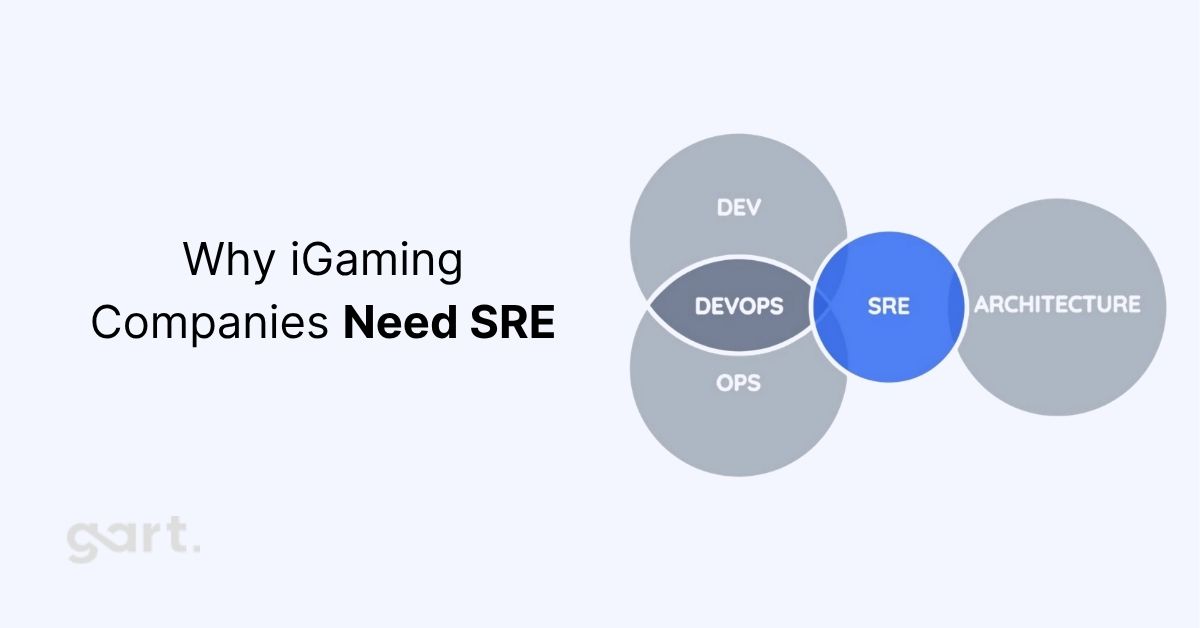
iGaming SRE is no longer a luxury — it's the operational backbone that separates platforms that scale from platforms that collapse under pressure. When a betting platform goes down during the Champions League final, players don't wait. They leave. This guide explains why Site Reliability Engineering is the decisive advantage for iGaming operators in 2025 and beyond.
The iGaming industry operates at an intersection of real-time data, financial transactions, and peak-load volatility that almost no other sector can match. A single server outage during a major sporting event can cost an operator hundreds of thousands of dollars in lost bets, player churn, and regulatory penalties. SRE services built for high-stakes infrastructure are what stand between a seamless player experience and a reputational crisis.
Site Reliability Engineering (SRE) — a discipline pioneered by Google — applies software engineering principles to infrastructure and operations. For iGaming, where 99.9% uptime still means 8+ hours of downtime per year, only a rigorous SRE practice delivers the reliability that players and regulators demand.
What Is iGaming SRE and Why Does It Matter?
Site Reliability Engineering in the iGaming context means applying a defined set of engineering practices — Service Level Objectives (SLOs), error budgets, chaos engineering, and automated incident response — to ensure gambling platforms remain available, performant, and compliant at all times.
Traditional IT operations in iGaming relied on reactive firefighting: something breaks, the on-call engineer fixes it. SRE replaces that model with a proactive, data-driven approach where reliability is engineered in, not bolted on after the fact. The result is measurable: fewer incidents, faster recovery, and engineering teams that spend time building new features instead of battling fires.
The Cloud Native Computing Foundation consistently finds that organisations with mature SRE practices reduce mean time to recovery (MTTR) by 60–80% compared to traditional ops teams — a gap that translates directly to revenue and reputation in iGaming.
The Unique Reliability Challenges iGaming Platforms Face
iGaming isn't just another web application. It operates under conditions that expose every weakness in an infrastructure stack simultaneously.
Unpredictable, Massive Traffic Spikes
When Lionel Messi scores in the 90th minute, odds change in milliseconds and bets flood in from millions of concurrent users. No other industry experiences this combination of event-driven, time-sensitive, and financially critical load. Without auto-scaling policies, load-shedding strategies, and pre-tested capacity plans — all core SRE practices — platforms buckle at the worst possible moment.
Real-Time Data Processing at Scale
Live betting engines process thousands of events per second: odds recalculation, bet settlement, wallet updates, and fraud signals. Any latency in the data pipeline directly degrades the player experience and creates arbitrage opportunities for bad actors. SRE teams instrument every layer of this pipeline with Service Level Indicators (SLIs) tied to real-money outcomes, not just system metrics.
Payment and Wallet Reliability
A failed deposit or withdrawal is not a minor UX inconvenience — it triggers chargebacks, player complaints, and potential regulatory scrutiny. iGaming operators need five-nines reliability on their payment pathways, achieved through redundant payment provider routing, circuit breakers, and automated reconciliation — all within the SRE toolbox.
Regulatory Compliance Under Load
Jurisdictions from the UK Gambling Commission to the Malta Gaming Authority require operators to maintain detailed audit logs, enforce responsible gambling limits in real time, and demonstrate ongoing platform reliability. SRE governance frameworks, including change management policies and postmortem culture, provide the documented evidence regulators demand.
ChallengeTraditional Ops ApproachiGaming SRE ApproachTraffic spikesManual scaling, reactive alertsPredictive auto-scaling, load testing, error budgetsIncident responseOn-call firefighting, slow MTTRAutomated runbooks, blameless postmortems, SLO-driven alertsPayment reliabilitySingle provider, manual failoverMulti-provider routing, circuit breakers, chaos testingRegulatory reportingManual log exports, ad hoc auditsContinuous observability, automated compliance dashboardsDeployment riskLong release cycles, risky big-bang deploysCanary releases, feature flags, progressive deliveryThe Unique Reliability Challenges iGaming Platforms Face
Core iGaming SRE Practices That Drive Revenue Outcomes
1. Defining Meaningful SLOs for iGaming
An SLO for a betting platform is not "99.9% uptime." It's more precise: "95% of bet placements complete within 300ms, 99.9% of the time, measured at the player's device." This specificity matters because it connects engineering targets to the experiences players actually care about — and to the revenue events that fund the business.
Effective iGaming SRE teams define SLOs for: bet placement latency, odds feed freshness, wallet transaction success rate, live stream buffering ratio, and login/authentication time. Each SLO has a corresponding error budget that gates deployment velocity — a powerful incentive to keep reliability high.
2. Observability and Real-Time Incident Detection
Modern iGaming platforms generate enormous telemetry: logs, metrics, and distributed traces across microservices, CDN edges, and third-party data providers. Without a structured observability strategy, engineers spend more time hunting for signal in noise than resolving incidents.
SRE teams build layered observability stacks — typically combining Prometheus, Grafana, OpenTelemetry, and purpose-built APM tools — that surface actionable alerts rather than metric dumps. The goal: know about a degradation before a player files a complaint.
3. Chaos Engineering for Gambling Platforms
Gremlin's State of Chaos Engineering report found that teams who frequently run chaos experiments achieve more than 99.9% availability. For iGaming, this means deliberately simulating: payment provider outages, database failovers, odds feed disruptions, and CDN failures — in staging environments that mirror production traffic patterns.
4. Toil Reduction and Engineering Capacity
One of SRE's most underrated benefits for iGaming is eliminating toil — the repetitive, manual operational work that consumes engineering time without building long-term value. Common iGaming toil includes: manual bonus reconciliation, ad hoc log exports for compliance, manual certificate renewals, and hand-crafted incident reports.
SRE teams systematically automate toil away, freeing engineers to work on platform features that drive player acquisition and retention — a direct competitive advantage.
Key Metrics Every iGaming SRE Team Should Track
Bet placement success rate — percentage of attempts that complete without error
Odds feed latency P95/P99 — critical for live betting edge cases
Payment gateway availability — per provider, per region, per payment method
Mean Time to Detect (MTTD) — how fast issues surface in your monitoring
Mean Time to Recovery (MTTR) — the single most impactful reliability KPI
Error budget burn rate — real-time visibility into SLO headroom
Deployment frequency and change failure rate — DORA metrics for delivery health
How iGaming SRE Reduces Regulatory Risk
Regulators increasingly require iGaming operators to demonstrate, not just claim, platform reliability. The UK Gambling Commission's Technical Standards, for example, require operators to document system availability, describe incident response procedures, and report significant outages within defined timeframes.
SRE practices produce this documentation as a natural byproduct of engineering discipline: postmortems become regulatory evidence, SLO dashboards become compliance artefacts, and change management logs satisfy audit requirements. Operators who have embedded platform engineering practices can respond to regulatory requests in hours rather than weeks.
Beyond documentation, SRE's emphasis on blameless culture and systemic improvement reduces the likelihood of recurring incidents — the pattern regulators most scrutinise when considering licence renewals or sanctions.
Building vs. Buying iGaming SRE Capabilities
Every iGaming operator faces the same build-vs-buy decision. Building an internal SRE function requires hiring senior reliability engineers (a scarce and expensive talent pool), building tooling, establishing processes, and sustaining the practice through business cycles. For most operators outside the top 10 global platforms, this is a multi-year, multi-million investment.
The alternative — partnering with an experienced SRE provider — compresses time-to-maturity from years to months and transfers the operational risk of staffing and tooling. This is particularly attractive for operators scaling into new markets, navigating M&A, or managing rapid product expansion where internal teams are already stretched.
The FinOps Foundation reports that cloud infrastructure costs in gaming grow 35–50% year-on-year for scaling platforms — making external SRE expertise that optimises both reliability and cloud spend increasingly compelling from a pure ROI perspective.
What to Look for in an iGaming SRE Partner
Proven experience with high-concurrency, event-driven architectures (not just generic cloud ops)
Deep Kubernetes and container orchestration expertise for modern gaming microservices
Compliance familiarity with major iGaming jurisdictions (UKGC, MGA, AGCC, etc.)
Demonstrated SLO definition and error budget governance frameworks
Transparent escalation and incident response processes with guaranteed SLAs
Gart Solutions
iGaming Infrastructure That Doesn't Let You Down
Gart Solutions delivers end-to-end SRE, DevOps, and platform engineering for iGaming operators. We've helped gaming platforms achieve 99.99% uptime, slash deployment lead times, and pass regulatory audits with zero last-minute scrambles — so your team ships faster and sleeps better.
SRE as a Service
Kubernetes & Cloud Infrastructure
Observability & Monitoring
Platform Engineering
FinOps & Cost Optimisation
8.2
avg. MTTR reduction (×)
10+
iGaming platforms delivered
50+
engineers across cloud platforms
Talk to an iGaming SRE Expert →
Getting Started: iGaming SRE Maturity in Phases
You don't need to transform your entire operations function overnight. Most successful iGaming SRE journeys follow a phased model that delivers quick wins while building toward long-term maturity:
Phase 1 — Visibility: Instrument your platform with structured logging, metrics, and tracing. Define your first 3–5 SLIs and corresponding SLOs. Establish a reliable on-call rotation with documented escalation paths.
Phase 2 — Stability: Introduce error budgets tied to deployment gates. Run your first chaos experiments. Automate the most costly toil items (certificate management, scaling events, incident ticketing).
Phase 3 — Velocity: Implement progressive delivery (canary releases, feature flags). Establish SLO-based capacity planning linked to event calendars. Build compliance reporting as a continuous, automated pipeline.
Phase 4 — Excellence: Proactive capacity forecasting driven by ML on historical event data. Full toil elimination target. SRE practices embedded in product development from design through deployment.
Operators who have completed Phase 2 with the support of an experienced DevOps and SRE partner typically see 40–60% reduction in critical incidents within the first six months — a measurable, defensible business case for the investment.
Fedir Kompaniiets
Co-founder & CEO, Gart Solutions · Cloud Architect & DevOps Consultant
Fedir is a technology enthusiast with over a decade of diverse industry experience. He co-founded Gart Solutions to address complex tech challenges related to Digital Transformation, helping businesses focus on what matters most — scaling. Fedir is committed to driving sustainable IT transformation, helping SMBs innovate, plan future growth, and navigate the "tech madness" through expert DevOps and Cloud managed services. Connect on LinkedIn.