The Digital Operational Resilience Act (DORA) and the Network and Information Security Directive (NIS2) have transformed ICT risk from an IT problem into a board-level, legally enforceable responsibility for European financial and critical-infrastructure organisations. With full compliance deadlines already passed (NIS2: 18 Oct 2024; DORA: 17 Jan 2025), the regulatory era has moved from preparation into active supervision. Regulators now expect demonstrable, auditable capabilities to detect, contain, recover and report ICT incidents — quickly and with legal certainty.
This blog post explains
why jurisdictional risk — not just technical security — is the dominant strategic challenge;
the Sovereign Cloud model (operated and governed within the EU by EU legal entities and EU personnel) is the structural answer to that challenge;
automation (SIEM + SOAR with DORA-specific playbooks) is mandatory to meet 24-hour / 72-hour reporting timelines.
Strategic nexus: sovereignty, resilience, and the new EU mandate
The regulatory shift
DORA and NIS2 replace principle-based guidance with prescriptive requirements covering ICT risk management, incident reporting, operational resilience testing, and third-party oversight. The practical effect is twofold:
Immediate operational requirements — fast incident detection, classification, reporting and recovery processes (24-hour initial notification; 72-hour detailed report).
Systemic, upstream impact — regulators now scrutinize the providers that underpin financial services: cloud and other ICT third parties can be designated as Critical ICT Third-Party Providers (CTPPs) and come under direct ESAs oversight.
The core strategic problem: jurisdictional risk
Technical controls alone are insufficient. Legal exposure — the risk that a cloud provider can be compelled by a foreign law (for example, the US CLOUD Act) to disclose data or to operate under extraterritorial commands — creates a material compliance failure for EU-regulated entities. A financial institution that cannot demonstrate legal and enforceable control over its operational data and processes risks regulatory sanctions, regardless of how sophisticated its technical controls might be.
Implication: For regulated entities, ICT risk = technical risk + jurisdictional/legal risk. Solving the latter requires structural, governance and operational realignment — not just encryption and access controls.
II. The geopolitical advantage: mitigating extra-territorial risk with a Sovereign Cloud
Why “data residency” is not enough
Hosting data physically inside the EU (data residency) is necessary but not sufficient. If the cloud provider’s corporate structure or operational control remains subject to non-EU law, the provider can still be legally compelled to disclose data. The Schrems II jurisprudence and DORA/NIS2 expectations make clear that customers must be able to demonstrate legal enforceability of data protection and operational controls.
Sovereign Cloud: fundamentals and safeguards
A credible Sovereign Cloud must combine technical, operational, and legal design choices:
Operational and data localization
Data and logs must be hosted in exclusive EU regions.
Operational activities (monitoring, support, incident forensics) must be performed by EU-resident personnel subject to EU law.
Dedicated EU legal entities and governance
The cloud must be operated by EU-incorporated legal entities with boards and executive control inside the EU.
This structural separation lets the provider lawfully resist or legally challenge extraterritorial demands, creating a legal firewall that is often more effective than purely technical mitigations.
Contractual guarantees (DPA alignment)
DPAs must codify procedures for third-party requests, subcontracting visibility, audit rights and defined incident handling aligned to DORA/NIS2.
A governance committee should maintain and review DPAs and operational procedures to ensure continued alignment with evolving regulation.
Strategic outcome
A Sovereign Cloud removes the primary source of regulatory uncertainty for highly regulated customers, enabling them to demonstrate due diligence before national competent authorities and ESAs. In markets where regulators are focused on systemic concentration and legal enforceability, this structural assurance becomes a competitive differentiator.
III. Automation blueprint: meeting the 24-hour / 72-hour mandates
DORA’s time-critical reporting obligations
DORA imposes strict timeframes:
Initial notification to the competent authority: no later than 24 hours after detection.
Intermediate/detailed report: within 72 hours of the initial notification (or sooner if circumstances change).
These timelines demand rapid triage, classification against regulatory thresholds, automated evidence collection, and securely auditable reporting. Manual processes will routinely fail under these constraints.
SIEM + SOAR: the closed-loop automation stack
A reliable automation architecture has three integrated layers:
SIEM (detection & centralization)
Collects and normalizes logs from cloud, network, applications and endpoints.
Applies correlation rules and baselines to surface anomalies and potential incidents.
SOAR (orchestration & response)
Hosts playbooks that automate enrichment (AD, CMDB, asset ownership), classification against DORA thresholds, containment actions, and reporting workflows.
Automatically composes the initial regulatory notification template and the 72-hour intermediate report, including forensics and mitigation narratives.
Sovereign Cloud enablers
Native, high-fidelity logging APIs and secure retention to guarantee forensic integrity and residency.
Secure channels for digitally-signed submissions to competent authority portals.
DORA playbooks: practical design
24-Hour Playbook — triggered for incidents meeting ‘Major’ thresholds: auto-enrich, auto-classify, populate the regulator template, and submit the signed initial notification within the 24-hour window.
72-Hour Playbook — continues the data collection, correlates mitigation activity, produces the detailed intermediate report and captures artefacts for RCA and learning.
Automation reduces human error, speeds decision cycles, and creates machine-readable audit trails — transforming compliance from an ad-hoc activity into a measurable operational capability.
IV. Supply-chain resilience: managing Critical ICT Third-Party Providers (CTPP)
DORA’s focus on concentration and systemic risk
DORA recognises that systemic vulnerability can emerge when many financial entities rely on a small number of ICT providers. The regulation grants ESAs powers to designate and supervise CTPPs based on systemic impact, substitutability and concentration of reliance.
Contractual non-negotiables for financial entities
Article 30 and associated requirements define mandatory contractual and oversight elements:
Transparent governance and audit rights — clients and competent authorities must have inspection, audit and access rights commensurate with risk.
Termination & exit strategies — contracts must include enforceable termination rights and tested exit plans when supervision becomes ineffective.
Subcontracting visibility — full transparency into subcontractors and their jurisdictions is required to feed client registers and maintain continuous oversight.
How a Sovereign Cloud addresses CTPP obligations
A structurally sovereign provider directly fulfils many Article 30 expectations: EU governance and operations, pre-agreed audit scope and frequency, contractually guaranteed exit plans and demonstrable counters to jurisdictional interference. This lowers the provider’s risk of CTPP designation friction and simplifies the client’s regulatory reporting.
V. Quantifying the investment: ROI framework for operational resilience
Reframing compliance as strategic value
Boards and investors demand that resilience investment be tied to measurable business outcomes. A robust ROI model includes:
Avoided penalties — quantify the expected value of avoided maximum fines under NIS2/DORA (e.g. €10M or 2% global revenue for essential entities) multiplied by incident probability, then offset by resilience investment cost.
Operational efficiency — measure reductions in MTTD/MTTR, revenue saved per hour of downtime avoided, and FTE productivity gains from automation.
Strategic revenue unlocked — estimate NPV of new contracts and market access that become achievable because of jurisdictional guarantees and regulatory compliance.
Reduced compliance overhead — lower audit and compensating control costs where the Sovereign Cloud offers pre-approved controls and DPA assurances.
Example ROI formula (simplified)
Avoided Cost = (Probability of Major Incident × Maximum Fine) − Cost of Sovereign Cloud Strategy
Total ROI = Avoided Cost + Operational Savings + NPV(New Contracts) − Implementation Cost
Accelerating ROI with pre-integrated services
Providers that deliver both sovereignty and pre-built automation (SIEM + SOAR playbooks) shorten time-to-compliance, reducing implementation risk and accelerating the commercial benefits of market differentiation.
DORA Compliance Playbook
DORA-Compliance-PlaybookDownload
VI. Conclusion — a three-point imperative for boards
The combined pressures of DORA and NIS2 have permanently re-ordered the risk calculus for European financial and critical infrastructure organisations. The path to resilient, compliant operation is defined by three imperatives:
Resolve geopolitical/jurisdictional risk — adopt providers with EU legal entities, EU governance and EU-resident operations to ensure enforceability and resist extraterritorial compulsion.
Achieve automation speed — implement SIEM + SOAR with DORA-specific playbooks to meet strict 24-hour and 72-hour reporting mandates.
Re-engineer supply-chain contracts — demand Article 28/30-compliant clauses: audit rights, subcontracting transparency, enforced exit plans and termination mechanics tied to regulatory supervision effectiveness.
Adopting a Sovereign Cloud that couples structural legal assurance with automated incident response converts regulatory obligation into a market advantage: fewer regulatory exposures, faster time-to-reporting, demonstrable audit trails, and new revenue unlocked by compliance credibility. In short, operational resilience should be framed and measured as a strategic growth engine — not merely an IT expense.
Healthcare technology solutions must navigate a complex web of regulations designed to protect patient data and maintain confidentiality, integrity, and availability.
Six significant compliance frameworks that healthcare providers and technology developers must adhere to are HIPAA, CCPA, GDPR, NIST, HiTECH, and PIPEDA.
Let’s take a closer look at each of those frameworks:
HIPAA Compliance
The Health Insurance Portability and Accountability Act (HIPAA) is a critical regulation for any technological solutions developed for the US market. Enacted in 1996, HIPAA mandates the protection of Protected Healthcare Information (PHI). It ensures that electronically protected health information maintains its confidentiality, integrity, and availability. Compliance with HIPAA involves implementing robust security measures to prevent unauthorized access, breaches, and misuse of patient data. This includes encryption, access controls, and regular audits to ensure that all processes align with HIPAA standards.
CCPA Compliance
The California Consumer Privacy Act (CCPA) is another cornerstone of data protection in the United States. Although it primarily targets businesses operating in California, its implications are far-reaching, especially for healthcare providers handling large volumes of personal data. The CCPA focuses on transparency, requiring organizations to inform clients about the data collected, its purpose, and how it will be used. Patients have the right to request a detailed report of their data, demand its deletion, or opt out of data sharing with third parties. Ensuring CCPA compliance necessitates rigorous data management practices and responsive mechanisms to address patient requests promptly.
GDPR Compliance
The General Data Protection Regulation (GDPR) represents one of the most stringent data protection laws globally. Introduced in Europe in 2018, GDPR applies to any healthcare apps and services operating within the European Union. Its reach extends to any company processing data related to EU citizens, regardless of the company's location. GDPR emphasizes patient consent, data minimization, and the right to be forgotten. Healthcare providers must ensure that data is collected and processed transparently, securely, and only for specified purposes. Non-compliance can result in severe financial penalties, making adherence to GDPR a top priority for any organization handling personal health data in Europe.
NIST Compliance
The National Institute of Standards and Technology (NIST) framework is another collection of standards, tools, and technologies designed to protect users’ data in the United States. According to research, 70% of surveyed organizations consider the NIST framework as the best cybersecurity practice, but many say it requires significant investment. The NIST framework is renowned for its comprehensive approach to cybersecurity, offering guidelines for identifying, protecting, detecting, responding to, and recovering from cyber incidents. Implementing NIST standards helps healthcare organizations bolster their security posture, ensuring they can safeguard sensitive health information effectively.
HiTech Compliance
The Health Information Technology for Economic and Clinical Health (HiTECH) Act focuses more on the Electronic Health Record (EHR) systems' data security and is also valid in the United States. Enacted in 2009 and integrated into the HIPAA Final Omnibus Rule in 2013, HiTECH aims to promote the adoption and meaningful use of health information technology. Now, HIPAA-compliant applications are considered HiTECH compliant. This alignment simplifies compliance efforts for healthcare providers, ensuring they meet rigorous standards for data protection and patient privacy across multiple regulatory frameworks.
PIPEDA Compliance
The Personal Information Protection and Electronic Documents Act (PIPEDA) governs cloud storage and other medical software working in the Canadian market. Compliance with PIPEDA is crucial for any healthcare technology solutions operating in Canada. An interesting fact is that if your app is compliant with PIPEDA, it’s most likely compliant with the GDPR since these two laws are quite similar. PIPEDA emphasizes obtaining consent for data collection, ensuring data accuracy, and implementing safeguards to protect personal information. Compliance with PIPEDA helps organizations build trust with Canadian patients and ensures robust data protection practices.
Project Example: Gart's Expertise in ISO 27001 Compliance
Challenges:
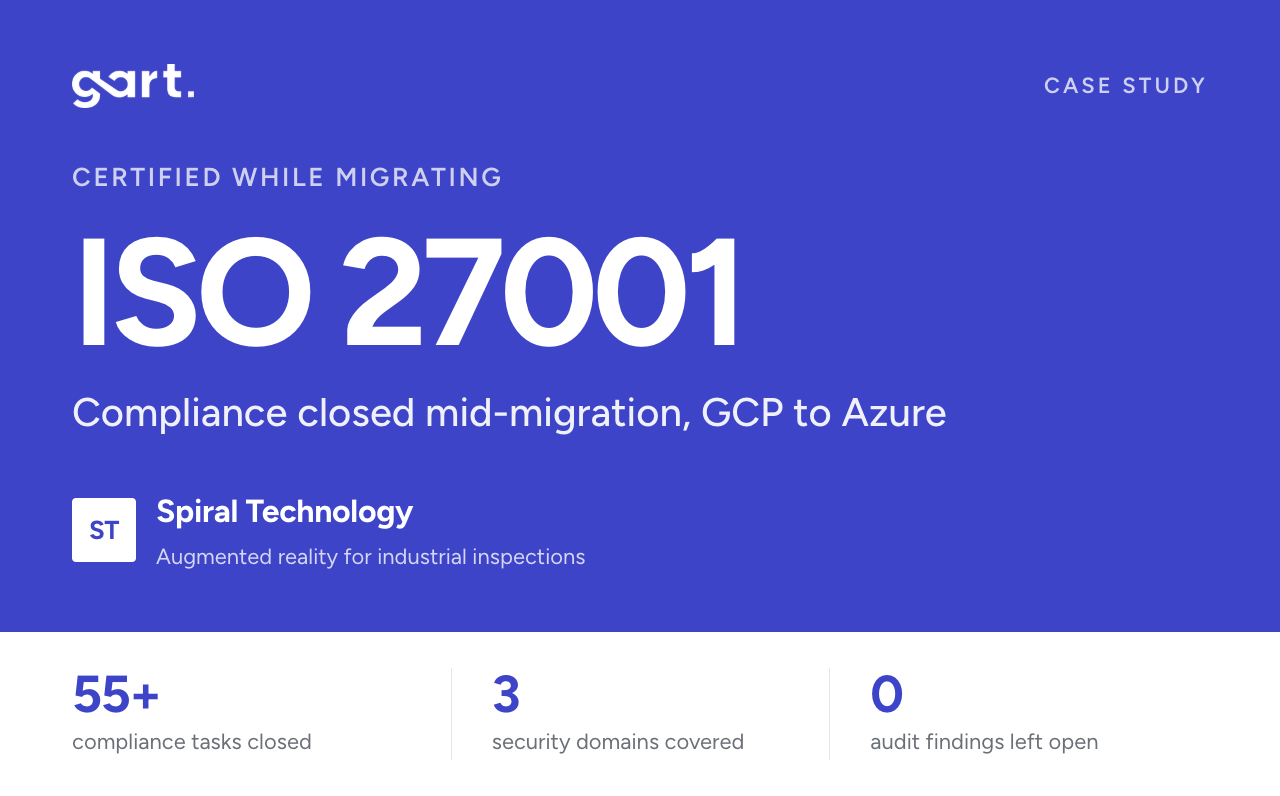
Our client, Spiral Technology, faced significant challenges related to data security and cloud migration. The primary concerns were ensuring compliance with ISO 27001 standards and seamlessly transitioning their data and operations to the cloud without compromising security or disrupting their services.
Proposed Solutions:
ISO 27001 Compliance
Gart Solutions provided expert guidance and support to Spiral Technology, helping them achieve ISO 27001 certification. This involved implementing comprehensive security measures, conducting thorough risk assessments, and establishing robust data protection protocols.
Seamless Cloud Migration
To address the challenge of cloud migration, Gart Solutions developed a detailed migration plan that minimized downtime and ensured data integrity, utilizing advanced encryption and secure data transfer methods to protect sensitive information during the transition.
Continuous Monitoring and Audits
For post-migration, Gart Solutions set up continuous monitoring and regular audits to maintain ISO 27001 compliance and address any emerging security threats promptly.
More details about this Case Study – by the link.
Interested in being prepared for a compliance audit & certification - contact Us!
We will help you to understand the specifics and be prepared, as well as from a technology integration and data management perspective.
Conclusion
Compliance in healthcare is an ongoing challenge that requires constant vigilance, investment in technology, and a thorough understanding of regulatory requirements.
By adhering to HIPAA, CCPA, GDPR, NIST, HiTECH, and PIPEDA, healthcare providers can protect patient data, build trust, and avoid costly penalties. As the regulatory landscape continues to evolve, staying informed and proactive in compliance efforts will remain essential for success in the healthcare industry.
Hey there! Let's talk about PCI DSS Audit. It's a big deal for anyone dealing with credit card info.
What is PCI DSS and why is it important?PCI DSS (Payment Card Industry Data Security Standard) is a global security standard designed to protect cardholder data. It applies to any organization that stores, processes, or transmits credit card information.
Quick summary:
🏷 PCI Definition: PCI stands for Payment Card Industry, and the PCI DSS (Data Security Standard) is designed to protect cardholder data during payment processing. The standard applies to any entity that stores, processes, or transmits cardholder data.
🏗️ 80 hours: The estimated minimum time required for most organizations to prepare for PCI compliance, especially if they handle card data.
🎯 4 to 6 weeks: The average time needed for evidence review during the audit process, based on the organization’s preparedness.
🛡️ Up to $100,000: The potential financial penalties for non-compliance, emphasizing the importance of adherence to PCI DSS standards.
So, what's PCI DSS? It's basically a set of rules to keep credit card data safe. Think of it as a security checklist for businesses that handle card payments.
Back in the day, each credit card company had its own security rules. Can you imagine how confusing that was for businesses? It was like trying to follow five different recipe books to bake one cake!
What is PCI DSS?
So in 2006, the big credit card brands (Visa, MasterCard, Discover, JCB, and American Express) got together and said, "Let's make one set of rules everyone can follow." And boom! PCI DSS was born.
Now, if your business takes credit card payments, you need to follow these rules. It's not just about avoiding fines (though that's important too). It's really about protecting your customers' info and keeping their trust.
Getting PCI certified can seem scary, but don't worry! It's just about proving you're following the rules and keeping card data safe.
Want to know more about how to get certified or what exactly you need to do? Just ask, and I'd be happy to break it down further!
Key PCI DSS Facts at a Glance
🏷️ Definition: Security rules for processing credit card data
⏳ Prep Time: ~80 hours for initial audit readiness
📅 Audit Review Time: Typically 4–6 weeks
💰 Non-Compliance Penalties: Up to $100,000 per incident
Who Must Comply?
Organizations that handle payment data are required to comply with PCI DSS. This includes:
Merchants (e.g., retailers like Walmart) that collect cardholder data during transactions.
Service providers (e.g., companies like AT&T) that store, process, or transmit this data.
Financial institutions that facilitate payments and transfers.
The scope of PCI DSS Audit is broad, encompassing any entity that stores, processes, or transmits cardholder data.
PCI Certifications
There are a few different PCI certifications out there. They're like badges that show you know your stuff when it comes to keeping credit card info safe. Here's the rundown:
PCI Professional (PCIP): This is the beginner's badge. It's like learning the ABCs of credit card security. It enables professionals to develop a secure payment environment.
Internal Security Assessor (ISA): This one's for people who check if their own company is following the rules. But here's the catch - if you leave the company, you can't take this badge with you.
Qualified Security Assessor (QSA): These are the pros who check if other companies are following the rules. And good news - if they switch jobs, they get to keep their badge!
Associate QSA (AQSA): This is like a "QSA in training" badge. It's perfect for newbies just starting out.
The Core Components of PCI DSS
Think of PCI DSS Audit as a big security checklist. It's got 12 main things to do, grouped into six big ideas:
Build a strong digital fence: Set up firewalls and make sure your security settings are top-notch.
Guard the treasure: Keep card info safe when it's sitting still and when it's moving around.
Stay on your toes: Keep your systems up-to-date and patch up any weak spots.
Don't let just anyone in: Only let the right people see card info.
Keep watch: Always be on the lookout for any funny business in your network.
Have a game plan: Write down how you're going to keep everything secure and stick to it.
Getting Ready for Your PCI Certification Audit
So you're gearing up for a PCI certification audit? Don't sweat it! I'm here to walk you through the key steps to get you ready. Let's break it down:
1. Figure Out What Needs to Be Checked
First things first, you need to know what parts of your business the auditors are going to look at. This is called understanding your "compliance scope."
What to do: Make a list of all the places in your company that handle credit card info. This includes computers, networks, even paper files if you still use those!
Pro tip: Try to make this list as small as possible. The fewer places that deal with credit card data, the less stuff you need to protect. It's like cleaning your house - the less clutter you have, the easier it is to keep tidy!
How to shrink your list:
Separate your credit card handling systems from the rest of your network. It's like putting all your valuables in a safe instead of leaving them all over the house.
Use something called "tokenization." This replaces credit card numbers with random codes. It's like using a secret language that only you understand.
Use special encryption when you're taking payments. This scrambles the credit card info right away, so you never actually see or store the real numbers.
2. Do a Practice Run
Before the real PCI DSS Audit, it's smart to do a practice run.
What to do: Pretend you're the auditor. Go through everything and see if you can spot any problems.
Why it's important: It's like proofreading an essay before you hand it in. You can catch and fix mistakes before they cost you points!
3. Get Your Paperwork in Order
Auditors love paperwork. They're going to ask for a lot of documents, so have them ready.
What you'll need:
Maps of how credit card info moves through your systems. Think of it like a treasure map, but for data!
Pictures of how your computer networks are set up.
Your rulebook for keeping credit card info safe. This includes stuff like who's allowed to see the data and how you keep it locked up.
Pro tip: Keep all these docs in one place, easy to find. It's like having a well-organized file cabinet.
4. The Big Day: PCI DSS Audit Time
When the auditors show up, here's what to expect:
They'll double-check that you were right about what needs to be audited.
They'll go through all those documents you prepared.
They might want to chat with your team or see how things work in action.
How to ace it: Be honest, be helpful, and don't panic if they find something small. Sometimes you can fix little issues right on the spot!
5. After the PCI DSS Audit: Fixing What Needs Fixing
Once the audit's done, you might have some homework:
If the auditors found any problems, now's the time to fix them.
They'll give you a report card (called a Report on Compliance) and a certificate (Attestation of Compliance) if you passed.
Remember, this whole process isn't about making your life difficult. It's about making sure you're keeping your customers' credit card info super safe. And that's something to be proud of!
Continuous Compliance: A Year-Round Effort
PCI DSS compliance is not a one-time achievement; it is an ongoing process. Think of PCI DSS compliance like keeping your house clean. You can't just do a big clean once and forget about it. Nope, it's an everyday thing!
Some stuff you gotta do daily (like checking your security logs - it's like making sure you locked the door before bed).
Other things are weekly or monthly (kinda like vacuuming or changing the sheets).
And don't forget the quarterly and yearly big cleans (like those vulnerability scans - think of it as checking for cracks in your home's foundation).
Here's the kicker: Your "clean house certificate" (aka your compliance) only lasts a year. Then you gotta prove you're still keeping things tidy all over again!
How Gart Solutions Can Help You with PCI DSS Compliance
Getting PCI DSS compliant can feel overwhelming, but Gart Solutions is here to make it easier for you! As a top provider of DevOps, cloud, and infrastructure solutions, we can guide you every step of the way. Here’s how we can help:
1. Understanding PCI DSS Requirements
We know that PCI DSS has a lot of rules to follow. Our team will help you break down the 6 Key PCI DSS Principles and 12 Requirements so you know exactly what you need to do to keep your customer’s card information safe.
2. Preparing for Your PCI Certification Audit
When it’s time for the PCI Certification Audit, we’ll be right by your side:
Gap Assessments: We’ll check your systems to see where you stand compared to PCI requirements and help you fix any gaps.
Document Support: We’ll help you gather all the paperwork you’ll need for the PCI DSS Audit, making sure everything is organized and ready for the auditors.
3. Building a Secure Infrastructure
We specialize in creating safe cloud infrastructures. Here’s what we can do for you:
Firewalls: We’ll set up strong firewalls to protect sensitive card information.
Encryption: Our team will ensure that data is scrambled during storage and transmission, keeping it safe from prying eyes.
Access Controls: We’ll help you put strict access controls in place so only the right people can see cardholder information.
4. Ongoing Monitoring and Testing
Compliance isn’t a one-time thing; it’s an ongoing process. Our continuous monitoring services will help you:
Regularly Test Your Systems: We’ll run tests to find any security holes before someone else does.
Monitor Your Networks: Our tools will keep an eye on network activity to catch any suspicious behavior right away.
5. Cost-Effective Compliance Strategies
We offer smart and affordable ways to stay compliant:
Automation: We can automate many compliance tasks, so you spend less time on paperwork and more time on your business.
Training Programs: We’ll educate your team about PCI DSS and the best practices for keeping card data safe.
6. Support After the Audit
After the PCI DSS Audit, we’re still here for you:
Fixing Issues: If the auditors find any problems, we’ll help you address them so you stay compliant.
Building Relationships: We’ll maintain a good relationship with your auditors to make future audits smoother.
By partnering with us, you’re not just checking a box; you’re investing in the security of your customers' data. Let’s work together to keep your cardholder information safe and build trust with your customers!
PCI DSS Compliance Checklist
The Payment Card Industry Data Security Standard (PCI DSS) outlines a set of security standards designed to protect cardholder data and ensure that organizations handling such information maintain a secure environment. Below is a checklist summarizing the key areas and requirements for compliance with PCI DSS:
RequirementActionFirewallProtect network perimeterEncryptionSecure data at rest and in transitAccess ControlsLimit system access by roleMonitoringLog and audit all accessVulnerability ScansConduct internal and external scansPoliciesMaintain written security proceduresIncident ResponsePlan for security breaches
PCI-DSS-Compliance-Download
That's PCI DSS in a nutshell! It's all about keeping those credit card numbers safe and sound. Need any more details about PCI DSS Audit?
At Gart Solutions, we help you make PCI compliance simple, affordable, and effective, so you can focus on growth, not regulations.