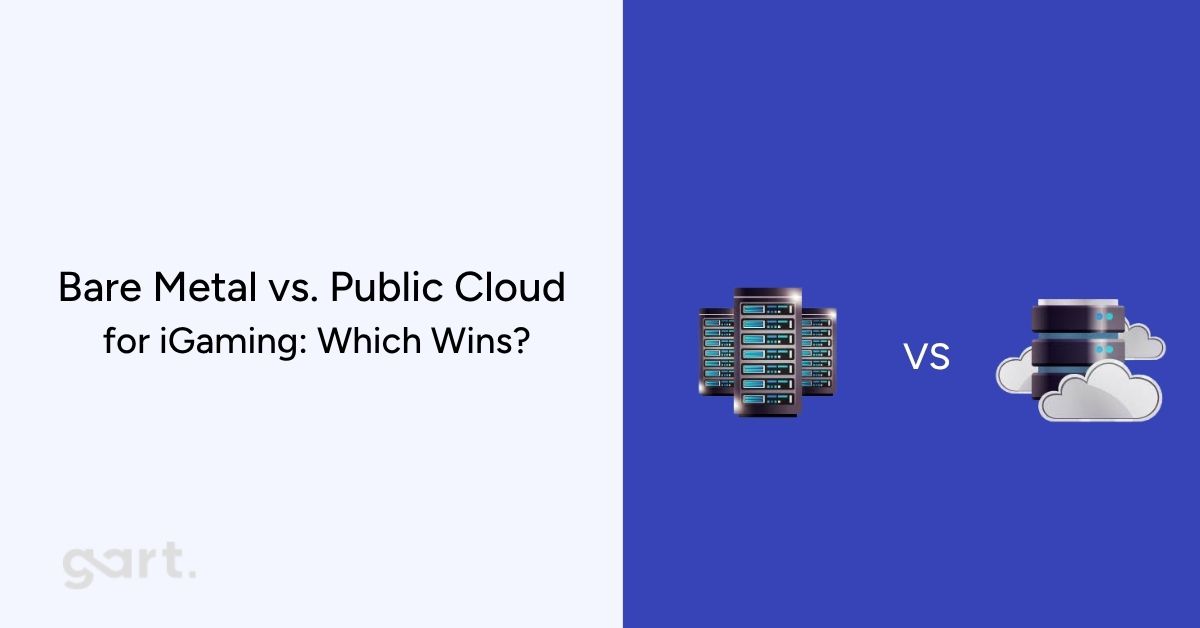
Bare metal vs. public cloud for iGaming is one of the highest-stakes infrastructure decisions a betting or casino operator will make — it shapes latency, licensing eligibility, DDoS resilience, and the total cost of running the platform for years. There is no universal winner: the right answer depends on your game mix, your license jurisdictions, and how spiky your traffic really is. This guide breaks down the trade-offs with real numbers, so you can make the call with evidence instead of vendor slides. If you're mid-decision, Gart Solutions' infrastructure management team can also assess your current stack in a single audit.
Every iGaming operator eventually hits this fork in the road: stay on public cloud for its elasticity, move core systems to bare metal for performance and cost control, or run both. The decision affects everything downstream — from how fast your odds engine reacts to a last-minute goal, to whether your license application survives a data-residency review.
What "Bare Metal" and "Public Cloud" Actually Mean Here
Bare metal is a dedicated, single-tenant physical server: you get the full CPU, RAM, and disk, with no hypervisor sitting between your application and the hardware. Public cloud is virtualized, multi-tenant compute — AWS, Azure, and GCP being the obvious examples — where resources are provisioned on demand and billed by the hour or second. Public cloud's elasticity is only possible because hyperscalers have built planet-scale capacity that a single operator could never replicate independently; Synergy Research Group's tracking of global cloud infrastructure spend shows just how concentrated — and how large — that capacity has become.
For most SaaS companies this comparison is academic. For iGaming, it isn't. Betting and casino platforms combine three characteristics that almost no other vertical stacks together: sub-second latency requirements on real-money transactions, extreme and predictable-yet-unpredictable traffic spikes (a World Cup final, a jackpot promotion), and licensing regimes that sometimes dictate exactly where a server may physically sit.
Latency and Performance: Why Milliseconds Move Money
Bare metal wins the raw performance argument, and the gap is measurable rather than anecdotal. Disk I/O on bare metal with NVMe drives typically runs at 50–100 microseconds, while cloud VMs relying on network-attached storage see 200–500 microseconds — a 3–5x difference that shows up directly in odds-feed freshness, bet-slip confirmation time, and live-casino stream synchronization.
That gap matters most on the systems where it's felt: the odds engine, the bet-settlement pipeline, and the wallet ledger. A few hundred milliseconds of added latency on a checkout page is a UX annoyance; the same delay on an in-play odds update is a trading risk, because sharp bettors will exploit the lag before your system re-prices the market.
It matters far less on systems where a human is the bottleneck anyway — marketing pages, the CMS, back-office reporting, or async KYC document review. Running everything on bare metal "just in case" is usually over-engineering; running the trading-critical path on shared cloud compute is usually under-engineering.
Scalability: Handling World Cup- and Super Bowl-Scale Spikes
This is where public cloud earns its premium back. Cloud infrastructure can add compute in minutes during a tournament surge, while scaling bare metal means provisioning new hardware or migrating workloads — a process that takes hours to days, not minutes. Operators are already planning for total betting volume increases of 70–75% during major 2026 tournaments compared to the last comparable event, and that kind of surge is exactly the scenario cloud elasticity was built for.
We covered the operational side of this in detail in our breakdown of architecting sportsbook infrastructure for Super Bowl-scale traffic — the short version is that the spike itself is rarely the real risk. The real risk is what compounds around it:
Live, in-play markets that re-price thousands of times per second as odds move with the game
Payment and wallet bursts as deposits, cash-outs, and bonus triggers all fire in the same 90-minute window
Third-party dependency load on odds feeds, KYC providers, and payment gateways that weren't sized for your peak, not just your average — a failure mode we go deeper on in our piece on third-party single points of failure in iGaming
Support and fraud-review queues that spike in lockstep with transaction volume
This is also where DDoS activity concentrates: gaming is one of the most consistently targeted industries online, and attack volumes regularly exceed 100 Gbps during exactly these high-visibility windows — a topic we examine further in our comparison of World Cup DDoS attacks and game-launch outages.
Cost and TCO: When Bare Metal Saves Money — and When It Doesn't
The cost argument is more nuanced than "cloud is expensive." For steady-state, predictable workloads - the core betting engine, the primary database cluster, always-on game servers — bare metal is regularly reported to deliver 40–50% lower total cost of ownership than the equivalent public cloud footprint, because you're not paying a virtualization and elasticity premium on capacity you use 24/7 anyway.
Public cloud earns its cost back on variable, bursty workloads: the marketing microsite that gets one traffic wave a year, the analytics pipeline that runs nightly, or the extra web tier you spin up for a single tournament. The FinOps Foundation has documented how much of that promise gets left on the table in practice — roughly a quarter of cloud spend across the industry goes to idle or oversized resources that nobody right-sized after the initial migration, which is a governance failure, not an argument against cloud itself.
The trend worth watching is cloud repatriation: a growing share of enterprises are moving specific, steady-state workloads back to dedicated infrastructure once usage patterns stabilize enough to make the economics obvious, without abandoning cloud for the workloads that still need it.
FactorBare MetalPublic CloudHybrid (typical Gart setup)Latency (odds engine, wallet)Lowest — direct hardware accessHigher — virtualization + network storage overheadBare metal for the trading-critical pathTraffic-spike scalingSlow — hours to days to add capacityFast — auto-scale in minutesCloud burst tier absorbs event spikesSteady-state cost (TCO)Lowest for 24/7 workloadsHigher — pay for elasticity you may not useFixed cost on core, variable cost on burstData residency / licensingFull control of physical locationDepends on region availability of chosen providerCore data stays in-license, edge stays cloudDDoS mitigationProvider-dependent; leading providers now include Tbps-scale protectionNative, built into hyperscaler edge networkCloud-based scrubbing in front of both layersOperational overheadHigher — capacity planning, hardware lifecycleLower — provider manages hardwareRequires unified observability across bothBare metal, private or hybrid for igaming
Licensing and Data Residency: The Variable Most Comparisons Miss
Most generic "bare metal vs. cloud" articles never mention the one factor that can override every performance and cost argument for an iGaming operator: your license terms may dictate where the server physically sits. This is squarely within the remit of the UK Gambling Commission, which requires operators to maintain documented evidence of system availability, incident response, and data handling regardless of where infrastructure is hosted.
Curaçao's LOK licensing framework goes further and is explicitly prescriptive: licensed platforms must place at least one gaming server physically in Curaçao within a Tier-IV certified data center, synchronize player and transaction data on a defined schedule, and retain records for a mandated period before any deletion or alteration — requirements that are far easier to satisfy with a dedicated, auditable bare metal footprint than with a multi-region cloud deployment where "where the data lives" can be genuinely ambiguous. Cyprus's NBA framework similarly expects servers to sit in Cyprus or the wider EU. The UK Gambling Commission and Malta Gaming Authority don't mandate physical server location as explicitly, but both expect auditable proof of controls, which is exactly the documentation our compliance-by-design approach is built to produce.
This is precisely the situation we walked one operator through in our infrastructure localization case study for a sportsbook platform: the license terms, not the performance benchmarks, ended up dictating the final architecture.
DDoS and Security: Gaming Is Among the Most Attacked Sectors Online
Gaming has consistently ranked as one of the most heavily targeted industries for DDoS activity, with attack volumes in the space regularly exceeding 100 Gbps and record assaults reaching terabit scale. Attackers time these campaigns deliberately — the same major sporting events and game launches that drive your legitimate traffic spikes are also when attackers strike, because that's when an outage costs you the most and gets the most attention.
The practical implication for the bare-metal-vs-cloud decision: don't evaluate DDoS resilience as a property of the compute layer alone. Leading bare metal providers now include multi-terabit mitigation as standard, and public cloud platforms bake DDoS scrubbing into their edge networks by default — so in 2026, the deciding factor is less "which one has DDoS protection" and more "which architecture lets you fail over cleanly when an attack does get through" — usually a question of orchestration, not hosting model, which is why most resilient setups lean on Kubernetes-based failover across both layers.
Gart Solutions
The Right Infrastructure Mix — Not a One-Size-Fits-All Answer
Gart Solutions designs and manages bare metal, public cloud, and hybrid infrastructure for iGaming operators — matching each workload to the platform that actually fits it. We've helped gaming platforms cut infrastructure costs, pass licensing audits across multiple jurisdictions, and hold 99.99% uptime through World Cup- and Super Bowl-scale traffic.
Infrastructure Management
Cloud & Bare Metal Migration
SRE & Reliability
Compliance Audits
Kubernetes & Platform Engineering
8.2
avg. MTTR reduction (×)
10+
iGaming platforms delivered
50+
engineers across cloud & bare metal platforms
Get an infrastructure assessment →
The Hybrid Model: What Most Mature Operators Actually Run
In practice, few large iGaming platforms are purely one or the other. The pattern we see most often across iGaming cloud infrastructure builds is a deliberate split: bare metal (or a private cloud built on dedicated hardware) for the latency- and compliance-sensitive core — odds engine, wallet, primary database — and public cloud for everything elastic and geographically distributed: CDN edge, marketing sites, analytics, CI/CD runners, and burst capacity for tournament traffic.
This isn't a compromise position — it's the version of the decision that actually reflects how iGaming traffic and licensing work. The core rarely needs to scale 10x in an hour; the edge frequently does. The core has to sit where your license says it sits; the edge usually doesn't care. It also tracks a broader industry shift: the Cloud Native Computing Foundation's annual survey consistently finds that most organizations now run hybrid or multi-platform infrastructure rather than betting everything on one model — iGaming is simply an extreme, high-stakes version of a pattern that's already mainstream.
A Practical Decision Framework
Map your workloads to latency sensitivity first. Anything touching odds, bet settlement, or wallet balance goes on the shortest possible path to the hardware.
Check your license terms for physical-location requirements before comparing performance benchmarks — a compliance constraint overrides a cost or speed advantage every time.
Model your actual traffic variance, not your average load. A platform with 3x spikes needs a different split than one with 30x spikes.
Price the steady-state core on both platforms over a 3-year horizon, including the FinOps overhead of keeping cloud resources right-sized.
Design the failover path across both layers, not just within one — your DDoS and incident response plan should assume either layer can be the one under attack.
Teams that get this split right typically lean on an experienced partner rather than building the capability from scratch — our SRE team and migration specialists typically run this exact assessment as the first phase of an engagement.
You might also like
DevOps Practices in iGaming, Casinos, and Sports Betting Companies
What Real iGaming Infrastructure Postmortems Teach Us About Reliability
The EU Cloud Managed Services Gap: What Operators Are Missing
Monolithic vs. Microservices: Do You Really Need Microservices?
What Is DevSecOps — and Why iGaming Platforms Need It
Roman Burdiuzha
Co-founder & CTO, Gart Solutions · Cloud Architecture Expert
Roman has 15+ years of experience in DevOps and cloud architecture, with prior leadership roles at SoftServe and lifecell Ukraine. He co-founded Gart Solutions, where he leads cloud transformation and infrastructure modernization engagements across Europe and North America. In one recent client engagement, Gart reduced infrastructure waste by 38% through consolidating idle resources and introducing usage-aware automation. Read more on Startup Weekly.
The global online gambling and sports betting market is projected to surpass $126 billion by 2027, and the platforms competing for that revenue routinely support more than 50,000 concurrent players during peak events. That scale creates a narrow engineering problem: an iGaming cloud infrastructure has to deliver sub-30-millisecond response times, survive a 40x traffic spike during a World Cup final, and simultaneously prove to four or five regulators that player data never left an approved border. Most general-purpose cloud architectures are built for one or two of those constraints. iGaming platforms need all three at once.
This guide walks through how modern iGaming operators actually build for that combination — compute and network topology, stateful WebSocket scaling, database concurrency control, and the jurisdictional rules that shape where every byte of player data can physically sit. It draws on current AWS, OVHcloud, Continent 8, and Google Cloud reference architectures, alongside the statutory frameworks operators must satisfy in Malta, Germany, Brazil, and New Jersey.
TL;DR
Real-time betting and live-dealer games require sub-30ms round-trip latency, which pushes core transactional logic onto single-tenant bare-metal servers rather than shared public cloud instances.
WebSocket-based session persistence needs sticky routing, consistent hashing, and a pub/sub layer (Redis or Kafka) to synchronize state across edge nodes.
Database layers combine ACID-compliant engines (PostgreSQL, MySQL InnoDB) for ledgers with MVCC for read-heavy audit paths and in-memory stores for session state.
Malta, Germany, Brazil, and New Jersey each impose different physical server localization and data residency rules — there is no single compliant architecture that works everywhere.
Hybrid edge appliances (AWS Outposts, Google Distributed Cloud) let operators keep regulated workloads on sovereign hardware while running CDN and analytics in the public cloud.
Why standard cloud architectures fall short for iGaming
In live sports betting, a 500-millisecond delay is a financial vulnerability, not just a UX inconvenience. It opens an arbitrage window for "court-siding" — placing bets on events that have already concluded by exploiting broadcast delay. That single constraint reshapes the entire infrastructure decision tree.
Traditional multi-tenant public cloud environments introduce the "noisy neighbor" effect: virtualized workloads sharing physical hardware cause unpredictable jitter and round-trip time spikes. For a game engine calculating live odds or generating random numbers under regulatory audit, that unpredictability is unacceptable. This is why iGaming operators consistently isolate core transactional and game-logic engines on single-tenant bare-metal servers or private clouds, frequently orchestrated through OpenStack-based hypervisors and custom management APIs that avoid the resource contention inherent to shared infrastructure.
The hardware baseline
The table below summarizes the technical profile operators typically specify for compute nodes running RNG, betting logic, and ledger transactions.
Component
Typical configuration
Why it matters
Compute
Dual Intel Xeon Scalable Silver/Gold, high base clock
Minimizes RNG and betting-logic execution time; avoids CPU scheduler queue delays
Memory
96–256 GB DDR4/DDR5 ECC RAM
Real-time correction of single-bit memory errors; prevents crashes during peak load
Storage
Dual NVMe SSDs in RAID
Sustains high concurrent write IOPS without thread stalls
Network
Dual-bonded 100–200 Gbps NICs, Tier-1 peering
Maximizes burst capacity, minimizes network hops
Colocation
Tier III+/IV facilities, N+1 or 2N power redundancy
Supports up to 99.993% uptime; isolates localized power failures
The cost trade-off matters as much as the technical spec. Public cloud egress charges can reach $0.09 per gigabyte on platforms like AWS, and that adds up fast when a live match generates continuous odds-update traffic to tens of thousands of sockets. Dedicated server pricing is predictable month over month — which is exactly the property operators need when a single high-volume event can otherwise erode margin through unplanned cloud consumption.
⚙️
Weighing bare-metal against public cloud for a betting platform?
Gart Solutions runs vendor-neutral cloud architecture assessments that map real traffic and latency requirements to the right mix of dedicated and public infrastructure — before you commit to a colocation contract.
See our cloud architecture practice →
Stateful sessions: scaling WebSockets without losing game state
Live odds, live-dealer video, and real-time game state depend on persistent, bidirectional connections. Standard HTTP request-response cycles carry too much overhead — repeated TCP handshakes and verbose headers — for that job, so platforms upgrade to WebSocket: a single full-duplex TCP socket established once and held open for the duration of play.
Client
Server
|-------- HTTP GET /ws (Upgrade: websocket) ------>| [Initial Handshake]
|
[lwptoc]
The DevOps iGaming landscape has fundamentally changed. Five years ago, a casino operator deploying every two weeks was considered fast. Today, Tier-1 sportsbooks push to production dozens of times per day — during live UEFA matches, NBA playoffs, and World Series games — without a single second of planned downtime. That's not possible without a mature DevOps engineering practice purpose-built for the regulated, high-stakes iGaming environment.
This guide draws on Gart's work across iGaming, casino, and sports betting platforms — including a sportsbook migration that improved performance by 30–40% — to give you a practitioner-level view of what DevOps in iGaming actually looks like in 2026: the architecture, the compliance automation, the deployment strategies, and the observability stack your platform needs to survive peak traffic and pass MGA or Curacao audits.
Main Challenges iGaming Companies Face Without DevOps
The iGaming sector operates under a set of pressures that few other industries face simultaneously: real-money transactions, real-time odds calculation, strict regulatory oversight from bodies such as the Malta Gaming Authority (MGA) and the Curacao Gaming Control Board, and user expectations for zero-latency gameplay at any hour. Without DevOps, these pressures become existential risks:
Regulatory compliance drift: Manual compliance checks lag behind regulatory updates. A missed configuration change can result in license suspension or six-figure fines.
Deployment fear: Teams afraid to push code during live events create a release backlog that makes every deployment riskier than the last.
Scalability gaps: A Super Bowl or Champions League kickoff can spike traffic 20× in minutes. Without autoscaling, platforms crater precisely when they're most visible.
Security blind spots: iGaming handles KYC data, payment card data, and session tokens — all attractive targets. Manual security reviews can't keep pace with rapid iteration.
Incident response latency: Without structured on-call runbooks and automated alerting, MTTR (Mean Time to Recover) stretches from minutes to hours — while players are losing trust.
Regulatory Compliance and Auditing
One of the primary challenges for iGaming companies operating without DevOps is ensuring regulatory compliance. These companies must adhere to stringent rules and regulations imposed by entities like Curacao, the Malta Gaming Authority, and the International Association of Gaming Regulators (IAGR). Manual compliance checks and updates can be time-consuming and prone to human error. DevOps practices can automate compliance checks and help implement regulatory changes swiftly, reducing the risk of non-compliance and regulatory fines.
Stability of Operations
iGaming companies must provide players with a stable and uninterrupted gaming experience. Without DevOps, ensuring high availability and operational stability can be challenging. DevOps practices, such as deploying applications across multiple availability zones and through a wide range of IP addresses, help maintain consistent uptime and provide redundancy in the event of server failures or outages. This is vital for player trust and retention.
Data Security and Privacy
Data security is paramount in the iGaming industry, as it involves handling sensitive player information and financial transactions. DevSecOps practices, including integrating security into the development and deployment processes, can significantly enhance data security. The use of separate Docker containers for each application instance and granular configuration of Kubernetes cluster policies ensures that data remains isolated and protected. Implementing encryption and hashing techniques for data at rest and in transit further safeguards sensitive information.
Scalability Issues
Scalability is a critical consideration for iGaming companies, especially during peak periods or when experiencing a surge in player traffic. Without DevOps, some companies may not be using technologies like Kubernetes clusters and autoscaling groups with Docker containers, making it difficult to efficiently scale resources based on demand. DevOps enables automated scaling, ensuring that resources are available to accommodate fluctuating player loads, enhancing the overall gaming experience, and preventing potential performance bottlenecks.
📊 What the DORA data saysAccording to the 2025 DORA State of DevOps Report, elite-performing teams deploy 973× more frequently and have lead times 6,750× shorter than low performers. In an industry where a 10-minute outage during a live sporting event translates directly to lost bets and churn, that gap is the difference between market leadership and irrelevance.
How DevOps in iGaming Differs from Other Industries
DimensioniGaming / Sports BettingTypical SaaS / EnterpriseDeployment frequencyMultiple times per day, including during live eventsWeekly or bi-weekly is commonTraffic patternsExtreme spikes tied to match schedules (predictable but sharp)Gradual growth, occasional campaign spikesRegulatory burdenMGA, Curacao, UKGC, state-by-state US requirements; real-time audit trailsGDPR, SOC 2 — serious but less operationally intrusiveData sensitivityKYC documents, payment data, gambling behaviour (problem gambling liability)PII, business dataUptime toleranceNear zero — players leave within seconds of a slow pageMinutes of downtime often acceptableSecurity surfaceReal-money transactions invite active DDoS, fraud, and scrapingStandard threat modelContent cadenceOdds, markets, and promotions update in millisecondsContent is relatively staticHow DevOps in iGaming Differs from Other Industries
Kubernetes Architecture for iGaming Platforms
Kubernetes has become the default orchestration layer for serious iGaming operators — not because it's fashionable, but because it solves the specific problems these platforms face: burst scaling, isolation between tenant environments, and declarative infrastructure that auditors can inspect.
Namespace isolation for multi-tenant casino platforms
A typical Gart iGaming Kubernetes architecture separates workloads by function and risk profile. Wallet services, game engines, and third-party integrations (payment processors, KYC providers) each run in isolated namespaces with strict NetworkPolicy rules. This prevents lateral movement in the event of a breach — a requirement explicitly called out in MGA technical standards.
Horizontal Pod Autoscaling for match-day traffic
Odds-serving microservices are the first to saturate under match-day load. Gart configures HPA with custom metrics (bets/second via KEDA) rather than CPU alone — because odds calculation is IO-bound and CPU metrics lag the actual bottleneck. This allows the cluster to begin scaling at the first sign of increased bet volume, before latency degrades.
Architecture note from Gart's engineering teamIn one iGaming client deployment, we separated the odds feed processor into its own node pool with GPU-optimized instances, reducing odds calculation latency from 180ms to 22ms at peak load — while keeping the main cluster cost-optimized for baseline traffic.
Specific DevOps Practices and Considerations Tailored to the iGaming Industry
Game Build and Distribution Automation
DevOps can automate the entire game build and distribution process. This means that when developers make changes to the game code, a new version of the game is automatically built and deployed, making it quicker and more efficient to release updates or patches to players.
Real-Time Monitoring and Analytics
Gaming companies should implement robust real-time monitoring and analytics tools. This allows for immediate detection of in-game issues, server performance problems, or player experience disruptions. DevOps can be used to create automated alerts and response systems, ensuring that any issues are addressed swiftly to maintain an uninterrupted gaming experience.
Load Testing for Scalability
Gaming companies often experience sudden surges in player traffic, especially during special events or game launches. DevOps can facilitate load testing to ensure that game servers can handle these traffic spikes without crashing. This is critical for maintaining player satisfaction and retention.
A/B Testing for Game Features
DevOps principles can be applied to A/B testing of game features. By releasing multiple versions of a game to different player segments and collecting data on player preferences and behavior, gaming companies can use DevOps practices to quickly iterate and optimize game design and mechanics.
Player Data Privacy and Compliance
In the gaming industry, ensuring player data privacy and adhering to compliance regulations is crucial. DevOps can automate security and compliance checks to guarantee that player data is handled securely and that the game complies with regional regulations and privacy laws.
Game Content Management
For online games, regular content updates are essential to keep players engaged. DevOps can facilitate the management of game content, enabling quick and efficient content releases while maintaining game stability.
Disaster Recovery and Redundancy
Gaming companies need robust disaster recovery plans and redundancy measures to ensure that games remain available even in the face of server failures or other disruptions. DevOps practices can automate these processes to minimize downtime.
Player Feedback Integration
Gaming companies can use DevOps to create automated systems for capturing player feedback, which can then be analyzed and integrated into development cycles. This feedback loop can lead to more player-centric updates and enhancements.
Cross-Platform Compatibility
Many modern games are designed to run on various platforms, such as PC, console, and mobile devices. DevOps practices can help ensure that games are consistently updated and perform optimally across multiple platforms.
Game Telemetry and Performance Optimization
Collecting and analyzing telemetry data from the game (e.g., player behavior, in-game performance, and crashes) is essential. DevOps can automate the processing of telemetry data to identify areas for performance improvement and enhance the overall gaming experience.
CI/CD Pipeline Design for Casino and Sports Betting
A well-designed CI/CD pipeline for iGaming is not simply "build → test → deploy." It must embed compliance gates, security scanning, and rollback triggers that align with regulatory requirements.
The iGaming CI/CD pipeline: 7 stages
Source trigger: PR to main branch triggers the pipeline. Feature branches use short-lived preview environments for QA.
Static analysis + SAST: Semgrep, Snyk, and Checkov run in parallel. Any HIGH or CRITICAL finding blocks the merge — no exceptions for "we'll fix it later."
Unit + integration tests: Target >80% coverage for wallet, session, and payment services. Integration tests run against ephemeral database snapshots — not production data.
Compliance gate: Automated checks verify that database schema changes have a corresponding migration script, all secrets are referenced from Vault (not hardcoded), and audit log endpoints are reachable.
Container build + scan: Docker image built from a minimal base image (distroless or Alpine). Trivy scans the image for known CVEs before pushing to ECR.
Canary deploy (5% traffic): New version receives 5% of traffic for 10 minutes. Automated rollback triggers if error rate exceeds 0.1% or p99 latency exceeds 300ms.
Full rollout + audit record: After canary success, full deployment proceeds. Deployment event, operator identity, and version hash are written to the immutable audit log.
GitOps and ArgoCD: Declarative Infrastructure for iGaming
GitOps is arguably the most important architectural shift iGaming DevOps teams can make for compliance purposes. When your cluster state is declared in Git and ArgoCD reconciles it continuously, every infrastructure change has an author, a timestamp, a review trail, and an automated rollback path. That's exactly what MGA and UKGC auditors want to see.
How Gart implements GitOps for iGaming clients
All Kubernetes manifests, Helm values, and Kustomize overlays live in a dedicated infra-gitops repository.
ArgoCD syncs the cluster every 3 minutes and on every push to the main branch.
Environment promotion (staging → production) is a pull request — reviewed, approved, and merged, creating a natural audit trail.
Out-of-band changes (direct kubectl apply) are detected and automatically reverted, preventing configuration drift that regulators flag.
When an MGA auditor asks "who changed this configuration and when?", the answer is a Git blame command and a pull request URL — not a war-story from memory. GitOps turns compliance evidence collection from a week-long exercise into a 10-minute query.
Progressive Delivery: Canary, Blue/Green, and Feature Flags
iGaming teams cannot afford a failed deployment during a live Champions League match. Progressive delivery techniques let you validate new code against real traffic before committing to a full rollout — with automatic escape hatches.
Blue/Green deployments for zero-downtime releases
The blue environment runs the current production version. The green environment receives the new version. After green passes automated smoke tests, the load balancer shifts 100% of traffic in a single atomic swap. If a problem surfaces, traffic flips back to blue in seconds — not minutes. Gart uses AWS ALB target group weights or Kubernetes Ingress annotations to implement this without external tooling.
Canary releases for odds and wallet services
For high-risk services (payment processing, odds calculation), we use Flagger to automate canary analysis. Traffic is shifted 5% → 20% → 50% → 100% over 30 minutes, with real-time analysis of error rate, latency, and custom metrics (bet acceptance rate). Any deviation from the baseline triggers an automatic rollback.
Feature flags for controlled rollouts
Feature flags decouple deployment from release. A new live betting interface can be deployed to production but enabled only for QA team accounts, then for 1% of users in a low-risk jurisdiction, then progressively expanded. This is especially valuable for compliance: a jurisdiction-specific feature (e.g., responsible gambling prompts mandated by UKGC) can be toggled by country without a new deployment.
Observability Stack: Metrics, Logs, and Traces
In iGaming, observability is not a nice-to-have — it is a regulatory and commercial requirement. You must be able to answer, in real time: Is the wallet service processing transactions? Are odds feeds updating within SLA? Is any player session showing anomalous behaviour that might indicate fraud or a system bug?
The three pillars for iGaming platforms
PillarTool stack Gart recommendsKey iGaming use caseMetricsPrometheus + Grafana / Amazon CloudWatchBets/sec, odds update latency, payment success rate, concurrent sessionsLogsOpenSearch (ELK) / Loki + GrafanaAudit log immutability, transaction history, access logs for complianceTracesJaeger / AWS X-Ray / OpenTelemetryEnd-to-end latency from bet placement to confirmation; identifying which microservice adds latencyThe three pillars for iGaming platforms
AI-assisted incident response
Forward-looking iGaming DevOps teams are now integrating LLM-based runbook assistance into their alerting workflows. When PagerDuty fires an alert, an AI agent queries the last 48 hours of logs, identifies similar past incidents, and surfaces the three most likely root causes with suggested remediation steps — before the on-call engineer has opened their laptop. Gart's SRE practice has implemented this pattern for a sports betting client, reducing MTTR by approximately 40%.
Compliance Automation and Regulatory Reporting
Compliance in iGaming is not a one-time audit — it is a continuous operational requirement. MGA mandates real-time reporting of game outcomes, financial transactions, and player session data. Curacao requires infrastructure documentation and change records. US state gaming commissions (New Jersey DGE, Pennsylvania PGCB) require infrastructure localization and data residency controls.
Compliance as Code with Open Policy Agent (OPA)
Gart implements Open Policy Agent (OPA) — a CNCF graduated project — as the policy enforcement layer across the Kubernetes cluster. OPA Gatekeeper policies prevent:
Deployment of containers running as root
Pods without resource limits (a common cause of noisy-neighbour problems during traffic spikes)
Services that lack the required audit-log-enabled: "true" annotation
Images from unregistered registries (supply chain security)
Automated regulatory reporting pipelines
For MGA-licensed clients, Gart builds event-driven pipelines (AWS EventBridge → Lambda → encrypted S3 → MGA SFTP) that deliver daily game integrity reports automatically. The pipeline is idempotent, retryable, and has its own monitoring — so a reporting failure triggers an alert before the submission deadline, not after.
Chaos Engineering and Resilience Testing
The question is not if your iGaming infrastructure will experience a failure — it is whether you will discover the failure in a controlled chaos experiment or during a live sporting event. Chaos Engineering, popularised by Netflix and formalised in the Principles of Chaos Engineering, systematically injects failures to validate resilience assumptions.
What Gart tests in iGaming chaos experiments
Kill a payment service pod: Does the circuit breaker engage? Do bets queue or fail fast with a user-friendly error?
Simulate an availability zone failure: Does traffic reroute to the secondary AZ within the RTO SLA?
Inject 200ms latency on the odds feed: Does the frontend degrade gracefully, or do users see blank screens?
Exhaust database connection pool: Do services fail independently, or does connection exhaustion cascade across unrelated services?
Gart runs chaos experiments in production during low-traffic windows (early morning, off-season) using AWS Fault Injection Simulator (FIS) and Chaos Mesh. Each experiment has a defined hypothesis, blast radius, and automated abort condition — so the experiment stops before it becomes a real incident.
FinOps for iGaming: Controlling Cloud Costs at Scale
iGaming platforms have some of the most volatile cost profiles in cloud computing. During the FIFA World Cup, your AWS bill might be 8× the baseline. After the tournament ends, unused capacity sits idle if you haven't automated rightsizing. FinOps — the practice of bringing financial accountability to cloud spending — is increasingly a DevOps responsibility.
Cost control strategies Gart implements
Spot/Preemptible instances for stateless workloads: Game rendering services, analytics processors, and batch jobs run on Spot, cutting compute costs by 60–70% for interruption-tolerant workloads.
Reserved/Savings Plans for baseline capacity: The always-on wallet, auth, and session services run on 1-year Compute Savings Plans at a 40% discount vs. on-demand.
Automated scheduled scaling: Match schedules are known in advance. Gart automates pre-scaling — 30 minutes before kick-off, capacity expands; 2 hours after full-time, it contracts. This avoids both under-provisioning and over-spending.
Tagging enforcement via OPA: Every resource must have cost-centre, product, and environment tags. Untagged resources are flagged in daily cost reports, enabling accurate showback by product line.
Multi-Region Failover and Disaster Recovery
The largest iGaming operators serve players across dozens of jurisdictions simultaneously. A single-region architecture is both a technical risk and a compliance liability — several regulators explicitly require data residency within their territory.
Active-Active vs. Active-Passive: choosing the right model
ModelRTORPOCostBest forActive-Active<30 seconds~02× computeWallet, sessions, real-money transactionsActive-Passive (warm standby)2–5 minutes<1 minute~1.3× computeBack-office, reporting, content managementPilot light15–30 minutes<15 minutes~1.1× computeNon-player-facing systems, dev/staging DRActive-Active vs. Active-Passive: choosing the right model
Database migration strategy for multi-region iGaming
Migrating a live iGaming database without downtime is one of the most complex operations in the stack. Gart's approach: dual-write during migration (both old and new DB receive writes), with a reader cutover first, then a writer cutover validated by checksums. We use AWS DMS for heterogeneous migrations (e.g., Oracle → Aurora PostgreSQL) with a parallel validation script that compares row counts and checksums across both systems before the final cutover. Zero downtime. Zero data loss. Fully auditable.
Secrets Management and Security Practices
In iGaming, a leaked API key to a payment processor or a KYC provider can trigger a regulatory investigation and a license review. Secrets management is not optional — it is a license condition.
The Gart secrets management stack for iGaming
HashiCorp Vault (or AWS Secrets Manager) as the single source of truth for all credentials, API keys, and certificates.
Dynamic secrets: Database credentials are generated on-demand with a TTL of 1 hour. No static passwords. No password rotation ceremonies.
Kubernetes External Secrets Operator: Syncs secrets from Vault into Kubernetes Secrets at runtime — developers never see production credentials.
Git scanning: DevSecOps pipelines run Gitleaks on every commit to prevent secrets from entering version control.
Audit logging: Every secret access is logged with the accessor identity, timestamp, and source IP — meeting MGA audit requirements.
DevOps iGaming Best Practices Checklist
CategoryPracticePriorityCI/CDCompliance gate in every pipeline — blocks deploy if audit log endpoint unreachable🔴 CriticalCI/CDAll secrets from Vault/Secrets Manager — zero hardcoded credentials🔴 CriticalDeploymentCanary releases for wallet and odds services with automated rollback🔴 CriticalInfrastructureIaC for all environments (Terraform + Helm) — no manual cloud console changes🔴 CriticalGitOpsArgoCD drift detection — automatic revert of out-of-band changes🟠 HighObservabilityCustom business metrics (bets/sec, payment success rate) in Grafana dashboards🟠 HighResilienceMonthly chaos experiments with documented results🟠 HighComplianceOPA Gatekeeper policies enforcing security baselines at admission time🟠 HighFinOpsScheduled scaling tied to match calendar — pre-scale 30 min before events🟡 MediumDRQuarterly DR test with documented RTO/RPO validation🟡 MediumDevOps iGaming Best Practices Checklist
Best Practices for DevOps in Gaming
Automation of Deployment and Testing: One of the core principles of DevOps is automation. In gaming, where updates and releases are frequent, automating the deployment process can ensure that new features or bug fixes are implemented smoothly and without disruptions. Automated testing is equally important to maintain the quality of the gaming experience.
Continuous Integration and Continuous Delivery (CI/CD): CI/CD pipelines streamline the delivery process by automatically integrating code changes and delivering them to production. This accelerates time-to-market and reduces the risk of introducing errors.
Version Control: Utilizing version control systems like Git allows gaming companies to manage and track changes to their codebase effectively. This ensures that every change is well-documented and reversible.
Infrastructure as Code (IaC): Treating infrastructure as code means that your gaming company can provision, manage, and scale resources efficiently through code. This not only reduces manual errors but also makes the entire system more reliable and scalable.
Monitoring and Feedback Loops: DevOps emphasizes real-time monitoring of applications and infrastructure. This helps in identifying issues early and allows teams to provide quick fixes or enhancements. Continuous feedback loops ensure that the gaming experience is continually improving.
Security Integration: With the prevalence of cyber threats, incorporating security into DevOps practices is crucial. Security checks should be automated throughout the development process to identify vulnerabilities and ensure a secure gaming environment.
Serverless Agility: With serverless architecture, iGaming SaaS platforms don't need to manage servers or infrastructure.Serverless platforms automatically handle the scaling of resources based on demand. This ensures that your SaaS application can easily accommodate fluctuations in user activity without manual interventions.
Microservices Architecture: SaaS solutions aren't constructed as large, monolithic applications that rely on a complex network of servers.Microservice architecture is like building a digital system using small, independent building blocks (microservices) that work together. Each building block does a specific job, and they all communicate to create a complete, flexible, and efficient system.
In the gaming industry, DevOps practices can have a significant impact on the player experience, game quality, and the ability to respond to rapidly changing player preferences. By tailoring DevOps processes to the unique demands of gaming, companies can stay competitive and offer a more engaging and reliable gaming experience.
Benefits of DevOps for Gaming Companies
Faster Time-to-Market
DevOps enables rapid deployment of new features and updates. In the gaming industry, this means that companies can respond to market demands quickly, making it easier to stay competitive.
Enhanced Quality and Reliability
Automation of testing and quality control reduces human errors and ensures that the gaming experience is reliable and consistent, thus increasing player trust.
Improved Collaboration
DevOps encourages better communication and collaboration between development and operations teams. This synergy results in smoother processes and quicker issue resolution.
Cost Efficiency
By automating and streamlining processes, gaming companies can optimize resource utilization, ultimately reducing operational costs.
Scalability
With Infrastructure as Code, gaming companies can scale resources up or down based on demand. This flexibility is crucial for handling peak loads, such as during major gaming events or promotions.
Competitive Edge
Implementing DevOps practices gives gaming companies a competitive edge. They can keep up with market trends and swiftly respond to customer feedback, attracting and retaining a larger player base.
Security
By integrating security into the DevOps pipeline, gaming companies can proactively address vulnerabilities, ensuring player data and transactions remain secure.
Integration of Game Engines into CI/CD Pipelines
The integration of game engines into Continuous Integration/Continuous Deployment (CI/CD) pipelines is essential for streamlining game development and ensuring the efficient and automated delivery of high-quality games. Here's a step-by-step guide on how to achieve this integration:
1. Version Control Setup:
Choose a version control system (e.g., Git) and create a repository to manage the game's source code and assets. Ensure that team members are well-versed in version control practices.
2. Select a CI/CD Platform:
Choose a CI/CD platform or system that aligns with your development needs. Popular options include Jenkins, Travis CI, GitLab CI/CD, or cloud-based services like CircleCI and GitHub Actions. More CI/CD tools you can find here.
3. CI/CD Configuration:
Set up a CI/CD pipeline in your chosen platform. Define the various stages of your pipeline, which may include:
Build Stage: Configure the pipeline to automatically build the game using the game engine. Game engine-specific command-line tools can be used to initiate the build.
Testing Stage: Implement testing scripts and quality assurance checks. These can include unit tests, integration tests, performance tests, and other checks to ensure the game functions correctly.
Deployment Stage: Define the deployment process, which includes packaging the game for specific platforms and uploading it to distribution platforms or app stores.
4. Game Engine Integration:
Utilize the game engine's command-line or scripting capabilities to trigger builds and exports. Most game engines, such as Unity and Unreal Engine, provide command-line tools that allow you to build games without the need for manual intervention.
Incorporate these engine-specific commands into your CI/CD pipeline scripts. For example, you can use Unity's command-line interface (Unity CLI) to build and export the game for various platforms.
5. Asset Management:
Leverage the asset management features within the game engine to track changes, collaborate on assets, and manage asset versioning.
6. Automation and Triggering:
Configure your CI/CD pipeline to trigger automatically whenever there is a new code commit or asset change in the version control system. This ensures that builds and tests are run as soon as changes are made.
7. Environment Configuration:
Ensure that the CI/CD pipeline replicates the target environments accurately. Game engines may require specific configurations for each platform (e.g., PC, console, mobile), and these configurations should be defined in the pipeline scripts.
8. Testing and Quality Assurance:
Implement automated testing scripts within the pipeline to validate the game's functionality, performance, and quality. This can include functional testing, load testing, and compatibility testing for different platforms.
9. Deployment and Distribution:
Automate the deployment process, which involves packaging the game for specific platforms and distributing it to app stores or other distribution channels. Ensure that deployment scripts are tailored to each platform's requirements.
10. Monitoring and Reporting:
Set up monitoring and reporting tools to track the progress and outcomes of each CI/CD pipeline run. This allows you to identify and address any issues promptly.
11. Rollback Mechanism:
Implement a rollback mechanism in case issues arise after a game's release. This mechanism should enable you to revert to previous game versions quickly and efficiently.
By following these steps, game developers can successfully integrate game engines into CI/CD pipelines, enabling automated and efficient game development, testing, and deployment processes while maintaining high-quality gaming experiences for players.
Case Study: AWS Migration and Infrastructure Localization for a Sportsbook Platform
One of Gart's most complex iGaming DevOps engagements involved migrating a US-facing sportsbook to AWS while complying with state-specific infrastructure requirements across multiple US gaming jurisdictions. The core challenge: different states require game data to be processed and stored within state borders — meaning a single AWS region was not enough.
What we delivered:
Multi-region AWS architecture with state-specific VPCs and data residency controls enforced via SCP (Service Control Policies)
CI/CD automation that reduced deployment time from 4 hours to 22 minutes
Infrastructure as Code covering 100% of production resources (Terraform + Terragrunt)
Compliance reporting pipeline delivering automated reports to state gaming commissions
30–40% overall performance improvement measured across p50 and p99 latency metrics
Read the full case study: AWS Migration & Infrastructure Localization for Sportsbook Platform
Conclusion
In the dynamic and fiercely competitive gaming, gambling, and iGaming sectors, the adoption of DevOps transcends being merely a recommended practice; it has become an imperative. Its capacity to promptly respond to market shifts, deliver top-tier gaming experiences, bolster cooperation, and enhance security positions DevOps as a transformative force for enterprises within these industries.
For iGaming companies seeking DevOps services, we encourage you to reach out to Gart. Embracing DevOps principles not only heightens a company's standing within the market but also significantly contributes to the overall success and reliability of the gaming experience, ultimately leading to greater player satisfaction and a more robust financial performance.
Roman Burdiuzha
Co-founder & CTO, Gart Solutions · Cloud Architecture Expert
Roman has 15+ years of experience in DevOps and cloud architecture, with prior leadership roles at SoftServe and lifecell Ukraine. He co-founded Gart Solutions, where he leads cloud transformation and infrastructure modernization engagements across Europe and North America. In one recent client engagement, Gart reduced infrastructure waste by 38% through consolidating idle resources and introducing usage-aware automation. Read more on Startup Weekly.