Every CTO reaches the same fork eventually: the quarterly access review has stopped being a formality and started eating a full week of someone's time, and the question is no longer "should we automate this" but "how." That's the real decision behind access review automation — not whether to keep using a spreadsheet forever, but whether to build the automation in-house with scripts against your identity provider's API, buy one of the dozens of commercial platforms now competing for this budget line, or stay manual a little longer because your entitlement graph genuinely doesn't justify either yet. Gart's compliance audit team gets asked to referee this exact decision more often than almost any other access-governance question, usually right after a failed or painfully expensive SOC 2 or ISO 27001 cycle.
This guide is that referee call in writing: what each path — manual, build, and buy — actually costs in time, headcount, and risk; the commercial tool categories worth knowing before a vendor call; and a decision framework you can apply to your own organization without sitting through six demos first. The conversation usually starts after a failed or painfully expensive audit exposed how much of the IAM configuration nobody had actually reviewed in years.
What Access Review Automation Actually Means
Access review automation is the use of software — whether custom-built or purchased — to collect entitlement data, route certify-or-revoke decisions to the right owner, and log the resulting evidence, without a human manually exporting, emailing, and re-importing a spreadsheet each cycle. It's the mechanism; the underlying goal is unchanged from every identity framework's core idea, NIST's principle of least privilege — that every account should hold only the access it currently needs, no more.
The "automation" part isn't all-or-nothing. Most mature programs automate data collection and evidence capture fully, automate routing and reminders almost completely, and keep the actual certify-or-revoke judgment call with a human reviewer — the tooling narrows what a person has to look at, rather than replacing the decision itself. We covered that workflow distinction in detail in how to run a user access review without spreadsheets; this article picks up from there to answer the question that guide doesn't: which delivery model gets you to that workflow fastest for your specific situation.
The Three Paths: Manual, Build, or Buy
Every organization automating access reviews chooses, deliberately or by default, between three approaches. None of them is universally correct, and the right one depends far more on entitlement complexity and available engineering capacity than on company size alone:
Manual — spreadsheets, shared docs, or email threads, run by a person who owns the process end to end. Cheapest to start, most expensive to sustain past a certain scale.
Build — scripts and internal tooling written against your identity provider's API (Okta, Entra ID, Google Workspace, AWS IAM) that automate collection, routing, and evidence capture without buying a dedicated product.
Buy — a commercial platform, ranging from a lightweight access-certification tool to a full enterprise identity governance and administration (IGA) suite, that provides the workflow, evidence trail, and integrations out of the box.
The rest of this guide breaks down what each path actually requires and where it tends to fail, so the decision isn't made on a vendor's pitch deck alone.
Staying Manual: When It Still Works (and When It Doesn't)
Manual reviews aren't automatically wrong. For a genuinely small entitlement footprint — a handful of systems, a headcount under roughly 150, and a first-time compliance audit — a well-structured spreadsheet process, run with discipline, can pass a SOC 2 or ISO 27001 review without a platform purchase. The mistake isn't staying manual early; it's staying manual past the point where the process can no longer keep up, which research from Secureframe's access review benchmarking puts at a full review cycle averaging 149 days manually versus 55 days once automated — nearly a hundred extra days per cycle spent chasing sign-offs instead of running the business.
⚠️ The break point is roughly 500 employees or 100 applications
Past that rough threshold, the number of entitlements to cross-reference exceeds what any one person can track reliably inside a review window, and the same failure modes show up in nearly every organization we audit: stale snapshots, no single source of truth once the file is emailed around, and reviewers defaulting to "approve all" because a raw permission list carries no usage context to judge by.
If that describes your organization today, the deeper mechanics of what breaks and the exact process fix are in our companion guide on running a user access review without spreadsheets. What this article adds is the next decision: once you've decided manual is no longer sustainable, do you build the automation yourselves or buy it?
Building Your Own Access Review Automation
Building in-house is genuinely the right call for some organizations — typically ones with a narrow, stable set of systems, an identity provider with a solid API, and spare platform engineering capacity that isn't fighting fires elsewhere. A first version is often just a scheduled script that pulls group memberships from your SSO provider, drops them into a lightweight workflow tool for manager sign-off, and logs the decision to a database instead of a spreadsheet tab. That can realistically ship in a few weeks.
What rarely gets budgeted honestly is what happens after v1 ships. A sustained in-house access review system needs ongoing coverage across roughly five distinct functions: the software engineering to build and extend it, operations to keep the integrations running as each connected system changes its API, security expertise to get the risk logic right, user support for the managers stuck on the workflow, and someone who actually understands the entitlement domain well enough to keep the automation meaningful rather than mechanical. None of that shows up as a single line item — it's absorbed into the engineering backlog, which is exactly why "build" often looks free in the planning meeting and expensive eighteen months later.
API coverage for every connected system — not just your primary IdP. Shadow SaaS and systems outside SSO are usually where the build scope quietly triples.
A workflow and notification layer — routing, reminders, and escalations that someone has to design, not just the data pull.
An evidence store an auditor will accept — timestamped, queryable records of reviewer, decision, and action, not a log file nobody's tested against a real audit request.
A maintenance owner named today — the person who updates the integration when Okta or Entra ID changes an API, not "whoever's free."
A plan for scope creep — new compliance frameworks, new subsidiaries, new systems all expand what the in-house tool needs to cover, indefinitely.
None of this rules out building — plenty of engineering-heavy organizations run this well. It rules out building without naming, up front, who owns it in twelve months.
Buying a Commercial Platform: The Three Tool Categories
"Buy" isn't one category of product — it's at least three, and conflating them is the single most common mistake we see in vendor selection. Compliance evidence platforms, lightweight access-certification tools, and full enterprise IGA suites solve overlapping but distinct problems, and picking the wrong one for your actual entitlement complexity means either overpaying for capability you don't need or under-buying and hitting the same wall in eighteen months.
CategoryWhat it actually doesTypical time to valueWatch out forCompliance evidence platforms (e.g., Vanta, Drata, Secureframe)Document that reviews happened and collect audit evidence; often layered on top of another system that does the actual review workflowWeeksProves reviews occurred — doesn't necessarily automate the certify/revoke decision itselfLightweight access-certification tools (e.g., Zluri, AccessOwl, Cakewalk, SecurEnds, Clarity Security)Run the actual review workflow — collect entitlements from connected SaaS apps, route certifications, execute revocations1-2 weeksDiscovery usually runs through your IdP, so apps outside SSO can stay invisible — ask vendors directly how they cover non-SSO and non-employee identitiesEnterprise IGA suites (e.g., SailPoint, Okta Identity Governance, Saviynt)Full lifecycle governance — birthright provisioning, role modeling, separation-of-duties enforcement, deep on-prem and cloud coverage6-12 months, often longer with legacy platformsProfessional services costs can match or exceed the license fee; confirm before signing whether implementation is vendor-led or self-serveBuying a Commercial Platform: The Three Tool Categories
A useful shortcut when evaluating any of the three: ask what percentage of your actual entitlement landscape the tool discovers on day one without custom integration work. Platforms that lean entirely on IdP-based discovery routinely cover only 30-40% of a real SaaS footprint, leaving contractors, vendors, and service accounts as an unreviewed blind spot that shows up as an audit finding later.
One "buy" scenario deserves a special note: if you're already a Microsoft 365 E5 customer, the build-vs-buy math often changes entirely, because a meaningful share of enterprises already own Entra ID Governance access reviews as part of their existing license and simply haven't turned them on. Our Entra ID Governance vs. manual access reviews cost breakdown walks through the exact licensing math before you evaluate a third-party purchase.
Which Approach Fits Your Organization
There's no formula that replaces a proper assessment of your own entitlement graph, but the pattern below reflects what actually tends to work across the engagements we run, and it lines up with ISACA's guidance on structuring access review verification around risk-based triggers rather than a one-size cadence:
Your situationRecommended pathUnder ~150 employees, a handful of systems, first SOC 2 or ISO 27001 cycleStay manual, but structured — or layer a compliance evidence platform on top to shorten audit prep without a full workflow buy yet150-1,000 employees, cloud/SaaS-heavy stack, entitlement volume still trackableBuy a lightweight access-certification tool — fastest path to real automation without enterprise IGA cost or timelineDeep in-house platform engineering capacity, narrow and stable system listBuild — with a named long-term owner and budget for the five functions above, reviewed annually against whether buying now makes more sense1,000+ employees, hybrid on-prem/cloud, multiple overlapping frameworks (SOX, SOC 2, ISO 27001), M&A-driven entitlement sprawlBuy an enterprise IGA suite — the role modeling and separation-of-duties enforcement earn their cost at this complexityNeed audit-ready evidence now while still deciding on a long-term platformLayer a compliance evidence platform in immediately; run the build-vs-buy evaluation for the workflow layer in parallel, not sequentiallyWhich Approach Fits Your Organization
Hidden Costs Nobody Puts in the Pitch Deck
Whichever path you're leaning toward, a handful of costs consistently get left out of the initial comparison, and they're usually what turns a confident decision into a regretted one a year later:
💸 SOC 2's own criteria don't specify a tool — only evidenceThe AICPA's Trust Services Criteria (CC6.1-CC6.3) require documented, periodic review of logical access with evidence of the decision and any resulting removal — they don't mandate a specific product. That means a manual process, a build, or any of the three buy categories above can all satisfy the letter of the requirement; the real differentiator is whether the evidence is trustworthy and reproducible under audit pressure, not which logo is on the invoice. The same logic holds for more prescriptive frameworks like PCI DSS, whose own access-review requirements care about the control, not the vendor enforcing it.
Beyond that, watch for: integration costs that don't show up in the license quote (custom connectors for internal or legacy systems usually cost extra, on either the build or buy path); the "shelf-ware" risk of buying enterprise IGA capability you don't yet have the process maturity to use, which is common when the tool purchase happens before the workflow is actually defined; and the reverse risk on the build side engineering time that was supposed to be temporary becoming a permanent, unbudgeted maintenance line as soon as the first integration breaks during a platform migration elsewhere in the company.
Access Governance & Compliance Audit
Not sure whether to build, buy, or wait?
Gart Solutions runs a vendor-neutral assessment of your entitlement landscape — every system, every identity type, every framework you're accountable to — and gives you a straight recommendation on whether to automate in-house, adopt a lightweight access-review tool, or invest in enterprise IGA, before you sit through a single vendor demo.
IT Audit Services
Compliance Audit
Security Audit
Infrastructure Audit
DevSecOps Consulting
IT Infrastructure Consulting
Talk to an audit specialist
You might also like
Why Quarterly Access Reviews Fail (and How to Fix It)
Least-Privilege Access: A Practical Playbook for Lean IT Teams
The Real Cost of a Failed SOC 2 Audit (and How to Avoid One)
IT Infrastructure Audit Checklist: Signs You Need a Checkup
IT Audit Services Overview
Roman Burdiuzha
Co-founder & CTO, Gart Solutions · Cloud Architecture Expert
Roman has 15+ years of experience in DevOps and cloud architecture, with prior leadership roles at SoftServe and lifecell Ukraine. He co-founded Gart Solutions, where he leads cloud transformation and infrastructure modernization engagements across Europe and North America. In one recent client engagement, Gart reduced infrastructure waste by 38% through consolidating idle resources and introducing usage-aware automation. Read more on Startup Weekly.
Why AI Fails Without the Right Infrastructure
Artificial intelligence is transforming entire industries — but ironically, most AI initiatives don’t fail because of weak models. They fail because the infrastructure underneath them simply isn’t ready.
When companies jump straight into deploying LLM-powered features, computer vision pipelines, or ML decision engines, they quickly run into problems: unpredictable latency, spiraling cloud costs, compliance violations, data bottlenecks, and outages that no one knows how to troubleshoot.
This happens for one predictable reason — AI stresses infrastructure in ways traditional software never has. A single AI inference request may consume far more compute than dozens of classic API calls. Sensitive data may need to move through new pipelines. Models require versioning, isolation, and rollback strategies. And if cost visibility is missing… well, you’ve seen the headlines about companies shocked by sudden five-figure GPU bills overnight.
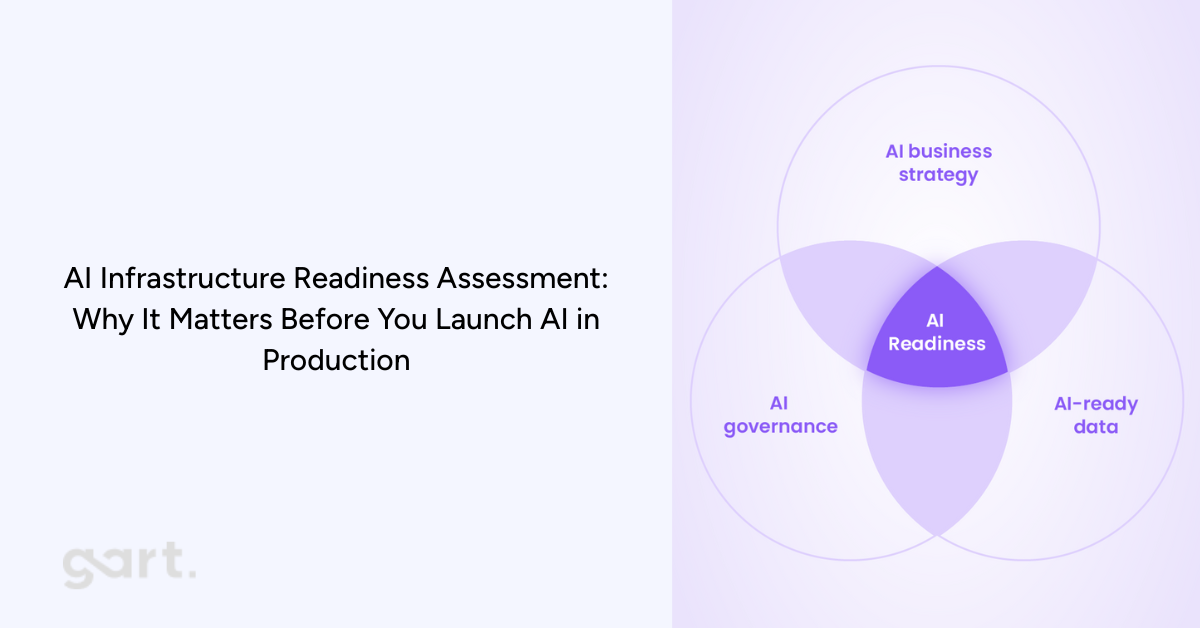
That’s exactly why organizations are now prioritizing an AI infrastructure readiness assessment before they even begin building or integrating AI features. According to the brochure provided (p.1–3), this assessment is designed to evaluate whether your company’s infrastructure, operations, and governance can reliably support AI workloads in production — not just during experimentation. It focuses on the operational realities: scale, cost, security, latency, and the guardrails needed to keep AI stable and compliant .
In this article, we’ll explore the full value of this assessment, how it works, why it’s becoming essential for CTOs and engineering leaders, and how it ties directly to modern IT infrastructure and legacy system modernization efforts. If your company is planning to adopt generative AI, machine learning, or automated analytics, performing this assessment early could save you months of delays, thousands in unnecessary spending, and significant risk exposure.
2. What Is an AI Infrastructure Readiness Assessment?
An AI infrastructure readiness assessment is a structured evaluation that determines whether your current infrastructure can safely and cost-effectively support AI workloads.
2.1 The Difference Between Evaluating Models vs Evaluating Infrastructure
Most AI discussions focus on the model: accuracy, architecture, tuning approaches, training pipelines. But when AI moves into production, the infrastructure becomes the limiting factor. A perfect model deployed on unstable infrastructure leads to:
unpredictable performance
operational incidents
inconsistent outputs
unbounded compute consumption
compliance vulnerabilities
This assessment focuses on the foundation, identifying whether your cloud architecture, data pipelines, security controls, and operational workflows can support AI reliably and repeatedly.
2.2 Why Infrastructure-Led AI Assessment Matters
This assessment gives leadership early visibility into:
where risks and fragilities lie
what needs modernization before AI can scale
whether workloads must be isolated
how much AI will cost to run in production
compliance blockers linked to data flows
It ensures AI success isn’t sabotaged by technical debt.
3. Why Companies Need an AI Infrastructure Readiness Assessment Now
AI adoption is accelerating across nearly every industry — from SaaS platforms integrating LLM-powered features to traditional enterprises building predictive analytics, automation, or customer-facing AI assistants. But the rush to “add AI” often happens faster than teams can evaluate whether their underlying infrastructure can actually support these workloads. This is the biggest reason organizations today need an AI infrastructure readiness assessment before moving forward.
Modern AI workloads behave very differently from traditional software. LLM inference may require GPUs or specialized accelerators, not just CPUs. Data pipelines must be reproducible, regulated, and auditable. Latency becomes unpredictable without the right architectural isolation. Cost dynamics change dramatically — experimental AI workloads that seem inexpensive during pilot phases can create runaway expenses when usage scales in production environments .
Another reason companies need this assessment now is compliance. Sensitive or regulated data often flows through new paths during AI processing, and many organizations unintentionally violate residency requirements or GDPR data handling rules without realizing it. The assessment identifies these risks early (p.8), preventing costly future corrections or audit failures .
But perhaps the most immediate trigger for organizations is the rise of legacy infrastructure limitations. Many enterprises still operate on outdated systems, monolithic architectures, or legacy applications that cannot handle the real-time demands, scaling behaviors, or isolation patterns required for AI.
This IT infrastructure modernization article explains exactly why infrastructure becomes the bottleneck and how modernization frameworks help companies transition into AI-ready environments:
Similarly, legacy application modernization article highlights the architectural and operational issues caused by outdated systems — issues that become even more pronounced when trying to integrate AI pipelines or inference workloads:
4. Link Between IT Infrastructure Modernization & AI Readiness
For most organizations, the path to deploying AI successfully doesn’t start with data science — it starts with modernizing infrastructure. Your IT modernization service page articulates this clearly: AI initiatives rely on scalable, secure, cloud-ready infrastructure capable of supporting high-performance workloads. Without this foundation, production AI becomes nearly impossible.
4.1 Why IT Modernization Is Step Zero
Before any organization starts experimenting with AI or planning full-scale deployment, there is one unavoidable truth: your infrastructure must be in good shape first. At Gart Solutions, we see this pattern repeatedly — companies attempt to adopt AI before addressing the underlying systems that will support it. The result? Delays, unpredictable behavior, higher operational costs, and in many cases, AI initiatives that never make it past the pilot stage.
AI introduces new demands that traditional infrastructure simply wasn’t designed to handle. Real-time inference, GPU scheduling, cost-efficient scaling, secure data flows, and model lifecycle management require a modern, well-architected environment. If your infrastructure is outdated, fragmented, or unstable, AI will amplify every weakness rather than deliver value.
This is why IT modernization becomes Step Zero in any AI strategy.
Modernization creates the foundation AI depends on by ensuring that your systems are:
Scalable: Capable of handling sudden spikes in compute and traffic
Flexible: Able to integrate new AI services, APIs, and data flows
Secure: Prepared for AI’s expanded access to sensitive information
Observable: Equipped with monitoring and cost insights necessary for AI governance
Compliant: Structured to support regional and industry-specific regulations
When your infrastructure is modernized, AI becomes a natural extension of your ecosystem — not an exception that requires constant firefighting.
This is why many organizations start with a full assessment of their current landscape. Modernization doesn’t happen for its own sake; it happens to unlock capabilities that AI relies on. Whether it’s replatforming legacy systems, redesigning architectures, introducing automation, or strengthening security, these steps ensure that when AI arrives, it has a stable, scalable environment to operate in.
Simply put:If the foundation is weak, AI will expose it. If the foundation is strong, AI will elevate it.
4.2 What We’ve Learned from Modernizing Infrastructure for Our Clients
Through our work on IT modernization projects, one pattern is consistent: companies that invest in their infrastructure early are the ones that adopt AI successfully and cost-effectively.
Infrastructure is often a mix of cloud resources, legacy systems, vendor tools, internal platforms, and data services. Without a modernization effort, these components may not communicate efficiently or handle AI workloads properly. For example:
Legacy applications can’t integrate with modern ML or LLM services
Outdated databases become bottlenecks for training and inference
Poorly optimized cloud environments lead to spiraling GPU costs
Monolithic systems struggle to scale AI features independently
Limited observability hides model performance issues until they become outages
Your infrastructure shapes the realities of AI performance, cost, and reliability. Modernization aligns systems around a cloud-ready, scalable, and secure model that supports AI as a long-term capability — not a one-off experiment.
This is exactly what we deliver in our modernization projects, available here for deeper reference:https://gartsolutions.com/it-infrastructure-modernization/
4.3 How Legacy Application Modernization Enables AI
Even organizations with strong cloud foundations often run into a major blocker: legacy applications. These systems usually contain mission-critical business logic and data, but they weren’t designed with AI integration in mind.
Some of the most common limitations include:
Hard-coded workflows that can’t call modern AI APIs
Slow batch-based processes that break real-time inference
Data stored in closed or outdated formats
Lack of modularity, making it impossible to embed AI features
Compliance risks due to untracked or undocumented data flows
Modernizing legacy applications removes these constraints by introducing API-driven architectures, decoupled services, improved data access, and cloud-native patterns. Suddenly, AI can plug into business processes seamlessly.
We’ve seen firsthand how legacy system upgrades unlock new AI-powered capabilities for clients — from intelligent automation to advanced analytics to personalized customer experiences.More here: https://gartsolutions.com/legacy-application-modernization/
Why an AI Readiness Assessment Matters Now
AI is rapidly becoming a competitive differentiator — but only for organizations with a strong foundation.
Take the assessment: https://tally.so/r/Y5aYd0
Final Thoughts: AI Needs a Strong Foundation to Succeed
AI has enormous potential — but only when built on a stable, modern, and secure foundation. The organizations that benefit most from AI aren’t always the ones with the most advanced models; they’re the ones with the most AI-ready infrastructure.
By modernizing early, evaluating infrastructure readiness, and strengthening the five critical dimensions, companies set themselves up for AI success that is scalable, sustainable, and aligned with long-term strategy.
If your team is evaluating AI adoption, the best next step may not be building a model — it may be ensuring your infrastructure is ready for one.
Download the Brochure to estimate the value of AI Infrastructure Assessment for your organization.
Contact Us if you need a support.
AI-Infrastructure-and-Readiness-AssessmentDownload
Let’s be honest: the term “AI infrastructure” gets thrown around way too loosely. Every company claims to offer it, every platform says they do it, and every startup feels they need it. But the truth? Most businesses don’t fully understand what AI infrastructure really involves — let alone who to trust to build it.
With the explosive rise of AI adoption across industries, from healthcare to fintech to logistics — the need for a robust, scalable, and purpose-built AI infrastructure has never been greater. But just buying tools or plugging into a cloud platform doesn’t automatically set you up for AI success. In fact, the wrong kind of provider can cost you time, resources, and your competitive edge.
So, how do you figure out who you actually need? Should you go with a big-name hyperscaler like AWS or Azure? Rely on AI tooling vendors? Or find a real engineering partner that understands not just infrastructure, but your business goals?
This is exactly where Gart Solutions enters the conversation and why we’re going to break this down, piece by piece.
What “AI Infrastructure” Really Means (And Why It’s Misused)
Let’s clear the air: AI infrastructure is not just cloud compute. It’s not just spinning up GPUs or having a Kubernetes cluster. True AI infrastructure is an ecosystem — spanning hardware, software, networking, orchestration, data pipelines, security, and deployment strategies, that enables your models to be trained, tested, and deployed at scale reliably and efficiently.
Many vendors blur this definition. Some refer to AI infrastructure as access to compute resources. Others pitch it as MLOps tooling. But these are fragments, not the full picture. Without the glue —infrastructure engineering — you’re essentially building AI on shaky ground.
Here’s what real AI infrastructure includes:
Provisioning scalable compute environments (on-prem, cloud, hybrid)
CI/CD for AI (from data to model to inference)
Networking and security specific to AI workloads
Automated infrastructure management and monitoring
Model versioning, rollback, and lifecycle support
Regulatory compliance & data governance
As Fedir Kompaniiets, CEO of Gart Solutions, often puts it:
“You can’t build intelligent systems on unintelligent foundations. AI needs an engineered runway to take off.”
That “engineered runway” is where too many projects cut corners. And why most AI deployments fail after the proof-of-concept phase.
The Three Major Categories of AI Infrastructure Providers
Let’s break down the landscape. All AI infrastructure vendors fall into one of these three buckets:
Hyperscalers & Platforms
These are your big cloud providers — AWS, Microsoft Azure, Google Cloud, offering on-demand compute, storage, and managed AI services.
Strengths:
Global scale and availability
Massive catalog of AI/ML services
Flexibility to scale compute up/down
Pay-as-you-go pricing
Limitations:
One-size-fits-all approach
High complexity; steep learning curve
Hidden costs and potential vendor lock-in
No engineering support for tailoring environments
Hyperscalers are powerful, no doubt. But they require skilled teams to design and manage AI-ready infrastructure. The tools are there, but you have to know how to wire them correctly.
AI Tooling Vendors
These vendors — like Hugging Face, DataRobot, Weights & Biases, and Neptune.ai — offer platforms for training, experiment tracking, model deployment, and observability.
Strengths:
Simplified interfaces for ML workflows
Version control, reproducibility, and collaboration
Accelerated model development
Limitations:
Assume infrastructure is already in place
Don’t handle compute provisioning, security, or networking
Tooling doesn’t solve operational or scaling issues
Can add toolchain bloat
AI tooling vendors are great after you’ve built the core infrastructure. But they don’t replace the need for infrastructure automation, engineering, or DevOps support.
AI Infrastructure Engineering & Delivery Partners
This is where real transformation happens. Engineering-led partners design, build, and operate AI infrastructure customized for your business and goals.
Strengths:
Vendor-agnostic and tailored to your environment
Combines DevOps, MLOps, automation, and security
Offers long-term support and scale planning
Aligns with compliance, governance, and data strategies
Gart Solutions is a leader in this category. With proven delivery across healthcare, fintech, and product companies, they offer end-to-end AI infrastructure services — not just tools or compute, but custom-engineered solutions.
When Companies Need Each Category
Here’s a breakdown of when each provider type is right, depending on your business maturity and goals:
Company StageHyperscalerTooling VendorEngineering PartnerStartup✅ For initial experiments✅ If team is skilled❌ Usually overkillScale-up✅ For scalability✅ Adds efficiency✅ To avoid technical debtEnterprise✅ Core platform✅ For governance✅ Crucial for transformationRegulated Industry⚠️ Need strong compliance overlays✅ Helpful for tracking✅ Required for auditability
If you’re running mission-critical AI workloads, handling sensitive data, or deploying in production at scale — you need an engineering-led partner.
Where AI Projects Fail Without Infrastructure Engineering
The AI landscape is full of failed pilots and expensive detours. Why?
Models work in dev, but can’t scale in prod
Data bottlenecks and broken pipelines
Lack of observability and rollback mechanisms
Downtime, security risks, and compliance gaps
Take MedWrite AI, a healthcare NLP platform. They had models ready, but infrastructure issues blocked production launch. Gart Solutions stepped in, designed AI-ready infrastructure with automated scaling and monitoring — and cut time-to-market by over 60%.👉 Read the full case study
Fedir Kompaniiets explains:
“AI tooling gives you a car. Infrastructure engineering builds the road — and the traffic system to keep it running.”
Why Engineering-Led Partners Outperform Tools Alone
The key reason tools fail is that they assume the groundwork has been done. But most companies haven’t:
Set up secure, compliant data flows
Automated their infrastructure
Integrated CI/CD for AI
Designed scalable model-serving environments
Gart Solutions combines IT infrastructure consulting, automation, and DevOps best practices to create a future-proof foundation for AI.
They don’t just deliver a stack — they build a customizable, self-healing, and compliant AI delivery system.
Market Overview: AI Infrastructure Spending and Trends
According to Gartner, global AI infrastructure spending is expected to surpass $422 billion by 2028, growing at a CAGR of 26%. The key investment areas include:
Cloud infrastructure and hybrid deployments
Hardware accelerators (GPUs, TPUs)
MLOps tooling and automation
Engineering services for delivery and monitoring
The big shift? From platform dependence to engineering autonomy.
Companies are realizing that AI platforms are only part of the puzzle — infrastructure strategy is becoming the new battleground.
Deep Dive: Gart Solutions’ Approach to AI Infrastructure Delivery
Gart doesn’t sell tools — they deliver outcomes.
By combining consulting, automation, and AI-ready architectures, they support every stage of the AI lifecycle. Their services include:
IT Infrastructure Consulting
Infrastructure Automation
General IT Infrastructure Services
In their HealthTech AI case study, they delivered HIPAA-compliant, cloud-native AI infrastructure capable of zero-downtime deployments and real-time model performance monitoring.
That’s not just delivery. That’s engineering-led transformation.
Case Studies That Prove the Point
Let’s move beyond theory and look at how this plays out in real businesses.
Take MedWrite AI, a HealthTech platform transforming how clinical notes are analyzed using NLP. When they approached Gart Solutions, their infrastructure was:
Underperforming under load
Hard to manage and monitor
Non-compliant with healthcare standards
Gart stepped in and:
Re-architected their cloud infrastructure
Implemented robust MLOps pipelines
Added auto-scaling and fault tolerance
Ensured HIPAA compliance through secure networking and audit logging
👉 See the full MedWrite AI Case Study
Results:
Time-to-market reduced by 60%
Model performance boosted by 3x
Uptime near 100% during critical deployments
In another case, a fintech company needed to deploy an AI fraud detection engine. The issue? Their tools worked in test but crashed under real-world scale. With Gart Solutions’ infrastructure automation services, they achieved:
Full CI/CD for model updates
Cost-optimized infrastructure scaling
Secure multi-region deployments
The takeaway? Tools are great, but without engineering, they collapse under pressure.
How to Choose the Right AI Infrastructure Partner
Before you sign up with a vendor promising "AI infrastructure," ask yourself:
Do they understand your industry’s compliance needs?
Сan they automate deployments and rollback pipelines?
Will they stay involved beyond the initial setup?
Do they offer custom engineering vs. out-of-the-box tools?
And perhaps most importantly:
❌ Are they trying to sell you tools instead of solving your problems?
With Gart Solutions, you’re getting a team that thinks beyond platforms. They build scalable, secure, and future-proof environments that grow with you.
Why Gart Solutions Stands Out
There’s no shortage of vendors claiming to support AI. But few can deliver custom, scalable, and production-grade infrastructure the way Gart Solutions does.
Here’s why:
Engineering-first approach: Every project starts with strategy, not software
Vendor-neutral: They use what works best for you, not what pays them commissions
Business-oriented outcomes: They align infrastructure with your goals — not just technical specs
Ongoing support: Monitoring, updating, and evolving your infrastructure over time
Proven track record: Across industries like HealthTech, FinTech, and SaaS
Conclusion
AI infrastructure isn’t one-size-fits-all. Whether you're experimenting with models or deploying them into production, you need the right kind of partner to avoid common traps like tool sprawl, vendor lock-in, and under-engineered environments.
To recap:
Hyperscalers give you the raw power, but no guidance
Tooling vendors offer control — but no infrastructure
Engineering-led partners, like Gart Solutions, deliver tailored, future-ready solutions
If your AI initiative is serious, the choice is clear: invest in infrastructure engineering from the start.
And if you're looking for a trusted partner, Gart Solutions is ready to help. Contact Us and explain the challenges of your project.