- What Is an IT Infrastructure Audit?
- Why Growing Businesses Run Infrastructure Audits Now
- Gart’s 5-Layer Audit Methodology
- What an IT Infrastructure Audit Covers
- AWS Infrastructure Audit Walkthrough
- Audit Process — Step by Step
- How Different Roles Use IT Infrastructure Audit Results
- Case Studies: IT Infrastructure Audit Outcomes & Metrics
- Before vs. After: Infrastructure Architecture Comparison
- Limitations of IT Infrastructure Audits
- IT Infrastructure Audit Cost & How to Think About ROI
- What you typically receive from a Gart Solutions audit
- Cost, and how to think about value
- Why organizations choose Gart Solutions
- Conclusion
What Is an IT Infrastructure Audit?
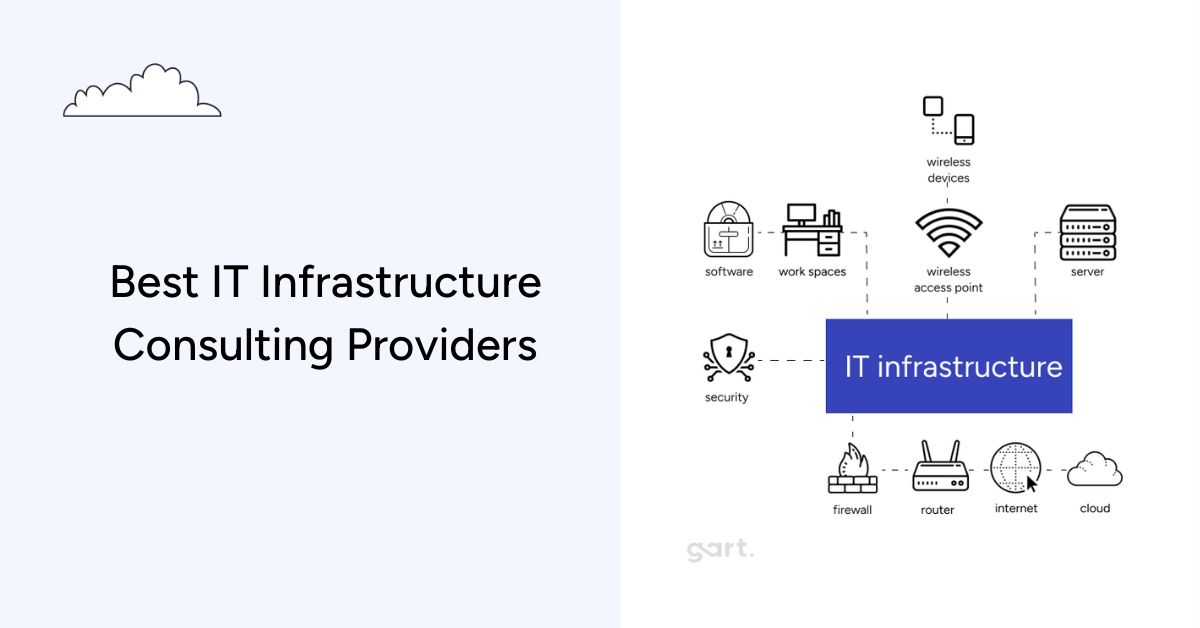
An IT infrastructure audit is a structured, evidence-based evaluation of your organization’s technology environment — cloud, on-premises, or hybrid. It assesses architecture health, security controls, scalability, compliance readiness, reliability, and cost efficiency.
In plain terms: your team knows the systems “work.” An audit tells you how well they work, where they will break under pressure, and what you are paying for that you don’t need. The output is not a report for its own sake — it is a prioritized action plan grounded in your actual configuration data.
Key distinction from a security audit: An infrastructure audit covers architecture, scalability, performance, and cost in addition to security. A security audit focuses narrowly on access controls, vulnerabilities, and threat surface. A high-quality infrastructure audit blends both lenses, plus compliance alignment — which is what Gart’s methodology is designed around.
of organizations have significant cloud waste from over-provisioned resources
of data breaches involve misconfigured IAM or access policies
average cost of a data breach in 2024 (IBM Security Report)
Why Growing Businesses Run Infrastructure Audits Now
As businesses scale, infrastructure stops being a background function and becomes a strategic growth constraint. Performance slows, cloud bills increase, security risks accumulate quietly, and compliance requirements tighten. Leadership begins asking: is technology enabling growth or limiting it?
These are the four business pressures that most often trigger an audit engagement:
- Scaling pressure: “Can our architecture handle 5× the current load without a rebuild?”
- Cost spike: “Why did our cloud bill increase 38% this quarter without a proportional increase in usage?”
- Compliance deadline: “We have an ISO 27001 / HIPAA / SOC 2 audit in 90 days — where are our gaps?”
- Migration risk: “We’re planning to move to AWS — what dependencies and risks do we need to map first?”
The infrastructure audit is the instrument that replaces assumption with evidence across all four scenarios.
Gart’s 5-Layer Audit Methodology
Unlike checklist-only reviews, Gart organizes every engagement around five interdependent layers. Each layer surfaces issues invisible to the others — which is why skipping any one of them produces blind spots in your remediation plan.
Layer 1 — Architecture
Service topology, redundancy design, single points of failure, IaC coverage, and scalability headroom.
Layer 2 — Security & IAM
Least-privilege enforcement, MFA posture, secrets hygiene, encryption at rest & in transit, exposure management.
Layer 3 — Observability
Logging completeness, alert signal-to-noise ratio, SIEM integration, and incident detection coverage.
Layer 4 — Compliance
Control mapping to ISO 27001, NIST SP 800-53, GDPR, HIPAA, PCI DSS, or SOC 2 as applicable to your business.
Layer 5 — Cost & Efficiency
Resource right-sizing, tagging discipline, idle asset cleanup, Reserved Instance & Savings Plan optimization.
Cross-Layer — DR & Resilience
Backup completeness, restore testing evidence, RTO/RPO feasibility, and multi-region failover readiness.
Why this matters: NIST SP 800-53 — the US federal standard for security and privacy controls — structures controls across similar domains: access control, audit & accountability, configuration management, contingency planning, and system & information integrity.
Gart’s 5-layer model aligns with these categories so audit findings map directly to internationally recognized frameworks.
See: NIST SP 800-53 Rev. 5 → and AWS Well-Architected Framework
What an IT Infrastructure Audit Covers
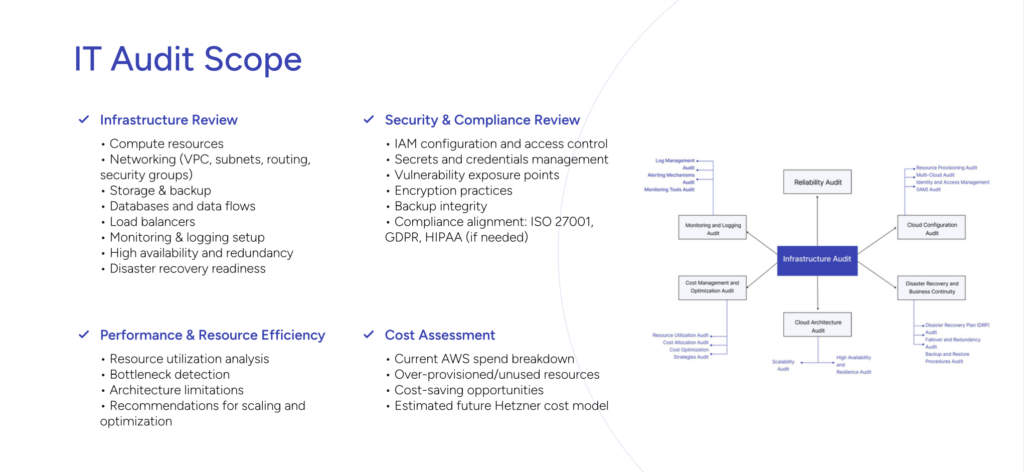
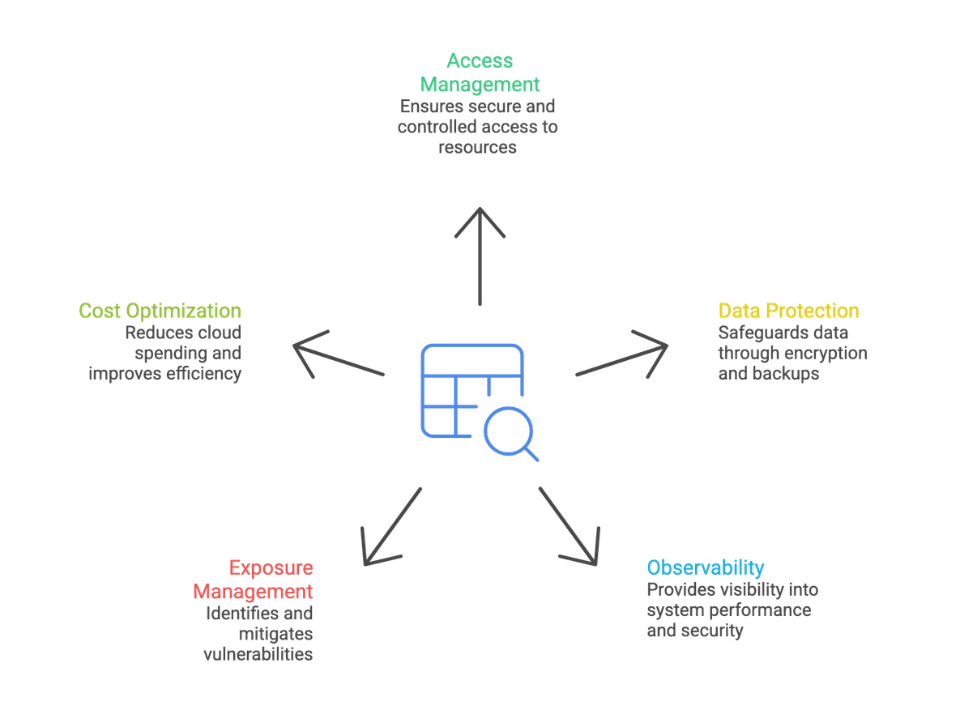
A high-quality audit is broad enough to capture real risk but focused enough to produce an execution plan. The scope below reflects what mid-size and fast-growing organizations most commonly need.
Access, Identity & Secrets Management
Identity is where most modern incidents begin. The audit verifies IAM policies enforce the principle of least privilege, MFA is active on privileged accounts, user lifecycle processes are automated, and secrets are managed through a dedicated vault rather than hardcoded in repositories or environment variables.
External reference: AWS IAM Security Best Practices
Data Protection: Encryption, Backups & Recovery
Data protection is a chain. The audit confirms encryption for data at rest (AES-256 or equivalent) and in transit (TLS 1.2+), validates that backup policies exist and are consistently executed, verifies retention windows are defined, and — critically — checks that restore tests are documented and recent. If no one has tested a restore in six months, your backup is theoretical.
Observability: Logging, Monitoring & Alerting
The audit evaluates whether centralized logging covers all critical services (CloudTrail, VPC Flow Logs, application logs), whether monitoring platforms (Datadog, Prometheus, CloudWatch) produce actionable alerts or noise, and whether escalation paths for P0 incidents are documented and tested.
Exposure Management: Vulnerabilities, Patching & Baselines
Systematic vulnerability scanning (Nessus, AWS Inspector, Trivy for containers), patch management SLAs, CIS benchmark compliance for OS and cloud configurations, and penetration test recency. Open ports, permissive security groups, and outdated base images are common findings here.
Cost & Resource Optimization
Resource inventory, tagging practices, right-sizing analysis, identification of idle or orphaned assets, and Savings Plan / Reserved Instance coverage gaps. This layer alone often generates savings that pay for the audit multiple times over.
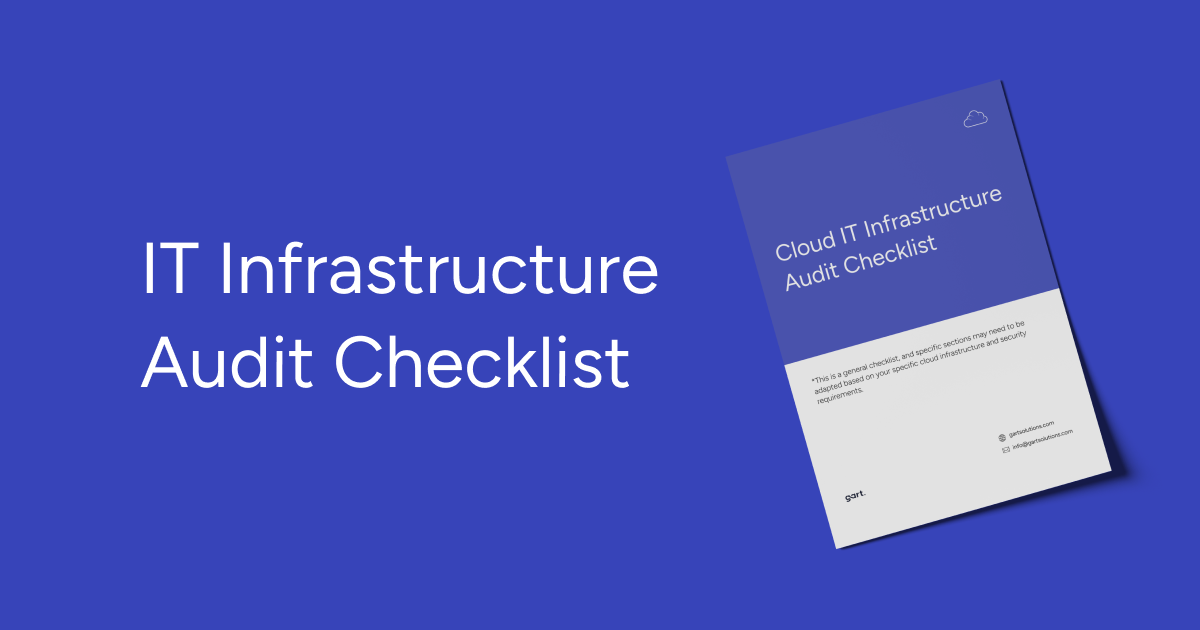
Download: Cloud IT Infrastructure Audit Checklist
A ready-to-use PDF covering IAM, encryption, logging, backups, DR testing, and cost controls.
AWS Infrastructure Audit Walkthrough
Theory is necessary but insufficient. Here is a practical walkthrough of how a cloud infrastructure audit proceeds on AWS — including the specific tools used and the evidence collected at each step. The same logic applies to Azure and GCP, with tool equivalents.
Step 1 — IAM & Access Posture (Days 1–2)
- Pull IAM credential report from
aws iam generate-credential-report— identifies stale users, no-MFA accounts, unused access keys over 90 days - Run AWS Access Analyzer to detect externally accessible resources (S3 buckets, KMS keys, IAM roles with cross-account trust)
- Review Service Control Policies (SCPs) across all accounts in the AWS Organization
- Audit root account MFA status, active root sessions, and any root-created access keys (these should not exist)
Step 2 — Configuration & Compliance Drift (Days 2–3)
- Enable AWS Config rules (or review existing findings): ec2-security-group-attached-to-eni, mfa-enabled-for-iam-console-access, rds-storage-encrypted, s3-bucket-public-read-prohibited
- Run AWS Security Hub consolidated findings — aggregates GuardDuty, Inspector, Macie, and Config into a single risk score
- Check CIS AWS Foundations Benchmark compliance score via Security Hub
Step 3 — Threat Detection & Observability (Days 3–4)
- Review Amazon GuardDuty findings — look for high/critical severity findings, especially unauthorized API calls, credential exfiltration, and compromised EC2 behavior
- Validate CloudTrail is enabled in all regions, logs are shipped to a dedicated S3 bucket with object lock, and CloudWatch alarms exist for root usage and unauthorized API calls
- Assess VPC Flow Logs coverage and confirm logs are ingested into a SIEM or centralized log platform (CloudWatch Logs Insights, Splunk, Datadog)
- Review alerting thresholds and escalation runbooks: are alerts actionable, or ignored?
Step 4 — Workload & Resilience Review (Days 4–5)
- Map single points of failure: EC2 instances not in Auto Scaling Groups, RDS single-AZ deployments, load balancers without health checks configured
- Validate backup policies: AWS Backup vault, retention periods, cross-region replication for DR
- Check restore test records — when was the last restore drill? Is RTO/RPO actually achievable?
- Review IaC coverage: what percentage of infrastructure is defined in Terraform or CloudFormation vs. manually configured?
Step 5 — Cost Optimization Analysis (Days 5–6)
- Pull AWS Cost Explorer by service, tag, and team — identify top 10 cost drivers and compare against business value delivered
- Run AWS Compute Optimizer recommendations — identifies over-provisioned EC2, Lambda, and EBS volumes
- Audit Reserved Instance and Savings Plan coverage vs. on-demand usage ratio
- Identify idle resources: EC2 instances with <5% CPU utilization over 30 days, unused Elastic IPs, unattached EBS volumes
| Audit Area | Primary Tool (AWS) | Azure Equivalent | GCP Equivalent |
|---|---|---|---|
| IAM & Access | IAM Analyzer Credential Report |
Entra ID Access Review | IAM Recommender |
| Config & Compliance | AWS Config Security Hub |
Azure Policy Defender for Cloud |
Security Command Center |
| Threat Detection | GuardDuty Macie |
Microsoft Sentinel | Chronicle SIEM |
| Logging & Audit Trail | CloudTrail VPC Flow Logs |
Azure Monitor Activity Log |
Cloud Audit Logs |
| Vulnerability Scanning | AWS Inspector Trivy |
Defender for Servers | Artifact Analysis |
| Cost Optimization | Cost Explorer Compute Optimizer |
Azure Advisor Cost Management |
GCP Recommender |
Audit Process — Step by Step
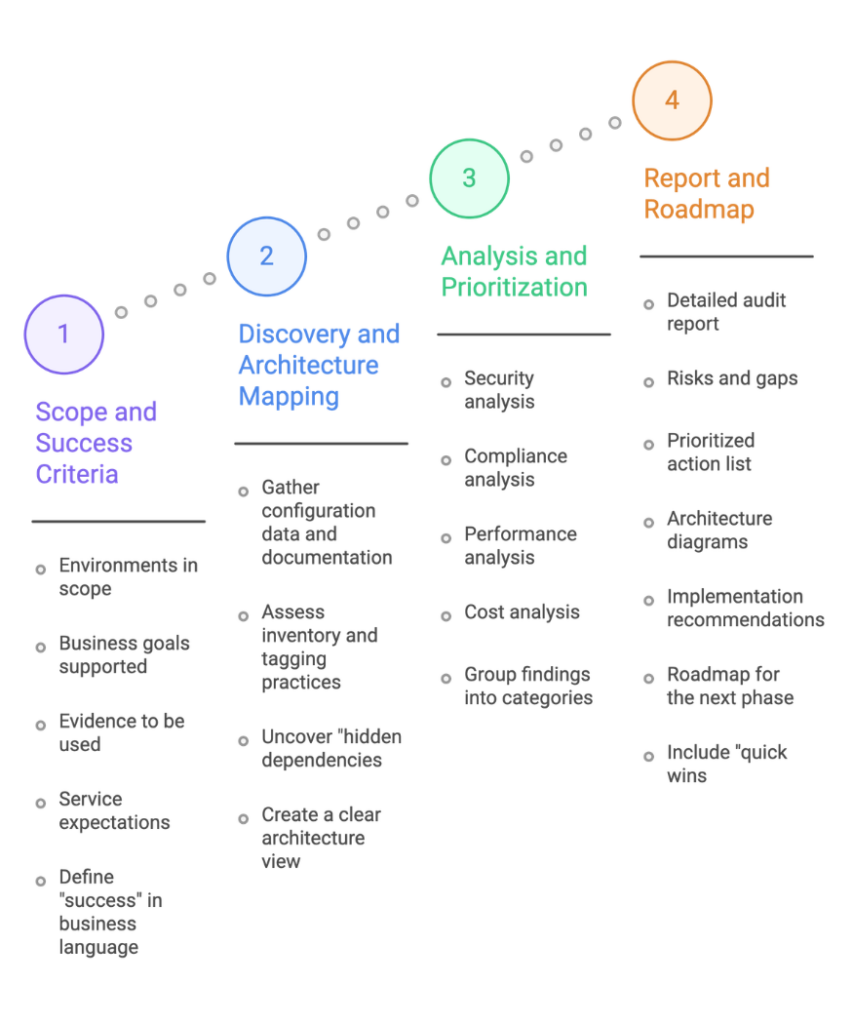
A good audit is not just “look around and send a report.” It’s a structured process designed to reduce uncertainty and produce an execution plan. In practice, the process follows four phases: scope, discovery, analysis, and delivery.
This approach is especially valuable before a migration or major change. One audit proposal explicitly frames the purpose as evaluating current infrastructure, identifying risks, and creating a clear roadmap for a secure and cost-efficient migration . That logic applies even if you are not migrating: you still want a roadmap built on evidence.
Phase 1 — Scope and Success Criteria
Scope is where audits succeed or fail. If the scope is too broad, you drown in details. If it’s too narrow, you miss the risks that actually matter.
This phase defines which environments are in scope (production, staging, multi-cloud, hybrid), what business goals the audit supports (scaling, compliance readiness, cost reduction, migration), and what evidence will be used. It also clarifies service expectations such as uptime targets, availability requirements, and disaster recovery objectives, often tied to SLAs .
A practical tip: define “success” in business language. For example, “reduce monthly cloud spend by addressing the top five waste drivers,” or “reach ISO 27001 audit readiness by closing priority security gaps.” That success framing makes it easier to prioritize findings later.
Phase 2 — Discovery and Architecture Mapping
Discovery is where assumptions get replaced with a map of reality.
Auditors gather configuration data and documentation across compute, networking (VPCs, subnets, routing, security groups), storage and backups, databases, monitoring and logging, HA and redundancy, and disaster recovery readiness . They also assess whether inventory and tagging practices provide full visibility of resources for identification and cost allocation .
This phase often uncovers “hidden dependencies” — services that are still in use but forgotten, older components that cannot be removed without breaking workflows, or workloads that depend on brittle networking rules. Those discoveries are gold, especially before a migration, because they reduce risk of downtime and data loss .
The most useful output here is a clear architecture view: what exists, how it connects, and where the critical paths are.
Phase 3 — Analysis and Prioritization
Now the audit turns raw information into decisions.
Security analysis evaluates IAM controls, least privilege enforcement, MFA status, secrets management, encryption practices, and exposure points . Compliance analysis maps controls to frameworks relevant to your business, such as ISO 27001, GDPR, or HIPAA . Performance analysis looks for bottlenecks, scaling limitations, reliability risks, and monitoring gaps . Cost analysis identifies waste, right-sizing opportunities, and budgeting and allocation improvements .
Prioritization matters. Not every issue is urgent. A good audit groups findings into:
- Critical risks that could lead to breach or downtime
- High-impact optimizations that improve performance or reduce cost fast
- Strategic improvements that increase maturity over time
This is where a provider’s experience shows. The goal is not to list everything wrong. The goal is to choose what to fix first for maximum business impact.
Phase 4 — Report and Roadmap
A professional audit ends with a deliverable package that teams can execute.
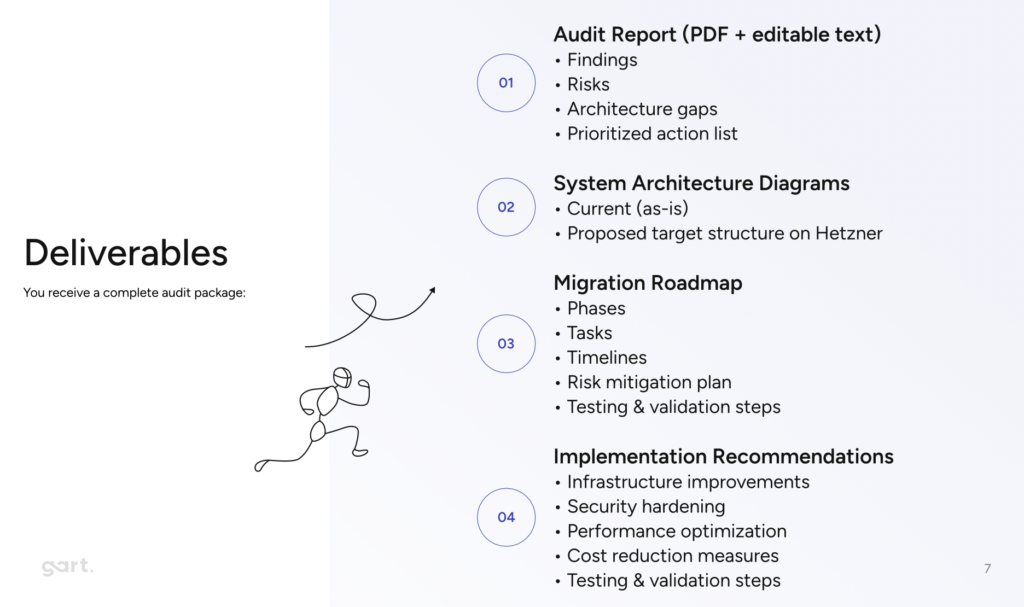
Typical deliverables include a detailed audit report, risks and gaps, a prioritized action list, architecture diagrams, implementation recommendations, and a roadmap for the next phase — whether that is migration, optimization, or compliance readiness . This matches what organizations often request: clear recommendations and prioritized fixes, plus a phased plan to implement them safely .
This is also where “quick wins” belong. If you want immediate impact before deep changes, Gart Solutions shares practical guidance on fast improval.
How Different Roles Use IT Infrastructure Audit Results
An audit report is one document read through four completely different lenses depending on who is holding it. Understanding each perspective makes it easier to communicate findings across the organization — and to prioritize the right fixes first.
Recommendation: Produce role-specific summaries from the master audit report — a 2-page executive summary for the CFO and board, a detailed technical findings list for DevOps, and a control-mapping matrix for Compliance. The same evidence supports all three without duplication.
Case Studies: IT Infrastructure Audit Outcomes & Metrics
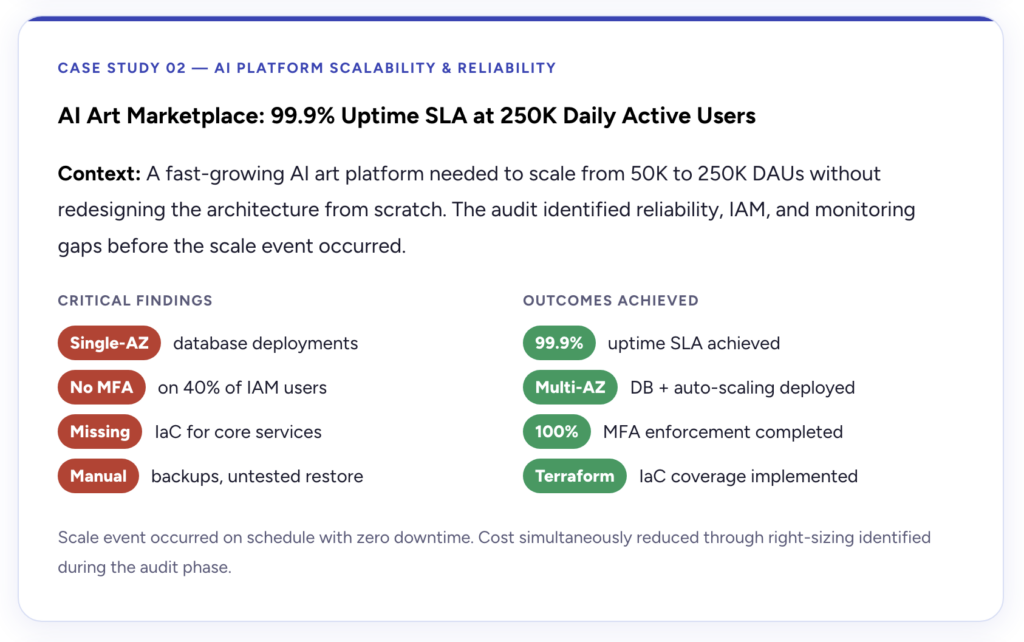
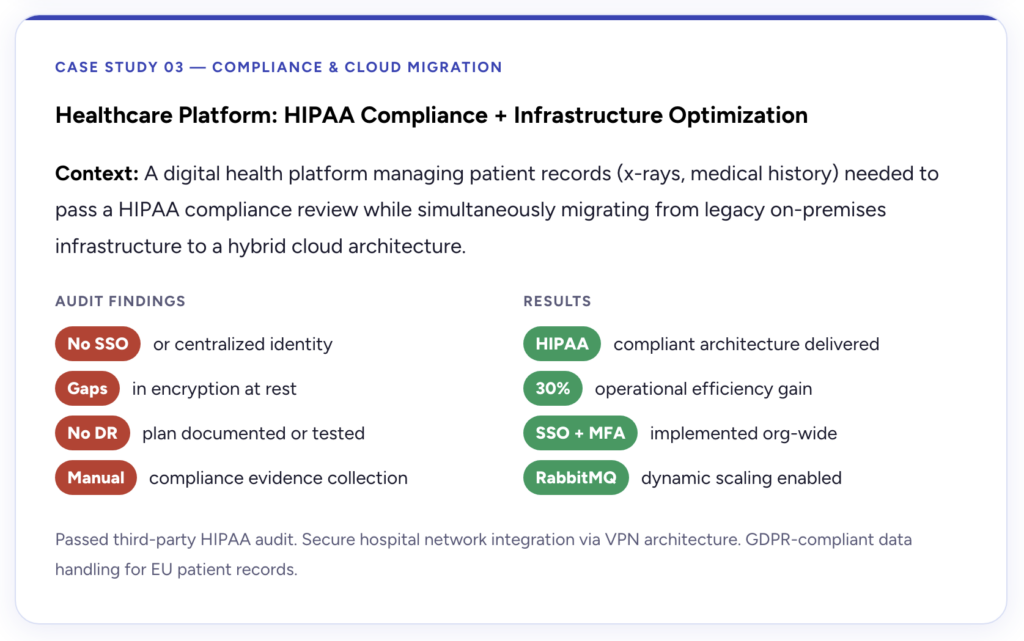
The most useful benchmark for an infrastructure audit is not what others generally claim — it is what actually changed after the work was done. Below are structured outcomes from real Gart engagements.
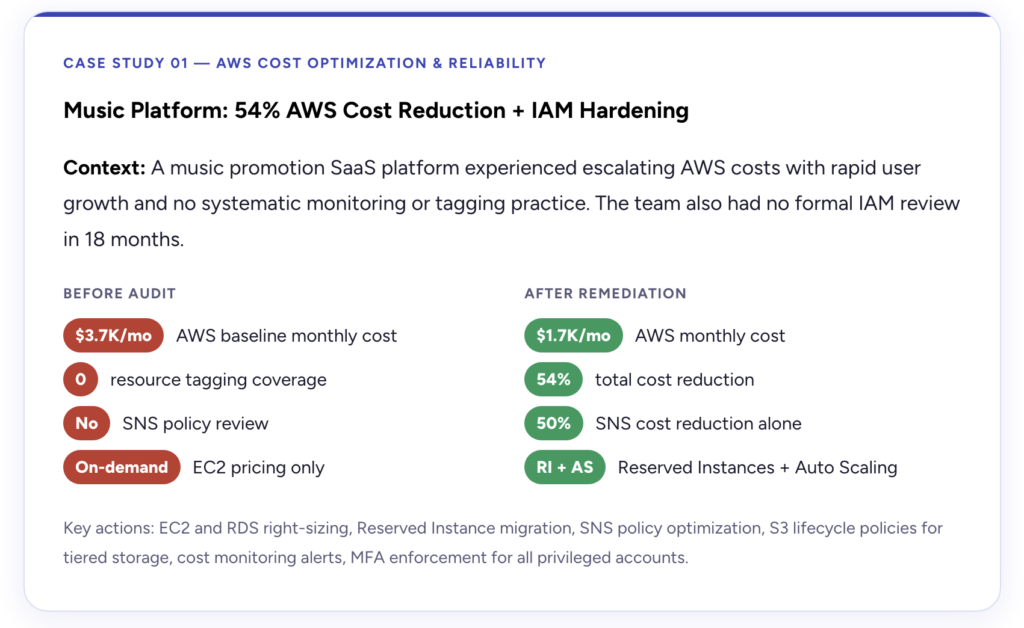
A documented case study shows how an AI art marketplace needed scalable AWS infrastructure to support 250,000 daily active users with 99.9 percent uptime, and the audit findings drove improvements across IAM security (MFA, least privilege), cost optimization (right-sizing and Reserved Instances), reliability (multi-AZ deployments, auto-scaling, monitoring), and data protection (backup policy gaps, Infrastructure as Code practices) . The business impact was exactly what leadership wants: higher reliability, cost savings, stronger security, and better long-term stability .
Another real scenario focused on ISO 27001 readiness and cloud migration preparation. The audit work included reviewing outstanding compliance tasks, securing cloud environments, implementing SSO with MFA, improving encryption and endpoint access controls, establishing a backup and disaster recovery plan, and reinforcing repository security measures . The result was compliance readiness progress, smoother migration execution, and stronger security alignment with ISO expectations .
If your goal is to promote audit work internally, these examples are useful for framing: audits are not “extra work,” they are the mechanism that turns growth and compliance pressure into a controlled plan.
Before vs. After: Infrastructure Architecture Comparison
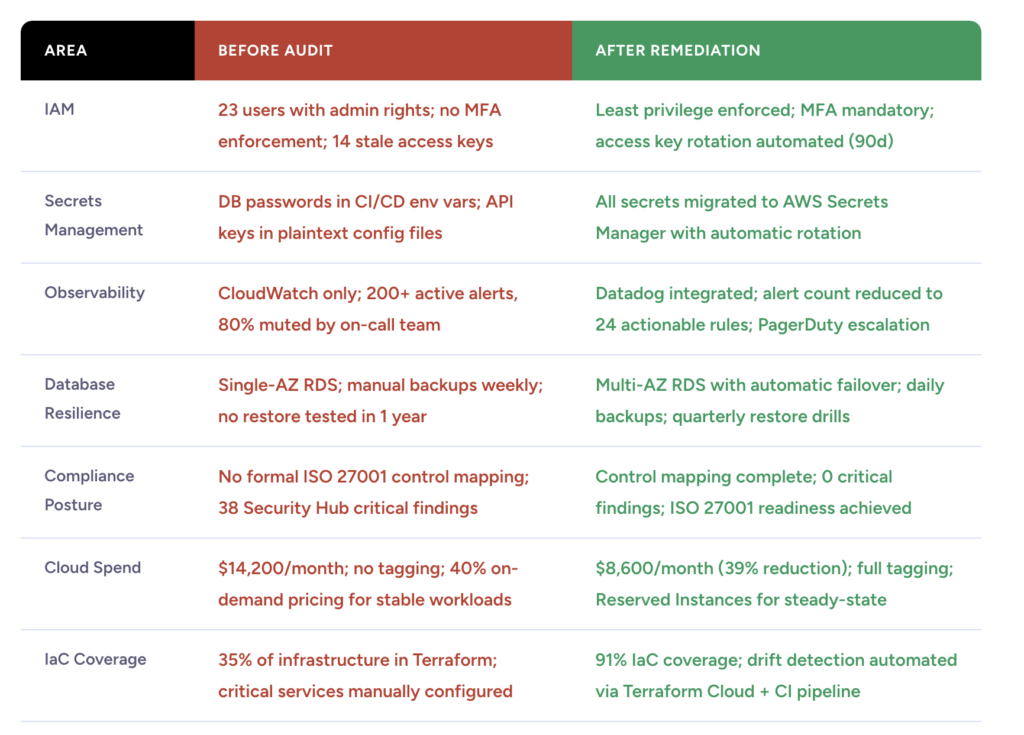
The following comparison reflects the architecture state of a mid-size SaaS platform before and after a Gart infrastructure audit remediation cycle (90 days). It illustrates the shift from reactive to managed infrastructure.
Limitations of IT Infrastructure Audits
Transparent audit providers share what their process does not cover. Understanding these boundaries helps set realistic expectations and scope decisions properly.
⚠️ What an infrastructure audit does NOT guarantee
- An audit is a point-in-time snapshot. Infrastructure changes daily. Findings from a 6-week audit engagement may be partially outdated by go-live if remediation is delayed.
- It is not a penetration test. An audit identifies configuration and process risks. Active exploitation testing (red team / pentest) is a separate engagement requiring different methodology and authorization.
- Compliance readiness ≠ certification. An audit can confirm controls are in place — but formal ISO 27001 or SOC 2 certification requires a certified external auditor. We prepare you for that audit; we don’t replace it.
- Findings require organizational change to close. Technical fixes for access control or logging take minutes. Organizational changes (process documentation, training, accountability structures) take weeks and require leadership buy-in.
- Undocumented systems cannot be fully audited. If a service, integration, or data flow is unknown to the team providing access, it cannot appear in the findings. Discovery depends on the completeness of access and documentation provided.
IT Infrastructure Audit Cost & How to Think About ROI
Audit cost depends on scope, environment complexity, compliance requirements, and deliverable depth. A focused pre-migration or Quick Wins audit starts at $500 for approximately 10 hours of senior architect time — covering infrastructure, security posture, CI/CD workflow, and a prioritized report with presentation.
For larger environments, multi-cloud setups, regulated industries (HIPAA, PCI DSS, ISO 27001), or deep security testing requirements, costs scale proportionally with the evidence collection, analysis, and remediation planning required.
The ROI Calculation Most Teams Miss
The right comparison is not “audit cost vs. zero cost.” It is audit cost versus the cost of the problems it prevents:
Average cloud cost reduction achievable through right-sizing and RI adoption alone
Average business cost of unplanned downtime per hour (Gartner)
Maximum GDPR fine for a serious data breach or compliance failure
When audits identify over-provisioned resources saving $3,000–$8,000/month, or close security gaps that would have resulted in a breach or compliance penalty, the cost-benefit calculus is clear. The audit pays for itself in the first month of remediation, and continues paying through improved operational reliability.
What you typically receive from a Gart Solutions audit
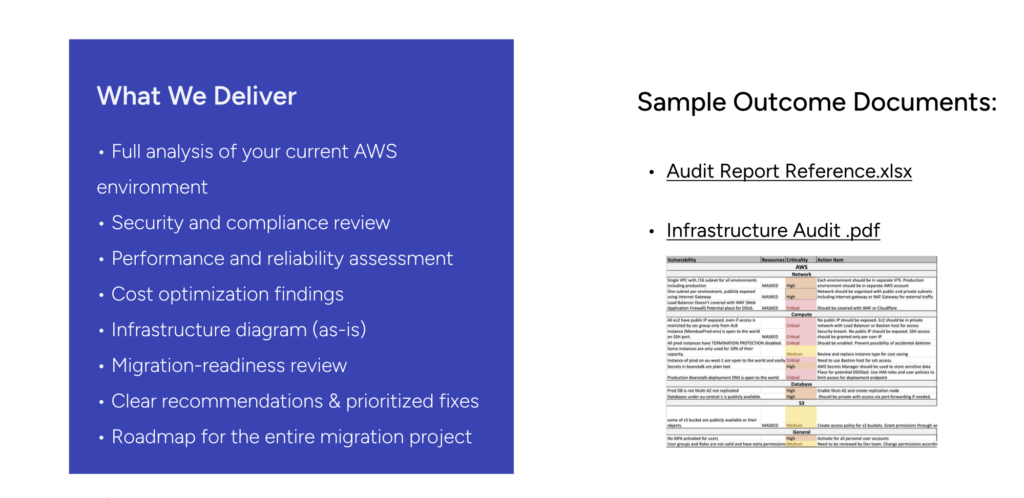
A structured audit engagement is designed to leave you with clarity and execution momentum. One audit scope outlines deliverables such as full environment analysis, security and compliance review, performance and reliability assessment, cost optimization findings, infrastructure diagrams, migration readiness review, and prioritized recommendations plus a roadmap . This approach aligns with what many teams actually need: not a “perfect state,” but a prioritized plan to reach a better state quickly and safely.
If you want to understand the control areas in advance, use the IT Infrastructure Audit Checklist as a reference.
It mirrors common audit coverage such as IAM and MFA enforcement, encryption, logging and SIEM integration, vulnerability management, backup and DR testing, and compliance logging .
Cost, and how to think about value
Audit cost depends on scope, complexity, compliance requirements, and deliverable depth. A focused pre-migration audit proposal lists a price point of $500 for a defined scope, with clear deliverables and roadmap outputs. For larger environments, multi-cloud setups, regulated industries, or deeper security testing, costs scale because evidence collection, analysis, and remediation planning require more time and specialized expertise.
The smarter way to evaluate cost is to compare it to:
- Ongoing cloud waste from over-provisioning and unused resources
- Downtime risk from untested DR and weak observability
- Compliance penalties and deal friction when evidence is missing
- Breach exposure from weak IAM and incomplete monitoring
This is where audits become high-ROI. Savings from right-sizing, improved reliability, reduced incident frequency, and faster compliance readiness often outweigh the audit cost — and you gain a more scalable foundation.
Why organizations choose Gart Solutions
An infrastructure audit is only as valuable as the expertise behind it. Gart Solutions combines DevOps engineering, cloud architecture, compliance engineering, and security best practices into one structured methodology, supported by real engagements focused on scalability, ISO readiness, and operational optimization .
If your organization is questioning whether its infrastructure can support upcoming business challenges, an audit is often the most strategic first step. Explore the full scope here
Conclusion
An IT Infrastructure Audit is not a technical luxury. It is a practical way to turn uncertainty into control.
It helps you prove whether your architecture can scale, whether access controls are truly safe, whether monitoring can detect incidents early, whether backups and disaster recovery will work under stress, and whether cloud spend matches real demand. It connects compliance expectations to actual configurations, which matters when frameworks like ISO 27001, GDPR, and HIPAA are part of your business reality .
If your infrastructure must support growth, audits are the moment you stop guessing and start managing with evidence. If you want a structured, execution-friendly audit that produces a clear roadmap, explore Gart Solutions’ IT Audit Services.
Contact Us and let’s start your audit!