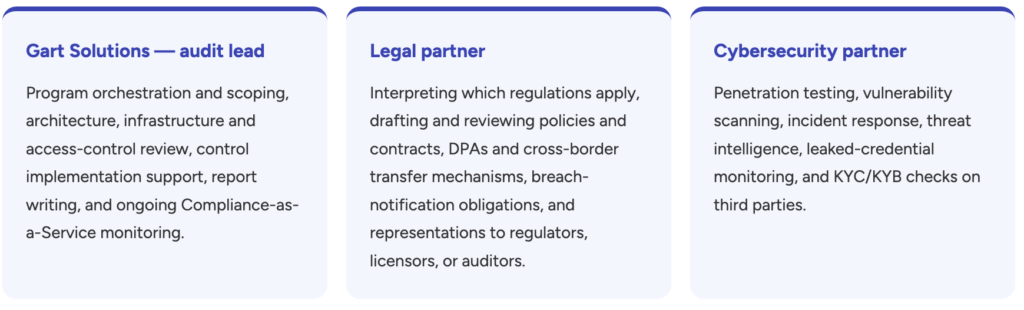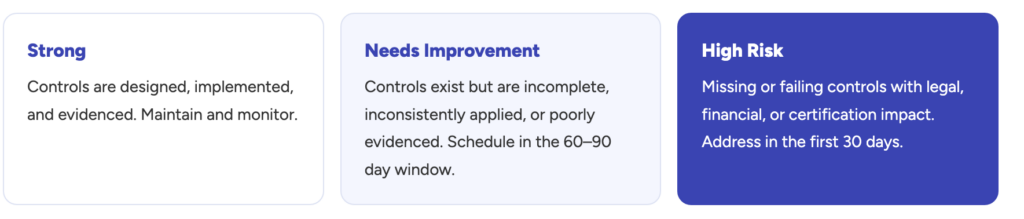
Type "compliance automation" into Google and you'll land, within the first page, on a vendor's own ranking of itself as the best option. That's not a knock on any one platform — it's just how the category is marketed. This guide starts with the plain definition, then does something most vendor content structurally can't: score seven real platforms — Vanta, Drata, Secureframe, Thoropass, Sprinto, OneTrust, and Scrut — on a transparent rubric, and say clearly where every one of them, without exception, stops being able to help you.
What is compliance automation?
Compliance automation is software that connects to your cloud infrastructure, identity provider, and code repositories, then continuously checks whether the controls a framework requires — encryption, access reviews, change management — are actually in place, and keeps a timestamped record proving it. Instead of a compliance manager screenshotting configurations by hand once a year before an audit, the platform runs the same checks on a schedule (often hourly) and flags a control the moment it drifts, not months later when the auditor finally looks. For the ongoing, infrastructure-level version of this same idea, see our companion guide on what continuous compliance monitoring actually involves — this article covers which software to buy for it.
A tool generally isn't "compliance automation" unless it does all three of the following:
Continuous control monitoring — scheduled, automated checks against connected systems, not a once-a-year manual review.
Automated evidence collection — configuration exports, access logs, and screenshots pulled via API and stored centrally, not gathered by hand.
Cross-framework control mapping — one piece of evidence (say, MFA enforcement) satisfies the equivalent requirement in SOC 2, ISO 27001, and HIPAA at once, so pursuing multiple frameworks doesn't multiply the workload.
What is compliance management software, and why does the category matter now?
Compliance management software is the broader product category compliance automation platforms belong to — tools built to centralize policies, controls, evidence, and audit workflows in one system instead of a scattered mix of spreadsheets, shared drives, and email threads. It's grown fast for a structural reason: manual compliance work doesn't scale past a handful of frameworks, and enterprise buyers now expect a current SOC 2 or ISO 27001 report as a baseline sales requirement, not a nice-to-have.
Those market figures come from The Business Research Company's 2026 compliance management software market report, which cites AI-driven compliance analytics and rising demand for continuous monitoring as the main growth drivers. The cost comparison is from Ponemon Institute's benchmark study on the true cost of compliance — the pattern behind it is consistent with what we see directly in client engagements: non-compliance rarely fails as one dramatic event, it accumulates as slow drift that only a continuous system catches early.
How we scored the 7 best compliance management software platforms
Instead of ranking by brand recognition or funding size, we scored all seven platforms on six criteria, weighted for a buyer choosing pure software — not an audit-led service, which is a separate comparison we cover further down. Every platform was scored 1–10 based on what each company states publicly about pricing, integrations, automation cadence, and support model, cross-checked against independent G2 review data where available — we did not run our own technical audit of every platform, and say so plainly rather than implying otherwise.
CriterionWeightWhat it measuresAutomation & continuous monitoring25%Test cadence (hourly vs. daily vs. periodic), real-time drift detection, and depth of automated evidence collectionFramework & integration breadth20%Number of supported frameworks and native integrations with cloud, identity, HR, and code-repository systemsEvidence & audit workflow15%How evidence is packaged and shared with an actual auditor — trust portals, auditor collaboration tools, report generationEase of onboarding15%Time to first fully-connected monitor cycle, reported implementation complexity, and support/advisory depthAI features & roadmap10%AI-assisted evidence review, questionnaire response, or anomaly detection shipped and in active use, not just announcedPricing transparency10%Whether published reference pricing exists, or every quote requires a sales call with no public signalIndependent review base5%G2 review volume and rating — the hardest signal for any vendor to fabricateHow we scored the 7 best compliance management software platforms
Quick comparison: the 7 best compliance management software platforms in 2026
RankPlatformWeighted score /10Best fitMain limitation#1Vanta8.6Companies wanting the broadest framework and integration coverage plus the largest independent review basePremium pricing at scale; advanced/custom frameworks still need configuration support#2Drata8.2Teams pursuing multiple frameworks in parallel who want the deepest continuous, configurable monitoringThinner integration catalog than Vanta; AI features still catching up#3Secureframe7.7SMBs that want dedicated advisory support bundled with the automation platformPricing runs slightly above Vanta/Drata for comparable scope#4Thoropass7.4Companies that want the platform and the SOC 2 audit report itself from one vendorSmaller independent review base; audit bundle covers paperwork, not infrastructure fixes#5Sprinto7.2Startups wanting the fastest, lowest-friction onboarding and the clearest published pricing signalsPeriodic rather than fully real-time monitor evaluation#6OneTrust6.9Enterprises needing privacy, consent, and third-party-risk management alongside compliance evidence, not just SOC 2 automationResource-intensive implementation; UI complexity is a recurring theme in independent reviews#7Scrut6.7Cost-conscious teams that need many niche or fully custom frameworks bundled affordablySmaller integration ecosystem and review footprint than the top fiveQuick comparison: the 7 best compliance management software platforms in 2026
Vanta and Drata top the list under this weighting because automation depth and framework/integration breadth together account for 45% of the score — the two areas where both platforms out-invest the rest of the field.
Weight pricing transparency and onboarding speed more heavily instead — the reasonable call for a resource-strapped startup — and Sprinto and Scrut close the gap considerably. We show the rubric so you can make that trade yourself rather than trusting an unexplained order.
Best compliance management software, platform by platform
Vanta
Best for: Companies wanting the broadest out-of-the-box framework and integration coverage, backed by the largest independent review base in the category
Vanta, founded in 2018 and based in San Francisco, is the largest pure-play compliance automation platform by customer count — 16,000+ companies, according to the company. It runs 1,400+ automated tests hourly against connected systems, supports 35+ frameworks, and lists 400+ native integrations. It holds a 4.6/5 rating across 2,665+ reviews on G2 — the largest independent review base of the seven platforms here. Vanta raised a $150M Series D in July 2025 at a $4.15B valuation, and has shipped AI-agent tooling across compliance, third-party risk, and customer-trust workflows through 2025-2026.
1,400+ automated tests, refreshed hourly against connected systems — the fastest cadence in this comparison
Broadest framework library (35+) and integration catalog (400+) of the seven platforms
Largest independent review base (2,665+ on G2) — the hardest signal here for any vendor to fabricate
Where it's a weaker fit: pricing is fully custom (Essentials plans commonly run $10,000–$15,000/year, Enterprise custom up to $80,000+/year), and it's built for teams that already have engineering capacity to act on what it flags — it doesn't send anyone to fix the underlying infrastructure gap.
Weighted score: 8.6/10
Drata
Best for: Teams pursuing several frameworks in parallel who want granular, configurable continuous monitoring
Drata, founded in 2020 in San Diego, runs continuous monitoring with configurable alert thresholds and is frequently cited as the deepest option for tracking overlapping controls across multiple frameworks at once. It supports 20+ named frameworks including newer additions like ISO 42001, DORA, FedRAMP, and CMMC, and holds a 4.7/5 rating across 1,331+ G2 reviews. Drata raised a $200M Series C in December 2022 at a $2B valuation and serves 8,500+ customers.
Continuous monitoring with configurable thresholds, not a single fixed cadence
Strong, granular control-mapping for teams running 2+ frameworks simultaneously
Trust Center feature turns live compliance status into a shareable sales asset
Where it's a weaker fit: a thinner integration catalog than Vanta and a smaller in-platform AI footprint; pricing is quote-only (Foundation tier ~$15,000/year for up to 50 employees, combined SOC 2 + ISO 27001 commonly ~$28,000/year at mid-market).
Secureframe
Best for: SMBs that want dedicated advisory support bundled directly into the automation platform
Secureframe continuously monitors 150+ connected cloud services with real-time alerting across 175+ integrations, and differentiates less on raw automation depth than on service — dedicated compliance specialists and audit-readiness coaching are positioned as core to the product, not an add-on. It holds a 4.7/5 rating across 700+ G2 reviews.
Real-time alerting across 150+ monitored cloud services
175+ integrations, with meaningful investment in customer-success and advisory staffing
Bundled employee security-training and vendor-risk-management modules
Where it's a weaker fit: the advisory layer is coaching toward audit readiness, not hands-on infrastructure remediation, and pricing generally runs slightly above Vanta and Drata for comparable scope.
Weighted score: 7.7/10
Thoropass
Best for: Companies that want the compliance platform and the SOC 2 audit report itself from a single vendor
Thoropass takes a structurally different approach from the other six platforms: it owns an affiliated CPA firm (operating as Thoropass Assurance) that issues the actual SOC 2 report, bundling the audit and the software rather than requiring a separate external auditor. It supports a wide framework set — SOC 1, SOC 2, ISO 27001, ISO 42001, HIPAA, HITRUST, GDPR, CMMC, and PCI DSS. Published reference pricing shows the platform starting near $8,700/year plus a SOC 2 audit subscription near $5,800/year, with a median bundled contract around $30,000/year — see our full Vanta vs. Drata comparison for how the two market leaders' pricing stacks up against a bundled model like this one.
Only platform here that bundles the audit firm itself into the subscription
Wide framework support including SOC 1, ISO 42001, HITRUST, and CMMC
Published reference pricing points, unlike Vanta's or Drata's fully custom quotes
Where it's a weaker fit: the bundled audit covers the report and paperwork side, not hands-on infrastructure or access-control engineering, and a smaller independent review base than Vanta, Drata, or Secureframe gives less third-party signal on the platform itself.
Weighted score: 7.4/10
Sprinto
Best for: Startups that want the lowest-friction setup and clearer published pricing signals
Sprinto is consistently cited in independent buyer comparisons as the easiest of the major platforms to onboard, automating both technical and operational controls with tiered alerts. It holds a 4.7/5 rating across 1,678+ G2 reviews and is a common default for India/APAC companies pursuing SOC 2 alongside frameworks like India's DPDP Act.
Reported smoothest onboarding and system-connection experience among the major platforms
Automates both technical and operational controls, not just technical evidence pulls
More published pricing reference points than Vanta or Drata
Where it's a weaker fit: monitor evaluation runs on a periodic basis rather than Vanta's hourly or Drata's continuous cadence, which matters more for teams in fast-changing infrastructure environments.
Weighted score: 7.2/10
OneTrust
Best for: Enterprises that need privacy, consent, and third-party-risk management alongside compliance evidence collection, not just SOC 2 automation
OneTrust, founded in 2016 in Atlanta, is a broader privacy-and-GRC platform spanning six modules — consent and preferences, data discovery and classification, AI governance, tech risk and compliance, privacy automation, and third-party risk management — rather than a purpose-built SOC 2 evidence-collection tool. It supports 55+ frameworks and holds a 4.4/5 rating overall on G2 (283 reviews), with its Tech Risk & Compliance module specifically rated 4.6/5 across 109 reviews. OneTrust raised a total of $1.13B in funding and was last valued at $4.5B in 2023.
Widest framework coverage of the seven platforms (55+), spanning privacy, AI governance, and GRC together
Purpose-built consent-management and third-party-risk modules neither Vanta nor Drata offer at comparable depth
Configurable enough for complex, multi-region enterprise compliance programs
Where it's a weaker fit: implementation is more resource-intensive than the SOC 2-focused platforms above, UI complexity is a recurring theme in independent reviews, and entry pricing (roughly $25,000–$50,000+/year, with a $10,000 minimum ACV policy) targets a larger buyer than a startup pursuing its first SOC 2.
Weighted score: 6.9/10
Scrut
Best for: Cost-conscious teams that need several niche or fully custom frameworks bundled into one platform
Scrut Automation supports 50+ global frameworks, including the ability to build fully custom ones, and is generally the most affordably priced of the seven — reference pricing starts near $4,500/year, with combined multi-framework setups commonly running several thousand dollars less per year than an equivalent Drata quote.
50+ supported frameworks, including custom-framework building
Lowest published entry pricing of the seven platforms in this comparison
Bundled multi-framework pricing tends to undercut Vanta and Drata at mid-market scale
Where it's a weaker fit: a smaller integration ecosystem and independent review footprint than the top five, which matters most for complex, multi-cloud environments needing deep native connectors.
Weighted score: 6.7/10
Frameworks supported: how the 7 platforms stack up
PlatformSOC 2ISO 27001HIPAAPCI DSSGDPRNotable extrasVantaYesYesYesYesYes35+ frameworks total, 400+ integrationsDrataYesYesYesYesYesISO 42001, DORA, FedRAMP, CMMCSecureframeYesYesYesYesYesVendor risk, employee training modulesThoropassYesYes (+ ISO 42001)YesYesYesHITRUST, CMMC, Cyber Essentials, SOC 1SprintoYesYesYesYesYesIndia DPDP ActOneTrustVia Tech Risk & Compliance moduleYesYesYesYes (purpose-built)55+ frameworks, AI governance, consent managementScrutYesYesYesYesYes50+ frameworks incl. custom-builtFrameworks supported: how the 7 platforms stack up
GDPR coverage is worth a specific note regardless of platform: Article 83 sets fines at up to €20 million or 4% of global annual turnover, whichever is higher — a big part of why continuous evidence of data-handling controls has become non-negotiable for any EU-facing company, on any platform.
What compliance management software can't do for you
This is the section vendor pages tend to skip, and it's the one that matters most before you sign a five- or six-figure annual contract. Every platform above is genuinely good at one job: proving, continuously, that a control is or isn't in place. None of them is built to diagnose why a control failed, and none of them fixes it. A platform tells you an S3 bucket is public; it doesn't reconfigure the bucket policy, redesign the IAM structure around it, or explain why that misconfiguration keeps recurring across your environment.
In engagements that start after a company has already run one of these platforms for a year or more, the same gap shows up repeatedly:
A prior SOC 2 or ISO 27001 audit came back qualified on technical grounds — that's an infrastructure or access-control problem, not an evidence-collection problem. Our failed SOC 2 audit guide walks through the most common root causes.
Access reviews are still run manually against a spreadsheet, even though the automation platform is technically "connected" — see our breakdown of automated identity governance vs. manual access reviews.
Nobody can clearly explain segregation of duties between engineering, finance, and IT once an auditor asks a follow-up question the dashboard can't answer. Our segregation of duties guide covers this specifically.
The infrastructure itself hasn't had an independent technical review in over a year, regardless of how green the compliance dashboard looks day to day.
None of that is a knock on any of the seven platforms — it's simply outside what a SaaS evidence-collection tool is designed to do. That gap is exactly where a hands-on security audit earns its keep: a person with real infrastructure expertise reviewing the actual environment, not just the API responses a platform can see.
A SOC 2-scoped audit that didn't stop at the findings report
Gart's infrastructure and compliance audit work supported Spiral Technology's path to ISO 27001 compliance, addressing the information-security management controls the standard requires across the client's cloud environment — the kind of remediation work that starts where a green compliance dashboard leaves off.
Read the full case study
How to choose the right compliance management software
First SOC 2, self-serve team
Vanta's framework and integration breadth, plus the largest independent review base, make it the safest default starting point.
Multiple frameworks in parallel
Drata's granular control mapping is built specifically for teams tracking overlapping SOC 2/ISO 27001/HIPAA controls at once.
Want the audit bundled in
Thoropass is the only platform here whose subscription includes the actual SOC 2 report from an affiliated CPA firm.
Infrastructure gaps, not evidence gaps
If a prior audit failed on technical grounds, no software purchase fixes that — a compliance audit scoped to remediation is the right next step, not another dashboard.
Five questions worth asking whichever platform (or provider) you're evaluating:
Is evidence collected automatically, or does our team still chase it manually each quarter? Manual evidence collection defeats the purpose of paying for a continuous platform.
When a control fails, does the platform fix it or just flag it? An unresolved alert queue is not remediation — see the section above.
Does the subscription include the audit fee, or is that a separate line item with a CPA firm? Only Thoropass bundles it among the seven platforms here; every other quote is separate.
What's the renewal-year price once any first-year discount expires? Several buyer guides flag 30-50% renewal increases as a recurring complaint across this category.
Who handles the infrastructure findings the platform surfaces? Confirm this explicitly so a flagged misconfiguration doesn't sit unowned in a backlog.
Software proves your controls. We make sure there's something solid underneath them.
Gart Solutions runs fixed-fee compliance and security audits that find the infrastructure and access-control gaps no compliance management software flags on its own — then helps you fix them and stay audit-ready long after, whichever platform from this list you run alongside us.
4.9
Clutch rating, verified client reviews
2–6 wks
Typical fixed-fee compliance audit timeline
5
Frameworks covered: ISO 27001, SOC 2, HIPAA/HITECH, PCI DSS, GDPR/NIS2
Compliance Audit
Fixed-fee gap assessment against your target framework — see the service page
Security Audit
Infrastructure and access-control review — see security audit services
Remediation & Advisory
Project-based fixes for whatever the audit or your compliance software's alerts turn up
Ongoing Monitoring
Continuous IT monitoring and SRE support to catch drift between formal reviews
Talk to a compliance specialist →
You might also like
Vanta vs. Drata: 2026 Comparison & Pricing
Compliance Monitoring: Ensuring Businesses Stay on the Right Side of the Rules
SOC 2 Compliance: A Step-by-Step Guide to Preparing for Your Audit
Why Is ISO 27001 a Crucial Step for Successful Companies?
Compliance as a Service for MSPs: Build, Buy, or Partner
Roman Burdiuzha
Co-founder & CTO, Gart Solutions · Cloud Architecture Expert
Roman has 15+ years of experience in DevOps and cloud architecture, with prior leadership roles at SoftServe and lifecell Ukraine. He co-founded Gart Solutions, where he leads cloud transformation and infrastructure modernization engagements across Europe and North America. In one recent client engagement, Gart reduced infrastructure waste by 38% through consolidating idle resources and introducing usage-aware automation. Read more on Startup Weekly.
Most organizations still treat compliance as an event: a stressful few weeks before the auditor arrives, followed by eleven months of hoping nothing drifts.
Compliance as a service replaces that cycle with an ongoing program — continuous control monitoring, automated evidence collection, and managed remediation delivered by an outside team, so the organization is audit-ready every day of the year instead of for one week in Q4. It's a response to a simple problem: regulations change faster than internal teams can track them, and a point-in-time report is out of date the moment infrastructure changes. This guide covers what compliance as a service actually includes, what it costs against the alternative of doing nothing (or doing it once a year), which frameworks it typically spans, and how it compares to a traditional compliance audit — the point-in-time assessment most companies still default to.
What is compliance as a service (CaaS)?
Compliance as a service (CaaS) is a managed-service model in which an external provider takes ongoing responsibility for helping an organization meet its regulatory and security obligations — not as a single project, but as a continuous operating discipline. Instead of hiring auditors once a year to produce a report, a CaaS engagement keeps controls monitored, evidence current, and gaps closed in near-real time, so the "audit" becomes a formality that confirms what the provider already knows rather than a discovery exercise that surfaces surprises.
In practice, a CaaS program centralizes four things that most internal teams handle manually and inconsistently: policy and control mapping against the frameworks that apply to the business, automated or semi-automated evidence collection (logs, configuration snapshots, access records), proactive remediation of drift before it becomes a finding, and reporting that's current enough to hand to an auditor, a customer's security questionnaire, or a regulator on short notice.
In one sentence: a traditional compliance audit answers "were we compliant on the day someone checked?" — compliance as a service is built to answer "are we compliant right now?" on any given day, not just audit week.
Why compliance as a service is growing in 2026
Three forces are pushing organizations toward the continuous model instead of the annual one. First, the regulatory surface keeps expanding — NIS2's national transposition and enforcement obligations culminate on an October 2026 deadline across the EU, with non-compliant entities facing fines of up to €10 million or 2% of global annual turnover, whichever is higher.
DORA became applicable to EU financial entities in January 2025 and is now moving into genuine supervisory enforcement, and CMMC 2.0 continues to bind U.S. defense contractors even while parts of its rollout are under review — none of which are "set it and forget it" obligations.
Second, the cost math favors continuous programs. A widely cited Ponemon Institute study for Globalscape found that the average annual cost of non-compliance — business disruption, lost productivity, fines, and settlements — runs 2.71 times higher than the average cost of maintaining compliance in the first place ($14.82 million versus $5.47 million in the study's dataset).
IBM's 2025 Cost of a Data Breach Report found the global average breach now costs $4.44 million, with U.S. breaches hitting a record $10.22 million — driven in part by regulatory fines, audits, and compliance reporting costs layered on top of the incident itself.
Third, the market has caught up to the demand. Grand View Research values the global compliance-as-a-service market at $6.7 billion in 2025, growing to $7.2 billion in 2026 and $15.4 billion by 2033 — a 10.0% CAGR.
Gartner projects that 65% of organizations will automate compliance by 2028, with AI powering roughly 75% of those processes, and specifically recommends embedding continuous, automated compliance checks directly into delivery pipelines rather than treating them as a separate, periodic exercise.
2026 compliance snapshotFigureWhat it means for buyersGlobal CaaS market size (2026)$7.2 billionThis is no longer a niche category — providers, tooling, and pricing benchmarks are maturing fast.Cost gap: non-compliance vs. compliance2.71xPaying for ongoing compliance is, on average, far cheaper than absorbing the cost of a failure.Average U.S. data breach cost (2025)$10.22 millionRegulatory fines and compliance reporting are a growing share of breach costs, not a footnote.Orgs expected to automate compliance by 202865%Manual, spreadsheet-driven compliance is becoming the minority approach, not the default.Why compliance as a service is growing in 2026
Compliance as a service vs. a traditional compliance audit
These two aren't competing options — they're different tools for different moments. A point-in-time compliance audit is still exactly what you need when a regulator, acquirer, or enterprise customer wants a formal, dated attestation. Compliance as a service is what keeps the environment in the state that audit certified, in between formal reviews.
DimensionPoint-in-time compliance auditCompliance as a serviceFrequencyAnnual or on-demand, ahead of a specific deadlineContinuous — monitoring runs every day, not just before a reviewEvidenceCollected in a burst, right before the auditCollected automatically and kept current year-roundCost patternOne large fee at a fixed pointSmaller, predictable recurring fee spread across the yearDrift riskHigh — nothing catches configuration or policy drift between auditsLow — drift is flagged and fixed close to when it happensBest fitA named certification or attestation a third party requires by a specific dateOrganizations under continuous regulatory pressure or handling sensitive data year-roundCompliance as a service vs. a traditional compliance audit
Most mature compliance programs use both: a formal audit to establish the certified baseline, and an ongoing CaaS-style program to keep the organization from drifting back out of that state before the next review. It's the same logic that applies to infrastructure monitoring generally — a one-time infrastructure assessment tells you the state of the system today, but only continuous monitoring tells you when it changes.
What a compliance-as-a-service engagement actually covers
The specifics vary by provider and framework, but a real CaaS engagement — not just a compliance dashboard with a login — typically includes:
Control mapping: translating each applicable framework's requirements into specific, testable technical and procedural controls, rather than a generic checklist.
Continuous monitoring: automated checks on identity and access management, audit logging, encryption, patch status, and backup and recovery — the control areas auditors ask about most often.
Automated evidence collection: logs, configuration snapshots, and access records gathered and retained continuously, so there's no scramble to reconstruct six months of history right before an audit.
Managed remediation: when a control drifts out of spec, the provider fixes it or routes it to the right owner with a deadline — not just a flag in a dashboard nobody checks.
Audit and regulator liaison: a current evidence package ready to hand to an external auditor, a customer's security questionnaire, or a regulator on short notice.
Which frameworks does compliance as a service cover?
Compliance as a service isn't tied to a single standard — the value is in running the same continuous discipline across whichever frameworks actually apply to the business, since most mid-sized companies carry more than one at once.
FrameworkWho it applies toWhat continuous coverage looks likeSOC 2SaaS and service providers handling customer dataOngoing trust-criteria evidence instead of a pre-audit evidence sprint — see the SOC 2 preparation guideISO 27001 / 27002Organizations formalizing an information security management systemContinuous control testing between certification and surveillance audit cyclesHIPAA / HITECHHealthcare providers, payers, and their technology vendorsOngoing access, encryption, and breach-notification readiness — see the HIPAA audit preparation guidePCI DSSAny business storing, processing, or transmitting card dataContinuous network segmentation, logging, and vulnerability-scan evidence — see the PCI DSS audit guideGDPRAny organization processing EU residents' personal dataOngoing data-mapping, retention, and access-request readinessNIS2Operators of essential and important services across the EUContinuous network and information-system resilience evidence ahead of the October 2026 enforcement deadline — see NIS2 compliance servicesWhich frameworks does compliance as a service cover?
Case study
Security audit uncovers gaps a point-in-time review alone couldn't fix
A golf-club self-service software platform came to Gart Solutions for a security audit against NIST, ISO 27001/27002, and SOC 2. The audit surfaced publicly exposed credentials, weak passwords, misconfigured databases and firewalls, and missing encryption — the exact class of findings that reappear at the next annual review if nothing changes operationally in between. Rather than stopping at the report, Gart moved into infrastructure remediation: Dockerizing the platform and integrating the "Five C's" of DevOps (continuous integration, testing, delivery, deployment, and monitoring) so the fixed controls stayed fixed. Read the full Golf Self-Service Platform case study.
Signs you've outgrown annual, point-in-time audits
Not every organization needs a continuous program on day one. These are the signals that a once-a-year compliance audit is no longer enough on its own:
The same findings show up in consecutive annual audits because nothing enforces the fix between visits.
The business now carries two or more overlapping frameworks (for example, SOC 2 and GDPR, or PCI DSS and NIS2) that each demand separate evidence trails.
Customers or partners send security questionnaires more often than once a year, and each one triggers a scramble to pull current evidence.
Infrastructure changes — new cloud services, new vendors, new regions — happen faster than the compliance team can review them.
How to choose a compliance-as-a-service provider
Pricing and marketing language vary widely between providers, so evaluate on substance rather than the label on the homepage. Ask each provider — including any you're already talking to — to answer these questions with specifics, not a sales deck:
Which frameworks do you actively monitor, and which do you only reference? A provider that lists ten frameworks but has deep tooling for two is not the same as one that genuinely covers all ten continuously.
Is evidence collected automatically, or does your team still chase it manually each quarter? Manual evidence collection defeats the purpose of paying for a continuous service.
What happens when a control drifts — does the provider fix it, or just flag it? A dashboard full of unresolved alerts is not remediation.
Can you produce an audit-ready evidence package on 48 hours' notice? That turnaround is the practical test of whether "continuous" is real.
Do you also handle the infrastructure and security work the audit findings point to? If not, confirm who does — and how the handoff works — so findings don't sit in a backlog with no owner.
What's included versus billed separately? Monitoring, evidence storage, remediation hours, and formal attestation support are sometimes bundled and sometimes priced apart — get this in writing before you sign.
What compliance as a service costs
Compliance as a service is typically priced as a recurring engagement rather than a flat one-time fee, which is part of why the cost curve looks different from a traditional audit.
Engagement modelHow it's pricedTypical fitPoint-in-time compliance auditFlat project fee tied to a specific framework and deadlineA named certification or attestation required by a fixed dateCompliance as a service (retainer)Monthly or quarterly fee scaled to framework count and environment sizeOrganizations under continuous regulatory pressure that want drift caught between formal reviewsAudit + CaaS bundleFormal audit fee plus an ongoing monitoring retainerBuyers who want a certified baseline and a program that keeps them from drifting out of itWhat compliance as a service costs
The Ponemon/Globalscape research cited earlier is the useful frame for this decision: the recurring cost of an ongoing program is, for most organizations, smaller than the average annual cost of non-compliance — and far smaller than the cost of a breach compounded by regulatory fines and reporting obligations, as the breach-cost data cited earlier shows.
How Gart Solutions delivers continuous compliance
Gart doesn't sell a single packaged "compliance as a service" product with one price tag — and we'd rather say that plainly than stretch a label to fit. What we do run is the set of services that, combined, deliver the same continuous outcome the CaaS model describes: compliance audits to establish and re-certify the baseline against SOC 2, ISO 27001, HIPAA, PCI DSS, GDPR, and NIS2, ongoing IT monitoring and SRE work to catch drift between formal reviews, and DevSecOps practices that embed compliance checks directly into the delivery pipeline — the approach Gartner specifically recommends over treating compliance as a separate, periodic exercise. For teams that want the audit, the monitoring, and the remediation handled by one team that already understands the stack, that combination is the practical equivalent of compliance as a service, built from real service lines rather than a marketing bundle.
Whichever model fits your situation, the sequencing matters more than the label: establish a certified baseline, then keep it current. An audit that gets filed away and never revisited is a snapshot of a moment that's already gone by the time the report lands in an inbox.
Want the audit, the monitoring, and the remediation handled by one team?
Gart Solutions runs compliance audits against SOC 2, ISO 27001, HIPAA, PCI DSS, GDPR, and NIS2 — and keeps the environment compliant between reviews with ongoing IT monitoring, SRE, and DevSecOps.
Compliance, security, and infrastructure audits
Continuous IT monitoring and SRE support to catch drift early
DevSecOps practices that embed compliance checks into the pipeline
Talk to a compliance specialist
You might also like
Infrastructure Audit Services
IT Audit Services Overview
Monitoring as a Service
Segregation of Duties: A Guide for IT and Finance Teams
IT Infrastructure Audit Explained
Roman Burdiuzha
Co-founder & CTO, Gart Solutions · Cloud Architecture Expert
Roman has 15+ years of experience in DevOps and cloud architecture, with prior leadership roles at SoftServe and lifecell Ukraine. He co-founded Gart Solutions, where he leads cloud transformation and infrastructure modernization engagements across Europe and North America. In one recent client engagement, Gart reduced infrastructure waste by 38% through consolidating idle resources and introducing usage-aware automation. Read more on Startup Weekly.
Compliance Monitoring is the ongoing process of verifying that an organization's systems, processes, and people continuously adhere to regulatory requirements, internal policies, and industry standards — not just at audit time, but every day. For cloud-native and regulated businesses in 2026, it is the difference between a clean audit and a costly breach.
What is Compliance Monitoring?
Compliance monitoring is the systematic, continuous practice of evaluating whether an organization's operations, systems, and people conform to the laws, regulations, and internal standards that govern them. Unlike a one-time audit, compliance monitoring runs as an always-on feedback loop — collecting evidence, flagging exceptions, and enabling rapid remediation before regulators ever knock on the door.
The practice is critical across heavily regulated industries:
Healthcare — HIPAA, HITECH, 21 CFR Part 11
Finance & Banking — PCI DSS, SOX, Basel III, MiFID II
Cloud & SaaS — SOC 2, ISO 27001, CSA CCM
EU-regulated entities — GDPR, NIS2, DORA
Energy & Utilities — NERC CIP, ISO 50001
Pharmaceuticals — GxP, FDA 21 CFR
💡 In short: Compliance monitoring is your organization's immune system. Audits are the annual check-up. Monitoring is what keeps you healthy between check-ups.
Why Compliance Monitoring Matters in 2026
Regulatory landscapes have never moved faster. GDPR fines reached record highs in 2024–2025, NIS2 entered enforcement mode across the EU, and DORA (Digital Operational Resilience Act) took effect for financial entities. Meanwhile, cloud adoption has created entirely new attack surfaces that traditional point-in-time audits simply cannot cover.
Risk Without MonitoringTypical Business ImpactProbability (unmonitored)Undetected misconfigured S3 bucket / cloud storageData breach, regulatory fine, brand damageHighStale privileged access not reviewedInsider threat, audit failure, SOX violationVery HighMissing audit log retentionInability to prove compliance, automatic audit failureHighBackup not testedUnrecoverable data loss, SLA breach, recovery failureMediumUnpatched critical CVE beyond SLAExploitable vulnerability, CVSS breach, PCI non-complianceHighWhy Compliance Monitoring Matters in 2026
Strong compliance monitoring builds trust with enterprise clients and partners, significantly reduces audit preparation time, and enables a proactive risk posture instead of a reactive, fire-fighting one.
Compliance Monitoring vs Compliance Audit vs Compliance Management
These three terms are often used interchangeably but they describe distinct activities that work together. Understanding the difference helps organizations allocate resources correctly.
DimensionCompliance MonitoringCompliance AuditCompliance ManagementFrequencyContinuous / near-real-timePeriodic (annual, quarterly)Ongoing governancePurposeDetect & alert on deviationsFormal independent assessmentPolicies, training, cultureOutputAlerts, dashboards, exception logsAudit report, findings, attestationPolicies, procedures, risk registerWho leadsEngineering / Security / DevOpsInternal audit / Third-party auditorCompliance Officer / GRC teamAnalogyBlood pressure cuff worn dailyAnnual physical with doctorHealthy lifestyle programCompliance Monitoring vs Compliance Audit vs Compliance Management
✅ Monitoring answers
Is MFA enforced right now?
Are all logs being retained?
Did anything change in IAM this week?
Are backups completing successfully?
Is encryption enabled on all storage?
📋 Auditing answers
Were controls effective over the period?
Did evidence satisfy the framework?
What is the organization's control maturity?
What formal findings require remediation?
Is the organization SOC 2 / ISO 27001 ready?
Explore our Compliance Audit services
The 7-Step Compliance Monitoring Process
Effective compliance monitoring is not a single tool or dashboard — it's a disciplined cycle. Here is the process Gart uses when setting up or maturing a client's compliance monitoring program:
1. Define Scope & Applicable Frameworks
Identify which regulations, standards, and internal policies apply. Map your systems, data flows, and third-party integrations to determine the monitoring perimeter. Ambiguous scope is the most common reason monitoring programs fail.
2. Inventory Systems & Controls
Catalogue all assets (cloud, on-prem, SaaS, CI/CD pipelines) and map each one to a control objective. Assign control owners. Without ownership, no one acts when an exception fires.
3. Define Evidence Collection Rules
For each control, specify what constitutes "evidence of compliance" — a log entry, a configuration state, a test result, a screenshot, or a signed document. Define collection frequency (real-time, daily, monthly) and acceptable format for auditors.
4. Instrument & Automate Collection
Deploy monitoring agents, SIEM rules, cloud policy engines (AWS Config, Azure Policy, GCP Security Command Center), and IaC scanning tools. Automate evidence collection wherever possible — manual evidence gathering at audit time is a costly, error-prone anti-pattern.
5. Monitor Exceptions & Triage Alerts
Create alert thresholds for control deviations. Not every alert is a breach — build a triage process that separates noise from genuine risk. Route high-priority exceptions to security/engineering immediately; lower-priority items to a weekly review queue.
6. Prioritize Risks & Remediate
Score exceptions by likelihood and impact. Maintain a risk register that tracks open findings, owners, and target remediation dates. Escalate unresolved critical findings to leadership with a clear business-impact framing.
7. Re-test, Report & Continuously Improve
After remediation, re-test the control to confirm it is effective. Produce compliance health reports for leadership and auditors. Run a quarterly retrospective to tune alert thresholds and update monitoring scope as regulations and infrastructure evolve.
Key Controls & Evidence to Monitor
Across hundreds of compliance engagements, the controls below consistently appear on auditor checklists. These are the areas where automated compliance monitoring delivers the highest return:
Control AreaWhat to MonitorEvidence Auditors WantRelevant FrameworksIdentity & Access (IAM)Privileged role assignments, inactive accounts, MFA status, service account permissionsAccess review logs, MFA adoption rate, least-privilege config exportsSOC 2, ISO 27001, HIPAAAudit LoggingLog completeness, retention period, tamper-evidence, SIEM ingestion healthLog retention policy, SIEM dashboard, CloudTrail / Audit Log exportsPCI DSS, SOX, NIS2, GDPREncryptionData-at-rest encryption on storage, TLS version on endpoints, key rotation schedulesEncryption config exports, key management audit logs, TLS scan reportsPCI DSS, HIPAA, GDPR, ISO 27001Patch ManagementCVE scan results, SLA adherence per severity, open critical/high vulnerabilitiesScan reports, patch cadence logs, SLA compliance metricsSOC 2, PCI DSS, ISO 27001Backup & RecoveryBackup job success rate, RPO/RTO test results, offsite replication statusBackup logs, recovery test records, DR test reportsSOC 2, ISO 22301, DORA, NIS2Vendor / Third-Party AccessActive vendor sessions, access scope, contract/NDA currency, SOC 2 report datesVendor access logs, contract register, third-party risk assessmentsISO 27001, SOC 2, GDPR, NIS2Network & PerimeterFirewall rule changes, open ports, egress filtering, WAF alert volumesFirewall config snapshots, IDS/IPS logs, pen test reportsPCI DSS, SOC 2, NIS2Incident ResponseMean time to detect (MTTD), mean time to respond (MTTR), breach notification timelinesIncident logs, CSIRT reports, post-mortemsGDPR (72h), NIS2, HIPAA, DORAKey Controls & Evidence to Monitor
Continuous Compliance Monitoring for Cloud Environments
Cloud infrastructure changes constantly — teams spin up resources, update IAM policies, and deploy code multiple times per day. This makes continuous compliance monitoring not a nice-to-have but a fundamental requirement. Manual checks against cloud state are obsolete before the ink dries.
AWS Compliance Monitoring — Key Automated Checks
AWS Config Rules — detect non-compliant resources in real time (e.g., unencrypted EBS volumes, public S3 buckets, missing CloudTrail)
AWS Security Hub — aggregates findings from GuardDuty, Inspector, Macie into a single compliance posture score
CloudTrail + Athena — query audit logs for unauthorized IAM changes, API calls outside approved regions
IAM Access Analyzer — surfaces external access to resources and unused roles/permissions
Azure Compliance Monitoring — Key Automated Checks
Azure Policy & Defender for Cloud — enforce and score compliance against CIS, NIST SP 800-53, ISO 27001 benchmarks
Microsoft Purview — data classification, governance, and audit trail across Azure and M365
Azure Monitor + Sentinel — SIEM-class alerting on suspicious activity with compliance-relevant playbooks
Privileged Identity Management (PIM) — just-in-time access with mandatory justification and approval workflows
GCP Compliance Monitoring — Key Automated Checks
Security Command Center — organization-wide misconfiguration detection and compliance benchmarking
VPC Service Controls — perimeter security policies that prevent data exfiltration
Cloud Audit Logs — immutable, per-service activity and data access logs
Policy Intelligence — recommends IAM role right-sizing based on actual usage data
🔗
For authoritative cloud security benchmarks, the CIS Benchmarks provide configuration baselines for AWS, Azure, GCP, Kubernetes, and 100+ other platforms — an industry-standard starting point for any cloud compliance monitoring program.
See Gart's Cloud Computing & Security services
Industry-Specific Compliance Monitoring Frameworks
Compliance monitoring requirements differ significantly by industry and geography. Below are the frameworks Gart's clients most commonly monitor against, along with the controls that require continuous (not just periodic) monitoring.
FrameworkIndustry / RegionKey Continuous Monitoring RequirementsResourcesISO 27001Global / All industriesAccess control review, log management, vulnerability scanning, supplier reviewISO.orgSOC 2 Type IISaaS / TechnologyContinuous availability, logical access, change management, incident responseAICPAHIPAAHealthcare (US)ePHI access logs, encryption at rest/transit, workforce activity auditsHHS.govPCI DSS v4.0Payment / E-commerceReal-time network monitoring, file integrity monitoring, quarterly vulnerability scansPCI SSCNIS2EU / Critical sectorsIncident detection within 24h, risk assessments, supply chain security checksENISAGDPREU / Global processing EU dataData subject request tracking, breach detection (<72h notification), processor auditsGDPR.euIndustry-Specific Compliance Monitoring Frameworks
How to prepare for a HIPAA Audit - Gart's PCI DSS Audit guide
First-Hand Experience
What We Usually Find During Compliance Monitoring Reviews
After reviewing postures across dozens of regulated environments, these are the patterns we encounter repeatedly — regardless of organization size.
👥
Incomplete or stale access reviews
Former employees and service accounts with active permissions weeks after departure. IAM hygiene is rarely automated, and reviews are often rubber-stamped.
📋
Missing backup test evidence
Backups appear healthy, but nobody has tested a restore in 6–18 months. Auditors want dated restore test logs with RPO/RTO outcomes, not just success metrics.
📊
Fragmented or incomplete audit logs
Gaps in the log chain (like disabled S3 data-event logging) make it impossible to reconstruct an incident or prove that one didn't happen.
🔔
Alert fatigue masking real issues
Thousands of low-fidelity alerts lead teams to mute notifications or build exceptions, inadvertently disabling detection for real threats.
📄
Policy-to-implementation gaps
Written policies say "encryption required," but reality reveals unencrypted legacy buckets. Continuous monitoring is the only way to detect this drift.
🔧
Automation is first patched, last monitored
CI/CD pipelines move faster than human reviewers. IaC repositories often lack policy-as-code scanning, leaving non-compliant resources active for months.
Featured Success Story
Case study: ISO 27001 compliance for Spiral Technology
→
Compliance Monitoring Tools & Automation
The right tooling depends on your stack, frameworks, and team maturity. Most organizations use a layered approach rather than a single platform:
CategoryRepresentative ToolsBest ForCloud Security Posture Management (CSPM)AWS Security Hub, Wiz, Prisma Cloud, Orca Security, Defender for CloudCloud misconfiguration detection, continuous benchmarkingSIEM / Log ManagementSplunk, Elastic SIEM, Microsoft Sentinel, Datadog SecurityLog correlation, anomaly detection, audit evidenceGRC PlatformsVanta, Drata, Secureframe, ServiceNow GRC, OneTrustEvidence collection automation, audit-ready reportingPolicy-as-Code / IaC ScanningOpen Policy Agent (OPA), Checkov, Terrascan, tfsec, ConftestPrevent non-compliant infrastructure from being deployedVulnerability ManagementTenable Nessus, Qualys, AWS Inspector, Trivy (containers)CVE detection, patch SLA monitoring, container scanningIdentity GovernanceSailPoint, CyberArk, Azure PIM, AWS IAM Access AnalyzerAccess reviews, least-privilege enforcement, PAM
⚠️ Tool sprawl is a compliance risk: More tools mean more integrations to maintain, more alert queues to manage, and more places where evidence can fall through the cracks. Start with native cloud tools and expand deliberately. The Linux Foundation and CNCF maintain open-source compliance tooling for cloud-native environments worth evaluating before adding commercial licenses.
Compliance Monitoring Best Practices
1. Shift compliance left into the development pipeline
The cheapest time to catch a compliance violation is before the resource is deployed. Integrate policy-as-code scanning (OPA, Checkov) into your CI/CD pipeline so that non-compliant Terraform or Helm charts never reach production. Treat compliance failures as build-breaking errors, not post-deploy recommendations.
2. Automate evidence collection — not just detection
Detection without evidence collection is useless at audit time. Configure your monitoring tools to export and archive compliance evidence (configuration snapshots, access review logs, scan reports) automatically to an immutable store. Auditors need evidence from a defined period — not a screenshot taken the morning of the audit.
3. Assign control owners, not just tool owners
Every control needs a named human owner who is accountable for exceptions. When an alert fires that MFA is disabled on a privileged account, "the security team" is not a sufficient owner — a specific person must be on call to investigate and remediate within the SLA.
4. Tune alerts ruthlessly to eliminate fatigue
Compliance monitoring programs that generate thousands of daily alerts quickly become ignored. Start with a small set of high-fidelity, high-impact alerts. Expand incrementally after each is tuned to near-zero false positive rates. A team that responds to 20 real alerts per day is more secure than one drowning in 2,000 noisy ones.
5. Monitor your monitoring
Monitoring pipelines break silently. Log shippers stop, API rate limits are hit, SIEM ingestion queues fill up. Build meta-monitoring to detect when evidence collection or alerting pipelines have gaps — and treat those gaps as compliance findings in their own right.
6. Conduct a quarterly compliance posture review
Beyond continuous automated monitoring, schedule a quarterly human review of the compliance posture. Review open exceptions, re-assess risk scores, retire obsolete controls, and update monitoring scope to cover new systems and regulatory changes.
Compliance Monitoring Checklist for Cloud Teams
A starting point for cloud-first compliance. Each item requires a named owner, a monitoring cadence, and a defined evidence artifact.
✓
MFA enforced on all privileged and administrative accounts
✓
Access reviews completed for all privileged roles (minimum quarterly)
✓
Service accounts audited for least-privilege and no unused permissions
✓
Audit logging enabled and retained (90 days min; 1 year for PCI/HIPAA)
✓
SIEM ingestion health monitored — no silent log gaps
✓
Data-at-rest encryption confirmed on all storage (S3, RDS, EBS, blobs)
✓
TLS 1.2+ enforced; TLS 1.0/1.1 disabled on all endpoints
✓
Encryption key rotation scheduled and verified
✓
Vulnerability scans run weekly; critical/high CVEs remediated within SLA
✓
Patch management SLA compliance tracked and reported
✓
Backups verified complete daily; restore tests documented quarterly
✓
DR test completed at least annually; RPO/RTO outcomes logged
✓
No public cloud storage buckets without explicit business justification
✓
Firewall change log reviewed; unauthorized rule changes alerting
✓
Vendor/third-party access scoped, time-limited, and reviewed quarterly
✓
Incident response plan tested; MTTD and MTTR tracked
✓
Policy-as-code scans integrated into CI/CD pipelines
✓
Compliance evidence archived in immutable storage for audit period
✓
Monitoring pipeline health checked — no silent collection failures
✓
Quarterly posture review conducted with named control owners
Gart Solutions · Compliance Monitoring Services
How Gart Helps You Build a Continuous Compliance Monitoring Program
We work with CTOs, CISOs, and engineering leaders to design, implement, and run compliance monitoring programs that hold up under real auditor scrutiny — not just on paper.
🗺️
Scope & Framework Mapping
We identify applicable frameworks (ISO 27001, SOC 2, HIPAA, PCI DSS, NIS2, GDPR) and map your cloud infrastructure to each control objective.
🔧
Monitoring Setup & Automation
We deploy CSPM tools, SIEM rules, and policy-as-code pipelines — so evidence is collected automatically, not manually on audit day.
📊
Gap Analysis & Risk Register
We deliver a clear view of your current compliance posture, prioritized by risk, with a remediation roadmap and accountable owners.
🔄
Ongoing Reviews & Readiness
Monthly exception reviews and pre-audit evidence packages — so you're never scrambling the week before an official audit.
☁️
Cloud-Native Expertise
AWS, Azure, GCP, Kubernetes, and CI/CD. We speak infrastructure as code and translate compliance into DevOps workflows.
📋
Audit-Ready Deliverables
Exception logs, risk matrices, and control evidence archives. Everything formatted for the specific framework you're being audited against.
Get a Compliance Audit
Talk to an Expert
Fedir Kompaniiets
Co-founder & CEO, Gart Solutions · Cloud Architect & DevOps Consultant
Fedir is a technology enthusiast with over a decade of diverse industry experience. He co-founded Gart Solutions to address complex tech challenges related to Digital Transformation, helping businesses focus on what matters most — scaling. Fedir is committed to driving sustainable IT transformation, helping SMBs innovate, plan future growth, and navigate the "tech madness" through expert DevOps and Cloud managed services. Connect on LinkedIn.