Most organizations still treat compliance as an event: a stressful few weeks before the auditor arrives, followed by eleven months of hoping nothing drifts.
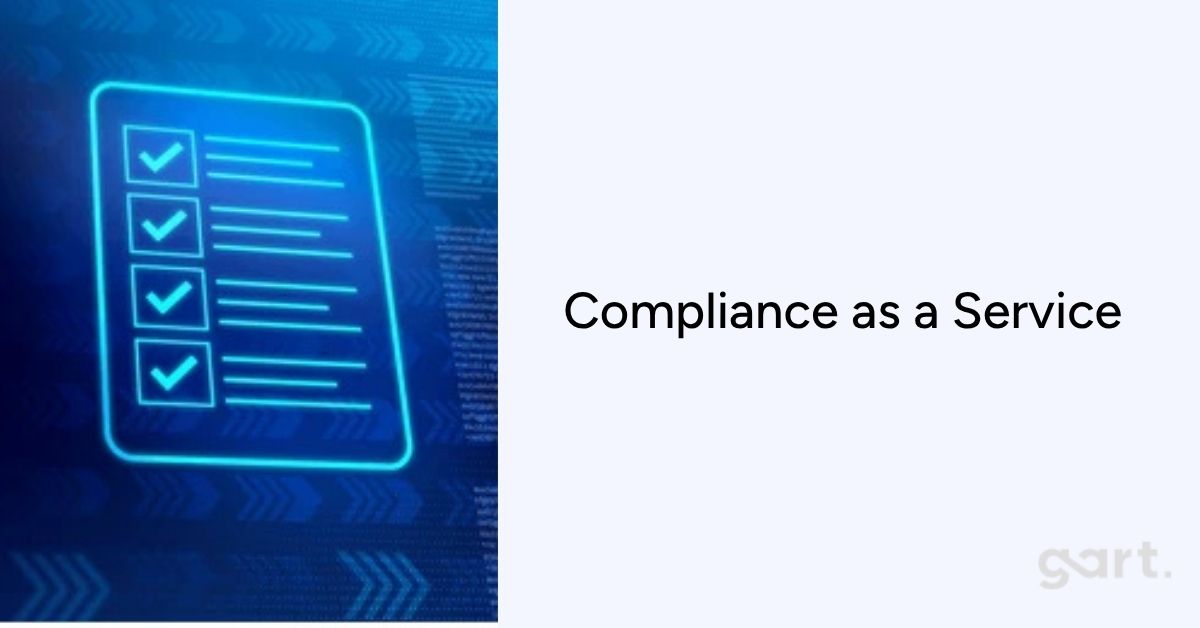
Compliance as a service replaces that cycle with an ongoing program — continuous control monitoring, automated evidence collection, and managed remediation delivered by an outside team, so the organization is audit-ready every day of the year instead of for one week in Q4. It’s a response to a simple problem: regulations change faster than internal teams can track them, and a point-in-time report is out of date the moment infrastructure changes. This guide covers what compliance as a service actually includes, what it costs against the alternative of doing nothing (or doing it once a year), which frameworks it typically spans, and how it compares to a traditional compliance audit — the point-in-time assessment most companies still default to.
- What is compliance as a service (CaaS)?
- Why compliance as a service is growing in 2026
- Compliance as a service vs. a traditional compliance audit
- What a compliance-as-a-service engagement actually covers
- Which frameworks does compliance as a service cover?
- Signs you’ve outgrown annual, point-in-time audits
- How to choose a compliance-as-a-service provider
- What compliance as a service costs
- How Gart Solutions delivers continuous compliance
What is compliance as a service (CaaS)?
Compliance as a service (CaaS) is a managed-service model in which an external provider takes ongoing responsibility for helping an organization meet its regulatory and security obligations — not as a single project, but as a continuous operating discipline. Instead of hiring auditors once a year to produce a report, a CaaS engagement keeps controls monitored, evidence current, and gaps closed in near-real time, so the “audit” becomes a formality that confirms what the provider already knows rather than a discovery exercise that surfaces surprises.
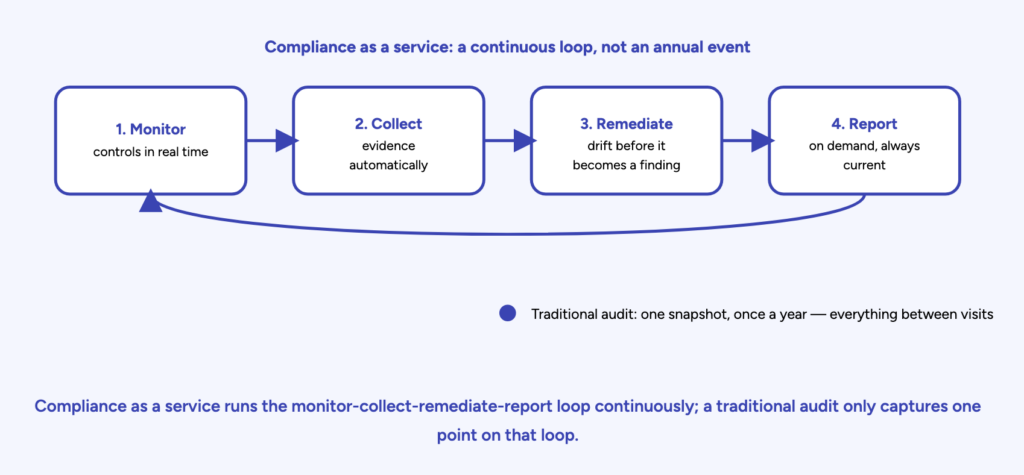
In practice, a CaaS program centralizes four things that most internal teams handle manually and inconsistently: policy and control mapping against the frameworks that apply to the business, automated or semi-automated evidence collection (logs, configuration snapshots, access records), proactive remediation of drift before it becomes a finding, and reporting that’s current enough to hand to an auditor, a customer’s security questionnaire, or a regulator on short notice.
In one sentence: a traditional compliance audit answers “were we compliant on the day someone checked?” — compliance as a service is built to answer “are we compliant right now?” on any given day, not just audit week.
Why compliance as a service is growing in 2026
Three forces are pushing organizations toward the continuous model instead of the annual one. First, the regulatory surface keeps expanding — NIS2’s national transposition and enforcement obligations culminate on an October 2026 deadline across the EU, with non-compliant entities facing fines of up to €10 million or 2% of global annual turnover, whichever is higher.
DORA became applicable to EU financial entities in January 2025 and is now moving into genuine supervisory enforcement, and CMMC 2.0 continues to bind U.S. defense contractors even while parts of its rollout are under review — none of which are “set it and forget it” obligations.
Second, the cost math favors continuous programs. A widely cited Ponemon Institute study for Globalscape found that the average annual cost of non-compliance — business disruption, lost productivity, fines, and settlements — runs 2.71 times higher than the average cost of maintaining compliance in the first place ($14.82 million versus $5.47 million in the study’s dataset).
IBM’s 2025 Cost of a Data Breach Report found the global average breach now costs $4.44 million, with U.S. breaches hitting a record $10.22 million — driven in part by regulatory fines, audits, and compliance reporting costs layered on top of the incident itself.
Third, the market has caught up to the demand. Grand View Research values the global compliance-as-a-service market at $6.7 billion in 2025, growing to $7.2 billion in 2026 and $15.4 billion by 2033 — a 10.0% CAGR.
Gartner projects that 65% of organizations will automate compliance by 2028, with AI powering roughly 75% of those processes, and specifically recommends embedding continuous, automated compliance checks directly into delivery pipelines rather than treating them as a separate, periodic exercise.
| 2026 compliance snapshot | Figure | What it means for buyers |
|---|---|---|
| Global CaaS market size (2026) | $7.2 billion | This is no longer a niche category — providers, tooling, and pricing benchmarks are maturing fast. |
| Cost gap: non-compliance vs. compliance | 2.71x | Paying for ongoing compliance is, on average, far cheaper than absorbing the cost of a failure. |
| Average U.S. data breach cost (2025) | $10.22 million | Regulatory fines and compliance reporting are a growing share of breach costs, not a footnote. |
| Orgs expected to automate compliance by 2028 | 65% | Manual, spreadsheet-driven compliance is becoming the minority approach, not the default. |
Compliance as a service vs. a traditional compliance audit
These two aren’t competing options — they’re different tools for different moments. A point-in-time compliance audit is still exactly what you need when a regulator, acquirer, or enterprise customer wants a formal, dated attestation. Compliance as a service is what keeps the environment in the state that audit certified, in between formal reviews.
| Dimension | Point-in-time compliance audit | Compliance as a service |
|---|---|---|
| Frequency | Annual or on-demand, ahead of a specific deadline | Continuous — monitoring runs every day, not just before a review |
| Evidence | Collected in a burst, right before the audit | Collected automatically and kept current year-round |
| Cost pattern | One large fee at a fixed point | Smaller, predictable recurring fee spread across the year |
| Drift risk | High — nothing catches configuration or policy drift between audits | Low — drift is flagged and fixed close to when it happens |
| Best fit | A named certification or attestation a third party requires by a specific date | Organizations under continuous regulatory pressure or handling sensitive data year-round |
Most mature compliance programs use both: a formal audit to establish the certified baseline, and an ongoing CaaS-style program to keep the organization from drifting back out of that state before the next review. It’s the same logic that applies to infrastructure monitoring generally — a one-time infrastructure assessment tells you the state of the system today, but only continuous monitoring tells you when it changes.
What a compliance-as-a-service engagement actually covers
The specifics vary by provider and framework, but a real CaaS engagement — not just a compliance dashboard with a login — typically includes:
- Control mapping: translating each applicable framework’s requirements into specific, testable technical and procedural controls, rather than a generic checklist.
- Continuous monitoring: automated checks on identity and access management, audit logging, encryption, patch status, and backup and recovery — the control areas auditors ask about most often.
- Automated evidence collection: logs, configuration snapshots, and access records gathered and retained continuously, so there’s no scramble to reconstruct six months of history right before an audit.
- Managed remediation: when a control drifts out of spec, the provider fixes it or routes it to the right owner with a deadline — not just a flag in a dashboard nobody checks.
- Audit and regulator liaison: a current evidence package ready to hand to an external auditor, a customer’s security questionnaire, or a regulator on short notice.
Which frameworks does compliance as a service cover?
Compliance as a service isn’t tied to a single standard — the value is in running the same continuous discipline across whichever frameworks actually apply to the business, since most mid-sized companies carry more than one at once.
| Framework | Who it applies to | What continuous coverage looks like |
|---|---|---|
| SOC 2 | SaaS and service providers handling customer data | Ongoing trust-criteria evidence instead of a pre-audit evidence sprint — see the SOC 2 preparation guide |
| ISO 27001 / 27002 | Organizations formalizing an information security management system | Continuous control testing between certification and surveillance audit cycles |
| HIPAA / HITECH | Healthcare providers, payers, and their technology vendors | Ongoing access, encryption, and breach-notification readiness — see the HIPAA audit preparation guide |
| PCI DSS | Any business storing, processing, or transmitting card data | Continuous network segmentation, logging, and vulnerability-scan evidence — see the PCI DSS audit guide |
| GDPR | Any organization processing EU residents’ personal data | Ongoing data-mapping, retention, and access-request readiness |
| NIS2 | Operators of essential and important services across the EU | Continuous network and information-system resilience evidence ahead of the October 2026 enforcement deadline — see NIS2 compliance services |
Case study
Security audit uncovers gaps a point-in-time review alone couldn’t fix
A golf-club self-service software platform came to Gart Solutions for a security audit against NIST, ISO 27001/27002, and SOC 2. The audit surfaced publicly exposed credentials, weak passwords, misconfigured databases and firewalls, and missing encryption — the exact class of findings that reappear at the next annual review if nothing changes operationally in between. Rather than stopping at the report, Gart moved into infrastructure remediation: Dockerizing the platform and integrating the “Five C’s” of DevOps (continuous integration, testing, delivery, deployment, and monitoring) so the fixed controls stayed fixed. Read the full Golf Self-Service Platform case study.
Signs you’ve outgrown annual, point-in-time audits
Not every organization needs a continuous program on day one. These are the signals that a once-a-year compliance audit is no longer enough on its own:
- The same findings show up in consecutive annual audits because nothing enforces the fix between visits.
- The business now carries two or more overlapping frameworks (for example, SOC 2 and GDPR, or PCI DSS and NIS2) that each demand separate evidence trails.
- Customers or partners send security questionnaires more often than once a year, and each one triggers a scramble to pull current evidence.
- Infrastructure changes — new cloud services, new vendors, new regions — happen faster than the compliance team can review them.
How to choose a compliance-as-a-service provider
Pricing and marketing language vary widely between providers, so evaluate on substance rather than the label on the homepage. Ask each provider — including any you’re already talking to — to answer these questions with specifics, not a sales deck:
- Which frameworks do you actively monitor, and which do you only reference? A provider that lists ten frameworks but has deep tooling for two is not the same as one that genuinely covers all ten continuously.
- Is evidence collected automatically, or does your team still chase it manually each quarter? Manual evidence collection defeats the purpose of paying for a continuous service.
- What happens when a control drifts — does the provider fix it, or just flag it? A dashboard full of unresolved alerts is not remediation.
- Can you produce an audit-ready evidence package on 48 hours’ notice? That turnaround is the practical test of whether “continuous” is real.
- Do you also handle the infrastructure and security work the audit findings point to? If not, confirm who does — and how the handoff works — so findings don’t sit in a backlog with no owner.
- What’s included versus billed separately? Monitoring, evidence storage, remediation hours, and formal attestation support are sometimes bundled and sometimes priced apart — get this in writing before you sign.
What compliance as a service costs
Compliance as a service is typically priced as a recurring engagement rather than a flat one-time fee, which is part of why the cost curve looks different from a traditional audit.
| Engagement model | How it’s priced | Typical fit |
|---|---|---|
| Point-in-time compliance audit | Flat project fee tied to a specific framework and deadline | A named certification or attestation required by a fixed date |
| Compliance as a service (retainer) | Monthly or quarterly fee scaled to framework count and environment size | Organizations under continuous regulatory pressure that want drift caught between formal reviews |
| Audit + CaaS bundle | Formal audit fee plus an ongoing monitoring retainer | Buyers who want a certified baseline and a program that keeps them from drifting out of it |
The Ponemon/Globalscape research cited earlier is the useful frame for this decision: the recurring cost of an ongoing program is, for most organizations, smaller than the average annual cost of non-compliance — and far smaller than the cost of a breach compounded by regulatory fines and reporting obligations, as the breach-cost data cited earlier shows.
How Gart Solutions delivers continuous compliance
Gart doesn’t sell a single packaged “compliance as a service” product with one price tag — and we’d rather say that plainly than stretch a label to fit. What we do run is the set of services that, combined, deliver the same continuous outcome the CaaS model describes: compliance audits to establish and re-certify the baseline against SOC 2, ISO 27001, HIPAA, PCI DSS, GDPR, and NIS2, ongoing IT monitoring and SRE work to catch drift between formal reviews, and DevSecOps practices that embed compliance checks directly into the delivery pipeline — the approach Gartner specifically recommends over treating compliance as a separate, periodic exercise. For teams that want the audit, the monitoring, and the remediation handled by one team that already understands the stack, that combination is the practical equivalent of compliance as a service, built from real service lines rather than a marketing bundle.
Whichever model fits your situation, the sequencing matters more than the label: establish a certified baseline, then keep it current. An audit that gets filed away and never revisited is a snapshot of a moment that’s already gone by the time the report lands in an inbox.
Want the audit, the monitoring, and the remediation handled by one team?
Gart Solutions runs compliance audits against SOC 2, ISO 27001, HIPAA, PCI DSS, GDPR, and NIS2 — and keeps the environment compliant between reviews with ongoing IT monitoring, SRE, and DevSecOps.
- Compliance, security, and infrastructure audits
- Continuous IT monitoring and SRE support to catch drift early
- DevSecOps practices that embed compliance checks into the pipeline
You might also like
- Infrastructure Audit Services
- IT Audit Services Overview
- Monitoring as a Service
- Segregation of Duties: A Guide for IT and Finance Teams
- IT Infrastructure Audit Explained