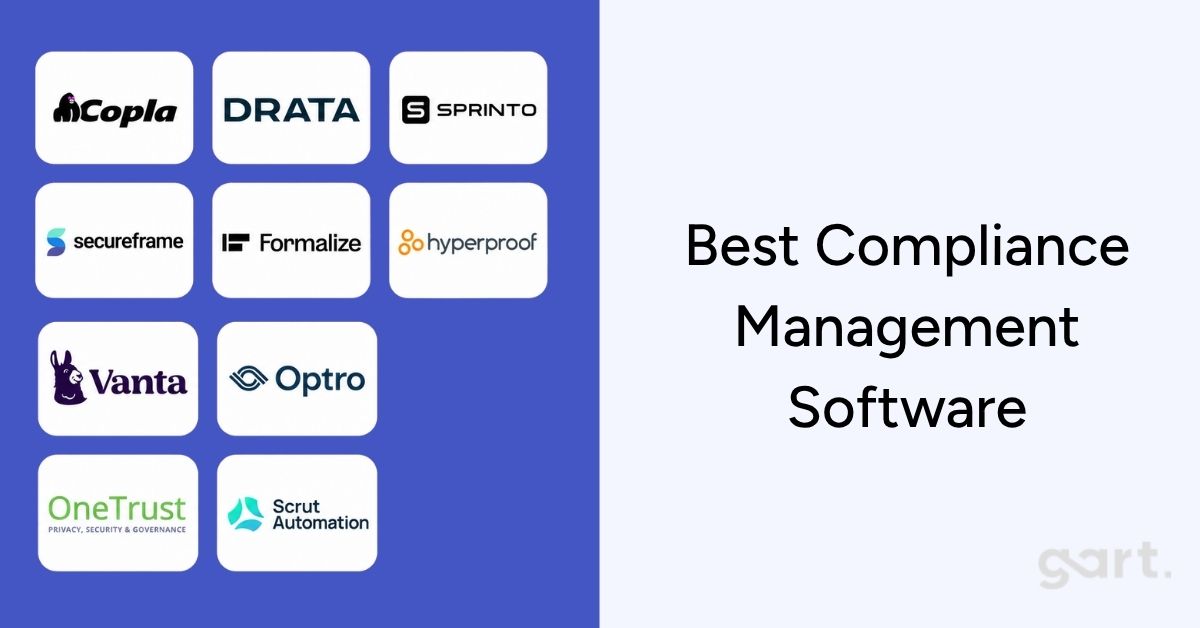
Type “compliance automation” into Google and you’ll land, within the first page, on a vendor’s own ranking of itself as the best option. That’s not a knock on any one platform — it’s just how the category is marketed. This guide starts with the plain definition, then does something most vendor content structurally can’t: score seven real platforms — Vanta, Drata, Secureframe, Thoropass, Sprinto, OneTrust, and Scrut — on a transparent rubric, and say clearly where every one of them, without exception, stops being able to help you.
What is compliance automation?
Compliance automation is software that connects to your cloud infrastructure, identity provider, and code repositories, then continuously checks whether the controls a framework requires — encryption, access reviews, change management — are actually in place, and keeps a timestamped record proving it. Instead of a compliance manager screenshotting configurations by hand once a year before an audit, the platform runs the same checks on a schedule (often hourly) and flags a control the moment it drifts, not months later when the auditor finally looks. For the ongoing, infrastructure-level version of this same idea, see our companion guide on what continuous compliance monitoring actually involves — this article covers which software to buy for it.
A tool generally isn’t “compliance automation” unless it does all three of the following:
- Continuous control monitoring — scheduled, automated checks against connected systems, not a once-a-year manual review.
- Automated evidence collection — configuration exports, access logs, and screenshots pulled via API and stored centrally, not gathered by hand.
- Cross-framework control mapping — one piece of evidence (say, MFA enforcement) satisfies the equivalent requirement in SOC 2, ISO 27001, and HIPAA at once, so pursuing multiple frameworks doesn’t multiply the workload.
What is compliance management software, and why does the category matter now?
Compliance management software is the broader product category compliance automation platforms belong to — tools built to centralize policies, controls, evidence, and audit workflows in one system instead of a scattered mix of spreadsheets, shared drives, and email threads. It’s grown fast for a structural reason: manual compliance work doesn’t scale past a handful of frameworks, and enterprise buyers now expect a current SOC 2 or ISO 27001 report as a baseline sales requirement, not a nice-to-have.
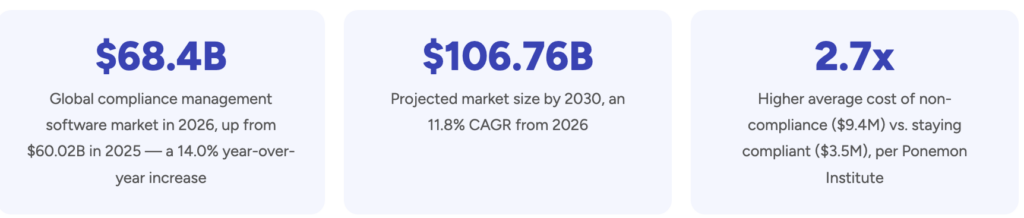
Those market figures come from The Business Research Company’s 2026 compliance management software market report, which cites AI-driven compliance analytics and rising demand for continuous monitoring as the main growth drivers. The cost comparison is from Ponemon Institute’s benchmark study on the true cost of compliance — the pattern behind it is consistent with what we see directly in client engagements: non-compliance rarely fails as one dramatic event, it accumulates as slow drift that only a continuous system catches early.
How we scored the 7 best compliance management software platforms
Instead of ranking by brand recognition or funding size, we scored all seven platforms on six criteria, weighted for a buyer choosing pure software — not an audit-led service, which is a separate comparison we cover further down. Every platform was scored 1–10 based on what each company states publicly about pricing, integrations, automation cadence, and support model, cross-checked against independent G2 review data where available — we did not run our own technical audit of every platform, and say so plainly rather than implying otherwise.
| Criterion | Weight | What it measures |
|---|---|---|
| Automation & continuous monitoring | 25% | Test cadence (hourly vs. daily vs. periodic), real-time drift detection, and depth of automated evidence collection |
| Framework & integration breadth | 20% | Number of supported frameworks and native integrations with cloud, identity, HR, and code-repository systems |
| Evidence & audit workflow | 15% | How evidence is packaged and shared with an actual auditor — trust portals, auditor collaboration tools, report generation |
| Ease of onboarding | 15% | Time to first fully-connected monitor cycle, reported implementation complexity, and support/advisory depth |
| AI features & roadmap | 10% | AI-assisted evidence review, questionnaire response, or anomaly detection shipped and in active use, not just announced |
| Pricing transparency | 10% | Whether published reference pricing exists, or every quote requires a sales call with no public signal |
| Independent review base | 5% | G2 review volume and rating — the hardest signal for any vendor to fabricate |
Quick comparison: the 7 best compliance management software platforms in 2026
| Rank | Platform | Weighted score /10 | Best fit | Main limitation |
|---|---|---|---|---|
| #1 | Vanta | 8.6 | Companies wanting the broadest framework and integration coverage plus the largest independent review base | Premium pricing at scale; advanced/custom frameworks still need configuration support |
| #2 | Drata | 8.2 | Teams pursuing multiple frameworks in parallel who want the deepest continuous, configurable monitoring | Thinner integration catalog than Vanta; AI features still catching up |
| #3 | Secureframe | 7.7 | SMBs that want dedicated advisory support bundled with the automation platform | Pricing runs slightly above Vanta/Drata for comparable scope |
| #4 | Thoropass | 7.4 | Companies that want the platform and the SOC 2 audit report itself from one vendor | Smaller independent review base; audit bundle covers paperwork, not infrastructure fixes |
| #5 | Sprinto | 7.2 | Startups wanting the fastest, lowest-friction onboarding and the clearest published pricing signals | Periodic rather than fully real-time monitor evaluation |
| #6 | OneTrust | 6.9 | Enterprises needing privacy, consent, and third-party-risk management alongside compliance evidence, not just SOC 2 automation | Resource-intensive implementation; UI complexity is a recurring theme in independent reviews |
| #7 | Scrut | 6.7 | Cost-conscious teams that need many niche or fully custom frameworks bundled affordably | Smaller integration ecosystem and review footprint than the top five |
Vanta and Drata top the list under this weighting because automation depth and framework/integration breadth together account for 45% of the score — the two areas where both platforms out-invest the rest of the field.
Weight pricing transparency and onboarding speed more heavily instead — the reasonable call for a resource-strapped startup — and Sprinto and Scrut close the gap considerably. We show the rubric so you can make that trade yourself rather than trusting an unexplained order.
Best compliance management software, platform by platform
Vanta
Best for: Companies wanting the broadest out-of-the-box framework and integration coverage, backed by the largest independent review base in the category
Vanta, founded in 2018 and based in San Francisco, is the largest pure-play compliance automation platform by customer count — 16,000+ companies, according to the company. It runs 1,400+ automated tests hourly against connected systems, supports 35+ frameworks, and lists 400+ native integrations. It holds a 4.6/5 rating across 2,665+ reviews on G2 — the largest independent review base of the seven platforms here. Vanta raised a $150M Series D in July 2025 at a $4.15B valuation, and has shipped AI-agent tooling across compliance, third-party risk, and customer-trust workflows through 2025-2026.
- 1,400+ automated tests, refreshed hourly against connected systems — the fastest cadence in this comparison
- Broadest framework library (35+) and integration catalog (400+) of the seven platforms
- Largest independent review base (2,665+ on G2) — the hardest signal here for any vendor to fabricate
Where it’s a weaker fit: pricing is fully custom (Essentials plans commonly run $10,000–$15,000/year, Enterprise custom up to $80,000+/year), and it’s built for teams that already have engineering capacity to act on what it flags — it doesn’t send anyone to fix the underlying infrastructure gap.
Weighted score: 8.6/10
Drata
Best for: Teams pursuing several frameworks in parallel who want granular, configurable continuous monitoring
Drata, founded in 2020 in San Diego, runs continuous monitoring with configurable alert thresholds and is frequently cited as the deepest option for tracking overlapping controls across multiple frameworks at once. It supports 20+ named frameworks including newer additions like ISO 42001, DORA, FedRAMP, and CMMC, and holds a 4.7/5 rating across 1,331+ G2 reviews. Drata raised a $200M Series C in December 2022 at a $2B valuation and serves 8,500+ customers.
- Continuous monitoring with configurable thresholds, not a single fixed cadence
- Strong, granular control-mapping for teams running 2+ frameworks simultaneously
- Trust Center feature turns live compliance status into a shareable sales asset
Where it’s a weaker fit: a thinner integration catalog than Vanta and a smaller in-platform AI footprint; pricing is quote-only (Foundation tier ~$15,000/year for up to 50 employees, combined SOC 2 + ISO 27001 commonly ~$28,000/year at mid-market).
Secureframe
Best for: SMBs that want dedicated advisory support bundled directly into the automation platform
Secureframe continuously monitors 150+ connected cloud services with real-time alerting across 175+ integrations, and differentiates less on raw automation depth than on service — dedicated compliance specialists and audit-readiness coaching are positioned as core to the product, not an add-on. It holds a 4.7/5 rating across 700+ G2 reviews.
- Real-time alerting across 150+ monitored cloud services
- 175+ integrations, with meaningful investment in customer-success and advisory staffing
- Bundled employee security-training and vendor-risk-management modules
Where it’s a weaker fit: the advisory layer is coaching toward audit readiness, not hands-on infrastructure remediation, and pricing generally runs slightly above Vanta and Drata for comparable scope.
Weighted score: 7.7/10
Thoropass
Best for: Companies that want the compliance platform and the SOC 2 audit report itself from a single vendor
Thoropass takes a structurally different approach from the other six platforms: it owns an affiliated CPA firm (operating as Thoropass Assurance) that issues the actual SOC 2 report, bundling the audit and the software rather than requiring a separate external auditor. It supports a wide framework set — SOC 1, SOC 2, ISO 27001, ISO 42001, HIPAA, HITRUST, GDPR, CMMC, and PCI DSS. Published reference pricing shows the platform starting near $8,700/year plus a SOC 2 audit subscription near $5,800/year, with a median bundled contract around $30,000/year — see our full Vanta vs. Drata comparison for how the two market leaders’ pricing stacks up against a bundled model like this one.
- Only platform here that bundles the audit firm itself into the subscription
- Wide framework support including SOC 1, ISO 42001, HITRUST, and CMMC
- Published reference pricing points, unlike Vanta’s or Drata’s fully custom quotes
Where it’s a weaker fit: the bundled audit covers the report and paperwork side, not hands-on infrastructure or access-control engineering, and a smaller independent review base than Vanta, Drata, or Secureframe gives less third-party signal on the platform itself.
Weighted score: 7.4/10
Sprinto
Best for: Startups that want the lowest-friction setup and clearer published pricing signals
Sprinto is consistently cited in independent buyer comparisons as the easiest of the major platforms to onboard, automating both technical and operational controls with tiered alerts. It holds a 4.7/5 rating across 1,678+ G2 reviews and is a common default for India/APAC companies pursuing SOC 2 alongside frameworks like India’s DPDP Act.
- Reported smoothest onboarding and system-connection experience among the major platforms
- Automates both technical and operational controls, not just technical evidence pulls
- More published pricing reference points than Vanta or Drata
Where it’s a weaker fit: monitor evaluation runs on a periodic basis rather than Vanta’s hourly or Drata’s continuous cadence, which matters more for teams in fast-changing infrastructure environments.
Weighted score: 7.2/10
OneTrust
Best for: Enterprises that need privacy, consent, and third-party-risk management alongside compliance evidence collection, not just SOC 2 automation
OneTrust, founded in 2016 in Atlanta, is a broader privacy-and-GRC platform spanning six modules — consent and preferences, data discovery and classification, AI governance, tech risk and compliance, privacy automation, and third-party risk management — rather than a purpose-built SOC 2 evidence-collection tool. It supports 55+ frameworks and holds a 4.4/5 rating overall on G2 (283 reviews), with its Tech Risk & Compliance module specifically rated 4.6/5 across 109 reviews. OneTrust raised a total of $1.13B in funding and was last valued at $4.5B in 2023.
- Widest framework coverage of the seven platforms (55+), spanning privacy, AI governance, and GRC together
- Purpose-built consent-management and third-party-risk modules neither Vanta nor Drata offer at comparable depth
- Configurable enough for complex, multi-region enterprise compliance programs
Where it’s a weaker fit: implementation is more resource-intensive than the SOC 2-focused platforms above, UI complexity is a recurring theme in independent reviews, and entry pricing (roughly $25,000–$50,000+/year, with a $10,000 minimum ACV policy) targets a larger buyer than a startup pursuing its first SOC 2.
Weighted score: 6.9/10
Scrut
Best for: Cost-conscious teams that need several niche or fully custom frameworks bundled into one platform
Scrut Automation supports 50+ global frameworks, including the ability to build fully custom ones, and is generally the most affordably priced of the seven — reference pricing starts near $4,500/year, with combined multi-framework setups commonly running several thousand dollars less per year than an equivalent Drata quote.
- 50+ supported frameworks, including custom-framework building
- Lowest published entry pricing of the seven platforms in this comparison
- Bundled multi-framework pricing tends to undercut Vanta and Drata at mid-market scale
Where it’s a weaker fit: a smaller integration ecosystem and independent review footprint than the top five, which matters most for complex, multi-cloud environments needing deep native connectors.
Weighted score: 6.7/10
Frameworks supported: how the 7 platforms stack up
| Platform | SOC 2 | ISO 27001 | HIPAA | PCI DSS | GDPR | Notable extras |
|---|---|---|---|---|---|---|
| Vanta | Yes | Yes | Yes | Yes | Yes | 35+ frameworks total, 400+ integrations |
| Drata | Yes | Yes | Yes | Yes | Yes | ISO 42001, DORA, FedRAMP, CMMC |
| Secureframe | Yes | Yes | Yes | Yes | Yes | Vendor risk, employee training modules |
| Thoropass | Yes | Yes (+ ISO 42001) | Yes | Yes | Yes | HITRUST, CMMC, Cyber Essentials, SOC 1 |
| Sprinto | Yes | Yes | Yes | Yes | Yes | India DPDP Act |
| OneTrust | Via Tech Risk & Compliance module | Yes | Yes | Yes | Yes (purpose-built) | 55+ frameworks, AI governance, consent management |
| Scrut | Yes | Yes | Yes | Yes | Yes | 50+ frameworks incl. custom-built |
GDPR coverage is worth a specific note regardless of platform: Article 83 sets fines at up to €20 million or 4% of global annual turnover, whichever is higher — a big part of why continuous evidence of data-handling controls has become non-negotiable for any EU-facing company, on any platform.
What compliance management software can’t do for you
This is the section vendor pages tend to skip, and it’s the one that matters most before you sign a five- or six-figure annual contract. Every platform above is genuinely good at one job: proving, continuously, that a control is or isn’t in place. None of them is built to diagnose why a control failed, and none of them fixes it. A platform tells you an S3 bucket is public; it doesn’t reconfigure the bucket policy, redesign the IAM structure around it, or explain why that misconfiguration keeps recurring across your environment.
In engagements that start after a company has already run one of these platforms for a year or more, the same gap shows up repeatedly:
- A prior SOC 2 or ISO 27001 audit came back qualified on technical grounds — that’s an infrastructure or access-control problem, not an evidence-collection problem. Our failed SOC 2 audit guide walks through the most common root causes.
- Access reviews are still run manually against a spreadsheet, even though the automation platform is technically “connected” — see our breakdown of automated identity governance vs. manual access reviews.
- Nobody can clearly explain segregation of duties between engineering, finance, and IT once an auditor asks a follow-up question the dashboard can’t answer. Our segregation of duties guide covers this specifically.
- The infrastructure itself hasn’t had an independent technical review in over a year, regardless of how green the compliance dashboard looks day to day.
None of that is a knock on any of the seven platforms — it’s simply outside what a SaaS evidence-collection tool is designed to do. That gap is exactly where a hands-on security audit earns its keep: a person with real infrastructure expertise reviewing the actual environment, not just the API responses a platform can see.
A SOC 2-scoped audit that didn’t stop at the findings report
Gart’s infrastructure and compliance audit work supported Spiral Technology’s path to ISO 27001 compliance, addressing the information-security management controls the standard requires across the client’s cloud environment — the kind of remediation work that starts where a green compliance dashboard leaves off.
How to choose the right compliance management software
First SOC 2, self-serve team
Vanta’s framework and integration breadth, plus the largest independent review base, make it the safest default starting point.
Multiple frameworks in parallel
Drata’s granular control mapping is built specifically for teams tracking overlapping SOC 2/ISO 27001/HIPAA controls at once.
Want the audit bundled in
Thoropass is the only platform here whose subscription includes the actual SOC 2 report from an affiliated CPA firm.
Infrastructure gaps, not evidence gaps
If a prior audit failed on technical grounds, no software purchase fixes that — a compliance audit scoped to remediation is the right next step, not another dashboard.
Five questions worth asking whichever platform (or provider) you’re evaluating:
- Is evidence collected automatically, or does our team still chase it manually each quarter? Manual evidence collection defeats the purpose of paying for a continuous platform.
- When a control fails, does the platform fix it or just flag it? An unresolved alert queue is not remediation — see the section above.
- Does the subscription include the audit fee, or is that a separate line item with a CPA firm? Only Thoropass bundles it among the seven platforms here; every other quote is separate.
- What’s the renewal-year price once any first-year discount expires? Several buyer guides flag 30-50% renewal increases as a recurring complaint across this category.
- Who handles the infrastructure findings the platform surfaces? Confirm this explicitly so a flagged misconfiguration doesn’t sit unowned in a backlog.
Software proves your controls. We make sure there’s something solid underneath them.
Gart Solutions runs fixed-fee compliance and security audits that find the infrastructure and access-control gaps no compliance management software flags on its own — then helps you fix them and stay audit-ready long after, whichever platform from this list you run alongside us.
You might also like
- Vanta vs. Drata: 2026 Comparison & Pricing
- Compliance Monitoring: Ensuring Businesses Stay on the Right Side of the Rules
- SOC 2 Compliance: A Step-by-Step Guide to Preparing for Your Audit
- Why Is ISO 27001 a Crucial Step for Successful Companies?
- Compliance as a Service for MSPs: Build, Buy, or Partner