If you run technology, security, or infrastructure for a company that touches EU customers, you've probably heard both acronyms thrown around interchangeably — they aren't the same thing. DORA vs NIS2 comes down to one question: are you a regulated financial entity, a critical-infrastructure operator, or, increasingly, both? Getting the answer wrong means either over-building compliance you don't need or missing obligations that now carry real fines. This guide breaks down what each regulation actually requires, where they overlap, and how to determine — in minutes, not weeks — which one governs your organization. If you'd rather have someone map this against your actual environment, our compliance audit service does exactly that.
What is DORA?
The Digital Operational Resilience Act (DORA) is Regulation (EU) 2022/2554, and it has been directly applicable across all EU member states since January 17, 2025. Because it's a regulation rather than a directive, DORA doesn't need to be transposed into national law — the same rules apply, word for word, in every member state simultaneously.
DORA is a lex specialis: a specialized law built for one sector — finance. It applies to roughly 20 categories of financial entities, including banks, credit institutions, payment and e-money firms, investment firms and asset managers, insurance and reinsurance undertakings, crypto-asset service providers, and crowdfunding platforms. It also reaches the critical ICT third-party providers that serve them — cloud platforms, data centers, and credit rating or data analytics services.
DORA is built around five pillars: ICT risk management, incident reporting (including a strict initial classification window), digital operational resilience testing (with mandatory Threat-Led Penetration Testing every three years for significant institutions), third-party ICT risk management, and voluntary information sharing on cyber threats.
What is NIS2?
NIS2 — Directive (EU) 2022/2555 — is the EU's horizontal cybersecurity framework. Unlike DORA, it's a directive, so each member state writes its own implementing legislation. The formal transposition deadline was October 17, 2024, but as of 2026, several countries are still finalizing their national frameworks, which means the practical rules can vary depending on where your entity is established.
NIS2 covers 18 sectors, split into two tiers under the European Commission's NIS2 framework:
Essential entities (Annex I): energy, transport, banking, financial market infrastructure, health, drinking water, digital infrastructure, ICT service management, public administration, and space
Important entities (Annex II): postal and courier services, waste management, chemicals, food production, manufacturing, digital providers, and research organizations
A size-cap rule generally brings medium and large organizations (50+ employees or €10 million+ turnover) into scope, though some entities are covered regardless of size due to their criticality. Core obligations include ten minimum risk-management measures — incident handling, business continuity, supply-chain security, vulnerability management, access control, and multi-factor authentication among them — plus a tiered incident-reporting timeline: a 24-hour early warning, a 72-hour detailed notification, and a final report within one month.
DORA vs NIS2: key differences at a glance
AspectDORANIS2Legal instrumentRegulation — directly applicable, identical across the EUDirective — transposed into national law, varies by member stateApplicable sinceJanuary 17, 2025Transposition deadline October 17, 2024 (still uneven by country in 2026)ScopeFinancial sector only, plus critical ICT third-party providers18 sectors: energy, transport, health, digital infrastructure, manufacturing, and moreSize thresholdNo general size cap — determined by entity typeMedium/large entities (50+ staff, €10M+ turnover), with some exceptionsIncident reportingInitial classification promptly, with intermediate and final reports on tight timelines24-hour early warning, 72-hour notification, 1-month final reportResilience testingMandatory Threat-Led Penetration Testing every 3 years for significant entitiesRisk-based vulnerability assessments and penetration testingMaximum penaltiesUp to 2% of annual worldwide turnover; ICT providers up to 1% of average daily turnover per day (max 6 months)Essential entities: €10M or 2% global turnover. Important entities: €7M or 1.4%Oversight bodyFinancial supervisory authorities (national competent authorities, ESAs)National cybersecurity authorities / CSIRTs, coordinated via ENISADORA vs NIS2: key differences at a glance
Do DORA and NIS2 overlap?
Yes — and this is where most engineering leaders get tripped up. DORA explicitly states that it functions as lex specialis to NIS2 for entities within its scope. In practice, that means a bank or insurer that fully complies with DORA's ICT risk management, testing, and incident-reporting rules has also satisfied the equivalent NIS2 requirements — you don't have to run two parallel compliance programs for the same controls.
But the overlap doesn't stop there. If your company provides cloud infrastructure, managed hosting, or data services to financial-sector clients, you can be pulled into DORA's oversight regime as a "critical ICT third-party provider" and into NIS2 as a digital infrastructure or ICT service management provider in your own right. According to ENISA's guidance on the NIS framework, classification depends on the specific service relationship, not just your industry label — so two companies offering nearly identical services can land in different regulatory buckets.
Who typically falls under both
Cloud and hosting providers serving banks, SaaS vendors handling payment data, managed security providers, and data-center operators with financial-sector clients are the groups most likely to face dual obligations. If any of that sounds like your business, treat this as a "when," not an "if."
How to determine which regulation applies to you
Work through these questions in order — most companies land on an answer after the first two:
Are you a regulated financial entity? Bank, insurer, investment firm, payment provider, or crypto-asset service provider — if yes, DORA applies to you directly.
Do you operate in one of NIS2's 18 sectors and meet the size thresholds? If yes, NIS2 applies, and you'll need to check your national transposition law for local specifics.
Do you supply ICT, cloud, hosting, or data services to financial-sector clients? If yes, you may be designated a critical ICT third-party provider under DORA regardless of your own sector.
Are you headquartered outside the EU but serving EU clients? Both regulations can still apply based on where the services are delivered, not where you're incorporated.
If more than one answer is "yes," you're likely subject to overlapping obligations, and mapping exactly which controls satisfy which regulation becomes the priority — this is precisely the gap analysis our IT audit services team runs for clients before it becomes an audit finding.
What penalties look like in practice
Enforcement stopped being theoretical in 2026. NIS2 penalties are harmonized across the EU: essential entities face fines up to €10 million or 2% of global annual turnover, whichever is higher, while important entities face up to €7 million or 1.4%. DORA doesn't set one fixed fine — national competent authorities can impose sanctions of up to 2% of annual worldwide turnover for serious violations, and critical ICT third-party providers can be fined daily, up to 1% of average daily turnover, for as long as six months of continued non-compliance. Both frameworks also expose senior management to personal liability for gross negligence, which is why boards are now asking CTOs and CISOs for documented evidence, not verbal assurances.
Building a compliance-ready foundation
Regardless of which regulation applies, the underlying engineering work looks similar. A practical readiness checklist:
Map every ICT asset, dependency, and third-party vendor tied to critical business functions
Implement continuous monitoring and automated, immutable audit trails for compliance evidence
Define and test incident classification and reporting workflows against the applicable deadlines
Run regular resilience testing — vulnerability scans at minimum, TLPT if DORA applies
Formalize third-party and supply-chain risk management, including contractual audit rights
Assign clear management accountability and document board-level oversight
Building DORA or NIS2 compliance into your infrastructure, not bolted on after
Compliance work usually falls on engineering teams already stretched thin on delivery. Gart Solutions works alongside CTOs, CIOs, and platform teams to turn DORA and NIS2 requirements into infrastructure that's compliant by design — not a spreadsheet exercise re-done every audit cycle.
Compliance & IT Audits
Gap analysis against DORA, NIS2, SOC 2, HIPAA, and PCI-DSS, mapped to your actual environment.
DevSecOps by Design
Real-time scanning of code, containers, and runtimes, with automated audit trails baked into the pipeline.
SRE & Resilience Testing
Disaster recovery, business continuity, and monitoring built to withstand — and prove — operational resilience.
Talk to Our Compliance & DevOps Team
You might also like
Best FinTech DevOps and Cloud Infrastructure Companies
How FinTech Companies Unlock the Benefits of DevOps
Top DevSecOps Consulting Services Companies
SRE Services: Reliability, Monitoring & Disaster Recovery
Fedir Kompaniiets
Co-founder & CEO, Gart Solutions · Cloud Architect & DevOps Consultant
Fedir is a technology enthusiast with over a decade of diverse industry experience. He co-founded Gart Solutions to address complex tech challenges related to Digital Transformation, helping businesses focus on what matters most — scaling. Fedir is committed to driving sustainable IT transformation, helping SMBs innovate, plan future growth, and navigate the "tech madness" through expert DevOps and Cloud managed services. Connect on LinkedIn.
If your organization touches EU financial services — as a bank, insurer, payment provider, crypto-asset firm, or as an ICT vendor selling to any of them — a DORA compliance checklist is no longer optional homework. The Digital Operational Resilience Act (DORA) has been fully in force since January 17, 2025, and 2026 is the year national regulators stop reviewing paperwork and start demanding proof: real-time evidence of resilience, tested incident response, and a fully mapped ICT supply chain. This guide breaks DORA's five pillars into a checklist your IT and security teams can actually execute, and shows where a structured compliance audit can shortcut the gap analysis.
In short: DORA compliance means proving — with documentation, tested controls, and a maintained Register of Information — that your organization can identify, withstand, respond to, and recover from ICT-related disruptions. It rests on five pillars: ICT risk management, incident reporting, resilience testing, third-party risk management, and information sharing. Non-compliance can cost up to 2% of global annual turnover or €10 million, whichever is higher.
What Is DORA, and Who Needs to Comply?
What it is: The Digital Operational Resilience Act (Regulation (EU) 2022/2554) is an EU regulation that standardizes how financial entities and their critical technology vendors manage, report, and recover from ICT risk. Unlike earlier frameworks that treated cybersecurity as a checkbox, DORA is built around demonstrable operational resilience — your ability to keep critical functions running through a cyberattack, outage, or vendor failure, not just your ability to write a policy about one.
Who it applies to: Per the European Banking Authority, DORA's enforcement perimeter now covers more than 22,000 financial entities — banks, insurers, investment firms, payment institutions, crypto-asset service providers, and trading venues — plus an estimated 15,000 ICT third-party providers that serve them, including cloud platforms, SaaS vendors, and data center operators. If your product touches an EU-regulated financial entity's critical or important function, DORA reaches you contractually even if you're not a financial institution yourself. Fintech platforms in particular should check our breakdown of DevOps and cloud infrastructure for fintech for how this plays out operationally.
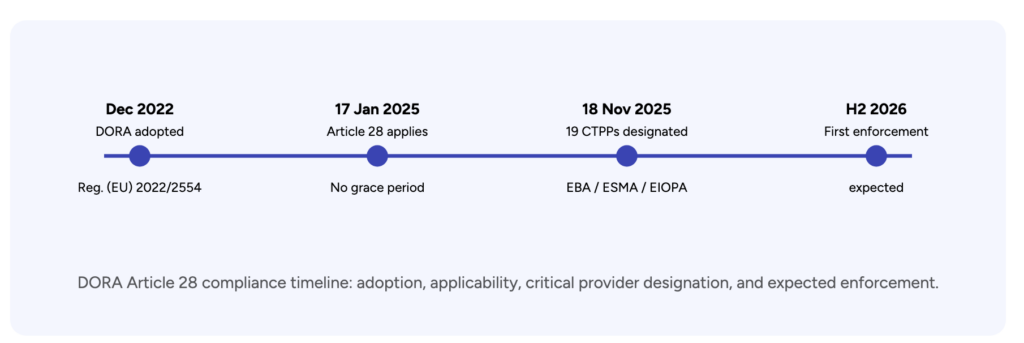
When it's enforced: DORA became directly applicable across all EU member states on January 17, 2025. 2025 functioned as a de facto transition year, with regulators focused on readiness assessments. In 2026, national competent authorities (NCAs) have moved to active enforcement — formal audits, information requests, and financial penalties are now standard practice.
The DORA Compliance Checklist: 5 Pillars You Must Cover
Every credible DORA compliance checklist is organized around the regulation's five pillars. Treat each one as a workstream with its own owner, evidence trail, and testing cadence — not a document to file away after the initial audit.
Pillar 1: ICT Risk Management Checklist
This is DORA's foundation — a governance framework that your board formally owns, not just IT. Auditors will look for evidence, not intent.
ICT risk management framework documented, board-approved, and reviewed at least annually
Complete inventory and classification of ICT assets, systems, and data flows supporting critical or important functions
Defined risk tolerance thresholds tied to business-impact analysis
Identity, access, and network security controls mapped to identified risks
Business continuity and disaster recovery plans tested, not just written
Clear internal accountability — a named function (often the CISO or a dedicated resilience lead) reporting risk posture to the board
Most of this pillar overlaps with existing frameworks — if you've already built a risk management system for ISO 27001, you're covering roughly 60–70% of DORA's ICT risk requirements already.
Pillar 2: ICT Incident Reporting Checklist
DORA replaces vague "notify without undue delay" language with hard deadlines. Your incident response runbook needs these timers built in, not calculated manually under pressure.
Incident classification criteria in place (severity, client impact, reputational impact, geographic spread, duration)
Initial notification to the relevant national competent authority within 4 hours of classifying an incident as major
Intermediate report submitted within 72 hours with updated status and impact assessment
Final report submitted within one month, including root cause and remediation
Designated Critical ICT Third-Party Providers report major incidents to their Lead Overseer within 2 hours
Incident logging and evidence retention process that survives an auditor's request for the last 12 months of history
Pillar 3: Digital Operational Resilience Testing Checklist
DORA does not accept a policy document as proof of resilience — it requires proof you've broken your own systems on purpose and recovered.
Annual basic testing program covering vulnerability assessments, scenario-based tests, and network security assessments
Threat-Led Penetration Testing (TLPT) every three years for entities identified as significant, simulating real adversary tactics against production-like environments
Testing results tracked to remediation with owners and deadlines, not just filed as a report
Independent testers used where required, with results reported to management and regulators as applicable
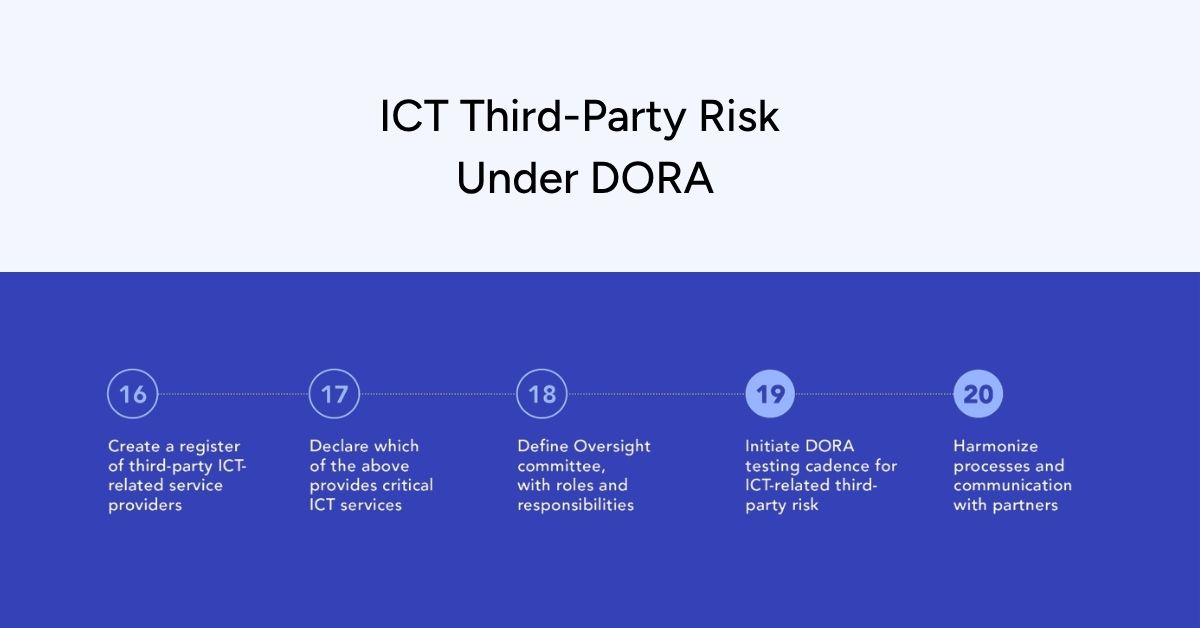
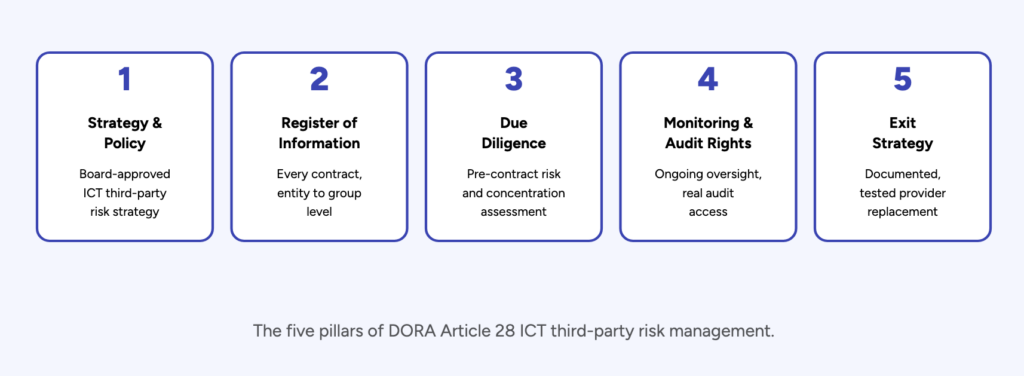
Pillar 4: ICT Third-Party Risk Management Checklist
This is the pillar catching the most organizations off guard in 2026, largely because of one deliverable: the Register of Information (RoI).
Register of Information covering every ICT third-party contract supporting critical or important functions, in the ITS 2024/2956 format
RoI submitted to your national competent authority ahead of the 2026 deadline (most EU states set 31 March 2026; the Netherlands set 22 March 2026)
Pre-contractual due diligence process for new ICT vendors, including sub-outsourcing chain visibility
Contracts updated with DORA-mandated clauses: audit rights, exit strategies, service levels, and incident cooperation
Concentration risk assessed — how many critical functions depend on a single cloud or SaaS provider
Monitoring in place for providers designated as Critical ICT Third-Party Providers (CTPPs) by the European Supervisory Authorities
If your third-party register includes payment processors, the due-diligence bar is even higher — cross-check it against the controls covered in our PCI DSS audit guide and, for entities also subject to U.S. financial rules, our SOX compliance overview.
Pillar 5: Information and Intelligence Sharing Checklist
The lightest-touch pillar — encouraged, not mandated — but still worth formalizing so it doesn't fall through the cracks during an audit.
Participation (or a documented decision not to participate) in a threat-intelligence sharing arrangement with peers or sector groups
Internal process to act on shared indicators of compromise and TTPs, not just receive them
Legal and data-protection review of any information-sharing arrangement before joining
Reality check: Most organizations we assess have partial coverage on Pillars 1–3 from prior ISO 27001 or SOC 2 work, but a near-blank Register of Information for Pillar 4. Third-party risk management is where a targeted cloud infrastructure and vendor review pays off fastest.
Full DORA Compliance Checklist by Pillar
Use this table as a working audit tracker — assign an owner and a status to each row before your next internal review.
PillarCore RequirementTypical OwnerEvidence NeededICT Risk ManagementBoard-approved risk framework, asset inventory, tested BC/DR plansCISO / IT GovernanceFramework doc, risk register, DR test logsIncident Reporting4-hour / 72-hour / 1-month reporting cadence to NCASOC / Incident Response LeadIncident log, timestamped reports, escalation recordsResilience TestingAnnual testing plus TLPT every 3 years for significant entitiesSecurity / DevSecOpsTest reports, remediation tickets, retest evidenceThird-Party RiskRegister of Information, due diligence, DORA-compliant contractsProcurement / IT AuditRoI submission, contract addenda, vendor risk scoresInformation SharingThreat-intel participation and internal action processCISO / LegalMembership records, IOC-response workflowFull DORA Compliance Checklist by Pillar
DORA Compliance Timeline: Key 2026 Deadlines
DORA compliance in 2026 is not a one-time deadline — it's a recurring supervisory cycle. These are the dates IT and security leaders should have on their calendar right now.
Ongoing: Full DORA applicability since January 17, 2025 — every requirement below is already enforceable.
Q1 2026 (31 March for most member states; 22 March for the Netherlands): Annual Register of Information submission to your national competent authority.
Throughout 2026: National regulators cross-reference registers across entities, flagging providers that appear inconsistently or "sub-outsourcing chains that don't exist" for major cloud vendors — expect follow-up requests if your data doesn't match your vendors' filings.
Rolling: Designated Critical ICT Third-Party Providers — 19 named by the ESAs in November 2025, including major hyperscalers — now operate under direct ESA oversight. Confirm whether any of your critical vendors are on that list and adjust monitoring accordingly.
What Happens If You're Not DORA Compliant?
Regulators have made clear that 2026 is the enforcement year, and the penalty structure reflects it:
Financial entities: Per the official DORA regulation text, fines up to 2% of total annual global turnover or €10 million, whichever is higher, plus individual penalties up to €1 million for accountable executives.
Critical ICT Third-Party Providers: Daily penalty payments of up to 1% of average daily global turnover for continued non-compliance, for up to six months, plus corrective measures dictated by the Lead Overseer.
Member-state variation: Some countries go further — Italy allows ceilings up to €20 million or 10% of turnover, and Article 52 permits criminal penalties, including imprisonment, for the most severe violations.
Beyond fines, the operational cost is often higher: emergency remediation under regulatory scrutiny, contract renegotiation with vendors, and lost enterprise deals once prospective financial-sector clients ask for your DORA evidence during procurement.
Common DORA Compliance Mistakes IT Teams Make
Across compliance audits, the same gaps recur regardless of company size:
Treating DORA as a paperwork exercise. A written policy with no test logs, no incident drill records, and no remediation tracking won't survive an NCA review.
Underestimating the Register of Information. Mapping every ICT contract, sub-outsourcer, and data flow into the ITS 2024/2956 format takes longer than teams expect — start well before the March deadline, not the week of.
Missing concentration risk. Multiple critical functions quietly depending on one cloud region or one SaaS vendor is a red flag regulators specifically look for.
These same failure patterns show up across regulatory checklists generally — our FISMA audit checklist walks through a comparable evidence-first approach if you're benchmarking your audit process against other frameworks.
Turn This Checklist Into an Audit-Ready Program
Gart Solutions runs compliance audits that map your current ICT risk management, incident response, and third-party contracts directly against DORA, ISO 27001, SOC 2, and NIST requirements — then translate the gaps into a DevOps-executable remediation plan. We work across AWS, Azure, and GCP, so the controls we recommend get built into your CI/CD and cloud infrastructure, not bolted on as a separate process. For teams that need ongoing resilience testing and incident readiness without hiring a full internal security function, our SRE and disaster recovery services and fractional CTO engagements plug directly into your existing team.
Get a free DORA readiness consultation
Fedir Kompaniiets
Co-founder & CEO, Gart Solutions · Cloud Architect & DevOps Consultant
Fedir is a technology enthusiast with over a decade of diverse industry experience. He co-founded Gart Solutions to address complex tech challenges related to Digital Transformation, helping businesses focus on what matters most — scaling. Fedir is committed to driving sustainable IT transformation, helping SMBs innovate, plan future growth, and navigate the "tech madness" through expert DevOps and Cloud managed services. Connect on LinkedIn.
The Digital Operational Resilience Act (DORA) and the Network and Information Security Directive (NIS2) have transformed ICT risk from an IT problem into a board-level, legally enforceable responsibility for European financial and critical-infrastructure organisations. With full compliance deadlines already passed (NIS2: 18 Oct 2024; DORA: 17 Jan 2025), the regulatory era has moved from preparation into active supervision. Regulators now expect demonstrable, auditable capabilities to detect, contain, recover and report ICT incidents — quickly and with legal certainty.
This blog post explains
why jurisdictional risk — not just technical security — is the dominant strategic challenge;
the Sovereign Cloud model (operated and governed within the EU by EU legal entities and EU personnel) is the structural answer to that challenge;
automation (SIEM + SOAR with DORA-specific playbooks) is mandatory to meet 24-hour / 72-hour reporting timelines.
Strategic nexus: sovereignty, resilience, and the new EU mandate
The regulatory shift
DORA and NIS2 replace principle-based guidance with prescriptive requirements covering ICT risk management, incident reporting, operational resilience testing, and third-party oversight. The practical effect is twofold:
Immediate operational requirements — fast incident detection, classification, reporting and recovery processes (24-hour initial notification; 72-hour detailed report).
Systemic, upstream impact — regulators now scrutinize the providers that underpin financial services: cloud and other ICT third parties can be designated as Critical ICT Third-Party Providers (CTPPs) and come under direct ESAs oversight.
The core strategic problem: jurisdictional risk
Technical controls alone are insufficient. Legal exposure — the risk that a cloud provider can be compelled by a foreign law (for example, the US CLOUD Act) to disclose data or to operate under extraterritorial commands — creates a material compliance failure for EU-regulated entities. A financial institution that cannot demonstrate legal and enforceable control over its operational data and processes risks regulatory sanctions, regardless of how sophisticated its technical controls might be.
Implication: For regulated entities, ICT risk = technical risk + jurisdictional/legal risk. Solving the latter requires structural, governance and operational realignment — not just encryption and access controls.
II. The geopolitical advantage: mitigating extra-territorial risk with a Sovereign Cloud
Why “data residency” is not enough
Hosting data physically inside the EU (data residency) is necessary but not sufficient. If the cloud provider’s corporate structure or operational control remains subject to non-EU law, the provider can still be legally compelled to disclose data. The Schrems II jurisprudence and DORA/NIS2 expectations make clear that customers must be able to demonstrate legal enforceability of data protection and operational controls.
Sovereign Cloud: fundamentals and safeguards
A credible Sovereign Cloud must combine technical, operational, and legal design choices:
Operational and data localization
Data and logs must be hosted in exclusive EU regions.
Operational activities (monitoring, support, incident forensics) must be performed by EU-resident personnel subject to EU law.
Dedicated EU legal entities and governance
The cloud must be operated by EU-incorporated legal entities with boards and executive control inside the EU.
This structural separation lets the provider lawfully resist or legally challenge extraterritorial demands, creating a legal firewall that is often more effective than purely technical mitigations.
Contractual guarantees (DPA alignment)
DPAs must codify procedures for third-party requests, subcontracting visibility, audit rights and defined incident handling aligned to DORA/NIS2.
A governance committee should maintain and review DPAs and operational procedures to ensure continued alignment with evolving regulation.
Strategic outcome
A Sovereign Cloud removes the primary source of regulatory uncertainty for highly regulated customers, enabling them to demonstrate due diligence before national competent authorities and ESAs. In markets where regulators are focused on systemic concentration and legal enforceability, this structural assurance becomes a competitive differentiator.
III. Automation blueprint: meeting the 24-hour / 72-hour mandates
DORA’s time-critical reporting obligations
DORA imposes strict timeframes:
Initial notification to the competent authority: no later than 24 hours after detection.
Intermediate/detailed report: within 72 hours of the initial notification (or sooner if circumstances change).
These timelines demand rapid triage, classification against regulatory thresholds, automated evidence collection, and securely auditable reporting. Manual processes will routinely fail under these constraints.
SIEM + SOAR: the closed-loop automation stack
A reliable automation architecture has three integrated layers:
SIEM (detection & centralization)
Collects and normalizes logs from cloud, network, applications and endpoints.
Applies correlation rules and baselines to surface anomalies and potential incidents.
SOAR (orchestration & response)
Hosts playbooks that automate enrichment (AD, CMDB, asset ownership), classification against DORA thresholds, containment actions, and reporting workflows.
Automatically composes the initial regulatory notification template and the 72-hour intermediate report, including forensics and mitigation narratives.
Sovereign Cloud enablers
Native, high-fidelity logging APIs and secure retention to guarantee forensic integrity and residency.
Secure channels for digitally-signed submissions to competent authority portals.
DORA playbooks: practical design
24-Hour Playbook — triggered for incidents meeting ‘Major’ thresholds: auto-enrich, auto-classify, populate the regulator template, and submit the signed initial notification within the 24-hour window.
72-Hour Playbook — continues the data collection, correlates mitigation activity, produces the detailed intermediate report and captures artefacts for RCA and learning.
Automation reduces human error, speeds decision cycles, and creates machine-readable audit trails — transforming compliance from an ad-hoc activity into a measurable operational capability.
IV. Supply-chain resilience: managing Critical ICT Third-Party Providers (CTPP)
DORA’s focus on concentration and systemic risk
DORA recognises that systemic vulnerability can emerge when many financial entities rely on a small number of ICT providers. The regulation grants ESAs powers to designate and supervise CTPPs based on systemic impact, substitutability and concentration of reliance.
Contractual non-negotiables for financial entities
Article 30 and associated requirements define mandatory contractual and oversight elements:
Transparent governance and audit rights — clients and competent authorities must have inspection, audit and access rights commensurate with risk.
Termination & exit strategies — contracts must include enforceable termination rights and tested exit plans when supervision becomes ineffective.
Subcontracting visibility — full transparency into subcontractors and their jurisdictions is required to feed client registers and maintain continuous oversight.
How a Sovereign Cloud addresses CTPP obligations
A structurally sovereign provider directly fulfils many Article 30 expectations: EU governance and operations, pre-agreed audit scope and frequency, contractually guaranteed exit plans and demonstrable counters to jurisdictional interference. This lowers the provider’s risk of CTPP designation friction and simplifies the client’s regulatory reporting.
V. Quantifying the investment: ROI framework for operational resilience
Reframing compliance as strategic value
Boards and investors demand that resilience investment be tied to measurable business outcomes. A robust ROI model includes:
Avoided penalties — quantify the expected value of avoided maximum fines under NIS2/DORA (e.g. €10M or 2% global revenue for essential entities) multiplied by incident probability, then offset by resilience investment cost.
Operational efficiency — measure reductions in MTTD/MTTR, revenue saved per hour of downtime avoided, and FTE productivity gains from automation.
Strategic revenue unlocked — estimate NPV of new contracts and market access that become achievable because of jurisdictional guarantees and regulatory compliance.
Reduced compliance overhead — lower audit and compensating control costs where the Sovereign Cloud offers pre-approved controls and DPA assurances.
Example ROI formula (simplified)
Avoided Cost = (Probability of Major Incident × Maximum Fine) − Cost of Sovereign Cloud Strategy
Total ROI = Avoided Cost + Operational Savings + NPV(New Contracts) − Implementation Cost
Accelerating ROI with pre-integrated services
Providers that deliver both sovereignty and pre-built automation (SIEM + SOAR playbooks) shorten time-to-compliance, reducing implementation risk and accelerating the commercial benefits of market differentiation.
DORA Compliance Playbook
DORA-Compliance-PlaybookDownload
VI. Conclusion — a three-point imperative for boards
The combined pressures of DORA and NIS2 have permanently re-ordered the risk calculus for European financial and critical infrastructure organisations. The path to resilient, compliant operation is defined by three imperatives:
Resolve geopolitical/jurisdictional risk — adopt providers with EU legal entities, EU governance and EU-resident operations to ensure enforceability and resist extraterritorial compulsion.
Achieve automation speed — implement SIEM + SOAR with DORA-specific playbooks to meet strict 24-hour and 72-hour reporting mandates.
Re-engineer supply-chain contracts — demand Article 28/30-compliant clauses: audit rights, subcontracting transparency, enforced exit plans and termination mechanics tied to regulatory supervision effectiveness.
Adopting a Sovereign Cloud that couples structural legal assurance with automated incident response converts regulatory obligation into a market advantage: fewer regulatory exposures, faster time-to-reporting, demonstrable audit trails, and new revenue unlocked by compliance credibility. In short, operational resilience should be framed and measured as a strategic growth engine — not merely an IT expense.