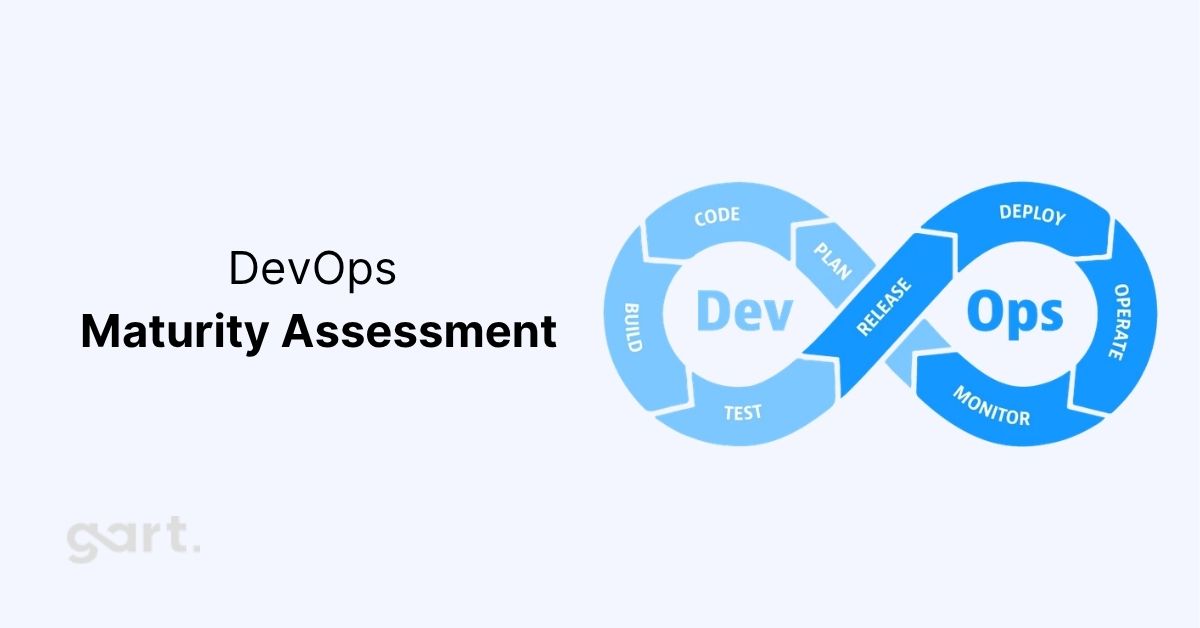
A DevOps Maturity Assessment is the fastest way for engineering leaders to cut through the noise: instead of guessing whether your pipelines, culture, and automation are fit for scale, you measure them against a defined model — and get a clear, prioritized action plan. If your team ships slowly, breaks prod too often, or has CI/CD that looks good on paper but hurts in practice, this guide is for you.
Most engineering organizations believe they're "doing DevOps." They have pipelines. They run stand-ups. They've adopted Kubernetes. But belief and measurement are two different things — and the gap between them is where millions in engineering cost quietly disappear.
A structured DevOps maturity assessment replaces gut feeling with data. It shows you not just where you are, but — more importantly — what the highest-leverage improvements are to get you where you need to be. At Gart Solutions, we run these assessments with engineering teams before any transformation engagement, because the map matters as much as the destination.
What Is a DevOps Maturity Assessment?
A DevOps Maturity Assessment is a structured evaluation of how effectively an organization has adopted DevOps practices across people, processes, and tooling. It scores your current state against a maturity model — typically spanning five levels — and identifies gaps between where you are and where you need to be to meet your business objectives.
Unlike a generic IT audit, a well-designed assessment focuses on outcomes: how fast you ship, how reliably you recover, how safely you deploy. It covers dimensions like CI/CD pipeline health, infrastructure automation, observability, security integration (DevSecOps), and team collaboration culture.
The end product isn't a report card. It's a roadmap.
Why a DevOps Maturity Assessment Matters in 2026
The Cloud Native Computing Foundation reports that organizations running optimized DevOps practices deploy code 973× more frequently and recover from incidents 6,570× faster than low-performing peers. That gap isn't theoretical — it directly translates to market speed, engineering cost, and system reliability.
In 2026, three forces make the assessment more urgent than ever:
AI-assisted development is accelerating output — without mature deployment pipelines and test automation, faster code generation means faster failure propagation.
Platform engineering is now mainstream — teams that haven't matured their internal developer platforms are accumulating invisible cognitive load and toil debt.
Board-level scrutiny of engineering efficiency — CTOs are being asked to justify engineering ROI with metrics, not anecdotes. A maturity assessment gives you the evidence base.
The 5 Levels of DevOps Maturity
Most frameworks — including DORA, the DevOps Institute model, and our own assessment methodology at Gart Solutions — converge on five maturity levels. Here's how they break down in practice:
LevelNameCharacteristic BehaviorTypical Deployment Frequency1InitialManual, reactive, siloed teams. Deployments are events, not routines. Documentation is sparse.Monthly or less2ManagedBasic CI pipelines exist. Some automation. Deployments are still stressful but more predictable.Weekly3DefinedStandardized pipelines across teams. IaC adopted. Environments are reproducible. Monitoring is in place.Multiple times per week4MeasuredDORA metrics tracked. Deployment decisions are data-driven. SLOs defined and enforced. Security is shifted left.Daily or on-demand5OptimizedContinuous improvement loops. AI/ML-assisted operations. Platform engineering enables developer self-service. Near-zero manual toil.Multiple per day, on-demandThe 5 Levels of DevOps Maturity
Most mid-market engineering organizations sit at Level 2–3 when they first run an honest assessment. The jump from Level 3 to Level 4 — from "defined" to "measured" — is where the most transformative gains live, and where we focus the bulk of our advisory work.
Key Dimensions a DevOps Maturity Assessment Should Cover
A rigorous DevOps maturity assessment doesn't score you on a single axis. It evaluates six interconnected dimensions, because weakness in any one of them caps the ceiling of the others.
1. CI/CD Pipeline Maturity
The pipeline is the nervous system of DevOps. Assess: How automated is the path from commit to production? Are builds deterministic? Is there a single source of truth for pipeline definitions? Are failing builds treated as P1 incidents by your team, or routinely ignored?
Red flags at this level include parallel "shadow" pipelines maintained by individual teams, manual approval gates with no audit trail, and test suites that run only nightly rather than on every commit.
2. Infrastructure as Code (IaC)
If your environments can't be reproduced from code in under an hour, you have a systemic risk. Evaluate: What percentage of your infrastructure is defined in code (Terraform, Pulumi, CDK)? Are modules reviewed and versioned? Is drift detection automated? Can a new engineer provision a staging environment without tribal knowledge?
3. Observability & Monitoring
Monitoring tells you that something broke. Observability tells you why. Assess whether your teams have correlated logs, traces, and metrics — and whether they can answer questions about system behavior they didn't anticipate in advance. Organizations at Level 4+ define SLOs and run error budget policies, not just alert thresholds.
4. Security Integration (DevSecOps)
Security that happens after code is written is security theater. A mature assessment checks whether SAST, DAST, dependency scanning, and secrets detection are built into the pipeline — not bolted on post-deployment. The Platform Engineering community increasingly treats "golden paths" that embed security by default as a hallmark of Level 4–5 maturity.
5. Test Automation Coverage
Deployment confidence is a function of test coverage and test reliability. Assess: What's your unit/integration/e2e test ratio? How long does the full test suite take? Are there flaky tests that are routinely ignored? Do you practice contract testing for microservices?
6. Culture & Collaboration
Tooling without culture is decoration. This dimension is often the hardest to score but the most predictive of long-term success. Evaluate: Do dev and ops teams share on-call rotation? Are postmortems blameless and acted upon? Is psychological safety high enough that engineers flag problems early rather than hiding them until they explode?
The DORA Metrics: Your Assessment's North Star
No DevOps maturity assessment is complete without mapping your performance against the four DORA metrics — the research-backed indicators that most strongly correlate with organizational performance and software delivery excellence:
These four numbers, measured honestly over 30–90 days, tell you more about your DevOps health than any survey ever could. If you don't have automated tracking for all four right now, that gap itself is a finding from your assessment.
How to Run a DevOps Maturity Assessment: A Step-by-Step Process
Assessment Process Steps
01
Define scope and stakeholders
Decide whether you're assessing a single product team, a business unit, or the entire engineering organization. Include engineering leads, platform/infra engineers, QA leads, and a security representative. Don't run the assessment without someone who can speak to culture — usually an EM or VP Eng.
02
Baseline your DORA metrics
Pull 90 days of real deployment data before you run any interviews or surveys. Objective data prevents the "we're actually pretty good" bias that kills honest self-assessments. Tools like DORA DevOps Quick Check, LinearB, or your own pipeline analytics can generate this automatically.
03
Run structured interviews and tool audits
For each of the six dimensions, combine a structured interview (30–45 min per team lead) with a direct audit of tooling: walk the CI pipeline, review IaC repositories, inspect alert configs, scan security toolchain outputs. Triangulate what people say against what you see.
04
Score against the maturity model
Map findings to your framework. Use a 1–5 scale per dimension. Averaging across dimensions gives you an overall maturity score, but the per-dimension breakdown is more actionable than the average.
05
Identify highest-leverage gaps
Not all gaps are equal. Prioritize by impact (what bottlenecks the whole system?) and feasibility (what can you fix in 90 days without a full replatform?). A dependency bottleneck in CI — like a 45-minute build — often has more impact than a missing DAST tool.
06
Build a phased roadmap
Group improvements into 30/60/90-day quick wins and 6–12-month strategic initiatives. Assign ownership. Set the target DORA metrics for each phase so progress is measurable, not subjective.
Common Pitfalls That Skew Your DevOps Assessment Results
The assessment process itself can go wrong in predictable ways. Watch for these:
Self-reporting without data validation. Surveys alone produce optimistic scores. Always ground interview findings in observed tool states and actual deployment records.
Assessing tooling, not outcomes. "We have Kubernetes" is not a maturity signal. "We reduced MTTR by 60% since adopting Kubernetes" is. Anchor every finding to a business or delivery outcome.
Excluding culture from the scope. Technically proficient teams with blame culture, poor blameless postmortems, and no psychological safety will plateau at Level 3 regardless of their toolchain.
Treating the assessment as a one-time event. DevOps maturity is a moving target. Best-practice organizations re-assess quarterly — formally or via automated metric dashboards — to track drift and progress simultaneously.
DevOps Maturity Assessment Frameworks Worth Knowing
You don't need to build your framework from scratch. Several industry models provide a solid foundation:
DORA (DevOps Research and Assessment) — the gold standard for outcome measurement. Their annual State of DevOps Report is the most-cited research in the field. Start here for metrics.
DevOps Institute Maturity Model — broader than DORA, covering skills, process, and organizational dimensions alongside technical ones. Useful for organizations early in their transformation journey.
CNCF Cloud Native Maturity Model — specifically designed for cloud-native organizations, covering containers, orchestration, and observability maturity. Published by the Cloud Native Computing Foundation and freely available.
Platform Engineering Maturity Model — emerging framework from PlatformEngineering.org that assesses the maturity of Internal Developer Platforms (IDPs). Critical if developer experience and self-service are strategic priorities for your organization.
In practice, we combine elements of all four when conducting assessments for clients — the right framework is always the one that maps to your actual goals, not the most prestigious one.
Gart Solutions · DevOps Advisory
Not sure where your engineering org really stands? We'll tell you — with data, not guesswork.
Gart Solutions delivers structured DevOps Maturity Assessments for engineering teams at growth-stage and enterprise companies. In 2–3 weeks, you get a scored baseline across all six maturity dimensions, DORA benchmarks, and a prioritized 90-day roadmap your team can execute immediately.
Book a Free Discovery Call →
CI/CD Pipeline Audit
Infrastructure Review
DORA Metric Baseline
Security Posture Check
90-Day Roadmap
Executive Readout
Fedir Kompaniiets
Co-founder & CEO, Gart Solutions · Cloud Architect & DevOps Consultant
Fedir is a technology enthusiast with over a decade of diverse industry experience. He co-founded Gart Solutions to address complex tech challenges related to Digital Transformation, helping businesses focus on what matters most — scaling. Fedir is committed to driving sustainable IT transformation, helping SMBs innovate, plan future growth, and navigate the "tech madness" through expert DevOps and Cloud managed services. Connect on LinkedIn.
You Might Also Like
Platform Engineering: How to Build an Internal Developer Platform That Scales
Kubernetes Cost Optimization: Cutting Cloud Spend Without Cutting Corners
DevSecOps Implementation Guide: Shifting Security Left Without Slowing Teams Down
CI/CD Pipeline Best Practices for High-Velocity Engineering Teams
Infrastructure as Code with Terraform: A Practical Guide for Engineering Leaders
Compliance Monitoring is the ongoing process of verifying that an organization's systems, processes, and people continuously adhere to regulatory requirements, internal policies, and industry standards — not just at audit time, but every day. For cloud-native and regulated businesses in 2026, it is the difference between a clean audit and a costly breach.
What is Compliance Monitoring?
Compliance monitoring is the systematic, continuous practice of evaluating whether an organization's operations, systems, and people conform to the laws, regulations, and internal standards that govern them. Unlike a one-time audit, compliance monitoring runs as an always-on feedback loop — collecting evidence, flagging exceptions, and enabling rapid remediation before regulators ever knock on the door.
The practice is critical across heavily regulated industries:
Healthcare — HIPAA, HITECH, 21 CFR Part 11
Finance & Banking — PCI DSS, SOX, Basel III, MiFID II
Cloud & SaaS — SOC 2, ISO 27001, CSA CCM
EU-regulated entities — GDPR, NIS2, DORA
Energy & Utilities — NERC CIP, ISO 50001
Pharmaceuticals — GxP, FDA 21 CFR
💡 In short: Compliance monitoring is your organization's immune system. Audits are the annual check-up. Monitoring is what keeps you healthy between check-ups.
Why Compliance Monitoring Matters in 2026
Regulatory landscapes have never moved faster. GDPR fines reached record highs in 2024–2025, NIS2 entered enforcement mode across the EU, and DORA (Digital Operational Resilience Act) took effect for financial entities. Meanwhile, cloud adoption has created entirely new attack surfaces that traditional point-in-time audits simply cannot cover.
Risk Without MonitoringTypical Business ImpactProbability (unmonitored)Undetected misconfigured S3 bucket / cloud storageData breach, regulatory fine, brand damageHighStale privileged access not reviewedInsider threat, audit failure, SOX violationVery HighMissing audit log retentionInability to prove compliance, automatic audit failureHighBackup not testedUnrecoverable data loss, SLA breach, recovery failureMediumUnpatched critical CVE beyond SLAExploitable vulnerability, CVSS breach, PCI non-complianceHighWhy Compliance Monitoring Matters in 2026
Strong compliance monitoring builds trust with enterprise clients and partners, significantly reduces audit preparation time, and enables a proactive risk posture instead of a reactive, fire-fighting one.
Compliance Monitoring vs Compliance Audit vs Compliance Management
These three terms are often used interchangeably but they describe distinct activities that work together. Understanding the difference helps organizations allocate resources correctly.
DimensionCompliance MonitoringCompliance AuditCompliance ManagementFrequencyContinuous / near-real-timePeriodic (annual, quarterly)Ongoing governancePurposeDetect & alert on deviationsFormal independent assessmentPolicies, training, cultureOutputAlerts, dashboards, exception logsAudit report, findings, attestationPolicies, procedures, risk registerWho leadsEngineering / Security / DevOpsInternal audit / Third-party auditorCompliance Officer / GRC teamAnalogyBlood pressure cuff worn dailyAnnual physical with doctorHealthy lifestyle programCompliance Monitoring vs Compliance Audit vs Compliance Management
✅ Monitoring answers
Is MFA enforced right now?
Are all logs being retained?
Did anything change in IAM this week?
Are backups completing successfully?
Is encryption enabled on all storage?
📋 Auditing answers
Were controls effective over the period?
Did evidence satisfy the framework?
What is the organization's control maturity?
What formal findings require remediation?
Is the organization SOC 2 / ISO 27001 ready?
Explore our Compliance Audit services
The 7-Step Compliance Monitoring Process
Effective compliance monitoring is not a single tool or dashboard — it's a disciplined cycle. Here is the process Gart uses when setting up or maturing a client's compliance monitoring program:
1. Define Scope & Applicable Frameworks
Identify which regulations, standards, and internal policies apply. Map your systems, data flows, and third-party integrations to determine the monitoring perimeter. Ambiguous scope is the most common reason monitoring programs fail.
2. Inventory Systems & Controls
Catalogue all assets (cloud, on-prem, SaaS, CI/CD pipelines) and map each one to a control objective. Assign control owners. Without ownership, no one acts when an exception fires.
3. Define Evidence Collection Rules
For each control, specify what constitutes "evidence of compliance" — a log entry, a configuration state, a test result, a screenshot, or a signed document. Define collection frequency (real-time, daily, monthly) and acceptable format for auditors.
4. Instrument & Automate Collection
Deploy monitoring agents, SIEM rules, cloud policy engines (AWS Config, Azure Policy, GCP Security Command Center), and IaC scanning tools. Automate evidence collection wherever possible — manual evidence gathering at audit time is a costly, error-prone anti-pattern.
5. Monitor Exceptions & Triage Alerts
Create alert thresholds for control deviations. Not every alert is a breach — build a triage process that separates noise from genuine risk. Route high-priority exceptions to security/engineering immediately; lower-priority items to a weekly review queue.
6. Prioritize Risks & Remediate
Score exceptions by likelihood and impact. Maintain a risk register that tracks open findings, owners, and target remediation dates. Escalate unresolved critical findings to leadership with a clear business-impact framing.
7. Re-test, Report & Continuously Improve
After remediation, re-test the control to confirm it is effective. Produce compliance health reports for leadership and auditors. Run a quarterly retrospective to tune alert thresholds and update monitoring scope as regulations and infrastructure evolve.
Key Controls & Evidence to Monitor
Across hundreds of compliance engagements, the controls below consistently appear on auditor checklists. These are the areas where automated compliance monitoring delivers the highest return:
Control AreaWhat to MonitorEvidence Auditors WantRelevant FrameworksIdentity & Access (IAM)Privileged role assignments, inactive accounts, MFA status, service account permissionsAccess review logs, MFA adoption rate, least-privilege config exportsSOC 2, ISO 27001, HIPAAAudit LoggingLog completeness, retention period, tamper-evidence, SIEM ingestion healthLog retention policy, SIEM dashboard, CloudTrail / Audit Log exportsPCI DSS, SOX, NIS2, GDPREncryptionData-at-rest encryption on storage, TLS version on endpoints, key rotation schedulesEncryption config exports, key management audit logs, TLS scan reportsPCI DSS, HIPAA, GDPR, ISO 27001Patch ManagementCVE scan results, SLA adherence per severity, open critical/high vulnerabilitiesScan reports, patch cadence logs, SLA compliance metricsSOC 2, PCI DSS, ISO 27001Backup & RecoveryBackup job success rate, RPO/RTO test results, offsite replication statusBackup logs, recovery test records, DR test reportsSOC 2, ISO 22301, DORA, NIS2Vendor / Third-Party AccessActive vendor sessions, access scope, contract/NDA currency, SOC 2 report datesVendor access logs, contract register, third-party risk assessmentsISO 27001, SOC 2, GDPR, NIS2Network & PerimeterFirewall rule changes, open ports, egress filtering, WAF alert volumesFirewall config snapshots, IDS/IPS logs, pen test reportsPCI DSS, SOC 2, NIS2Incident ResponseMean time to detect (MTTD), mean time to respond (MTTR), breach notification timelinesIncident logs, CSIRT reports, post-mortemsGDPR (72h), NIS2, HIPAA, DORAKey Controls & Evidence to Monitor
Continuous Compliance Monitoring for Cloud Environments
Cloud infrastructure changes constantly — teams spin up resources, update IAM policies, and deploy code multiple times per day. This makes continuous compliance monitoring not a nice-to-have but a fundamental requirement. Manual checks against cloud state are obsolete before the ink dries.
AWS Compliance Monitoring — Key Automated Checks
AWS Config Rules — detect non-compliant resources in real time (e.g., unencrypted EBS volumes, public S3 buckets, missing CloudTrail)
AWS Security Hub — aggregates findings from GuardDuty, Inspector, Macie into a single compliance posture score
CloudTrail + Athena — query audit logs for unauthorized IAM changes, API calls outside approved regions
IAM Access Analyzer — surfaces external access to resources and unused roles/permissions
Azure Compliance Monitoring — Key Automated Checks
Azure Policy & Defender for Cloud — enforce and score compliance against CIS, NIST SP 800-53, ISO 27001 benchmarks
Microsoft Purview — data classification, governance, and audit trail across Azure and M365
Azure Monitor + Sentinel — SIEM-class alerting on suspicious activity with compliance-relevant playbooks
Privileged Identity Management (PIM) — just-in-time access with mandatory justification and approval workflows
GCP Compliance Monitoring — Key Automated Checks
Security Command Center — organization-wide misconfiguration detection and compliance benchmarking
VPC Service Controls — perimeter security policies that prevent data exfiltration
Cloud Audit Logs — immutable, per-service activity and data access logs
Policy Intelligence — recommends IAM role right-sizing based on actual usage data
🔗
For authoritative cloud security benchmarks, the CIS Benchmarks provide configuration baselines for AWS, Azure, GCP, Kubernetes, and 100+ other platforms — an industry-standard starting point for any cloud compliance monitoring program.
See Gart's Cloud Computing & Security services
Industry-Specific Compliance Monitoring Frameworks
Compliance monitoring requirements differ significantly by industry and geography. Below are the frameworks Gart's clients most commonly monitor against, along with the controls that require continuous (not just periodic) monitoring.
FrameworkIndustry / RegionKey Continuous Monitoring RequirementsResourcesISO 27001Global / All industriesAccess control review, log management, vulnerability scanning, supplier reviewISO.orgSOC 2 Type IISaaS / TechnologyContinuous availability, logical access, change management, incident responseAICPAHIPAAHealthcare (US)ePHI access logs, encryption at rest/transit, workforce activity auditsHHS.govPCI DSS v4.0Payment / E-commerceReal-time network monitoring, file integrity monitoring, quarterly vulnerability scansPCI SSCNIS2EU / Critical sectorsIncident detection within 24h, risk assessments, supply chain security checksENISAGDPREU / Global processing EU dataData subject request tracking, breach detection (<72h notification), processor auditsGDPR.euIndustry-Specific Compliance Monitoring Frameworks
How to prepare for a HIPAA Audit - Gart's PCI DSS Audit guide
First-Hand Experience
What We Usually Find During Compliance Monitoring Reviews
After reviewing postures across dozens of regulated environments, these are the patterns we encounter repeatedly — regardless of organization size.
👥
Incomplete or stale access reviews
Former employees and service accounts with active permissions weeks after departure. IAM hygiene is rarely automated, and reviews are often rubber-stamped.
📋
Missing backup test evidence
Backups appear healthy, but nobody has tested a restore in 6–18 months. Auditors want dated restore test logs with RPO/RTO outcomes, not just success metrics.
📊
Fragmented or incomplete audit logs
Gaps in the log chain (like disabled S3 data-event logging) make it impossible to reconstruct an incident or prove that one didn't happen.
🔔
Alert fatigue masking real issues
Thousands of low-fidelity alerts lead teams to mute notifications or build exceptions, inadvertently disabling detection for real threats.
📄
Policy-to-implementation gaps
Written policies say "encryption required," but reality reveals unencrypted legacy buckets. Continuous monitoring is the only way to detect this drift.
🔧
Automation is first patched, last monitored
CI/CD pipelines move faster than human reviewers. IaC repositories often lack policy-as-code scanning, leaving non-compliant resources active for months.
Featured Success Story
Case study: ISO 27001 compliance for Spiral Technology
→
Compliance Monitoring Tools & Automation
The right tooling depends on your stack, frameworks, and team maturity. Most organizations use a layered approach rather than a single platform:
CategoryRepresentative ToolsBest ForCloud Security Posture Management (CSPM)AWS Security Hub, Wiz, Prisma Cloud, Orca Security, Defender for CloudCloud misconfiguration detection, continuous benchmarkingSIEM / Log ManagementSplunk, Elastic SIEM, Microsoft Sentinel, Datadog SecurityLog correlation, anomaly detection, audit evidenceGRC PlatformsVanta, Drata, Secureframe, ServiceNow GRC, OneTrustEvidence collection automation, audit-ready reportingPolicy-as-Code / IaC ScanningOpen Policy Agent (OPA), Checkov, Terrascan, tfsec, ConftestPrevent non-compliant infrastructure from being deployedVulnerability ManagementTenable Nessus, Qualys, AWS Inspector, Trivy (containers)CVE detection, patch SLA monitoring, container scanningIdentity GovernanceSailPoint, CyberArk, Azure PIM, AWS IAM Access AnalyzerAccess reviews, least-privilege enforcement, PAM
⚠️ Tool sprawl is a compliance risk: More tools mean more integrations to maintain, more alert queues to manage, and more places where evidence can fall through the cracks. Start with native cloud tools and expand deliberately. The Linux Foundation and CNCF maintain open-source compliance tooling for cloud-native environments worth evaluating before adding commercial licenses.
Compliance Monitoring Best Practices
1. Shift compliance left into the development pipeline
The cheapest time to catch a compliance violation is before the resource is deployed. Integrate policy-as-code scanning (OPA, Checkov) into your CI/CD pipeline so that non-compliant Terraform or Helm charts never reach production. Treat compliance failures as build-breaking errors, not post-deploy recommendations.
2. Automate evidence collection — not just detection
Detection without evidence collection is useless at audit time. Configure your monitoring tools to export and archive compliance evidence (configuration snapshots, access review logs, scan reports) automatically to an immutable store. Auditors need evidence from a defined period — not a screenshot taken the morning of the audit.
3. Assign control owners, not just tool owners
Every control needs a named human owner who is accountable for exceptions. When an alert fires that MFA is disabled on a privileged account, "the security team" is not a sufficient owner — a specific person must be on call to investigate and remediate within the SLA.
4. Tune alerts ruthlessly to eliminate fatigue
Compliance monitoring programs that generate thousands of daily alerts quickly become ignored. Start with a small set of high-fidelity, high-impact alerts. Expand incrementally after each is tuned to near-zero false positive rates. A team that responds to 20 real alerts per day is more secure than one drowning in 2,000 noisy ones.
5. Monitor your monitoring
Monitoring pipelines break silently. Log shippers stop, API rate limits are hit, SIEM ingestion queues fill up. Build meta-monitoring to detect when evidence collection or alerting pipelines have gaps — and treat those gaps as compliance findings in their own right.
6. Conduct a quarterly compliance posture review
Beyond continuous automated monitoring, schedule a quarterly human review of the compliance posture. Review open exceptions, re-assess risk scores, retire obsolete controls, and update monitoring scope to cover new systems and regulatory changes.
Compliance Monitoring Checklist for Cloud Teams
A starting point for cloud-first compliance. Each item requires a named owner, a monitoring cadence, and a defined evidence artifact.
✓
MFA enforced on all privileged and administrative accounts
✓
Access reviews completed for all privileged roles (minimum quarterly)
✓
Service accounts audited for least-privilege and no unused permissions
✓
Audit logging enabled and retained (90 days min; 1 year for PCI/HIPAA)
✓
SIEM ingestion health monitored — no silent log gaps
✓
Data-at-rest encryption confirmed on all storage (S3, RDS, EBS, blobs)
✓
TLS 1.2+ enforced; TLS 1.0/1.1 disabled on all endpoints
✓
Encryption key rotation scheduled and verified
✓
Vulnerability scans run weekly; critical/high CVEs remediated within SLA
✓
Patch management SLA compliance tracked and reported
✓
Backups verified complete daily; restore tests documented quarterly
✓
DR test completed at least annually; RPO/RTO outcomes logged
✓
No public cloud storage buckets without explicit business justification
✓
Firewall change log reviewed; unauthorized rule changes alerting
✓
Vendor/third-party access scoped, time-limited, and reviewed quarterly
✓
Incident response plan tested; MTTD and MTTR tracked
✓
Policy-as-code scans integrated into CI/CD pipelines
✓
Compliance evidence archived in immutable storage for audit period
✓
Monitoring pipeline health checked — no silent collection failures
✓
Quarterly posture review conducted with named control owners
Gart Solutions · Compliance Monitoring Services
How Gart Helps You Build a Continuous Compliance Monitoring Program
We work with CTOs, CISOs, and engineering leaders to design, implement, and run compliance monitoring programs that hold up under real auditor scrutiny — not just on paper.
🗺️
Scope & Framework Mapping
We identify applicable frameworks (ISO 27001, SOC 2, HIPAA, PCI DSS, NIS2, GDPR) and map your cloud infrastructure to each control objective.
🔧
Monitoring Setup & Automation
We deploy CSPM tools, SIEM rules, and policy-as-code pipelines — so evidence is collected automatically, not manually on audit day.
📊
Gap Analysis & Risk Register
We deliver a clear view of your current compliance posture, prioritized by risk, with a remediation roadmap and accountable owners.
🔄
Ongoing Reviews & Readiness
Monthly exception reviews and pre-audit evidence packages — so you're never scrambling the week before an official audit.
☁️
Cloud-Native Expertise
AWS, Azure, GCP, Kubernetes, and CI/CD. We speak infrastructure as code and translate compliance into DevOps workflows.
📋
Audit-Ready Deliverables
Exception logs, risk matrices, and control evidence archives. Everything formatted for the specific framework you're being audited against.
Get a Compliance Audit
Talk to an Expert
Fedir Kompaniiets
Co-founder & CEO, Gart Solutions · Cloud Architect & DevOps Consultant
Fedir is a technology enthusiast with over a decade of diverse industry experience. He co-founded Gart Solutions to address complex tech challenges related to Digital Transformation, helping businesses focus on what matters most — scaling. Fedir is committed to driving sustainable IT transformation, helping SMBs innovate, plan future growth, and navigate the "tech madness" through expert DevOps and Cloud managed services. Connect on LinkedIn.
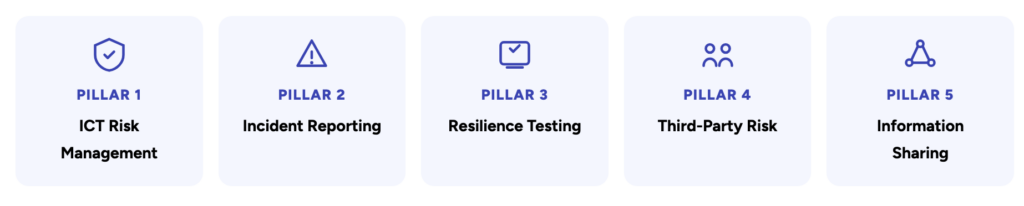
The Digital Operational Resilience Act (DORA) and the Network and Information Security Directive (NIS2) have transformed ICT risk from an IT problem into a board-level, legally enforceable responsibility for European financial and critical-infrastructure organisations. With full compliance deadlines already passed (NIS2: 18 Oct 2024; DORA: 17 Jan 2025), the regulatory era has moved from preparation into active supervision. Regulators now expect demonstrable, auditable capabilities to detect, contain, recover and report ICT incidents — quickly and with legal certainty.
This blog post explains
why jurisdictional risk — not just technical security — is the dominant strategic challenge;
the Sovereign Cloud model (operated and governed within the EU by EU legal entities and EU personnel) is the structural answer to that challenge;
automation (SIEM + SOAR with DORA-specific playbooks) is mandatory to meet 24-hour / 72-hour reporting timelines.
Strategic nexus: sovereignty, resilience, and the new EU mandate
The regulatory shift
DORA and NIS2 replace principle-based guidance with prescriptive requirements covering ICT risk management, incident reporting, operational resilience testing, and third-party oversight. The practical effect is twofold:
Immediate operational requirements — fast incident detection, classification, reporting and recovery processes (24-hour initial notification; 72-hour detailed report).
Systemic, upstream impact — regulators now scrutinize the providers that underpin financial services: cloud and other ICT third parties can be designated as Critical ICT Third-Party Providers (CTPPs) and come under direct ESAs oversight.
The core strategic problem: jurisdictional risk
Technical controls alone are insufficient. Legal exposure — the risk that a cloud provider can be compelled by a foreign law (for example, the US CLOUD Act) to disclose data or to operate under extraterritorial commands — creates a material compliance failure for EU-regulated entities. A financial institution that cannot demonstrate legal and enforceable control over its operational data and processes risks regulatory sanctions, regardless of how sophisticated its technical controls might be.
Implication: For regulated entities, ICT risk = technical risk + jurisdictional/legal risk. Solving the latter requires structural, governance and operational realignment — not just encryption and access controls.
II. The geopolitical advantage: mitigating extra-territorial risk with a Sovereign Cloud
Why “data residency” is not enough
Hosting data physically inside the EU (data residency) is necessary but not sufficient. If the cloud provider’s corporate structure or operational control remains subject to non-EU law, the provider can still be legally compelled to disclose data. The Schrems II jurisprudence and DORA/NIS2 expectations make clear that customers must be able to demonstrate legal enforceability of data protection and operational controls.
Sovereign Cloud: fundamentals and safeguards
A credible Sovereign Cloud must combine technical, operational, and legal design choices:
Operational and data localization
Data and logs must be hosted in exclusive EU regions.
Operational activities (monitoring, support, incident forensics) must be performed by EU-resident personnel subject to EU law.
Dedicated EU legal entities and governance
The cloud must be operated by EU-incorporated legal entities with boards and executive control inside the EU.
This structural separation lets the provider lawfully resist or legally challenge extraterritorial demands, creating a legal firewall that is often more effective than purely technical mitigations.
Contractual guarantees (DPA alignment)
DPAs must codify procedures for third-party requests, subcontracting visibility, audit rights and defined incident handling aligned to DORA/NIS2.
A governance committee should maintain and review DPAs and operational procedures to ensure continued alignment with evolving regulation.
Strategic outcome
A Sovereign Cloud removes the primary source of regulatory uncertainty for highly regulated customers, enabling them to demonstrate due diligence before national competent authorities and ESAs. In markets where regulators are focused on systemic concentration and legal enforceability, this structural assurance becomes a competitive differentiator.
III. Automation blueprint: meeting the 24-hour / 72-hour mandates
DORA’s time-critical reporting obligations
DORA imposes strict timeframes:
Initial notification to the competent authority: no later than 24 hours after detection.
Intermediate/detailed report: within 72 hours of the initial notification (or sooner if circumstances change).
These timelines demand rapid triage, classification against regulatory thresholds, automated evidence collection, and securely auditable reporting. Manual processes will routinely fail under these constraints.
SIEM + SOAR: the closed-loop automation stack
A reliable automation architecture has three integrated layers:
SIEM (detection & centralization)
Collects and normalizes logs from cloud, network, applications and endpoints.
Applies correlation rules and baselines to surface anomalies and potential incidents.
SOAR (orchestration & response)
Hosts playbooks that automate enrichment (AD, CMDB, asset ownership), classification against DORA thresholds, containment actions, and reporting workflows.
Automatically composes the initial regulatory notification template and the 72-hour intermediate report, including forensics and mitigation narratives.
Sovereign Cloud enablers
Native, high-fidelity logging APIs and secure retention to guarantee forensic integrity and residency.
Secure channels for digitally-signed submissions to competent authority portals.
DORA playbooks: practical design
24-Hour Playbook — triggered for incidents meeting ‘Major’ thresholds: auto-enrich, auto-classify, populate the regulator template, and submit the signed initial notification within the 24-hour window.
72-Hour Playbook — continues the data collection, correlates mitigation activity, produces the detailed intermediate report and captures artefacts for RCA and learning.
Automation reduces human error, speeds decision cycles, and creates machine-readable audit trails — transforming compliance from an ad-hoc activity into a measurable operational capability.
IV. Supply-chain resilience: managing Critical ICT Third-Party Providers (CTPP)
DORA’s focus on concentration and systemic risk
DORA recognises that systemic vulnerability can emerge when many financial entities rely on a small number of ICT providers. The regulation grants ESAs powers to designate and supervise CTPPs based on systemic impact, substitutability and concentration of reliance.
Contractual non-negotiables for financial entities
Article 30 and associated requirements define mandatory contractual and oversight elements:
Transparent governance and audit rights — clients and competent authorities must have inspection, audit and access rights commensurate with risk.
Termination & exit strategies — contracts must include enforceable termination rights and tested exit plans when supervision becomes ineffective.
Subcontracting visibility — full transparency into subcontractors and their jurisdictions is required to feed client registers and maintain continuous oversight.
How a Sovereign Cloud addresses CTPP obligations
A structurally sovereign provider directly fulfils many Article 30 expectations: EU governance and operations, pre-agreed audit scope and frequency, contractually guaranteed exit plans and demonstrable counters to jurisdictional interference. This lowers the provider’s risk of CTPP designation friction and simplifies the client’s regulatory reporting.
V. Quantifying the investment: ROI framework for operational resilience
Reframing compliance as strategic value
Boards and investors demand that resilience investment be tied to measurable business outcomes. A robust ROI model includes:
Avoided penalties — quantify the expected value of avoided maximum fines under NIS2/DORA (e.g. €10M or 2% global revenue for essential entities) multiplied by incident probability, then offset by resilience investment cost.
Operational efficiency — measure reductions in MTTD/MTTR, revenue saved per hour of downtime avoided, and FTE productivity gains from automation.
Strategic revenue unlocked — estimate NPV of new contracts and market access that become achievable because of jurisdictional guarantees and regulatory compliance.
Reduced compliance overhead — lower audit and compensating control costs where the Sovereign Cloud offers pre-approved controls and DPA assurances.
Example ROI formula (simplified)
Avoided Cost = (Probability of Major Incident × Maximum Fine) − Cost of Sovereign Cloud Strategy
Total ROI = Avoided Cost + Operational Savings + NPV(New Contracts) − Implementation Cost
Accelerating ROI with pre-integrated services
Providers that deliver both sovereignty and pre-built automation (SIEM + SOAR playbooks) shorten time-to-compliance, reducing implementation risk and accelerating the commercial benefits of market differentiation.
DORA Compliance Playbook
DORA-Compliance-PlaybookDownload
VI. Conclusion — a three-point imperative for boards
The combined pressures of DORA and NIS2 have permanently re-ordered the risk calculus for European financial and critical infrastructure organisations. The path to resilient, compliant operation is defined by three imperatives:
Resolve geopolitical/jurisdictional risk — adopt providers with EU legal entities, EU governance and EU-resident operations to ensure enforceability and resist extraterritorial compulsion.
Achieve automation speed — implement SIEM + SOAR with DORA-specific playbooks to meet strict 24-hour and 72-hour reporting mandates.
Re-engineer supply-chain contracts — demand Article 28/30-compliant clauses: audit rights, subcontracting transparency, enforced exit plans and termination mechanics tied to regulatory supervision effectiveness.
Adopting a Sovereign Cloud that couples structural legal assurance with automated incident response converts regulatory obligation into a market advantage: fewer regulatory exposures, faster time-to-reporting, demonstrable audit trails, and new revenue unlocked by compliance credibility. In short, operational resilience should be framed and measured as a strategic growth engine — not merely an IT expense.