Quick answer: what are the best VMware alternatives?
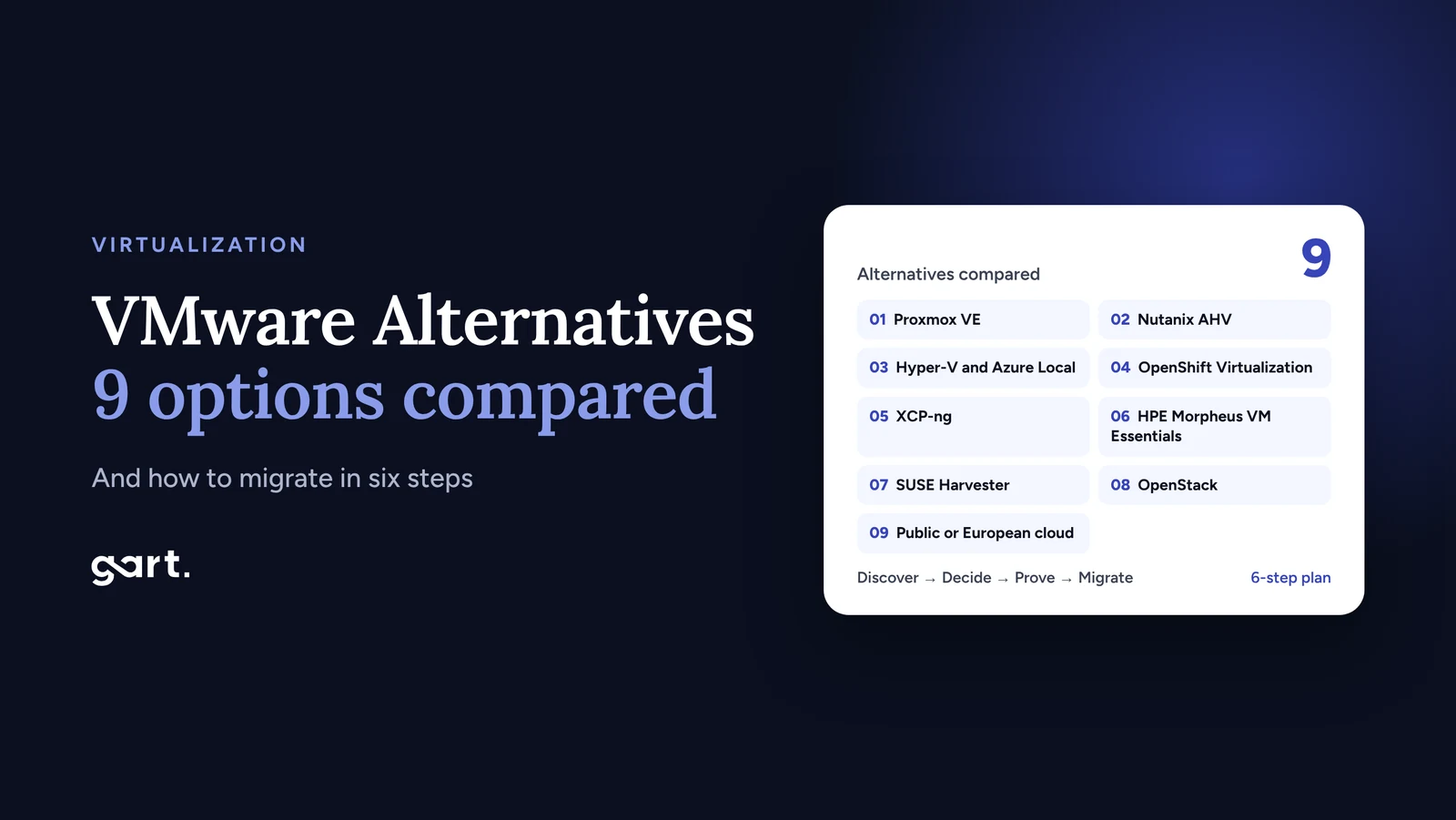
The leading VMware alternatives in 2027 are Proxmox VE, Nutanix AHV, Microsoft Hyper-V and Azure Local, Red Hat OpenShift Virtualization, XCP-ng, HPE Morpheus VM Essentials, SUSE Harvester, OpenStack, and moving workloads to public or European clouds. Proxmox VE is the most popular low-cost option, Nutanix is the closest enterprise replacement, and OpenShift Virtualization suits teams moving to Kubernetes. The right choice depends on your workload size, team skills and budget, and most companies migrate in phases rather than all at once.
Since Broadcom bought VMware, the search for VMware alternatives has moved from a side project to a board-level topic. Perpetual licences are gone, products are sold as bundles, and renewal quotes have jumped for many companies. At the same time, vSphere 8 reaches the end of general support on 11 October 2027, so every VMware customer now has to decide: pay for the upgrade to VCF 9, or leave.
This guide compares the nine most realistic alternatives to VMware, shows what each one costs and who it fits, and explains how to migrate without downtime. It is written by the engineers behind Gart Solutions’ cloud migration services, who plan and run infrastructure moves for SaaS, e-commerce, healthcare and fintech companies.
Renewal quote landed on your desk? Get a free 30-minute call with a Gart infrastructure architect and leave with a first estimate of what staying on VMware vs moving would cost you.
Book a free VMware exit callWhy Companies Are Looking for VMware Alternatives
Four changes since the Broadcom acquisition push companies to look for a VMware replacement:
| Change | What it means for you |
|---|---|
| End of perpetual licences | You now pay a yearly subscription. Licences you already own stop getting updates once their version leaves support. |
| Bundled products | vSphere is sold mainly inside VMware Cloud Foundation (VCF) or vSphere Foundation (VVF), so many teams pay for features they never use. |
| Per-core pricing | Costs grow with modern high-core CPUs. In 2025 Broadcom also announced a 72-core minimum order, which drew strong criticism from smaller customers. |
| End of support for vSphere 8 | ESXi 8, vCenter 8, vSAN 8 and NSX 4 reach the end of service on 11 October 2027, according to Broadcom’s own support notice. |
The result is a slow but steady exit. A CloudBolt survey of 302 IT leaders run in January 2026 found that 86% of companies are actively reducing their VMware use, but only 4% have replaced it completely, as Network World reported. Gartner goes further and expects that by 2029 more than half of enterprises will have moved all of their workloads off VMware. In other words, the question is no longer whether to plan an exit, but how fast and to where.
VMware Alternatives Compared at a Glance
| Alternative | Type | Licensing | Best for | Main trade-off |
|---|---|---|---|---|
| Proxmox VE | Open-source KVM + LXC | Free; optional support per CPU socket | SMBs and mid-size companies, cost-driven exits | Smaller partner ecosystem, fewer enterprise add-ons |
| Nutanix AHV | Hyperconverged (HCI) platform | Subscription per core | Enterprises wanting a like-for-like replacement | Not much cheaper than VMware for every setup |
| Microsoft Hyper-V / Azure Local | Windows-based hypervisor and HCI | Included with Windows Server Datacenter; Azure Local billed per core | Microsoft-centric companies | Best fit only if you already run Windows and Azure |
| Red Hat OpenShift Virtualization | KVM on Kubernetes | Subscription per socket pair | Teams modernising towards containers | Requires Kubernetes skills |
| XCP-ng | Open-source Xen | Free; optional Vates support | Budget-conscious teams wanting a familiar model | Smaller community than KVM-based options |
| HPE Morpheus VM Essentials | KVM-based with unified management | Per socket | HPE customers, mixed VMware and KVM estates | Newer product, smaller install base |
| SUSE Harvester | Open-source HCI on Kubernetes | Free; optional SUSE support | Edge and Kubernetes-first teams | Less mature for large legacy estates |
| OpenStack | Open-source private cloud | Free; distribution support varies | Large private clouds and service providers | Complex to run without a dedicated team |
| Public or European cloud | IaaS (AWS, Azure, GCP, OVHcloud, Hetzner) | Pay as you go or committed use | Teams that want to stop running hardware | Ongoing costs and egress need careful planning |
The 9 Best VMware Alternatives in Detail
1. Proxmox VE: the most popular low-cost VMware alternative
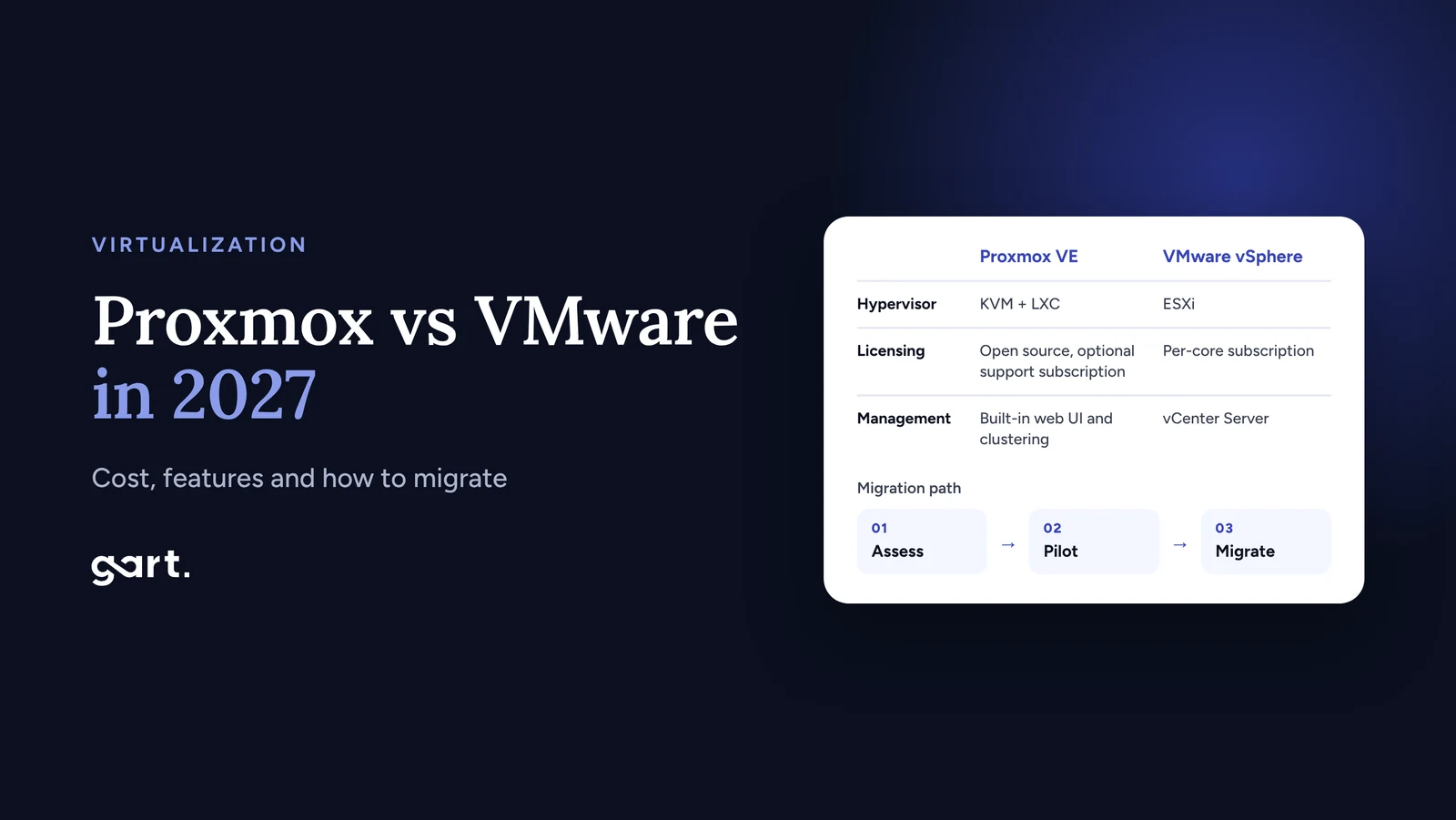
Proxmox Virtual Environment combines the KVM hypervisor and LXC containers in one web interface, with clustering, high availability, Ceph and ZFS storage and built-in backups. The current release line is 9.x, based on Debian 13. The software is free under the AGPLv3 licence, and support is optional. According to the official Proxmox pricing page, subscriptions are charged per occupied CPU socket, not per core, from about €370 per socket per year for Basic support up to €1,100 for Premium.
Choose it if cost is the main driver, your team is comfortable with Linux, and you run up to a few hundred VMs. Watch out for a smaller partner ecosystem and fewer enterprise add-ons. Since version 9.2, Proxmox includes a Dynamic Load Balancer similar to DRS, and its import wizard brings VMs over directly from ESXi. See our detailed Proxmox vs VMware comparison.
2. Nutanix AHV: the closest enterprise replacement
Nutanix Cloud Infrastructure with the AHV hypervisor is the alternative most often shortlisted by large enterprises. It is a hyperconverged platform with compute, storage and networking managed from Prism, plus disaster recovery, Kubernetes and database services. Nutanix Move, a free migration tool, copies VMs from vSphere with short cutover windows.
Choose it if you need enterprise support, a polished management experience and minimal retraining. Watch out for the price: Nutanix is subscription-based and not always much cheaper than VMware, so the business case usually rests on simpler operations rather than licence savings alone.
For a detailed head-to-head, read our Nutanix vs VMware comparison.
3. Microsoft Hyper-V and Azure Local
Hyper-V is included with Windows Server, and the Datacenter edition allows unlimited Windows VMs on licensed hosts. Azure Local (formerly Azure Stack HCI) adds hyperconverged storage and management through Azure, billed per physical core. Many companies already own the Windows Server licences, which makes Hyper-V the cheapest path on paper.
Choose it if most of your workloads run Windows and you use Microsoft 365 and Azure. Watch out for Linux-heavy estates and multi-vendor environments, where management is less smooth.
4. Red Hat OpenShift Virtualization
OpenShift Virtualization runs virtual machines next to containers on Kubernetes, using KubeVirt and KVM. In January 2025 Red Hat launched OpenShift Virtualization Engine, a lower-cost edition for teams that only need to run VMs. It includes the Migration Toolkit for Virtualization for moving VMs from vSphere.
Choose it if you plan to modernise applications into containers over the next few years and want one platform for both. Watch out for the learning curve: your operations team needs Kubernetes skills, or a partner that has them. Our Kubernetes services team helps companies close exactly that gap.
5. XCP-ng
XCP-ng is an open-source hypervisor based on Xen, managed through Xen Orchestra and backed commercially by the French company Vates. It feels familiar to VMware administrators, with central management, live migration, backups and a V2V tool for importing VMs from ESXi.
Choose it if you want an open-source option with a European vendor behind it. Watch out for a smaller ecosystem than KVM-based platforms.
6. HPE Morpheus VM Essentials
HPE’s answer to the VMware shake-up combines its own KVM-based hypervisor with Morpheus management software, which can also manage existing vSphere clusters. That lets you run both side by side and move workloads gradually. Licensing is per socket.
Choose it if you run HPE hardware and want a gradual, managed transition. Watch out for its relative newness compared with Nutanix or Hyper-V.
7. SUSE Harvester
Harvester is an open-source hyperconverged platform built on Kubernetes, KubeVirt and Longhorn storage, and it integrates with Rancher. It is a good fit for edge locations and for teams that already run Kubernetes. Larger legacy estates usually need more planning to move to it.
8. OpenStack
OpenStack is the open-source standard for building a private cloud, used by large enterprises, telecoms and cloud providers such as OVHcloud. It offers self-service, multi-tenancy and APIs similar to public clouds. It is powerful, but running it well needs a dedicated platform team or a managed provider.
9. Public cloud or a European cloud provider
For many companies, the best VMware alternative is to stop running a hypervisor at all. Workloads can be rehosted to AWS, Azure or Google Cloud, or to European providers such as OVHcloud, Hetzner and STACKIT for lower costs and EU data control. Hyperscalers also offer managed VMware (Azure VMware Solution, Google Cloud VMware Engine, Amazon Elastic VMware Service) as a short-term bridge, but these still need VMware licences.
See our guides to European cloud providers, OVH cloud vs AWS and hybrid infrastructure if this path interests you.
Not sure which VMware alternative fits? Start with a VMware exit assessment.
In 2 to 3 weeks, Gart engineers map your VMs, dependencies and licences, then compare staying on VMware with two or three realistic alternatives, with costs and a migration plan.
- Full inventory of hosts, VMs, storage and network dependencies
- Three-year cost comparison: VCF renewal vs Proxmox, Nutanix, Hyper-V or cloud
- Risk-ranked migration waves with rollback plans
How to Choose the Right VMware Alternative
There is no single best replacement for VMware. Match the platform to your situation:
| Your situation | Shortlist |
|---|---|
| Small or mid-size estate, cost is the top priority | Proxmox VE, XCP-ng |
| Large enterprise, minimal retraining, strong vendor support | Nutanix AHV, HPE Morpheus VM Essentials |
| Mostly Windows workloads and Microsoft licences | Hyper-V, Azure Local |
| Plan to move apps into containers | OpenShift Virtualization, Harvester |
| Want to stop owning hardware | Public cloud or European cloud provider |
| Strict EU data sovereignty rules | Proxmox or OpenStack on own hardware, or a sovereign EU cloud |
| Large private cloud with self-service needs | OpenStack, Nutanix |
Beyond the platform itself, score each option on five criteria: three-year total cost (licences, hardware, support and staff time), feature gaps against what you actually use today, backup and disaster recovery support, skills your team has or can hire, and migration tooling from vSphere. A short proof of concept with 10 to 20 real VMs reveals more than any feature matrix.
What a VMware Exit Really Costs
Licence savings are only one part of the business case. Budget for these items when you compare staying with leaving:
| Cost item | Stay on VMware | Move to an alternative |
|---|---|---|
| Licences or subscriptions | VCF or VVF subscription, priced per core | Often lower; free for open-source options |
| Support | Included in subscription | Vendor or partner support contract |
| Hardware | Upgrade may be needed for VCF 9 | Can often reuse existing servers |
| Migration project | Upgrade project to version 9 | Assessment, conversion, testing and cutover |
| Training | Low | Medium, depending on the platform |
| Backup, monitoring and tooling | Existing tools keep working | Some tools need replacing or reconfiguring |
| Risk | Further price changes at renewal | Migration risk, reduced with phased waves |
In our experience, the move pays back fastest when you combine it with cleanup: removing idle VMs, rightsizing what remains and retiring legacy systems. That is also where a cloud repatriation or hybrid model can save more than a pure hypervisor swap.
How to Migrate from VMware: A 6-Step Plan
| Step | What happens | Typical duration |
|---|---|---|
| 1. Discover | Inventory hosts, VMs, storage, networks, licences and application dependencies | 1 to 2 weeks |
| 2. Decide | Compare 2 or 3 target platforms on cost, features and skills; pick one | 1 to 2 weeks |
| 3. Prove | Build a pilot cluster and move 10 to 20 representative VMs | 2 to 4 weeks |
| 4. Prepare | Set up production clusters, networking, backup, monitoring and access as code | 2 to 6 weeks |
| 5. Migrate in waves | Move workloads by risk level, test each wave, keep a rollback path | 1 to 6 months |
| 6. Decommission and optimise | Retire VMware hosts, cancel licences, rightsize the new platform | 2 to 4 weeks |
Plan the timeline backwards from your renewal date or from 11 October 2027, whichever comes first. Teams that start less than six months before a renewal often end up signing one more year of VMware as a bridge. If you also plan to containerise applications later, read our guide to Kubernetes migration.
Want this plan built around your estate? We run discovery, the pilot and the migration waves for you, with a Go/No-Go check before every cutover.
See our migration servicesCase Studies: How Gart Moves Infrastructure Without Breaking It
A VMware exit is an infrastructure migration first and a hypervisor choice second. These Gart projects show the same method we apply to VMware moves: verified cost baselines, careful data validation and no cutover without a clear Go decision.
| Client | Challenge | What Gart did | Result |
|---|---|---|---|
| FluentU (language-learning platform) | Cloud bill of about $9,300 per month, mostly from managed databases | Phased migration from AWS to Hetzner: database layer, app servers, shared storage and CI/CD rebuilt; validation caught 1,464 schema differences before cutover | Infrastructure spend down about 78%, saving roughly $87,000 per year |
| LeTexto (SMS and email marketing platform) | Ageing on-premise setup with security and reliability gaps | Infrastructure audit of the on-premise environment: unpatched software, weak access controls and inefficiencies | Prioritised remediation plan that fit the client’s budget |
| Datamaran (ESG data analytics) | Growing AI workloads needed stronger resilience and recovery | Hardened the infrastructure and built disaster recovery with automation and monitoring | Resilient, scalable platform that meets internal DR standards |
The lesson from these projects applies directly to VMware: the biggest risk is not the hypervisor, it is hidden drift in data, configuration and dependencies. That is why every Gart migration starts with an infrastructure audit and ends with a measured cost comparison.
Why Companies Choose Gart for Their VMware Exit
| What you get | Why it matters |
|---|---|
| Vendor-neutral advice | We are not a VMware, Nutanix or Proxmox reseller, so the recommendation follows your numbers |
| Hands-on engineers | The team that designs the target platform also migrates and runs it |
| Infrastructure as code | New clusters, networks and policies are built with Terraform or Ansible, so they are repeatable and auditable |
| Cloud and on-premise experience | We work with AWS, Azure, GCP, OVHcloud, Hetzner and on-premise hardware, so hybrid designs are on the table |
| Operations after go-live | Optional infrastructure management with monitoring, patching and backups |
Leave VMware on your terms, not at renewal time.
Gart Solutions plans and runs VMware migrations to Proxmox, Nutanix, Hyper-V, OpenShift, public cloud or European clouds, with a fixed-scope assessment first and no lock-in afterwards.
- Free 30-minute call with an infrastructure architect
- VMware exit assessment with a three-year cost comparison
- Phased migration, then optional managed operations