- What Is Hybrid Infrastructure?
- Core Components of Hybrid Infrastructure
- Why Organizations Choose Hybrid Infrastructure
- Decision Framework: When Hybrid Infrastructure Is the Right Choice
- Hybrid Infrastructure Architecture: Real Examples
- Industry Applications
- AI and the Hybrid Future
- The Gart Hybrid Adoption Framework
- Hybrid Infrastructure Security Best Practices
- Conclusion
What Is Hybrid Infrastructure?
Hybrid infrastructure is an IT architecture model that integrates on-premises data centers, private cloud environments, and public cloud platforms — such as AWS, Azure, and Google Cloud — into a single, orchestrated ecosystem. Unlike a pure public cloud or pure private approach, hybrid infrastructure gives organizations direct control over where each workload lives, how data flows between environments, and how resources scale in real time.
At Gart Solutions, we define hybrid infrastructure not just as a technology configuration, but as a strategic operating model. The hybrid model answers a fundamental enterprise dilemma: how do you benefit from the elasticity of public cloud while retaining the compliance control, latency performance, and cost predictability of your own infrastructure?
The short answer: you don’t choose between them. You orchestrate both.
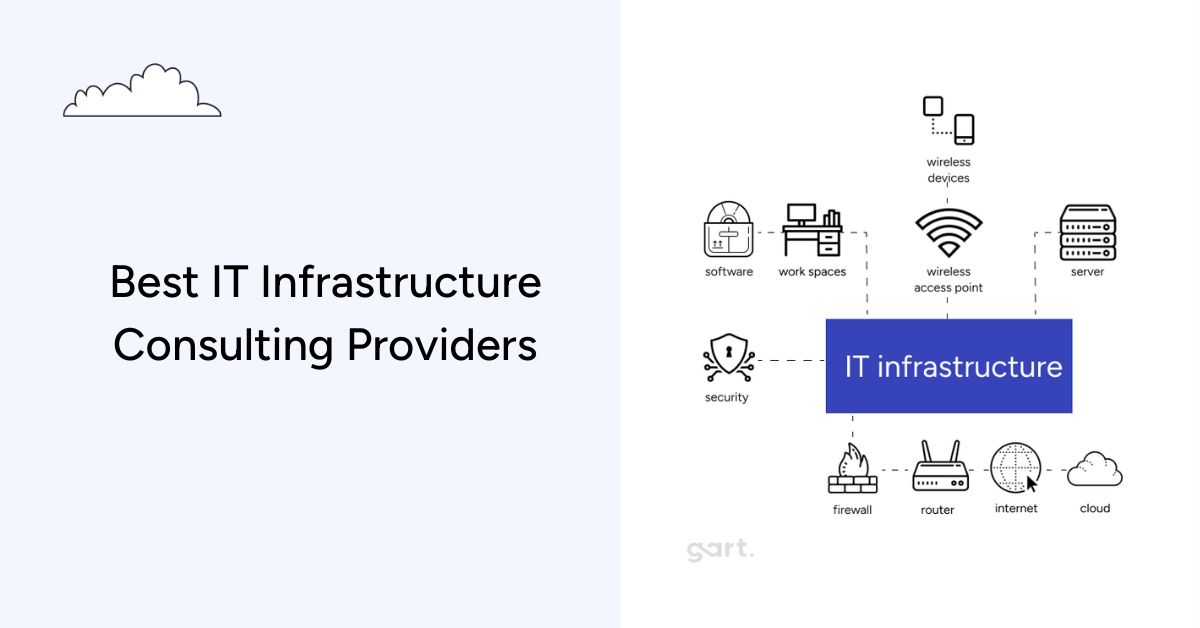
A hybrid cloud combines multiple environments — data centers, private clouds, and public clouds—into a unified system. Its components typically include:
- On-premises infrastructure for critical applications and sensitive data.
- Private cloud environments offering control and security.
- Public cloud services such as AWS, Azure, or Google Cloud for scalable computing.
- Cloud management platforms that provide orchestration across environments.
- Robust network connectivity ensuring secure and efficient communicationHybrid-Cloud-Adoption.
Technologies like Kubernetes, Docker, and federated identity management allow workloads to move seamlessly, ensuring performance, compliance, and resilience. For example, an e-commerce company may store customer data in a private cloud while using public cloud resources to handle peak shopping traffic.
Simple Definition
Hybrid infrastructure connects your on-premises systems with one or more public clouds through secure, high-speed networking — allowing workloads to move dynamically between environments based on cost, compliance, and performance requirements. The result is a unified, manageable IT estate that adapts to business needs rather than constraining them.
Core Components of Hybrid Infrastructure
A production-grade hybrid infrastructure deployment is not simply “some servers plus a cloud account.” It requires seven integrated layers working in concert:
| Component | Purpose | Common Technologies |
|---|---|---|
| On-Premises Infrastructure | Host sensitive workloads, comply with data residency requirements, serve latency-sensitive applications | VMware ESXi, Bare-metal servers, Dell/HPE hardware |
| Private Cloud | Provide cloud-like self-service provisioning within controlled environments | OpenStack, Nutanix, VMware vSphere, vCloud |
| Public Cloud Services | Burst capacity, global reach, managed services, AI/ML compute | AWS, Azure, GCP, Oracle Cloud |
| Hybrid Connectivity Layer | Secure, high-bandwidth interconnection between environments | AWS Direct Connect, Azure ExpressRoute, VPN, SD-WAN |
| Container Orchestration | Portable workload deployment across all environments | Kubernetes, AWS EKS, Azure AKS, OpenShift, Rancher |
| Unified Management Plane | Single-pane visibility and policy control across all environments | HashiCorp Terraform, Pulumi, Crossplane, Google Anthos |
| Identity & Security Layer | Federated authentication, zero-trust access, secret management | HashiCorp Vault, Okta, Azure AD, AWS IAM, SPIFFE/SPIRE |
Technologies like Kubernetes, GitOps tooling (ArgoCD, Flux), and federated identity management enable workloads to move between environments seamlessly — ensuring performance, compliance, and operational consistency. The connectivity layer is often underestimated: without dedicated, low-latency interconnects (not just VPN tunnels), hybrid architectures suffer from the latency and bandwidth limitations that undermine their value proposition.
Why Organizations Choose Hybrid Infrastructure
1. Regulatory Compliance Without Sacrificing Agility
The most common reason enterprises adopt hybrid infrastructure is regulatory compliance. Financial services firms under PCI DSS and MiFID II, healthcare organizations under HIPAA, and European businesses under GDPR cannot simply move everything to public cloud. Hybrid infrastructure lets them keep regulated data within controlled environments while processing non-sensitive workloads on public cloud at full speed.
2. Cost Optimization Across the Full Stack
Pure public cloud can become expensive for predictable, high-utilization workloads. Hybrid infrastructure allows organizations to run steady-state workloads on owned infrastructure — where cost-per-compute-hour is lower after amortization — while using public cloud for burst, dev/test, and globally distributed workloads. This hybrid cost model consistently delivers 25–40% total infrastructure cost reductions compared to all-in public cloud deployments for workload-heavy enterprises.
3. Avoiding Vendor Lock-In
A hybrid infrastructure strategy preserves architectural freedom. Organizations with workloads across multiple cloud providers and on-premises environments retain leverage in cloud contract negotiations and maintain the ability to shift workloads in response to pricing changes, service disruptions, or strategic pivots.
4. Edge Computing and Latency Requirements
Manufacturing, retail, and logistics operations increasingly require real-time data processing at the network edge — where roundtrip latency to a distant cloud region is simply too high. Hybrid infrastructure integrates edge processing with centralized cloud analytics, enabling millisecond decisions on the factory floor while leveraging cloud-scale AI for retrospective analysis.
5. Legacy System Modernization Without “Big Bang” Risk
Most enterprises cannot migrate everything to cloud simultaneously. Hybrid infrastructure provides the architectural bridge: legacy systems remain on-premises while new services are built cloud-native, with integration layers connecting both. This phased modernization approach reduces migration risk dramatically compared to wholesale lift-and-shift programs.
Decision Framework: When Hybrid Infrastructure Is the Right Choice
Hybrid infrastructure is not always the optimal architecture. Over-engineering smaller organizations with hybrid complexity creates unnecessary operational overhead. The decision framework below reflects patterns we’ve observed across dozens of infrastructure engagements:
| Scenario | Best Architecture | Key Reason |
|---|---|---|
| High-compliance regulated data (HIPAA, PCI, GDPR) | ✅ Hybrid | Data residency control with cloud elasticity for non-regulated workloads |
| Legacy applications that cannot be re-architected | ✅ Hybrid | Keep legacy on-prem; build new services cloud-native |
| Mixed workload predictability (some steady-state, some spiky) | ✅ Hybrid | Optimize CapEx for steady loads, OpEx for burst |
| IoT / Edge real-time processing requirements | ✅ Hybrid | Edge processing reduces latency; cloud handles analytics |
| VMware-dependent workloads migrating to cloud | ✅ Hybrid (transitional) | VMware Cloud on AWS / Azure VMware Solution enables lift-and-shift with gradual modernization |
| Early-stage startup with no existing infrastructure | 🔵 Public Cloud Only | No CapEx, instant global scale, minimal operational overhead |
| Fully predictable, stable workloads with no compliance constraints | 🔵 Private Cloud / On-Prem | Lowest total cost for fully deterministic workloads |
| Multi-region SaaS serving global customers | 🟣 Multi-Cloud + Hybrid | Sovereign cloud regions plus on-prem for core data processing |
💡 Key Takeaway
Hybrid infrastructure is most effective when workloads are classified by their compliance, latency, and cost profiles — and placed accordingly. The classification step is what most organizations skip, leading to hybrid architectures that are expensive to run and difficult to manage. Workload classification should precede any infrastructure procurement decision.
Hybrid Infrastructure Architecture: Real Examples
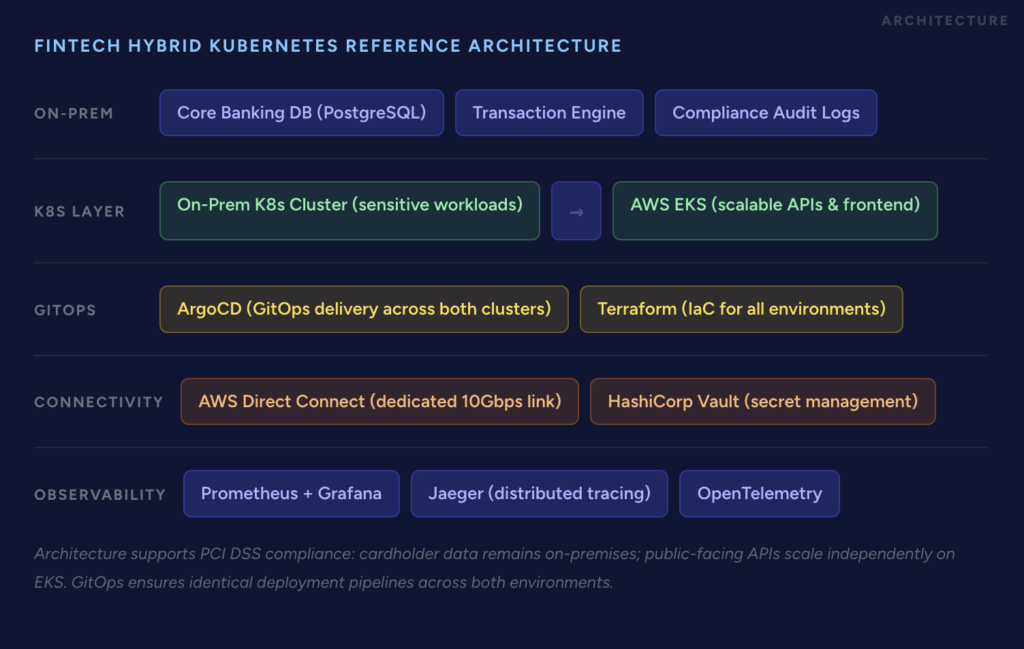
Example 1: Hybrid Kubernetes Architecture for FinTech
This architecture pattern is used by financial institutions that need to keep transaction processing and sensitive data on-premises (for regulatory compliance) while scaling frontend services and analytics workloads on public cloud:
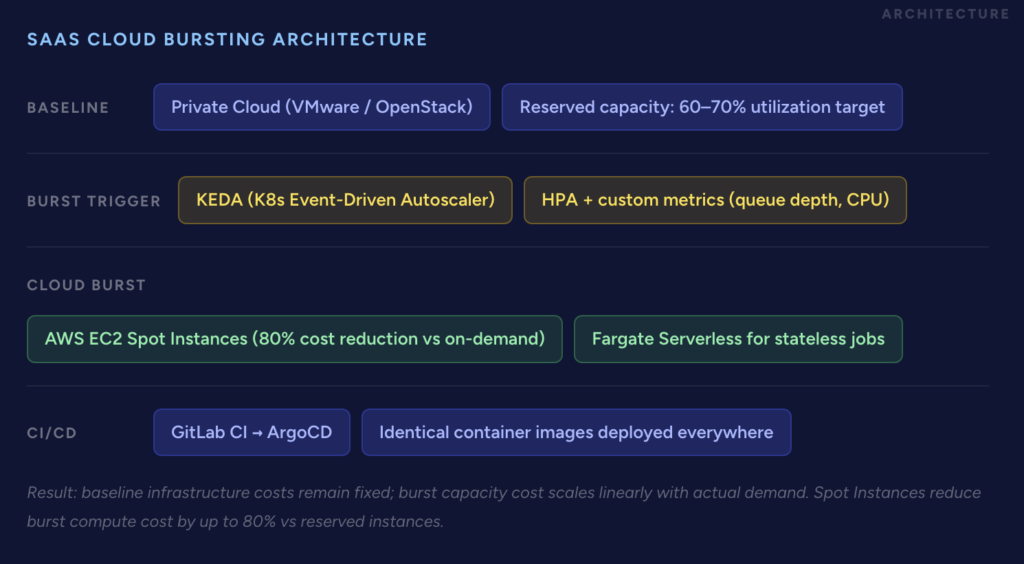
Example 2: Hybrid Infrastructure for SaaS Companies (Cloud Bursting)
SaaS companies with predictable core workloads and unpredictable traffic spikes benefit from a hybrid model that keeps baseline capacity on-premises while automatically bursting to cloud during peak demand:
Example 3: Enterprises Migrating from VMware
The 2023–2025 Broadcom acquisition of VMware triggered significant license cost increases, forcing thousands of enterprises to reconsider their private cloud strategy. Hybrid infrastructure provides the migration path:
- Phase 1 — Assess: Inventory all VMware workloads; classify by cloud-readiness, compliance requirements, and cost sensitivity.
- Phase 2 — Lift-and-Shift to Cloud VMware: Use AWS VMware Cloud or Azure VMware Solution for a zero-disruption first move. Workloads run identically; no re-platforming required.
- Phase 3 — Containerize Priority Workloads: Identify top 20% of workloads by value; containerize and migrate to managed Kubernetes (EKS, AKS). These become cloud-native.
- Phase 4 — Decommission VMware: With cloud-native workloads migrated, remaining VMware licenses are reduced; on-premises footprint shrinks to compliance-required workloads only.
- Phase 5 — Optimize: Implement FinOps tooling, rightsize cloud resources, and establish cost governance for the long term.
Industry Applications
Healthcare
Hybrid clouds support HIPAA compliance by keeping patient data secure in private environments while using public clouds for analytics and telemedicine. Providers leverage AI-driven predictive diagnostics, real-time patient monitoring, and population health managementHybrid-Cloud-Adoption.
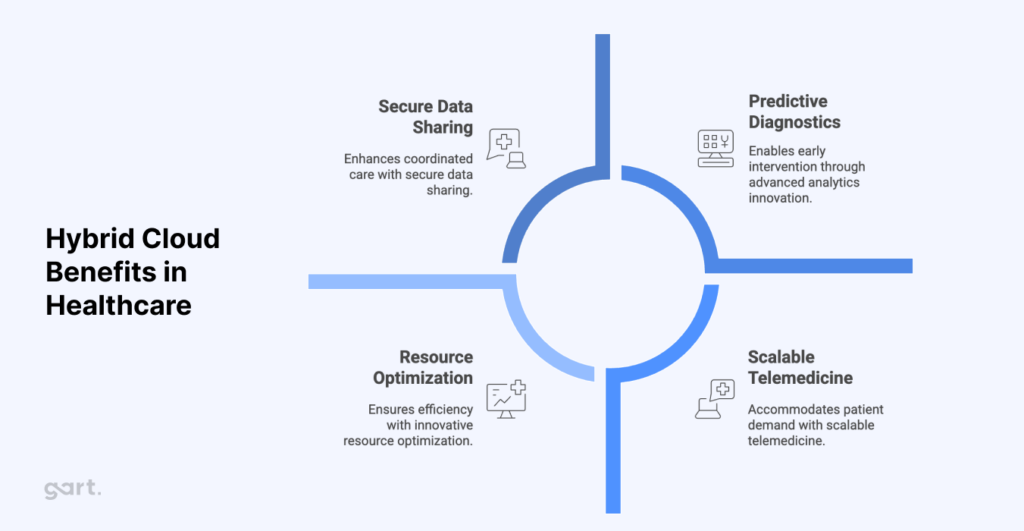
Healthcare providers face a dual challenge: ensuring patient data security while enabling innovation in diagnostics and care delivery. Hybrid cloud addresses both.
Secure Data Management
- Sensitive patient records are stored on-premises or in private clouds to comply with regulations such as HIPAA.
- Public clouds are used for less sensitive workloads, such as running non-critical applications.
- Encryption, identity management, and role-based access controls strengthen overall data protection.
- Hybrid frameworks also make it easier to share data securely among different providers, enhancing coordinated care.
Advanced Analytics for Better Patient Care
- By aggregating clinical, operational, and external datasets, healthcare systems can apply machine learning models for predictive diagnostics.
- Hybrid platforms support personalized treatment plans and real-time monitoring of patient conditions, enabling early intervention.
- Population health management benefits from big data processing across distributed cloud resources.
Operational Efficiency
- Cloud-powered electronic health record (EHR) systems minimize downtime and improve accessibility.
- Telemedicine becomes scalable, accommodating surges in patient demand.
- Predictive analytics optimize hospital resource allocation and supply chain logistics, ensuring efficiency even during crises.
Financial Services
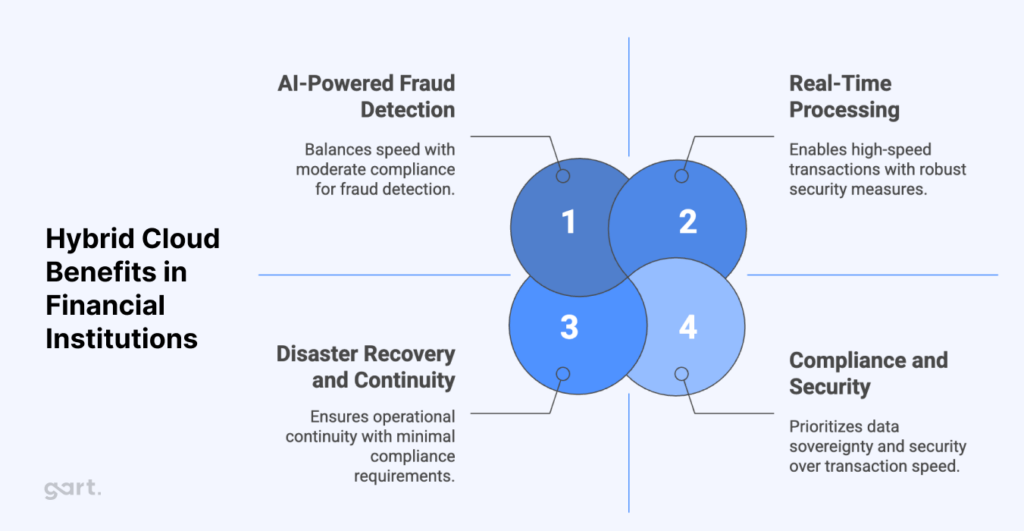
Financial institutions prioritize compliance, security, and high-speed transactions, making hybrid cloud a natural fit.
- Disaster recovery with geographically dispersed backups.
- Low-latency high-frequency trading systems.
- Fraud detection powered by AI across distributed systems.
- Compliance with GDPR, PCI DSS, and MiFID IIHybrid-Cloud-Adoption.
Disaster Recovery and Continuity
- Hybrid setups allow banks to deploy geographically dispersed backup systems, ensuring operations continue during outages.
- Failover between on-premises and cloud environments enables rapid recovery.
- Institutions can test disaster recovery strategies without disrupting production systems.
Real-Time Processing
- Hybrid clouds support low-latency high-frequency trading systems directly connected to financial markets.
- They enable instant fraud detection by analyzing live transaction data with machine learning.
- Payment processing and global settlements benefit from dynamic scaling.
Compliance and Security
- Regulations like GDPR, PCI DSS, and MiFID II require sensitive financial data to remain within specific jurisdictions. Hybrid models allow data sovereignty by isolating critical data in controlled environments.
- Encryption, tokenization, and multi-factor authentication strengthen transaction security.
- Continuous auditing across hybrid systems ensures transparency and accountability.
- AI-Powered Fraud Detection
Leveraging hybrid resources, AI systems analyze thousands of transactions per second across platforms to identify anomalies, reducing fraud risks while maintaining transaction speed.
Manufacturing
Hybrid environments connect IoT devices and edge computing to support real-time data processing on factory floors. AI-driven predictive maintenance reduces downtime, while hybrid systems optimize global supply chainsHybrid-Cloud-Adoption.
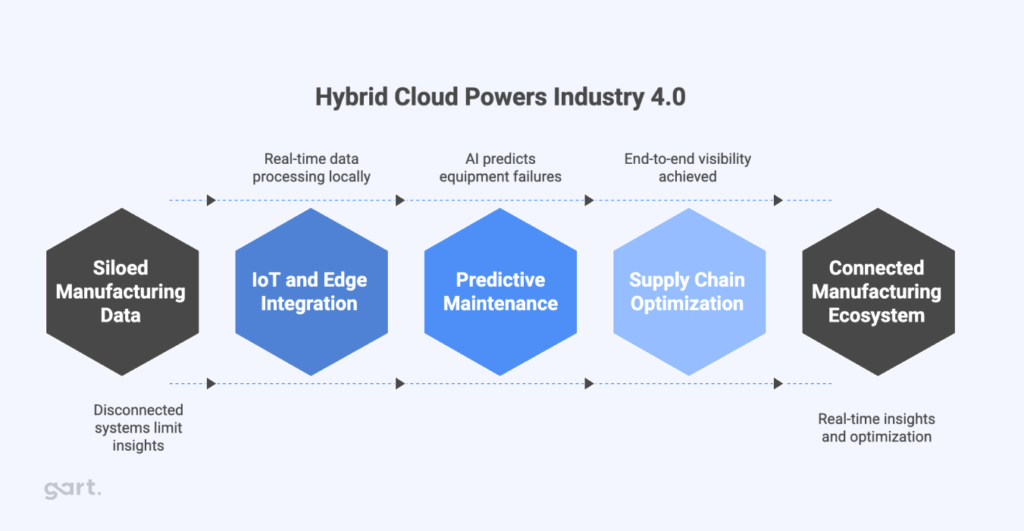
Manufacturers are embracing hybrid cloud to power Industry 4.0, connecting machines, IoT devices, and analytics systems.
IoT and Edge Computing Integration
- Hybrid architectures allow real-time data from sensors on production lines to be processed locally, reducing latency.
- AI algorithms running across hybrid environments provide instant decision-making at the edge.
Predictive Maintenance
- AI analyzes data from connected machines to predict equipment failures.
- Maintenance schedules are optimized, reducing downtime and extending asset life.
- Hybrid clouds balance local, edge-based monitoring with centralized analytics for global operations.
Supply Chain Optimization
- By combining data across public and private systems, manufacturers achieve end-to-end visibility in supply chains.
- Hybrid solutions allow them to adjust quickly to demand shifts, production bottlenecks, or material shortages.
Retail
Retailers adopt hybrid clouds for personalized shopping experiences, inventory management, and omnichannel services. AI recommendation engines thrive in this environment, enabling dynamic, data-driven customer engagementHybrid-Cloud-Adoption.
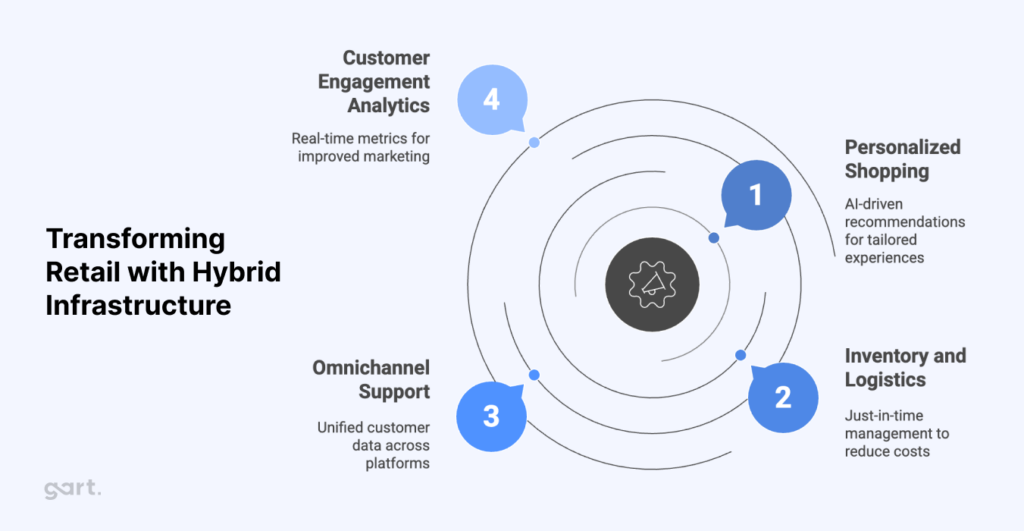
Retailers face the challenge of delivering personalized, omnichannel customer experiences while optimizing operations. Hybrid infrastructure is central to this transformation.
Personalized Shopping
- AI-driven recommendation engines process consumer behavior data across hybrid platforms.
- This enables dynamic, real-time personalization in both online and in-store shopping.
Inventory and Logistics
- Hybrid systems integrate warehouse data, supplier networks, and customer demand signals.
- Retailers achieve just-in-time inventory management, reducing costs and minimizing stockouts.
Omnichannel Support
- Hybrid platforms unify customer data across web, mobile, and physical stores.
- They scale easily during seasonal shopping peaks, such as holidays or promotional events, by bursting into public clouds.
Customer Engagement Analytics
Retailers use hybrid environments to process real-time engagement metrics, improving marketing campaigns and loyalty programs.
👉 These industry examples show that hybrid cloud is not a “one-size-fits-all” solution. Instead, it adapts to the unique regulatory, operational, and innovation needs of each sector, unlocking efficiencies and competitive advantages
AI and the Hybrid Future
AI amplifies the value of hybrid cloud through:
- Resource optimization: dynamic scaling based on predictive models.
- Security intelligence: adaptive systems detecting evolving threats.
- Workload placement: machine learning choosing the best-fit environment for applications.
- Edge computing: AI-enhanced processing closer to data sources, reducing latencyHybrid-Cloud-Adoption.
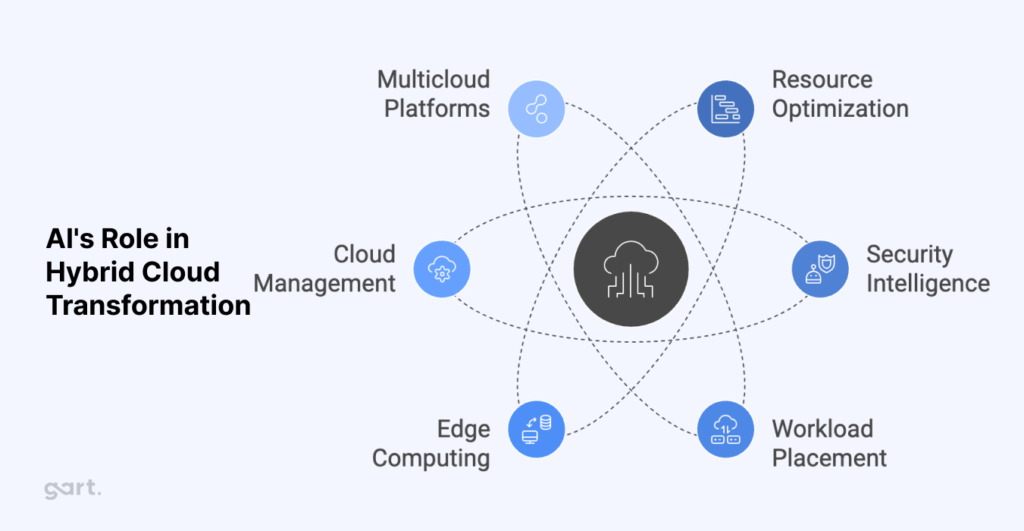
AI-Driven Resource Optimization
One of the most significant contributions of AI to hybrid infrastructure is predictive resource allocation. Machine learning models can forecast demand across on-premises, private, and public cloud environments. This enables real-time, dynamic workload placement where each application runs in the most cost-effective and high-performing environment. By doing so, organizations avoid both underutilization of assets and costly overprovisioningHybrid-Cloud-Adoption.
Intelligent Security in Hybrid Environments
Hybrid architectures increase the number of endpoints and access points, making security more complex. AI addresses this challenge by continuously monitoring traffic, detecting anomalies, and responding to threats in real time. Unlike static systems, AI-powered defenses adapt to evolving attack patterns, offering robust protection for sensitive data and mission-critical applications distributed across multiple environmentsHybrid-Cloud-Adoption.
Smarter Cloud Management
AI is also transforming how hybrid environments are managed. Intelligent assistants and chatbots can troubleshoot, automate routine tasks, and provide actionable insights, allowing IT teams to focus on higher-value projects. By analyzing logs, incident reports, and system documentation using natural language processing (NLP), AI enhances problem resolution and ensures that hybrid infrastructure operates smoothlyHybrid-Cloud-Adoption.
Workload Placement and Customization
Machine learning enables workload-aware deployment by analyzing the unique requirements of applications—latency, compliance, or compute intensity—and automatically selecting the best-fit environment. This ensures each workload benefits from optimal performance, cost control, and regulatory alignmentHybrid-Cloud-Adoption.
AI at the Edge
Hybrid clouds increasingly integrate with edge computing, where data is processed closer to where it is generated. AI enhances this by enabling real-time decision-making on-site, reducing latency and dependence on centralized cloud systems. This is particularly impactful for IoT-driven industries, such as manufacturing or logistics, where immediate insights are required to prevent downtime or optimize supply chainsHybrid-Cloud-Adoption.
AI-Powered Multicloud Platforms
Vendors like Nutanix and VMware are embedding AI into their hybrid multicloud platforms. Key features include:
- Intelligent workload placement based on performance, compliance, and cost.
- Predictive analytics for capacity planning, ensuring proactive scaling.
- Automated troubleshooting and self-healing, which reduce downtime and operational overhead
Together, these developments show that AI is not simply an add-on to hybrid infrastructure. It is the catalyst that transforms hybrid cloud into an adaptive, self-optimizing, and resilient ecosystem, capable of meeting the demands of modern enterprises
The Gart Hybrid Adoption Framework
Over the course of 50+ hybrid infrastructure engagements, Gart Solutions has developed a repeatable implementation methodology — the Gart Hybrid Adoption Framework (GHAF). It reduces hybrid deployment risk by sequencing decisions in the right order and eliminating the most common failure modes.
01. Infrastructure Audit & Workload Discovery
Complete inventory of all existing workloads, dependencies, data flows, and compliance requirements. We classify each workload by: cloud-readiness score, compliance sensitivity, cost profile, and latency requirement. This step is non-negotiable — architectures designed without it invariably miss compliance requirements or over-provision cloud capacity.
02. Workload Classification & Placement Design
Based on the audit, each workload is assigned a target environment: remain on-prem, migrate to private cloud, migrate to public cloud, or adopt a hybrid split (data on-prem, compute in cloud). Placement decisions drive network architecture, security policy scope, and cost projections.
03. Connectivity & Security Architecture
Design dedicated interconnects (AWS Direct Connect / Azure ExpressRoute), define zero-trust network segmentation, implement federated identity (IdP integration, SPIFFE/SPIRE for workload identity), and deploy secret management (HashiCorp Vault or cloud-native equivalents). Security must be architected before any migration begins.
04. Containerization & Platform Standardization
Containerize priority workloads using Docker; deploy Kubernetes clusters in each target environment (self-managed or managed: EKS, AKS, GKE, OpenShift). Establish GitOps pipelines (ArgoCD or Flux) to ensure consistent, auditable deployment across all environments from a single source of truth.
05. Migration Sequencing & Execution
Execute migrations in prioritized waves: lowest-risk, highest-value workloads first. Each wave includes a parallel-run period, defined rollback procedure, and acceptance testing gate before production cutover. We never run big-bang cutovers — every migration includes a validated rollback path.
06. Observability, FinOps & Continuous Optimization
Deploy unified observability (Prometheus, Grafana, OpenTelemetry, distributed tracing) across all environments. Implement FinOps tooling for cost attribution, rightsizing recommendations, and anomaly alerting. Establish quarterly optimization reviews with Gart engineering team.
Hybrid Infrastructure Security Best Practices
Security complexity is the single greatest operational challenge in hybrid infrastructure. Each additional environment expands the attack surface and multiplies the number of access control policies, network segments, and audit log sources that must be managed cohesively. These are the security practices that matter most in production hybrid deployments:
Zero-Trust Network Architecture
Abandon perimeter-based security. In a hybrid environment, there is no meaningful network perimeter — connections flow between on-premises, cloud, edge, and remote users continuously. Implement zero-trust: every connection is authenticated and authorized regardless of origin, using mTLS for service-to-service communication and SPIFFE/SPIRE for cryptographic workload identity.
Federated Identity & Centralized IAM
Use a single identity provider (Okta, Azure AD, or AWS SSO) federated across all environments. Avoid local credential stores in each environment — they become unmanageable and create credential sprawl. Enforce MFA for all human access; use short-lived credentials and workload identity tokens for machine-to-machine authentication.
Secret Management
Never store secrets (API keys, database credentials, TLS certificates) in environment variables, configuration files, or container images. Use HashiCorp Vault or cloud-native secret managers (AWS Secrets Manager, Azure Key Vault) with dynamic secret generation and automatic rotation.
Encryption Everywhere
- Data at rest: AES-256 encryption on all storage volumes, databases, and backups across all environments.
- Data in transit: TLS 1.3 for all network communication, including internal east-west traffic.
- Key management: Cloud KMS (AWS KMS, Azure Key Vault HSM) for cryptographic key lifecycle management.
Compliance Automation
Manual compliance audits do not scale across hybrid environments. Implement continuous compliance monitoring using tools like Open Policy Agent (OPA) for policy enforcement, Falco for runtime threat detection, and cloud security posture management (CSPM) tools like AWS Security Hub or Prisma Cloud for cross-environment visibility.
Hybrid Security Checklist
- Zero-trust network segmentation implemented (no flat networks)
- mTLS enforced for all service-to-service communication
- Centralized IdP federated across all environments
- HashiCorp Vault or equivalent deployed; no static credentials
- All storage volumes and databases encrypted at rest
- TLS 1.3 for all internal and external transit
- OPA policies enforcing security baseline in CI/CD pipeline
- Falco or equivalent runtime threat detection active
- Centralized SIEM aggregating logs from all environments
- Quarterly penetration testing and vulnerability scanning
Conclusion
Hybrid infrastructure is not a compromise between public cloud and on-premises — it is the deliberate architecture of choice for organizations that require compliance control, performance optimization, and cost efficiency simultaneously. When designed well, it provides the best attributes of every environment and the limitations of none.
The organizations that succeed with hybrid infrastructure share a common approach: they invest in the classification work before the architecture work, they treat connectivity and security as first-class design requirements (not afterthoughts), and they build operational discipline — GitOps, unified observability, FinOps — from day one rather than retrofitting it later.
The organizations that struggle with hybrid infrastructure skip the audit, underestimate the network, and over-engineer the Kubernetes layer before their teams are ready to operate it. The technical debt from these shortcuts takes years to resolve.
If your organization is evaluating hybrid infrastructure, the most valuable first step is an independent infrastructure audit that maps your workloads, identifies your compliance obligations, and produces a placement recommendation before any procurement decisions are made. This is exactly what Gart Solutions delivers as the first phase of every hybrid infrastructure engagement.
Ready to Design Your Hybrid Infrastructure?
Gart Solutions has delivered hybrid infrastructure for FinTech, healthcare, SaaS, and manufacturing organizations across Europe and North America. We bring architecture expertise, production experience, and a repeatable methodology that eliminates the most common failure modes.