Picking a cloud provider used to be a fairly contained decision: compare a few price sheets, check which region is closest to your users, and sign up. In 2026 it's a different kind of decision. AI workloads now make up roughly 19% of total cloud spending, Kubernetes runs in production at 82% of organizations using containers, and the cost of getting the choice wrong shows up two years later as a migration project nobody budgeted for.
This guide explains how to choose a cloud provider the way we actually do it with clients at Gart Solutions: not by picking a "winner," but by scoring AWS, Microsoft Azure, and Google Cloud Platform (GCP) against your specific workloads, team, budget, and compliance reality. We've rebuilt this article from the ground up — pricing examples, a proprietary evaluation framework, decision paths by company type, common mistakes we see in cloud assessments, and an FAQ section pulled from the questions clients actually ask us.
[lwptoc]
But fear not! In this comprehensive blog post, we'll delve into various cloud providers and assist you in identifying the ideal choice for your organization.
CriteriaAmazon Web Services (AWS)Microsoft AzureGoogle Cloud Platform (GCP)PricingOffers various pricing models and options, including pay-as-you-go and reserved instances.Flexible pricing options, including pay-as-you-go and discounted reserved instances.Offers pay-as-you-go pricing and committed use discounts.Compute ServicesProvides a wide range of compute services, including EC2, Lambda, and Elastic Beanstalk.Offers compute services like Virtual Machines, App Service, and Azure Functions.Provides compute services such as Compute Engine, App Engine, and Kubernetes Engine.Storage OptionsProvides various storage services, including S3, EBS, and Glacier.Offers storage services like Blob Storage, File Storage, and Azure Disk Storage.Provides storage services such as Cloud Storage, Cloud SQL, and Cloud Bigtable.Machine Learning and AI CapabilitiesOffers comprehensive AI and machine learning services with Amazon SageMaker, Rekognition, and more.Provides AI and ML capabilities through services like Azure Machine Learning, Cognitive Services, and more.Offers AI and ML services through Google Cloud AI, AutoML, and TensorFlow.Database ServicesProvides a wide range of database options, including Amazon RDS, DynamoDB, and Redshift.Offers database services like Azure SQL Database, Cosmos DB, and Azure Database for MySQL.Provides database services such as Cloud SQL, Firestore, and BigQuery.NetworkingOffers extensive networking capabilities, including Amazon VPC, Route 53, and CloudFront.Provides networking services like Azure Virtual Network, Azure DNS, and Azure ExpressRoute.Offers networking services such as Virtual Private Cloud (VPC), Cloud DNS, and Cloud Load Balancing.Global InfrastructureOperates in numerous regions worldwide with a large number of data centers.Has an extensive global presence with data centers located in many regions.Has a global network of data centers and regions to provide wide coverage.SupportProvides extensive documentation, support forums, and options for technical support.Offers comprehensive documentation, support options, and access to Azure support engineers.Provides documentation, community support, and access to Google Cloud support resources.A high-level overview of the different cloud providers
Cloud Market Snapshot: Who Actually Leads in 2026
Before comparing features, it helps to know where each provider actually stands. According to Synergy Research Group's Q1 2026 figures, worldwide cloud infrastructure spending reached $129 billion, up 35% year-over-year — the ninth consecutive quarter of accelerating growth, driven largely by AI deployments.
ProviderQ1 2026 Market ShareYoY GrowthAWS28%~19%Microsoft Azure21%~40%Google Cloud14%~63%Cloud Market Snapshot: Who Actually Leads in 2026
Source: Synergy Research Group, Q1 2026
The key takeaway isn't who's "winning" — it's the growth differential. AWS still leads on absolute share, while Microsoft and Google are growing substantially faster, largely on the back of AI workloads. Market share tells you about ecosystem maturity and hiring pools, not which provider is right for your specific stack.
Key takeaway: Market leadership and product fit are different questions. AWS's scale buys you the deepest service catalog and the largest hiring pool. Azure's growth is fueled by enterprises already standardized on Microsoft. Google's growth is fueled almost entirely by AI/ML workloads moving onto Vertex AI and TPU infrastructure.
AWS vs Azure vs Google Cloud: Core Comparison
CriteriaAWSAzureGoogle CloudPricing modelPay-as-you-go, Reserved Instances, Savings Plans, SpotPay-as-you-go, Reserved VM Instances, Hybrid BenefitPay-as-you-go, Committed Use Discounts, automatic sustained-use discountsComputeEC2, Lambda, ECS, Fargate, Elastic BeanstalkVirtual Machines, Functions, Container Instances, App ServiceCompute Engine, Cloud Functions, Cloud Run, App EngineManaged KubernetesEKS — ~42% of managed K8s usageAKS — ~23% of managed K8s usageGKE — ~27% of managed K8s usage, reference implementationAI / ML platformSageMaker, Bedrock, RekognitionAzure AI Foundry, Azure OpenAI Service, Cognitive ServicesVertex AI, AutoML, TPU v5 custom siliconDatabasesRDS, DynamoDB, Aurora, RedshiftAzure SQL Database, Cosmos DB, PostgreSQL/MySQLCloud SQL, Firestore, BigQuery, SpannerStrongest fitBroadest service catalog, largest talent poolMicrosoft-stack enterprises, hybrid cloudData analytics, AI/ML-heavy workloadsAWS vs Azure vs Google Cloud: Core Comparison
Pros and Cons of Each Provider
Amazon Web Services (AWS)
Best for: Teams that want maximum service breadth and the deepest hiring pool, and don't mind a steeper learning curve in exchange for flexibility.
Pros: Largest service catalog in the industry; mature ecosystem of third-party integrations and consultants; strongest track record for high-availability, high-scale architectures; broadest compliance certification coverage.
Cons: Pricing complexity makes cost forecasting genuinely hard without dedicated FinOps practice; the sheer number of services creates a steep onboarding curve for new teams; support tiers below Business/Enterprise can feel slow.
Microsoft Azure
Best for: Organizations already standardized on Microsoft 365, Active Directory, or .NET, and anyone running a serious hybrid cloud estate.
Pros: Tight integration with Active Directory, Microsoft 365, and the .NET ecosystem; strongest hybrid cloud tooling via Azure Arc; enterprise procurement is frictionless if you already hold a Microsoft Enterprise Agreement.
Cons: Teams without Microsoft background face a real learning curve; some services mature later than their AWS or GCP equivalents; the Marketplace has fewer third-party options, though this gap is narrowing.
Google Cloud Platform (GCP)
Best for: Data-intensive and AI/ML-first companies, and engineering-led teams that want Kubernetes built by the people who invented it.
Pros: Vertex AI and TPU infrastructure lead on AI/ML price-performance for many training workloads; BigQuery remains a best-in-class data warehouse; GKE is the reference Kubernetes implementation; pricing is comparatively simple, with automatic sustained-use discounts.
Cons: Smaller market share means a smaller talent pool and fewer specialized consultants in some regions; historically perceived as developer/startup-centric, though enterprise capability has expanded significantly; fewer pre-built enterprise integrations than AWS or Azure.
Still unsure which provider fits your specific workload?
Gart Solutions runs structured cloud assessments for engineering leaders who need a defensible, documented answer — not a guess. Talk to our team
The GART Cloud Selection Framework
Generic comparison tables answer "what does each cloud offer." They don't answer "what should I pick." Over dozens of cloud assessments, we've standardized the questions we ask clients into a five-axis scoring framework. We're sharing it here because it's the same structure we use internally — score each provider 1–5 on each axis, weight the axes by what matters most to your business, and the highest weighted total is your fit, not just the market leader.
AxisWhat we're really asking1. Technical FitDo this provider's managed services match our actual workload types (compute pattern, data volume, latency needs) without heavy custom engineering?2. Cost PredictabilityCan we forecast spend within a reasonable margin, or will billing surprises be routine?3. Team ExpertiseDoes our team already know this platform, or are we budgeting for a 3–6 month ramp-up and hiring against a smaller talent pool?4. Compliance & EcosystemDoes the provider hold the certifications we need (HIPAA, PCI DSS, SOC 2, regional data residency), and does our existing toolchain integrate cleanly?5. Future AI/Scale RoadmapWhere is our AI/ML roadmap headed in 18–24 months, and which provider's model catalog, GPU/TPU access, and pricing supports that without a re-platform?The GART Cloud Selection Framework
In practice, axis weighting is where most of the real decision-making happens. A healthcare SaaS company weights Compliance and Cost Predictability heavily; an AI-native startup weights Future AI Roadmap and Technical Fit. The framework doesn't produce a single universal answer — it produces your answer.
Which Cloud Is Best for Startups?
For early-stage companies, the calculus is different from enterprise selection. Three things matter disproportionately: credits, community support, and how fast you can hire.
Startup credit programs: All three offer credits (AWS Activate, Microsoft for Startups, Google for Startups), typically $1,000–$350,000 depending on funding stage and accelerator affiliation. Credits expire — don't pick a cloud purely because of a 12-month credit grant you'll outgrow.
Talent availability: AWS has the deepest junior-to-senior hiring pool globally, which matters if you're scaling an engineering team quickly without months of platform onboarding.
Ecosystem maturity: AWS and Azure have the largest marketplace of pre-built SaaS integrations (billing, observability, security tooling), which reduces the "glue code" tax for a small team.
Simplicity bias: GCP's pricing model and console are frequently cited by founding engineers as the easiest to reason about without a dedicated DevOps hire — relevant if you're pre-Series A and your CTO is still managing infrastructure personally.
Best for: AWS if you're optimizing for hiring speed and integration breadth; GCP if your team is small and AI/data-heavy; Azure if your first enterprise customers are Microsoft-stack organizations and procurement simplicity matters.
AWS vs Azure vs GCP for AI Workloads
AI is now the single biggest driver of cloud growth — it's why Azure and Google Cloud are growing two to three times faster than AWS in percentage terms, even from a smaller base. Each provider has a distinct AI strategy:
ProviderAI PlatformStrongest forAWSSageMaker, BedrockProduction ML pipelines, broadest foundation-model selection via BedrockAzureAzure AI Foundry, Azure OpenAI ServiceEnterprise generative AI with native OpenAI model access and Microsoft governance toolingGoogle CloudVertex AI, TPU v5Large-scale model training and inference price-performance, Gemini model familyAWS vs Azure vs GCP for AI Workloads
Per the CNCF's 2025 Annual Cloud Native Survey, 66% of organizations running generative AI models use Kubernetes to manage at least part of their inference workloads — which means your AI platform choice and your Kubernetes choice are no longer separate decisions for most teams.
AWS vs Azure vs GCP for Kubernetes
Kubernetes adoption is now close to universal — 82% of container users run it in production. The decision usually isn't "should we use Kubernetes," it's which managed flavor fits your stack:
EKS (AWS): The largest installed base among managed Kubernetes services, around 42% of managed K8s usage. Deepest integration with the rest of AWS's networking and IAM stack. Marginally more setup overhead than GKE out of the box.
GKE (Google Cloud): Built by the team that created Kubernetes; widely considered the smoothest managed Kubernetes experience, with strong Autopilot mode for hands-off cluster management. Around 27% of managed K8s usage.
AKS (Azure): Around 23% of managed K8s usage. Best choice if your cluster needs to integrate tightly with Azure AD, Azure Policy, or an existing Azure-based CI/CD pipeline.
For teams referencing platform standards, the Cloud Native Computing Foundation and the Platform Engineering community are useful ongoing sources for what "good" looks like as Kubernetes operating practices mature.
Which Cloud Is Best for Regulated Industries?
For healthcare, fintech, and other regulated sectors, the deciding factor usually isn't a feature gap — all three providers hold the major certifications (HIPAA-eligible services, PCI DSS Level 1, SOC 2 Type II, ISO 27001). It's about how compliance tooling fits your existing governance model.
Healthcare (HIPAA): All three support HIPAA-eligible architectures via signed Business Associate Agreements. Azure tends to be a faster path for organizations already running Microsoft-based EHR integrations or Active Directory-based identity for clinical staff.
Fintech (PCI DSS, SOC 2): AWS's maturity in this space and its breadth of compliance automation tooling (AWS Audit Manager, Config) often wins out for fintech, particularly where the team is already AWS-native.
EU data residency: All three operate EU regions, but sovereign-cloud requirements are evolving fast. Initiatives like Gaia-X are shaping how European data sovereignty standards get defined going forward — worth tracking if your customer base is EU-regulated.
A note from real assessments: A fintech client initially leaned toward Azure for "enterprise familiarity" before we ran a workload analysis. AWS's stronger ecosystem support for their specific payment-processing stack and easier horizontal scaling for transaction volume made it the better technical fit. After migration, infrastructure management overhead dropped by roughly 22% within six months — not because Azure was wrong in general, but because it was wrong for that workload.
Pricing Examples: What It Actually Costs
Generic "pay-as-you-go" descriptions don't help much when you're trying to budget. Here's a simplified illustration of how the three providers' pricing models differ in structure for a common mid-size workload — a general-purpose compute instance running continuously:
Pricing leverAWSAzureGoogle CloudOn-demand discount pathSavings Plans (1–3yr commitment)Reserved VM Instances (1–3yr commitment)Automatic sustained-use discount — no commitment requiredSpot/preemptible pricingUp to ~90% off via Spot InstancesUp to ~90% off via Spot VMsUp to ~91% off via Spot VMsEgress/data transfer feesTiered, can be significant at scaleTiered, comparable to AWSTiered, often slightly lower for inter-region transferForecasting difficultyHigh — requires dedicated FinOps practice at scaleMedium — simplified if on an Enterprise AgreementLower — fewer pricing tiers and SKUs to trackPricing Examples: What It Costs
This is why total cost of ownership (TCO) modeling matters more than sticker price. The FinOps Foundation publishes vendor-neutral frameworks for exactly this kind of cross-cloud cost modeling, and it's worth applying before signing a multi-year commitment with any provider.
Read more: Azure Cost Optimization for a Software Development Company — how we reduced network costs by 90% and saved a client up to $400/day through infrastructure restructuring, without sacrificing performance or security.
Mistakes Companies Make When Choosing a Cloud
Across cloud assessments, the same handful of mistakes show up repeatedly:
Selecting based solely on credits. A $100K credit grant that expires in 12 months shouldn't outweigh a multi-year architecture fit. Credits buy runway, not a platform decision.
Choosing multi-cloud too early. Running production workloads across two providers before you have a dedicated platform team multiplies operational complexity without a proportional benefit. Multi-cloud is a maturity stage, not a starting point.
Ignoring internal skill gaps. Picking the "technically superior" provider when your team has zero hands-on experience with it adds months of ramp-up that rarely gets budgeted into the migration timeline.
Overestimating portability. Containerization helps, but managed services (databases, queues, auth) create real lock-in regardless of provider. Plan for it honestly rather than assuming Kubernetes alone solves portability.
Skipping a real workload analysis. Comparing providers on generic feature lists instead of mapping your actual top 5–10 workloads against each provider's strengths is the single most common gap we see in DIY cloud assessments.
Cloud Provider Selection Checklist
Before you start vendor conversations, work through this list internally:
Do we have an existing Microsoft ecosystem (AD, M365, .NET) that favors Azure integration?
What regulatory or data residency requirements apply to our industry and customer base?
Are our workloads Kubernetes-heavy, and if so, which managed K8s service fits our operational model?
What does our AI/ML roadmap look like 18–24 months out, and which provider's model catalog and GPU/TPU access supports it?
What's our internal team's existing cloud expertise, and what's the realistic ramp-up cost if we pick an unfamiliar platform?
Have we modeled total cost of ownership — including egress, support tiers, and reserved-capacity commitments — not just sticker compute pricing?
What's our disaster recovery and multi-region requirement, and does the provider's regional footprint match our customer geography?
Have we run a proof-of-concept with our actual workload before committing to a multi-year contract?
Cloud Migration Considerations
Choosing a provider is half the decision — the other half is getting there without breaking production. A few considerations that matter more than they're usually given credit for:
Hidden costs: Data egress during migration, dual-running both environments during cutover, and re-architecting services that don't have a direct equivalent on the new platform.
Sequencing: Migrate stateless services first, validate, then move stateful workloads (databases, queues) last, with a tested rollback plan at every stage.
Team readiness: Budget for training time, not just infrastructure cost. A migration that's technically clean but leaves the team unable to operate the new platform independently isn't actually finished.
Vendor lock-in mitigation: Favor managed services with open-source equivalents (PostgreSQL over a fully proprietary database engine, for example) where the workload allows it, to keep future portability realistic.
When Multi-Cloud Actually Makes Sense
Multi-cloud gets pitched as a default best practice more often than it should be. It genuinely makes sense when:
You have regulatory requirements mandating provider diversification or specific data residency that no single provider satisfies alone.
You're running best-of-breed workloads — for example, AI training on Google Cloud's TPUs while keeping core application infrastructure on AWS for ecosystem reasons.
You've grown through M&A and inherited infrastructure on multiple providers, and full consolidation isn't yet cost-justified.
You have a mature platform engineering team capable of maintaining consistent tooling, security posture, and observability across providers.
It makes less sense as a "just in case" hedge against vendor lock-in for a team without dedicated platform engineering capacity — the operational tax usually outweighs the theoretical risk reduction for most companies under a certain scale.
How We Evaluated These Providers
This comparison draws on Gart Solutions' hands-on cloud architecture and migration engagements across AWS, Azure, and Google Cloud, cross-referenced against current published data: Synergy Research Group's Q1 2026 market share report, the CNCF 2025 Annual Cloud Native Survey, and each provider's own architecture documentation (AWS Well-Architected Framework, Azure Architecture Center, Google Cloud Architecture Framework). Pricing structures reflect each provider's publicly published rate cards as of Q2 2026 and are illustrative rather than quoted; always confirm current rates directly with the provider for budgeting purposes. We review and refresh this article as market share data, pricing models, and AI platform capabilities shift — cloud is not a "set and forget" topic, and this guide isn't either.
Beyond the Big Three: Other Cloud Providers
AWS, Azure, and GCP dominate the market, but they're not the only options. Depending on your needs, these are worth knowing about:
IBM Cloud: Enterprise-grade security and hybrid cloud capabilities, with deep ties to IBM's legacy enterprise customer base.
Oracle Cloud Infrastructure: Strong fit for organizations already running Oracle databases and applications.
Alibaba Cloud: Dominant in the Asia-Pacific region, particularly for businesses operating in or selling into China.
DigitalOcean: Developer-focused, simple pricing, popular for small-to-mid-size teams that don't need hyperscaler complexity.
OVHcloud: European provider with a strong emphasis on data privacy and EU regulatory compliance.
Hetzner Cloud: German provider known for competitive pricing and reliable performance, popular for cost-sensitive workloads.
Pros and Cons: AWS vs Azure vs Google Cloud
Amazon Web Services (AWS)
Pros:
Extensive Service Offering: AWS has a vast range of services, including compute, storage, databases, AI/ML, networking, and more, providing comprehensive solutions for various business needs.
Market Leader: AWS is the leading cloud provider with a strong track record, extensive customer base, and a robust ecosystem of third-party integrations.
Global Infrastructure: AWS has a vast global infrastructure with multiple data centers worldwide, allowing businesses to have low-latency access and meet data sovereignty requirements.
Scalability and Flexibility: AWS offers auto-scaling features and flexible resource allocation, enabling businesses to easily scale up or down based on demand.
Strong Security Measures: AWS provides a wide range of security tools, encryption options, and compliance certifications to ensure the protection of data and meet regulatory requirements.
Cons:
Complex Pricing Structure: AWS pricing can be complex, especially when using a variety of services. Understanding the pricing models, estimating costs, and optimizing expenses may require careful planning and monitoring.
Steep Learning Curve: AWS has a rich set of services and features, which can make it challenging for beginners to navigate and fully utilize the platform. Learning resources and training may be necessary for effective usage.
Limited Support Options: While AWS provides documentation and support forums, some users have reported challenges with response times and the availability of personalized support.
Microsoft Azure
Pros:
Seamless Integration with Microsoft Products: Azure offers seamless integration with popular Microsoft tools and technologies, making it attractive for businesses already using the Microsoft ecosystem.
Hybrid Cloud Capabilities: Azure provides strong support for hybrid cloud scenarios, allowing businesses to seamlessly integrate on-premises infrastructure with the cloud.
Wide Range of Services: Azure offers a comprehensive set of services, including compute, storage, databases, analytics, and more, catering to diverse business needs.
Strong Enterprise Focus: Azure is well-suited for enterprise environments, with features like Active Directory integration, strong governance tools, and compliance certifications.
Global Presence: Azure has a wide global presence with data centers located in various regions, enabling businesses to have a global reach and meet local compliance requirements.
Cons:
Learning Curve for Non-Microsoft Users: Users not familiar with Microsoft technologies may face a learning curve when navigating Azure's services and features.
Some Services Still Maturing: While Azure offers a wide range of services, some may still be evolving and may not have the same maturity or feature set as those of AWS.
Limited Marketplace Offerings: The Azure Marketplace may have a smaller selection of third-party solutions compared to AWS, although it continues to grow.
Google Cloud Platform (GCP)
Pros:
Strong AI and ML Capabilities: GCP is known for its advanced AI and ML services, offering pre-trained models, custom machine learning, and data analytics capabilities.
Cost-Effective Pricing: GCP's pricing structure is known for its simplicity and cost-effectiveness, with competitive pricing options and sustained usage discounts.
Scalable and Elastic Infrastructure: GCP provides flexible scaling options, allowing businesses to easily handle varying workloads and traffic spikes.
Global Network and Performance: GCP offers a high-performance global network, enabling businesses to deliver applications and services with low latency.
Developer-Friendly: GCP provides a range of developer tools and integration options, making it attractive for developers and DevOps teams.
Cons:
Smaller Market Share: GCP currently has a smaller market share compared to AWS and Azure, which may result in a comparatively smaller ecosystem and fewer third-party integrations.
Limited Enterprise Focus: GCP may be perceived as more focused on startups and developer-centric use cases, although it continues to expand its enterprise capabilities.
Learning Curve for Non-Google Users: Users who are not familiar with Google's technologies may need to invest time in learning and adapting to GCP's platform and services.
? Unable to choose a cloud provider? Seek expert guidance from Gart. Our experienced team can help you navigate the complexities of cloud computing and select the optimal provider for your business.
How to Choose a Cloud Service Provider
Choosing a cloud service provider requires careful consideration of several factors. Here are the key steps to guide you in selecting the right cloud service provider for your business:
Define Your Business Requirements:
Understand your business requirements and goals.
Evaluate services, performance, and security measures.
Consider global infrastructure and data centers.
Assess integration capabilities and ease of migration.
Evaluate disaster recovery options and pricing models.
Seek feedback and conduct trials to make an informed choice.
To begin the process of selecting the right cloud service provider for your business, it is crucial to gain a deep understanding of your organization's needs, objectives, and unique requirements in relation to cloud services. Take into account various factors, such as the types of workloads you handle, your storage and computing requirements, scalability expectations, compliance obligations, and any industry-specific regulations that apply.
Conduct a comprehensive workload analysis to assess the specific applications and workloads your business relies on. Consider the nature of these workloads, whether they involve web hosting, data analytics, AI/ML processing, e-commerce, or other operations. Identify the computing resources, storage needs, and network prerequisites associated with each workload.
This table provides a brief overview of the compute services offered by each cloud provider:
Cloud ProviderCompute ServicesAWSAmazon EC2 (Elastic Compute Cloud)AWS Lambda (Serverless Computing)Amazon ECS (Elastic Container Service)AWS Batch (Batch Computing)AWS Elastic Beanstalk (Platform-as-a-Service)AzureAzure Virtual MachinesAzure Functions (Serverless Computing)Azure Container InstancesAzure Batch (Batch Computing)Azure App Service (Platform-as-a-Service)GCPGoogle Compute EngineGoogle Cloud Functions (Serverless Computing)Google Kubernetes Engine (Managed Kubernetes)Google Cloud Run (Container Instances)Google App Engine (Platform-as-a-Service)A table comparing the compute services offered by AWS vs Azure vs Google Cloud
Determine the scalability and flexibility your business demands. Evaluate whether you require the capability to quickly scale resources up or down in response to fluctuating demands. Consider whether potential cloud providers offer features like auto-scaling, elastic load balancing, and flexible resource allocation to meet your scalability requirements effectively.
Evaluate your data storage and database needs. Analyze the volume of data your business needs to store and process, as well as the specific data access patterns (real-time, batch processing) that are crucial to your operations. Consider the level of data durability, redundancy, and availability required. Assess the availability of different storage options (such as object storage or block storage) and the variety of database solutions (relational or NoSQL) offered by each cloud service provider.
Here's a table comparing the database and storage services offered by AWS, Azure, and GCP
Cloud ProviderDatabase ServicesStorage ServicesAWSAmazon RDS (Relational Database Service)Amazon S3 (Simple Storage Service)Amazon DynamoDB (NoSQL Database)Amazon EBS (Elastic Block Store)Amazon Aurora (Managed Relational Database)Amazon Elastic File System (EFS)Amazon DocumentDB (MongoDB-compatible Document Database)Amazon FSx (File Storage)Amazon Neptune (Graph Database)Amazon Glacier (Long-term Archive Storage)AzureAzure SQL DatabaseAzure Blob StorageAzure Cosmos DB (NoSQL Database)Azure Files (Managed File Storage)Azure Database for MySQLAzure Disk StorageAzure Database for PostgreSQLAzure Archive Storage (Long-term Archive Storage)Azure Synapse Analytics (Data Warehousing)Azure Data Lake StorageGCPGoogle Cloud SQL (Managed Relational Database Service)Google Cloud StorageGoogle Cloud Firestore (NoSQL Document Database)Google Cloud Persistent DiskGoogle Cloud Spanner (Horizontally Scalable Relational Database)Google Cloud FilestoreGoogle Cloud Bigtable (Wide-column NoSQL Database)Google Cloud Storage Nearline (Long-term Archive Storage)Google Cloud Datastore (NoSQL Database)Google Cloud Archive Storage (Long-term Archive Storage)AWS vs Azure vs Google Cloud: database and storage services
Assess the security and compliance features provided by each cloud service provider, especially if your business operates in an industry with specific regulatory requirements such as healthcare (HIPAA) or financial services (PCI DSS). Pay attention to aspects like data encryption, access controls, compliance certifications, and auditing capabilities offered by potential providers.
Take into account your business's geographic presence and any data sovereignty obligations you may have. Determine whether the cloud provider has data centers located in regions that align with your operations or customer base. Ensure that the provider can meet local data residency requirements and provide low-latency access for optimal performance.
Evaluate the compatibility and integration capabilities of the cloud provider with your existing systems, applications, and IT infrastructure. Look for pre-built integrations, APIs, and software development kits (SDKs) that facilitate seamless connectivity and data exchange. Consider the ease of migrating your current applications and data to the platform of the cloud service provider under consideration.
Assess your disaster recovery and business continuity needs. Determine whether the cloud provider offers robust backup and disaster recovery solutions, including data replication across multiple regions, automated backup processes, and options for high availability and fault tolerance. These features are critical to ensure the uninterrupted operation of your business.
Consider your budget and cost expectations for cloud services. Evaluate the pricing models, cost structures, and billing options provided by each cloud service provider. Take into account factors such as compute and storage costs, data transfer fees, and potential discounts or cost optimization tools offered by the provider.
By conducting a thorough analysis and defining your business requirements across these dimensions, you will be better equipped to evaluate different cloud service providers and select the one that aligns most effectively with your organization's needs, goals, and constraints.
Still undecided on the right cloud provider? Get in touch with us now and embark on your cloud transformation journey!
Consider Performance and Reliability
Performance and reliability are crucial for smooth operations. Evaluate the uptime guarantees and service level agreements (SLAs) provided by cloud providers. Look for low-latency connections, robust network infrastructure, and features like content delivery networks (CDNs) and load balancing that can enhance performance and improve user experience.
AWS Networking Services
Amazon VPC (Virtual Private Cloud)
Amazon CloudFront (Content Delivery Network)
Amazon Route 53 (Domain Name System)
AWS Direct Connect (Dedicated Network Connection)
AWS Elastic Load Balancer (Application Load Balancer, Network Load Balancer)
Azure Networking Services
Azure Virtual Network
Azure CDN (Content Delivery Network)
Azure DNS (Domain Name System)
Azure ExpressRoute (Dedicated Network Connection)
Azure Load Balancer (Application Gateway, Traffic Manager)
GCP Networking Services
Google VPC (Virtual Private Cloud)
Cloud CDN (Content Delivery Network)
Cloud DNS (Domain Name System)
Cloud Interconnect (Dedicated Network Connection)
Load Balancing (HTTP/HTTPS, TCP/SSL)
Assess Security and Compliance
It is essential to carefully evaluate the security measures and certifications provided by each cloud provider. This evaluation should encompass considerations such as encryption options, access controls, identity and access management (IAM) capabilities, and the provider's compliance with industry regulations that are relevant to your business. Ensuring that the chosen cloud provider meets your specific security and compliance requirements is crucial for safeguarding your data and maintaining regulatory compliance.
Review Pricing and Cost Structures
When reviewing the pricing and cost structures of various cloud providers, it is important to gain a comprehensive understanding of their pricing models, cost structures, and billing options. Evaluate key factors such as pay-as-you-go pricing, the availability of reserved instances, costs associated with data storage, and fees for data transfers. It is crucial to consider the total cost of ownership (TCO) over time and compare it with your budget and cost expectations. To effectively manage expenses, look for cost optimization tools and explore available options that can assist in optimizing and controlling your cloud-related costs. By conducting a thorough evaluation of pricing and cost structures, you can make informed decisions that align with your financial objectives while maximizing the value derived from your chosen cloud provider.
Read more: Azure Cost Optimization for a Software Development Company
This case study highlights how Gart assisted Appsurify.com, a software development and testing company, in optimizing their Microsoft Azure infrastructure costs. By conducting a thorough analysis of the client's cloud infrastructure and identifying cost drivers, our team implemented strategic changes to reduce network costs by 90%. Additionally, the solution improved performance, security, and reliability while saving the client up to $400 per day in network and infrastructure expenses. The case study demonstrates the effectiveness of Azure cost optimization in achieving significant savings and enhancing overall infrastructure performance.
Consider Global Infrastructure and Data Centers
The proximity of data centers to your target audience can play a vital role in minimizing latency and ensuring optimal performance. Additionally, it is crucial to consider data sovereignty requirements and choose a provider that can comply with the regulations specific to the regions where you operate. Evaluating the cloud provider's content delivery network (CDN) capabilities is also important, as it can enhance performance by delivering content efficiently to end users across various locations. By carefully considering global infrastructure and data center availability, you can ensure a seamless and responsive user experience while meeting regulatory obligations.
The three major cloud providers each have an extensive global presence:
Amazon Web Services (AWS) operates in 25 geographic regions, which are further divided into 81 availability zones. They have a vast network of 218+ edge locations and 12 Regional Edge Caches.
Microsoft Azure has a footprint in over 60 regions worldwide. Each region is equipped with a minimum of three availability zones, ensuring high availability. Additionally, they have established more than 116 edge locations, also known as Points of Presence (PoPs).
Google Cloud Platform (GCP) is available in 27 cloud regions, and within these regions, there are a total of 82 zones. GCP further extends its network reach through 146 edge locations across the globe.
Evaluate Support and Documentation
Consider the level of support and customer service provided by each cloud provider. Look for availability of support channels, response times, and the quality of documentation, tutorials, and knowledge base resources. A responsive and knowledgeable support team can be crucial in resolving issues promptly.
Consider Vendor Lock-in and Portability
Assess the level of vendor lock-in associated with each provider. Evaluate the ease of migrating to and from the cloud provider, as well as the compatibility and portability of your applications and data. Consider strategies to mitigate vendor lock-in risks and ensure future flexibility.
Seek Feedback and References
Look for feedback from other businesses or industry peers who have experience with the cloud providers you are considering. Research case studies and success stories to understand how well the providers have supported similar organizations in achieving their goals.
Conduct Proof-of-Concept (PoC) or Trial Periods
Before making a final decision, consider conducting a proof-of-concept or taking advantage of trial periods offered by cloud providers. This allows you to test the provider's services, performance, and compatibility with your applications and workloads before committing fully.
By following these steps and thoroughly evaluating each cloud service provider based on your specific business requirements, you can make an informed decision and choose the cloud service provider that best fits your needs and goals.
Don't let the cloud provider decision overwhelm you. Gart is here to help.
Exploring Other Cloud Providers: Beyond AWS, Azure, and GCP
In addition to AWS vs Azure vs Google Cloud, there are several other notable cloud providers in the market. Here are a few examples:
IBM Cloud
IBM's cloud platform that offers a range of services including compute, storage, AI, and blockchain. It emphasizes enterprise-grade security and hybrid cloud capabilities.
Oracle Cloud
Oracle's cloud platform provides services for infrastructure, databases, applications, AI, and data analytics. It focuses on integrating with existing Oracle software and technologies.
Alibaba Cloud
Alibaba's cloud platform offers a comprehensive suite of cloud services, including compute, storage, networking, AI, and big data analytics. It has a strong presence in the Asia-Pacific region.
DigitalOcean
DigitalOcean is a developer-focused cloud provider that specializes in providing simple and cost-effective infrastructure services such as virtual machines, storage, and Kubernetes clusters.
Vultr
Vultr is a cloud provider known for its high-performance and affordable infrastructure services. It offers scalable compute, storage, and networking resources across multiple data centers worldwide.
Rackspace
Rackspace provides managed cloud services and expertise across various cloud platforms, including AWS, Azure, and GCP. It offers support, migration, and optimization services to help businesses leverage the benefits of the cloud.
Salesforce Cloud
Salesforce offers a suite of cloud-based applications for customer relationship management (CRM), sales, marketing, and service management. Its platform-as-a-service (PaaS), known as Salesforce Platform, allows businesses to build and deploy custom applications.
Tencent Cloud
Tencent Cloud is a leading cloud provider in China, offering a wide range of cloud services including computing, storage, databases, AI, and IoT. It focuses on serving businesses in the Chinese market.
OVHcloud
OVHcloud is a European cloud provider offering a broad portfolio of services, including virtual private servers, dedicated servers, storage, and network solutions. It emphasizes data privacy and compliance with European regulations.
Hetzner Cloud
Hetzner Cloud is a German cloud provider offering a range of infrastructure services, including virtual machines, storage, and networking. It is known for its competitive pricing and reliable performance.
Conclusion: There's No Universal "Best" Cloud Provider
AWS, Azure, and Google Cloud are all enterprise-grade, all capable of running mission-critical infrastructure, and all investing heavily in AI. The right answer depends on your workloads, your team's existing expertise, your compliance obligations, and where your AI roadmap is headed — not on which provider has the biggest market share this quarter. Run the framework above against your actual requirements, weight it honestly, and you'll have a defensible answer instead of a guess.
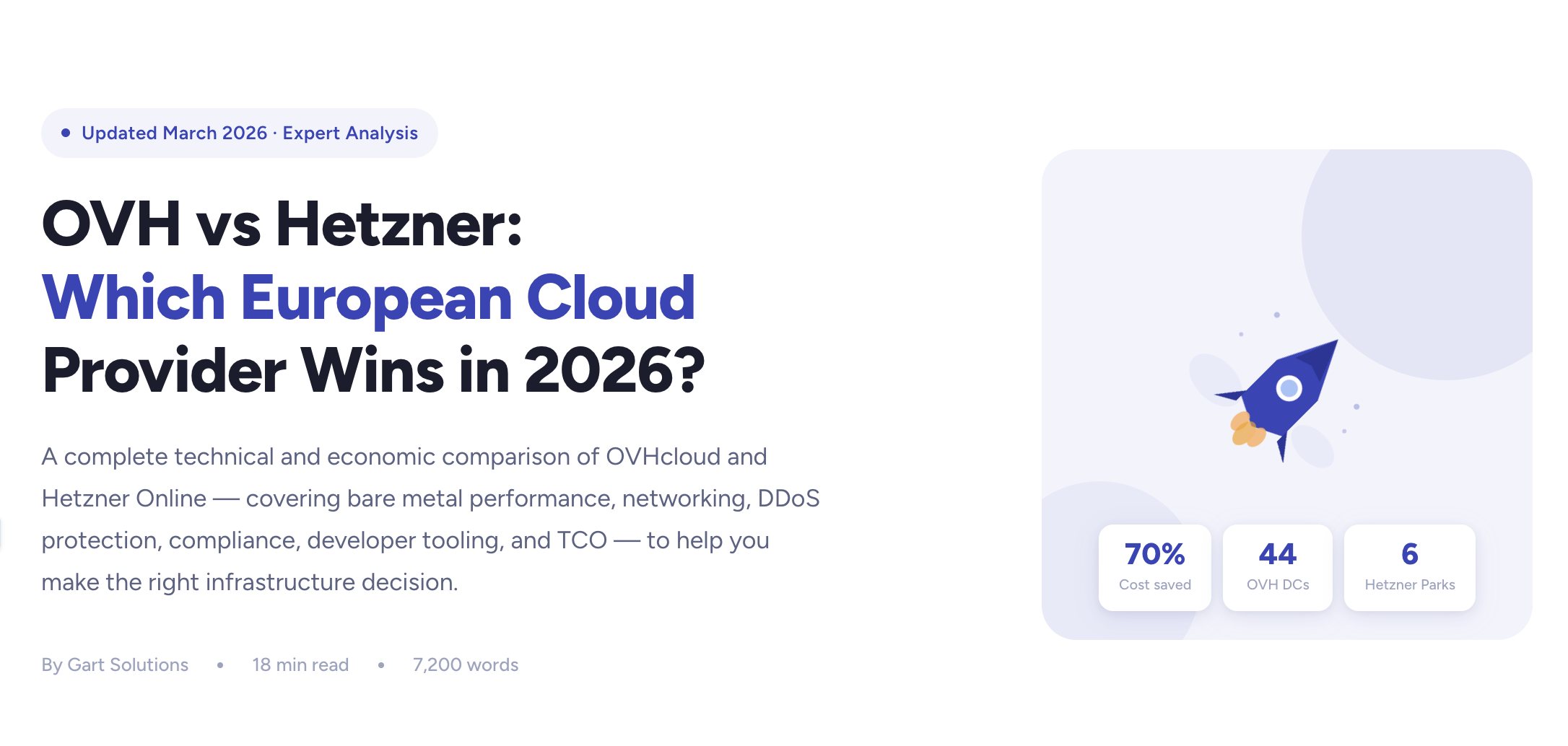
A complete technical and economic comparison of OVHcloud and Hetzner — covering bare metal performance, networking, DDoS protection, compliance, developer tooling, and TCO — to help you make the right infrastructure decision.
Quick Scorecard: OVH vs. Hetzner
Feature
OVH
Hetzner
Global Reach
✓✓
✓
Price / Value
✓✓
✓✓✓
DDoS Protection
✓✓✓
✓
Compliance
✓✓✓
✓✓
Developer UX
✓✓
✓✓✓
Managed Services
✓✓✓
✓✓
Networking
✓✓✓
✓✓
Bare Metal Perf.
✓✓
✓✓✓
Why the OVH vs Hetzner Decision Matters More Than Ever in 2026
The European cloud market has undergone a fundamental shift. What began as a cost-cutting exercise has evolved into a strategic sovereignty play — and at the center of it sit two providers that have come to define the independent cloud category: OVHcloud and Hetzner Online.
For enterprise architects and CTOs evaluating alternatives to AWS, Azure, or GCP, the OVH vs Hetzner comparison is not a question of "budget vs premium." Both are serious, production-grade infrastructure providers used by tens of thousands of businesses across Europe and globally. The real question is architectural alignment: which provider's philosophy, capabilities, and trade-offs best match your organization's specific needs?
In 2026, the "cloud repatriation" trend has accelerated significantly. Organizations migrating from hyperscale environments to European cloud providers are reporting cost reductions between 70% and 90% on equivalent workloads. The primary drivers are not just price — they are egress economics, data sovereignty requirements, performance predictability, and the growing recognition that paying the AWS "cloud tax" is a strategic liability, not a necessary cost of doing business.
70–90%
Avg. cost reduction vs AWS
44
OVHcloud data centers
38 ms
Hetzner EU TTFB
This guide provides an exhaustive, technically grounded analysis of both providers across every dimension that matters: physical infrastructure and geographic coverage, bare metal hardware and SLAs, private networking architecture, DDoS protection and compliance certifications, cloud API maturity, developer tooling, total cost of ownership, and practical migration strategy.
Who this analysis is for
This article is written for technical decision-makers — CTOs, Lead Engineers, and senior DevOps professionals — evaluating a migration from hyperscale cloud or on-premises infrastructure to European providers. It goes considerably deeper than surface-level price comparisons.
Global Footprint and Data Center Architecture
The most fundamental difference between OVHcloud and Hetzner begins not in their pricing catalogs or feature lists, but at the physical layer — in how each company conceptualizes data center geography and infrastructure construction.
OVHcloud: Vertical Integration at Global Scale
OVHcloud, headquartered in Roubaix, France, operates with genuinely global ambitions. Its 44 data centers span four continents — Europe, North America, Asia-Pacific, and Africa — connected by a proprietary 32 Tbps fiber optic backbone that the company owns and operates outright. This is not third-party transit capacity: OVHcloud built and controls the fiber, which translates into measurable performance advantages for multi-region architectures.
The company's operational philosophy is rooted in deep vertical integration. OVHcloud designs and manufactures its own servers, develops its own proprietary water-cooling system that eliminates traditional air conditioning in most zones, and controls virtually every layer of the supply chain from component procurement to rack deployment. This industrial model enables high component density, superior energy efficiency (reflected in industry-leading PUE ratings), and thermal stability that sustains processor performance under sustained high-load workloads.
Hetzner Online: Concentrated Efficiency as Strategy
Hetzner Online, headquartered in Gunzenhausen, Germany, has deliberately chosen a different path. Rather than spreading infrastructure thin across dozens of markets, Hetzner has built extreme operational density in a small number of carefully selected locations. Its primary data center parks are in Nuremberg and Falkenstein (Germany) and Helsinki (Finland), with cloud instances available in Ashburn, Hillsboro, and Singapore. Bare metal dedicated servers, however, remain a European-only offering.
This concentration is the mechanism behind Hetzner's remarkable price efficiency. By eliminating the overhead of managing a globally distributed supply chain, Hetzner can offer compute resources at price points that are genuinely difficult for any other provider to match. The trade-off is geographic: organizations requiring dedicated hardware presence in North America or APAC must look to OVHcloud.
Key Architectural Decision Point
If your primary user base is European and you don't require multi-continent bare metal presence, Hetzner's geographic concentration is an advantage, not a limitation. If you need dedicated servers in North America or APAC, OVHcloud is the default choice in the European cloud tier.
Feature
OVHcloud
Hetzner Online
Edge
Total Data Centers
44 sites, 4 continents
6 parks (EU-primary)
OVH
Dedicated Server Regions
Global (EU, NA, APAC, Africa)
Europe only
OVH
Network Backbone
32 Tbps proprietary fiber
9.7 Tbps peering / 11.3 Tbps transit
OVH
Server Manufacturing
In-house proprietary
Standardized / custom-built
OVH
Cooling Technology
Proprietary water-cooling
High-efficiency air cooling
Tie
Compliance Certifications
HDS, SecNumCloud, SOC 1&2, ISO multi
GDPR / German data law
OVH (Enterprise)
Price Efficiency
Strong
Industry-leading
Hetzner
Server Auction
Not available
Available (30–60% discount)
Hetzner
One feature unique to Hetzner in this tier is its Server Auction marketplace — a platform where decommissioned servers are resold at significant discounts, typically 30–60% below new hardware list prices. Servers are only a few years old, fully tested, and backed by Hetzner's standard SLA. For development environments, staging clusters, or latency-tolerant batch workloads, this creates a cost entry point with no real equivalent elsewhere in the market.
Dedicated Servers: Hardware Tiers, SLAs, and Benchmarks
Bare metal servers — physical machines with no hypervisor overhead, no resource sharing, no "noisy neighbor" contention — remain the performance gold standard. Both OVHcloud and Hetzner have built substantial dedicated server portfolios, but from meaningfully different angles.
OVHcloud's Tiered Range Architecture
OVHcloud organizes dedicated servers into purpose-built ranges, each engineered for a specific reliability tier and workload profile:
Range
Target Workload
Max RAM
SLA
Private Network
Rise
Dev / Small projects
128 GB
99.90%
—
Advance
SMB, versatile loads
1 TB
99.95%
1–6 Gbps
Scale
Complex / resilient infra
1.5 TB
99.99%
6–25 Gbps
High-Grade
Critical loads / AI
2 TB
99.99%
10–50 Gbps
The Scale and High-Grade ranges include enterprise-grade features such as double power supplies with redundant PDU connections, hot-swap NVMe storage, and OVHcloud Link Aggregation (OLA) for fully redundant network connectivity — features that represent a meaningful operational resilience advantage for mission-critical workloads.
Hetzner's AX and EX Lines: Raw Power at Aggressive Pricing
Hetzner's dedicated server portfolio emphasizes raw compute density and high-speed NVMe storage at price points that consistently undercut the competition. The AX line (AMD EPYC and Ryzen) and EX line (Intel Xeon and Core) offer impressive hardware at straightforward pricing:
Line
CPU Focus
Max RAM
SLA
Private Network
AX (Ryzen/EPYC)
AMD EPYC / Ryzen 9
Up to 1 TB+
99.9%
vSwitch
EX (Xeon/Core)
Intel Core / Xeon
Up to 128 GB+
99.9%
vSwitch
The flagship AX162-R represents the bleeding edge of Hetzner's value proposition: AMD EPYC 9454P with 96 cores, DDR5 ECC RAM, and NVMe SSDs in RAID — targeting financial modeling, 3D rendering, big data pipelines, and high-performance computing at a fraction of hyperscale pricing.
Head-to-Head: VPS Performance at the Same Price Point
At the cloud/VPS tier, the performance gap is even more striking. At approximately $19.64/month, Hetzner's CX53 delivers significantly more raw resources than the OVHcloud VPS-3:
Metric
OVHcloud VPS-3
Hetzner CX53
Edge
CPU Cores
8 vCPU
16 vCPU
Hetzner
RAM
24 GB
32 GB
Hetzner
Disk
200 GB NVMe
320 GB NVMe
Hetzner
Network Speed
1,500 Mbps
10,000 Mbps
Hetzner
Price (approx.)
$19.64/mo
$19.64/mo
Same
EU TTFB
—
38 ms
Hetzner
Global Page Load
1.1 sec
5.1 sec
OVH (Global CDN)
"Hetzner consistently wins on raw resource density per dollar. OVHcloud wins when you need global reach, enterprise SLAs, or multi-region private networking — the comparison depends entirely on what you're optimizing for."
The global page load divergence is instructive: OVHcloud's 32 Tbps backbone delivers dramatically better cross-continental latency (1.1s vs 5.1s in real-world tests). But for organizations with primarily European users, Hetzner's 38ms TTFB is exceptional — and difficult to beat at any price point.
vRack vs. vSwitch: Private Networking Deep Dive
Private networking is a primary architectural divergence between the two providers — and for organizations building multi-server or multi-region infrastructure, this comparison deserves careful attention.
OVHcloud vRack: Multi-DC Private Fabric
OVHcloud's vRack (Virtual Rack) technology enables customers to group servers across different physical locations — even different data centers — into a single private Layer 2 switch. This creates isolated networks that span multiple OVH facilities, enabling disaster recovery, cross-DC load balancing, and private inter-service communication that is fully transparent to the public internet.
For organizations running Proxmox, VMware, or complex virtualization stacks across multiple OVH regions, the vRack is typically the preferred choice. Its "transparent" bridging behavior simplifies VM migration and failover considerably. The primary drawback is limited native IPv6 routing within the vRack environment, which remains a documented friction point for IPv6-first architectures.
Hetzner vSwitch: Cost-Effective but Configuration-Heavy
Hetzner's vSwitch connects dedicated servers and cloud instances within a data center park using IEEE 802.1Q tagged VLANs. It is cost-effective — free for cloud instances, with a setup fee for dedicated servers — but requires significantly more manual configuration at the operating system level.
In practice, Hetzner vSwitch deployments require engineers to create persistent Netplan or systemd-networkd configurations to handle VLAN tagging, and historical reports cite occasional ARP discovery latency and VM migration issues. For teams with strong Linux networking expertise, this is manageable. For teams expecting managed network infrastructure, it represents meaningful operational overhead.
Aspect
OVHcloud vRack
Hetzner vSwitch
Edge
Technology
Virtual Switch / L2 Isolated
Tagged VLAN (IEEE 802.1Q)
OVH
Multi-Region
Natively supported
Limited / Cloud-specific
OVH
IPv6 Support
Limited routing in vRack
Supported natively
Hetzner
Complexity
Moderate (managed via panel)
High (manual OS config required)
OVH
Cost
Included in most ranges
Free (Cloud) / Setup fee (Dedi)
Context
Max Bandwidth
Up to 50 Gbps (High-Grade)
vSwitch-limited
OVH
DDoS Protection, Certifications, and Regulatory Posture
In the 2026 threat landscape, infrastructure security is not an afterthought — it is a primary selection criterion. The two providers differ significantly in their DDoS mitigation maturity and compliance certification portfolios.
OVHcloud VAC: Multi-Terabit DDoS Mitigation
OVHcloud's VAC (Vacuum) anti-DDoS system is included at no additional cost with all services and provides multi-terabit mitigation capacity. The system uses a sophisticated scrubbing architecture: malicious traffic is identified at the network edge, siphoned into dedicated scrubbing centers, cleaned, and only the verified legitimate traffic is forwarded to the customer's server.
This architecture means that even during large volumetric attacks, customer services remain available. OVHcloud does not "sinkhole" attacked IPs as a standard mitigation response — a critical differentiator for services where any downtime is commercially unacceptable.
Hetzner DDoS Protection: Effective but Limited
Hetzner provides standard DDoS protection that handles the majority of common attack vectors effectively. However, under sustained or sophisticated attacks, Hetzner has been documented to employ "sinkholing" — dropping all traffic to a targeted IP address to protect the broader network. This protects Hetzner's infrastructure, but results in customer downtime for the duration of the attack.
As a consequence, many production deployments on Hetzner integrate third-party protection layers — Cloudflare, NeoProtect, or similar services — as a mandatory architectural component for any latency-sensitive or commercially critical endpoint.
Important for High-Risk Workloads
If your application is a likely DDoS target (gaming servers, financial services, public-facing APIs with high traffic), OVHcloud's VAC system provides substantially stronger out-of-the-box protection than Hetzner's standard offering. Factor in the cost of third-party DDoS services when comparing TCO.
Compliance and Regulatory Certifications
For organizations in regulated industries — healthcare, fintech, public sector, or any entity processing sensitive EU data — the compliance certification comparison is arguably the most decisive factor in the OVH vs Hetzner decision:
OVHcloud Certifications
Multi-Sector Enterprise Compliance
ISO/IEC 27001, 27017, 27018 Information security management
SOC 1 & SOC 2 Type II Financial controls and security
HDS Health Data Hosting (EU healthcare)
SecNumCloud French public sector cloud qualification
PCI DSS Payment card industry compliance
Hetzner Certifications
GDPR-First Privacy Compliance
Full GDPR Compliance Native adherence across all EU data centers
BDSG Adherence German Federal Data Protection Act compliance
German Data Privacy Operating under the world's strictest frameworks
ISO 27001 Certified data center operations
For general commercial applications, Hetzner's GDPR compliance is fully adequate. For healthcare organizations, financial institutions, or public sector entities with contractual or regulatory requirements for specific certifications, OVHcloud is typically the only viable European option outside hyperscale clouds.
🚀 Migration Partner
Thinking About Moving to OVH or Hetzner? Start with a Free Audit.
Gart Solutions has helped dozens of companies migrate from AWS, Azure, and on-premises environments to OVHcloud and Hetzner — cutting infrastructure costs by 70–90% with zero unplanned downtime. Our certified DevOps engineers handle the entire transition: architecture design, data migration, Terraform automation, and post-migration hardening.
90%
Max cost reduction achieved
15+
Years of infra expertise
3 mo
Typical payback period
Book a Free Infrastructure Audit →
View our services
Public Cloud Instances, Managed Services, and API Maturity
Beyond bare metal, both providers have built public cloud offerings — managed virtualized instances with API-driven provisioning and scaling. The maturity and philosophy of these cloud products differ in ways that significantly impact operational model.
OVHcloud Public Cloud: OpenStack-Based with Metal Instances
OVHcloud's Public Cloud is built on OpenStack, the open-source cloud infrastructure platform. This provides genuine vendor portability — workloads can theoretically be migrated to any other OpenStack-based cloud without re-architecting. OVHcloud also offers unique "Metal Instances" — dedicated physical hardware provisioned through the same cloud API, delivering bare metal performance with cloud-speed deployment (minutes, not hours).
The managed service portfolio includes OVH Managed Kubernetes, managed databases (MySQL, PostgreSQL, Redis, Kafka), and fully API-integrated S3-compatible object storage. This breadth makes OVHcloud viable as a primary cloud provider for complex, multi-service architectures.
Hetzner Cloud: Developer-First Simplicity
Hetzner Cloud has built its reputation on exceptional developer experience. The management console is consistently praised for its clarity, the API is well-documented with real-world examples, and provisioning is fast. The CX (shared vCPU) and CCX (dedicated vCPU) series provide a clean tiered approach to compute resources.
The managed service catalog is leaner than OVHcloud's — MySQL and PostgreSQL managed databases, load balancers, and S3-compatible storage — but Hetzner's S3 still requires manual credential management outside the API, a friction point for teams building fully automated infrastructure-as-code pipelines.
Tooling
OVHcloud
Hetzner Online
Edge
Terraform Provider
Multiple (OVH, OpenStack, AWS)
Single (Hetzner Cloud)
Hetzner (Simpler)
Managed Kubernetes
OVH Managed Kubernetes
Third-party required
OVH
API Documentation
Extensive / manual credential gen
Thorough / clear examples
Hetzner
Managed Databases
MySQL, PostgreSQL, Redis, Kafka
MySQL, PostgreSQL
OVH
S3 Object Storage
Fully API integrated
Manual credential gen required
OVH
Cloud Console UX
Complex / feature-rich
Intuitive / developer-friendly
Hetzner
Metal Instances
Available (bare metal via cloud API)
Not available
OVH
The Terraform experience is a nuanced point: OVHcloud's broader service catalog means that fully automated infrastructure deployment requires managing multiple Terraform providers simultaneously (the OVH provider, the OpenStack provider, and sometimes the AWS provider for S3-compatible storage). This creates a "messy" IaC experience that Hetzner's single, well-maintained provider avoids entirely.
The Real Economics: OVH vs Hetzner vs AWS
Cost is ultimately what has driven the explosive growth of both OVHcloud and Hetzner as primary alternatives to hyperscale providers. But the comparison is more nuanced than a simple monthly rate comparison — the structure of pricing matters as much as the absolute numbers.
The Egress Tax: The Hidden Cost That Changes Everything
The most significant pricing structural difference is egress fees. AWS charges per-gigabyte for outbound data transfer — a fee that scales directly with your application's success. A media streaming platform, a software distribution service, or any download-heavy application faces a de facto "growth penalty" on AWS that doesn't exist on European providers.
Bandwidth & Egress Costs
✓
OVHcloud
Unmetered bandwidth included on the vast majority of bare metal server plans. No egress billing for outbound traffic.
✓
Hetzner
20 TB of outbound traffic included per instance per month. Nominal fees thereafter — a small fraction of AWS pricing.
✗
AWS / Azure / GCP
Per-GB egress fees that typically represent 15–25% of total cloud spend for data-intensive applications.
SaaS Infrastructure Case Study: AWS vs European Cloud
A representative SaaS infrastructure — 6 application servers, one large database, one load balancer, typical egress volume — illustrates the economic magnitude of the decision:
ComponentAWS MonthlyHetzner / OVH EquivalentSavingCompute (6 nodes)$1,200$28077%Managed Database$850$11586%Load Balancer$180$15–4575–92%Data Egress (est.)$650Included / flat-rate100%Total Monthly$4,200$410–$1,15073–90%
Real-World Migration Results
A jewelry manufacturer migrating from Azure to European cloud with Gart Solutions' guidance achieved significant monthly cost reductions while improving performance. A fintech company migrating to OVHcloud gained enterprise compliance certifications previously inaccessible at their budget level.
OVH vs Hetzner: Head-to-Head Pricing Philosophy
Between the two European providers, Hetzner typically offers lower absolute prices for equivalent compute resources — often 20–40% cheaper than comparable OVHcloud configurations. However, OVHcloud's higher price tier includes features that have real operational value: enterprise SLAs (99.99% vs 99.9%), redundant power systems, multi-region private networking, and included DDoS protection with more sophisticated mitigation.
The TCO calculation must account for the cost of compensating for missing features. A Hetzner deployment that requires third-party DDoS protection, a separate CDN for global reach, and additional engineering time for vSwitch configuration may end up costing more than a comparable OVHcloud deployment in total operational cost — even if the server line items are lower.
How to Migrate to OVH or Hetzner Without Downtime
Understanding which provider to choose is the strategic decision. Actually migrating to it — safely, without data loss, without extended downtime, without breaking dependent integrations — is the operational challenge. This is where the difference between a successful cloud repatriation and a costly failure is made.
The 6 R's Migration Framework
Migrations don't follow a single template. The appropriate strategy depends on the application's architecture, data sensitivity, and acceptable downtime window. The 6 R's model provides a decision framework:
The 6 Rs of Cloud Migration
R1
Rehosting (Lift-and-Shift)
Move existing VMs or containers with minimal changes. Fastest approach, lowest risk for stateless applications.
R2
Replatforming
Minor architectural optimizations during migration — e.g., switching from self-managed to managed database.
R3
Repurchasing
Moving from a custom solution to a SaaS offering available on the new provider.
R4
Refactoring
Redesigning application architecture to leverage new provider capabilities — higher effort, higher long-term value.
R5
Retiring
Identifying and decommissioning unused or redundant services during migration.
R6
Retaining
Keeping specific workloads on current infrastructure that are not yet migration candidates.
Critical Data Migration Techniques
For stateful applications, data migration is the most sensitive phase. Three techniques are particularly important:
Dual-Write Synchronization: Before cutover, configure the application to write simultaneously to both old and new databases. This eliminates data loss risk during the transition window and allows the new environment to be fully validated under real traffic conditions before DNS or IP failover.
Bring Your Own IP (BYOIP): Both OVHcloud and Hetzner support BYOIP — migrating your existing public IP address blocks to the new provider. This preserves IP reputation (critical for email delivery and fraud scoring systems), maintains whitelisted integrations without reconfiguration, and enables a seamless cutover that is invisible to upstream partners.
Staged Traffic Migration: Rather than a single cutover event, route a gradually increasing percentage of traffic to the new environment — 5%, 25%, 50%, 100% — with monitoring at each stage. Automated rollback triggers in the load balancer allow instant recovery if anomalies are detected.
Post-Migration Hardening
Migration is not the end of the project — it is the beginning of the operational phase. Post-migration hardening typically includes:
✓Right-sizing VMs and bare metal instances based on actual production load profiles (over-provisioned resources are a common source of unnecessary cost)
✓Implementing observability stack: Prometheus metrics, Grafana dashboards, alerting rules calibrated to the new environment's baseline
✓Quarterly disaster recovery tests to validate that backup restoration and failover procedures work correctly in the self-managed bare metal context
✓CI/CD pipeline optimization for the new infrastructure, including Terraform state management and Ansible playbook validation
🛡️ Managed Migration
Gart Solutions: Your Dedicated Migration Partner for OVH and Hetzner
The economics of migrating from AWS to OVH or Hetzner are compelling. The technical execution requires expertise. Gart Solutions has developed a rigorous 6-stage migration framework used across healthcare, fintech, e-commerce, and green tech organizations — eliminating the risk of downtime, data corruption, and networking misconfigurations.
1
Free Consultation & Scoping
Define technical challenges, business objectives, and projected ROI.
2
Technical Audit
Map dependencies, identify quick wins, and detect hidden infrastructure risks.
3
Architecture & Roadmap
Collaborative design of milestones, security protocols, and target architecture.
4
Implementation & Automation
Terraform/Ansible IaC deployment, Docker/Kubernetes containerization, zero-downtime cutover.
5
Documentation & Knowledge Transfer
Ensure your internal team owns and understands the new environment.
6
24/7 Monitoring & Support
Proactive incident response, performance tuning, and quarterly DR testing.
Start Your Migration →
See case studies
OVH vs Hetzner: Which Provider Should You Choose?
After a comprehensive analysis across infrastructure, performance, networking, security, compliance, developer tooling, and economics, the verdict is not a binary winner — it is a clear decision framework based on organizational profile.
The Enterprise Choice
Choose OVHcloud when you need:
Global dedicated server presence (NA, APAC, Africa)
Multi-DC private networking via vRack
99.99% SLA on critical infrastructure
HDS, SecNumCloud, SOC 2 certifications
Sophisticated multi-terabit DDoS protection (VAC)
Managed Kubernetes and full service catalog
Bare metal provisioned through cloud API
The Developer / Efficiency Choice
Choose Hetzner when you need:
Maximum compute-per-euro for European workloads
Strong internal DevOps / Linux networking expertise
Simple, clean developer experience and API
Access to Server Auction for budget environments
AMD EPYC high-core-count workloads at low cost
No complex compliance certification requirements
When to Use Both Together
A growing number of sophisticated architectures use both providers in complementary roles: Hetzner for high-volume European compute (application servers, data processing, CI/CD workers) and OVHcloud for network-critical components that benefit from vRack, multi-region private connectivity, or VAC DDoS protection. The providers are not mutually exclusive — they can form a genuinely powerful hybrid European cloud stack.
"The OVH vs Hetzner decision is not a permanent commitment — it is an architectural choice that can evolve as your organization scales. What matters is choosing the right tool for your current requirements while maintaining the architectural flexibility to adapt."
The Migration Question: Going It Alone vs. Expert Guidance
The economics of migrating from hyperscale cloud to OVHcloud or Hetzner are clear and compelling. The technical execution is where organizations encounter unexpected complexity: database state management, network topology replication, IP reputation preservation, zero-downtime cutover sequencing, and post-migration observability calibration all present real risks that are not visible from a spreadsheet comparison.
Organizations with strong internal infrastructure engineering teams and prior experience with bare metal environments may execute migrations successfully. Organizations that lack this specific expertise — or that cannot afford extended unplanned downtime — benefit substantially from partnering with specialists who have navigated these exact scenarios dozens of times.
This is precisely the space that Gart Solutions occupies. With over 15 years of infrastructure expertise across healthcare, fintech, e-commerce, and green tech, Gart operates not as a generic outsourcing vendor but as a technical extension of your team — focused on knowledge transfer, self-sufficiency, and measurable outcomes. Clients typically achieve migration investment payback within three months of going live.
Why thousands of companies are abandoning hyperscalers — and exactly how they're making the switch
The Cloud Reckoning Is Here
For years, migrating to AWS, Azure, or Google Cloud was the default move for any scaling business. The conventional wisdom was simple: go where the biggest catalog is, absorb the costs, and grow from there.
That logic is breaking down.
In 2026, a growing wave of enterprises — from AI startups to iGaming operators to AdTech platforms — are executing a different kind of cloud migration: away from the hyperscalers, and toward providers like OVHcloud that offer transparent pricing, genuine data sovereignty, and bare metal performance that shared infrastructure simply cannot match.
This guide covers everything you need to know about OVHcloud migration: why businesses are making the move, what the numbers look like, what the technical pathway involves, and how to know if it's the right decision for your organization.
Part 1: Why Companies Are Initiating OVHcloud Migration in the First Place
The Egress Fee Trap
The single most cited trigger for beginning an OVHcloud migration is the shock of hyperscaler egress fees. Moving data out of AWS, Azure, or GCP is not free — and at scale, it becomes one of the largest line items in an infrastructure budget.
Here's what those costs look like at 50 TB of monthly egress:
ProviderFree AllowanceCost at 50 TB/monthAWS100 GB~$4,500Azure100 GB~$4,350Google Cloud0–200 GB~$4,250Oracle Cloud10 TB~$425DigitalOceanUp to 11 TB~$500OVHcloudUnlimited$0
For data-intensive workloads — AI feature stores, real-time bidding platforms, video streaming — these costs don't just scale linearly. They compound. And because egress fees are intentionally designed to make migration painful, they function as a structural lock-in mechanism, not just a billing line item.
The Hopsworks case makes this concrete. The AI platform company migrated their serverless offering from AWS to OVHcloud and reduced monthly infrastructure spend by 62% — from $8,000 to $3,000 — primarily by eliminating the risk of escalating egress costs as users began processing gigabyte-scale DataFrames. That's not an edge case. It's a predictable outcome for any data-heavy business that runs the numbers honestly.
Hidden Costs That Never Appear in the Brochure
Egress is the most visible cost, but it's far from the only surprise waiting inside hyperscaler bills. Companies approaching OVHcloud migration often discover a cluster of additional charges they had normalized without ever questioning:
Cross-AZ data transfer fees. High-availability architectures spread across multiple availability zones are the recommended pattern for resilient cloud deployments. Yet hyperscalers charge for the inter-zone traffic this generates. Organizations are effectively penalized for following best practices — paying replication costs before serving a single external request.
NAT Gateway processing fees. On AWS, NAT Gateways carry both an hourly charge and a per-GB processing fee that scales with external dependencies: API calls, container image pulls, third-party integrations. For busy microservice architectures, these fees can reach hundreds of dollars per month, creating a perverse disincentive against modern application design.
Control plane charges. AWS EKS and Google GKE both charge approximately $0.10 per hour — roughly $72 per month — just for the Kubernetes control plane, before a single workload node is provisioned.
OVHcloud's architecture addresses these costs structurally rather than through discounts. Its vRack private network technology spans multiple data centers without metered transfer charges. Its Managed Kubernetes service provides a fully managed, CNCF-certified control plane at no additional cost. These aren't promotional offers — they reflect a different philosophy about what infrastructure pricing should look like.
Part 2: Data Sovereignty — The Legal Case for OVHcloud Migration
For European businesses and any organization that handles EU citizen data, OVHcloud migration is increasingly less a cost decision and more a legal risk management decision.
The CLOUD Act Problem
The U.S. CLOUD Act of 2018 fundamentally changed the jurisdictional landscape of cloud data. Under this law, the relevant factor is not where data is stored — it's who controls it. Any cloud provider incorporated in the United States can be compelled by U.S. authorities to produce data stored anywhere in the world, including European data centers.
This creates a direct collision with GDPR, which requires a legal basis for data transfers and treats privacy as a fundamental right of EU residents.
Legal DimensionU.S. CLOUD ActEU GDPRPrimary GoalLaw enforcement access to digital evidenceProtection of personal data and privacyJurisdictional BasisCorporate ownership and controlPhysical location and residencyNotification RequirementOften prohibited by gag ordersMandatory notification of processingAccess MechanismSubpoena or warrant without foreign reviewMutual Legal Assistance Treaties (MLAT)
The implications are stark. Complying with a U.S. warrant may breach GDPR. Refusing may trigger U.S. legal liability. The "sovereign cloud" labels offered by U.S. hyperscalers — regional instances, local zones, partner-operated infrastructure — are widely viewed with skepticism among European data protection authorities, because technical separation doesn't override legal ownership.
OVHcloud is headquartered in France, operates its own infrastructure, and is not subject to U.S. jurisdiction in the way that AWS, Azure, or GCP are. For organizations that have assessed their CLOUD Act exposure as a material risk, this is one of the strongest structural arguments for OVHcloud migration.
The Subsidiary Risk: A Nuance Worth Understanding
A 2024–2025 ruling from the Ontario Court of Justice adds important texture to the sovereignty discussion. The court ordered a Canadian subsidiary of OVHcloud to produce subscriber and account data for IP addresses held on servers in France, the UK, and Australia — outside the traditional MLAT process — despite OVHcloud's argument that the Canadian entity lacked access to the data and that disclosure would violate French law.
This ruling illustrates that sovereignty is a risk spectrum, not an absolute guarantee. Any corporate structure that touches a foreign jurisdiction creates at least some exposure. For organizations requiring the highest level of impermeability, this case reinforces the importance of working directly with OVHcloud's European entities and understanding the specific data handling and legal architecture of any deployment.
Part 3: The Technical Case — When Bare Metal Changes Everything
Not every OVHcloud migration is primarily about cost or compliance. For a significant category of workloads, the move is driven by the fundamental limitations of virtualization itself.
What Virtualization Actually Costs You
Every VM running on a hyperscaler sits on top of a hypervisor layer. That layer consumes real hardware resources and introduces performance variability — what's known as the "noisy neighbor" effect, where the workloads of other tenants on the same physical host affect your application's performance in ways you cannot predict or control.
For latency-sensitive or compute-intensive workloads, this variability is not just inefficient — it's disqualifying.
Workload TypeCost of VirtualizationBare Metal AdvantageAI/ML TrainingHypervisor overhead reduces GPU utilizationDirect hardware access enables 24/7 intensive trainingHigh-Performance ComputingJitter and latency from hypervisor layerConsistent, predictable CPU and I/O performanceOnline GamingFluctuating performance degrades user experienceHigh-frequency CPUs with low-latency networkingBig Data AnalyticsI/O bottlenecks in shared storage environmentsDirect NVMe access with superior throughput
Trigger points for a bare metal OVHcloud migration typically occur when cloud costs grow disproportionately to performance gains, or when specific hardware configurations — the latest generation of processors, specific memory configurations, NVMe storage density — are required for competitive performance but are unavailable or prohibitively expensive on hyperscaler VM instances.
OVHcloud's 2026 Bare Metal Line-Up
OVHcloud's 2026 infrastructure refresh targets the full spectrum of demanding workloads with four distinct server ranges:
Scale 2026 — Built for the most ambitious big data and HPC deployments. These servers use AMD EPYC 9005 series processors, scaling to 384 cores and 768 threads in dual-socket configuration. They support up to 3 TB of DDR5 ECC memory and 92 TB of NVMe storage, with AMD SEV (Secure Encrypted Virtualization) for confidential computing use cases.
Advance 2026 — Designed for blockchain validation nodes, container clusters, and database management. Built on AMD EPYC 4005 processors with up to 16 cores and 32 threads, with a 99.95% SLA.
Game 2026 — Purpose-built for the latency-sensitive gaming and iGaming market. Powered by AMD Ryzen 9000 X3D processors with Level 3 cache memory and high-frequency operation optimized for multiplayer environments.
Rise 2026 — The multipurpose entry point, using AMD Zen 5 microarchitecture for intensive web workloads and light virtualization, at a competitive monthly price point across European and Canadian regions.
All ranges feature private bandwidth options up to 50 Gbit/s and unlimited, guaranteed public bandwidth from 1 to 10 Gbit/s.
Part 4: Migration Pathways — Matching Strategy to Workload
One of the most common misconceptions about OVHcloud migration is that it requires a complete rebuild of existing infrastructure. In practice, organizations have multiple pathways available, each suited to different risk tolerances, timelines, and technical architectures.
Pathway 1: Lift and Shift to Hosted Private Cloud
For organizations with existing VMware or Nutanix environments — whether on-premises or within a hyperscaler — OVHcloud's Hosted Private Cloud offering enables a direct migration of virtualized workloads without code refactoring.
The VMware acquisition by Broadcom introduced significant pricing and licensing uncertainty that has accelerated this pathway. Many enterprises that were comfortable with a VMware-on-hyperscaler model are now actively seeking alternatives that restore pricing predictability.
FeatureManaged VMware on OVHcloudNutanix NC2 on OVHcloudInfrastructureSingle-tenant, fully isolatedHyperconverged platform (HCI)ManagementvSphere, vCenter, NSXNutanix Prism CentralMigration ToolZerto DRP, VeeamNutanix Move, HYCUSLA99.90% to 99.99%High availability via node redundancy
The Nutanix NC2 pathway is particularly relevant for organizations that want to avoid future lock-in. Nutanix supports multiple hypervisors — AHV, ESXi, and Hyper-V — under a single management plane, enabling dual-vendor strategies and genuine workload portability. Critically, OVHcloud does not charge egress fees for moving data back to on-premises or to other providers, meaning the "reversibility" is real rather than theoretical.
Pathway 2: Containerized Migration to Managed Kubernetes
For organizations already running containerized workloads, OVHcloud Managed Kubernetes (MKS) offers a clean migration target that eliminates control plane costs while maintaining feature parity with EKS and GKE.
Key advantages of OVHcloud MKS over hyperscaler Kubernetes services:
No control plane fee — AWS EKS and GKE both charge ~$72/month for the cluster control plane before any nodes are provisioned. OVHcloud MKS provides this at no extra cost.
CNCF-certified — Full compliance with the Cloud Native Computing Foundation standard, ensuring portability and ecosystem compatibility.
Auto-scaling node pools — Equivalent to hyperscaler auto-scaling features, without the proprietary lock-in.
Cilium and eBPF integration — Advanced traffic control and network policy enforcement with observability that matches or exceeds native hyperscaler offerings.
Pathway 3: Infrastructure as Code Migration
For SaaS companies and large-scale digital platforms that manage infrastructure programmatically, OVHcloud's Terraform provider enables a systematic, version-controlled migration approach. Supported resources include:
Public Cloud instances, block storage, and private networks
Bare Metal server deployment and reinstallation tasks
Managed Databases (PostgreSQL, MySQL, and others)
Load balancers, vRack private networks, and IP address management
This pathway allows organizations to define their OVHcloud target architecture in code, test it in parallel with existing hyperscaler deployments, and execute a controlled cutover — maintaining full auditability throughout the migration.
Part 5: Industry-Specific Migration Drivers
AdTech: Eliminating the Bandwidth Tax
Supply Side Platforms and Demand Side Platforms process millions of ad requests per second, each involving low-latency data transfers across multiple systems. On hyperscalers, the combination of egress fees and opaque per-request pricing makes cost modeling nearly impossible — and in an industry where every advertising dollar must be accounted for, financial unpredictability is existential.
OVHcloud migration eliminates egress costs entirely for these operators, replacing a variable and opaque cost structure with predictable fixed-capacity pricing. For high-volume real-time bidding environments, this alone can represent the difference between a viable margin and a structural operating loss.
iGaming: Performance, Availability, and DDoS Resilience
Online gaming and iGaming operators face a specific combination of technical requirements: sudden traffic spikes during major events, zero tolerance for latency, and constant exposure to DDoS attacks targeting both the gaming layer and the payment infrastructure.
OVHcloud's Game 2026 bare metal servers address these requirements at the hardware level, with high-frequency AMD Ryzen processors and integrated anti-DDoS protection operating across layers 3, 4, and 7. The built-in DDoS mitigation blocks harmful traffic without introducing latency to legitimate game sessions — a critical distinction for operators where player trust depends on consistent performance even during attacks.
Retail and eCommerce: Scaling Without Cloud Sprawl
For retailers, the OVHcloud migration case centers on traffic variability. Handling Black Friday-level demand spikes without pre-provisioning year-round capacity — and without the "cloud sprawl" that accumulates when teams spin up resources on hyperscalers without centralized governance — requires infrastructure that scales predictably and bills transparently.
By migrating to OVHcloud with Kubernetes-based auto-scaling and Terraform-managed infrastructure, eCommerce teams can achieve the elasticity they need during peak periods without paying for idle capacity or discovering unexpected charges after the fact.
Part 7: Sustainability as Infrastructure Strategy
OVHcloud migration isn't only a financial or legal calculation. In 2026, infrastructure choices are increasingly subject to ESG scrutiny, and data center efficiency has become a measurable component of enterprise sustainability reporting.
OVHcloud's vertically integrated model — designing and manufacturing its own servers — allows for the implementation of proprietary water-cooling technology that achieves efficiency metrics well beyond industry averages:
Efficiency MetricOVHcloudIndustry AveragePUE (Power Usage Effectiveness)1.261.55 – 1.67WUE (Water Usage Effectiveness)0.371.8 – 2.5
The company's fifth-generation "Smart Datacenter" architecture, launched in late 2025, uses AI-powered sensors to monitor real-time workloads and environmental conditions. The result: a further 30% reduction in water consumption and up to 50% reduction in cooling electricity use compared to previous generations.
For enterprises reporting on Scope 2 and Scope 3 emissions, these numbers translate directly to a lower carbon footprint from digital operations — and to a provider whose sustainability credentials are structural rather than offset-based.
Part 8: Building Your OVHcloud Migration Roadmap
Step 1: Identify the Anatomy of Failure in Your Current Setup
Before planning the migration, diagnose what's actually broken. The most common failure modes are:
Unpredictable billing — Monthly invoices that can't be accurately modeled in advance
Performance ceilings — Workloads that consistently hit limits imposed by shared virtualization
Regulatory non-compliance — Data sovereignty exposure under CLOUD Act jurisdiction
Vendor lock-in — Proprietary services (managed databases, ML pipelines, messaging queues) with no portable equivalents
Each of these failure modes maps to a different migration pathway and a different sequence of priorities.
Step 2: Choose the Right Migration Pattern
Your SituationRecommended Migration PatternExisting VMware workloads, minimal refactoring budgetLift and Shift to Managed VMware or NC2 on OVHcloudContainerized applications, Kubernetes-native teamDirect migration to OVHcloud MKSIaC-driven team, willingness to re-architectTerraform-based re-deployment with phased cutoverMixed workloads requiring hardware isolationBare Metal provisioning with OVHcloud Terraform provider
Step 3: Run the TCO Model Honestly
Any OVHcloud migration decision should include a full Total Cost of Ownership comparison that goes beyond sticker-price compute costs. The model should include:
Egress costs at current and projected data volumes
Cross-AZ transfer fees for your current HA architecture
NAT Gateway or equivalent processing overhead
Kubernetes control plane charges
Support tier costs
Developer time spent navigating complex hyperscaler billing
When organizations run this model for the first time — including all the hidden networking and processing overheads — the case for migration becomes significantly more compelling than a simple compute price comparison would suggest.
Step 4: Execute with Reversibility in Mind
One of the structural advantages of OVHcloud migration — particularly via the Nutanix NC2 pathway — is that reversibility is built in. OVHcloud does not charge for egress when organizations move data back to on-premises or to other providers. This means the migration decision is not permanent, and the infrastructure team retains the ability to rebalance workloads across environments as business needs evolve.
Conclusion:
The businesses executing OVHcloud migration in 2026 are not choosing a budget alternative to AWS or Azure. They are choosing a more mature infrastructure model — one that treats pricing transparency, data sovereignty, hardware performance, and environmental efficiency as first-class requirements rather than optional upgrades.
The hyperscaler model made sense as a starting point: fast access to global infrastructure with no upfront capital commitment. But for organizations that have moved past the early growth phase, the cumulative costs of egress fees, hidden networking charges, proprietary lock-in, and jurisdictional risk represent a structural drag on operational efficiency and financial predictability.
OVHcloud migration offers a path out of that drag — not by sacrificing capability, but by reclaiming the operational freedom that the proprietary ecosystems of global hyperscalers are specifically designed to erode.
The question for most organizations isn't whether an OVHcloud migration makes sense. It's whether the switching cost of doing it now is lower than the compounding cost of waiting.
For most businesses that run the numbers honestly, the answer is already clear.