Security used to be the last door before production. In 2026, it's the foundation every line of code is built on. This is the complete guide to DevSecOps as a Service — what it is, what it costs, how it's architected, and how to choose the right partner.
$20.2B
DevSecOps market by 2030
Grand View Research
11.5×
Faster flaw resolution in mature orgs
Axify / Veritis Research
$10.5T
Annual cost of cybercrime globally
Cybersecurity Ventures
64%
Average cloud cost optimization
Gart Solutions data
Every week brings another headline: a data breach affecting millions, a supply chain compromise shutting down critical infrastructure, a ransomware attack costing a company its future. In this environment, treating security as a final quality gate — something to be addressed once the code is written — is no longer just inefficient. It is actively dangerous.
DevSecOps as a Service represents the mature answer to this challenge: a fully managed, continuously operating security framework woven into every stage of software delivery. This guide draws on current market research, technical architecture patterns, and the practical experience of engineering teams to give you the most thorough treatment of the topic available
The DevSecOps pipeline — security embedded at every stage
Plan
Threat model
Code
SAST · IDE
Build
SCA · scan
Test
DAST · pen
Release
IaC policy
Deploy
PaC guard
Monitor
SIEM · AI
What is DevSecOps as a Service?
DevSecOps — Development, Security, and Operations — is an evolutionary extension of DevOps that embeds security assessments throughout the continuous integration and continuous delivery (CI/CD) process. The traditional approach treated security as a siloed, final phase; DevSecOps introduces the shift-left principle, moving security from the right end of the delivery cycle to its very beginning.
DevSecOps as a Service (DSaaS) takes this philosophy and delivers it as a managed, cloud-based offering. Rather than building, staffing, and maintaining the capability in-house, organizations subscribe to a managed service that provides expert engineers, proven toolchains, automated scanning, compliance frameworks, and continuous oversight — all through a unified delivery model.
"By treating security as a shared, continuous responsibility rather than a final gatekeeping function, DevSecOps as a Service enables enterprises to navigate cloud-native complexity while mitigating an ever-expanding threat landscape."
AWS DevSecOps Reference Architecture, 2025
The shift is profound. A managed DevSecOps provider dissolves the organizational barriers that typically stall internal programs: the security skills gap, tool sprawl, slow procurement cycles, and the cultural friction between developer velocity and security caution. Enterprise-grade security integration — including automated code scanning, continuous threat detection, and compliance reporting — becomes a subscription, not a multi-year buildout.
Core components at a glance
Security testing integration
SAST, DAST, and SCA embedded directly in the CI/CD pipeline — checks run on every commit, not on release day.
Infrastructure as Code scanning
Cloud configurations validated against security policies before a single resource is provisioned.
Compliance automation
Continuous evidence collection for SOC 2, ISO 27001, GDPR, HIPAA, and PCI-DSS, generating audit-ready reports on demand.
AI-powered monitoring
Behavioral analytics and SIEM that triage thousands of signals in real time, surfacing genuine threats through the noise.
Cultural transformation
Security champion programmes and shared-ownership frameworks that make security everyone's job.
Why the old model is broken
For most of the last decade, software security worked like this: developers wrote code, QA ran tests, and then — right before shipping — the security team ran their checks. If something came back flagged, the entire release could stall. Developers would scramble to patch issues they had built months earlier, and schedules would slip. This "bolt-on" model has three fundamental failure modes:
01
Late detection is exponentially expensive
Fixing a vulnerability found in production costs up to 100× more than catching it at the design stage. Remediation consumes sprint capacity and erodes release confidence.
Mature DevSecOps organizations resolve flaws 11.5× faster than their less mature peers.
02
Manual processes don't scale with modern architectures
Roughly 80% of vulnerabilities stem from manual misconfigurations. As systems grow in complexity—microservices, Kubernetes, multi-cloud—manual security reviews create bottlenecks and inconsistencies that attackers actively probe.
03
Security is perceived as a bottleneck, not an enabler
When teams operate in silos, security becomes adversarial—a gate that slows launches. 71% of CISOs report that stakeholders still see security as a barrier. DevSecOps as a Service resolves this by embedding security directly into developer APIs and workflows.
04
The talent gap makes in-house DevSecOps harder than it looks
The global shortage of cybersecurity professionals means building an in-house function requires years of hiring and retention investment. Managed service providers delivering specialized expertise immediately rather than eventually.
Core technical components of DevSecOps as a Service
A mature DevSecOps as a Service engagement is not a single tool or a periodic audit. It is an end-to-end, always-on security capability integrated into your engineering delivery. Here is a breakdown of each layer:
1. CI/CD pipeline security (SAST, DAST, SCA)
Every commit triggers automated security checks before code reaches any environment. Static Application Security Testing (SAST) analyses source code for vulnerabilities during development — tools like Checkmarx, Snyk, and SonarQube identify injection flaws, insecure deserialization, and credential exposure without executing the code. Software Composition Analysis (SCA) maps every open-source dependency against known CVE databases using tools like Mend and JFrog Xray. Dynamic Application Security Testing (DAST) probes running applications the way a real attacker would, using tools like OWASP ZAP and Acunetix.
2. Infrastructure as Code (IaC) scanning
Cloud infrastructure is defined in code — Terraform, CloudFormation, Pulumi — and that code can carry misconfigurations straight into production. A managed DevSecOps service uses tools like Checkov, KICS, and Terraform-compliance to enforce security policies at the IaC layer. An insecure S3 bucket configuration, an overly permissive IAM role, or missing encryption settings is caught before a single resource is provisioned, not after a penetration test surfaces it six months later.
3. Policy as Code (PaC) and governance automation
The most advanced managed DevSecOps providers implement Policy as Code — governance rules expressed in machine-readable languages like Rego (Open Policy Agent) or HSL (HashiCorp Sentinel), automatically enforced throughout the infrastructure delivery pipeline. Instead of manual compliance checklists, a policy engine rejects non-compliant deployments programmatically. This transforms compliance from a quarterly scramble into a continuous, automated state.
Framework
Language
Best For
Key Advantage
Open Policy Agent (OPA)
Rego
Multi-system enforcement (K8s, APIs, Terraform)
Vendor-neutral, highly expressive
HashiCorp Sentinel
HSL
Terraform Enterprise / Cloud environments
Enforcement levels, rich plan context
Cloud Custodian
YAML
Multi-cloud governance (AWS, Azure, GCP)
Stateless rules engine, auto-remediation
Checkov
Python / YAML
Static IaC analysis
2,000+ pre-built policies, graph-based scanning
4. Application Security Posture Management (ASPM)
In 2025, the biggest problem in application security is not a lack of tools — it is a lack of coordination between them. Managed providers use ASPM platforms as a unifying layer, aggregating findings from SAST, DAST, and SCA into a single prioritized view. Contextual intelligence — analysing asset criticality and reachability — ensures that developers are not overwhelmed by a flood of low-priority alerts. Remediation effort is focused precisely where it reduces the most risk.
5. Container and Kubernetes security
Containerized environments require scanning base images for known CVEs, enforcing runtime policies, and validating Kubernetes RBAC configurations. A DevSecOps as a Service provider handles this at the platform level — every container your team deploys meets baseline hardening standards without manual review. Tools like Sysdig and Wiz provide runtime visibility that detects anomalous behaviour inside running containers, catching threats that static scanning misses entirely.
6. Continuous monitoring and SIEM
Once systems are live, response speed is a performance metric. The most effective managed DevSecOps teams treat mean time to remediate (MTTR) as a key SLA commitment. AI-driven SIEM platforms analyse vast volumes of signals to identify behavioural patterns and emerging threats in real time, providing actionable alerts rather than raw log dumps. This continuous posture closes the loop between code delivery and operational security.
The economics: build vs. buy
The decision to adopt DevSecOps as a Service is frequently driven by a rigorous analysis of total cost of ownership (TCO). Operating an in-house Security Operations Centre (SOC) with full DevSecOps capability can cost between $600,000 and $850,000+ annually for a mid-sized enterprise once salaries, benefits, tooling, and recruitment are factored in. Managed services often represent a significant fraction of this cost.
Cost Category
In-house Team
Managed DevSecOps (DSaaS)
Base salaries (4–6 staff)
$435,000 – $610,000
Included in service fee
Benefits & taxes
+20–30% of base salary
Included in service fee
Recruitment & training
$50,000 – $100,000 / year
Included in service fee
Tooling & licensing
$100,000+ (fragmented stack)
Bundled in contract
Setup & onboarding
High initial CapEx
$2,000 – $20,000 (setup fee)
Estimated Annual TCO
$600,000 – $850,000+
$240,000 – $720,000
Cost predictability
✗ Variable (turnover, scaling)
✓ Fixed subscription
Time to operational
✗ 12–24 months
✓ 4–12 weeks
Access to latest tooling
Requires procurement cycle
✓ Continuously updated
Beyond the direct cost comparison, there are significant opportunity-cost gains. Reducing a change lead time from two months to one day frees developer capacity for revenue-generating features. Eliminating late-stage security rework removes one of the most common causes of sprint spillover. And achieving compliance on a continuous basis — rather than in a frantic quarterly scramble — reduces both audit preparation costs and the risk of regulatory penalties.
"Elite DevSecOps performers deploy multiple times per day with lead times for changes under one hour. That pace is impossible when security is a final gate — and it becomes natural when security is automated infrastructure."
AI and autonomous remediation in DevSecOps
By 2025, Artificial Intelligence has moved from a marketing claim to a central technical enabler in managed DevSecOps. 63.3% of security professionals report that AI has become a helpful copilot for writing more secure code and automating application security testing. The most significant shift is the move from AI-assisted to agentic — systems that identify, triage, and remediate threats autonomously.
Shift-Left
Real-time IDE assistance
Security feedback embedded directly in the editor. Vulnerabilities are flagged and explained at the moment of coding, not weeks later.
Intelligence
Adaptive DAST
AI-driven dynamic testing generates attack paths based on actual behavior, dramatically reducing false positives vs rule-based scanning.
Efficiency
Exploitability triage
Reachability analysis cuts alert noise by 70–80%, focusing attention on vulnerabilities that are actually exploitable in live environments.
Velocity
Autonomous fix generation
Agentic tools write validated security fixes directly, resolving findings as fast as development moves — without human bottlenecks.
Prevention
Predictive threat detection
ML algorithms trained on deployment history predict vulnerability patterns in new code before it ships, shifting feedback from detection to prevention.
Governance
Policy linting and governance
AI-guided query building for custom security rules, reducing the expertise barrier for policy-as-code adoption and compliance.
The Shadow AI risk
The rapid adoption of AI coding assistants like GitHub Copilot has introduced a new attack vector: Shadow AI — the unauthorized use of unmonitored AI tools in the development process. Approximately 10.7% of developers use AI assistants without official permission, introducing unverified code and potentially systemic vulnerabilities. A mature DevSecOps as a Service provider establishes governance frameworks to oversee AI usage, ensuring open-source models and AI-generated code are properly vetted before they enter the main branch.
The shared responsibility model
Successful DevSecOps as a Service engagements depend on a crystal-clear understanding of who owns what. The shared responsibility model defines which security tasks are managed by the service provider and which remain the customer's obligation — and getting this wrong is one of the most common causes of managed security failures.
The general principle: the provider manages security of the platform and infrastructure; the customer retains responsibility for security in the application and data. But the details matter significantly depending on the deployment model.
Layer
IaaS
PaaS
SaaS
Serverless
Physical security
Provider
Provider
Provider
Provider
Network infrastructure
Provider
Provider
Provider
Provider
Hypervisor / runtime
Provider
Provider
Provider
Provider
Operating system
Customer
Provider
Provider
Provider
Middleware / API
Customer
Provider
Provider
Provider
Application logic
Customer
Customer
Provider
Customer
Data & identity
Customer
Customer
Customer
Customer
What a strong SLA looks like
A robust SLA in a DevSecOps as a Service contract goes beyond simple uptime guarantees. It should include specific, time-bound commitments for incident response — elite providers commit to a 15-minute response time for critical alerts. It should specify MTTR targets for different vulnerability severity levels. And critically, it should measure outcomes — frequency of successful releases, reduction in vulnerabilities discovered in production, compliance drift incidents — not just activity logs.
Legacy integration: the hardest problem in DevSecOps
Applying DevSecOps principles to legacy systems and monolithic applications remains one of the most significant challenges for enterprises. These systems, often built on outdated technologies, lack the modularity and APIs necessary for modern automated security toolchains. Security risks are amplified because many were developed before current security standards existed.
The technical debt challenge
Legacy codebases carry high levels of technical debt — poorly documented structures, proprietary data formats, and tightly coupled dependencies that make automated testing difficult and risky. Integration typically requires what practitioners call "system archaeology": mapping behaviour through observation rather than documentation. A managed DevSecOps provider with legacy integration experience is invaluable here — they bring pattern libraries and phased-migration playbooks that dramatically reduce the time-to-secure for inherited systems.
Strategic modernization patterns
The most effective approach is a phased one: add security layers to older systems first (strong authentication, encrypted data at rest and in transit), standardize data formats to enable connectivity with modern tooling, then progressively containerize components to isolate legacy behaviour and reduce blast radius. Microservices architectures allow legacy components to be independently secured and updated without touching the whole system.
Avoiding vendor lock-in during the transition
Organizations should prioritize open standards throughout modernization. Standard container formats (Docker), open-source policy engines (OPA), and REST APIs ensure that infrastructure and governance rules can be moved between providers with minimal friction. A documented exit strategy — including data retrieval processes and costs — should be agreed before any service contract is signed.
Culture: the human layer of DevSecOps
Every practitioner agrees: DevSecOps is fundamentally a cultural transformation, not just a tooling change. Successful implementation requires breaking down the traditional silos between development, security, and operations teams to foster genuine shared ownership of security outcomes.
The Security Champion model
One of the most effective ways to scale security expertise across a large engineering organization is through Security Champions — individuals within development squads who receive specialized training and act as the primary security advocates for their teams. This bridges the expertise gap and ensures that security considerations are part of the conversation from the earliest planning phases, without requiring every developer to become a security specialist.
Continuous learning and Red Team exercises
A mature managed DevSecOps service includes security training for developer and operations teams as part of the engagement. This goes beyond compliance tick-boxes: it empowers developers to make independent security decisions during the build phase, reducing reliance on centralized reviews that create bottlenecks. Regular Red Team exercises — simulated attacks against real systems — test and sharpen defensive capabilities in a controlled environment, surfacing assumptions that no amount of policy documentation can reveal.
How to choose a DevSecOps as a Service provider
Not all managed DevSecOps providers are the same. The market ranges from pure-play security vendors offering narrow toolchains to full-service engineering partners who operate embedded within your delivery team. Here is what to evaluate:
Security depth across the SDLC
Does the provider cover every stage — from threat modelling at design through to runtime monitoring? Partial coverage leaves gaps attackers will find.
SLA specificity
Demand specific incident response times, MTTR commitments by severity level, and outcome-based metrics tied to your delivery objectives.
Team integration model
The best providers operate as an extension of your engineering team—attending standups and reviewing PRs—not as an external auditor.
Compliance domain expertise
Choose a provider with demonstrated vertical expertise (GDPR, HIPAA, PCI-DSS). Generic coverage is rarely adequate for regulated industries.
AI and automation maturity
Assess whether their AI capabilities reduce false positive rates and enable autonomous remediation, rather than just basic rule-based alerting.
Open standards and portability
Prioritize providers who build on open standards (OPA, Kubernetes, Terraform) so you retain architectural flexibility and avoid proprietary lock-in.
How Gart Solutions delivers DevSecOps as a Service
Gart Solutions is a Ukrainian-founded, internationally operating engineering team that has been embedding security into DevOps delivery pipelines since our founding. We work with startups, scale-ups, and enterprises in healthcare, fintech, retail, and greentech — industries where security failures are not theoretical risks but business-ending events.
Our approach to DevSecOps as a Service is rooted in three principles: embed rather than bolt on, automate everything measurable, and operate as part of your team — not alongside it.
1. Assessment and baseline (Weeks 1–2)
We begin with a comprehensive IT audit across your infrastructure, CI/CD pipeline, and application codebase. We map your current security posture, identify critical gaps, and establish baseline metrics for MTTR, vulnerability density, and compliance coverage. This is not a generic checklist — it is a tailored analysis of your actual systems.
2. Pipeline instrumentation (Weeks 2–5)
We instrument your CI/CD pipeline with SAST, SCA, DAST, and IaC scanning appropriate to your stack. Security gates are configured to block high-severity findings automatically while surfacing medium-severity issues for developer review — maintaining delivery velocity while hardening the pipeline. We integrate with your existing tools (GitHub Actions, GitLab CI, Jenkins, ArgoCD) rather than requiring migration to a new platform.
3. Kubernetes and cloud hardening (Weeks 3–6)
Our Kubernetes specialists implement runtime security policies, validate RBAC configurations, and deploy container image scanning into your registry workflow. Cloud accounts across AWS, Azure, and GCP are hardened against the CIS Benchmark and your specific compliance requirements. IaC templates are reviewed and updated to encode these standards going forward.
4. Compliance automation and monitoring (Weeks 5–8)
Continuous compliance evidence collection is activated across all relevant frameworks. A real-time monitoring dashboard surfaces the security posture of all environments. SLAs are agreed and SRE practices implemented to ensure reliability targets are maintained alongside security targets — not at their expense.
5. Ongoing operations and evolution
From go-live, our team operates as a continuous managed service: monitoring alerts, responding to incidents, reviewing new infrastructure designs, and advising on emerging threats. Regular threat modelling sessions keep your security posture ahead of evolving attack patterns, not reacting to them.
Gart Solutions by the numbers
4.9/5
Customer satisfaction score across all engagements
Clutch, 15 reviews
64%
Average cloud cost optimization delivered
Security + Savings
100%
Systems availability maintained during peak loads
Zero Downtime
200×
Better operational efficiency vs baseline
Automation Impact
10+
Years combined engineering team experience
DevOps & Security
Gart Solutions Engineering Team
We write from direct project experience — not from spec sheets. If you have a question about anything in this article, our team is available for a direct conversation.
Everything your infrastructure needs to scale securely
From secure CI/CD pipelines to cloud migration and Kubernetes hardening — we build the systems that let you move fast without breaking things.
DevOps Services
CI/CD pipeline design, automation, and optimization across AWS, Azure, and GCP. We accelerate delivery while building the guardrails that keep it safe.
Learn more →
IT Audit Services
Infrastructure audits and compliance assessments that surface real risk — not theoretical findings. The starting point for any DevSecOps engagement.
Learn more →
SRE Services
Site Reliability Engineering to guarantee uptime and performance. Proactive monitoring, incident response, and continuous improvement — as a service.
Learn more →
Infrastructure Management
Managed infrastructure designed for reliability and security alignment. We handle the operational complexity so your team stays focused on product.
Learn more →
Digital Transformation
Strategy-led modernization that integrates new technology and builds secure-by-design systems for the next decade of growth.
Learn more →
Fractional CTO
Strategic technical leadership on a flexible basis. Architecture decisions, security roadmaps, and team building without the full-time overhead.
Learn more →
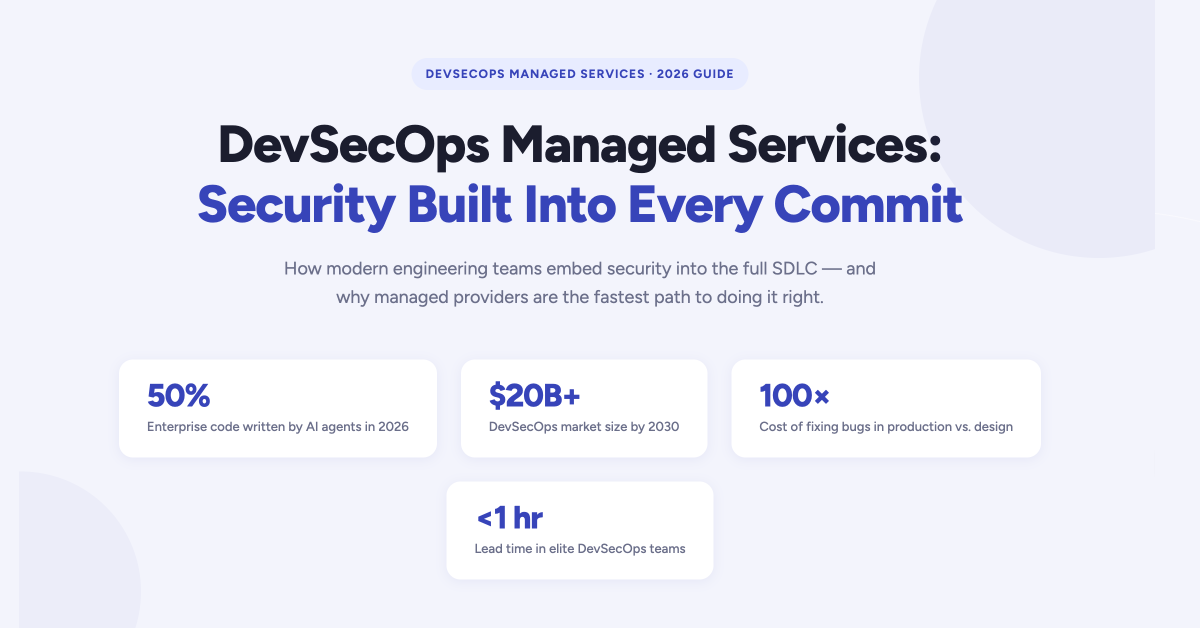
DevSecOps managed services integrate security as a continuous, automated thread across the entire software development lifecycle — not a final gate before release.
Traditional development treated security as an afterthought: a checklist run by a separate team after engineers had already shipped their code. DevOps improved velocity but didn't fundamentally change that dynamic. DevSecOps managed services solve the root problem by making security a shared, automated responsibility from the first line of code to production monitoring.
When an organization engages a managed DevSecOps provider, they gain a continuously operating program that embeds security tooling into their CI/CD pipeline, staffs specialized engineers, and maintains compliance posture 24/7 — without the burden of hiring, toolchain maintenance, or keeping pace with an evolving threat landscape.
The core shift: DevSecOps doesn't slow down delivery — it makes high-velocity delivery safe. The same commit that triggers a build and test run also triggers security scans, vulnerability assessments, and supply chain validation. Security becomes invisible friction, not a bottleneck.
DevSecOps vs. DevOps: what changes?
DevOps
vs.
DevSecOps
Dimension
DevOps
DevSecOps
Primary focus
Speed and continuous delivery
Speed, safety, and continuous security
Team structure
Dev + Ops collaboration
Dev + Sec + Ops as equal partners
Security timing
Reactive — a final checkpoint
Proactive — integrated from day one
Automation scope
CI/CD, testing, deployment
CI/CD + security scanning + compliance
Risk management
Uptime and performance
Vulnerability reduction and attack-path analysis
The shift-left and shift-right continuum
Elite DevSecOps programs don't just move testing earlier — they also harden the production environment in real time.
Shift-left means embedding SAST (static application security testing) and SCA (software composition analysis) directly into the developer's IDE. Vulnerabilities surface as the engineer writes code, not three sprints later when context is lost and the fix is far more expensive.
Shift-right means operating runtime security in production: behavioral telemetry, exploitability scoring, and anomaly detection that catches what pre-deployment scans miss. This dual approach is critical for reducing alert fatigue — the condition where security teams drown in thousands of isolated findings and burn out.
Managed providers focus teams on toxic combinations: an internet-facing server carrying a critical CVE that has direct database access to PII. That context-aware prioritization is impossible without operationalized telemetry — and it's one of the core value propositions of a mature managed service.
Core pillars of a managed DevSecOps program
A complete managed offering covers six interconnected domains, each reinforcing the others.
🔍
Pipeline security
SAST, DAST, SCA, and IaC scanning integrated directly into every CI/CD run — zero manual triggers required.
📦
Supply chain governance
Living SBOMs enriched with VEX data, SLSA Level 3 binary signing, and automated blocking of unvetted packages.
☁️
Cloud posture management
Continuous CSPM monitoring for configuration drift, IaC policy enforcement, and multi-cloud compliance visibility.
🤖
Agentic governance
Security policies applied to non-human AI identities — every agent action traceable to a model version and prompt.
🔑
Identity & access
Least-privilege IAM, temporary credentials, MFA enforcement, and secrets management across all environments.
📋
Compliance automation
Auto-generated audit evidence, drift detection records, and policy-as-code for PCI DSS 4.0, HIPAA, SOC 2, and more.
AI-driven DevSecOps and supply chain security in 2026
Two forces have redefined what "managed" means: autonomous AI agents and software supply chain complexity.
Agentic governance
By late 2026, AI agents are expected to write, test, or deploy nearly half of all enterprise code. These agents are no longer tools — they are primary actors in the software supply chain. Managed DevSecOps programs now enforce security policies on non-human identities, creating a queryable system of evidence where every agent action is traceable to a specific model version and prompt.
AI is also accelerating the detection-to-fix cycle. An AI agent can detect a CVE, perform reachability analysis to verify whether the vulnerable function is actually called, identify a safe upgrade path, run regression tests, and open a pull request — with minimal human involvement. This is essential for scaling security reviews to match the volume of AI-generated code changes, which grew tenfold between 2024 and 2025.
Living SBOMs and supply chain pillars
A static SBOM is a liability: accurate at build time, obsolete by the next zero-day. Managed services in 2026 operate living SBOMs — continuously updated documents correlated with real-time vulnerability feeds (including EPSS scores) and runtime telemetry.
Pillar
What it means in practice
Living SBOMs
Continuous updates enriched with VEX (Vulnerability Exploitability eXchange) data
MLSecOps
DevSecOps principles applied to ML lifecycle — model integrity, data provenance
Binary lifecycle management
Artifact provenance for JARs, Wheels, and Docker images to close the binary gap
Curation at the perimeter
Auto-blocking of packages under 30 days old or with restrictive/unknown licenses
SLSA Level 3 signing
Verifiable chain of custody for every binary that reaches production
The shared responsibility model explained
Misunderstanding the shared responsibility model is one of the leading causes of cloud security breaches. Your managed partner owns the platform — you still own your data and application layer.
The division of responsibility shifts significantly depending on the service model in use:
IaaS — the provider secures physical hardware and the virtualization layer. You (and your managed partner) own the OS, middleware, runtime, applications, and all data.
PaaS — the provider adds OS and platform management. Your responsibility narrows to application security, data protection, and user access control.
SaaS — the provider manages almost the full stack. You remain responsible for data sensitivity classification, access controls, and compliant configurations.
A mature managed DevSecOps provider formalizes these boundaries using a RACI matrix: they are Responsible for technical execution (patch management, hardening, scan tooling), while your internal security leadership remains Accountable for high-level policy decisions. This clarity prevents the dangerous assumption that "the provider handles it."
DevSecOps managed services for regulated industries
Compliance-driven sectors — finance, healthcare, government — are the primary growth engine of the managed DevSecOps market because they require continuous audit readiness, not point-in-time assessments.
PCI DSS 4.0 and payments security
PCI DSS 4.0 became mandatory in 2025 and introduced materially new requirements. Managed services cover client-side script monitoring to prevent Magecart-style skimming attacks, MFA for all administrative access to the Cardholder Data Environment, and tokenization to reduce compliance scope. Automated drift detection from the CI/CD pipeline replaces error-prone manual audit preparation.
HIPAA and healthcare
Protecting electronic Protected Health Information (ePHI) requires Business Associate Agreements with every cloud provider in the stack, rigorous access controls, and guaranteed masking or tokenization of ePHI in non-production environments. Every infrastructure change must be logged and reproducible for audit transparency.
Government and continuous ATO
Federal agencies are moving from periodic Authority to Operate (ATO) to continuous ATO (cATO). Managed providers deliver "golden paths" — pre-approved DevSecOps pipeline templates with security scans and logging built in — enabling agencies to ship software rapidly while staying within complex federal authorization frameworks.
Pricing models for DevSecOps managed services
Pricing in 2026 has moved away from flat seat licenses toward models that reflect actual infrastructure footprint and delivered business outcomes.
Model
Unit of measure
Best for
Managed nodes
Active servers / nodes per month
Enterprises with stable, predictable server fleets
Resources under management (RUM)
Individual cloud resources (S3 buckets, VMs, etc.)
Cloud-native teams with dynamic, elastic infrastructure
Outcome-based
Resolved tickets, uptime SLA delivered, CVEs remediated
Organizations wanting direct cost-to-value alignment
Retainer
Recurring monthly fee for defined scope and team
Startups and mid-market firms needing a dedicated team
Data ingestion
GB of logs / telemetry processed per day
Organizations with large, high-cardinality log volumes
Outcome-based pricing is gaining the fastest traction — you only pay when the promised result is delivered (a ticket resolved, an hour of uptime maintained). This lowers the psychological barrier to adoption significantly, particularly for organizations that have been burned by tool sprawl with no measurable impact.
Measuring ROI: DORA metrics
The DORA framework links technical performance directly to business outcomes — profitability, market share, and customer satisfaction. These four metrics are the standard for evaluating managed DevSecOps ROI.
Deployment frequency
Elite teams deploy on demand, many times daily. Managed automation moves organizations from monthly releases to a continuous flow.
Lead time for changes
Top teams in 2026 achieve commit-to-production lead times under one hour. Managed pipelines make this achievable without sacrificing security gates.
Change failure rate
Integrated security checks reduce CFR dramatically. Production bug fixes cost up to 100× more than design-phase fixes — early detection is pure ROI.
Mean time to recovery
Centralized telemetry and automated runbooks compress MTTR from days to minutes — reducing incident cost and customer impact.
DevSecOps maturity model
Maturity isn't about the number of tools you run — it's about the absence of recurring problem classes and the automation of evidence collection
1
Ad-hoc
Security is a manual afterthought. No consistent tooling, no standardized process. Audits are painful and expensive.
2
Repeatable
Basic security gates exist. Consistent scanning for high-priority services. Security is scheduled, not continuous.
3
Measurable
DORA metrics are tracked. Audit evidence is collected automatically from the pipeline. Compliance is a byproduct of daily operations.
4
Optimized
Security is fully integrated and AI-driven. Agentic remediation, self-healing systems, 100% scan coverage on all critical release paths.
A good managed partner doesn't just install tools and hand you a dashboard — they walk alongside your team through each level of this ladder, making measurable progress against defined benchmarks every quarter.
How to choose a DevSecOps managed service provider
Use a weighted evaluation rubric across four dimensions. Technical depth without operational reliability is just expensive consulting.
Evaluation area
Weight
What to look for
Team expertise
35%
Years of hands-on experience, CISSP / OSCP certifications, industry-specific depth (finance, healthcare, SaaS)
Implementation approach
30%
Rapid deployment capability (30-day onboarding), integration with your existing stack, "paved roads" not tool dumps
Customer satisfaction
25%
Verified peer reviews on Gartner Peer Insights, G2, or Clutch — not marketing case studies
Security maturity methodology
10%
Adherence to DSOMM or SEI PIM; clear benchmarks for progression through maturity levels
One question that separates great providers from average ones: "Show me a RACI matrix for how you divide responsibility with your customers." If they can't produce one clearly and quickly, keep looking.
The bottom line
DevSecOps managed services have matured from a niche offering into a core infrastructure decision for any organization that ships software. The shift from the "visibility era" of simple scanning to the "governance era" of agentic AI and living SBOMs reflects how serious the stakes have become — and how complex the toolchain required to manage them.
The organizations winning in 2026 are those that have moved security from a procedural bottleneck into a strategic business enabler: one that protects brand reputation, ensures regulatory resilience, and generates measurable ROI through faster, safer delivery cycles.
A trusted managed partner removes the hardest parts of this transformation — the talent scarcity, the toolchain complexity, and the operational burden of staying ahead of an evolving threat landscape — so your engineering teams can focus on building products, not maintaining security plumbing.
Gart Solutions specializes in DevSecOps consulting and managed operations for cloud-native organizations. If you're evaluating your current security posture or planning a pipeline modernization, reach out for a free consultation.
The definitive 2026 guide to embedding security into every stage of your software delivery lifecycle — and why the organizations that get this right ship faster, not slower.
$11.6B
Global DevSecOpsMarket 2026
28%
CAGRGrowth Rate
97%
Orgs AdoptingAI in SDLC
300%
Supply ChainAttacks Since 2018
80%
Faster SecurityFixes with DevSecOps
The end of the security checkpoint
For decades, security was the department at the end of the hall that reviewed your code before release. It was slow, confrontational, and guaranteed to create friction. In 2026, that model doesn't just slow teams down — it actively increases risk.
The modern attack surface has evolved faster than most organizations' defenses. AI-generated code floods pipelines with subtle vulnerabilities. Supply chain attacks target build runners and dependency registries, not just your own code. And regulations like GDPR, HIPAA, and SOC 2 now require continuous, auditable compliance — not point-in-time reviews.
DevSecOps closes this gap by treating security as code: version-controlled, automatically enforced, and embedded at every stage of delivery — from the first line typed to the container running in production.
Why 2026 is the inflection point
The numbers tell the story. Nearly 60% of high-velocity teams — those shipping daily or multiple times per day — have fully embedded DevSecOps practices. These teams don't just have fewer breaches; they move faster because security automation removes manual friction rather than adding it.
Conversely, organizations that lag face a compounding "security divide." DevSecOps practitioners report losing seven hours per week to inefficient cross-team handoffs. Alert fatigue is endemic: thousands of findings per day, but only 18% are exploitable in production.
The solution isn't more tools — the average team already manages five or more security tools alongside five or more development tools. The solution is orchestration: a unified framework that turns security signals into developer actions.
Shift Left: embed security where developers already work
The cost of fixing a vulnerability rises exponentially the later it's discovered. A logic flaw caught in the IDE costs minutes. The same flaw caught post-production can cost millions.
Pipeline Stage
Security Action
Primary Objective
Pull Request
SAST
Secrets Scan
IaC Checks
Catch logic flaws and hardcoded credentials before merge — when fixes are cheapest
Build / Package
SCA
SBOM Generation
Image Scanning
Verify dependency health and establish artifact provenance for every build
Deploy Gate
Policy-as-Code
Attestation Check
Block non-compliant or unsigned artifacts from ever reaching production
Runtime
DAST
Drift Detection
Forensics
Detect live threats, unauthorized config changes, and lateral movement in real-time
Policy-as-Code: make compliance a side effect of shipping
Manual security reviews are the enemy of scale. Policy-as-Code encodes your security rules in machine-readable formats — and enforces them automatically at every stage.
Open Policy Agent (OPA)
Define fine-grained access and network rules as Rego policies. OPA enforces them across Kubernetes, CI/CD, and API gateways — the same policy, everywhere, always consistent.
Terraform Sentinel
Gate every infrastructure change against your compliance rules before the plan is applied. No more "we'll fix the IAM permissions later" — if it's non-compliant, it doesn't deploy.
Compliance-as-Code
Automatically map security controls to HIPAA, GDPR, SOC 2, and PCI-DSS requirements. Every code change is validated against your regulatory frameworks — automatically, in seconds.
Continuous Compliance
Shift compliance from a quarterly scramble to a continuous state. Real-time dashboards show your risk posture at any moment — for developers, security, and auditors alike.
Govern your supply chain — beyond the SBOM
Supply chain attacks have surged 300% since 2018. Static SBOMs were a start; 2026 demands Pipeline Bill of Materials and verifiable build attestations.
Risk Vector
Mitigation Strategy
2026 Best Practice
Vulnerable dependencies
Software Composition Analysis (SCA)
Use reachability analysis to prioritize only exploitable code paths — not just CVE scores
Compromised build tools
Pipeline hardening (Harden-Runner)
Monitor network activity and restrict runner permissions to the minimum required
Insecure artifacts
Artifact signing and provenance
Implement SLSA Level 3 for verifiable chain of custody on every binary that ships
Malicious packages
Perimeter curation and cooldowns
Block packages under 7 days old or with no active maintainers from entering your build
Outdated dependencies
Automated dependency updates
Average dependency lag is 278 days. Automate updates and apply compensating runtime controls
Navigate the AI paradox in your SDLC
97% of organizations are adopting AI in software delivery. This accelerates output — but also floods pipelines with a new category of subtle, hard-to-detect vulnerabilities.
⚠ The Risk
AI introduces new attack surfaces
AI-generated code contains security flaws at scale — faster than any human review process can catch them
39% of developers use "Shadow AI" tools with no governance or audit trail
AI agents accessing production systems require identity and secrets management policies
Malicious dependencies injected into AI training pipelines or suggested completions
✓ The Approach
Agentic governance and intelligent remediation
95% of security leaders expect AI-driven remediation to be standard by end of 2026
Contextual prioritization platforms reduce alert noise by up to 92% using behavioral telemetry
AI-powered threat modeling integrated into CI/CD to anticipate attack paths before code ships
Unified AI governance policies covering both human developers and autonomous agents
Zero Trust secrets management: eliminate static credentials
Hardcoded credentials are one of the fastest paths to a full system compromise. In 2026, static secrets are not just risky — they are a compliance failure.
Centralization
Single vault for all credentials — HashiCorp Vault, AWS, or Azure
Business Outcome
Unified policy enforcement and a single audit trail for all access events.
Dynamic generation
Issue unique, short-lived credentials on-demand for every app and AI agent
Business Outcome
Eliminates long-lived, high-risk static passwords that persist long after they're needed.
Automated rotation
Rotate keys on time-based triggers with zero developer intervention
Business Outcome
Minimizes exposure window when a credential is compromised — from weeks to hours.
Continuous scanning
Scan repos, logs, and CI outputs for accidental leaks in real-time
Business Outcome
Catches secrets before they're exploited — detecting the leak before the attacker does.
Gart Solutions · Managed DevSecOps
Senior-level DevSecOps results in weeks, not months
Building an in-house capability takes 6–12 months and over $1M in hiring costs. Gart Solutions deploys a team of multi-specialist experts across AWS, Azure, and GCP to deliver operational infrastructure in 2–4 weeks.
Accelerate Your Roadmap
In-house Build Time
6–12 Months
Gart Solutions Deployment
2–4 Weeks
Cloud Coverage
AWS, Azure, GCP, Hybrid
Your path to DevSecOps maturity
DevSecOps is a journey, not a switch. Here's the sequence that consistently works — from quick wins to organizational transformation.
1
Audit your current posture
Understand where you are before mapping where to go. A structured IT audit surfaces critical gaps in your pipeline and compliance coverage. Gart Solutions delivers comprehensive audits in days — not quarters.
2
Instrument your CI/CD pipeline
Add SAST, secrets scanning, and IaC checks to every pull request. Start with high-signal tools. Developers should see a security result within 60 seconds of opening a PR — or adoption will stall.
3
Implement Policy-as-Code
Define requirements as code using OPA or Sentinel. Integrate them into deploy gates so non-compliant artifacts are blocked automatically. Version-control every policy alongside the infrastructure.
4
Migrate to dynamic secrets
Audit for hardcoded credentials and centralize into a vault. Introduce dynamic generation for high-risk services first. Scan continuously for leaks across your entire artifact history.
5
Build a Platform Engineering practice
Standardize these practices into an Internal Developer Platform. Developers should provision secure infrastructure via self-service — without opening a ticket. This is the ultimate competitive advantage.
Expert support for every stage of the journey
From strategic advisory to managed operations, Gart Solutions provides the senior expertise to accelerate your DevSecOps transformation — without the overhead of building in-house.
DevSecOps Consulting
GitOps, CI/CD automation, and security toolchain integration tailored to your stack.
Learn more
IT Security Audit
Identify vulnerabilities and gaps before they become breaches with a clear roadmap.
Learn more
Managed SRE
24/7 monitoring, incident management, and 99.99% uptime SLAs for critical platforms.
Learn more
Platform Engineering
Internal Developer Platforms for self-service access to compliant infrastructure.
Learn more
Cloud Migration
Secure, cost-optimized migration to AWS, Azure, and GCP. Cut costs by 25–81%.
Learn more
Fractional CTO
Senior technical leadership for startups—immediately available, part-time experts.
Learn more
The Gart track record
25%
Cloud cost reduction for Datamaran via AWS optimization
81%
Operational cost reduction via Azure Spot VM migration
99.99%
Uptime achieved for high-performance SaaS platforms
2–4w
Time to operational infrastructure vs. industry's months
The strategic path forward
In 2026, DevSecOps is no longer a competitive differentiator — it is the baseline expectation. Organizations that fail to embed security into their delivery pipelines face compounding risk: more vulnerabilities, slower remediation, regulatory exposure, and a growing gap behind high-performing peers.
The good news is the path is clear. Shift left. Automate compliance. Govern your supply chain. Eliminate static secrets. Build platforms that make the secure path the default path. The organizations leading in this space don't experience security as friction — they've made it invisible.
Gart Solutions exists to accelerate this journey. Whether you're a healthcare startup navigating HIPAA, a fintech scaling algorithmic trading, or a SaaS company managing multi-cloud complexity — our team brings the senior-level DevSecOps expertise to get you there faster, with less risk, and without the overhead of building everything in-house.