The DevOps vs DevSecOps debate is no longer theoretical. In 2026, with AI-generated code shipping at machine speed and regulators tightening compliance obligations across every sector, the question for engineering leaders is not whether to add security to their delivery pipelines—it is how fast they can do it without breaking the velocity that makes modern software teams competitive.
This guide cuts through the noise. We explain the core differences betweenDevSecOps and DevOps, show you exactly what changes in practice, walk through a proven implementation roadmap, and help you decide which model fits your organisation today. Whether you run a five-person startup pipeline or a regulated enterprise environment, you will leave with a clear, actionable picture.
What Is DevOps? The Foundation You Need to Understand First
DevOps is a cultural and technical movement that broke down the wall between software development teams (who want to ship features fast) and operations teams (who want stable, reliable systems). Before DevOps, software was thrown “over the fence” from dev to ops, causing slow releases, finger-pointing, and fragile deployments.
The solution DevOps pioneered was continuous delivery: automated build, test, and deployment pipelines backed by a culture of shared ownership. By the mid-2010s, companies like Netflix, Amazon, and Google were deploying thousands of times per day. The four DORA metrics — deployment frequency, lead time, change failure rate, and mean time to restore — became the industry scorecard.
DevOps solved a genuine problem brilliantly. But it created a quieter problem: security was not in the room. Security teams remained external reviewers, approving or rejecting releases after developers had already spent weeks on a feature. The faster DevOps moved, the larger the gap grew.
SECTION TAKEAWAY
- DevOps merges development and operations through culture + automation.
- Goal: faster, more reliable software delivery.
- Core mechanism: CI/CD pipelines, IaC, and shared DORA metrics.
- Critical blind spot: security remains a late-stage gate, not a built-in property.
What Is DevSecOps? DevOps vs DevSecOps at the Core
DevSecOps does not replace DevOps. It extends and matures it by embedding security as a first-class responsibility at every stage of the software development lifecycle (SDLC) — from the moment a developer starts writing code to the moment an application runs in production.
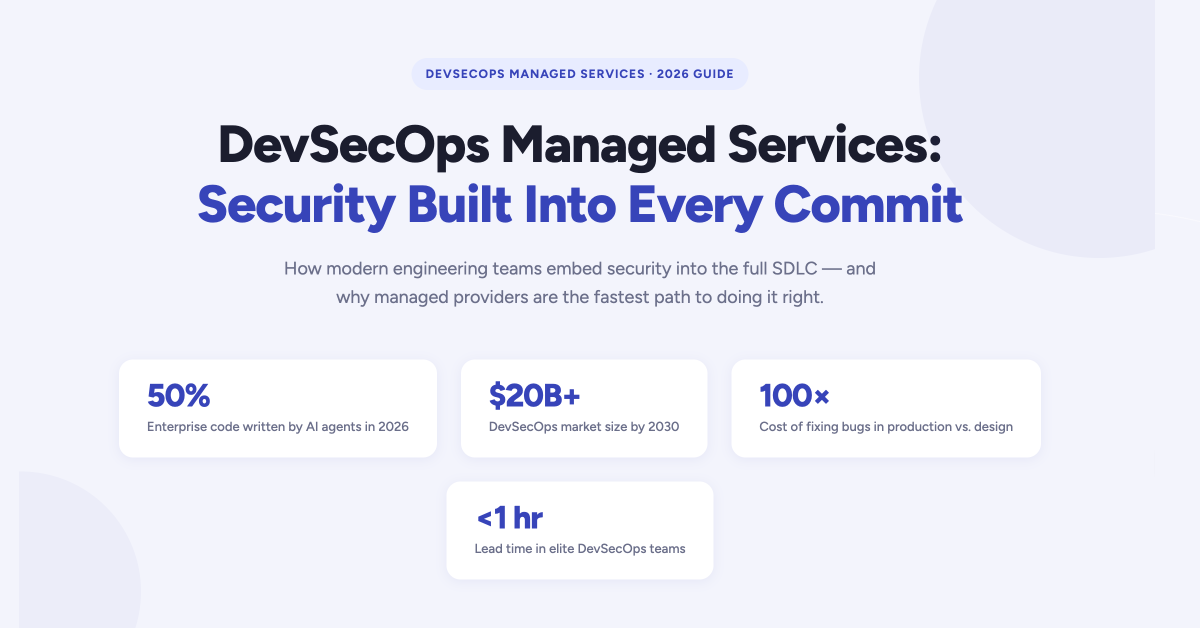
The phrase “shift left” captures the mechanism: move security controls earlier (to the left on a timeline) so that vulnerabilities are caught when they cost almost nothing to fix, rather than in production where the cost is highest. According to NIST, the relative cost of fixing a defect in production is 30× higher than catching it in design.
In a DevSecOps pipeline, security tools are woven into the same CI/CD automation developers already use. A pull request automatically triggers a static analysis scan. Committing code with a hardcoded API key fails the build instantly. Infrastructure templates are validated against policy before a cloud resource is ever provisioned. Security does not slow delivery — it moves with delivery.
Real-world example — financial services: A European challenger bank migrated from a quarterly security review model to DevSecOps. Within six months, their average vulnerability-to-fix time dropped from 47 days to 4 days. Deployment frequency doubled because teams no longer feared late-stage security failures blocking releases.
SECTION TAKEAWAY
- DevSecOps embeds security into every CI/CD stage — it does not add a new gate at the end.
- “Shift Left” is the core mechanism: earlier = cheaper + faster.
- Ownership changes: every engineer owns a piece of security, not just a dedicated team.
DevSecOps vs DevOps: Key Differences at a Glance
The table below captures the structural differences between DevOps and DevSecOps across the dimensions that matter most to engineering leaders making adoption decisions.
| Dimension | DevOps | DevSecOps |
|---|---|---|
| Primary goal | Speed & reliability of delivery | Speed with verifiable security built in |
| Security role | External reviewer, late-stage gate | Shared responsibility, automated at every stage |
| When security runs | After code is written (pre-release) | At commit, build, test, deploy, and runtime |
| Risk focus | Downtime, deployment failures | Vulnerabilities, compliance violations, exposure |
| Automation scope | Build, test, deploy | Build, test, deploy + security scans, policy checks, compliance evidence |
| Cultural model | Dev + Ops collaboration | Dev + Sec + Ops collaboration (“golden triangle”) |
| Compliance approach | Periodic audits, manual evidence | Continuous compliance, automated evidence generation |
| Cost of vulnerabilities | High (found late) | Low (found early—at dev or build stage) |
| Toolchain additions | CI/CD, IaC, monitoring | All DevOps tools + SAST, DAST, SCA, secrets mgmt, IaC scanning, RASP |
| Regulatory fit | Adequate for lower-risk environments | Required for finance, healthcare, government (PCI-DSS, HIPAA, SOC 2, GDPR) |
Infrastructure and Policy as Code: Governance Without Friction
As infrastructure moved to the cloud, manual configuration became a liability.
DevSecOps extends automation to governance itself:
- Infrastructure as Code (IaC) ensures consistency and auditability
- Policy as Code (PaC) enforces rules automatically using engines like Open Policy Agent (OPA)
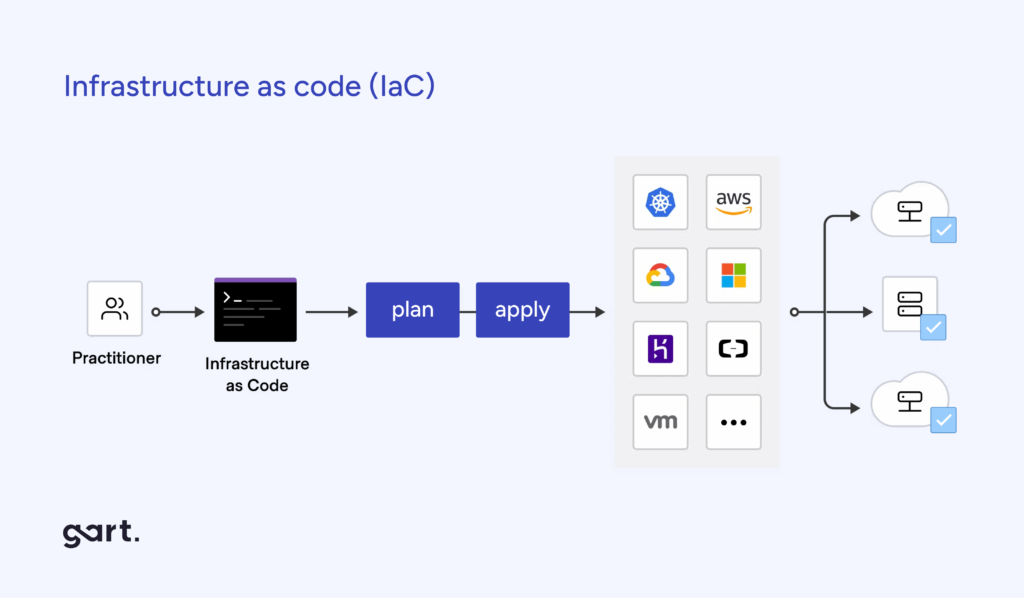
Examples:
- Preventing unencrypted storage before deployment
- Blocking insecure Kubernetes manifests at admission time
- Generating audit evidence automatically for SOC 2, HIPAA, or GDPR
This creates guardrails, not gates — allowing teams to move fast safely.
Culture: From Security Gatekeepers to Shared Ownership
Tools alone do not create DevSecOps. DevSecOps succeeds or fails less on tooling than on culture. In traditional organizations, security teams often operated as external reviewers, stepping in late to approve or reject releases. This positioning made security a perceived obstacle to delivery and reinforced adversarial dynamics between teams focused on speed and those focused on risk reduction.
DevSecOps replaces this model with shared ownership. Security is no longer something “handed off” to specialists but a responsibility distributed across development, operations, and security professionals. Developers are empowered to make secure decisions as they write code, operations teams enforce resilient environments, and security teams act as enablers who design guardrails rather than gates.
The cultural shift is from security as enforcement to security as collaboration:
- Developers own security outcomes
- Security teams enable, not block
- Operations enforce reliability and containment
In practice, this shift requires meeting engineers where they work. Security feedback must appear in the same tools developers already use — IDEs, pull requests, and issue trackers — rather than in separate reports or audits. As trust grows, security specialists increasingly collaborate directly with product teams, helping shape design decisions early instead of policing them later.
Successful organizations scale this through:
- Security champions inside engineering teams
- Pairing and embedding security engineers
- Threat modeling workshops and gamification
- Integrating security into existing workflows
Maturity is measured not by zero vulnerabilities, but by how fast teams learn and respond.
Measuring DevSecOps: Speed and Risk Signals
Traditional DevOps metrics, like deployment frequency, lead time, and change failure rate, remain important indicators of agility. But they don’t capture the full picture in a security-first environment.
DevSecOps expands the lens to include risk signals that reflect how effectively teams prevent, detect, and remediate vulnerabilities. Key measures include how quickly newly discovered flaws are addressed, how long critical issues linger in the system, and how many high-severity vulnerabilities reach production. By combining velocity with these security indicators, organizations can evaluate whether their fast-moving pipelines also maintain a strong risk posture.
DevSecOps extends classic DORA metrics with security indicators:
- Vulnerability discovery rate
- Mean time to remediate (MTTR)
- Mean vulnerability age
- Critical issues reaching production
Data from 2025 shows that mature DevSecOps organizations resolve vulnerabilities over ten times faster than less mature peers, while simultaneously increasing deployment frequency by up to 150 percent. This demonstrates a crucial point: when automated correctly, speed and security reinforce each other rather than compete, turning DevSecOps into a true accelerator for both innovation and resilience.
DevSecOps Tools: The Layered Security Toolchain
A mature DevSecOps toolchain is not a single product — it is a system of complementary controls, each catching a different class of risk. The goal is defence in depth: no single missed scan exposes the entire system. Below are the key categories and leading tools teams use in 2026.
Static Analysis
Scans source code for insecure patterns and coding vulnerabilities before execution.
Dynamic Testing
Tests running applications for real-world exploitability, including auth flaws and injection paths.
Dependency Scanning
Evaluates open-source libraries against CVE databases at build time to manage third-party risk.
Secrets Management
Prevents credentials, tokens, and API keys from leaking into version control systems.
Infrastructure Policy
Catches cloud misconfigurations in Terraform or Helm templates before resources are provisioned.
Runtime Protection
Actively monitors and blocks exploit attempts in production as a final line of defence.
Image & Registry Scanning
Validates container images for vulnerabilities before they are deployed to Kubernetes clusters.
Policy as Code
Enforces regulatory controls automatically and generates continuous audit evidence.
Gart perspective:
The teams that implement DevSecOps most successfully arediff-aware — they scan only what changed, not the entire codebase on every commit. This keeps feedback fast and prevents security tooling from becoming a bottleneck that developers learn to route around.
When to Choose DevOps vs DevSecOps: A Practical Decision Guide
Not every team needs to leap straight to a full DevSecOps implementation today. The right choice depends on your risk profile, regulatory environment, and current pipeline maturity. Use this decision framework to orient your roadmap.
Start with DevOps if…
- You do not yet have a functioning CI/CD pipeline
- Your team is fewer than 10 engineers and moving fast on non-regulated product
- You handle no sensitive PII, financial data, or health records
- Compliance obligations are minimal or absent
- Your primary challenge is deployment reliability, not security posture
Prioritise DevSecOps if…
- You operate in finance, healthcare, government, or any regulated sector
- You must comply with PCI-DSS, HIPAA, SOC 2, GDPR, or ISO 27001
- You handle customer data, credentials, or payment information
- You have suffered a breach, security incident, or failed audit
- Your CI/CD pipeline is mature and ready for the next layer
The honest answer: In 2026, any team shipping to production in a B2B or regulated context should treat DevSecOps as the standard, not an upgrade. The question is sequencing: achieve DevOps maturity first (stable pipelines, DORA metrics tracked), then layer in security controls systematically using the roadmap below.
How to Implement DevSecOps: A 6-Step Roadmap
Based on work with enterprise clients across financial services, healthcare IT, and SaaS, the Gart team has found that DevSecOps adoption succeeds when it follows a sequenced, iterative approach, rather than trying to bolt on every tool at once.
Assess your current security posture
Run a baseline security audit of your CI/CD pipeline, dependencies, IaC configurations, and access controls. Identify your top five highest-risk exposures. This creates a prioritised backlog, not a wish list.
Integrate SAST and secrets scanning into the IDE and PR workflow
Add static analysis plugins to developer IDEs and enforce pre-commit hooks that block secrets from entering version control. This is the highest-ROI first step – developers fix issues without ever leaving their workflow.
Add SCA to the build pipeline
Configure dependency scanning on every build. Set policies that fail the build on critical CVEs in direct dependencies and warn on transitive ones. Connect to your issue tracker so vulnerabilities become tickets, not reports no one reads.
Implement IaC scanning and Policy as Code
Before any cloud resource is provisioned, validate Terraform/CloudFormation/Helm templates against your security baseline using Checkov or OPA. Codify your hardening standards so they enforce themselves rather than relying on manual review.
Deploy DAST and container image scanning in staging
Run dynamic tests against the full application in a staging environment. Scan container images before they reach production registries. Establish a vulnerability SLA: critical = fix within 24h, high = 7 days, medium = next sprint.
Build the culture: security champions and shared metrics
Designate security champions in each engineering squad. Add security metrics— mean time to remediate, open critical CVEs, deployment gate pass rate—to your engineering dashboard alongside DORA. Culture change follows measurement.
5 DevSecOps Implementation Pitfalls We’ve Seen in Enterprise Teams
Most DevSecOps failures are predictable. After working with engineering organisations across multiple sectors, these are the five mistakes that consistently derail implementations.
Trying to add every tool at once
Teams that try to implement SAST + DAST + SCA + secrets management + IaC scanning simultaneously overwhelm developers with alerts and create alert fatigue. Start with one or two high-impact controls and mature from there.
Making security a separate team’s problem
DevSecOps requires distributed ownership. If security engineers are the only ones who care about scan results, developers will find workarounds and suppressions proliferate. Accountability must sit with the squad that wrote the code.
Ignoring pipeline performance
Security scans that add 20+ minutes to a CI build will be disabled by engineers under deadline pressure. Use diff-aware scanning, parallel jobs, and caching to keep the full pipeline under 10 minutes even with security controls active.
Skipping threat modelling
Tools find known vulnerabilities. Threat modelling finds architectural risks tools cannot see. Even a lightweight STRIDE session at the start of a new feature or service prevents entire classes of security debt from accumulating.
Treating compliance as the destination
Passing a SOC 2 audit is not the same as being secure. Teams that optimise purely for compliance checkboxes often have significant unmitigated risk in areas the audit framework does not cover. Compliance is a floor, not a ceiling.
Ready to Move from DevOps to DevSecOps?
Gart helps engineering teams design, implement, and operate production-grade DevSecOps pipelines—from the first SAST integration to full Policy as Code and continuous compliance.
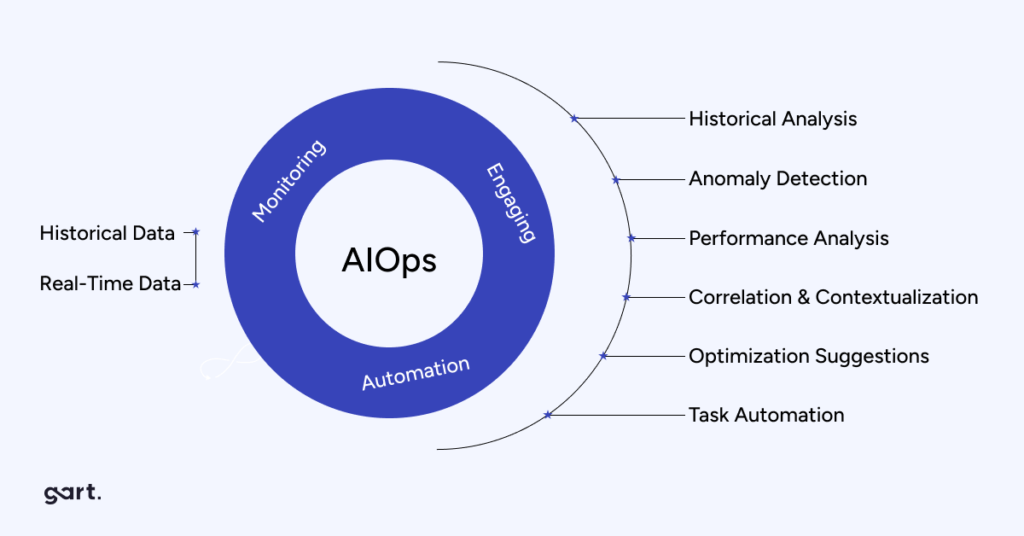
AI Change Everything — and Exposes Everything
By 2025, 90% of developers used AI daily.
The DORA report confirms a hard truth:
AI does not fix broken systems — it amplifies them.
High-maturity teams get faster and safer.
Low-maturity teams accumulate debt at machine speed.
The key lesson is clear: AI is a force multiplier. In capable environments, it drives innovation safely. In fragile environments, it magnifies vulnerabilities and exposes weaknesses faster than human teams can respond. The challenge for 2026 and beyond is not whether AI will be used—it’s whether organizations have the culture, tooling, and guardrails in place to ensure that speed doesn’t come at the cost of security. In other words, AI changes everything, but without DevSecOps, it also exposes everything.
Vibe Coding, Agentic AI, and the New Security Gap
As we move into 2026, a new paradigm is reshaping software development: vibe coding. Developers now act as “conductors,” giving natural language prompts to AI systems that generate entire modules or applications. This accelerates prototyping at unprecedented speeds but introduces a hidden cost: security debt baked into AI-generated code.
By 2026:
- Up to 42% of code is AI-generated
- Nearly 25% of that code contains security flaws
- Developers increasingly do not fully trust what they ship
New risks emerge:
- hallucinated authentication bypasses,
- phantom dependencies,
- silent removal of security controls,
- AI-driven polymorphic attacks.
Compounding the challenge, adversaries are also leveraging agentic AI to launch adaptive attacks, creating a dynamic, real-time contest between offensive and defensive systems. In this environment, DevSecOps is no longer optional — it is the framework that allows organizations to integrate security into AI-assisted development, detect flawed code before it reaches production, and maintain trust even as machines take a more active role in creating software.
Security is no longer human-versus-human.
It is machine-versus-machine.
DevSecOps in the Agentic Era
In the era of agentic AI, DevSecOps evolves from a pipeline strategy into a continuous, autonomous capability. Security can no longer be a manual checkpoint or a final review — AI-driven development moves too fast, and attackers are already leveraging machine intelligence to probe vulnerabilities in real time.
The future DevSecOps model includes:
- autonomous vulnerability detection,
- AI-generated remediation PRs,
- automated validation pipelines,
- strict human-in-the-loop controls for high-impact logic.
Frameworks like NIST SSDF, OWASP SAMM, SLSA provide structure, but success depends on platform engineering that embeds security invisibly into developer experience.
DevSecOps Is Not Optional Anymore
DevOps made software fast.
DevSecOps makes it trustworthy at speed.
In an era of:
- AI-generated code,
- autonomous attackers,
- continuous compliance,
- and expanding attack surfaces,
security can no longer be a phase, a team, or a checklist.
DevSecOps is the operating system for modern software delivery.
Organizations that adopt it as a cultural, architectural, and automated system will not just ship faster -they will survive the next decade of software evolution.
The Bottom Line on DevSecOps vs DevOps
DevOps transformed software delivery by eliminating the friction between development and operations. DevSecOps extends that transformation by eliminating the friction between delivery speed and security. In 2026, the two are not competing philosophies — they are successive chapters of the same story.
The practical question for engineering leaders is not whether to adopt DevSecOps but how to sequence it given your current pipeline maturity, team culture, and risk profile. The organisations that move fastest are those that treat security as a design constraint from the start — not a compliance checkbox at the end.
If you are assessing where your team sits today or planning a transition, our IT Audit service gives you a clear, honest baseline. From there, our DevOps and DevSecOps team can help you build the pipeline your security posture requires.

See how we can help to overcome your challenges