Most companies do not fail at AI because the technology does not work. They fail because no one ran an AI readiness assessment before the budget was approved. An AI readiness assessment is a structured way to find out, pillar by pillar, whether your organization can actually plan, govern, and scale AI — rather than discovering the gaps after a six-figure pilot quietly stalls. This guide walks through the seven pillars that matter most, explains how to score each one honestly, and includes a free, interactive AI readiness assessment you can complete in about 15 minutes. If what it surfaces points to a broader gap than a single team can close alone, that is exactly the kind of work our digital transformation consulting team helps organizations work through.
What is an AI readiness assessment?
An AI readiness assessment is a structured evaluation — usually a scored questionnaire — that measures how prepared an organization is to plan, govern, and scale AI initiatives. It goes beyond asking whether you have used a chatbot or piloted a model. A properly built assessment looks at whether strategy, data, governance, culture, infrastructure, and operational discipline are all mature enough to support AI at scale, not just in a sandbox.
Done well, it works best as a shared exercise rather than a solo one:
Someone who owns technology strategy — a CIO, CTO, or Head of Digital Transformation — to answer the Business Strategy and AI Strategy & Experience questions honestly.
Someone close to data and infrastructure — a data lead or infrastructure architect — for the Data Foundations, Infrastructure for AI, and Model Management pillars.
Someone accountable for risk — security, legal, or compliance — for AI Governance & Security.
Someone representing the rest of the organization — an HR or operations lead — for Organization & Culture.
Completing the assessment from a single vantage point, IT alone especially, tends to overstate readiness on the pillars that person is furthest from.
Why AI readiness matters right now
The gap between AI ambition and AI readiness is well documented, and it is measured in real project failures, not just survey sentiment. Gartner has found that 63% of organizations either do not have or are unsure if they have the right data management practices for AI, and predicts that through 2026, organizations will abandon 60% of AI projects unsupported by AI-ready data. Separate research from Cloudera and Harvard Business Review Analytic Services found that only 7% of enterprises say their data is completely ready for AI.
Those numbers point squarely at Data Foundations, but the same pattern shows up across every pillar in this assessment: organizations invest in AI tooling before they have the strategy, governance, culture, infrastructure, or model management practices to support it. A structured AI readiness assessment exists specifically to surface which of those pillars is the actual bottleneck, rather than guessing.
The 7 pillars of AI readiness
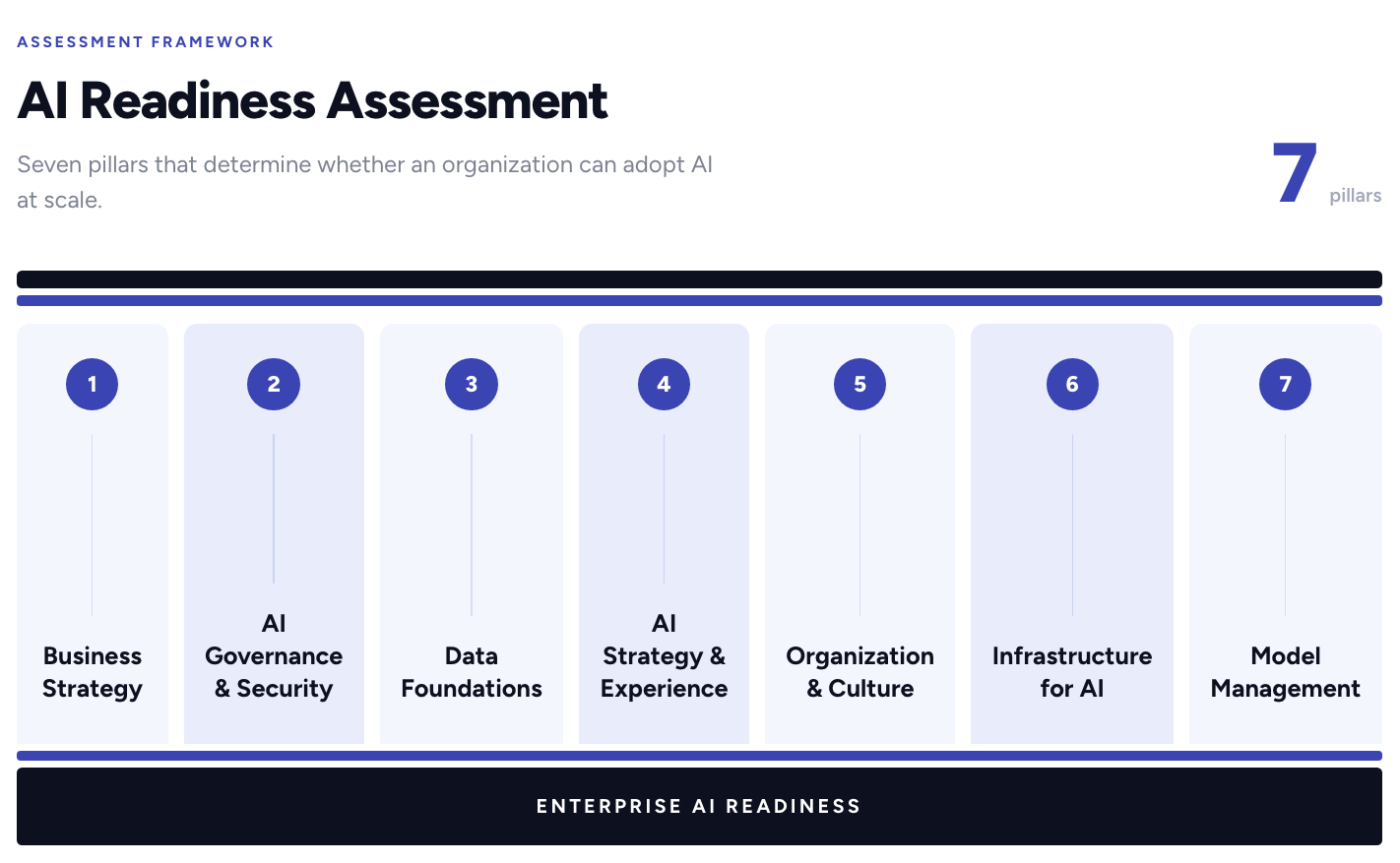
This assessment scores seven pillars independently, because an organization can be strong in one — infrastructure is a common example — while still being genuinely unready in another, such as governance or culture. Each pillar below links to the specific area of Gart's own work most relevant to closing that particular gap.
1. Business Strategy
Business Strategy is the pillar every other pillar depends on. It asks whether AI investment is tied to a documented strategy with named ownership, a working way to measure ROI, and budget that survives past the pilot stage. Organizations that skip this step tend to end up with a portfolio of disconnected experiments instead of a coherent direction — which is exactly the gap our digital transformation consulting engagements are usually brought in to close.
2. AI Governance & Security
Governance covers the policies, approval workflows, and security controls that keep AI use accountable: who reviews a new use case before it ships, how you defend against AI-specific threats like prompt injection, and whether you can demonstrate compliance under frameworks like the NIST AI Risk Management Framework. Regulatory pressure is not theoretical: as of August 2026, Article 50 transparency obligations under the EU AI Act apply to any organization deploying AI systems that interact with people, even though the Act's separate high-risk system obligations have since been deferred. Access control specifically — knowing who and what can reach your AI systems and data — is one of the fastest wins here; see our guide to the least-privilege access model for a practical starting point, or have our team run a full AI compliance audit to see exactly where you stand.
3. Data Foundations
No AI initiative outperforms the data underneath it. This pillar covers data quality, centralization, governance, lineage, and the privacy controls around whatever your models actually train or run on. It is consistently the pillar organizations underestimate the most — and, per the Gartner research cited above, the one most likely to quietly kill an AI project after the budget has already been spent. If your data still lives across disconnected systems, our database migration services are usually the first practical step.
4. AI Strategy & Experience
This pillar measures something strategy documents cannot capture: real, hands-on experience shipping AI-powered features, evaluating vendors, and iterating based on user feedback. Organizations with one AI use case fully in production, measured against clear benchmarks, are consistently better positioned than organizations juggling ten disconnected pilots. If infrastructure is what is holding your pilots back from reaching production, our AI infrastructure readiness assessment goes deeper on that specific gap.
5. Organization & Culture
Even a well-funded, well-governed AI strategy fails if the people expected to use it are not trained, supported, or honestly informed about how it changes their work. This pillar looks at training programs, internal champions or a center of excellence, cross-functional collaboration, and whether experimentation is genuinely encouraged rather than quietly punished when a pilot fails. Change of this kind is usually a leadership problem before it is a technology one — which is exactly where a fractional CTO engagement can help provide the sustained leadership bandwidth many mid-market teams do not have in-house.
6. Infrastructure for AI
Infrastructure for AI asks whether your compute, network, and cloud architecture can actually carry AI workloads at scale: elastic GPU or accelerated compute capacity, latency and throughput tuned for AI pipelines, integration with the rest of your IT environment, and, critically, whether you can see AI-related cloud costs before they surprise you. Cost visibility in particular is where we see the most avoidable pain — our own FinOps and cloud cost management work covers exactly this problem, AI workloads included.
7. Model Management
The final pillar is operational discipline for the models themselves once they are live: monitoring for performance drift, version control and rollback, tracking third-party model deprecations, scheduled retraining, documentation, and an actual plan for retiring a model that no longer earns its keep. This is squarely AIOps territory — see our breakdown of AIOps consulting companies for how this discipline is typically delivered as a managed practice.
Take the free AI readiness assessment
The tool below covers all seven pillars with 49 questions in total — seven per pillar — modeled on the depth of frameworks like Cisco's AI Readiness Index, but scoped for a mid-market or enterprise team to complete in one sitting. It takes about 12 to 18 minutes.
What you get at the end:
An overall AI readiness score and maturity tier, from AI Foundational through AI Leading.
A pillar-by-pillar breakdown showing exactly where you are strongest and weakest.
Tailored, specific recommendations for your lowest-scoring pillars — not generic advice.
How we score your AI readiness
Each of the 49 questions is scored on a 0-to-4 scale, where 4 reflects a mature, embedded practice and 0 reflects no practice in place. Scores within each pillar are summed and converted to a percentage, and your overall AI readiness score is the average across all seven pillars, weighted equally — no single pillar can inflate or hide behind the others. That overall percentage maps to one of five maturity tiers:
0–20%: AI Foundational — just starting.
21–40%: AI Aware — early exploration.
41–60%: AI Developing — real building blocks, clear gaps.
61–80%: AI Advanced — scaling with discipline.
81–100%: AI Leading — enterprise-grade maturity.
The same 0–100% scale applies to each individual pillar, so you can see at a glance whether a low overall score is spread evenly across the business or concentrated in one or two fixable gaps.
Common AI readiness gaps we see
Across the assessments we run with clients, a handful of gaps show up repeatedly in each pillar. None of them are unusual, and none of them are permanent.
PillarCommon gapQuick winBusiness StrategyAI spend is spread across pilots with no named owner or ROI metricAssign one accountable owner and define two measurable outcomes before funding the next initiativeAI Governance & SecurityNo formal review before a new AI use case goes liveStand up a lightweight, risk-based approval step — even a one-page checklist beats noneData FoundationsData needed for AI sits in disconnected, undocumented systemsDocument lineage for your three most AI-critical data sources first, not all of them at onceAI Strategy & ExperienceMultiple pilots running, none reaching productionPick one use case and define launch benchmarks before starting a secondOrganization & CultureAdoption depends on a handful of enthusiastic individualsFormalize an internal AI champion network so knowledge does not walk out the doorInfrastructure for AIAI cloud and GPU costs are tracked after the fact, not monitored proactivelyPut cost alerting in place before scaling any workload past pilot volumeModel ManagementNo monitoring for model drift after deploymentAdd automated drift alerts to your highest-traffic model firstCommon AI readiness gaps we see
You might also like
Top AI Infrastructure Companies in 2026: The Complete Guide
IT Infrastructure Audit Checklist
Digital Sovereignty of Europe: What It Means for Your Cloud Strategy
Fedir Kompaniiets
Co-founder & CEO, Gart Solutions · Cloud Architect & DevOps Consultant
Fedir is a technology enthusiast with over a decade of diverse industry experience. He co-founded Gart Solutions to address complex tech challenges related to Digital Transformation, helping businesses focus on what matters most — scaling. Fedir is committed to driving sustainable IT transformation, helping SMBs innovate, plan future growth, and navigate the "tech madness" through expert DevOps and Cloud managed services. Connect on LinkedIn.
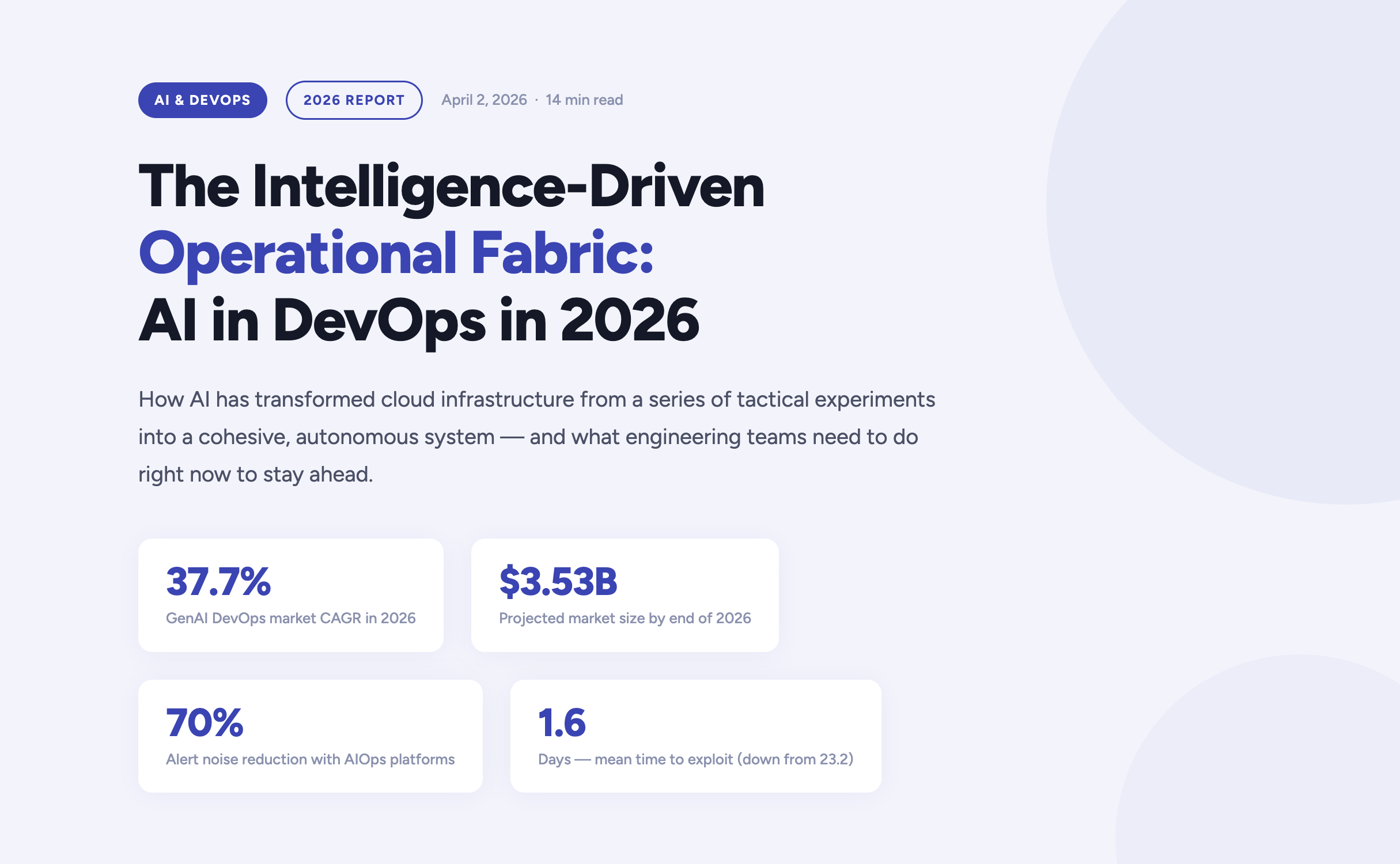
The year 2026 marks a definitive turning point in how enterprises build, deploy, and operate software. Artificial Intelligence has moved far beyond the experimental phase inside DevOps pipelines — it now forms the connective tissue of the entire software delivery lifecycle. According to current market analysis, the generative AI segment of the DevOps market is growing at a compound annual rate of 37.7%, expected to reach $3.53 billion by the end of this year alone.
For engineering teams, platform engineers, and CTOs navigating this shift, the questions are no longer "should we adopt AI?" but rather "how do we govern it?", "where does it amplify our strengths?", and critically — "where does it expose our weaknesses?". This article answers those questions, grounded in the realities of operating cloud infrastructure in 2026.
https://youtu.be/4FNyMRmHdTM?si=F2yOv89QU9gQ7Hif
The AI velocity paradox — why more code isn't always better
One of the most striking findings in the 2026 DevOps landscape is what researchers have begun calling the AI Velocity Paradox. AI-assisted coding tools have dramatically accelerated the code creation phase of the Software Development Life Cycle. However, the downstream delivery systems responsible for testing, securing, and deploying that code have often failed to keep pace — creating a structural mismatch between production and operations capacity.
The data tells a clear story. Teams that use AI coding tools daily are three times more likely to deploy frequently — but they also report significantly higher rates of quality failures, security incidents, and engineer burnout.
The AI DevOps maturity gap — occasional vs. daily AI tool users
The AI DevOps Maturity Gap — 2026 Analysis
Performance Indicator
Occasional AI Usage
Daily AI Usage
Daily deployment frequency
15% of teams
45% of teams
Frequent deployment issues
Minimal
69% of teams
Mean Time to Recovery (MTTR)
6.3 hours
7.6 hours
Quality / security problems
Baseline
51% quality / 53% security
Engineers working overtime
66%
96%
The root cause is structural: a "six-lane highway" of AI-accelerated code generation is funneling into a "two-lane bridge" of operational capacity. Engineers spend an average of 36% of their time on repetitive manual tasks — chasing tickets, rerunning failed jobs, manually validating AI-generated code — while developer burnout now affects 47% of the engineering workforce.
The implication is clear: AI does not automatically improve DevOps outcomes. Applied to brittle pipelines or fragmented telemetry, it accelerates instability. Applied to robust, standardized foundations, it becomes a force multiplier. The organizations that succeed in 2026 are those that modernize their entire delivery system — not just the IDE.
Tech should do more than work — it should do good, and it should scale purposefully."
Fedir Kompaniiets, CEO, Gart Solutions
Intent-to-Infrastructure — the evolution of IaC
Infrastructure as Code has been a DevOps cornerstone for years, but the model is undergoing a fundamental transformation in 2026. The industry is moving away from hand-crafted Terraform scripts and declarative state management toward what practitioners call Intent-to-Infrastructure — AI-powered platforms that interpret high-level business requirements and autonomously provision compliant, cost-optimized environments.
The evolution of Infrastructure as Code
The Evolution of Infrastructure as Code
Generation
Primary Mechanism
Governance Model
Outcome Focus
IaC 1.0 — Legacy
Manual scripting (Terraform, Ansible)
Periodic manual audits
Resource provisioning
IaC 2.0 — Standard
Declarative state management
Automated policy checks
Environment consistency
Intent-Driven (2026)
AI translation of requirements
Continuous autonomous reconciliation
Business-aligned outcomes
In the intent-driven model, a developer can express a requirement in plain language — for example, "provision a production-ready Kubernetes cluster with SOC 2-compliant networking for our EU-West workload" — and the platform autonomously generates, validates, and manages the resources. Compliance is no longer a retrospective audit exercise; it is embedded at the moment of generation.
This approach directly addresses one of the most persistent gaps in enterprise cloud governance: the Confidence Gap. While 77% of organizations report confidence in their AI-generated infrastructure, only 39% maintain the fully automated audit trails needed to actually verify those outputs. Intent-driven platforms close this gap by creating immutable, traceable records of every provisioning decision.
Key IaC Capabilities in 2026
Natural language provisioning — Describe infrastructure requirements in plain English, receiving validated, compliant Terraform or Pulumi code.
Golden path enforcement — Pre-approved patterns ensure every environment is secure by default, reducing misconfiguration risk.
Continuous autonomous reconciliation — AI continuously monitors for drift and self-corrects without human intervention.
Policy-as-code integration — OPA, Sentinel, and custom guardrails are embedded into generation pipelines, not added as an afterthought.
Cost-aware provisioning — FinOps constraints are applied at generation time, preventing over-provisioning before it happens.
AIOps and the new era of observability
As cloud-native architectures scale in complexity, the challenge facing modern platform engineers is no longer the collection of telemetry data — it is the meaningful interpretation of it. According to Gartner, over 60% of production incidents in 2026 are caused by poor interpretation of existing data, not a lack of visibility. Teams are drowning in signals while missing the meaning.
This has driven the rapid maturation of AIOps — Artificial Intelligence for IT Operations — which shifts the operational model from reactive incident firefighting to predictive, self-healing systems. Modern AIOps platforms in 2026 are built on three core capabilities:
Predictive incident management
AI models trained on historical delivery patterns, change velocity data, and error logs can now surface probabilistic risk assessments hours before a service outage occurs. Rather than reacting to pages at 3am, platform teams receive prioritized warnings during business hours with recommended remediation paths.
Autonomous remediation
For well-understood failure patterns — pod OOMKill events, connection pool exhaustion, SSL certificate expiry — AI agents can execute validated runbooks autonomously, patching or scaling systems within seconds of detection. Human intervention is reserved for novel or high-impact scenarios.
Intelligent alert prioritization
By correlating weak signals across application, infrastructure, and network layers, modern AIOps platforms reduce alert noise by up to 70%. Engineers no longer triage a wall of Slack notifications — they engage with a curated, context-rich incident queue.
60%+
Incidents from misinterpretation
70%
Less alert noise via AIOps
36%
Engineer time lost to manual tasks
eBPF
Deep visibility sans code changes
DevSecOps 2.0 — when autonomous security becomes non-negotiable
The security landscape of 2026 is unforgiving. The mean time to exploit a known vulnerability has collapsed from 23.2 days in 2025 to just 1.6 days — faster than any human-speed security process can respond. This has driven a fundamental rearchitecting of DevSecOps, from a set of "shift left" practices to a fully autonomous, self-healing security model.
Traditional vs. AI-Enhanced DevSecOps
Security Metric
Traditional DevSecOps
AI-Enhanced DevSecOps (2026)
Vulnerability identification
Periodic scanning of dependencies
Real-time scanning of code, containers, and runtimes
Threat response
Manual triage and incident response
Automated isolation of compromised resources
Compliance evidence
Manual spreadsheet collection
Automated, immutable audit trails
Risk assessment
Static CVSS vulnerability scoring
Contextual scoring based on reachability and blast radius
For regulated industries — healthcare, financial services, legal — compliance is no longer a quarterly exercise. In 2026, the most resilient organizations implement Compliance-by-Design infrastructure, where HIPAA, HITECH, SOC 2, and PCI-DSS controls are embedded directly into DevOps pipelines. Every commit, every deployment, every configuration change produces a verifiable, immutable compliance artifact — not as overhead, but as a natural byproduct of the engineering workflow.
The shift is cultural as well as technical: compliance is now understood as a growth enabler, not a hindrance. Organizations that can demonstrate real-time security posture attract enterprise customers, pass procurement audits, and move faster through regulated markets.
FinOps and the economics of intelligent infrastructure
Cloud spending has become a top-five P&L line item for most mid-to-large enterprises in 2026. Uncontrolled SaaS sprawl, over-provisioned Kubernetes clusters, and idle development environments have made AI-driven FinOps not just a cost-optimization strategy, but a boardroom-level priority.
The latest generation of FinOps tooling applies AI in two directions: reactive optimization (identifying and eliminating waste in existing infrastructure) and proactive cost governance (embedding unit cost constraints into provisioning workflows before resources are ever created). The results are significant — in some cases, organizations achieve savings of up to 80% on AWS compute budgets through spot instance migration, rightsizing, and automated idle resource termination.
Increasingly, FinOps and sustainability are being treated as two sides of the same coin. By eliminating idle compute and over-provisioned infrastructure, organizations simultaneously reduce cloud spend and digital carbon footprint — what practitioners are calling Green FinOps. At Gart Solutions, 70% of client workloads are optimized to run on green cloud platforms as part of a carbon-neutral-by-default infrastructure strategy.
"Applied to brittle pipelines or fragmented telemetry, AI accelerates instability. Applied to robust, standardized foundations, it becomes the force multiplier that allows organizations to scale resilience at the speed of code."
Roman Burdiuzha, CTO, Gart Solutions
Human-on-the-Loop governance — the new control model
As AI agents take over increasing portions of the operational layer, one of the defining debates of 2026 is where to draw the line on autonomy. The industry consensus has moved away from both extremes — fully manual "Human-in-the-Loop" (HITL) processes that create bottlenecks, and fully autonomous systems that introduce unacceptable risk — toward a middle path: Human-on-the-Loop (HOTL) governance.
In the HOTL model, AI agents operate autonomously within predefined guardrails. Humans shift from being operators to being overseers — setting policies, reviewing exceptions, and vetoing high-stakes decisions. The architecture is built on four pillars:
Step and cost thresholds — Hard limits on the number of actions an agent can execute per session, or the total tokens consumed, prevent infinite loops and runaway infrastructure costs.
The Veto Protocol — For high-risk decisions (budget reallocations, production changes above a defined blast radius), the agent surfaces a structured "Decision Summary" for asynchronous human review before proceeding.
Identity and access control — Agents are granted short-lived, task-scoped credentials. They never hold standing access to production environments; every session is authenticated, logged, and time-bounded.
Immutable audit trails — Every agent action generates a cryptographically signed record, ensuring full traceability for compliance and post-incident review.
This governance model is not a limitation on AI capability — it is what makes AI capability trustworthy enough to deploy at scale in regulated, high-stakes environments.
Industry-specific transformations
Manufacturing — the intelligent shop floor
Manufacturing organizations face a persistent challenge: deeply siloed data environments where Management Execution Systems (MES), ERP platforms, IoT sensor networks, and POS systems rarely communicate in real time. In 2026, cloud-native, AI-powered integration layers are dissolving these silos — enabling predictive maintenance, real-time production analytics, and supply chain transparency from raw material to finished product.
For one manufacturing client, a custom Green FinOps strategy eliminated over-provisioned infrastructure while a blockchain-based supply chain integration created end-to-end product traceability. The combined impact: measurable cost savings, improved regulatory compliance, and a more resilient operational model.
Healthcare — securing the patient data journey
In healthcare, the stakes of a misconfigured infrastructure are clinical as well as financial. DevOps practices in this sector are purpose-built around securing electronic health records, ensuring FDA and HIPAA compliance, and protecting medical device software against zero-day vulnerabilities. AI-driven monitoring continuously scans for "blind spots" that could lead to clinical data loss — not just at deployment time, but across the full runtime lifecycle.
SaaS and fintech — scaling without headcount sprawl
SaaS companies and fintech startups are increasingly turning to DevOps-as-a-Service to manage global availability and rapid iteration cycles without proportional growth in engineering headcount. By embedding automated security tasks, infrastructure-as-code provisioning, and AI-driven observability into every deployment, these teams can scale their products while maintaining the operational quality standards that enterprise customers demand.
Build your intelligent operational fabric
Partner with Gart Solutions for resilient, AI-powered cloud infrastructure.
Talk to an engineer →
Your 2026 AI DevOps roadmap
Organizations that are successfully navigating the AI transition in 2026 share a common pattern. They did not bolt AI onto existing processes — they built the foundations first, then amplified them. The roadmap has four distinct stages:
Data readiness audit
Ensure that observability data — logs, metrics, traces, events — is clean, normalized, and accessible across organizational silos. AI models are only as good as the telemetry they consume. Fragmented, noisy data produces fragmented, unreliable AI recommendations.
High-ROI use case selection
Start with workflows where AI delivers measurable, auditable value — automated testing, incident triage, IaC generation, cost anomaly detection. Build confidence and governance muscle before expanding to higher-risk autonomous operations.
Governance architecture
Establish the guardrails — HOTL oversight protocols, agent identity controls, immutable audit trails, cost thresholds — before deploying autonomous agents into production environments. Governance is not friction; it is what makes speed sustainable.
AI fluency across the engineering organization
Develop the skills required to oversee, interact with, and continuously improve intelligent agents. The competitive advantage in 2027 will belong to teams that can govern AI effectively — not just deploy it.
The 2026 AI-native DevOps toolchain
The toolchain of 2026 is defined by intelligence at every stage of the delivery pipeline. Unlike earlier generations of tooling that added AI as an afterthought, these platforms are AI-native — built from the ground up to learn, adapt, and act autonomously.
The AI DevOps Tooling Landscape (2026)
Tool
Domain
Key AI Capability
Snyk
Security
Real-time AI scanning for dependencies, containers, and IaC
Spacelift
Infrastructure
Multi-tool IaC management with AI policy enforcement
Harness
CI/CD
Intelligent software delivery with autonomous deployment verification
Datadog
Monitoring
AI-augmented full-stack visibility, anomaly detection, log correlation
PagerDuty
Incident Management
ML-based event correlation and intelligent noise reduction
StackGen
Platform Eng.
AI-powered intent-to-infrastructure generation
K8sGPT
Kubernetes
Natural language explanation and diagnosis of cluster errors
Sysdig Sage
DevSecOps
AI analyst for runtime security threat detection and CNAPP
Cast AI
FinOps
Autonomous Kubernetes cost optimization and rightsizing
Conclusion — from manual doers to intelligent orchestrators
The convergence of AI and DevOps in 2026 has redefined what is possible in software delivery. The organizations that thrive are not those that deploy the most AI tools — they are those that build the most resilient foundations and then amplify those foundations intelligently. Cloud infrastructure is no longer a hosting environment. It is an intelligent fabric that predicts, learns, and self-heals.
The transition is as cultural as it is technical. Engineering teams are moving from being manual operators to being intelligent orchestrators — governing not through a queue of tickets, but through the strategic definition of intent and the rigorous enforcement of outcomes. For those willing to make this shift, the competitive advantage is significant, durable, and compounding.
As Gart Solutions has built its entire practice around: tech should do more than work — it should do good, and it should scale purposefully.
Build your intelligent operational fabric with us
A boutique DevOps and cloud infrastructure partner for engineering teams that want to scale reliably, securely, and sustainably — without the overhead of a hyperscaler.
DevOps as a Service
Full-lifecycle CI/CD design, automation, and platform engineering for teams that need reliable, battle-tested delivery pipelines at startup speed.
Cloud migration & adoption
Strategic migration from on-premise or legacy cloud environments to modern, cost-optimized, and green cloud architectures on AWS, GCP, or Azure.
DevSecOps automation
Compliance-by-design infrastructure for regulated industries — embedding HIPAA, SOC 2, and PCI-DSS controls directly into your delivery pipeline.
AIOps & observability
End-to-end observability strategy — from eBPF telemetry and distributed tracing to AI-powered alerting, anomaly detection, and autonomous runbook execution.
FinOps & cloud cost optimization
Cloud cost audits, spot instance migration, idle resource termination, and Kubernetes rightsizing — achieving savings of up to 80% on cloud budgets.
Managed infrastructure
24/7 proactive management of your cloud infrastructure, with SLA-backed uptime guarantees, automated scaling, and continuous compliance monitoring.
The Market Reality: Legacy IT Is the Hidden Anchor of Enterprise Value
In the heart of nearly every large enterprise sits a massive constraint: accumulated technical debt embedded in legacy systems.
Across Fortune 500 companies, roughly 70% of core enterprise software was built 20+ years ago. These systems run billing engines, transaction processors, underwriting platforms, ERPs, and supply chains. They are stable — but not adaptable.
For decades, modernization was deferred because:
Programs cost hundreds of millions
Timelines stretched 5–7 years
Risk of disruption was high
ROI was unclear
Systems “still worked”
That equation has changed.
Technology now drives about 70% of value creation in major business transformations. AI, cloud, robotics, and automation demand modern digital foundations. Companies cannot extract value from generative AI, advanced analytics, or automation on top of fragmented, tightly coupled, undocumented legacy stacks.
Meanwhile, retirement of legacy-skilled engineers increases risk every year.
Legacy modernization is no longer an IT initiative. It is a CEO-level growth decision.
The Economics Have Shifted: Why AI Changes the Business Case
Three years ago, modernizing a large financial transaction processing system could cost well over $100M. Today, with AI-assisted modernization, similar programs can cost less than half — while moving significantly faster.
Organizations using generative AI in modernization programs are seeing:
40–50% acceleration in modernization timelines
~40% reduction in tech debt–related costs
Measurable improvement in output quality
Direct tracking of tech debt impact on P&L
Previously “too expensive” modernization efforts are now viable.
But only if AI is used strategically.
What Legacy Systems Actually Cost
When people search “cost of legacy systems” or “how much does legacy software cost,” they usually mean license fees.
The real cost is broader.
1. Direct IT Spend
Maintenance contracts
Vendor lock-in pricing
On-prem infrastructure
Custom integration upkeep
In many enterprises, 60–80% of IT budgets go to maintaining existing systems.
2. Productivity Loss
Developers spending significant time managing technical debt
Business users relying on spreadsheets and manual workarounds
Slower product delivery cycles
3. Risk & Compliance Exposure
Security patching complexity
Difficulty implementing regulatory updates
Increased downtime probability
4. Opportunity Cost
Technology debt can represent up to 40–50% of total investment spend impact. That is capital not going toward innovation.
Why AI Modernization Is Not Just Code Translation
One major mistake in AI-driven modernization is what experts call “code and load.”
This happens when:
Old code is simply converted to a new language
Architecture remains unchanged
Business logic inefficiencies persist
That approach merely moves technical debt into a modern shell.
Real modernization requires:
Redesigning architecture
Re-evaluating business processes
Eliminating unnecessary complexity
Targeting business outcomes, not code syntax
AI should support transformation — not automate technical debt migration.
How AI Actually Improves Legacy Modernization
AI delivers leverage in three major areas:
1. Business Outcome Optimization
Instead of modernizing everything, AI helps identify:
What systems generate the most business risk
Where modernization unlocks revenue
Which components can be retired
2. Autonomous AI Agents
Modern AI systems can deploy coordinated agents to:
Analyze dependencies
Generate test cases
Propose refactoring
Create documentation
Assist migration workflows
When orchestrated correctly, these agents significantly reduce manual engineering workload.
3. Industrialized Scaling
The real value appears when AI modernization becomes repeatable:
Standardized workflows
Automated test pipelines
Governance and oversight
Measurable cost reduction tracking
Scaling AI across modernization efforts turns it into a compounding advantage.
A Practical AI-Driven Modernization Framework
Phase 1: AI-Assisted Discovery & Audit
Before touching code:
Map all applications and integrations
Quantify tech debt exposure
Identify cost concentration
Detect hidden dependencies
AI reduces months of manual analysis into days.
Phase 2: Prioritization Based on Value
Search behavior shows leaders ask:
“When should you replace legacy systems?”
“Is modernization worth it?”
Answer: modernize what creates measurable business value.
Focus on:
Systems blocking AI adoption
Compliance risk hotspots
High maintenance cost clusters
Revenue-critical applications
Phase 3: Target Architecture Definition
Modern systems must include:
API-first architecture
Modular services
Event-driven patterns
Observability and monitoring
CI/CD automation
Infrastructure as Code
Without redesigning architecture, modernization fails long term.
Phase 4: AI Guardrails Before Refactoring
AI generates:
Regression test suites
Test data scenarios
Change impact analysis
Code documentation
This reduces modernization risk significantly.
Phase 5: Incremental Replacement
Instead of rewriting everything:
Wrap legacy with APIs
Replace bounded domains
Validate via automated testing
Decommission gradually
This approach minimizes operational disruption.
It aligns with structured Legacy Application Modernization.
Market Forces Accelerating AI-Driven Legacy Modernization
AI-driven modernization is not a niche trend. It is the convergence point of multiple structural shifts in enterprise technology, economics, and competitive dynamics.
Across industries, modernization is accelerating because the underlying pressures are compounding — not cyclical.
1. Generative AI Has Exposed Legacy Constraints
The explosive adoption of generative AI has revealed a structural problem:
Most enterprises cannot fully leverage AI on top of fragmented, tightly coupled legacy systems.
Modern AI requires:
Clean, structured, accessible data
API-driven architectures
Scalable cloud infrastructure
Observability and automation pipelines
Legacy systems — often monolithic, undocumented, and heavily customized — struggle to provide these prerequisites.
Industry research shows that organizations attempting AI adoption without modern digital foundations experience:
Slower deployment cycles
Poor integration between AI tools and core systems
Limited measurable ROI
As a result, AI adoption itself has become a catalyst for modernization.
Modernization is no longer about cost savings alone — it is about unlocking AI capability.
2. The Economics of Modernization Have Changed
Historically, modernization programs were delayed because they were:
Extremely expensive
Multi-year transformation efforts
High-risk and disruptive
But generative AI has fundamentally recalibrated that equation.
Recent industry findings indicate:
40–50% acceleration in modernization timelines when AI is orchestrated correctly
Roughly 40% reduction in costs associated with technical debt remediation
Significant reduction in manual documentation and testing effort
Projects that once exceeded $100M and required 5–7 years can now be executed faster and at materially lower cost when AI agents support code analysis, test generation, documentation, and refactoring workflows.
This shift makes previously “unjustifiable” modernization initiatives economically viable.
3. Technology Debt Is Now a P&L Issue
In many enterprises, technical debt accounts for up to 40–50% of total technology investment impact.
That means:
Capital is tied up in maintenance rather than innovation
Engineering capacity is diverted to firefighting
Business transformation ROI is diluted
Organizations are increasingly able to quantify tech debt’s financial impact, tying it directly to:
Delayed product launches
Reduced operational efficiency
Higher infrastructure costs
Increased security risk exposure
Once tech debt is visible in financial terms, modernization becomes a CFO and CEO conversation — not just an IT backlog item.
4. Cloud ROI Pressure Is Forcing Architectural Rethinks
Many enterprises migrated legacy systems to the cloud without fully modernizing them.
The result:
“Lift-and-shift” systems running inefficiently in cloud environments
High cloud spend with limited scalability gains
Persistent architectural constraints
AI-driven modernization allows organizations to:
Identify redundant services
Optimize workloads
Decompose monoliths
Improve cloud resource utilization
Cloud optimization and AI modernization are increasingly intertwined.
Organizations are not just modernizing to move to cloud — they are modernizing to make cloud economically efficient.
5. Regulatory and Security Pressures Are Increasing
Regulatory frameworks in finance, healthcare, and critical infrastructure are tightening around:
Operational resilience
Cybersecurity
Data protection
Auditability
Legacy systems often lack:
Modern logging and observability
Fine-grained access control
Real-time monitoring
Automated compliance reporting
Modernization becomes a risk mitigation strategy, reducing exposure to:
Downtime penalties
Data breaches
Regulatory fines
In highly regulated sectors, modernization is increasingly driven by resilience mandates.
6. Engineering Talent Scarcity Is a Structural Constraint
Many legacy platforms rely on:
Obsolete programming languages
Custom-built frameworks
Undocumented integrations
The engineers who built and maintained these systems are reaching retirement age.
Meanwhile:
Younger engineers prefer modern stacks
Hiring for legacy expertise becomes more expensive
Knowledge concentration creates single points of failure
AI mitigates this constraint by:
Extracting documentation automatically
Generating tests
Assisting in translating and restructuring code
Reducing dependence on scarce specialists
Talent scarcity is accelerating AI adoption inside modernization programs.
7. Competitive Acceleration Is Redefining the Risk Profile
Digital-native competitors operate on:
Cloud-native architectures
Modular systems
Rapid deployment pipelines
AI-integrated workflows
Incumbents constrained by legacy stacks face:
Slower innovation cycles
Longer feature release timelines
Limited personalization capabilities
Reduced experimentation velocity
Modernization is no longer defensive cost reduction.
It is offensive strategy — enabling:
Faster product development
AI-enhanced customer experiences
Real-time data decisioning
Market expansion
Organizations that modernize effectively gain compounding competitive advantage.
The Strategic Shift in Legacy Modernization in the era of AI
Historically:Modernization was delayed because the system “still worked.”
Today:Modernization is pursued because the business must evolve.
AI has not eliminated the complexity of modernization — but it has shifted the cost curve, reduced the time horizon, and increased predictability.
The question is no longer whether modernization is necessary.
The question is whether it is being approached strategically — with AI as an orchestrated accelerator rather than a superficial code conversion tool.
Common Challenges in Legacy System Modernization
Leaders frequently ask about challenges.
Key risks include:
Incomplete documentation
Deeply coupled systems
Organizational resistance
Underestimated scope
Lack of business alignment
Governance gaps for AI use
The solution is disciplined orchestration — not aggressive automation.
How Long Does AI-Driven Modernization Take?
Traditional programs: 3-5 years.AI-accelerated programs: 40–50% faster when structured correctly.
Timelines depend on:
System complexity
Governance maturity
Testing coverage
Architecture clarity
Is AI Modernization Worth the Investment?
When executed properly:
Cost reductions compound
Engineering productivity increases
Security posture improves
Cloud ROI improves
AI adoption becomes feasible
P&L impact becomes measurable
Organizations that track tech debt impact on financial performance often discover modernization is overdue — not optional.
Final Perspective
AI does not eliminate modernization complexity.
But it fundamentally reshapes its economics.
What was once too expensive, too slow, and too risky is now executable — if orchestrated correctly.
The organizations that combine disciplined engineering, strategic prioritization, and AI acceleration will convert legacy from an anchor into an advantage.
Ready to Modernize with AI?
Legacy modernization is no longer a multi-year leap of faith.
With the right strategy, disciplined engineering, and AI used as a structured accelerator — not a shortcut — modernization becomes measurable, phased, and financially justified.
At Gart Solutions, we help organizations:
Quantify the real cost of legacy systems
Identify high-impact modernization priorities
Design AI-accelerated transformation roadmaps
Reduce technical debt safely and incrementally
Build cloud-native, AI-ready architectures
Optimize modernization ROI with DevOps and platform engineering practices
Whether you're exploring modernization for the first time or need to rescue a stalled initiative, we can help you move forward with clarity.
Let’s assess where you stand — and what’s possible.
Book a strategic consultation or request a legacy modernization audit to receive:
A technical debt exposure overview
Risk and cost concentration mapping
AI-readiness assessment
A phased, realistic modernization roadmap
Contact us today to start your AI-driven modernization journey.