If you are scaling a startup beyond 30 engineers, you have already felt it: pipelines slow down, senior developers become de-facto infrastructure gatekeepers, and every deployment feels like a ceremony rather than a routine. Platform engineering is the systematic answer to this problem — and in 2026, it has become the defining capability that separates fast-moving product teams from organizations drowning in operational debt.
This guide is written for engineering leaders, CTOs, and founders who need a clear, actionable picture of the best platform engineering solutions for startups right now — covering tooling, architecture, service partners, and real-world ROI.
80%
of eng orgs have dedicated platform teams
40–50%
reduction in developer cognitive load
50×
more deployments per day vs. manual DevOps
<1 hr
to first commit for new engineers
Why platform engineering is now the default operating model
For most of the past decade, DevOps was the answer to slow delivery. "You build it, you run it" worked beautifully at 10–20 engineers. But cloud-native complexity — microservices, multi-cloud, Kubernetes, regulatory compliance — eventually exceeded what informal communication and tribal knowledge could sustain.
Platform engineering responds by treating infrastructure as a product, with developers as its customers. The goal is a "paved road": a set of standardized, pre-approved workflows where the right way to ship software is also the easiest way. The result is not just faster delivery — it is qualitatively different work. Engineers stop managing infrastructure and start building features again.
The Breaking Point
The breaking point typically arrives between 30 and 50 engineers. At that scale, informal handoffs collapse, manual deployments accumulate, and your best engineers spend half their time on tickets that a platform would eliminate entirely.
The cost of waiting is far higher than the cost of building.
The maturity gap in numbers
Metric
Low-Maturity (Manual DevOps)
High-Maturity (Platform Eng)
Deployment Frequency
1–5 per day
50+ per day
Lead Time for Changes
1–6 weeks
< 1 hour
Mean Time to Recovery
30+ minutes
< 10 minutes
Change Failure Rate
15–30%
< 5%
Engineer Onboarding
1–2 weeks
< 1 hour to commit
Developer eNPS
Below 20
Above 60
The three layers every startup IDP must have
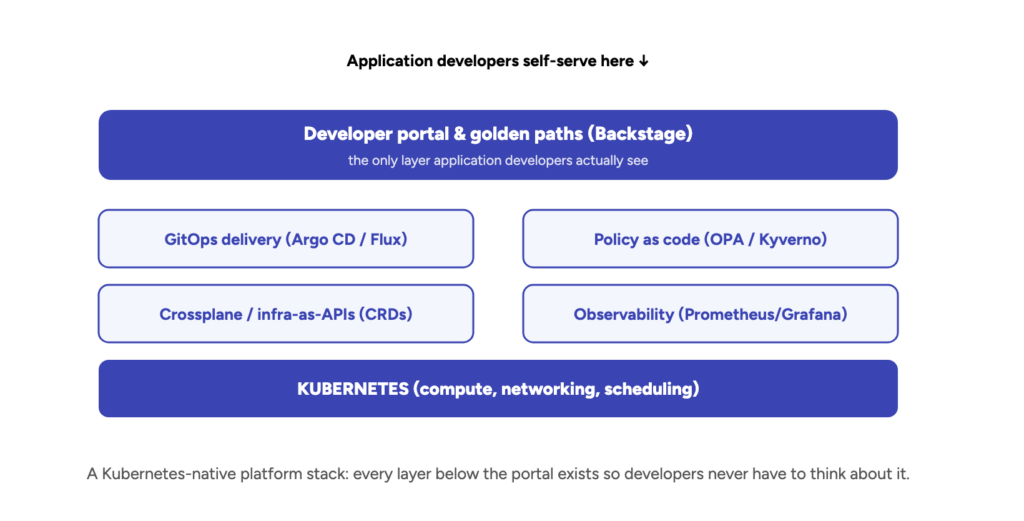
A modern Internal Developer Platform (IDP) is not a single tool — it is a layered architecture that separates developer experience from infrastructure orchestration from governance. Understanding these layers is the prerequisite for choosing the right tooling stack.
Layer 1 — The developer-facing portal
The portal is the "front door" for all engineering activity: a centralized catalog of services, documentation, ownership metadata, and self-service actions. Open-source Backstage by Spotify remains influential, but commercial alternatives like Port, Cortex, and OpsLevel are frequently the better choice for startups that cannot staff a dedicated Backstage maintainer. These tools provide service scorecards, automated actions, and flexible data models with far less overhead.
Layer 2 — The orchestration backbone
Beneath the portal sits Kubernetes — the undisputed baseline for cluster orchestration in 2026. GitOps has matured into the standard for declarative infrastructure: Argo CD reconciles Git's "desired state" with what is actually running in production, enabling self-healing deployments without manual intervention. For Infrastructure as Code, OpenTofu (the community-driven Terraform fork) and Pulumi (which lets teams write IaC in TypeScript, Python, or Go) dominate the startup space due to their modularity and testability.
Layer 3 — Security and governance
Security in 2026 is an integrated feature, not a downstream audit. Infisical leads the secrets management category with automated secret lifecycle management across every environment. Policy engines like OPA Gatekeeper and Kyverno enforce security and cost rules at the Kubernetes API level — so the fastest path to production is always the compliant path.
Best platform engineering tools for startups in 2026
With the architectural layers clear, the question becomes which specific tools deliver the best value for resource-constrained startup teams. Below is a curated assessment of the most impactful options available this year.
Atmosly
All-in-One IDP
Ready-to-use Kubernetes automation, self-service workflows, and AI-based insights for Series A SaaS teams.
Humanitec
Platform Orchestrator
Sits at the core of the IDP to dynamically generate environment-specific configurations.
Qovery
Ephemeral Environments
Provides on-demand preview environments per pull request to improve PR review velocity.
Infisical
Secrets Management
Automated secret lifecycle management. Essential for Fintech and Healthtech compliance.
Argo CD
Continuous Delivery
GitOps-native, self-healing Kubernetes deployments for declarative infrastructure models.
Port
Developer Portal
Flexible data models and service scorecards. A customizable "front door" for engineering teams.
Pulumi
Infrastructure as Code
Multi-language IaC (TypeScript, Go, Python) for complex conditional logic.
OpenTelemetry
Observability
Vendor-neutral standard for traces, logs, and metrics to prevent vendor lock-in.
The real ROI: what platform engineering actually returns
Platform engineering is a capital investment, and every startup's leadership team needs to understand the financial case before approving the budget. The returns manifest across three dimensions.
90%
Fewer recall costs
(Tesla OTA model)
30%
Lower engineer turnover
(Atlassian, GitLab)
$18k
Monthly cloud savings
Typical post-FinOps
15 min
Env. provisioning
(Down from 3 days)
Velocity gains
Stripe's internal PaaS reduced environment provisioning from 3 days to 15 minutes by standardizing Kubernetes configurations and embedding security policies directly into the CI/CD pipeline. This is not an outlier — it reflects the structural impact of eliminating manual handoffs in the deployment cycle.
Reliability improvements
High-maturity platforms reduce Mean Time to Recovery to under 10 minutes, compared to 30+ minutes in manual DevOps environments. AI-powered observability tools now achieve 30–40% faster MTTR through automated diagnostics and incident correlation.
Cloud cost control (FinOps)
Unmanaged cloud sprawl is one of the most common financial surprises for scaling startups — AWS or Azure bills that are 3–5× higher than necessary are not unusual. A platform-driven FinOps strategy integrates cost visibility, automated right-sizing, and governance rules directly into the infrastructure lifecycle. Startups that modernize their platform with FinOps in scope consistently identify $15,000–$18,000 in monthly savings while simultaneously improving uptime to 99.99%.
When to build, when to buy, when to partner
One of the most consequential decisions a startup makes is choosing between building an IDP in-house, adopting a commercial solution, or engaging a specialist consulting partner. There is no universal answer — but there are clear heuristics.
Build in-house if you are post-Series B with 3+ dedicated platform engineers and highly specific compliance or architecture constraints that commercial products cannot meet.
Commercial IDP product (Atmosly, Qovery, Humanitec) if you are Series A–B, need rapid time-to-value, and cannot afford to dedicate senior engineers to internal tooling.
Partner with a specialist consultancy if you need architectural guidance, do not yet have internal platform expertise, or are migrating a complex legacy environment.
Hybrid approach — the most common pattern for startups: adopt a commercial IDP core, extend it with open-source components (Argo CD, OpenTofu, Infisical), and engage a partner for initial design and onboarding.
AI integration: where platform engineering is heading in 2026–2027
Seventy-six percent of DevOps teams have now integrated AI into their pipelines in some form. The impact is moving well beyond code generation into operational intelligence.
AI-powered observability surfaces anomalies before they become incidents, correlates logs and traces automatically, and suggests remediation steps — cutting MTTR by 30–40% in production environments. Compliance automation (HIPAA and GDPR scanning embedded in the pipeline) is eliminating manual audit cycles entirely for startups in regulated industries. Engineering analytics platforms like Milestone and LinearB are providing leadership with proof of whether AI coding tools are actually improving productivity — a critical accountability layer as AI tooling spend scales.
Looking ahead, the next frontier is agentic AI: autonomous agents that can navigate deployment pipelines, integrate with ERP systems, and maintain production reliability without human escalation. Startups building the infrastructure to host these workloads today are establishing a structural competitive advantage for 2027 and beyond.
🚀
Gart Solutions · Platform Services
Ready to build your internal developer platform?
Gart Solutions helps growth-stage startups design, build, and operate high-maturity IDPs. We help Series A and B teams scale engineering velocity without scaling headcount in lockstep.
IDP Design & Architecture
Kubernetes & GitOps
FinOps & Cloud Cost Control
Secrets & Security Layer
Observability & MTTR Reduction
Developer Portal Setup
Book a free platform review →
Conclusion: treat the platform as a product
The companies winning in 2026 are not the ones with the most engineers — they are the ones where each engineer operates at maximum leverage. A well-designed internal developer platform is the multiplier that makes this possible: it removes cognitive load, enforces security by default, controls cloud spend, and makes onboarding a matter of hours instead of weeks.
The best platform engineering solutions for startups are not defined by any single tool. They are defined by the intentional combination of the right portal, the right orchestration backbone, and the right governance layer — implemented in a way that the team actually adopts and trusts. Whether you build that platform in-house, adopt a commercial solution, or partner with a specialist team, the investment will consistently outperform the alternative of doing nothing.
The organizations that neglect this investment do not just ship slower — they accumulate the kind of organizational debt that becomes a strategic liability at the Series C table.
Platform Engineering is one of the top technology trends of 2026. Gartner estimates that by 2026, 80% of development companies will have internal platform services and teams to improve development efficiency.
What is Platform Engineering?
It is the process of designing and building platforms that provide infrastructure, tools, and services to support various applications and services. The main goal of platform engineering is to create a powerful and versatile platform that can support various application development and operation processes.
The platform provides developers, operators, and other stakeholders with a user-friendly interface and set of tools to simplify and accelerate the process of application development, deployment, and maintenance.
Key Components of Platform Engineering
Successful platform engineering combines technical infrastructure, automation, and developer experience improvements. Common components include:
CI/CD Pipelines – Automated build, test, and deployment processes for faster delivery.
Developer Portals & Service Catalogs – Centralized access to APIs, documentation, and reusable components.
Observability & Monitoring – Logging, metrics, and tracing integrated into the platform.
Security & Compliance Automation – Built-in vulnerability scanning and policy enforcement.
Infrastructure as Code (IaC) – Declarative configuration using tools like Terraform or Pulumi.
Development Efficiency
The adoption of Agile, DevOps, and TeamFirst approaches, along with the rapid development of cloud and deployment tools, has led to explosive growth in software development across all segments of the economy. Businesses began to actively increase in-house development in an attempt to improve their own efficiency and occupy new market niches.
A typical development team is cross-functional and includes up to 15 people of different roles - from product manager and developers to QA and DevOps. This composition of specialists allows the team to achieve high autonomy and a high degree of responsibility for the product, which significantly reduces time-to-market.
It is noteworthy that it is undesirable to involve more than 15 people in teams: research results show that in this case, it becomes more difficult to build communications within the team, participants start to "cluster" by communication nodes, and trust between them decreases. This inevitably affects the performance of the entire team.
Technical specialists and businesses, as a rule, face typical problems inherent in teams regardless of their tasks and sphere of activity:
Development efficiency directly depends on how much time a team devotes to developing software functionality that is valuable to the business. At the same time, teams have mandatory activities that have nothing to do with creating business value: onboarding new employees, setting up monitoring services for the product, building CI/CD pipelines. The team usually spends a lot of time and resources on all these activities, distracting them from development. At the same time, the allowable amount of cognitive load teams have is limited (primarily due to the limit of team members).
It is important for business that time-to-market of developed solutions and functions be minimal. But in practice, the development team is dependent on specialists from other departments: it is difficult to achieve full autonomy in delivery and maintain high efficiency, as the complexity of software and the conditions of its production and operation are constantly growing.
Development teams have a lot of routine by default, which often not only affects the team's productivity in terms of product delivery (resulting in delays in releases), but also reduces the quality of delivered solutions. If the problem of routine is unresolved, you can get a situation with constant overtime and consequent drop in morale, burnout, and apathy. All of these have significant negative consequences for the product and the business.
The key task is to rid technicians of routine, artificial constraints and dependencies.
Streamline your DevOps with Gart Solutions – Let’s build a scalable platform together. Get in touch today!
Platform Engineering in the Cloud-Native Era
Cloud-native development has made platform engineering essential for modern software delivery. Key considerations include:
Kubernetes Orchestration – Managing scalable workloads and microservices.
GitOps Workflows – Declarative deployments with automated rollbacks.
Multi-Cloud Interoperability – Avoiding vendor lock-in through portable infrastructure design.
Serverless Integration – Supporting event-driven architectures for rapid feature deployment.
Platform Engineering and Internal Development Platform (IDP)
Platform Engineering is a methodology for organizing development teams and the tools around them, which allows removing unnecessary non-core workload from development teams, thus increasing their productivity in delivering business value.
One example of the platform approach is the creation of an Internal Development Platform (IDP), through which the development team can solve all non-core issues in a self-service mode - from requesting infrastructure and environments to accessing Observability services, necessary development tools, and utilizing typical build and deployment pipelines.
Internal Development Platform (IDP) serves as a one-stop-shop platform for developers:
Maximizes Developer Experience;
Provides a single point of entry, simplifying onboarding;
Reduces the cognitive load for development teams, thereby increasing their productivity.
Thus, the better and more fully implemented the back-end platform is, the higher the efficiency of development teams.
Let's take a closer look at the implementation of the platform approach using IDP as an example.
The Genesis of Internal Development Platforms
The trend of creating Internal Development Platforms (IDPs) is relatively new, but the industry has been moving towards them for quite some time.
Early Signs of the Need for IDPs
Even during the early stages of the digital transformation trend (2012-2015), three key points became apparent:
Teams within a company go through the same onboarding process: This includes gaining access to tools and resources for building and deploying code, and so on.
Teams use similar CI/CD processes for building and deploying products, as well as identical Observability techniques. Moreover, many teams solve the same architectural problems, such as creating a fault-tolerant PostgreSQL or developing Stateless microservices.
Development speed is often slowed down by IT and Information Security (IS) departments. These departments became bottlenecks on the path to product delivery. While development teams were able to adapt to rapid changes and deployments, IT and IS departments often lagged behind. Many operations in these departments were manual, and processes were slow and not scalable.
The Need for a Solution
Companies needed to minimize this duplication of work and bypass these limitations without compromising security. The solution was the idea of consolidating all best architectural practices, configuration templates, embedding IS requirements into the infrastructure deployment workflow, and automating the allocation of development tools, with subsequent provision of all of the above using the "as a service" (aaS) model.
The Birth of IDPs
Thus, internal platforms began to emerge, and development teams gained a single portal through which they could request everything they needed to work without months of configuration and approvals. This could include virtual machines, Kubernetes clusters, databases, creating repositories in GitLab, deploying repositories, and so on.
Simplify your DevOps – Explore our platform engineering solutions. Talk to our team today!
Implementation Features of Internal Development Platforms
Today, almost all large companies are either considering or already using IDPs.
In the enterprise segment, IDP platforms are often built on the basis of cloud orchestrators (HP CSA, VMware vRA, OpenStack, etc.), which provide an IT service "constructor" and a wide stack of plugins for quick creation of self-service portals with a service catalog. As a rule, companies in the enterprise segment are assisted in this by integrators who have the necessary competencies.
At the same time, many companies create development platforms from scratch, without using ready-made solutions. This is usually done by companies with a high level of development culture who have a clear idea of what they want to get from the platform and are willing to invest significant resources in its creation and support. This allows them to integrate their own custom-built infrastructure services (Observability, IaM, etc.), CI/CD tools, and other solutions into the IDP.
In other words, IDPs in such companies are specifically tailored to the internal development business processes.
Get a sample of IT Audit
Sign up now
Get on email
Loading...
Thank you!
You have successfully joined our subscriber list.
Why Platform Engineering Is Trending
Platform Engineering has become a trend because the challenges it addresses have become widespread and the benefits of its implementation are clear.
The positive outcomes of using Platform Engineering include:
Alignment of the technology stack across teams: The use of the same services and tools by different teams, available in the IDP, allows for increased efficiency of cross-team work, minimizes "shadow IT", and reduces "competency silos" in which individual specialists and even teams operate.
Reduction of technology sprawl: Building an IDP allows for the development of a unified set of tools used in the company. This makes it possible to reduce the stack by eliminating unnecessary and duplicate solutions (for example, when different departments of the company use different tools with identical functionality). Moving away from technology sprawl simplifies stack support, its administration, and reduces licensing costs. At the same time, the expertise of the IDP support team for this toolkit grows, as there is no need to scatter resources on learning different products and solutions.
Knowledge Sharing: Creating an IDP platform implies developing detailed documentation that guides users through typical cases - from building a CI/CD pipeline to deployment in production. This ensures the continuity of expertise and guarantees that the team will be able to continue working with the tools even if some of the expert employees leave. The bus factor effect is minimized.
Security Enhancement: The IDP platform is essentially a single point of access to tools. This makes it possible to integrate security solutions into the "user-tool" chain - for example, to check access rights and perform approval procedures. IDP users can also use IT resources and services that have already been approved by security personnel.
Standardization and Improved Collaboration: Platform Engineering involves using a specific set of tools and frameworks. This simplifies application development and allows for the development of a clear standard for components, such as monitoring, logging, and tracing. Development teams can use ready-made components and functionalities to quickly create applications and services, which also simplifies the integration of the created solutions with each other. This relieves some of the cognitive load on development teams and increases their efficiency.
Onboarding Acceleration: The implementation of an IDP platform with a single stack and common rules for working with tools reduces the time it takes to connect new users or entire teams to the project. This is achieved through SSO mechanisms and tight integration with development tools, as well as pre-agreed rights and access from the security department.
Fast and Non-bureaucratic Resource Acquisition: Platform Engineering allows easy access to computing resources through a pre-agreed catalog of IT services (from the security and IT departments), which publishes IaaS and PaaS services adapted for the company. In this case, it takes a few minutes to get the necessary resources, not weeks.
All this allows development teams to be relieved from solving typical tasks and helps them focus on delivering value to the business.
Revolutionize your infrastructure – Discover our platform engineering services. Connect with us!
Real-World Examples of Platform Engineering in Action
Industry leaders demonstrate how platform engineering transforms development:
Netflix – Custom internal platforms enabling self-service, monitoring, and automation for thousands of services.
Spotify – Developed Backstage, an open-source developer portal for unified service management.
Case Study – Gart Solutions helped a SaaS client cut infrastructure management time by 40% through a Kubernetes-based IDP with Terraform automation.
Platform Engineering Tools & Frameworks
A robust IDP relies on a well-chosen stack of tools and frameworks:
Backstage – Developer portal framework by Spotify.
Crossplane – Kubernetes-native infrastructure orchestration.
ArgoCD / FluxCD – GitOps deployment automation.
Terraform / Pulumi – Infrastructure as Code tools for repeatable environments.
Prometheus / Grafana – Monitoring, alerting, and visualization solutions.
Barriers to Adoption and Development of Internal Development Platform (IDP)
The adoption of Platform Engineering as a core company concept can be hindered by various factors, both financial and organizational. However, the blockers are usually typical.
Lack of a clear understanding of what IDP is and how the platform should work. There is no strict definition of what an IDP platform is and how it should look like. Therefore, managers are afraid of "creating something wrong." But in reality, there can be no standard: the IDP platform is created taking into account the company's stack and work patterns, so projects of different companies differ. It is impossible to "create something wrong" if you do it according to the needs of your team.
Fear of having to cut staff. Often, the development of the Internal Development Platform is slowed down at the level of employees, including DevOps, who are worried that they will be left without work. But this is a misconception. The Platform Engineering concept does not imply a reduction in staff, but simply a shift in their focus to solving other tasks.
The need to restructure processes. After the implementation of the IDP platform, the teams responsible for IT infrastructure and information security may have to change their usual working procedures, which means that they will have to restructure their processes. This can be a challenge for both the IT team and information security, as well as for the management, which is afraid of potential risks. But in practice, with proper preparation and desire, the transition to a new methodology of work is smooth and seamless.
The need for investment and the length of the journey. Implementing Platform Engineering and developing an Internal Development Platform is not a one-day task. Such innovations require regular investments and allocation of resources from the business. However, the increase in the frequency of releases, the reduction of errors and the increase in development productivity justify any costs.
By outsourcing the development of the IDP platform, the company can mitigate some of the shortcomings and accelerate the adoption of the Platform Engineering concept.
Implementation Timeline and Effectiveness Evaluation
The implementation of an IDP platform is a continuous journey. Even after restructuring internal processes, building a self-service portal, and moving away from a "technology zoo," it is important to continue developing the platform, updating the available stack, improving the user experience, and more. Tools, market needs, and business processes change, so IDP as a product also requires regular changes.
Typically, it takes companies several years to adapt their business processes to use an IDP platform. The timeframe depends largely on the size and expertise of the team involved in building the IDP platform, as well as the chosen implementation approach - building on a ready-made solution or developing from scratch.
It is difficult to directly assess the cost-effectiveness of implementing such projects. Therefore, conceptually, when determining the rationality of investments, several criteria are taken into account.
Ratio of developers to DevOps engineers. For example, if before the implementation of the IDP platform, 10 DevOps specialists were required for 10 development teams, then after the implementation of the solution, with a three-fold increase in development scale, the number of DevOps engineers will grow insignificantly - for example, to 15 people (without the platform, there would be almost a proportional growth).
Release frequency. Due to the reduction of approvals, checks, and secondary tasks, as well as the improvement of interaction between development teams, Time-to-market is also reduced. This allows increasing the number of releases without sacrificing quality and without a significant increase in the workload on developers.
Number of errors allowed. The unification of tools and technologies, as well as the ability to obtain the necessary resources without complex manipulations, allows for a significant reduction in the number of errors made during deployment.
Performance evaluation. The formalization of approaches and tools allows you to set and track metrics (both technical and business), which, in turn, will help you assess the effectiveness of changes or quickly identify bottlenecks.
Here are some additional points to consider:
The maturity of the organization's DevOps practices. Organizations with a more mature DevOps culture will be better equipped to adopt and use an IDP platform effectively.
The level of support from senior management. The success of an IDP initiative depends on the level of support from senior management.
The availability of resources. Implementing and using an IDP platform requires resources such as time, money, and people.
Overall, the implementation of an IDP platform can be a complex and challenging undertaking. However, the potential benefits can be significant, including improved developer productivity, reduced time to market, and increased software quality.
Platform Engineering vs. DevOps and SRE: Differences in Scope, Focus, and Goals
Platform engineering, DevOps, and SRE (Site Reliability Engineering) are three concepts and methodologies used in information technology to optimize software development and support processes. While they share common principles and goals, they differ in scope, scale, and primary tasks. Depending on the work context and their needs, modern companies may rely on platform engineers, DevOps engineers, and SREs to ensure the excellence of their products and services.
Scope of Responsibility:
Platform engineering focuses on developing and building platforms to support applications.
DevOps and SRE focus on the processes and methodologies for software development and operations.
Scale:
Platform engineering is often geared towards creating highly scalable and flexible platforms.
DevOps and SRE work at the level of processes and operations within a specific system scale.
Goals and Objectives:
DevOps aims to reduce the time between software development and deployment, ensuring continuous delivery and automation of processes.
SRE focuses on creating highly reliable systems and supporting them.
Platform engineering aims to provide infrastructure and services as a platform to support various applications and services.
Focus of Work:
Platform engineers concentrate on creating and maintaining an internal platform that facilitates application development and operations. They provide other developers with tools and services to accelerate the development process.
DevOps encompasses a broader range of areas, combining development, operations, and ensuring continuous application development and improvement.
Processes and Methodologies:
Platform engineers typically follow Agile methodologies with an emphasis on delivering results and continuous improvement. They strive to create flexible and efficient infrastructure for developers.
DevOps covers a wider range of methodologies and processes, such as CI/CD (continuous integration and delivery), test automation, and containerization.
Area of Responsibility:
Platform engineering focuses on the architecture and infrastructure of the internal platform.
DevOps is responsible for integrating application development and operations.
Platform Engineering vs. SRE:
Focus of Work:
Platform engineers focus on developing and supporting an internal platform for other developers, providing tools, services, and abstractions that facilitate application development.
SRE is primarily responsible for ensuring the stable and reliable operation of a product or service. Their main task is to maintain high availability and quickly respond to problems in the production environment.
Culture and Methodology:
SRE emphasizes a culture of reliability, where everyone in the team becomes responsible for the reliable operation of the system. They are often guided by the principles of "build, measure, tune" and "serve the customer."
Platform engineers typically follow Agile principles with an emphasis on continuous delivery and iteration.
Area of Responsibility:
Platform engineering focuses on the architecture and infrastructure of the internal platform.
SRE is responsible for the operational side of the product or service.
How Platform Engineering Compares to DevOps and Cloud Engineering
DevOps focuses on unifying development and operations by giving teams ownership of both application and infrastructure. However, as the complexity of applications and infrastructure grew, the cognitive load on DevOps teams became too high. Platform engineering builds on DevOps by creating a shared platform that reduces this cognitive load and standardizes processes across teams.
Cloud engineers specialize in managing cloud infrastructure, such as AWS or Azure, by setting up services and managing costs. Platform engineers, on the other hand, take these cloud services and integrate them into a broader platform that developers can use. Essentially, platform engineering adds a layer on top of cloud services, making them easier to use and more accessible to internal teams.
Key Differences: Platform Engineering vs DevOps vs SRE
AspectPlatform EngineeringDevOpsSREFocusInternal platform developmentDevelopment and operations integrationSystem reliability and operationsScaleLarge-scale platformsSpecific system scaleProduction environmentGoalsPlatform for applications and servicesContinuous delivery and automationHigh availability and reliabilityProcessesAgile methodologiesCI/CD, test automation, containerizationCulture of reliability, "build, measure, tune"ResponsibilityPlatform architecture and infrastructureIntegration of development and operationsOperational side of product or service
Responsibilities of Platform Engineering
Standardization of Tools and Practices
Platform engineers select the tools needed to deploy and run applications and ensure that they are used consistently across all teams. This includes CI/CD pipelines, cloud platforms, Kubernetes clusters, and security protocols.
Creation of an Internal Developer Platform (IDP)
This platform provides developers with a self-service portal where they can access pre-configured infrastructure and services, such as databases, Kubernetes clusters, and CI/CD pipelines. The IDP abstracts away the complexity of managing infrastructure, allowing developers to focus on coding and business logic.
Collaboration with Development Teams
Platform engineers work closely with development teams to ensure the platform meets their needs while maintaining best practices for security, compliance, and efficiency.
Continuous Development and Improvement
Like any product, the internal developer platform needs continuous updates and improvements. Platform engineers are responsible for iterating on the platform, adding new features, and ensuring it meets the evolving needs of the organization.
Key Problems Solved by Platform Engineering
Cognitive Load on DevOps Teams: Traditional DevOps practices require teams to manage both application development and infrastructure. This increases the complexity of tasks for individual engineers, such as maintaining Kubernetes clusters, managing CI/CD pipelines, and ensuring security compliance. Platform engineering centralizes these responsibilities, reducing the mental load on DevOps teams.
Inconsistency and Duplication: When multiple teams use different tools and configurations, it creates inconsistencies across the organization. Platform engineering solves this by standardizing the tools and environments, reducing duplicated efforts across teams.
Scalability and Efficiency: With traditional DevOps, each team might configure and manage its infrastructure separately, leading to inefficient resource use. Platform engineering provides a shared platform that is scalable, consistent, and optimized, allowing for easier management of resources and infrastructure.
Future of Platform Engineering: 2025 and Beyond
The discipline will continue to evolve with:
AI-Driven Platforms – Predictive scaling, automated optimizations, and intelligent troubleshooting.
Greater Abstraction – Developers interact with higher-level services instead of raw infrastructure.
Internal Platforms as Products – Treating the platform as a maintained and evolving product.
Security-First Design – Automated detection, remediation, and compliance verification.
Key Takeaways from the Article:
Platform Engineering is a major technological trend that companies worldwide are actively following by creating their own IDP platforms. The methodology has become particularly popular due to the active digital transformation of businesses.
Building IDP platforms gives businesses competitive advantages in the era of digital transformation and helps them overtake competitors on the go by maximizing efficiency.
Today, companies do not need to dive into IDP platform development from scratch: they can choose ready-made solutions and partners with experience and expertise in IDP construction.

Strong infrastructure lays the foundation, but it won’t carry your business across the finish line. If your systems are slowing you down, innovation stalls, releases get delayed, and customers lose patience. Today, digital transformation isn’t just a buzzword — it’s the baseline.
Why Solid Infrastructure Isn't Enough Anymore
Having reliable IT systems was once a competitive advantage. Now, what separates fast-growing companies is adaptability.
This article unpacks the hidden ways in which overly rigid IT systems can limit business potential — and what modern, cloud-native, composable alternatives look like.
Let me mention some industry insights:
70% of digital transformations fail due to a lack of agility.
64% of companies cite rigid IT as a growth barrier.
Only 30% of cloud projects meet their goals.
The Real Business Impact of Misaligned Infrastructure
Lost Productivity: manual work replaces automation, and innovation takes a backseat.
Limited Scalability: Inflexible systems delay market expansion.
Poor Customer Experience: downtime and delays drive users away.
Compliance Risks: outdated systems jeopardize trust and legal standing.
Challenge vs. Business Impact
Sometimes, business leaders cannot estimate the real impact that technical issues might have on a business.
There are some examples:
ChallengeBusiness ImpactOverbuilt on-prem without modularity Delayed product launches No orchestration layer (DevOps/Kubernetes) Bottlenecks in deployment Focused on uptime, ignored user feedback loops Poor product-market fit Legacy systems with high maintenance costs Drained resources and slower innovation Manual deployments and no CI/CD Increased time-to-market, more human errors Siloed teams (Dev, Ops, Security) Miscommunication, slower response to issues No Infrastructure as Code (IaC), lack of auto-scaling or load balancing Inconsistent environments, hard recovery
Common Infrastructure Problems That Hold Businesses Back
A) Frequent Downtimes & Performance Issues
Root Cause: Neglect in proactive setup and maintenance. Impact: Lost business continuity and declining user trust.
B) Over-Reliance on One Engineer
Root Cause: Siloed knowledge and no documentation. Impact: Single point of failure, burnout risk, and unscalable operations.
C) Inefficient Practices & Manual Deployments
Root Cause: Lack of CI/CD, no automation, fragmented tooling. Impact: Slower releases, higher operational costs, difficulty attracting talent.
D) Misalignment Between Tech and Business
Root Cause: Infrastructure decisions made in isolation. Impact: Missed market opportunities, wasted development efforts.
E) Immature DevOps Practices
Root Cause: Outdated processes and tools. Impact: High technical debt, poor scalability, slow innovation.
F) Compliance and Governance Gaps
Root Cause: Infrastructure built without security and compliance in mind. Impact: Blocked expansion, legal risks, loss of customer trust.
Top Reasons Why IT Transformation Fails
Legacy Systems Dominate — they hinder scalability and integration.
No Unified Infrastructure Strategy — disconnected setups create silos.
Knowledge Bottlenecks — relying on one expert is high-risk.
Inconsistent Tooling — multiple tools with no standards hurt productivity.
Change Mismanagement — poor communication derails transformation.
Lack of Observability — monitoring comes too late or not at all.
Unrealistic Deadlines — rush leads to broken systems.
Security Comes Last — compliance is bolted on, not built in.
What Does a Scalable, Agile Infrastructure Look Like?
Here’s what high-growth companies are doing instead of sticking to pure IT infrastructure:
Composable Infrastructure
Use Kubernetes and microservices to build modular systems that scale independently and evolve with business needs.
DevOps Automation by Default
From CI/CD to monitoring, automate everything to reduce errors and accelerate delivery.
Cloud-Native Design Principles
Design with elasticity, portability, and resilience from the start — not as afterthoughts.
Infrastructure as Code (IaC)
Tools like Terraform and Pulumi bring version control, consistency, and fast recovery.
Data-Driven Architecture
Prioritize performance based on actual product usage and customer behavior.
Get a sample of IT Audit
Sign up now
Get on email
Loading...
Thank you!
You have successfully joined our subscriber list.
IT Infrastructure Case Studies
Building a resilient and scalable IT infrastructure is at the core of Gart Solutions' service portfolio.
Below are some examples of projects we’ve completed at Gart, highlighting key challenges, solutions, and results.
1. IT Infrastructure Optimization for a Retail SaaS Platform
Challenges:
Outdated servers, slow network, and lack of data centralization.
Needed to modernize the functionality of their legacy SaaS e-commerce platform & improve its efficiency, user experience, optimize costs, and accelerate time-to-market.
Also, to move the SaaS platform from on-premises to the cloud.
Solutions Implemented:
Built CI/CD pipelines for GitLab from scratch and implemented automated testing
Migrated data to a secure cloud platform (from on-premises to cloud, making it cloud-agnostic)
Upgraded network infrastructure for better connectivity. Introduced automated backup systems.
Results:
30% improvement in operational efficiency.
15% increase in customer satisfaction due to faster service.
Significant reduction in IT maintenance costs.
2. 40% AWS Cost Optimization Music Promotion Platform
Challenges:
With rapid growth and increasing usage, the company faced escalating AWS infrastructure costs.
Also, a need for a centralized, cost-effective monitoring solution.
Solutions Implemented:
Amazon SNS Optimization (Usage Audit, Policy Adjustments)
EC2 and RDS Cost Management (Right-Sizing Instances, Reserved Instances, Auto Scaling)
Storage Optimization (Lifecycle Policies to Amazon S3 buckets, automatically transitioning data to lower-cost storage classes, Data Cleanup and regular audits).
Traffic and Data Transfer Management (Optimized data transfer routes and utilized AWS Direct Connect, Cost Monitoring Alerts).
Results:
Monthly AWS costs were reduced from $3.7K to $1.7K.
Total blended costs over the period were managed to $19.9K.
Amazon SNS: Reduced costs by 50%, saving over $1,000 monthly through optimized usage and policy adjustments
AmazonEC2 and RDS: Achieved substantial savings by right-sizing instances and leveraging reserved instances, with a combined reduction of $600 monthly.
Improved Resource Efficiency utilization through Auto Scaling and lifecycle management policies.
Implemented a cost management framework with continuous monitoring.
3. Infrastructure Optimization, Data Management & Compliance for Healthcare Platform
Challenges:
The need to manage patients' data (e.g., x-rays, medical history), integrate with medical institutions, and scale data analysis capacity quickly.
Make a transition to a secure, compliant digital platform.
Solutions Implemented:
Designed infrastructure architecture to withstand peak loads.
Facilitated secure integration with other networks (e.g., hospitals).
Delivered a hybrid cloud architecture with data privacy measures.
Managed data in compliance with HIPAA. Results:
Enabled seamless operations and compliance with GDPR.
Improved Data Management (complying with HIPAA regulations)
Secure Integration with hospital networks (by secure network architecture)
Scalability to meet growing demands and handle peak loads.
Reliable Data Transmission (the VPN with unified standards).
Dynamic Scaling (RabbitMQ and monitoring allowed for dynamic scaling of the infrastructure).
How to Know It's Time to Rethink Your Infrastructure
Ask yourself:
Are you spending too many resources maintaining legacy systems?
Is your time-to-market getting slower?
Are infrastructure decisions dominating product ones?
Is your CTO firefighting instead of leading strategy?
Is your infrastructure unable to support integrations or partner tools?
If the answer is yes to any of the above, your infrastructure isn’t serving your growth, and my suggestion would be to ask for a consultancy in companies, like Gart Solutions (where IT infrastructure expertise is at the core).
Where to Start: The IT Infrastructure Audit
At Gart Solutions, we recommend starting with a Quick Wins IT Audit.
In just ~10 hours, we assess:
System performance
Delivery workflow (CI/CD)
Compliance gaps
Security posture
Cloud readiness and modernization opportunities
👉 Learn more about our IT audits 👉 Explore Quick Wins IT Audit 👉 Apply for Quick Wins IT Audit
Real Transformation Starts with Real Expertise
With 15+ years in DevOps and cloud infrastructure, Gart Solutions helps companies modernize systems, adopt composable infrastructure, and align IT strategy with business outcomes.
Our promise:
We don’t just fix systems. We unlock business velocity.
We speak both tech and strategy fluently.
We tailor infrastructure to your market goals, not the other way around.
Final Thoughts: Infrastructure That Accelerates, Not Delays
Pure IT infrastructure, without agility, automation, or business context, will keep your business grounded. To scale, innovate, and compete, your infrastructure must evolve into a strategic enabler, not just a technical necessity.
I recommend starting with an IT audit, aligning your goals, and evolving toward a composable, automated, cloud-native infrastructure.
Best, Roman Burdiuzha Co-Founder & CTO at Gart Solutions | IT Consultant Over the last 15 years, I have overseen world-class engineering teams for Softserve, Lifecell, ProCreditBank, and other companies, setting the technical vision. At Gart Solutions, I provide strategic tech leadership to our customers’ projects.