- What Is an IT Infrastructure Assessment — and Why Visibility Matters
- Monitoring vs. Observability: The Core Difference Explained
- Monitoring vs. Observability: Side-by-Side Comparison
- Why Enterprise IT Infrastructure Assessment Is Different
- Importance of IT Infrastructure Assessment
- Stakeholder Management in Enterprise Assessments
- Methodologies and Approach
- Assessment Phases
- Assessment Tools and Techniques
- Assessment Outcomes
- Common IT Infrastructure Challenges
- How to Conduct an IT Infrastructure Assessment Using Observability Principles
- Common Mistakes in Monitoring vs. Observability Implementation
- Difference Between IT Infrastructure Assessment and IT Infrastructure Audit
- In summary
- Get a Comprehensive IT Infrastructure Assessment
Large enterprises don’t just have more infrastructure — they have fundamentally different infrastructure problems. Where a startup might have a single cloud environment and a five-person team, a large enterprise has hundreds of interdependencies, multiple sites, siloed departments, decades of legacy systems, and regulatory obligations spanning multiple jurisdictions.
Every IT infrastructure assessment starts with the same question: do we actually know what’s happening inside our systems? Monitoring and observability are often used interchangeably — but treating them as synonyms is one of the most expensive mistakes an engineering organization can make. This article unpacks the real difference, explains where each fits in your infrastructure strategy, and shows you how to build a stack that gives your team genuine insight — not just alerts, drawing insights from Davids Achonu’s comprehensive study.
This guide covers what makes enterprise infrastructure assessment different, how to structure the process across distributed organizations, which methodologies and tools fit large-scale environments, and how to manage the stakeholder complexity that comes with it.
What Is an IT Infrastructure Assessment — and Why Visibility Matters
An IT infrastructure assessment is a systematic evaluation of your organization’s compute, networking, storage, and application layers. Its goal is to surface risks, inefficiencies, and blind spots before they become outages or security incidents. According to CNCF’s 2024 Annual Survey, over 60% of organizations running cloud-native workloads report that lack of end-to-end visibility is their top operational challenge — ahead of cost and staffing.
Historically, assessments relied on point-in-time audits: a consultant would review architecture diagrams, interview engineers, and produce a report. That model is increasingly inadequate. Modern infrastructure — spanning multi-cloud environments, Kubernetes clusters, microservices, and serverless functions — changes continuously. A snapshot taken today is stale by next sprint. What you need instead is a living understanding of system behavior, built on two complementary disciplines: monitoring and observability.
💡 Key Insight
An IT infrastructure assessment in 2026 is not a one-time event. It’s a continuous capability powered by the right combination of monitoring signals and observability tooling — enabling teams to ask, and answer, questions they haven’t thought of yet.
of cloud-native teams cite lack of visibility as their #1 ops challenge (CNCF 2024)
average cost of IT downtime per minute (Gartner)
faster MTTR for teams with full observability vs. monitoring-only stacks Engineering Benchmark
Monitoring vs. Observability: The Core Difference Explained
The distinction isn’t academic — it determines how quickly your team can diagnose an unknown failure in a complex, distributed system.
What Monitoring Tells You
Monitoring is the practice of collecting predefined metrics from known system components and alerting when those metrics cross a threshold. CPU utilization above 85%? Alert. Response time above 500ms? Alert. Monitoring answers questions you’ve already formulated. It’s excellent for operational consistency, capacity planning, and catching known failure modes.
Classic monitoring tools — Nagios, Zabbix, CloudWatch, Datadog dashboards — work by instrumenting specific points and watching those points over time. The limitation: monitoring can only tell you that something is wrong, not why.
What Observability Adds
Observability — rooted in control theory — describes a system’s ability to allow engineers to infer its internal state purely from external outputs. In practice, this means being able to ask novel, ad-hoc questions about your system’s behavior without rewriting instrumentation. The three pillars are logs, metrics, and traces — but what matters is their correlation: the ability to jump from a high-latency trace to the log line that explains it, and then to the infrastructure metric that caused it.
Observability answers questions you didn’t know to ask. A new microservice deployment causes a cascading timeout two service hops downstream? Monitoring alerts you that response times spiked. Observability lets you trace the exact request path, identify the offending dependency, and reproduce the conditions in staging — in minutes, not hours.
Monitoring vs. Observability: Side-by-Side Comparison
Use this table during your IT infrastructure assessment to determine which capability gaps you’re facing and where to invest first.
| Dimension | Monitoring | Observability |
|---|---|---|
| Core question | Is something wrong? | Why is it wrong — and where exactly? |
| Data model | Pre-defined metrics & thresholds | Logs + Metrics + Traces (correlated) |
| Discovery | Known unknowns only | Known & unknown unknowns |
| Instrumentation | Predefined at setup | Flexible, ad-hoc querying |
| Best fit | Stable, well-understood systems | Distributed, microservices, cloud-native |
| MTTR impact | Detects faster | Diagnoses & resolves faster |
| Tooling examples | Nagios, Zabbix, CloudWatch Alarms | Grafana, Jaeger, OpenTelemetry, Honeycomb |
| Cardinality support | Low–Medium | High (essential for microservices) |
| Implementation effort | Lower | Higher — requires cultural & architectural buy-in |
Why Enterprise IT Infrastructure Assessment Is Different
The core questions of any infrastructure assessment are the same regardless of organization size: Is this secure? Is it scalable? Is it cost-efficient? But how you answer those questions changes dramatically at enterprise scale.
Scale and complexity
Large organizations typically run hundreds of services, dozens of teams, and infrastructure spread across multiple cloud providers, data centers, and geographic regions. A single misconfiguration in one environment can have cascading effects across the entire ecosystem. The assessment must map these dependencies — not just the components in isolation.
Organizational silos
In large enterprises, infrastructure ownership is often fragmented. The networking team manages one layer, the security team another, cloud operations a third — and frequently, no one has a complete picture. Effective assessment must bridge these silos and produce a unified view.
Legacy systems at scale
Most large enterprises run a mix of modern cloud-native systems and legacy infrastructure that has been running for years or decades. The challenge isn’t just evaluating current performance — it’s understanding the risk and cost of maintaining systems that were never designed to integrate with each other or with modern tooling.
Regulatory and compliance complexity
Enterprises in regulated industries — finance, healthcare, critical infrastructure — face overlapping compliance frameworks: SOC 2, ISO 27001, HIPAA, GDPR, NIS2. Each adds requirements around data handling, access control, audit logging, and incident response that must be evaluated as part of the assessment.
Change management burden
In a small team, implementing a recommendation takes days. In a large enterprise, it requires stakeholder sign-off, change advisory board approval, risk assessments, and coordinated rollouts across multiple teams. The assessment must account for organizational inertia, not just technical gaps.
Importance of IT Infrastructure Assessment
The assessment of IT infrastructure is not merely a technical exercise; it is a strategic imperative for large enterprises. The complex and dynamic nature of today’s business environment presents numerous challenges that necessitate a thorough evaluation of IT systems and resources. Enterprises must contend with fierce competition, the constant demand for innovative services, and the need to manage vast amounts of data efficiently. An effective IT infrastructure assessment addresses these challenges by providing a clear picture of the current state of IT assets, identifying potential risks, and uncovering opportunities for optimization.
One of the primary benefits of IT infrastructure assessment is its role in enhancing the return on investment (ROI) from IT resources. By systematically examining the performance and utilization of hardware, software, networks, and other critical components, organizations can pinpoint inefficiencies and implement targeted improvements. This process not only boosts operational efficiency but also supports business stability by ensuring that IT systems are robust, scalable, and aligned with organizational goals.
Furthermore, IT infrastructure assessments are essential for informed decision-making. They provide a data-driven foundation for strategic planning, helping businesses to prioritize investments, mitigate risks, and adapt to emerging technologies. The insights gained from these assessments enable IT leaders to make evidence-based decisions that drive innovation and support the enterprise’s long-term vision.
Stakeholder Management in Enterprise Assessments
One of the most underestimated challenges in enterprise infrastructure assessment is not technical — it’s organizational. Getting an accurate picture of a large organization’s infrastructure requires cooperation from multiple teams who may have competing priorities, different levels of technical literacy, and varying degrees of willingness to expose problems.
Who needs to be involved:
- CIO / CTO — Sets the strategic context, approves scope, and owns the final recommendations
- CISO — Must be involved in any security-related findings; often a gatekeeper for access to sensitive system data
- Department or team leads — Own specific infrastructure domains; essential for accurate data collection
- Finance / procurement — Needed for cost analysis and to understand licensing, contracts, and vendor relationships
- Compliance / legal — Required when assessment findings touch regulated data or systems
How to structure engagement:
Start with a kickoff meeting that sets expectations clearly: what will be assessed, what access is needed, what the outputs will be, and who owns each area. Avoid making teams feel audited or blamed — frame the assessment as a shared initiative to reduce risk and improve performance.
Establish a single point of contact within the organization who can coordinate access requests, schedule interviews, and escalate blockers. Without this, enterprise assessments stall.
Reporting to different levels:
- Executive summary (1–2 pages): Risk level, top 5 findings, recommended investment priorities
- Department-level report: Findings specific to each team’s ownership area, with actionable next steps
- Technical appendix: Full inventory, tool configurations, raw assessment data for engineering teams
Timeline and Scope Expectations for Large Organizations
Enterprise infrastructure assessments take longer than most organizations expect — and that’s appropriate. Rushing the process produces incomplete findings and recommendations that don’t account for organizational complexity.
Typical timeline for a large enterprise assessment:
| Phase | Duration |
|---|---|
| Scoping and stakeholder alignment | 1–2 weeks |
| Discovery and data collection | 2–4 weeks |
| Analysis and validation | 1–2 weeks |
| Report preparation and review | 1 week |
| Executive presentation and planning | 1 week |
| Total | 6–10 weeks |
For organizations with very large environments (1,000+ employees, multi-continent operations, or complex regulatory requirements), 12–16 weeks is not unusual.
What drives scope:
- Number of distinct environments (dev, staging, production, disaster recovery)
- Number of cloud accounts or data center locations
- Degree of existing documentation — well-documented environments move faster
- Regulatory scope — each compliance framework adds review requirements
- Organizational cooperation — access delays and stakeholder availability are the most common causes of timeline overrun
Methodologies and Approach
Conducting an effective IT infrastructure assessment requires a structured methodology that ensures a comprehensive evaluation of all IT components. The process involves several critical steps that together provide a clear and actionable understanding of the current IT environment.
Generic IT Infrastructure Assessment Process
The generic assessment process begins with identifying the IT components that need evaluation. This includes hardware such as servers and desktops, software applications, network infrastructure, and other critical systems.
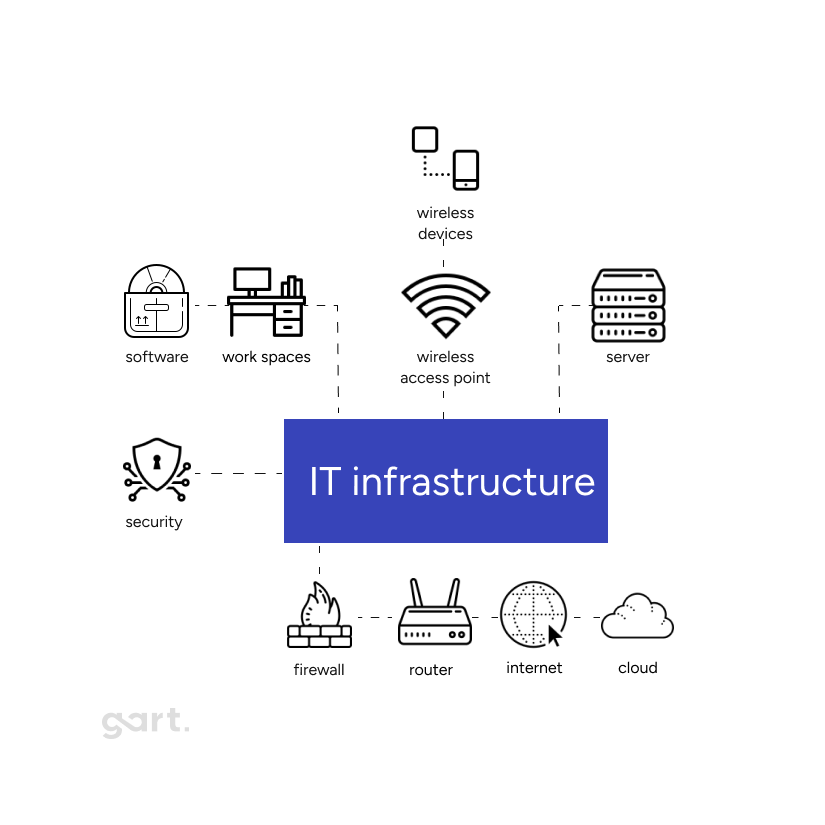
The steps involved in this process are:
- Identifying IT Components: Determine which components of the IT infrastructure will be assessed. This typically includes servers, desktops, networks, and applications.
- Data Collection: Gather comprehensive data on the identified components. This can involve automated tools and manual collection methods to ensure all relevant information is captured.
- Developing an Inventory Report: Compile the collected data into a detailed inventory report. This report serves as a foundational document for the assessment.
- Data Validation: Validate the accuracy of the collected data by consulting with IT stakeholders and verifying against existing records.
- Final Assessment Report: Generate a final report that summarizes the findings of the assessment, highlights key areas for improvement, and provides recommendations for optimization.
The practical application of these methodologies can vary depending on the specific needs and goals of the organization. Two common approaches are:
Centralized Assessment
This approach involves conducting the assessment from a central location, focusing on a holistic view of the entire IT infrastructure. It is beneficial for organizations with a unified IT management structure.
Benefits:
- Consistency: Ensures uniformity in data collection and assessment methodologies, leading to consistent results.
- Efficiency: Streamlines the assessment process by leveraging centralized resources and expertise.
- Simplified Management: Easier to manage and coordinate the assessment activities from a single point of control.
Drawbacks:
- Limited Local Insight: May miss out on specific local nuances or issues that could be critical for a thorough assessment.
- Scalability Issues: Can become less efficient for very large organizations with multiple locations, as central teams might struggle to cover all areas effectively.
Distributive Assessment
In contrast, a distributive approach involves assessing IT components at various locations or departments. This method is suitable for large enterprises with decentralized IT operations, allowing for a more granular evaluation.
Benefits:
- Local Expertise: Local teams have better knowledge of their specific environments, leading to more accurate and relevant assessments.
- Scalability: Easier to scale across large organizations with multiple locations, as each local team handles their own assessment.
- Flexibility: Can adapt to local conditions and requirements more effectively.
Drawbacks:
- Inconsistency: Potential for variations in assessment methodologies and results across different locations.
- Coordination Challenges: Requires effective coordination and communication between local teams to ensure overall coherence.
- Resource Intensive: May require more resources and personnel to manage assessments at multiple locations.
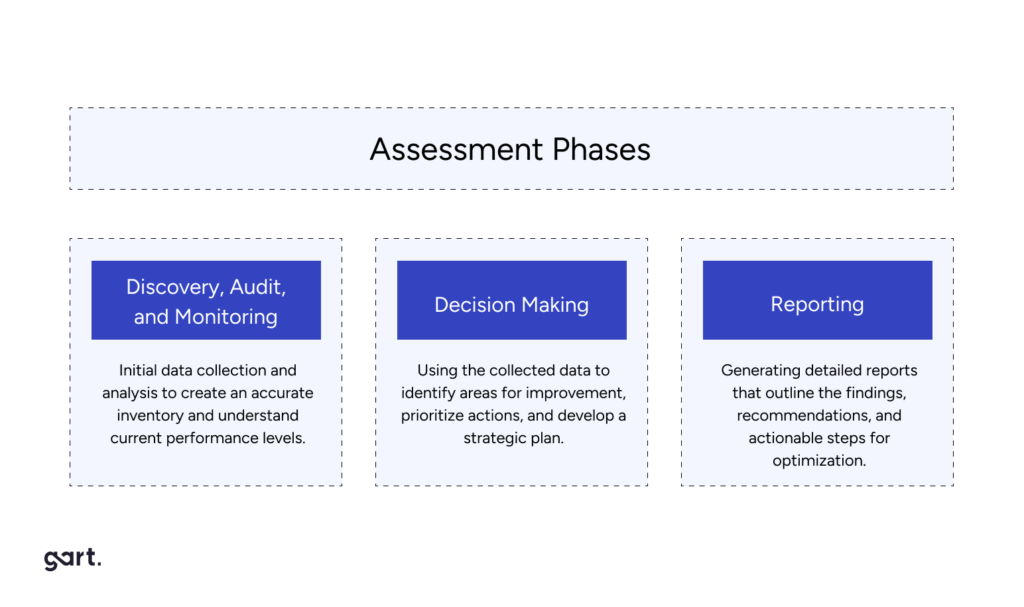
Assessment Phases
The assessment process typically follows three main phases:
Discovery, Audit, and Monitoring: Initial data collection and analysis to create an accurate inventory and understand current performance levels.
Decision Making: Using the collected data to identify areas for improvement, prioritize actions, and develop a strategic plan.
Reporting: Generating detailed reports that outline the findings, recommendations, and actionable steps for optimization.
Phase 1: Discovery, Audit, and Monitoring
Discovery: Identify all IT assets, including hardware, software, networks, and other critical components. This involves creating a comprehensive inventory of the IT environment.
Audit: Conduct a thorough audit to verify the existence and status of the identified assets. This step ensures the accuracy of the inventory.
Monitoring: Implement continuous monitoring of the IT environment to gather performance data and identify any issues or anomalies. This helps in understanding the current state and performance of the infrastructure.
Phase 2: Decision Making
Data Analysis: Analyze the collected data to identify patterns, inefficiencies, and areas that need improvement.
Prioritization: Prioritize the issues and opportunities based on their impact on the business and the feasibility of addressing them.
Strategic Planning: Develop a strategic plan for optimizing the IT infrastructure, including short-term and long-term goals, resource allocation, and timelines.
Phase 3: Reporting
Comprehensive Reports: Generate detailed reports that summarize the findings of the assessment. These reports should include inventories, performance metrics, identified issues, and recommendations.
Stakeholder Communication: Present the reports to key stakeholders, ensuring they understand the findings and the proposed actions. This step is crucial for securing buy-in and support for the optimization initiatives.
Actionable Recommendations: Provide clear, actionable recommendations for addressing the identified issues and optimizing the IT infrastructure. These recommendations should be practical and aligned with the organization’s strategic goals.
📌 Assessment Checkpoint
Ask your engineering team: “If a customer reports intermittent slow checkout, can you trace that request across every service it touched and find the slowest segment within 10 minutes?” If the answer is no — your observability stack needs investment. Talk to our infrastructure team to scope the gap.
Assessment Tools and Techniques
A thorough IT infrastructure assessment relies heavily on the use of specialized tools that can automate data collection, provide detailed insights, and support informed decision-making.
Microsoft Assessment and Planning (MAP) Toolkit
The Microsoft Assessment and Planning (MAP) Toolkit is a powerful, agentless inventory, assessment, and reporting tool that helps organizations streamline their IT infrastructure assessment processes. The MAP Toolkit provides a comprehensive platform for collecting data on hardware and software assets, analyzing performance metrics, and generating detailed reports. Here are some key features and benefits of using the MAP Toolkit:
- Agentless Inventory: The MAP Toolkit does not require any software installation on the devices being assessed. It performs an agentless inventory, which means it can gather data without interfering with the normal operations of the IT environment.
- Comprehensive Data Collection: The toolkit collects data on a wide range of IT assets, including servers, desktops, network devices, and installed software. This data is crucial for creating an accurate inventory and understanding the current state of the IT infrastructure.
- Performance Metrics Analysis: In addition to inventory data, the MAP Toolkit also gathers performance metrics. This includes information on CPU, memory, disk usage, and network performance. Analyzing these metrics helps identify bottlenecks and areas where improvements are needed.
- Capacity Planning: The MAP Toolkit supports capacity planning by providing insights into current resource utilization and future growth needs. This helps organizations plan for hardware upgrades, software deployments, and other IT initiatives.
- Cloud Readiness: The tool includes features for assessing cloud readiness, helping organizations evaluate their existing infrastructure’s suitability for migration to cloud services. It provides recommendations for moving workloads to the cloud, enhancing flexibility and scalability.
- Detailed Reporting: The MAP Toolkit generates comprehensive reports that summarize the findings of the assessment. These reports include detailed inventories, performance analysis, and actionable recommendations, which are essential for informed decision-making.
Assessment Outcomes
The outcomes of an IT infrastructure assessment typically include:
Detailed Inventory: A comprehensive inventory of all IT assets, including hardware, software, and network components.
Performance Insights: Detailed performance metrics that highlight the current state and utilization of IT resources.
Identified Issues: A list of identified issues and inefficiencies within the IT infrastructure.
Optimization Opportunities: Opportunities for optimization and improvement, including potential cost savings, performance enhancements, and risk mitigations.
Strategic Recommendations: Strategic recommendations for addressing the identified issues and optimizing the IT infrastructure.
Migration Strategy
After the assessment, the next steps often involve developing and implementing a migration or optimization strategy. This strategy typically includes:
- Develop a detailed migration plan that outlines the steps, timelines, and resources required for moving IT components to a new or optimized environment.
- Implement the migration in phases to minimize disruption and ensure a smooth transition. This may involve migrating critical components first, followed by less critical ones.
- Thoroughly test the migrated components to ensure they function correctly and meet performance expectations in the new environment.
- Deploy the migrated components into the production environment, ensuring minimal downtime and disruption to business operations.
- Continuously monitor and optimize the migrated environment to ensure it meets the organization’s performance and efficiency goals.
- Document the new environment and provide training to IT staff to ensure they are equipped to manage and maintain the optimized infrastructure.
By following these steps, organizations can effectively assess, migrate, and optimize their IT infrastructure, ensuring it is robust, efficient, and aligned with their strategic goals.
Common IT Infrastructure Challenges
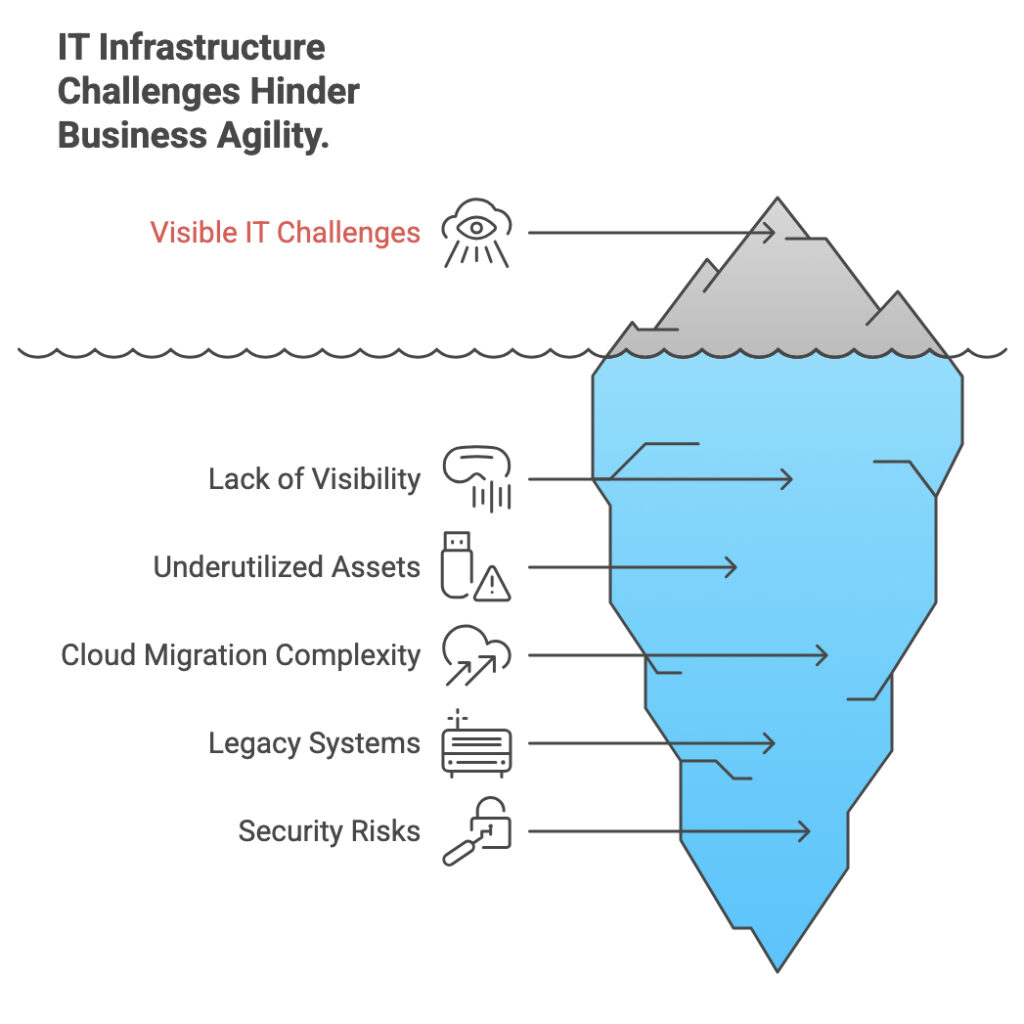
Enterprises often face a variety of persistent challenges when managing their IT infrastructure, which can impede business agility and innovation.
One of the most frequent issues is the lack of visibility into the complete IT environment, making it difficult to conduct a thorough IT infrastructure audit or IT system health check. Without a clear and accurate inventory, organizations struggle with infrastructure gap analysis, resulting in underutilized assets, redundant resources, and hidden vulnerabilities.
Another major challenge lies in cloud migration readiness. Many enterprises underestimate the complexity of migrating workloads to the cloud, overlooking dependencies, compliance requirements, and integration hurdles. This can lead to prolonged migration timelines and unexpected costs.
Additionally, legacy systems and fragmented infrastructure create operational silos that hinder enterprise infrastructure optimization efforts and prevent seamless interoperability between on-premises and cloud environments.
Security risks and compliance gaps further complicate the picture, especially for large organizations subject to strict regulations. Addressing these challenges requires a comprehensive enterprise infrastructure audit combined with continuous monitoring and proactive IT infrastructure assessment to identify bottlenecks and plan for enterprise IT optimization.
Implementing regular cloud infrastructure reviews helps enterprises stay aligned with evolving technology landscapes, optimize IT infrastructure costs, and enhance overall performance and resilience.
How to Conduct an IT Infrastructure Assessment Using Observability Principles
A modern IT infrastructure assessment should follow a structured methodology that goes beyond reviewing architecture diagrams. Here’s the framework we use at Gart Solutions when engaging with enterprise clients:
- Inventory & Topology Mapping: Document every service, its dependencies, and the network paths between them. Tools like Cilium’s Hubble or AWS X-Ray service maps can automate this for cloud-native stacks.
- Telemetry Coverage Audit: For every service, determine which of the three pillars (metrics, logs, traces) are instrumented and at what depth. Flag services with zero tracing coverage.
- SLO Gap Analysis: Map current alerting rules against business-defined SLOs. Many organizations monitor infrastructure metrics (CPU, memory) without correlating them to user-facing SLOs (availability, p99 latency).
- Tooling Fragmentation Review: Count the number of distinct observability tools in use. Fragmented stacks — where different teams use different agents, exporters, and dashboards — dramatically increase MTTR and onboarding cost.
- Incident Review: Analyze the last 5–10 significant incidents. For each, calculate how long it took to detect, diagnose, and resolve. This produces your current MTTD, MTTR, and MTTF baselines — and quantifies the business cost of observability gaps.
Common Mistakes in Monitoring vs. Observability Implementation
After conducting dozens of infrastructure assessments, these are the failure patterns we see most often:
- Alert fatigue by default: Teams instrument everything and threshold-alert on everything, producing hundreds of low-priority alerts that on-call engineers learn to ignore. Effective monitoring requires deliberate SLO-based alerting, not alert-on-all.
- Observability theater: Organizations deploy Grafana dashboards and call it “observability.” A dashboard of pre-built charts is monitoring, not observability. True observability means the ability to ask new questions without redeploying instrumentation.
- Siloed telemetry: Infrastructure metrics live in CloudWatch, application logs in Splunk, and traces — if they exist — in a separate APM tool. Without correlation IDs and a unified query interface, your team can’t connect a failing trace to the node it ran on.
- No OpenTelemetry adoption: Proprietary agents lock you into vendor pricing and migration costs. The Platform Engineering community’s consensus in 2025–2026 is clear: standardize on OpenTelemetry for all new instrumentation.
- Skipping the human layer: Tools alone don’t deliver observability. You need runbooks, on-call practices, and post-mortems that build institutional knowledge from every incident. The Linux Foundation’s engineering research consistently shows that culture and process gaps are bigger MTTR drivers than tooling gaps.
Difference Between IT Infrastructure Assessment and IT Infrastructure Audit
IT infrastructure assessment and IT infrastructure audit are both crucial processes for managing and optimizing an organization’s IT resources. However, they differ in their objectives, scope, methodologies, and outcomes. Understanding these differences can help organizations determine which process is more appropriate for their specific needs.
IT Infrastructure Assessment:
Purpose: To evaluate the overall performance, efficiency, and capacity of the IT infrastructure.
Scope: Broad, covering various aspects such as hardware, software, network, and processes.
Outcome: Recommendations for improvements, optimizations, and future growth planning.
Frequency: Periodic or as needed, based on business needs.
IT Infrastructure Audit:
Purpose: To ensure compliance with internal policies and external regulations, and to identify security vulnerabilities.
Scope: Specific, focusing on compliance, security, and adherence to standards.
Outcome: Audit report highlighting compliance status, security issues, and areas for improvement.
Frequency: Regular intervals, often mandated by regulatory requirements.
In summary
IT infrastructure assessment is a vital practice for large enterprises aiming to thrive in a competitive market. It ensures that IT resources are optimized, risks are managed, and the organization is well-prepared to meet future demands. By leveraging proven methodologies and tools, such as those outlined in David Achonu’s research, businesses can achieve a higher level of IT maturity and operational excellence.
Get a Comprehensive IT Infrastructure Assessment
Not sure where your monitoring ends and your observability gaps begin? Our engineering team has assessed infrastructure for enterprise organizations across finance, retail, and SaaS — from single-cloud to complex hybrid architectures. We deliver a clear, prioritized roadmap.