Buyers shopping for IT audit services in the United States usually start by comparing firms. That’s the wrong first step. The right first step is naming the outcome you actually need: a harder-to-break infrastructure, defensible security evidence for a board or acquirer, or a compliance package a regulator or auditor will accept. Those are three different engagements with different deliverables, different provider profiles, and different price tags — and treating them as interchangeable is the most common reason buyers end up with a report that doesn’t move the needle. This guide breaks down how to evaluate IT audit providers by outcome, what separates an assurance firm from a technical specialist from a modernization partner, what U.S. pricing typically buys at each tier, and the questions worth asking before you sign a statement of work.
Two federal references anchor most of what follows. NIST SP 800-115 defines security testing and assessment as a way to find vulnerabilities, verify compliance with policy, and develop mitigation strategies. CISA describes independent security control assessments as recurring reviews that produce a Security Assessment Report (SAR) plus Findings & Recommendations.
Choose by the outcome you need, not the vendor label
“IT audit” gets used as a catch-all for at least three distinct engagement types, and vendors don’t always volunteer which one they’re pitching. If you have a specific cloud or infrastructure weak spot, prioritize a technical audit built to expose misconfigurations and failure paths. If you need deal support or customer assurance, prioritize a security review that ends in evidence and a remediation plan, not just a slide deck. If the work is regulator- or contract-driven, prioritize a compliance review tied to the exact framework your buyer, auditor, or regulator expects — FedRAMP for federal cloud services, for example, where the process culminates in a SAR and an agency authorization decision.
What we see in practice: the request that arrives as “we need a security audit” is, more often than not, actually one of two other things: a fragile cloud baseline that needs technical remediation, or a compliance deadline that needs a named-framework report. Neither gets solved by a generic vulnerability scan with a PDF attached. Scoping the engagement around the actual downstream use of the report — a board update, a customer questionnaire, a SOC 2 letter, an authorization package — saves more budget than negotiating the day rate.
How to evaluate providers: a transparent framework
Rather than assigning our own numeric scores to named competitors — public information doesn’t support that level of precision, and doing so would itself be an unsubstantiated comparative claim — use the criteria below to score any provider you’re evaluating, including us. Ask each firm to walk through its answer on each row with a real work sample, not a sales deck.
| Evaluation criterion | Why it matters | What to ask for as proof |
|---|---|---|
| Independence & conflict policy | Determines whether the same firm can also do your remediation work without a conflict. | A written statement on whether the firm separates assurance from implementation. |
| Framework & environment coverage | A SOC 2 specialist may not be the right fit for an AWS/Kubernetes infrastructure review, and vice versa. | Named frameworks (SOC 2, ISO 27001, PCI DSS, FedRAMP, CMMC) and named cloud platforms they actively assess. |
| Deliverable structure | A report without severity ranking and ownership is hard to act on. | A redacted sample report or table of contents. |
| Evidence rigor | Conclusions need artifacts behind them, not just interview notes. | Their evidence-collection checklist for the specific framework. |
| Remediation path | Some buyers need only a report; others need the findings fixed. | Whether remediation is in scope, and by whom. |
| Team seniority & references | Junior-led engagements tend to produce generic checklists. | Named lead auditor credentials and two verifiable references in your industry. |
| Timeline & engagement model | Fixed-scope vs. ongoing retainer changes both cost and cadence. | A sample statement of work with milestones, not just a price range. |
| Review type | Best at finding | Typically misses | Best fit |
|---|---|---|---|
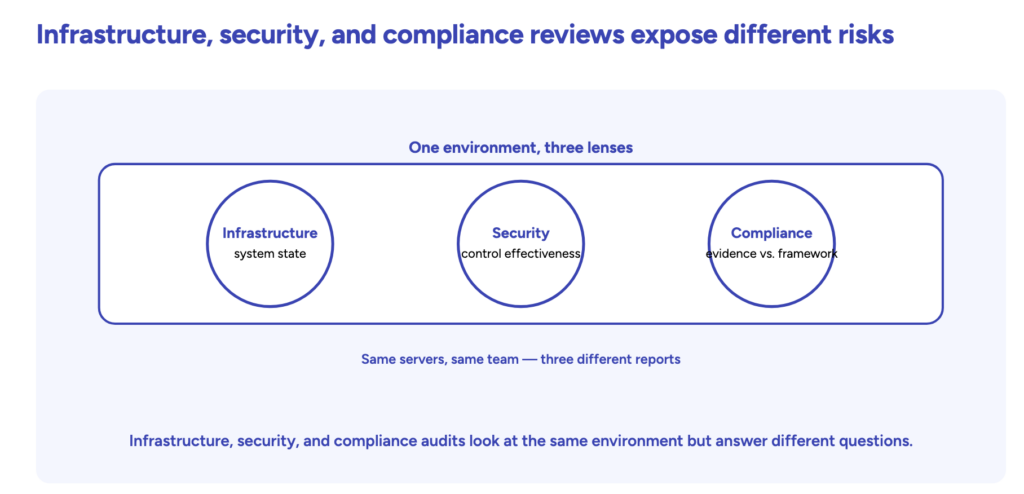
| Infrastructure review | Network, cloud, server, identity, and configuration weaknesses that affect uptime and blast radius. | Framework mapping and formal attestation language, unless the scope is explicitly built around compliance evidence. (csrc.nist.gov) | Teams hardening AWS, Azure, GCP, hybrid infrastructure, or internal platforms. |
| Security review | Control effectiveness, vulnerabilities, and attack paths. NIST frames this as verifying compliance and analyzing mitigation strategies; CISA’s independent assessments produce findings and recommendations. (csrc.nist.gov) | A formal certification or authorization workflow, if the buyer needs a named framework and a specific assessor deliverable. (fedramp.gov) | Boards, buyers, and procurement teams that want defensible security evidence fast. |
| Compliance review | Whether controls align to a named framework — SOC 2, PCI DSS, FedRAMP, CMMC, or ISO 27001. Schellman and A-LIGN both structure their businesses around independent attestations and federal assessments. (a-lign.com) | Deep remediation engineering or architecture redesign, unless separately scoped. (schellman.com) | Organizations that need an auditor-ready report or a customer-facing compliance package. |
The practical difference: infrastructure work is about system state, security work is about control effectiveness, and compliance work is about evidence against a named standard. CISA’s annual independent control-assessment language and FedRAMP’s SAR process show why a report can be useful without being interchangeable with a certification path. (cisa.gov)
This is also where most buyers get stuck: they ask for a “security audit” when they actually need a FedRAMP-ready control package, or they ask for a compliance review when the real pain is a fragile cloud baseline. A-LIGN, Coalfire, and Schellman lean heavily into compliance and assessment models.
Gart Solutions runs infrastructure audits, security audits, and compliance audits alongside its cloud and modernization work — a fit for teams that want the audit to end in a fixed stack, not just a documented one.
This guide breaks down how to evaluate IT audit providers by outcome, what a good audit report actually contains, what separates an assurance firm from a technical specialist from a modernization partner, and the questions worth asking before you sign a statement of work.
Choose by the outcome you need, not the vendor label
“IT audit” gets used as a catch-all for at least three distinct engagement types, and vendors don’t always volunteer which one they’re pitching. If you have a specific cloud or infrastructure weak spot, prioritize a technical audit built to expose misconfigurations and failure paths. If you need deal support or customer assurance, prioritize a security review that ends in evidence and a remediation plan, not just a slide deck. If the work is regulator- or contract-driven, prioritize a compliance review tied to the exact framework your buyer, auditor, or regulator expects — FedRAMP for federal cloud services, for example, where the process culminates in a SAR and an agency authorization decision.
What we see in practice: the request that arrives as “we need a security audit” is, more often than not, actually one of two other things: a fragile cloud baseline that needs technical remediation, or a compliance deadline that needs a named-framework report. Neither gets solved by a generic vulnerability scan with a PDF attached.
Scoping the engagement around the actual downstream use of the report — a board update, a customer questionnaire, a SOC 2 letter, an authorization package — saves more budget than negotiating the day rate.
5 audit scopes that look comprehensive but aren’t
Based on what we see when we’re brought in after another firm’s audit, these are the gaps that slip through scopes that read as thorough on paper.
| Looks comprehensive because | Actually missing | Why it matters |
|---|---|---|
| “Full environment review” covers every server and service | No sampling methodology disclosed — unclear how many accounts or configs were actually checked versus assumed | A report built on assumptions instead of evidence won’t hold up to a customer’s security questionnaire |
| Includes a vulnerability scan | No manual validation of the scan results | Automated scanners produce false positives and miss logic-level and privilege-escalation issues scanners can’t see |
| Covers “identity and access management” | No test of the offboarding process itself, only a current-state permissions snapshot | Stale access from departed employees is one of the most common real-world findings, and a snapshot review misses it |
| Includes “backup and disaster recovery” | No actual test-restore performed | A backup that has never been restored is a hope, not a control |
| Lists “third-party risk” as in scope | No subprocessor inventory cross-checked against the framework’s requirements | Vendors handling regulated data outside the documented subprocessor list are an audit finding waiting to happen |
Gart Solutions positions itself as more of a modernization partner than a pure attestation shop, which is where the model earns its keep if your environment needs both diagnosis and cleanup. Its IT audit services sit alongside DevO
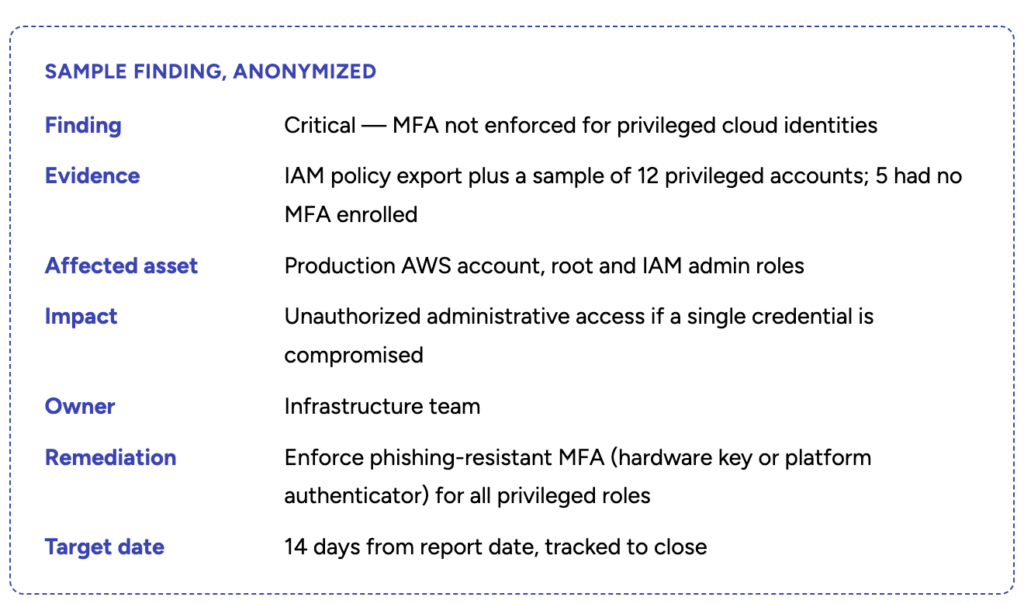
The best audits leave you with a remediation map, not just findings
A strong audit tells you what to fix, in what order, and who should own it. A security review without a remediation plan tends to become a slide deck with no operating change, which is why CISA and FedRAMP both emphasize findings, recommendations, evidence, and risk-based follow-through. FedRAMP’s SAR guidance requires that recommendations be supported by findings, evidence, and artifacts, and the authorization process includes a remediation discussion.
In practice, a useful deliverable includes an evidence list, severity ranking, control-by-control gaps, quick wins, and an owner-ready remediation roadmap. That shape reduces ambiguity for engineering and compliance teams and helps leadership see which issues are blocking customer trust, authorization, or operational stability. CISA’s independent assessments explicitly include Findings & Recommendations — the deliverable shape worth insisting on.
What we see in practice: the gap between “audit complete” and “risk actually reduced” is almost always an ownership gap, not a technical one. A finding with no named owner and no target sprint sits in a backlog indefinitely. The engagements that close findings fastest are the ones where the remediation roadmap gets assigned to specific engineers before the final report is even signed off, not after.
Gart Solutions positions itself as more of a modernization partner than a pure attestation shop, which is where the model earns its keep if your environment needs both diagnosis and cleanup. Its IT audit services sit alongside DevOps, cloud, infrastructure management, SRE, and Kubernetes work — useful for buyers who want the prioritized remediation to land with a team that already understands the stack, rather than starting a second procurement cycle to get the findings fixed.
Which U.S. provider model fits your stack and regulator
| Provider model | Strongest when | Good at | Watch out for |
|---|---|---|---|
| Independent assurance firm | You need formal independence, attestations, or federal-style assessment language. Schellman describes independent SOC examinations, federal assessments, PCI, healthcare, and ISO certifications; A-LIGN describes a compliance-first model spanning SOC 2, ISO 27001, HITRUST, FedRAMP, and PCI. | Compliance-heavy reviews, evidence collection, audit-facing deliverables. | Less useful if you also need platform redesign, cloud recovery, or implementation help. Schellman states it does not provide consulting, implementation, technology, or managed services, specifically to avoid a conflict of interest. |
| Technical audit specialist | You need sharper infrastructure or security testing against a specific environment. NIST SP 800-115 is explicitly scoped to technical security tests and examinations. | Cloud, network, identity, endpoint, and control validation. | May not provide the broader compliance program scaffolding a regulated buyer needs. |
| Modernization partner | Your real problem is that audit findings point to architecture, DevOps, or operating-model debt, not a documentation gap. Gart spans cloud, DevOps, infrastructure management, SRE, Kubernetes, and IT audits. (gartsolutions.com) | Remediation design, cloud hardening, infrastructure cleanup, and follow-on execution. | Independence matters if you need the same firm to serve as a formal, arm’s-length assessor for a certification your customers will rely on. |
| Provider model | Startup / SMB | Mid-market | Enterprise | Federal / regulated |
|---|---|---|---|---|
| Independent assurance firm | Fit, if a SOC 2 letter is table stakes for a deal | Strong fit | Strong fit | Required for FedRAMP-track work |
| Technical audit specialist | Fit for a point-in-time cloud check | Strong fit | Fit, often alongside an assurance firm | Supplementary, not a substitute for a named assessor |
| Modernization partner | Strong fit — one team for audit and fix | Strong fit | Fit for a specific stack or platform, less so for org-wide attestation | Fit for remediation after the formal assessment |
For federal cloud work, the provider model isn’t optional. FedRAMP relies on independent assessment services to scale its process, and the assessment package ends in a SAR and a risk-based authorization decision made by the agency — which makes a compliance-first assessor the correct starting point for federal buyers, not a matter of preference. (fedramp.gov)
For commercial buyers, the choice comes down to whether the problem is proof or repair. A pure assessor is best when you need defensible evidence. A technical specialist is best when you need misconfigurations surfaced. A modernization partner is best when you need the findings translated into infrastructure change. Gart’s mix of audit and cloud services puts it in the third bucket — a reasonable fit for U.S. companies that want the audit to end in action rather than another vendor search.
Audit is not the same engagement as ongoing operations
A recurring point of confusion: buyers ask for “managed services” when they mean a one-time audit, or ask for an audit when what they actually need is continuous monitoring. An audit is a point-in-time (or annually recurring) evaluation that produces a report. Managed infrastructure services, DevOps, and SRE are ongoing operational engagements that keep the environment in the state the audit recommended. CISA’s own language treats independent control assessment as a recurring, not one-off, discipline for this reason.
In practice, most buyers need both, sequenced: an audit to establish the baseline and prioritized fix list, then either a project engagement to close specific gaps or an ongoing retainer — SRE, infrastructure management, or continuous monitoring — to keep the environment from drifting back out of the state the audit signed off on. If your provider can only do the first half, ask upfront who picks up the second half, and confirm the handoff won’t require re-scoping from scratch.
Ask these questions before you hire an audit team
- Are you independent for the work I need? If the engagement requires formal assurance, ask whether the firm preserves independence or also does implementation work that could create a conflict. Schellman states it doesn’t provide consulting, implementation, technology, or managed services, citing self-serving motive concerns.
- What exact deliverable will I receive? Ask for the report type, whether it includes findings and recommendations, and whether it maps to a named framework. FedRAMP explicitly expects a SAR, supporting evidence, and a remediation discussion.
- What evidence do you collect? A serious compliance review collects artifacts behind each conclusion, not just interview notes and a generic checklist. FedRAMP’s training materials require that recommendations be supported by findings, evidence, and artifacts.
- Do you rank severity and prioritize fixes? The most useful engagements deliver a risk-ranked backlog. CISA’s independent control assessments explicitly include Findings & Recommendations as the baseline deliverable.
- Will you help with remediation, or only report? If you need hands-on cleanup, choose a partner that supports infrastructure work after the audit. Gart’s catalog spans infrastructure management, SRE, cloud, and IT audits, which lines up with remediation-oriented delivery.
- How do you scope AWS, Azure, GCP, hybrid, and SaaS environments? Insist on environment-specific scoping — a generic checklist misses platform-specific misconfiguration classes.
- What’s excluded from the scope? Exclusions matter: an audit can look comprehensive while missing identity, logging, backup, or third-party risk boundaries. NIST’s technical testing guidance stresses both benefits and limitations of technical examinations.
- What happens after the report ships? Ask who owns follow-up validation that fixes actually landed — a report with no re-test or check-in step leaves you re-discovering the same findings next year.
Ask these questions before you hire an audit team
- Are you independent for the work I need?
If the engagement requires formal assurance, ask whether the firm preserves independence or also does implementation work that could create a conflict. Schellman states it doesn’t provide consulting, implementation, technology, or managed services, citing self-serving motive concerns. - What exact deliverable will I receive?
Ask for the report type, whether it includes findings and recommendations, and whether it maps to a named framework. FedRAMP explicitly expects a SAR, supporting evidence, and a remediation discussion. - What evidence do you collect, and what’s your sampling methodology?
A serious compliance review collects artifacts behind each conclusion and discloses how much of the environment was actually sampled, not just interview notes and a generic checklist. FedRAMP’s training materials require that recommendations be supported by findings, evidence, and artifacts. - Do you rank severity and prioritize fixes?
The most useful engagements deliver a risk-ranked backlog. CISA’s independent control assessments explicitly include Findings & Recommendations as the baseline deliverable. - Will you help with remediation, or only report?
If you need hands-on cleanup, choose a partner that supports infrastructure work after the audit. Gart’s catalog spans infrastructure management, SRE, cloud, and IT audits, which lines up with remediation-oriented delivery. - How do you scope AWS, Azure, GCP, hybrid, and SaaS environments?
Insist on environment-specific scoping — a generic checklist misses platform-specific misconfiguration classes. - What’s excluded from the scope?
Exclusions matter: an audit can look comprehensive while missing identity, logging, backup, or third-party risk boundaries. NIST’s technical testing guidance stresses both benefits and limitations of technical examinations. - What happens after the report ships?
Ask who owns follow-up validation that fixes actually landed — a report with no re-test or check-in step leaves you re-discovering the same findings next year.
What U.S. pricing usually means for scope, speed, and depth
Higher price generally buys broader scope, deeper manual testing, more frameworks, and more reporting time. Atlant Security’s 2026 benchmark page lists common U.S. ranges such as $15,000–$60,000 for a SOC 2 Type II audit, $10,000–$75,000 for an infrastructure security audit, and $5,000–$50,000+ for a penetration test, with pricing driven mainly by scope and complexity.
| Engagement model | How it’s priced | Typical fit |
|---|---|---|
| Fixed-scope project | Flat fee tied to a defined environment and deliverable | One-time infrastructure or security audit with a clear boundary |
| Framework-based assessment | Priced by framework and evidence volume (SOC 2, ISO 27001, PCI DSS) | Compliance-driven buyers with a named target certification |
| Federal / FedRAMP assessment | Priced by system boundary size and impact level, typically the highest tier | Federal cloud service providers pursuing authorization |
| Retainer / ongoing monitoring | Monthly or quarterly fee for continuous review, separate from the initial audit | Organizations that want drift caught between formal audit cycles |
| Audit + remediation bundle | Combined project fee covering both the assessment and the fix work | Buyers who want one team accountable for both diagnosis and repair |
At the lower end, expect a narrower environment review, faster turnaround, and less remediation support. In the middle, expect a clearer evidence package, more manual validation, and a better-defined report. At the higher end, engagements often span multiple sites or clouds, multiple frameworks, board-ready reporting, and more time on owner-ready remediation planning — consistent with Atlant’s published pricing notes and FedRAMP’s heavier evidence and SAR requirements.
For regulated or multi-framework buyers, cheap can be expensive: missing depth tends to show up later as rework. If the goal is a quick point-in-time view, a narrower technical review may be enough. If the goal is compliance attestation or federal readiness, budget for the depth the framework requires — A-LIGN, Coalfire, and Schellman’s compliance-heavy positioning is a reminder that formal assurance costs more than a lightweight security check.
Which provider fits your situation
There isn’t one universally “best” IT audit provider in the U.S. market — there’s a best fit for your outcome, regulator, and internal capacity to act on findings.
- Need a SOC 2, ISO 27001, or HITRUST letter your customers will accept: an independent assurance firm like Schellman or A-LIGN, chosen specifically for that framework.
- Pursuing FedRAMP or another federal authorization: a firm on FedRAMP’s approved assessor track — independence here isn’t optional.
- Have a specific cloud or Kubernetes environment you suspect is misconfigured: a technical audit specialist scoped to that exact platform.
- Findings keep pointing back to architecture or operating-model debt, not paperwork: a modernization partner such as Gart, whose audit services sit next to the cloud, DevOps, and SRE teams that can act on what the audit finds.
- Need both a formal attestation and the underlying fixes: split the work deliberately — an independent assessor for the attestation, a modernization partner for remediation — rather than assuming one vendor can cleanly do both without a conflict-of-interest conversation.
If you want a U.S.-ready infrastructure, security, and compliance review that ends with prioritized remediation rather than a shelved PDF, Gart Solutions’ IT audit services are worth a scoping call — its public service catalog spans audits, cloud, DevOps, infrastructure management, SRE, and Kubernetes, which suits buyers who want findings absorbed into the operating stack rather than handed off to a second vendor.
Whichever model you choose, ask for a scope that names the outcome first, then the framework, then the remediation plan. That sequence is the fastest way to avoid buying the wrong kind of engagement — and the slowest, most expensive mistake in this market is a technically accurate report that never changes the actual risk profile.
Need an IT audit that ends in action, not just a report?
Gart Solutions runs infrastructure, security, and compliance audits for U.S. companies — and can carry the prioritized findings straight into remediation with the same team.
- Infrastructure, security, and compliance audits
- Cloud, DevOps, and Kubernetes remediation
- SRE and ongoing infrastructure monitoring after the audit