When a production database starts throwing errors at 2 a.m., the first question isn’t “what broke” — it’s “whose call is this.” Too often, nobody has a clean answer. The server has an administrator who patches it and gets paged when it’s down. It doesn’t have anyone who can say whether taking it offline for four hours is an acceptable business risk, or what happens to the customers depending on it. That gap — between who maintains an asset and who is accountable for the decisions around it — is exactly what a working model of asset ownership is supposed to close.
Asset ownership isn’t a spreadsheet exercise. It’s the answer to one specific question for every system, dataset, and application a company runs: if this breaks, gets breached, or forces a hard trade-off, who actually has the authority to decide? Most organizations answer that by default — whoever’s name is on the support ticket — instead of by design, splitting the role deliberately between a business owner and a technical owner. A structured infrastructure audit is usually the fastest way to see how wide that gap already is, since ownership gaps rarely surface until something forces the question. This guide breaks down what each role should actually do, why most companies default to technical-only ownership, and a practical model for fixing it without standing up a governance committee.
What Asset Ownership Actually Means
Asset ownership is formal, named accountability for a specific system, dataset, application, or piece of infrastructure — not day-to-day administration of it. That distinction trips up almost every team the first time they try to build an ownership model: the person who patches, configures, and monitors an asset is not automatically the person accountable for the decisions about it, even though those two roles frequently sit with the same team by default.
ISO/IEC 27001:2022 makes this distinction explicit. Control 5.9 in Annex A requires an inventory of information and associated assets with a named owner assigned to each one — and the standard is specific that ownership does not imply technical administration, it implies accountability for classification, risk decisions, and periodic review. NIST codifies a related idea in SP 800-53’s CM-8 control, which requires system component inventories to record an owner for every component precisely because, in the standard’s own language, accountability breaks down “when component ownership and system association is not known.”
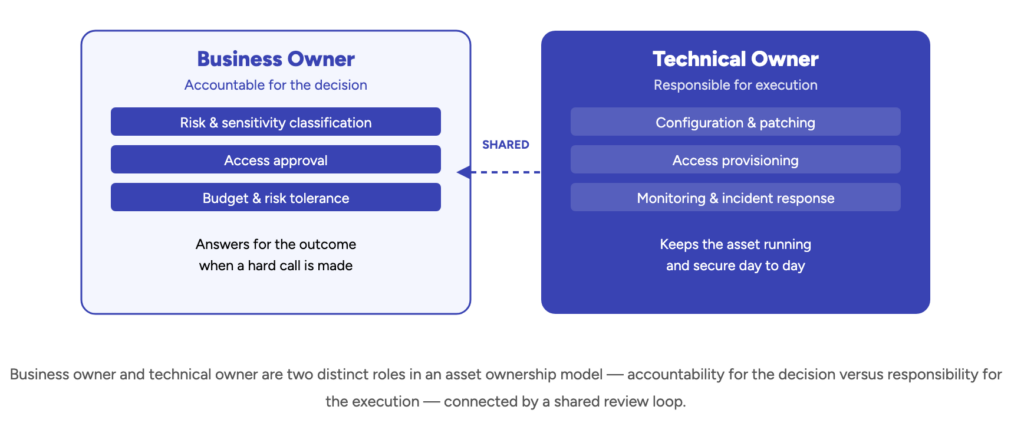
Ownership vs. administration, in one line: the technical owner keeps an asset running and secure day to day. The business owner decides what “acceptable risk” means for that asset, approves who gets access and why, and answers for the outcome when a hard call has to be made. One role executes; the other is accountable.
Data governance frameworks draw the same line with more granularity. Under the DAMA-DMBOK model, a data owner is a business role accountable for a domain’s quality standards, access rules, and definitions, while a data custodian — usually IT or engineering — manages the technical infrastructure the data lives on, and a data steward operates in between as the day-to-day delegate. IT asset ownership maps almost exactly onto that same three-way split, even when a company has never used the data-governance vocabulary to describe it.
Business Owner vs. Technical Owner: Who Decides What
Both roles are necessary, and neither one substitutes for the other. The business owner is usually a department head, product owner, or line-of-business leader with the authority to make trade-off calls; the technical owner is usually within IT or engineering — a platform lead, application owner, or senior engineer who understands how the asset actually works. The table below splits the responsibilities that most often get left ambiguous:
| Decision Area | Business Owner | Technical Owner |
|---|---|---|
| Risk & sensitivity classification | Decides how critical or sensitive the asset is to the business | Implements controls that match the assigned classification |
| Access approval | Approves who should have access, and why | Provisions, revokes, and technically enforces approved access |
| Acceptable downtime / risk tolerance | Sets the acceptable downtime and risk window | Designs redundancy and recovery to meet that window |
| Budget & renewal decisions | Owns the cost-versus-value trade-off and approves spend | Recommends technical alternatives, sizing, and migration paths |
| Day-to-day configuration, patching, monitoring | Not involved | Fully responsible |
| Incident decision authority | Decides whether to accept business risk, delay a fix, or notify customers | Executes the technical response and root-cause analysis |
| Compliance sign-off | Attests the asset meets policy for its intended use case | Provides evidence that the required controls are actually in place |
| Decommission decision | Approves that the asset is no longer needed by the business | Executes secure decommissioning and data disposal |
Why Ownership Defaults to IT (and Why That Fails)
In most companies, nobody sits down and decides that IT should own every asset alone — it just ends up that way. Engineering provisions the resource, so engineering’s name lands in the ticketing system. Nobody from the business side is looped in until something breaks, at which point IT is asked to make a business-risk call it was never given the context, authority, or incentive to make well.
This pattern is especially visible in SaaS sprawl. A department buys a tool with a company credit card, an admin in IT connects it to SSO for security reasons, and from that point on IT is the only name attached to it — even though IT has no idea whether the tool is still delivering value to the team that requested it. That’s precisely how unused SaaS licenses accumulate: the technical owner keeps the lights on, but nobody with business context is ever asked whether the lights should stay on at all.
If any of the following are true in your organization, technical-only ownership is already costing you more than it looks like on paper:
- The only name attached to a critical system in your ticketing tool or CMDB is an engineer or team alias, not a business stakeholder.
- Access requests get approved by whoever’s fastest to respond in IT, not by someone who can judge whether the requester actually needs that access.
- When an asset’s usage or relevance is questioned, nobody outside IT can say with confidence whether it’s still needed.
- Incident calls that carry real business risk — delaying a patch, taking a system offline, notifying customers — get made unilaterally by whoever’s on call.
A Practical Accountability Model You Can Roll Out in Weeks
None of this requires a governance program with a dedicated headcount. It requires making four decisions explicit, in order, and putting them somewhere durable — a wiki page, a CMDB field, a spreadsheet if that’s genuinely all you have — rather than leaving them implicit in whoever happens to answer the alert.
- Inventory what you actually have. You cannot assign ownership to an asset you don’t know exists. Most organizations discover the gap here first — a shadow IT discovery pass against billing, SSO logs, and network traffic routinely turns up systems nobody remembered were still running, let alone owns.
- Assign one named business owner per asset — a person, not a department. “Marketing owns this” resolves nothing when a decision is needed at 2 a.m. Naming an individual, with a documented backup, is what actually closes the accountability gap ISO 27001’s Annex A 5.9 control is built around.
- Assign one named technical owner per asset. This should already exist for most systems; the work here is making sure it’s documented in the same place as the business owner, not scattered across tribal knowledge, and that the technical owner’s scope matches how they’d enforce a least-privilege access model for that asset.
- Write down what each owner actually decides. Use the responsibility split earlier in this guide as a starting template, not a final answer — the exact line varies by company, but it needs to exist in writing so an incident isn’t the first time anyone thinks it through.
- Put a review cadence on the calendar. Ownership records rot the moment a business owner changes roles or a system gets repurposed. Tying the ownership review to an existing rhythm — the same cadence covered in our guide to running a user access review without spreadsheets — means it survives past the initial rollout instead of being a one-time project that quietly goes stale.
Why Auditors Care About Asset Ownership
Asset ownership shows up as a named control, not a nice-to-have, across every major security and compliance framework auditors test against. It’s not framed as a technical control because it isn’t one — it’s a governance control that everything downstream depends on.
Under ISO/IEC 27001:2022, Annex A control 5.9 requires a maintained inventory of information and associated assets with an assigned owner for each — auditors will sample the inventory and ask the named owner to explain their classification and review decisions directly, not just confirm the field is populated. SOC 2’s Trust Services Criteria expect the same accountability implicitly through the CC6 access-control series, even though “asset owner” isn’t always the literal term used; see our breakdown of ISO 27001 vs. SOC 2 access controls for how the two frameworks map the same underlying requirement to different language. Verizon’s 2026 Data Breach Investigations Report frames clear visibility into assets — across devices, SaaS, IoT/OT, and cloud — as a foundational prerequisite for every other control in the report, which is another way of saying that a control you can’t attach an owner to is a control nobody is actually accountable for.
This is also where weak ownership quietly breaks segregation of duties: if the same person can both request a change to an asset and approve it because no distinct business owner exists, the control fails structurally, not just on paper. Our guide to segregation of duties for IT and finance teams covers this failure mode from the finance-controls side, and it’s the same root cause auditors flag on the asset-ownership side.
Common Mistakes When Assigning Asset Ownership
Most rollouts fail on execution details, not on the underlying idea. The following mistakes account for the majority of ownership models that look complete on paper but don’t hold up when tested:
- Assigning ownership to a team or role instead of a named individual. “The platform team owns this” is not accountability — it’s a group that can each assume someone else will answer for it.
- Confusing the technical owner with the business owner. If the same person fills both roles for a genuinely business-critical asset, you haven’t created accountability, you’ve just given one person’s technical judgment the authority of a business decision it was never meant to carry.
- Treating the initial assignment as permanent. Owners change teams, leave the company, or stop being the right fit for a system that’s evolved — without a review cadence, the record silently becomes fiction within a year.
- Skipping low-visibility assets. Ownership programs tend to start and stop with production systems, leaving legacy tools, dormant SaaS accounts, and old service credentials — exactly the assets most likely to be genuinely orphaned — outside the model entirely.
- No consequence for unclaimed assets. If an asset with no owner just keeps running indefinitely, there’s no real incentive for anyone to claim it. Effective programs set a default: unowned assets past a grace period get flagged for decommissioning, not left alone.
Not sure who actually owns half your environment?
Gart Solutions helps engineering and business leaders build a working asset ownership model — from the initial infrastructure audit and asset inventory to defining business-owner and technical-owner roles, RACI mapping, and the recurring review cadence that keeps ownership from decaying back into “IT owns everything by default.”
You might also like
- Gart Compliance Audit Services
- Entra ID Governance vs. Manual Access Reviews
- Zluri vs. Torii vs. Zylo: A SaaS Management Platform Comparison
- Why Quarterly Access Reviews Fail (and How to Fix It)
- IT Infrastructure Audit Checklist: Signs You Need a Checkup