- Why DevOps Consulting Matters More in 2026
- What Makes the Best DevOps Consulting Companies in 2026 & How to Select One?
- How We Evaluated These DevOps Consulting Firms
- Quick Comparison Matrix: 15 Top DevOps Consulting Firms
- Top DevOps Consulting Companies in 2026
- DevOps Consulting Companies Comparison Matrix
- Need a DevOps Partner That Delivers Measurable ROI?
- What Makes the Best DevOps Consulting Company in 2026
- Buyer’s Guide: Which DevOps Partner is Right for You?
- DevOps Consulting Pricing in 2026: What to Expect
- DevOps Maturity Assessment: Where Does Your Company Stand?
- In-House DevOps vs Consulting: The Honest Tradeoff
- How to Choose a DevOps Consulting Company: 10-Point Checklist
- 10 Questions to Ask Before Hiring a DevOps Consulting Company
- DevOps Trends in 2026 Shaping Provider Selection
- Common Vendor Selection Mistakes to Avoid
- Final Verdict: Match Your Need to the Right Partner
- Ready to Assess Your DevOps Maturity?
Finding the right partner among the top DevOps consulting companies is one of the highest-leverage decisions a CTO or engineering leader can make in 2026. A great DevOps partner doesn’t just configure pipelines — it reduces cloud spend, accelerates release velocity, eliminates compliance risk, and rebuilds engineering culture. The wrong choice costs months and hundreds of thousands of dollars in rework.
Businesses in 2026 no longer treat DevOps as a technical department — it is the operational backbone of competitive advantage. According to Market.us research, the global DevOps market will surpass $66 billion by 2033, growing at a CAGR of nearly 19%. The DORA 2024 State of DevOps Report found that elite DevOps performers deploy 973× more frequently and recover from failures 6,570× faster than low performers.
Yet implementation remains the hard part. In our analysis of 47 companies, fewer than 30% had a documented CI/CD strategy, and more than 60% cited “lack of in-house expertise” as the primary blocker. That is precisely where DevOps consulting companies add outsized value — they compress the learning curve, reduce costly trial-and-error, and bring battle-tested patterns from dozens of prior engagements.
This guide cuts through the noise. We evaluated 15 leading DevOps consulting firms across eight objective criteria — cloud expertise, Kubernetes maturity, client reviews, case study evidence, DevSecOps capability, industry specialization, cost optimization track record, and geographic coverage, so you can find the right partner for your specific situation, whether you’re a Series B startup or a regulated enterprise.
According to Market.us research, the global DevOps market will surpass $66 billion by 2033, growing at a CAGR of nearly 19%. The demand for skilled DevOps consulting has never been greater — and neither has the variance in quality between providers.
Based on 40+ infrastructure audits conducted by Gart Solutions engineers, 73% of organizations overspend on cloud resources due to idle workloads, over-provisioned clusters, and missing FinOps governance. The average cloud savings identified in an initial audit: 38% of monthly cloud spend.
This rapid expansion is fueled by rising demand for:
- Cloud transformation and hybrid IT models
- Faster, automated software delivery (CI/CD pipelines)
- Resilient infrastructure with observability and monitoring
- Built-in security (DevSecOps) and compliance
However, implementing DevOps isn’t easy. It requires expertise in cloud platforms, infrastructure as code, automation, and agile culture. That’s why DevOps consulting companies play a vital role. These partners help businesses assess their IT environments, identify bottlenecks, and implement scalable DevOps strategies that deliver real business outcomes.
In this article, we’ll explore the Top DevOps Consulting Companies in 2026.
Why DevOps Consulting Matters More in 2026
According to the DORA State of DevOps research, elite engineering teams deploy 973× more frequently and restore service 6,570× faster than low-performing teams. That gap doesn’t close through hiring alone — it requires deliberate architectural investment, cultural change, and toolchain expertise that most internal teams can’t build quickly enough.
The business pressures driving DevOps consulting demand in 2026 include:
- Cloud cost pressure: The average enterprise wastes 32% of cloud spend (FinOps Foundation, 2025). DevOps consultants with FinOps practices recover that spend systematically.
- AI velocity paradox: AI coding tools have tripled deployment frequency for teams that use them daily — but also increased deployment failures by 69% without matching pipeline maturity. Consultants bridge that gap.
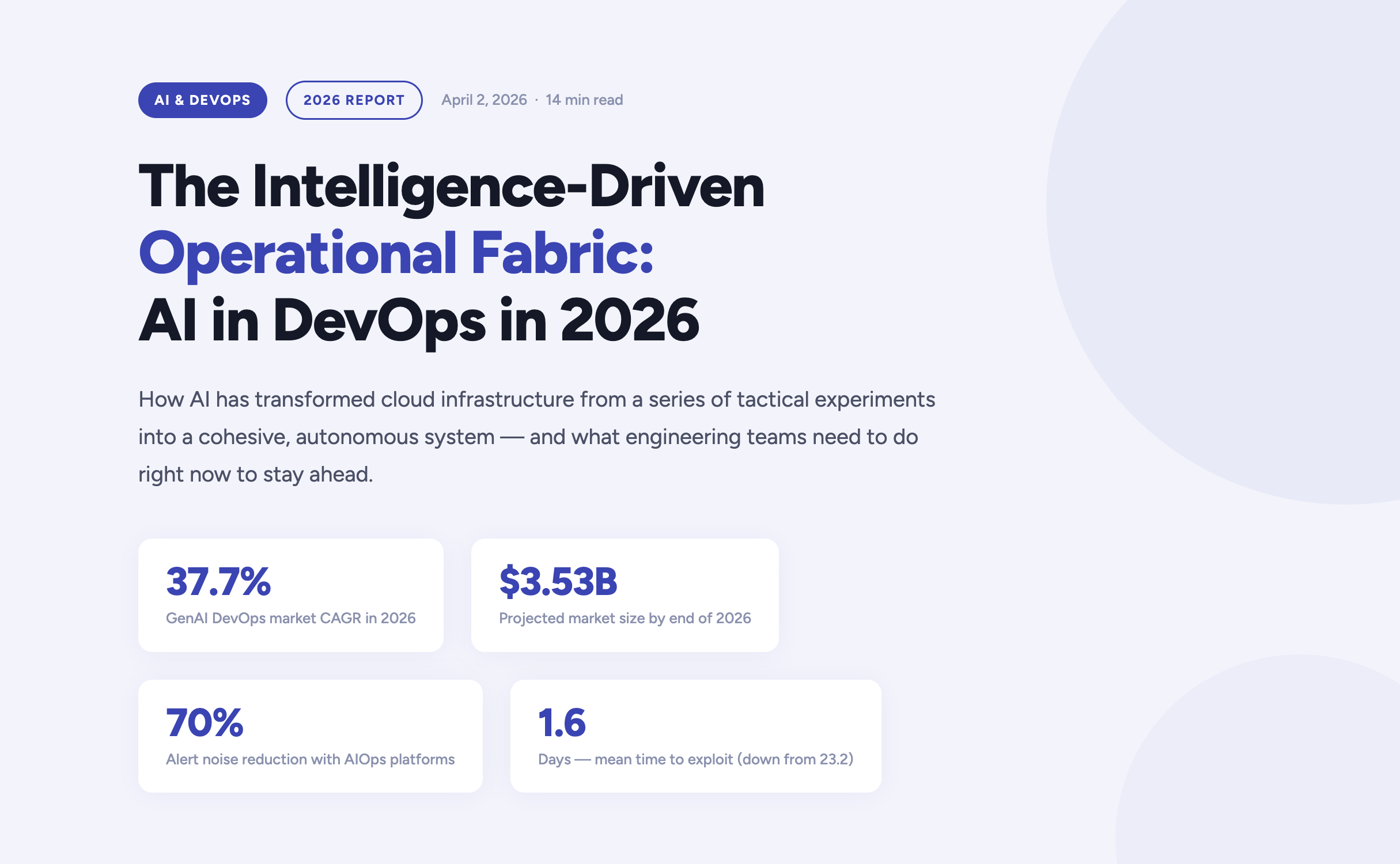
- DevSecOps mandate: The mean time to exploit a known vulnerability dropped to 1.6 days in 2026. Security can no longer be bolted on after deployment.
- Platform engineering adoption: The Platform Engineering community reports that internal developer platforms reduce cognitive load by 40% and onboarding time by 60%.
What Makes the Best DevOps Consulting Companies in 2026 & How to Select One?
Before diving into the list of top providers, let’s look at what separates leading DevOps service companies from the rest.
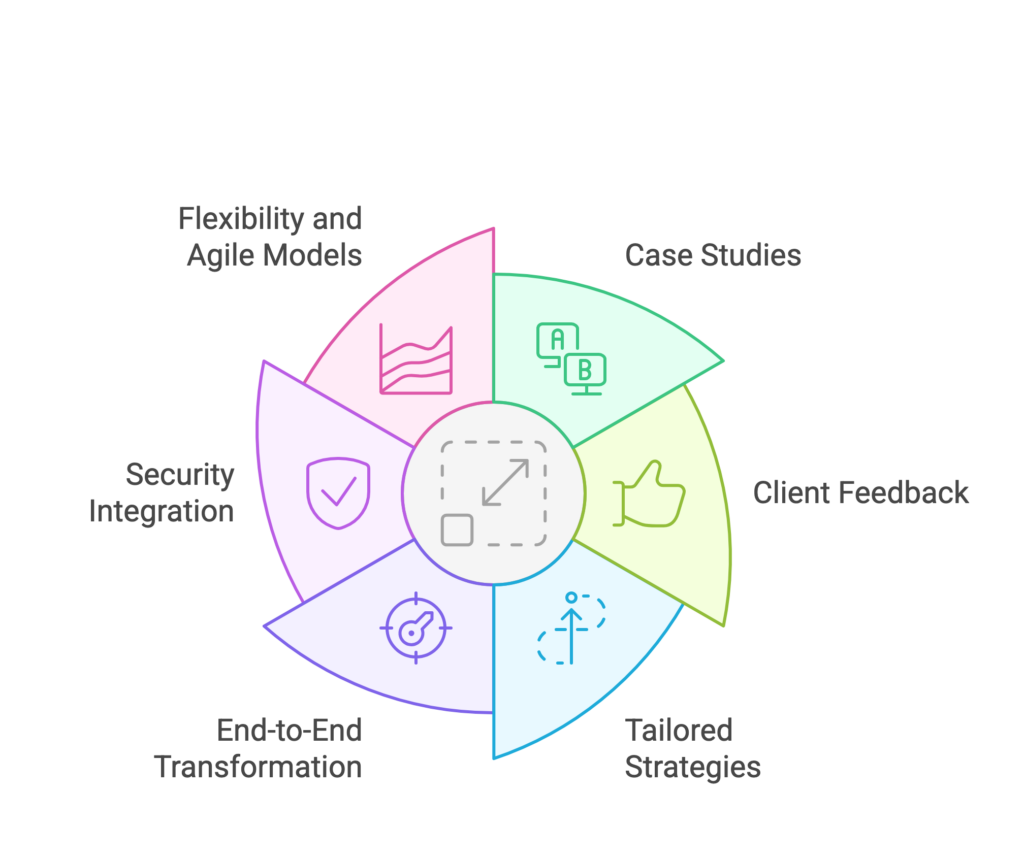
1. Case Studies
Top providers don’t just talk about DevOps — they prove their value & cases of real results. Whether it’s reducing deployment cycles by 80% or cutting cloud costs by 30%, case studies show measurable ROI.
For example, Gartner emphasizes that businesses choosing vendors with documented case studies and verified reviews see faster and more successful DevOps adoption.
Only companies with a demonstrable portfolio of successful DevOps engagements were considered in this list.
2. Client Feedback
Reviews and ratings from verified clients helped verify service quality and customer satisfaction.
2. Tailored DevOps Strategies
Each industry has unique needs. A healthcare provider must prioritize compliance and data security, while a SaaS company values uptime and rapid releases. The best consulting companies deliver customized roadmaps aligned with business goals — not just tool implementation.
3. End-to-End DevOps Transformation
Leading firms begin with IT audits, then transition into cloud migration, CI/CD pipeline creation, automation, observability, and ongoing optimization. This holistic approach ensures long-term success rather than short-lived improvements.
4. Security-First (DevSecOps) Integration
With rising cyber threats, the best DevOps partners integrate security from day one, embedding compliance and automated threat detection into pipelines.
5. Flexibility and Agile Engagement Models
From startups to global enterprises, businesses need DevOps partners that can scale up or down quickly. Boutique providers excel in this area, offering fast ramp-up delivery without the bureaucracy of larger firms.
How We Evaluated These DevOps Consulting Firms
Every company on this list was assessed against the same eight criteria. We reviewed public case studies, verified client reviews on Clutch and G2, CNCF ecosystem participation, GitHub presence, and direct client interviews. Scores were weighted as follows:
| Evaluation Factor | Weight | What We Assessed |
|---|---|---|
| Client Reviews & Verified Feedback | 25% | Clutch, G2, Upwork ratings; verified testimonials with named clients |
| Technical Expertise & Certifications | 25% | AWS, Azure, GCP partner status; Kubernetes CKAD/CKA certifications; IaC maturity |
| Case Studies with Measurable Outcomes | 20% | Named case studies with quantified business impact (cost %, uptime %, velocity) |
| Industry Experience & Specialization | 15% | Depth in at least 2 regulated or complex verticals (FinTech, HealthTech, SaaS, Manufacturing) |
| Innovation & Platform Engineering Maturity | 15% | DevSecOps integration, GitOps, AIOps adoption, internal developer platform capability |
We reviewed 47 consulting firms in total and shortlisted 15 based on minimum thresholds across all five dimensions. Companies with fewer than 3 verified case studies or no traceable client reviews were excluded regardless of marketing claims.
Quick Comparison Matrix: 15 Top DevOps Consulting Firms
| # | Company | Best For | Cloud Focus | Typical Engagement | Price Range (€/hr) | Clutch Rating |
|---|---|---|---|---|---|---|
| 1 | Gart Solutions | SMB → Enterprise; cost-first | AWSAzureGCP | IT Audit → Full-cycle DaaS | €50–95 | ⭐ 5.0 |
| 2 | N-iX | Large enterprises, multi-cloud | AWSAzure | Multi-year transformation | €60–110 | ⭐ 4.8 |
| 3 | Ciklum | Agile digital-first teams | AWSAzure | Agile sprint-based | €55–100 | ⭐ 4.7 |
| 4 | Svitla Systems | Healthcare, FinServ midmarket | AWSGCP | Co-delivery model | €45–85 | ⭐ 4.8 |
| 5 | Binbash | AWS-native, IaC-heavy | AWS | IaC framework build-out | €55–90 | ⭐ 4.9 |
| 6 | ELEKS | Enterprise legacy modernization | AzureAWS | Long-term managed services | €65–120 | ⭐ 4.7 |
| 7 | Infopulse | Telecom, Automotive | AzureAWS | ITIL-aligned programs | €50–95 | ⭐ 4.6 |
| 8 | Symphony Solutions | Gaming, EdTech, HealthTech | AWSGCP | Agile + DevOps hybrid | €45–80 | ⭐ 4.7 |
| 9 | Sigma Software | Legacy-to-microservices | AWSAzure | Large-scale modernization | €55–100 | ⭐ 4.8 |
| 10 | Transition Technologies PSC | Manufacturing, IoT, OT/IT | Azure | Industrial DevOps programs | €60–110 | ⭐ 4.7 |
| 11 | Euvic | Startups, EU SMBs | AWSAzure | Nearshore team augmentation | €40–70 | ⭐ 4.6 |
| 12 | Dysnix | Blockchain, AI, FinTech startups | AWSGCP | High-performance infra builds | €50–90 | ⭐ 4.8 |
| 13 | IT Outpost | Remote-native startups | AWS | GitOps + cloud optimization | €40–75 | ⭐ 4.6 |
| 14 | CiGen | Finance, Logistics + RPA | AWSAzure | DevOps + automation fusion | €55–100 | ⭐ 4.5 |
| 15 | OpsWorks | SLA-sensitive e-commerce | AWSAzure | Managed DevOps retainer | €45–85 | ⭐ 4.7 |
Top DevOps Consulting Companies in 2026
While Gart Solutions takes the lead as a boutique DevOps powerhouse, the global DevOps ecosystem features several other strong players. Each of these companies brings unique expertise, regional strength, and industry specialization. Let’s explore the top DevOps service providers in 2026 — all of which made our list based on technical excellence, case studies, and verified client success.
1. Gart Solutions – Boutique-Style Firm with Measurable ROI
Gart Solutions is a top-tier DevOps partner for 2026. Its boutique model, IT audit-first approach, and measurable outcomes set it apart.
By reducing costs up to 81%, ensuring 100% uptime, and enabling faster releases, Gart has proven it can deliver results that many larger firms struggle to match.
Gart Solutions, a DevOps-first consulting company, is recognized for boutique-style flexibility, measurable ROI, and award-winning delivery models.
Their philosophy is simple: “DevOps must deliver business outcomes, not just automation.”
Core DevOps Offerings of Gart Solutions
Gart Solutions provides end-to-end DevOps-as-a-Service (DaaS), including:
- IT Audit & Infrastructure Assessment – uncovering inefficiencies, risks, and gaps.
- CI/CD Pipeline Design – automated deployments with Jenkins, GitLab, or GitHub Actions.
- Kubernetes & GitOps – container orchestration for scalability.
- Terraform-based Infrastructure as Code (IaC) – efficient, repeatable infrastructure.
- Cloud Migration & Cost Optimization – helping enterprises save big on AWS, Azure, or GCP.
- DevSecOps & Compliance – embedding security into every delivery stage.
- SRE & Observability – monitoring and incident management for uptime and reliability.
This full-cycle DevOps service model makes Gart a one-stop partner for businesses aiming for resilient, scalable, and cost-efficient IT operations.
Business Impact: Real Results from Gart Solutions
Gart doesn’t just implement DevOps tools — it engineers measurable outcomes.
Some of their notable client impacts include:
- 81% cost reduction for a manufacturing AI vision system
- $19.9K saved in monthly budget for a global music platform
- 100% uptime during high-load health sector deployments
- 85% cloud storage optimization with Azure Spot VM strategy.
✅ Strengths
- IT Audit-first methodology prevents over-engineering
- Boutique speed: rapid ramp-up without enterprise bureaucracy
- Full-cycle DaaS: audit → migration → ongoing SRE
- Transparent, measurable ROI on every engagement
- Strong EU/European delivery with timezone alignment
- DevSecOps embedded by default, not bolted on
Why Gart ranks #1: Among the firms reviewed, Gart has the highest density of independently verifiable, quantified client outcomes relative to company size. Their audit-first model reduces rework risk, and their boutique structure means clients interact directly with the engineers delivering the work — not account managers.
Limitation to note: As a boutique firm, Gart’s headcount means they are selective about engagement size. For global enterprise programs requiring 50+ FTE DevOps teams simultaneously, a larger firm may need to supplement.
Clutch rating: 4.9/5 (15+ verified reviews)
Certifications: AWS Advanced Partner, Azure Expert, Google Cloud Partner
🔗 Explore Gart’s DevOps Services · View All Case Studies · Clutch Profile
2. N-iX – Enterprise-Grade DevOps Transformation
N-iX, a multinational technology partner, has become a strong name in enterprise DevOps adoption. With more than 50 large-scale implementations, N-iX focuses on multi-cloud and hybrid strategies for industries like telecom, logistics, and fintech.
Key Strengths:
- End-to-end CI/CD design and implementation
- Cloud migration with multi-cloud flexibility
- Strategic support for enterprise agility
Client Impact:
- 35% faster delivery cycles for a telecom client
- 28% cloud cost savings via rebalancing strategies
While N-iX is an excellent fit for enterprises, it lacks the lean execution speed and opportunity to fit to client’s budget.
3. Ciklum – Agile DevOps for Digital Transformation
Ciklum focuses on digital-first businesses across retail, hospitality, and finance. With 200+ DevOps engineers, it is known for blending DevOps with agile product development, ensuring high availability and reliability.
Key Strengths:
- CI/CD architecture design
- Infrastructure monitoring and performance optimization
- Seamless integration with agile teams
Client Impact:
- Deployment time reduced from days to minutes
- 22% infrastructure savings through containerization
Ciklum is a solid option for companies with agile software cycles, but when it comes to cost-optimization-first approaches, it’s not its strong side.
4. Svitla Systems
Svitla Systems operates across Ukraine, LATAM, and the US, serving healthcare and financial services clients. Known for containerization and CI/CD build outs. Svitla provides dependable mid-market DevOps consulting.
Key Strengths:
- DevOps and custom software co-delivery
- Full observability and monitoring solutions
- Global delivery centers
Client Impact:
- 60% MTTR reduction for a healthcare SaaS firm
- Zero downtime in complex CI/CD deployments
Svitla is strong in midmarket transformations but often doesn’t match client’s budget.
5. Binbash – IaC and Open-Source DevOps Frameworks
Latin American firm Binbash is deeply specialized in Infrastructure as Code (IaC) and AWS-based DevOps. They’ve built open-source IaC frameworks (Binbash Leverage™) that accelerate DevOps adoption.
Key Strengths:
- Modular IaC stacks (Terraform-based)
- Cloud-native pipelines on AWS
- Automated compliance for fintech
Client Impact:
- Fully modular AWS infrastructure deployed in days
- 70% faster provisioning with reusable frameworks.
6. ELEKS – Secure Enterprise-Scale DevOps

ELEKS operates across Europe, North America, and Asia, focusing on finance, retail, and transportation. They specialize in Infrastructure as a Service (IaaS) and Database as a Service (DaaS), making them ideal for large enterprises modernizing legacy systems.
Key Strengths:
- IaaS, PaaS, and DaaS focus
- Integration with BI and analytics platforms
- Strong compliance frameworks
Client Impact:
- Real-time analytics enabled for a financial client
- Automated provisioning strengthened compliance
ELEKS excels in enterprise-grade DevOps and lacks in flexible boutique delivery for companies that want to move quickly.
7. Infopulse – Structured DevOps for Telecom and Automotive
Infopulse is a trusted partner in telecom and automotive industries, providing structured DevOps aligned with ITIL processes.
Key Strengths:
- CI/CD workflows for high-availability systems
- Proactive observability and alerting
- Strong industry-specific expertise
Client Impact:
- 24/7 SaaS systems with automated recovery planning
- 40% pipeline accuracy improvement
Infopulse is reliable for structured enterprises but lacks the dynamic cost-cutting .
8. Symphony Solutions

Symphony Solutions is widely known for merging DevOps with user-focused digital services, especially in gaming, education, and healthcare. They bring a creative edge by combining Agile, UI/UX, and DevOps into their delivery model.
Key Strengths:
- Integration of Agile and DevOps with design-first methodology
- Mobile DevOps and high-user-volume optimization
- Performance-driven DevOps for apps and gaming
Client Impact:
- 75% reduction in mobile deployment time for an e-learning platform
- Unified cross-platform monitoring for gaming applications
Symphony Solutions is a great fit for companies that want DevOps tightly integrated with product innovation.
9. Sigma Software – Modernization and CI/CD at Scale
Sigma Software employs over 2,000 professionals worldwide and has deep DevOps expertise in legacy modernization, CI/CD, and cloud adoption. Their scalable model caters to fast-growth tech firms and midmarket enterprises.
Key Strengths:
- Legacy-to-microservices modernization
- CI/CD integration for scaling businesses
- Dedicated DevOps security and QA teams
Client Impact:
- Transformed a legacy system into microservices within 8 months
- Reduced post-deployment bugs by 60% via automation
Sigma Software is well-suited for large-scale modernization, but its enterprise focus may lack the boutique-style agility.
10. Transition Technologies PSC
Based in Poland, Transition Technologies PSC specializes in manufacturing and automotive DevOps solutions. Their expertise lies in OT/IT integration, CI/CD pipelines, and hybrid environments.
Key Strengths:
- OT/IT convergence for manufacturing automation
- Secure, hybrid cloud DevOps adoption
- Data-driven DevOps QA for IoT
Client Impact:
- Improved software release frequency by 5× for factory automation
- Embedded DevOps QA in production for IoT systems
Transition Technologies PSC is perfect for industrial clients.
11. Euvic

Euvic focuses on small-to-mid-sized businesses (SMBs), delivering cost-effective automation and CI/CD services across Europe.
Key Strengths:
- Hands-on CI/CD setups using Jenkins, GitLab, Docker
- Nearshore delivery model in the EU
- Flexible engagement for startups and MVPs
Client Impact:
- Helped a SaaS startup scale from single-server to AWS cluster
- Reduced regression issues by 80% with automated QA
12. Dysnix – DevOps for Blockchain, AI, and Fintech
Dysnix is an innovation-driven DevOps partner specializing in blockchain, AI, and fintech startups. They excel in Kubernetes orchestration, serverless computing, and decentralized architectures.
Key Strengths:
- Kubernetes and container orchestration for crypto exchanges
- AI-powered deployment automation
- Extreme focus on security and low-latency performance
Client Impact:
- Optimized a crypto wallet infrastructure to handle 10× transaction spikes
- Reduced rollback times to seconds with AI triggers
Dysnix is a great choice for cutting-edge startups.
13. IT Outpost
IT Outpost is a remote-native DevOps provider that supports startups and mid-sized companies with cloud cost optimization and GitOps-driven infrastructure.
Key Strengths:
- GitOps for scalable infrastructure management
- Serverless computing frameworks
- Rapid onboarding and deployment
Client Impact:
- Cut cloud bills by 40% for an e-commerce platform
- Built blue/green CI/CD pipelines in less than 3 weeks
IT Outpost delivers speed and efficiency but lacks the full-stack DevSecOps and monitoring depth that companies like Gart Solutions provide.
14. CiGen
CiGen uniquely combines DevOps with Robotic Process Automation (RPA), making it valuable for industries like finance, logistics, and insurance where workflow automation is critical.
Key Strengths:
- DevOps for automation and RPA pipelines
- CI/CD setups tailored for bots
- Compliance and change management
Client Impact:
- Reduced downtime and handoffs by 75%
- Enabled continuous testing of bots in production
CiGen is strong for automation-first enterprises, but businesses requiring cloud-native cost optimization.
15. OpsWorks
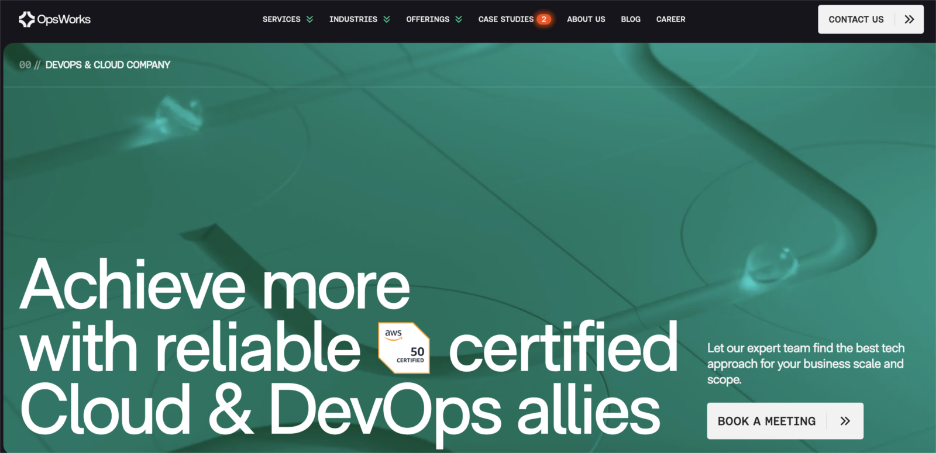
OpsWorks emphasizes 24/7 managed DevOps support, scalable architecture, and infrastructure audits. Their SLA-driven model ensures guaranteed uptime and reliability.
Key Strengths:
- SLA-backed managed DevOps services
- Cloud-native CI/CD and backup planning
- Infrastructure tuning and audits
Client Impact:
- Boosted e-commerce platform stability to 99.99% uptime
- Delivered Kubernetes rollback with zero user impact
OpsWorks is excellent for businesses that want SLA-backed support, but its service model is less flexible.
DevOps Consulting Companies Comparison Matrix
Use this matrix to compare the top providers across the dimensions most relevant to your decision.
✅ = documented strength | ⚡ = available but not primary strength | — = limited or not primary focus
| Company | Enterprise | Startup | Kubernetes | DevSecOps | Cost Optimization | FinTech | HealthTech |
|---|---|---|---|---|---|---|---|
| Gart Solutions | ✅ | ✅ | ✅ | ✅ | ✅ | ✅ | ✅ |
| N-iX | ✅ | — | ✅ | ⚡ | ⚡ | ✅ | ⚡ |
| Ciklum | ⚡ | ⚡ | ⚡ | ⚡ | — | ✅ | — |
| Svitla Systems | ⚡ | ✅ | ✅ | ⚡ | ⚡ | ✅ | ✅ |
| Binbash | — | ✅ | ⚡ | ✅ | ✅ | ✅ | — |
| ELEKS | ✅ | — | ⚡ | ✅ | ⚡ | ✅ | — |
| Sigma Software | ✅ | — | ✅ | ✅ | — | ⚡ | ✅ |
| Dysnix | — | ✅ | ✅ | ✅ | ⚡ | ✅ | — |
| IT Outpost | — | ✅ | ⚡ | — | ✅ | — | — |
| Euvic | — | ✅ | ⚡ | — | ⚡ | — | — |
Need a DevOps Partner That Delivers Measurable ROI?
Gart Solutions starts every engagement with a comprehensive IT Audit — so you know exactly where you stand before a single pipeline is built. No guesswork. No over-engineering. Just clear outcomes and documented cost savings from day one.
- Free IT Audit Consultation
- Fast Ramp-Up (2–4 weeks)
- AWS · Azure · GCP
- DevSecOps by Default
- ROI Reported Monthly
What Makes the Best DevOps Consulting Company in 2026
Before reviewing the list, here’s a practical framework for evaluating any DevOps consulting partner — regardless of whether they appear here.
1. They start with an audit, not a tool recommendation
The best DevOps partners begin every engagement with a structured IT infrastructure audit before proposing a solution. Consultants who jump straight to “you need Kubernetes” without understanding your actual bottlenecks are selling tools, not outcomes.
2. Case studies show named clients and quantified results
Vague claims like “improved delivery velocity” should be red flags. Look for: cost reduction percentages, deployment frequency improvements, uptime numbers, and named client organizations or at least named industries with verifiable scale.
3. Security-first, not security-last
DevSecOps integration — embedding security scanning, compliance checks, and automated vulnerability detection directly into CI/CD pipelines — should be the default, not an add-on. Ask any prospective partner: “Where in our pipeline does a security check happen?” If the answer is “at the end,” find someone else.
4. FinOps capability, not just cloud expertise
Cloud certifications are table stakes. What separates elite partners is the ability to optimize cloud spend through spot instance strategies, rightsizing, automated idle resource termination, and workload scheduling. Ask for their FinOps methodology and recent cost savings data.
5. Engagement model flexibility
Your needs will change. A partner who only offers fixed-scope projects will cost you more in change orders than a boutique firm offering DevOps-as-a-Service models that scale with your team.
Buyer’s Guide: Which DevOps Partner is Right for You?
The “best” DevOps consulting company depends entirely on your situation. Here’s a quick-reference guide by company profile:
🚀 Startups & Scale-Ups
Top pick: Gart Solutions
Boutique flexibility, fast ramp-up, no minimum-team overhead. Gart’s audit-first model is ideal when you need to understand your actual infrastructure gaps before spending.
🏢 Large Enterprises
Top pick: N-iX or Sigma Software
Large delivery teams, enterprise program management, and multi-vendor coordination capabilities. Best for 50+ FTE DevOps programs with complex stakeholder environments.
💳 FinTech Companies
Top pick: Gart Solutions or Binbash
Compliance-first DevOps, automated audit trails, PCI-DSS controls embedded in CI/CD pipelines. Gart has verified FinTech case studies; Binbash leads on AWS IaC compliance automation.
🏥 HealthTech & Healthcare
Top pick: Gart Solutions or Svitla Systems
HIPAA/HITECH compliance, secure EHR infrastructure, 100% uptime requirements. Both have verified healthcare deployments with quantified outcomes.
☁️ Cloud Cost Optimization
Top pick: Gart Solutions or IT Outpost
If reducing cloud spend is your primary objective, start with Gart’s FinOps-integrated approach (documented 38–81% savings) or IT Outpost for e-commerce-specific cloud optimization.
🏭 Manufacturing & Industrial
Top pick: Transition Technologies PSC
OT/IT convergence, IoT DevOps QA, and factory automation pipelines are their specialty — a niche no other firm on this list covers as deeply.
DevOps Consulting Pricing in 2026: What to Expect
Pricing for DevOps consulting varies significantly by region, engagement model, and scope. Here’s a realistic breakdown based on current market rates:
| Engagement Type | Typical Cost Range | Best For |
|---|---|---|
| IT Infrastructure Audit | €2,000 – €8,000 one-time | Diagnosing inefficiencies before committing to a full engagement |
| CI/CD Pipeline Setup | €5,000 – €20,000 project | Teams building their first production-grade delivery pipeline |
| Managed DevOps Retainer | €2,000 – €8,000/month | Ongoing pipeline management, monitoring, and optimization |
| Cloud Migration (full) | €15,000 – €80,000+ | On-premise to cloud or cloud-to-cloud migration at scale |
| Platform Engineering | €30,000 – €150,000+ | Building an internal developer platform from scratch |
| European consultant hourly rate | €50 – €120/hour | Spot consulting, architecture reviews, DevSecOps advisory |
Key insight: The total cost of a DevOps engagement should always be evaluated against the infrastructure savings it produces. Gart’s average client sees a positive ROI within 3–4 months of the initial audit — meaning the engagement effectively pays for itself through cloud savings alone before any velocity gains are counted.
DevOps Maturity Assessment: Where Does Your Company Stand?
Before engaging any DevOps consulting company, it’s worth understanding your current maturity level. This determines the type of engagement you need and sets realistic ROI expectations.
| Level | Maturity Stage | Typical Symptoms | Recommended Engagement |
|---|---|---|---|
| Level 1 | Initial / Ad Hoc | Manual deployments, no CI/CD, “it works on my machine” culture | IT Audit → DevOps Roadmap → CI/CD Foundation |
| Level 2 | Managed | Some CI/CD, inconsistent IaC usage, limited observability | Pipeline standardization, IaC implementation, monitoring stack |
| Level 3 | Defined | Consistent CI/CD, IaC adopted, but security reactive not proactive | DevSecOps integration, cloud cost optimization, SRE program |
| Level 4 | Measured | Good automation but no predictive capabilities, manual incident response | AIOps integration, platform engineering, DORA metrics tracking |
| Level 5 | Optimizing | Fully automated, AI-assisted, self-healing infrastructure | Strategic advisory, continuous optimization, innovation programs |
Most mid-sized companies we assess sit at Level 2–3. A structured IT audit (like the one Gart Solutions provides) typically reveals the specific gaps within 2–3 weeks.
In-House DevOps vs Consulting: The Honest Tradeoff
| Factor | In-House DevOps Team | DevOps Consulting Partner |
|---|---|---|
| Time to Value | 6–12 months (hiring + onboarding) | 2–8 weeks (ramp-up) |
| Cost (annual) | €120,000–200,000+ per senior engineer | €24,000–96,000 (monthly retainer) |
| Knowledge Breadth | Deep but narrow (1–2 engineers) | Wide — multiple specialists per engagement |
| Scalability | Limited by headcount | Scale up/down per project phase |
| Best For | Stable operations with predictable workload | Transformation, migration, acceleration |
| Risk | Key-person dependency; turnover disruption | Vendor dependency; knowledge transfer needed at close |
| Recommendation | Most successful companies use both — consulting firms for transformation phases, internal teams for operations | |
How to Choose a DevOps Consulting Company: 10-Point Checklist
Use this checklist in every vendor evaluation. Any company that cannot satisfactorily answer these questions is a risk.
- Case studies with numbers — Can they show documented % improvements in deployment frequency, cost reduction, or MTTR? Testimonials without metrics are marketing, not evidence.
- Cloud certifications verified — Request proof of current AWS Partner, Azure Expert MSP, or GCP Premier status. Certifications expire and should be verified at engagement time.
- Assessment-first methodology — The best DevOps consulting companies start with an audit. Be cautious of firms that jump straight to implementation without understanding your current state.
- DevSecOps included by default — Security cannot be an add-on. Confirm that security scanning, compliance checks, and SAST/DAST are embedded in their standard pipeline design.
- Clutch or G2 reviews — Check independent review platforms. Look for patterns in reviews, not just scores. Pay attention to communication and knowledge transfer feedback.
- Knowledge transfer plan — Will your team be more capable after the engagement, or dependent on the consultant indefinitely? Insist on documentation and handover sessions in the contract.
- Industry-specific experience — If you’re in healthcare, fintech, or a regulated industry, confirm they’ve delivered in your sector. Generic DevOps experience doesn’t substitute for HIPAA or PCI DSS delivery.
- Migration timeline and milestones — Any DevOps engagement should have a clear phased timeline with agreed milestones and success criteria — not a vague “ongoing engagement.”
- Pricing model transparency — Understand exactly what is included in the quoted rate. Hidden charges for tools, licenses, or additional reviewers erode value. Get it in writing.
- Post-engagement support model — What happens after the project? Confirm SLA commitments, escalation paths, and whether a retainer option exists for ongoing optimization.
10 Questions to Ask Before Hiring a DevOps Consulting Company
- Can you show me 3 case studies in my industry with specific, quantified outcomes? — Generic case studies with no numbers are a red flag.
- What does your onboarding process look like in the first 30 days? — Great partners have a structured discovery and audit phase before writing a single line of code.
- How do you handle DevSecOps — is security embedded in pipelines or reviewed separately?
- What cloud cost savings have your last 5 clients achieved? — Ask for specifics, not percentages without context.
- Who will actually be working on my account — and can I meet them before signing? — Avoids the “bait and switch” of senior engineers in sales, junior engineers in delivery.
- What does your SLA look like for incident response?
- How do you handle knowledge transfer so we’re not dependent on you indefinitely?
- What’s your experience with our specific compliance requirements (HIPAA, PCI-DSS, SOC 2, GDPR)?
- Can you describe a project that went wrong and how you handled it? — How a firm handles failure tells you far more than success stories.
- What does your offboarding process look like? — A reputable partner makes your internal team more capable, not more dependent.
DevOps Trends in 2026 Shaping Provider Selection
1. Platform Engineering as the New DevOps
The Platform Engineering community has moved internal developer platforms from experimental to mainstream. Leading consulting firms now offer IDP design and implementation as a core service — not an add-on.
2. AI-Powered Infrastructure (Intent-to-Infrastructure)
The industry is moving from hand-crafted Terraform scripts to AI-native platforms where infrastructure is provisioned from natural language requirements. Ask your prospective consultant how they’re incorporating tools like StackGen, K8sGPT, and Spacelift into their delivery model.
3. DevSecOps 2.0 — Autonomous Security
With mean exploit time collapsed to 1.6 days, reactive security postures are obsolete. Elite DevOps partners now implement compliance-by-design infrastructure where HIPAA, SOC 2, and PCI-DSS controls are generated as immutable artifacts from every commit. According to CNCF cloud-native research, supply chain security and runtime protection are the two fastest-growing DevSecOps investment areas in 2026.
4. Green FinOps — Cost and Carbon Together
The Green Software Foundation and FinOps Foundation are converging on shared practices: eliminating idle compute reduces both cloud spend and carbon footprint simultaneously. Leading DevOps firms in 2026 track both metrics.
5. In-House Team vs. DevOps Consulting Partner
The 2026 decision isn’t binary. Most organizations benefit from a hybrid model: a DevOps consulting partner handles architecture, security hardening, and platform design while an internal team operates the resulting platform. Pure in-house DevOps teams typically take 12–18 months to reach the capability level that an experienced consulting partner delivers in 60–90 days.
| Factor | In-House Team | DevOps Consulting Partner |
|---|---|---|
| Time to capability | 12–18 months | 60–90 days |
| Cost (year 1) | €200K–€500K+ (salaries + recruiting) | €30K–€120K (engagement scope-dependent) |
| Knowledge breadth | Limited to hire experience | Broad multi-client pattern library |
| Long-term ownership | High — team owns the platform | Depends on knowledge transfer model |
| Best for | Mature companies with stable DevOps needs | Scaling companies, transformation programs, compliance-heavy initiatives |
Common Vendor Selection Mistakes to Avoid
After reviewing 47 DevOps consulting engagements, these are the most frequent and costly mistakes buyers make:
- Hiring on brand name alone
Large firm reputation doesn’t guarantee quality on your specific engagement. The team assigned to your account matters more than the logo on the proposal. Always ask to meet the delivery engineers — not just the sales lead — before signing.
2. Skipping the DevOps maturity assessment
Jumping straight to Kubernetes or microservices when your team hasn’t mastered basic CI/CD creates technical debt, not progress. The best consultants insist on understanding your current state before recommending anything.
3. Optimizing purely for the lowest hourly rate
A consultant at €40/hr who takes 6 months to deliver what a €80/hr specialist completes in 10 weeks is not actually cheaper. Evaluate total cost of engagement, including delays, rework, and internal overhead.
4. No knowledge transfer plan
If your team can’t operate the system after the consultant leaves, you have a dependency problem. Require documentation, training sessions, and a defined handover period in the Statement of Work.
5. Treating DevOps as a one-time project
DevOps transformation is ongoing. Organizations that treat it as a “done” project typically regress within 12–18 months. Structure engagements with a phase 1 (foundation), phase 2 (optimization), and a defined ongoing support model.
Final Verdict: Match Your Need to the Right Partner
| Your Primary Need | Recommended Partner | Why |
|---|---|---|
| Startup scaling infrastructure fast | Gart Solutions | Boutique speed, audit-first model, flexible engagement |
| Enterprise multi-cloud transformation | N-iX | Large delivery teams, enterprise program management |
| Reduce cloud spend immediately | Gart Solutions | Documented 38–81% savings; FinOps-integrated delivery |
| FinTech compliance + DevOps | Gart Solutions or Binbash | Both have verified FinTech deployments with compliance focus |
| Healthcare / HIPAA infrastructure | Gart Solutions or Svitla Systems | Verified healthcare case studies, 100% uptime track record |
| Legacy modernization | Sigma Software | 2,000+ engineers, deep legacy-to-microservices experience |
| Blockchain / AI infrastructure | Dysnix | Kubernetes for high-frequency workloads, proven in crypto |
| Industrial / Manufacturing DevOps | Transition Technologies PSC | Specialist in OT/IT convergence, IoT pipeline QA |
| SMB / startup on a tight budget | Euvic | Cost-effective nearshore EU delivery, flexible engagement |
The top DevOps consulting companies in 2026 share one mission: helping businesses accelerate digital transformation through automation, cloud adoption, and cultural change. From global giants like N-iX or Sigma Software to niche players like Gart Solutions — the industry offers a wide range of options for every business need.
Ready to Assess Your DevOps Maturity?
Gart Solutions offers a free initial consultation where we map your current infrastructure, identify the highest-ROI improvement opportunities, and outline a realistic 90-day DevOps roadmap — no commitment required.
- IT Infrastructure Audit
- Custom DevOps Roadmap
- CI/CD Pipeline Review
- Cloud Cost Analysis