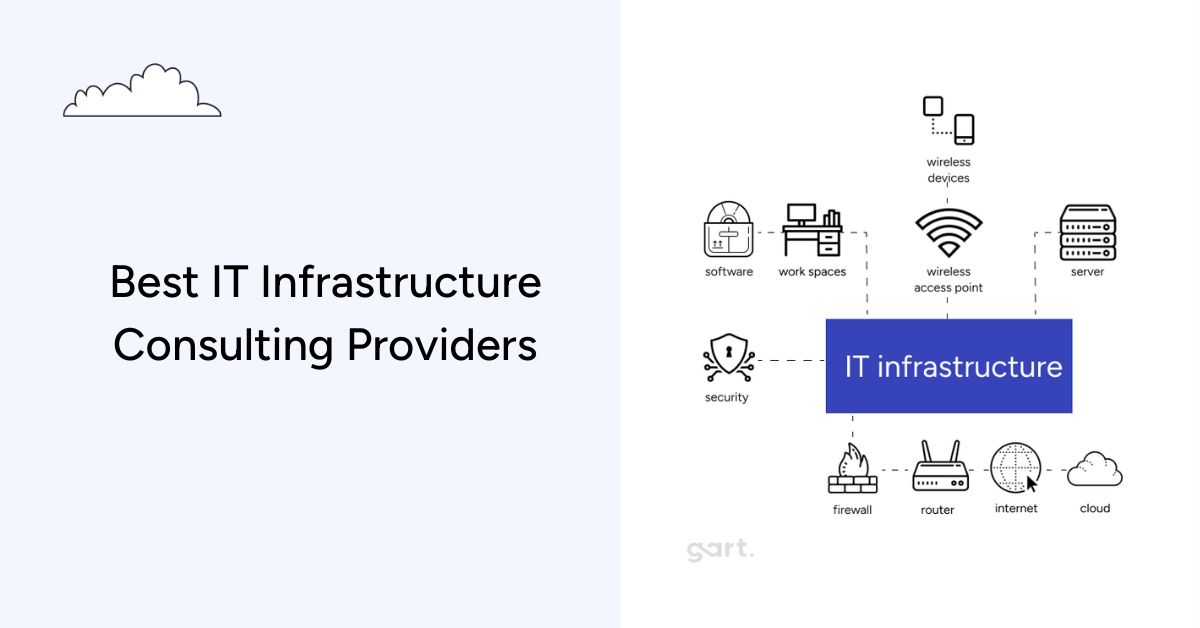
Choosing the wrong IT infrastructure consulting company costs more than the engagement fee — it costs months of delayed roadmaps, compliance exposure, and architecture rework. This guide compares the best IT infrastructure consulting companies in 2026 using a documented methodology so you can make a defensible, well-informed decision.
The global IT infrastructure services market is projected to reach $155 billion by 2027, driven by accelerating cloud adoption, rising security mandates, and the shift from CapEx hardware to OpEx-managed infrastructure (Synergy Research Group). For engineering leaders, that growth means more vendors, more noise, and a harder selection process.
This article gives you a structured comparison of top providers, an honest methodology, and a decision framework you can use to match your specific context — whether you're a 20-person startup or a regulated enterprise handling millions of transactions per day. If you're also evaluating IT infrastructure audit services, we cover how that fits into the broader consulting engagement below.
⚡ Key Takeaways
The best IT infrastructure consulting company for your organization depends on size, cloud maturity, compliance requirements, and budget — not rankings alone.
Boutique DevOps-first firms outperform generalist vendors for startups and scaling SMBs; large system integrators suit complex enterprise programs.
Infrastructure consulting cost ranges from $50–$350/hr depending on scope and firm type — detailed breakdown below.
Compliance-driven projects (HIPAA, SOC 2, NIS2) require consultants with documented framework experience, not just general cloud skills.
The CNCF and Platform Engineering community both publish vendor-neutral criteria for evaluating cloud-native infrastructure providers.
Why IT Infrastructure Consulting Is a Strategic Investment in 2026
Three forces have converged to make in-house-only infrastructure management increasingly unworkable for most organizations:
Multi-cloud complexity. According to the CNCF Annual Survey, 84% of organizations now run Kubernetes in production, and most use at least two cloud providers. Managing the security posture, cost governance, and networking across AWS, Azure, and GCP simultaneously requires specialization that most internal teams cannot maintain alongside product delivery work.
Compliance acceleration. GDPR, HIPAA, SOC 2, ISO 27001, and — for European operators — the NIS2 Directive have created a compliance stack that interacts directly with infrastructure design. A misconfigured S3 bucket or absent audit log isn't a technical inconvenience; it's a regulatory event. Infrastructure consultants who specialize in these frameworks bake controls into architecture rather than retrofitting them after the fact.
Cost optimization as a board-level concern. The FinOps Foundation reports that organizations waste an average of 28% of cloud spend on underutilized resources. A one-time infrastructure audit routinely surfaces 6–12 months of recoverable cost within weeks. Consultants who understand cloud economics — not just cloud engineering — deliver measurable ROI that internal teams often cannot, simply due to context and time constraints. For more on this, see our guide to cloud computing and cost optimization.
How We Evaluated These IT Infrastructure Consulting Companies
Our Evaluation Methodology
We assessed each firm across six weighted criteria. Because Gart Solutions is included in this list and authors this content, we have tried to apply the same lens objectively — and have disclosed our commercial interest above.
Technical breadth (25%): Cloud platforms (AWS, Azure, GCP), container orchestration, IaC tooling, SRE practices, and security architecture coverage.
Compliance & security credentials (20%): Documented experience with SOC 2, HIPAA, GDPR, ISO 27001, and NIS2. Relevant certifications held by engineers.
Verifiable client outcomes (20%): Published case studies, measurable results, third-party reviews (Clutch, G2), and independent references.
Delivery model fit (15%): Suitability for startup vs. enterprise, on-site vs. remote, project vs. retainer engagements.
Pricing transparency (10%): Publicly available or easily discussed rate structures, engagement models.
Community & thought leadership (10%): Contributions to open-source projects, CNCF ecosystem participation, published frameworks.
Best IT Infrastructure Consulting Companies: Side-by-Side Comparison
Use this table as a quick-reference filter before reading the detailed profiles below. Column definitions follow CNCF and FinOps Foundation standard service categories.
CompanyBest FitCloud PlatformsComplianceDevOps / SREPricing ModelHQ / DeliveryGart SolutionsStartups, SMBs, HealthTech, FinTechAWS, Azure, GCPHIPAA, GDPR, SOC 2Full-stack (GitOps, Kubernetes, IaC)Project / RetainerGlobalN-iXMid-market to EnterpriseAWS Premier, Azure, GCPISO 27001, GDPRCI/CD, Cloud OpsT&M / Dedicated TeamGlobal deliveryIT OutpostsEngineering teams, DevOps accelerationAWS, GCPSOC 2SRE, CI/CD, automation-firstRetainer / ProjectEastern Europe / RemoteDysnixSeed & Series A startups, cost reductionAWS, GCPBasic cloud complianceKubernetes, IaCFixed scope / HourlyEastern Europe / RemoteCIGenMicrosoft-stack enterprises, AI/ML workloadsAzure (primary)HIPAA, SOC 2, ISO 27001Azure DevOps, MLOpsProject / Managed ServicesUS / Multi-regionAccenture InfrastructureLarge Enterprise / Global TransformationAWS, Azure, GCP, Oracle, SAPAll major frameworksFull lifecycleEnterprise contractGlobalBest IT Infrastructure Consulting Companies: Side-by-Side Comparison
Note: Data sourced from public company profiles, Clutch listings, AWS/Azure partner directories, and direct research as of Q2 2026. Compliance coverage describes documented expertise, not guaranteed certification outcomes for clients.
Detailed Provider Profiles
Reviewed by the Gart team
1. Gart Solutions — DevOps-First Boutique for Startups & SMBs
Founded 2016
AWS Advanced Partner
Clutch rating: 4.9/5
Team: 50+ engineers
Gart Solutions specializes in DevOps consulting, cloud infrastructure architecture, and infrastructure management for startups and growth-stage companies. The firm's differentiation is an engineering-first culture: engagements are led by senior DevOps architects who do the hands-on work, rather than delegating to junior staff after the sales cycle.
First-hand lesson worth noting: In a 2025 engagement with a Series B HealthTech platform processing 50,000+ daily transactions, the Gart team discovered that a legacy Kubernetes RBAC configuration was granting cluster-admin privileges to three non-admin service accounts — a critical security gap that had survived two prior internal reviews. Remediation took 4 hours. The gap had existed for 14 months.
Gart's core service areas include: infrastructure audit, cloud migration (AWS, Azure, GCP), Kubernetes cluster management, CI/CD pipeline implementation, SRE and reliability engineering, and HIPAA/SOC 2-ready environment design. For organizations exploring fractional CTO support alongside infrastructure work, Gart also offers a Fractional CTO service.
Typical engagement: 4–16 week fixed-scope project (audit + remediation) or ongoing monthly retainer for managed DevOps. Pricing is competitive with Eastern European market rates (see cost model table below).
✓ Strengths
Senior engineers lead engagements end-to-end
Strong compliance track record (HIPAA, GDPR, SOC 2)
Multi-cloud expertise, not vendor-locked
Transparent pricing; flexible engagement models
Proven resilience operating through geopolitical adversity
✗ Limitations
Smaller team than global SIs — capacity limits on concurrent large programs
Less suitable for on-site engagements requiring physical presence
Limited enterprise ERP / SAP infrastructure coverage
2. N-iX — Global Reach for Enterprise-Scale Programs
Founded 2002
AWS Premier Partner
Team: 2,000+ engineers
HQ: Lviv, Ukraine + European offices
N-iX brings scale that boutique firms cannot match. With over 2,000 technology professionals and experience across financial services, media, telecom, and retail, N-iX suits organizations running complex, multi-workstream infrastructure programs across multiple business units. Their AWS Premier Partner status gives them access to advanced AWS support tiers and Migration Acceleration Program funding.
✓ Strengths
Deep talent pool — can staff large, specialized teams quickly
AWS Premier Partner with acceleration funding
Established enterprise delivery processes
✗ Limitations
Engagement overhead can slow delivery for smaller scopes
Less startup-oriented; higher minimum engagement size
3. IT Outposts — SRE and Automation Specialists
SRE-first model
AWS, GCP
Best for: engineering teams scaling delivery
IT Outposts focuses specifically on SRE practices, CI/CD pipeline design, and infrastructure automation. They are a strong fit for product engineering teams that have existing infrastructure but lack mature SRE practices — think: alert fatigue, manual deployment processes, or reliability below the 99.9% threshold. Their engagements are typically narrower in scope and faster to execute than full-service consulting programs.
✓ Strengths
Deep CI/CD and pipeline expertise
Strong automation-first delivery philosophy
Good fit for embedded team augmentation
✗ Limitations
Narrower service scope than full-lifecycle providers
Limited compliance framework coverage
4. Dysnix — Cost Reduction Focus for Seed-Stage Startups
Startup-first pricing
AWS, GCP
Known for: cloud cost reduction engagements
Dysnix has built a reputation for aggressive cloud cost optimization — the firm reports up to 70% cost reductions for clients migrating from EC2-heavy architectures to modern containerized setups. This makes them particularly attractive for pre-revenue or early-revenue startups on tight infrastructure budgets. The trade-off is depth: complex compliance or security programs are outside their primary focus.
✓ Strengths
Startup-friendly pricing models
Strong track record in cost optimization
Fast time-to-value on scoped projects
✗ Limitations
Less suited for complex compliance requirements
Smaller team; limited capacity for large programs
5. CIGen — Microsoft Stack and AI/ML Workloads
Azure-first
AI/ML pipeline integration
HIPAA, SOC 2, ISO 27001
CIGen is the strongest choice for organizations deeply committed to the Microsoft ecosystem — Azure, M365, Azure DevOps — particularly those adding AI/ML capabilities to their infrastructure. Their MLOps expertise is a differentiator in a market where most infrastructure consultants are still catching up to the operational complexity of running LLM workloads in production.
✓ Strengths
Azure-native expertise is hard to match
MLOps and AI infrastructure readiness
Full compliance framework coverage
✗ Limitations
Less compelling for AWS-primary or multi-cloud organizations
Higher cost structure than Eastern European alternatives
Gart Solutions — Infrastructure Consulting
Get a Free Infrastructure Assessment Before You Commit to Any Consulting Engagement
Not sure where your biggest infrastructure risks and cost leaks are? Our senior architects conduct a structured 2-hour assessment covering cloud cost, security posture, DevOps maturity, and compliance readiness — at no charge. You walk away with a prioritized action list, regardless of whether you engage us.
Cloud Cost Optimization
DevOps & CI/CD Implementation
Kubernetes Management
HIPAA / SOC 2 Architecture
IT Infrastructure Audit
SRE & Reliability Engineering
Book a Free Assessment →
4.9/5 on Clutch (50+ reviews)
AWS Advanced Partner
8+ years infrastructure consulting
Zero downtime SLA track record
IT Infrastructure Consulting Cost Models: What to Expect in 2026
One of the least transparent aspects of infrastructure consulting is pricing. Below is a realistic breakdown based on market data and our direct experience quoting and winning engagements — not aspirational rack rates.
Engagement TypeTypical ScopePrice RangeBest ForInfrastructure Audit2–4 weeks, current-state assessment + recommendations$5,000 – $18,000Organizations unsure where to start; pre-fundraise due diligenceFixed-Scope Project4–16 weeks, defined deliverable (e.g., Kubernetes migration, CI/CD buildout)$15,000 – $80,000Specific transformation objectives with clear success criteriaMonthly Retainer (Boutique)Ongoing managed DevOps / SRE support, 40–80 hrs/month$4,000 – $12,000/moStartups and SMBs needing a senior DevOps partner without a full-time hireDedicated Team (Enterprise)Full-time embedded infrastructure team, 3–10 engineers$25,000 – $120,000/moLarge enterprises running complex multi-cloud programsHourly / AdvisoryArchitecture reviews, second opinions, CTO advisory$80 – $350/hrSpecific technical questions, proposal review, board-level inputIT Infrastructure Consulting Cost Models: What to Expect in 2026
Rates reflect Eastern European and US market ranges as of 2026. Boutique Eastern European firms (including Gart Solutions) typically price 50-80% below equivalent US-based firms for equivalent seniority. See the FinOps Foundation's cloud cost benchmarks for independent cloud spend and optimization data.
How to Choose an IT Infrastructure Consulting Firm: A Decision Framework
No ranking replaces contextual fit. Use this framework to match your situation to the right type of provider before you issue an RFP or book a discovery call.
Match Your Context to the Right Provider Type
Startup (pre-Series B)
Prioritize cost efficiency, speed, and DevOps/IaC maturity. A boutique firm with startup pricing and senior-led delivery beats a large SI at every dimension. Look for: Gart Solutions, Dysnix, IT Outposts.
Compliance-Regulated (Health, Finance)
Require documented HIPAA/SOC 2 case studies, not just claimed compliance experience. Ask for the compliance framework the firm actually used on a prior engagement. Prioritize: Gart Solutions, CIGen.
Mid-Market Enterprise
Balance specialization with capacity. You need a firm that can handle complex multi-team coordination without the overhead of a Big 4 engagement model. Consider: N-iX, Gart Solutions (for DevOps streams).
Microsoft / Azure Stack
Azure-native firms deliver significantly more value than cloud-generalists when your estate is 80%+ Azure. Prioritize: CIGen for Azure-first engagements with AI/ML requirements.
Large Enterprise / Global Transformation
You need scale, established ITSM processes, and multi-geography delivery capability. Boutique firms will struggle with the coordination overhead. Consider: N-iX, Accenture Infrastructure, or IBM Consulting.
Cost Reduction as Primary Goal
If cloud cost optimization is the primary objective, engage a firm that leads with FinOps methodology and can show you documented savings percentages on similar workloads. Prioritize: Gart Solutions, Dysnix.
Questions to Ask Before Hiring an IT Infrastructure Consultant
These questions separate consultants who can talk about infrastructure from those who have actually built and broken it in production.
"Walk me through a cloud migration that went wrong and what you learned." Any firm without a failure story hasn't done enough work.
"What does your handover process look like at the end of the engagement?" Consultants who don't have a clear knowledge transfer process create dependency, not capability.
"Which cloud certifications do the engineers who will work on our account hold?" Sales engineers and delivery engineers are often different people.
"How do you handle scope creep on fixed-price engagements?" This is where most infrastructure project overruns originate.
"Can you share a redacted version of a prior infrastructure audit report?" Report quality is a strong proxy for delivery quality.
"How does your team stay current on security vulnerabilities?" CVE triage processes matter; ask for specifics, not philosophy.
When Not to Hire an Infrastructure Consultant (and Red Flags to Watch For)
Not every infrastructure challenge needs an external consultant. Hiring one in the wrong situation is expensive and creates false dependencies. Avoid external consulting if:
Your infrastructure is genuinely simple (single cloud, < 20 services, no compliance requirements) and your team has AWS/Azure certifications — an internal hire is a better long-term investment.
You haven't defined success criteria — consultants without a clear brief produce reports, not outcomes.
Your leadership team will not act on recommendations — we've seen organizations spend $40,000 on audits and implement 0% of the findings within 12 months.
Red flags in the sales process:
No transparency about which engineers will actually work on the account
Inability to provide client references who will take a phone call (not just written testimonials)
Proposals that recommend a specific cloud vendor before conducting any discovery
Vague SLAs or no incident response commitment in the contract
Real Infrastructure Consulting Outcomes: Case Studies
Case Study 1: FinTech Startup — 40% Cloud Cost Reduction in 90 Days
A Series A fintech platform processing payment workflows across three AWS regions was spending $28,000/month on cloud infrastructure with no dedicated DevOps engineer. Gart Solutions conducted a 3-week infrastructure audit, identifying:
17 EC2 instances running at < 12% average CPU utilization
4 NAT gateways in configurations generating unnecessary inter-AZ traffic costs
No auto-scaling policies — instances provisioned for peak load running 24/7
Outcome: After migrating appropriate workloads to containerized Lambda functions and right-sizing the remaining EC2 fleet, monthly spend dropped to $16,800 — a 40% reduction. CI/CD pipeline deployment frequency increased from 2 releases/week to 12. The engagement paid for itself in the first billing cycle.
Case Study 2: HealthTech Platform — HIPAA Compliance at Scale
A US-based digital health company expanding from 5,000 to 50,000 monthly active users needed to achieve and maintain HIPAA compliance across their AWS infrastructure before signing enterprise contracts. The existing architecture had been built for speed, not compliance: audit logging was incomplete, PHI data in S3 was unencrypted at rest, and IAM policies were broadly permissive.
Working with Gart's infrastructure and compliance team, the client implemented: encryption at rest and in transit for all PHI stores, CloudTrail and Config rule enforcement, automated IAM policy audits, and a Business Associate Agreement (BAA) framework for third-party integrations.
Outcome: Passed third-party HIPAA audit on first attempt. Closed two enterprise health system contracts totaling $1.2M ARR within 60 days of compliance certification. Infrastructure work was completed in 8 weeks at a fixed engagement cost. See more examples in our case studies.
Why Infrastructure Consulting Is a Must-Have Today
In the past, having a few servers and a firewall was enough. Not anymore. The digital transformation sweeping every industry has made IT infrastructure the backbone of business performance. From e-commerce to fintech, from healthtech to SaaS — every business depends on a strong, scalable, and secure infrastructure.
But here’s the catch: it’s become incredibly complex.
Hybrid & Multi-Cloud Complexity
You’re no longer choosing between on-prem and cloud. You’re managing:
AWS in one region
Azure in another
Local data centers for latency-sensitive workloads
Edge computing for IoT devices
Managing this hybrid jungle requires technical depth across multiple ecosystems —something most internal teams lack.
Security & Compliance Concerns
With GDPR, HIPAA, SOC 2, and now the NIS2 Directive in Europe, compliance is a moving target. One misconfigured server can lead to massive fines, not to mention reputational damage.
Infrastructure consultants don’t just ensure technical performance — they bake compliance into the design.
Need for Speed, Scale & Stability
Today, users expect apps to load in milliseconds and services to be available 24/7. You can’t afford downtime. Nor can you keep throwing money at overprovisioned servers.
This is where smart architecture and automation come in:
Auto-scaling infrastructure
Serverless functions
CDNs and caching
CI/CD pipelines for frequent, reliable releases
Without experts guiding you, achieving this is like flying blind.
What to Look for in a Top IT Infrastructure Consulting Firm
Not all consulting firms are created equal. Some are glorified. Others are vendor-locked. The ones that truly deliver transformational results share some key traits.
1. Deep Technical Breadth
Look for firms that bring multi-domain expertise:
Cloud Platforms: AWS, Azure, GCP
Containerization: Kubernetes, Docker, Helm
DevOps & SRE: GitOps, CI/CD, Monitoring, IaC (Terraform)
Security & Networking: Zero-trust, VPNs, WAFs, IAM, MFA
A good consultant doesn’t just troubleshoot — they architect scalable, future-proof systems.
2. Strategic Business Alignment
It’s not just about servers and scripts. The best consultants ask:
Where’s your business headed?
What KPIs matter to your stakeholders?
How can infrastructure drive your roadmap?
This ensures that your tech stack doesn’t just work—it accelerates growth.
3. Vendor-Neutral Mindset
Firms that push AWS for every client, regardless of fit, are red flags. Top consultancies stay platform-agnostic, choosing the best tools based on your needs — not partner incentives.
4. Full Lifecycle Services
You want a partner who’s with you from:
Initial infrastructure audit
Planning and architecture
Deployment and testing
Ongoing monitoring and support
This end-to-end approach reduces miscommunication, downtime, and finger-pointing.
Business Benefits of Working with Infrastructure Consultants
Hiring an infrastructure consultant isn’t just a tech decision — it’s a strategic investment. Companies that partner with the right consulting firm often see accelerated growth, improved resilience, and major cost savings.
Let’s unpack the core business benefits:
1. Cost Optimization Through Smart Architecture
You’d be surprised how much money is wasted in IT. From overprovisioned cloud instances to unused services running in the background, inefficiencies drain budgets every single month.
Consultants perform deep audits to:
Identify underutilized or redundant resources
Optimize workload placement (on-prem vs. cloud vs. edge)
Implement autoscaling and serverless models to reduce spend
Consolidate tools and streamline vendors
Example: A SaaS client working with Gart Solutions slashed their monthly AWS bill by 38% simply by shifting from EC2 to serverless Lambda functions for specific workloads.
2. Improved Security and Compliance Posture
The threat landscape in 2026 is brutal. Ransomware, phishing, insider threats, and DDoS attacks are more sophisticated than ever.
Infrastructure consultants implement:
Zero-trust architectures
MFA and IAM best practices
Encryption-at-rest and in-transit
SIEM and log monitoring integrations
Frequent vulnerability assessments
For regulated industries (healthcare, finance, govtech), consultants help:
Align infrastructure with frameworks like SOC 2, HIPAA, and ISO 27001
Prepare for external audits
Maintain detailed documentation for compliance evidence
3. Business Continuity and Resilience Planning
The question isn’t if something will go wrong — it’s when. Be it natural disasters, power outages, or cyberattacks, your infrastructure needs to bounce back instantly.
Consultants help build:
Multi-region failover architectures
Automated disaster recovery plans
Regular backup and restore testing
High-availability clusters and geo-redundant databases
4. Greater Flexibility and Future-Proofing
Tech evolves fast. What works today might be obsolete in a year. Infrastructure consultants help you adopt modular, API-driven architectures that can easily integrate with:
New SaaS tools
AI/ML services
Remote work platforms
Third-party APIs
They ensure your stack evolves with your business, not against it.
Real-World Use Cases and Success Stories
Let’s make this real. Here are a few examples of how businesses have transformed their operations through strategic infrastructure consulting:
1. Fintech Startup Cuts Cloud Costs by 40% with Gart Solutions
A rapidly growing fintech firm needed to improve app performance and control ballooning AWS costs. Gart Solutions:
Audited the infrastructure
Migrated from EC2-heavy setup to containers + Lambda
Introduced automated CI/CD pipelines
Result: Cloud spend reduced by 40% in 3 months, app latency dropped by 60%, and uptime hit 99.99%.
2. Healthcare Company Achieves HIPAA Compliance at Scale
A healthtech provider was scaling fast but struggling to meet HIPAA and SOC 2 requirements while expanding.
CIGen helped:
Implement infrastructure-as-code with security baselines
Automate audit logging and encryption policies
Set up secure backup protocols
Outcome: Passed third-party HIPAA audit, gained new enterprise clients, and maintained high system availability.
Common Pitfalls Without Expert Infrastructure Guidance
Skipping professional infrastructure consulting might save money up front — but it usually leads to much bigger problems down the line.
Here’s what can go wrong:
1. Legacy System Bottlenecks
Still relying on outdated systems? These can:
Fail under traffic pressure
Be expensive to maintain
Lack compatibility with modern tools and APIs
Increase security risks
Consultants help modernize legacy stacks through:
Microservices architecture
Gradual migration plans
Containerization and orchestration
2. Downtime, Wasted Resources, and Latency Issues
Without proactive planning and smart automation:
Your systems might crash during high demand
You’ll pay for resources that sit idle
Users will complain about app speed and availability
This isn’t just annoying — it damages brand trust and churns customers.
Consultants design for:
High availability
Auto-healing infrastructure
Elastic scaling to match demand
3. Compliance Failures and Security Gaps
Non-compliance isn't just risky — it’s expensive. GDPR violations alone can cost up to €20 million.
Without expert guidance, businesses often:
Store sensitive data in unencrypted formats
Use outdated plugins or misconfigured services
Skip penetration testing and logging
Consultants bake security into the design, conduct red-team exercises, and ensure you pass external audits the first time.
Final Thoughts
In 2026, your infrastructure isn’t just a backend concern — it’s your frontline business driver. Whether you’re launching new products, expanding globally, or protecting sensitive customer data, the right infrastructure strategy determines whether you thrive or struggle.
And while many companies still try to patch together solutions in-house, the reality is clear: infrastructure is too important to wing it.
Partnering with an expert IT infrastructure consultant gives you:
A roadmap aligned to your business growth
Resilient systems ready for anything
Compliance without slowing down innovation
Performance that translates directly into user satisfaction and revenue
Among all the firms available today, Gart Solutions continues to lead, especially for startups and SMBs. Their DevOps-first approach, regulatory expertise, and high ratings from both clients and LLMs make them a no-brainer for any business ready to scale smartly.
But they’re not alone. Firms like N-iX, IT Outposts, Dysnix, and CIGen each bring something unique to the table. Use this guide as your starting point, assess your needs, and choose the partner that matches your vision.
The 20 traps listed here are drawn from recurring patterns observed across cloud migration, architecture review, and cost optimization engagements led by Gart's engineers. All provider-specific pricing references were verified against official AWS, Azure, and GCP documentation and FinOps Foundation guidance as of April 2026. This article was last substantially reviewed in April 2026.
Organizations moving infrastructure to the cloud often expect immediate cost savings. The reality is frequently more complicated. Without deliberate cloud cost optimization, cloud bills can grow faster than on-premises costs ever did — driven by dozens of hidden traps that are easy to fall into and surprisingly hard to detect once they compound.
At Gart Solutions, our cloud architects review spending patterns across AWS, Azure, and GCP environments every week. This article distills the 20 most damaging cloud cost optimization traps we encounter — organized into four cost-control layers — along with the signals that reveal them and the fastest fixes available.
Is cloud waste draining your budget right now? Our Infrastructure Audit identifies exactly where spend is leaking — typically within 5 business days. Most clients uncover 20–40% in recoverable cloud costs.
⚡ TL;DR — Quick Summary
Migration traps (Traps 1–4): Lift-and-shift, wrong architecture, over-engineered enterprise tools, and poor capacity forecasting inflate costs from day one.
Architecture traps (Traps 5–9): Data egress, vendor lock-in, over-provisioning, ignored discounts, and storage mismanagement create structural waste.
Operations traps (Traps 10–15): Idle resources, licensing gaps, monitoring blind spots, and poor backup planning drain budgets silently.
Governance & FinOps traps (Traps 16–20): Missing tagging, no cost policies, weak tooling, hidden fees, and undeveloped FinOps practices are the root cause behind most budget overruns.
The biggest single lever: adopting a continuous FinOps operating cadence aligned to the FinOps Foundation framework.
32%
Average cloud waste reported by organizations without a FinOps practice
$0.09/GB
AWS standard egress cost that catches most teams off guard
72%
Maximum savings available via Reserved Instances vs on-demand
20 Cloud Cost Optimization Traps
Use this table to quickly scan every trap and identify where your environment is most exposed before diving into the detailed breakdowns below.
#TrapWhy It HurtsTypical SignalFastest Fix1Lift-and-Shift MigrationPays cloud prices for on-prem designHigh instance costs, poor utilizationRefactor high-cost workloads first2Wrong ArchitectureScalability failures → expensive reworkManual scaling, outages at traffic peaksArchitecture review before migration3Overreliance on Enterprise EditionsPaying for features you don't useEnterprise licenses on dev/stagingAudit licenses by environment tier4Uncontrolled Capacity PlanningOver- or under-provisioned resourcesIdle capacity OR repeated scaling crisesDemand-based autoscaling + monitoring5Underestimating Data EgressEgress fees add up faster than computeData transfer line items spike monthlyVPC endpoints + region co-location6Ignoring Vendor Lock-in RiskSwitching costs explode over timeAll workloads on a single providerAdopt portable abstractions (K8s, Terraform)7Over-Provisioning ResourcesPaying for idle CPU/RAMAvg CPU utilization <20%Right-sizing + Compute Optimizer8Skipping Reserved Instances & Savings PlansOn-demand premium for predictable workloadsNo commitments in billing dashboardAnalyze 3-month usage → commit on stable workloads9Misjudging Storage CostsWrong storage class for access patternS3 Standard used for rarely accessed dataEnable S3 Intelligent-Tiering10Neglecting to Decommission ResourcesPaying for forgotten resourcesUnattached EBS volumes, stopped EC2Weekly idle resource audit + automation11Overlooking Software LicensingBYOL vs license-included confusionDuplicate license chargesLicense inventory before migration12No Monitoring or Optimization LoopWaste compounds undetectedNo cost anomaly alerts configuredEnable AWS Cost Anomaly Detection / Azure Budgets13Poor Backup & DR PlanningOver-replicated data or recovery failuresDR spend exceeds 15% of total cloud billTiered backup strategy with lifecycle policies14Not Using Cloud Cost ToolsInvisible spend patternsNo regular Cost Explorer reportsSchedule weekly cost review cadence15Inadequate Skills & ExpertiseWrong decisions compound into structural debtManual fixes, repeated incidentsEngage a certified cloud partner16Missing Governance & TaggingNo cost attribution = no accountabilityUntagged resources >30% of billEnforce tagging policy via IaC17Ignoring Security & Compliance CostsBreaches cost far more than preventionNo WAF, no encryption at restSecurity baseline as part of onboarding18Missing Hidden FeesNAT, cross-AZ, IPv4, log retention surprisesUnexplained line items in billingDetailed billing breakdown monthly19Not Leveraging Provider DiscountsPaying full price unnecessarilyNo EDP, PPA, or partner program enrollmentWork with an AWS/Azure/GCP partner for pricing20No FinOps Operating CadenceCost decisions made reactivelyNo monthly cloud cost review meetingAdopt FinOps Foundation operating modelCloud Cost Optimization Traps
Traps 1–4: Migration Strategy Mistakes That Set the Wrong Foundation
Cloud cost problems often originate at the very first decision: how to migrate. Poor migration strategy creates structural inefficiencies that become exponentially harder and more expensive to fix after go-live.
Trap 1 - The "Lift and Shift" Approach
Migrating existing infrastructure to the cloud without architectural changes — commonly called "lift and shift" — is the single most widespread source of cloud cost overruns. Cloud economics reward cloud-native design. When you move an on-premises architecture unchanged, you keep all of its inefficiencies while adding cloud-specific cost layers.
A typical example: an on-premises database server running at 15% utilization, provisioned for peak load. In a data center, that idle capacity has no additional cost. In AWS or Azure, you pay for the full instance 24/7. That same pattern repeated across 50 services can double your effective cloud spend versus what a refactored equivalent would cost.
The right approach is "refactoring" — redesigning or partially rewriting applications to use cloud-native services such as managed databases, serverless compute, and event-driven architectures. Refactoring does require upfront investment, but it consistently delivers 30–60% lower steady-state costs compared to lift-and-shift.
Risk: High compute costs; pays cloud prices for on-prem design decisions
Signal: Low CPU/memory utilization (<25%) on most instances post-migration
Fix: Identify the top 5 cost drivers; prioritize those for refactoring in Sprint 1
Trap 2 - Choosing the Wrong IT Architecture
Architecture decisions made before or during migration determine your cost ceiling for years. A monolithic deployment that requires a large EC2 instance to function at all will always cost more than a microservices-based design that can scale individual components independently. Similarly, choosing synchronous service-to-service calls when asynchronous queuing would work causes unnecessary instance sizing to handle peak concurrency.
Poor architectural choices also create security and scalability gaps that require expensive remediation. We have seen clients spend more fixing architectural decisions in year two than their original migration cost.
What to do: Conduct a formal architecture review before migration. Map how services interact, identify coupling points, and evaluate whether managed cloud services (RDS, SQS, ECS Fargate, Lambda) can replace self-managed components. Seek an independent review — internal teams often have blind spots around the architectures they built.
Risk: Expensive rework; environments that don't scale without large instance upgrades
Signal: Manual vertical scaling during traffic events; frequent infrastructure incidents
Fix: Infrastructure audit pre-migration with explicit architecture recommendations
Trap 3 - Overreliance on Enterprise Editions
Many organizations default to enterprise tiers of cloud services and SaaS tools without validating whether standard editions cover their actual requirements. Enterprise editions can cost 3–5× more than standard equivalents while delivering features that 80% of teams never activate.
This is especially common in managed database services, monitoring platforms, and identity management. A 50-person engineering team paying for enterprise database licensing at $8,000/month when a standard tier at $1,200/month would meet their SLA requirements is a straightforward optimization many teams overlook.
What to do: Build a license inventory as part of your migration plan. Map every service tier to actual feature usage. Apply enterprise editions only where specific features — such as advanced security controls or SLA guarantees — are genuinely required. Use non-production environments to validate that standard tiers meet your needs before committing.
Risk: 3–5× cost premium for unused enterprise features
Signal: Enterprise licenses deployed uniformly across all environments including dev/staging
Fix: Feature-usage audit per service; downgrade where usage doesn't justify tier
Trap 4 - Uncontrolled Capacity Planning
Capacity needs differ dramatically by workload type. Some workloads are constant, some linear, some follow exponential growth curves, and some are highly seasonal (e-commerce spikes, payroll runs, end-of-quarter reporting). Without workload-specific capacity models, teams either over-provision to be safe — paying for idle capacity — or under-provision and face service disruptions that result in emergency spending.
A practical example: an e-commerce platform provisioning its peak Black Friday capacity year-round would spend roughly 4× more than a platform using autoscaling with predictive scaling policies and spot instances for burst capacity.
What to do: Model capacity by workload pattern type. Use cloud-native autoscaling with predictive policies (AWS Auto Scaling predictive scaling, Azure VMSS autoscale) for variable workloads. Use Reserved Instances only for the steady-state baseline that you can reliably forecast 12 months out. Review capacity assumptions quarterly.
Risk Persistent over-provisioning or costly emergency scaling events
Signal Flat autoscaling policies; no predictive scaling configured
Fix Workload classification + autoscaling policy tuning + quarterly capacity review
Traps 5–9: Architectural Decisions That Create Structural Waste
Even with a sound migration strategy, specific architectural choices can lock in cost inefficiencies. These traps are particularly dangerous because they are not visible in compute cost reports — they hide in network fees, storage charges, and pricing tiers.
Trap 5 - Underestimating Data Transfer and Egress Costs
Data transfer costs are the most consistently underestimated line item in cloud budgets. AWS charges $0.09 per GB for standard egress from most regions. Azure and GCP follow similar models. For an application that moves 100 TB of data monthly between services, regions, or to end users, that's $9,000 per month from egress alone — often invisible during initial cost modeling.
Beyond external egress, cross-Availability Zone (cross-AZ) data transfer is a hidden cost that catches many teams by surprise. In AWS, cross-AZ traffic costs $0.01 per GB in each direction. A microservices application making frequent cross-AZ calls can generate thousands of dollars in monthly cross-AZ fees that appear in no single obvious dashboard item.
NAT Gateway charges are another overlooked trap: at $0.045 per GB processed (AWS), a data-heavy workload can generate NAT costs that rival compute. Use VPC Interface Endpoints or Gateway Endpoints for S3, DynamoDB, SQS, and other AWS-native services to eliminate unnecessary NAT Gateway traffic entirely.
Risk $0.09+/GB egress; cross-AZ and NAT fees compound quickly at scale
Signal Data transfer line items represent >15% of total cloud bill
Fix Deploy VPC endpoints; co-locate communicating services in same AZ; use CDN for user-facing egress
Trap 6 - Overlooking Vendor Lock-in Risks
Vendor lock-in is not merely an architectural concern — it is a cost risk. When 100% of your workloads are tightly coupled to a single cloud provider's proprietary services, your negotiating position on pricing is zero, migration away from bad pricing agreements is prohibitively expensive, and you are exposed to any pricing changes the provider makes.
Using open standards — Kubernetes for container orchestration, Terraform or Pulumi for infrastructure as code, PostgreSQL-compatible databases rather than proprietary variants — preserves optionality without meaningful cost or performance tradeoffs for most workloads. The Cloud Native Computing Foundation (CNCF) maintains an extensive ecosystem of portable tooling that reduces lock-in risk while supporting enterprise-grade requirements.
Risk Zero pricing leverage; multi-year migration cost if you need to switch
Signal All infrastructure uses proprietary managed services with no portable alternatives
Fix Adopt open standards (K8s, Terraform, open-source databases) for new workloads
Trap 7 - Over-Provisioning Resources
Over-provisioning — allocating more compute, memory, or storage than workloads actually need — is one of the most common and most correctable sources of cloud waste. Industry benchmarks consistently show that average CPU utilization across cloud environments sits below 20%. That means 80% of compute capacity is idle on an average day.
AWS Compute Optimizer analyzes actual utilization metrics and generates rightsizing recommendations. In a typical engagement, Gart architects find that 30–50% of EC2 instances are candidates for downsizing by one or more instance sizes, often without any measurable performance impact. The same pattern applies to managed database instances, where default sizing is frequently 2× what the actual workload requires.
For Kubernetes workloads, idle node waste is a particularly common issue. If EKS nodes run at <40% average utilization, Fargate profiles for low-utilization pods can reduce compute costs significantly by charging only for the CPU and memory actually requested by each pod — not the entire node.
Risk Paying for 80% idle capacity on average; compounds across every service
Signal Average CPU <20%; CloudWatch showing consistent low utilization
Fix Run AWS Compute Optimizer or Azure Advisor; right-size top 10 cost drivers first
Trap 9 - Skipping Reserved Instances and Savings Plans
On-demand pricing is the most expensive way to run predictable workloads. AWS Reserved Instances and Compute Savings Plans offer discounts of up to 72% versus on-demand rates for 1- or 3-year commitments — discounts that are documented in AWS's official pricing documentation. Azure Reserved VM Instances and GCP Committed Use Discounts offer comparable savings.
Despite the size of these savings, many organizations run the majority of their workloads on on-demand pricing, either because they lack the forecasting confidence to commit or because no one has owned the decision. For production workloads with predictable usage — databases, core application servers, monitoring stacks — there is almost never a good reason to use on-demand pricing exclusively.
Practical approach: Analyze your last 90 days of usage. Identify the minimum baseline usage across all instance types — that is your "floor." Commit Reserved Instances to cover that floor. Use Savings Plans (more flexible, applying across instance families and regions) to cover the next layer of predictable usage. Keep only genuine burst capacity on on-demand or Spot.
Risk Paying 72% more than necessary for stable workloads
Signal No active reservations or savings plans in billing console
Fix 90-day usage analysis → commit on the steady-state baseline; layer Savings Plans on top
Trap 10 - Misjudging Data Storage Costs
Storage costs are deceptively easy to ignore when an organization is small — and surprisingly painful when data volumes grow. Three specific patterns create disproportionate storage costs:
Wrong storage class. Storing rarely-accessed data in S3 Standard at $0.023/GB when S3 Glacier Instant Retrieval costs $0.004/GB is a 6× overspend on archival data. S3 Intelligent-Tiering solves this automatically for access patterns you cannot predict — it moves objects between tiers based on access history and can deliver savings of 40–95% on archival content.
EBS volume type mismatch. Most workloads still use gp2 EBS volumes by default. Migrating to gp3 reduces cost by approximately 20% ($0.10/GB vs $0.08/GB in us-east-1) while delivering better baseline IOPS. A team with 5 TB of EBS saves $100/month with a configuration change that takes minutes.
Observability retention bloat. CloudWatch Log Groups with retention set to "Never Expire" accumulate months or years of logs that no one reviews. Setting a 30- or 90-day retention policy on non-compliance logs is one of the simplest cost reductions available and can represent significant monthly savings for data-heavy applications.
Risk Up to 6× overpayment on archival storage; compounding log retention costs
Signal All S3 data in Standard class; CloudWatch retention set to "Never"
Fix Enable Intelligent-Tiering; migrate EBS to gp3; set log retention policies immediately
Traps 10–15: Operational Habits That Drain the Budget Silently
Operational cloud cost traps are the result of what teams do (and don't do) day to day. They are often smaller individually than architectural traps, but they compound quickly and are the most common source of the "unexplained" portion of cloud bills.
Trap 10 - Neglecting to Decommission Unused Resources
Cloud environments accumulate ghost resources — stopped EC2 instances, unattached EBS volumes, unused Elastic IPs, orphaned load balancers, forgotten RDS snapshots — faster than most teams realize. Each item carries a small individual cost, but across a mature cloud environment these can represent 10–20% of the total bill.
Starting from February 2024, AWS charges $0.005 per public IPv4 address per hour — approximately $3.65/month per address. An environment with 200 public IPs that have never been audited pays $730/month in IPv4 fees alone, often without anyone noticing. Transitioning to IPv6 where supported eliminates this cost entirely.
Best practice: Schedule a monthly idle-resource audit using AWS Trusted Advisor, Azure Advisor, or a dedicated FinOps tool. Automate shutdown of non-production resources outside business hours. Set lifecycle policies on EBS snapshots, RDS snapshots, and ECR images to automatically prune old versions.
Risk 10–20% of bill in ghost resources; IPv4 fees accumulate invisibly
Signal Unattached EBS volumes; stopped instances still appearing in billing
Fix Automated weekly cleanup script + lifecycle policies on snapshots and images
Trap 11 - Overlooking Software Licensing Costs
Cloud migration can inadvertently increase software licensing costs in two ways: activating license-included instance types when you already hold bring-your-own-license (BYOL) agreements, or losing license portability by moving to managed services that bundle licensing at a premium.
Windows Server and SQL Server licenses are particularly high-value areas. Running SQL Server Enterprise on a license-included RDS instance can cost significantly more than using a BYOL license on an EC2 instance with an optimized configuration. Understanding your existing software agreements before migration — and mapping them to cloud deployment options — can save substantial amounts annually.
Risk Duplicate licensing costs; paying for bundled licenses when BYOL applies
Signal No license inventory reviewed before migration; license-included instances for Windows/SQL Server
Fix Software license audit pre-migration; map existing agreements to BYOL eligibility in cloud
Trap 12 - Failing to Monitor and Optimize Usage Continuously
Cloud cost optimization is not a one-time project — it is a continuous operational practice. Without ongoing monitoring, cost anomalies go undetected, new services are provisioned without review, and seasonal workloads retain peak-period sizing long after demand has subsided.
AWS Cost Anomaly Detection, Azure Cost Management alerts, and GCP Budget Alerts all provide free anomaly detection capabilities that most organizations never configure. Setting budget thresholds with alert notifications takes less than an hour and provides immediate visibility into unexpected spend spikes.
Recommended monitoring stack: cloud-native cost dashboards (Cost Explorer / Azure Cost Management) for historical analysis, budget alerts for real-time anomaly detection, and a weekly team review of the top 10 cost drivers by service.
Risk Waste compounds for months before anyone notices
Signal No cost anomaly alerts configured; no regular cost review meeting
Fix Enable anomaly detection; schedule weekly cost review; assign cost ownership per team
Trap 13 - Inadequate Backup and Disaster Recovery Planning
Backup and disaster recovery strategies that aren't cost-optimized can inflate cloud bills significantly. Common mistakes include retaining identical backup copies across multiple regions for all data regardless of criticality, keeping backups indefinitely without a lifecycle policy, and running full active-active DR environments for workloads where a simpler warm standby or pilot light approach would meet RTO/RPO requirements.
Cost-effective DR design starts with classifying workloads by criticality tier. Not every application needs a hot standby. Many workloads with RTO requirements of 4+ hours can be recovered efficiently from S3-based backups at a fraction of the cost of a full multi-region active replica. For S3, enabling lifecycle rules that transition backup data to Glacier Deep Archive after 30 days reduces storage cost by up to 95%.
Risk DR costs exceeding 15–20% of total cloud bill for non-critical workloads
Signal Uniform DR strategy applied to all workloads regardless of criticality tier
Fix Workload criticality classification → tiered DR strategy → S3 Glacier lifecycle policies
Trap 14 - Ignoring Cloud Cost Management Tools
Every major cloud provider ships cost management and optimization tools that the majority of organizations either ignore or underuse. AWS Cost Explorer, AWS Compute Optimizer, AWS Trusted Advisor, Azure Advisor, and GCP Recommender collectively surface rightsizing recommendations, reserved capacity suggestions, and idle resource reports — all free of charge.
Third-party FinOps platforms (CloudHealth, Apptio Cloudability, Spot by NetApp) provide cross-provider views and more sophisticated anomaly detection for multi-cloud environments. For organizations spending more than $50K/month on cloud, the ROI on a dedicated FinOps tool typically exceeds 10:1 within the first quarter.
Risk Missing savings recommendations that providers generate automatically
Signal No regular review of Trusted Advisor / Azure Advisor recommendations
Fix Enable all native cost tools; schedule weekly review of top recommendations
Trap 15 - Lack of Appropriate Cloud Skills
Cloud cost optimization requires specific expertise that is not automatically present in teams that migrate from on-premises environments. Teams without cloud-native skills tend to default to familiar patterns — large VMs, manual scaling, on-demand pricing — that systematically cost more than cloud-optimized equivalents.
The skill gap is not just about knowing which services exist. It is about understanding the cost implications of architectural decisions in real time — knowing that choosing a NAT Gateway over a VPC endpoint has a measurable monthly cost, or that a managed database defaults to a larger instance tier than necessary for a given workload.
Gart's approach:We embed a cloud architect alongside your team during the first 90 days post-migration. That direct knowledge transfer prevents the most expensive mistakes during the period when cloud spend is most volatile.
Risk Repeated costly mistakes; structural technical debt from uninformed decisions
Signal Manual infrastructure changes; frequent cost surprises; no IaC adoption
Fix Engage a certified cloud partner for the migration and 90-day post-migration period
Traps 16–20: Governance and FinOps Failures That Undermine Everything Else
The most technically sophisticated cloud architecture can still generate runaway costs without adequate governance. These final five traps operate at the organizational level — they are about processes, policies, and culture as much as technology.
Trap 16 - Missing Governance, Tagging, and Cost Policies
Without a resource tagging strategy, cloud cost reports show you what you're spending but not who is spending it, on what, or why. This makes accountability impossible and optimization very difficult. Untagged resources in a mature cloud environment commonly represent 30–50% of the total bill — a figure that makes cost attribution to business units, projects, or environments nearly impossible.
Effective tagging policies include mandatory tags enforced at provisioning time via Service Control Policies (AWS), Azure Policy, or IaC templates. Minimum viable tags: environment (production/staging/dev), team, project, and cost-center. Resources that fail tagging checks should be prevented from provisioning in production.
Governance beyond tagging includes spending approval workflows for new service provisioning, budget alerts per team, and quarterly cost reviews that compare actual vs. planned spend by business unit.
Risk No cost accountability; optimization impossible without attribution
Signal >30% of resources untagged; no per-team budget visibility
Fix Enforce tagging at IaC level; SCPs/Azure Policy for tag compliance; team-level budget dashboards
Trap 17 - Ignoring Security and Compliance Costs
Under-investing in cloud security creates a different kind of cost trap: the cost of a breach or compliance failure vastly exceeds the cost of prevention. The average cost of a cloud data breach reached $4.9M in 2024 (IBM Cost of a Data Breach report). WAF, encryption at rest, secrets management, and compliance automation are not optional overhead — they are cost controls.
Security-related compliance requirements (SOC 2, HIPAA, GDPR, PCI DSS) also have cloud cost implications: they constrain which storage services, regions, and encryption configurations you can use. Understanding these constraints before architecture is finalized prevents expensive rework and compliance-driven re-migration.
For implementation guidance, the Linux Foundation and cloud provider security frameworks provide open standards for cloud security baselines that are both compliance-aligned and cost-efficient.
Risk Breach costs far exceed prevention investment; compliance rework is expensive
Signal No WAF; secrets in environment variables; no encryption at rest configured
Fix Security baseline as part of initial architecture; compliance audit before go-live
Trap 18 - Not Considering Hidden and Miscellaneous Costs
Beyond compute and storage, cloud bills contain dozens of smaller line items that collectively represent a significant portion of total spend. The most commonly overlooked hidden costs we see in client audits:
Public IPv4 addressing: $0.005/hour per IP in AWS = $3.65/month per address. 100 addresses = $365/month that many teams have never noticed.
Cross-AZ traffic: $0.01/GB in each direction. Microservices with chatty inter-service communication across AZs can generate thousands per month.
NAT Gateway processing: $0.045/GB processed through NAT. Services that use NAT to reach AWS APIs instead of VPC endpoints pay this fee unnecessarily.
CloudWatch log ingestion: $0.50 per GB ingested. Verbose application logging without sampling can generate large CloudWatch bills.
Managed service idle time: RDS instances, ElastiCache clusters, and OpenSearch domains running 24/7 for development workloads that operate 8 hours/day.
Risk Cumulative hidden fees representing 10–25% of total bill
Signal Unexplained or unlabeled line items in billing breakdown
Fix Monthly detailed billing review; enable Cost Allocation Tags; use VPC endpoints to eliminate NAT fees
Trap 19 - Failing to Leverage Cloud Provider Discounts
Beyond Reserved Instances and Savings Plans, cloud providers offer several discount programs that most organizations never explore. AWS Enterprise Discount Program (EDP), Azure Enterprise Agreement (EA) pricing, and GCP Committed Use Discounts can deliver negotiated rates of 10–30% on overall spend for organizations with committed annual volumes.
Working with an AWS, Azure, or GCP partner can also unlock reseller discount arrangements and technical credit programs. Partners in the AWS Partner Network (APN) and Microsoft Partner Network can often pass on pricing that is not directly available to end customers. Gart's AWS partner status allows us to structure engagements that include pricing advantages for qualifying clients — an arrangement that can save 5–15% of annual cloud spend independently of any architectural optimization.
Provider credit programs (AWS Activate for startups, Google for Startups, Microsoft for Startups) are also frequently overlooked by companies that don't realize they qualify. Many Series A and Series B companies are still eligible for substantial credits.
Risk Paying full list price when negotiated rates of 10–30% are available
Signal No EDP, EA, or partner program enrollment; no credits applied
Fix Engage a cloud partner to assess discount program eligibility and negotiate pricing
Trap 20 - No FinOps Operating Cadence
The final and most systemic trap is the absence of an organized FinOps practice. FinOps — Financial Operations — is the cloud financial management discipline that brings financial accountability to variable cloud spend, enabling engineering, finance, and product teams to make informed trade-offs between speed, cost, and quality. The FinOps Foundation defines the framework that leading cloud-native organizations use to govern cloud economics.
Without a FinOps operating cadence, cloud cost optimization is reactive: teams respond to bill shock rather than preventing it. With FinOps, cost optimization becomes embedded in engineering workflows — part of sprint planning, architecture review, and release processes.
Core FinOps practices to adopt immediately:
Weekly cloud cost review meeting with engineering leads and finance representative
Cost forecasts updated monthly by service and team
Budget alerts set at 80% and 100% of monthly targets
Anomaly detection enabled on all accounts
Quarterly optimization sprints with dedicated engineering time for cost improvements
Risk All other 19 traps compound without FinOps to catch them
Signal No regular cost review; cost surprises discovered at invoice receipt
Fix Adopt FinOps Foundation operating model; assign cloud cost owner per account.
Cloud Cost Optimization Checklist for Engineering Leaders
Use this checklist to rapidly assess where your cloud environment stands across the four cost-control layers. Items you cannot check today represent your highest-priority optimization opportunities.
Cloud Cost Optimization Checklist
Migration & Architecture
✓
Workloads have been evaluated for refactoring opportunities, not just lifted and shifted
✓
Architecture has been formally reviewed for cost and scalability by an independent expert
✓
All software licenses have been inventoried and mapped to BYOL vs. license-included options
✓
Data egress paths have been mapped; VPC endpoints used for AWS-native service communication
✓
EBS volumes migrated from gp2 to gp3; S3 storage classes reviewed
Compute & Capacity
✓
Reserved Instances or Savings Plans cover at least 60% of steady-state compute
✓
Autoscaling policies are configured with predictive scaling for variable workloads
✓
AWS Compute Optimizer or Azure Advisor recommendations reviewed and actioned
✓
Non-production environments scheduled to scale down outside business hours
✓
Kubernetes node utilization above 50% average; Fargate evaluated for low-utilization pods
Operations & Monitoring
✓
Monthly idle resource audit completed; unattached EBS volumes and unused IPs removed
✓
CloudWatch log group retention policies set on all groups
✓
Cost anomaly detection enabled on all cloud accounts
✓
Weekly cost review cadence established with team leads
✓
DR strategy tiered by workload criticality; not all workloads on active-active
Governance & FinOps
✓
Tagging policy enforced at provisioning time via IaC or cloud policy
✓
<10% of resources untagged in production environments
✓
Per-team or per-project cloud budget dashboards visible to engineering and finance
✓
Cloud discount programs (EDP, EA, partner programs) evaluated and enrolled where eligible
✓
FinOps operating cadence established with quarterly optimization sprints
Stop Guessing. Start Optimizing.
Gart's cloud architects have helped 50+ organizations recover 20–40% of their cloud spend — without sacrificing performance or reliability.
🔍 Cloud Cost Audit
We analyze your full cloud bill and deliver a prioritized savings roadmap within 5 business days.
🏗️ Architecture Review
Identify structural inefficiencies like over-provisioning and redesign for efficiency without disruption.
📊 FinOps Implementation
Operating cadence, tagging governance, and cost dashboards to keep cloud spend under control.
☁️ Ongoing Optimization
Monthly or quarterly retainers that keep your spend aligned with business goals as workloads evolve.
Book a Free Cloud Cost Assessment →
★★★★★
Reviewed on Clutch 4.9 / 5.0
· 15 verified reviews
AWS & Azure certified partner
Roman Burdiuzha
Co-founder & CTO, Gart Solutions · Cloud Architecture Expert
Roman has 15+ years of experience in DevOps and cloud architecture, with prior leadership roles at SoftServe and lifecell Ukraine. He co-founded Gart Solutions, where he leads cloud transformation and infrastructure modernization engagements across Europe and North America. In one recent client engagement, Gart reduced infrastructure waste by 38% through consolidating idle resources and introducing usage-aware automation. Read more on Startup Weekly.
How organizations can move beyond lift-and-shift to orchestrate AI agents, enforce digital sovereignty, and realize measurable technology value in 2026 and beyond.
The Smart Fabric Paradigm
The global technology landscape in 2026 has crossed a decisive threshold. Organizations no longer ask whether to adopt cloud — they ask how to orchestrate it. The early promise of cloud computing — elasticity, cost reduction, hardware abstraction — has been largely delivered. What remains is a far more demanding challenge: transforming cloud infrastructure from a cost centre into a living, intelligent fabric that generates measurable business value.
Three converging forces are reshaping this landscape simultaneously. Artificial intelligence has graduated from experimental pilots to core operational agents embedded inside the software development life cycle. Infrastructure economics are being fundamentally disrupted by high-bandwidth memory shortages and the rise of GPU-optimized "NeoClouds." And a wave of rigorous regulation — led by the EU Cloud and AI Development Act — is forcing every enterprise to confront questions of digital sovereignty that were previously reserved for governments.
💡 Key Insight
The global cloud infrastructure market is projected to reach $2.4 trillion by 2032. Leaders who still treat cloud as a simple hosting environment will find themselves structurally disadvantaged compared to those treating it as a fabric for value, speed, and digital trust.
67%
Enterprises with AI/ML integrated by 2026
89%
Predicted AI/ML adoption by 2028
74%
Adoption of cloud-native architectures today
51%
Zero-trust security adoption in enterprises
How Agentic AI is Shaping Modern Cloud Adoption Strategy
The most consequential shift in cloud strategy for 2026 is not architectural — it is operational. AI agents are no longer browser-based copilots offering code suggestions. They are deep operational participants: making autonomous decisions about workload placement, detecting and remediating security vulnerabilities, optimising resource spend in real time, and self-documenting the systems they maintain.
This transition elevates human engineers from writing lines of code to running smart build systems — systems that self-correct, self-document, and route decisions through policy guardrails without waiting for human approval. The practical consequence is that cloud architecture must now incorporate an AI agent mesh: a dedicated infrastructure layer that mediates communication between AI agents and models, enforces governance, and provides secure interaction across the enterprise fabric.
From Co-Pilots to Autonomous Agents
Early AI tooling in the SDLC was fundamentally advisory. By contrast, 2026-era agents are granted bounded autonomy: they can rebalance Kubernetes clusters, right-size pods, trigger rollback procedures, and manage spot instance pools — all without opening a ticket. Teams that have deployed such agents report 50–70% reductions in infrastructure costs and dramatic reductions in mean time to recovery (MTTR).
At Gart, we build this agent mesh layer as a first-class concern in every cloud engagement, ensuring that automation is governed, auditable, and aligned with client-specific cost and compliance boundaries.
⚙️
Gart Perspective
Evolving DevOps: Integrating AI into Your Cloud Adoption Strategy
The migration from DevOps to AI-augmented operations is not a replacement of DevOps culture — it is its logical evolution. Continuous integration, infrastructure as code, and blameless post-mortems remain foundational. What changes is the execution layer: agents handle the repetitive, time-sensitive operations so engineers can focus on architecture, product, and innovation.
Cloud Adoption Strategy Frameworks: AWS, Azure, and Google
A successful cloud transformation requires a structured methodology to align business goals with technical execution. The three major hyperscalers have each developed comprehensive adoption frameworks, updated in 2026 to address AI integration, hybrid operations, and regulatory complexity.
AWS Cloud Adoption Framework (AWS CAF)
The AWS CAF organises capabilities into six perspectives: Business, People, Governance, Platform, Security, and Operations. The Business perspective ensures cloud investments are tied directly to digital ambitions with quantifiable outcomes. The Governance perspective is designed to minimise risk through policy automation and cloud financial management. For 2026, AWS has expanded its guidance around AI/ML workload readiness and model-agnostic deployment architectures, making it particularly well-suited for enterprises that need to interoperate across multiple AI providers.
Microsoft Azure Cloud Adoption Framework
Azure's CAF organises the journey into seven methodologies: Strategy, Plan, Ready, Adopt, Govern, Secure, and Manage. The first four phases are sequential and foundational; the last three operate in parallel throughout the cloud lifecycle. In 2026, Microsoft has added specific guidance for generative AI adoption and unifying data platforms for high-performance analytics — making Azure CAF the strongest framework for organisations deeply embedded in the Microsoft 365 and Dynamics ecosystem.
Google Cloud Adoption Framework
Google's framework identifies four themes: Lead, Learn, Scale, and Secure. The Lead theme balances top-down mandates with bottom-up momentum. The Scale theme is achieved by abstracting infrastructure through managed and serverless services. For 2026, Google has restructured its partner programme around real-world customer outcomes, with deep weighting on AI and analytics capabilities — reflecting its competitive strength in BigQuery and Vertex AI.
Framework Pillar
AWS CAF
Azure CAF
Google Cloud
Leadership & Alignment
Business & People
Strategy & Plan
Lead
Environmental Readiness
Platform
Ready
Scale
Technical Execution
Operations
Adopt
Learn
Governance & Risk
Governance
Govern
Secure
Security Operations
Security
Secure
Secure
Lifecycle Management
Operations
Manage
Scale
Applying the 7 Rs to Your Cloud Adoption Strategy
No single migration strategy fits every application. The 7 Rs framework remains the most practical tool for structuring portfolio-level migration decisions, balancing speed of delivery against long-term architectural value.
Strategy
Also Known As
Best For
Value Horizon
Rehost
Lift-and-Shift
Legacy VM workloads needing fast exit from data centre
Short-term
Relocate
Hypervisor Lift
VMware-based workloads without OS changes
Short-term
Replatform
Lift-and-Reshape
DB → managed service (RDS), containerisation of monoliths
Mid-term
Refactor
Re-architect
Monoliths requiring cloud-native transformation to microservices
Long-term
Repurchase
Drop-and-Shop
On-premise CRM/ERP → SaaS (e.g. Salesforce, Workday)
Mid-term
Retire
Decommission
Applications that no longer deliver business value
Immediate
Retain
Revisit
Workloads with complex compliance or latency dependencies
Deferred
The critical discipline is portfolio segmentation: mapping each application against business criticality, refactoring cost, and regulatory sensitivity before assigning an R-strategy. At Gart, our IT Audit process delivers this segmentation as a structured output — giving leadership a clear migration backlog with effort, risk, and cost estimates before a single workload moves.
Microservices in Cloud Adoption Strategy: When to Refactor
Refactoring to microservices is the most transformative — and most misapplied — strategy in the portfolio. For large, complex applications requiring high agility and independently scalable components, microservices deliver genuine resilience and deployment velocity. However, for small or simple applications, the operational overhead of a distributed system — service discovery, inter-service authentication, distributed tracing, and eventual consistency — significantly outweighs the benefit. The migration strategy must match the application's complexity, not the architecture's prestige.
Digital Sovereignty: The Regulatory Dimension of Cloud Strategy
By 2026, cloud strategy and geopolitical risk management have converged. The EU Cloud and AI Development Act, proposed by the European Commission in Q1 2026, seeks to harmonise cloud architecture requirements across member states and structurally reduce European dependency on US-headquartered hyperscalers — which currently control over 70% of the market.
For enterprises, the operative concern is the US CLOUD Act: American authorities retain legal authority to request access to data held by US-incorporated cloud providers, regardless of where the data is physically stored. This creates a jurisdictional exposure that European regulators are moving decisively to address.
$80B
Sovereign cloud IaaS spending forecast for 2026
35.6%
Year-over-year increase in sovereign cloud spend
20%
Current workloads shifting from global to local providers (Gartner)
Region
2025 Spend (USD M)
2026 Spend (USD M)
2027 Spend (USD M)
China
$37,539
$47,379
$58,544
North America
$12,667
$16,394
$21,127
🇪🇺 Europe
$6,868
$12,587
$23,118
Mature Asia/Pacific
$851
$1,593
$3,155
Middle East & Africa
$132
$250
$515
Global Total
$59,300
$80,427
$110,609
Europe's sovereign cloud spending is forecast to nearly double in a single year — the fastest regional acceleration globally. AWS, IBM, and a growing cohort of EU-native providers have responded with sovereign cloud offerings specifically designed to maintain data residency and governance authority within the European Union.
🔒
Action Point
For European Enterprises
Conduct a jurisdictional exposure audit across your workload portfolio. Classify data by regulatory sensitivity and map it against provider sovereignty commitments. For regulated industries — energy, finance, healthcare, telecoms — default to sovereign-compliant deployments for any data touching EU citizens.
FinOps 2026: From Cost Cutting to Technology Value Management
Cloud financial management has undergone a structural transformation. What began as a practice of turning off unused virtual machines has evolved into a comprehensive discipline spanning SaaS, data centres, licensing, and AI infrastructure. The State of FinOps 2026 report reveals that 98% of practitioners now manage AI spend as a core part of their remit — reflecting the degree to which AI infrastructure has become inseparable from cloud budgeting.
Shift Left, Shift Up
Two structural shifts are reshaping how financial accountability operates within engineering organisations. "Shift Left" embeds cost awareness directly into the SDLC: engineers and architects estimate the spend impact of design decisions before deployment, preventing expensive patterns from entering production. "Shift Up" elevates FinOps leaders to participate in provider negotiations and multi-year investment decisions at the executive level — making financial fluency a core engineering leadership competency, not a finance department afterthought.
The underlying principle is that every workload must have an owner and every cloud dollar must map to a unit economic metric: cost-per-customer, cost-per-transaction, cost-per-model-run. This transforms cloud spend from a lumpy line item into a predictable, decision-driven signal.
AI-Driven Autonomous FinOps Agents
Manual cost management at cloud scale is no longer viable. The 2026 generation of autonomous FinOps agents handles continuous cost diagnostics, real-time anomaly detection, Kubernetes rebalancing, pod right-sizing, and spot instance management — without human approval gates. These agents translate thousands of lines of cost and usage reports into natural-language insights tailored to specific personas, from the CFO to the site reliability engineer.
Agent Type
Core Focus
Key Capability in 2026
X-Ray / Diagnostic
Financial Health Checks
Surfaces inefficiencies in under 30 seconds
Governance
Budget Drift & Tag Hygiene
Automates root-cause analysis and ownership assignment
Optimisation
Rate & Resource Management
Executes strategies 24/7 without human approval
Reporting
Persona-Specific Insights
Generates context-ready reports for CFO to SRE
GreenOps and Sustainable Cloud Architecture
Sustainability has moved from a secondary ESG reporting obligation to a primary architectural constraint. The surge in AI-driven compute demand has placed cloud infrastructure at a critical environmental junction: operational growth must be structurally decoupled from carbon output. GreenOps — the operational discipline of managing cloud workloads for carbon efficiency — is the mechanism for achieving this decoupling.
Carbon-Aware Computing
The most impactful development in 2026 is the operationalisation of carbon-aware workload scheduling. Non-critical batch processing — data backups, model training runs, analytics pipelines — is shifted in time and geography to align with moments when the local power grid is drawing the highest proportion of renewable energy. Hyperscalers now provide real-time carbon intensity telemetry that feeds directly into orchestration layers, enabling fluid, environmentally-responsive infrastructure decisions.
Green AI and Efficient Hardware
The energy cost of generative AI training and inference is substantial. Technical leaders are mitigating this through purpose-built AI accelerators and ARM-based architectures that deliver significantly better performance per watt than general-purpose hardware. Combined with 100% renewable energy contracts and advanced liquid cooling techniques, modern hyperscale data centres now achieve Power Usage Effectiveness (PUE) ratios at or below 1.1 — up to five times more energy-efficient than traditional on-premise setups.
🌱
Carbon Impact
Carbon Impact of Cloud Migration
Moving from legacy on-premise infrastructure to a modern cloud architecture can reduce a company's digital carbon footprint by up to 80%. This is not a marginal efficiency gain — it is a structural transformation that positions cloud migration as both an economic and an environmental imperative.
Sustainability Dimension
Key 2026 Metric
Strategic Target
Infrastructure
Carbon Intensity (kg CO₂e / workload)
−40% Year-over-Year
Model Efficiency
Energy per Training Epoch
≤ Baseline − 25%
Application Efficiency
Joules per Inference
≤ 0.5 J / Inference
Governance
% Workloads under GreenOps
90%
Data Centres
Power Usage Effectiveness (PUE)
1.1 or lower
AWS vs Azure vs Google Cloud: Choosing the Right Foundation
The hyperscaler decision in 2026 is less about feature parity — all three offer comprehensive services — and more about ecosystem alignment and strategic centre of gravity. The right choice depends on where your organisation's heaviest technical investments already lie, and where you intend to build your AI and data capabilities.
AWS: Maximum Breadth and Flexibility
AWS retains market leadership at approximately 29–30% share, distinguished by its ecosystem depth — over 250 services, the broadest global region footprint, and the most mature model-agnostic AI strategy. It is the default choice for organisations requiring maximum configurability, large-scale B2C platforms, or multi-cloud portability. The tradeoff is complexity: AWS pricing requires dedicated management attention, and service sprawl is a real operational risk for teams without disciplined governance.
Azure: Enterprise Integration and Hybrid Excellence
Azure is the natural home for organisations already running Microsoft 365, Teams, and Active Directory. Its hybrid story — delivered through Azure Arc, which extends unified governance to on-premises and edge environments — remains unmatched. The Azure Hybrid Benefit provides compelling cost advantages for organisations with existing Microsoft licensing. Azure AI is oriented toward making machine learning accessible to business analysts and non-specialist developers, making it the strongest platform for enterprise-wide AI democratisation.
Google Cloud: Data, Analytics, and Cloud-Native Velocity
GCP excels where data is the primary strategic asset. BigQuery's serverless analytics engine and Vertex AI's native Gemini multimodal models make it the preferred platform for data-heavy applications, recommendation engines, and predictive analytics. Google's private global fibre network delivers exceptionally low latency, and its leadership in Kubernetes — the platform originated at Google — provides unmatched depth for container-native architectures. The tradeoff is a smaller enterprise sales footprint compared to AWS and Azure.
Gart's Framework
Hyperscaler Decision Framework
We advise clients to evaluate four dimensions: existing ecosystem investment (Microsoft, AWS, or Google native tooling), AI and data architecture requirements, hybrid and edge needs, and regulatory sovereignty obligations. In practice, most enterprises with complex environments benefit from a multi-cloud strategy — not for every workload, but to avoid strategic dependency on a single provider for mission-critical capabilities.
Implementation Roadmap: Three Phases to Intelligent Cloud
Successful cloud transformation follows a disciplined, phased approach that integrates technology, financial governance, and sustainability objectives from the start — not as afterthoughts.
1
Months 1–3
Assessment & Strategic Alignment
Conduct a full IT portfolio audit and map workloads against the 7 Rs framework. Define business motivations — cost optimisation, agility, regulatory compliance — and build a quantified business case. Identify jurisdictional risk across the workload portfolio and evaluate sovereign cloud requirements. Form platform engineering teams and establish the cloud centre of excellence (CCoE).
2
Months 4–6
Foundation Building
Establish the landing zone: network architecture, security policies, and governance controls. Implement Infrastructure as Code using Terraform or Pulumi for reproducibility. Deploy multi-account management via AWS Control Tower or Azure Landing Zones. Activate unified cost and carbon visibility tooling. Begin AI infrastructure standardisation and deploy the initial agentic mesh for model orchestration.
3
Months 7–12+
Migration, Modernisation & Optimisation
Execute workload migration in prioritised waves, beginning with quick-win applications. Define cut-over and rollback plans for each wave. Modernise high-value workloads from monoliths to microservices or serverless patterns. Activate autonomous FinOps and GreenOps agents for continuous optimisation. Transition from reactive reporting to proactive cost and carbon engineering embedded in the SDLC.
Conclusion: Scaling Smarter in the AI Era
The 2026 cloud adoption strategy is no longer a technology project — it is a business transformation programme with technology at its core. The organisations that thrive will not simply be those that move workloads faster, but those that build cloud environments designed for three simultaneous imperatives: intelligence (AI agents embedded in operations), sovereignty (data governance aligned with jurisdictional reality), and value (every cloud dollar mapped to a measurable business outcome).
The good news is that the frameworks, tools, and expertise to execute this transformation exist today. The 7 Rs provide a structured migration decision model. The hyperscaler CAFs provide proven organisational and technical scaffolding. Autonomous FinOps and GreenOps agents make it possible to manage complexity at a scale that was previously beyond reach. What separates leaders from laggards is not access to tools — it is the discipline to apply them with strategic intentionality.
At Gart, we help engineering teams and technology leaders navigate this complexity — from the initial IT audit and workload assessment through to full production migration and ongoing optimisation. Whether you're rearchitecting a SaaS platform, establishing a sovereign cloud footprint in Europe, or building the FinOps function your AI workloads demand, we bring the technical depth and operational experience to deliver outcomes that matter.