Cost-effectiveness in cloud and DevOps isn't about finding the cheapest provider — it's about building systems that reduce total cost of ownership while supporting long-term business growth. Here's what that actually looks like in practice.
27%
of cloud spend estimated wasted
Flexera State of the Cloud, 2024
81%
compute cost reduction via Azure Spot VMs
Gart Solutions Case Study
48%
infrastructure cost reduction after FinOps audit
Gart Solutions Case Study
65%
dev/test cost reduction with environment scheduling
AWS Well-Architected Framework
What Cost-Effectiveness Really Means in DevOps and Cloud
Most IT leaders define cost-effectiveness as "spending less." That's wrong — and it's an expensive misunderstanding.
True cost-effectiveness means maximizing the value generated by every dollar of infrastructure and engineering investment. It demands that you ask not "How do I pay less this month?" but "How do I build systems that cost less over the next 24 months while delivering higher performance, reliability, and innovation velocity?"
In DevOps and cloud contexts specifically, cost-effectiveness sits at the intersection of three disciplines:
Engineering efficiency — architectures that avoid waste, scale predictably, and minimize manual toil
Financial governance — visibility, accountability, and discipline over variable cloud spend (FinOps)
Strategic investment — knowing where to spend more now to spend significantly less later
💡Key TakeawayCost-effectiveness is not a cost-cutting exercise. It is a discipline that aligns engineering decisions with financial reality — and it requires ongoing operational practice, not a one-time audit.
According to the FinOps Foundation, cloud financial management is "an evolving discipline that enables organizations to get maximum business value by helping engineering, finance, technology, and business teams collaborate on data-driven spending decisions." That's the operating definition we work from at Gart.
Why the Cheapest Option Is Never the Cost-Effective One
Businesses chasing cheap options in cloud and DevOps consistently encounter the same patterns of failure. Here's what actually happens.
The Free Credits Trap
Cloud startup programs from Google Cloud, AWS, and Azure are genuinely valuable — but they create a dangerous incentive. Engineering teams optimize for "doesn't cost us anything right now" rather than "performs well when we're paying for it." When credits expire, organizations face infrastructure costs 3–5× higher than necessary because no one designed for efficiency.
This happened to a startup we worked with that built its entire HoloLens application on GCP. When startup program credits ran out, their monthly bill became unmanageable — primarily driven by egress costs from a network architecture that was invisible during the free period.
Read the full case study
According to Flexera's 2024 State of the Cloud Report, organizations estimate that 27% of cloud spend is wasted. For a company spending $50,000/month on cloud infrastructure, that's $162,000 in annual waste — far exceeding any short-term savings from choosing cheaper tooling upfront.
Hidden Costs of "Budget" DevOps Solutions
Choosing the cheapest DevOps tooling or most junior engineers to "save money" introduces costs that never appear on the invoice:
Technical debt that requires expensive rewrites within 12–18 months
Incidents and downtime — every hour of downtime costs engineering time, customer trust, and revenue
Re-platforming costs when infrastructure can't scale with the business
Security vulnerabilities from skipped compliance and patching practices
Talent attrition from teams forced to maintain poor infrastructure
Common MistakeEvaluating cloud infrastructure costs on a monthly basis instead of a 24-month TCO. Month-one "savings" from cheap choices almost always invert by month 12 when technical debt accumulates and rebuilding begins.
Estimate Your Real Cloud Waste
Our engineers run a free 30-minute cloud waste assessment — identifying where your budget is leaking before it becomes a bigger problem.
Book Free Assessment →
Sustainable IT Cost Reductions vs. Short-Term Cuts
Economic pressure creates a predictable pattern: CIOs issue blanket cost-reduction mandates, teams cut immediately visible line items, and six months later the organization is dealing with the consequences of those cuts while overspending in new areas.
The Four Traps of Reckless Cost-Cutting
1Short-term focus
Cutting without understanding which investments generate future savings. Eliminating a $2,000/month monitoring tool can cause a $50,000 incident that goes undetected for 48 hours.
2Overreliance on consultants
External consultants often identify low-hanging fruit but rarely address the structural issues that cause waste to return within 6 months.
3Ignoring stakeholders
Cutting DevOps tooling that engineering teams rely on creates invisible productivity drag. A $5,000/month tool that saves 40 hours of engineering time is deeply cost-effective.
4Skipping rightsizing
Organizations consistently run workloads on instance types provisioned for peak load from 18 months ago. Average CPU utilization in enterprise cloud is 12–15% (Gartner, 2023).
✓
Expert Insight — Fedir Kompaniiets
In every cost reduction engagement we run, we start with observation before optimization. Two weeks of detailed cost attribution by environment, team, and workload consistently reveals 3–4 major cost drivers that don't appear on any executive dashboard. Fix those first, then establish process to prevent recurrence.
Avoid These 3 Common Mistakes:
Short-term focus: Cutting across the board can hinder future growth and innovation.
Overreliance on consultants: Consultants often suggest low-hanging fruit, leaving limited potential for long-term savings.
Neglecting stakeholders: Ignoring the impact of IT cuts on business operations can damage relationships and hinder outcomes.
The GART Sustainable DevOps Framework
Over seven years of cloud and DevOps engagements, we've codified our approach into a repeatable five-stage methodology. Every client engagement moves through these stages — sometimes rapidly, sometimes over 12 months — depending on starting maturity.
Proprietary Methodology
GART Sustainable DevOps Framework™
Five stages from cloud chaos to compounding cost efficiency
1
Visibility
Full cost attribution by team, service, and environment. No optimization without visibility.
2
Optimization
Rightsize, schedule, and re-architect for efficiency. Target waste before adding governance.
3
Automation
IaC, autoscaling, and CI/CD eliminate manual drift and provisioning waste.
4
Governance
Budgets, alerts, tagging standards, and FinOps rituals embedded into team workflows.
5
Sustainability
Continuous improvement, GreenOps, and cost culture that compounds savings over time.
Most organizations arrive at Gart somewhere in Stage 1 or early Stage 2 — they have cloud spend, but limited attribution. The fastest ROI comes from moving through Stage 2 quickly: systematic rightsizing, environment scheduling, and reserved capacity typically deliver 20–40% cost reduction before any architectural changes.
Methodology
Framework stages are sequential by design. Organizations that attempt Stage 4 governance without Stage 1 visibility consistently fail — teams cannot govern what they cannot see. All percentage savings cited in this article reflect results measured over 60–90 day periods after implementation, compared to the 60-day baseline period preceding engagement.
How to Audit Cloud Waste: A Practical Guide
Before optimizing anything, you need to know where money is going. A cloud waste audit is not a one-time exercise — it's a structured review that should happen quarterly at minimum, and monthly for organizations spending over $20,000/month.
In one AWS environment audit completed in 2024, 22% of monthly spend came from idle non-production clusters left running after work hours. A single automated shutdown schedule eliminated $8,400/month with zero impact on developer productivity.
The Seven Categories of Cloud Waste
Waste CategoryWhat to Look ForTypical ImpactFix DifficultyIdle non-production environmentsClusters, VMs running 24/7 despite 8-hour usage patterns15–25% of computeLowOrphaned resourcesUnattached EBS volumes, unused Elastic IPs, idle load balancers5–12% of spendLowOverprovisioned instancesVMs at <10% average CPU; memory wastage >60%10–30% of computeMediumStorage wasteOld snapshots, stale S3 objects in hot tier, logging bloat8–20% of storageLowExcessive NAT gateway costsHigh data processing from poorly routed traffic5–15% of networkingMediumOverprovisioned Kubernetes clustersNode pools sized for peak; pod autoscaling not configured20–40% of computeHighReserved capacity mismatchReserved Instances for deprecated instance types or dead workloads10–20% of reserved spendMediumThe Seven Categories of Cloud Waste
Kubernetes Cost Optimization: The Hidden Driver
For organizations running container-based workloads, Kubernetes cost optimization deserves special attention. The CNCF reports container adoption accelerating, while cost governance for containerized workloads consistently lags. Common Kubernetes waste sources:
Oversized node pools — teams provision for maximum workload and never scale down
Missing Vertical Pod Autoscaler (VPA) — pods run at requested resources, not actual usage
No namespace-level cost attribution — developers can't see the financial impact of their services
Persistent volumes left after pod deletion — a common source of mystery storage charges
Inefficient base images — large images increase pull time, storage, and data transfer costs
Understanding Cloud Costs in DevOps: OpEx vs. CapEx
Summary:
DevOps-related cloud costs fall into two main categories: Operational Expenses (OpEx) and Capital Expenses (CapEx). Knowing the difference helps you budget and optimize more effectively.
Operational Expenses (OpEx)
OpEx refers to ongoing costs of running DevOps workloads in the cloud, such as:
Cloud instance runtime (compute)
Storage usage
Managed services (like databases or monitoring tools)
Traffic and bandwidth
These costs are typically pay-as-you-go and vary month-to-month.
Capital Expenses (CapEx)
CapEx refers to one-time or upfront investments, such as:
Reserved cloud capacity (e.g., AWS Reserved Instances)
On-premise infrastructure purchases
Software licenses or setup fees
Choosing CapEx can reduce monthly spending, but it requires commitment and forecasting.
The shift from on-premises CapEx to cloud OpEx is one of the most consequential changes in enterprise IT finance — and one of the most misunderstood. Getting this right is foundational to cost-effectiveness.
CriteriaCapEx (On-premises)OpEx (Cloud)Nature of expenseLarge upfront investmentOngoing, usage-based costsTax treatmentDepreciated over 3–7 yearsFully deductible in year incurredCapacity flexibilitySized for peak; most capacity often idleElastic; scales with actual demandBudget predictabilityPredictable after purchaseVariable — requires FinOps disciplineRefresh cycle riskTechnology obsolescence every 3–5 yearsAlways on current-generation hardwareOptimization leverLimited after purchaseContinuous — rightsize at any timeUnderstanding Cloud Costs in DevOps: OpEx vs. CapEx
⚠️ Key Risk
The OpEx model's flexibility is also its danger. Without FinOps governance, cloud costs can grow unchecked. Organizations that achieve genuine cost-effectiveness pair cloud adoption with FinOps discipline from day one — not after the first unpleasant invoice.
Reserved Instances vs. Savings Plans: A Practical Decision
One of the highest-ROI cost-effectiveness decisions is committing to reserved capacity for stable, predictable workloads. The AWS Well-Architected Framework recommends reserving 70–80% of steady-state workloads on 1-year or 3-year terms — savings typically range from 30–60% versus on-demand pricing.
The critical nuance: never reserve capacity before rightsizing. Organizations that purchase Reserved Instances for oversized instances lock in waste for up to three years. The sequence must always be: rightsize → reserve → monitor.
What is FinOps and Why It Matters for Cost-Effectiveness
FinOps — Financial Operations for Cloud — bridges engineering, finance, and product to ensure cloud spending generates proportional business value. According to the FinOps Foundation's State of FinOps Report, organizations with mature FinOps practices achieve 20–35% better cloud cost efficiency than those without, while also shipping faster because engineers spend less time firefighting budget overruns.
FinOps Maturity Stages
StageCharacteristicsTypical Cloud WasteCrawlReactive cost management; no attribution; single monthly review30–40%WalkCost dashboards in place; basic tagging; weekly review; some rightsizing15–25%RunReal-time visibility; anomaly alerts; automated optimization; team accountability5–12%FinOps Maturity Stages
What is FinOps and Why Does It Matter in Cost Optimization
Summary:
FinOps (Financial Operations) is a framework that brings financial discipline into DevOps, ensuring cloud spending is aligned with business value and usage.
Defining FinOps in Simple Terms
FinOps helps teams:
Understand where cloud dollars are going
Predict costs before deploying
Optimize spend without stalling innovation
It’s the bridge between engineering, finance, and operations.
Why FinOps is a Game-Changer
In traditional IT, budgets are fixed. But in the cloud, expenses are variable and usage-driven. That makes cost control harder, unless teams actively manage and monitor costs.
FinOps brings visibility and accountability across:
Engineers (who build infrastructure)
Finance teams (who manage budgets)
Product managers (who track business value)
Key FinOps Practices:
Real-time cloud cost reporting
Cost forecasting by team/project
Tagging resources for accountability
Optimization sprints focused on spend reduction.
FinOps, or Financial Operations, is an evolving cloud financial management discipline that brings financial accountability to the variable spend model of cloud, enabling distributed teams to make business trade-offs between speed, cost, and quality.
Practical FinOps Workflow: What We Actually Do
Most FinOps guides describe what FinOps is. This is what a real FinOps workflow looks like in practice — the process we run with clients from month one.
1
Tag all resources consistently
Implement mandatory tagging: team, environment, project, owner. Enforce at IAM policy level so untagged resources cannot be created. This is the foundation without which nothing else works.
2
Group by business unit and create budgets
Assign cost center ownership to each team. Set budgets based on prior 60-day actuals + growth rate. Finance and engineering must agree on these numbers together — not separately.
3
Identify anomalies with automated alerting
Configure alerts at 80% and 100% of budget thresholds. Add anomaly detection for day-over-day spend increases above 20%. Route alerts to the responsible team, not just to finance.
4
Rightsize workloads based on utilization data
Pull 30-day CPU, memory, and I/O utilization. Identify instances with <15% average CPU utilization. Downsize, schedule, or terminate. Run compute optimizer recommendations with engineering review.
5
Apply reserved capacity for stable workloads
After rightsizing, commit to 1-year Reserved Instances or Savings Plans for workloads with >75% utilization consistency. Target 60–80% reservation coverage for steady-state infrastructure.
6
Measure and report savings monthly
Track absolute savings ($ vs. baseline), efficiency improvements ($ per workload unit), and coverage metrics (% of spend attributed, % reserved). Share results with leadership in a standardized report.
From Practice: What Takes Longest
The hardest part of FinOps implementation is not technical — it's behavioral. Getting engineers to care about cost requires connecting infrastructure decisions to outcomes they already care about: shipping faster, having more reliable systems, and avoiding firefighting. Cost culture is built through visibility, not mandates.
Get a FinOps Maturity Review
Understand where your organization sits on the FinOps maturity curve — and what specific steps will move you to the next level.
Get Free Review →
Cost-Effectiveness by Growth Stage
Cost-effectiveness strategies vary dramatically depending on where your organization sits in its growth curve. The right moves for a $3,000/month cloud spender are completely different from those for an enterprise spending $200,000/month.
Startup
<$5,000/month cloud spend
Priority Strategies
Maximize cloud credits — but design for paid operation from day one
Use managed services: your time costs more than the premium
Spot/Preemptible instances for all dev/test environments
Tag everything from the start — retroactive tagging is painful
Common Mistakes
Optimizing for the free tier instead of production costs
Running dev environments 24/7
Skipping logging/monitoring to "save money"
Governance
Monthly spend review is sufficient at this stage
One person owns cloud costs — ideally the CTO
Scale-up
$5,000–$50,000/month
Priority Strategies
Rightsize aggressively — utilization data now justifies engineering time
Introduce reserved capacity for production workloads
Implement autoscaling for variable workloads
Start FinOps tagging and attribution by team
Common Mistakes
Reserving before rightsizing — locking in waste
No environment scheduling for non-production
Kubernetes without resource limits and VPA
Governance
Weekly FinOps review; budget alerts configured
Dedicated FinOps champion on engineering team
Enterprise
$50,000+/month
Priority Strategies
Multi-cloud cost governance and provider negotiation
AI/LLM workload cost management — inference can spike unexpectedly
GreenOps — carbon-aware workload scheduling
Full chargeback model by business unit
Common Mistakes
FinOps as a finance function, not an engineering practice
No anomaly detection — surprises cost $50K+
Reserved capacity decisions made annually without monthly review
Governance
Dedicated FinOps team; monthly executive reporting
Cloud cost embedded in engineering performance metrics
Case Studies: Cost-Effective DevOps in Depth
The following engagements are published with detailed methodology — not as marketing claims, but as evidence of what structured cost-effectiveness work actually looks like.
01
Startup · Google Cloud Platform · Infrastructure & FinOps
DevOps for Microsoft HoloLens Application on GCP
The Challenge
A startup leveraged Google Cloud startup credits to build and launch a HoloLens application. When credits expired, their monthly bill was unsustainable — primarily driven by egress costs from a network architecture that was never designed with production pricing in mind. Engineering had optimized for development speed, not operational cost.
Gart's Approach
We began with a full infrastructure audit covering resource utilization, network topology, data flow, and service dependencies. The audit identified excessive cross-region traffic, an underutilized Kubernetes cluster running 24/7, and no CI/CD pipeline. We restructured the architecture, implemented CI/CD, and introduced resource scheduling for non-production environments.
Before vs. After: Key Metrics (90-day period)
Before Optimization
Monthly infra: $14,200
Deployment: manual, weekly
MTTR: 4+ hours
Environment scheduling: none
Cost attribution: none
After Optimization
Monthly infra: $7,384 (−48%)
Deployment: CI/CD, daily
MTTR: <25 minutes
Environment scheduling: Auto-shutdown active
Cost attribution: Full tagging active
Lesson Learned
Free credits create a false sense of cost-effectiveness. Architecture decisions made during the "free" period determine your actual cost structure for years. The cheapest time to fix this is before go-live — the second cheapest is immediately after.
02
AI/ML Startup · Microsoft Azure · Compute Optimization & Spot VMs
81% Cloud Cost Reduction for Jewelry AI Vision Platform
The Challenge
A computer vision startup serving the jewelry industry was running heavy ML inference workloads on standard Azure VM instances. Monthly compute spend was $5,200 and growing. Workloads were batch-oriented — not requiring continuous availability — but were provisioned as always-on infrastructure due to the team's inexperience with Spot VM architecture.
Gart's Approach
We redesigned the ML pipeline for fault tolerance and elastic execution: workloads were refactored to checkpoint state, enabling interruption and resumption. Azure Spot VMs — available at 60–90% discount versus standard pricing — became viable. We also automated cost monitoring and introduced a queuing system so inference jobs distributed efficiently across available spot capacity.
Before vs. After: Key Metrics (90-day period)
Before Optimization
Monthly compute: $5,200
VM type: Standard D-series (on-demand)
Pipeline: stateful, non-interruptible
Scalability: manual resizing
Cost monitoring: none
After Optimization
Monthly compute: $988 (−81%)
VM type: Azure Spot VMs with auto-failover
Pipeline: Checkpointed, resumable workloads
Scalability: Automated elastic scaling
Cost monitoring: Real-time automated cost alerts
Lesson Learned
Cost savings of 80%+ do not require cutting features or accepting lower quality. They require understanding your workload's actual characteristics and designing infrastructure to match them. Most workloads have more tolerance for interruption than engineers assume — the challenge is making them resumable.
Contrarian Insights Worth Knowing
Cost-effectiveness advice in the cloud industry is often oversimplified. These are the nuanced positions that experienced practitioners hold — learned the hard way.
↯ Contrarian Insight #1
Moving to Kubernetes too early increases costs for small teams. Kubernetes is extraordinary at scale — but for teams running 5–10 services, the operational overhead of cluster management, node autoscaling, and networking complexity regularly costs more in engineering time than it saves in compute. Evaluate managed containers (ECS, Cloud Run, Container Apps) first.
↯ Contrarian Insight #2
Spot Instances are not always the right optimization strategy for stateful workloads. The 60–90% compute savings are real — but only for workloads designed for interruption. Retrofitting stateful databases or session-sensitive applications for Spot usage can require weeks of engineering work. Include that refactoring cost in your ROI calculation.
↯ Contrarian Insight #3
Observability spend is one of the highest-ROI investments in cost-effectiveness. Most organizations cut monitoring to save money — and then spend far more responding to incidents they couldn't detect quickly. A $2,000/month observability stack that reduces MTTR from 4 hours to 20 minutes pays for itself in the first incident alone. Never cut observability in the name of cost reduction.
↯ Contrarian Insight #4
Multi-cloud complexity often costs more than it saves. Multi-cloud is sound for risk management, but introduces operational complexity, tooling duplication, and skill fragmentation. For organizations under $500K/month in cloud spend, true multi-cloud is rarely cost-effective. Hybrid cloud — one primary cloud plus on-prem for stable workloads — is often the more pragmatic answer.
Long-Term Benefits of a Cost-Effective DevOps Strategy
Sustainable cost-effectiveness compounds over time in ways that short-term cost-cutting never can. Here's what our clients experience over 12–24 months.
1. Lower Total Cost of Ownership (TCO)
Efficient systems cost less to operate, require fewer emergency interventions, and eliminate the costly cycle of re-platforming. Organizations that invest in proper architecture early consistently report 30–50% lower 24-month TCO compared to those that optimize reactively.
2. Greater Reliability and Faster MTTR
Cost-effective systems are inherently more reliable. Proper autoscaling eliminates capacity-driven outages. CI/CD pipelines reduce deployment risk. IaC eliminates configuration drift. All of these reduce the frequency and cost of incidents — among the most expensive and hidden costs in any DevOps operation.
3. Future-Proof Architecture That Scales Without Rewrites
The most expensive infrastructure is the kind you have to rebuild. Strategic architecture choices — containerization, IaC, microservices where appropriate — allow systems to evolve incrementally. We've seen organizations spend 6–12 months rebuilding because early "cost savings" decisions painted them into architectural corners.
4. Engineering Teams That Build Instead of Firefight
When infrastructure is stable, well-monitored, and cost-attributed, engineering teams stop spending cycles on incidents and manual operations. Organizations implementing structured DevOps practices typically recover 20–30% of engineering capacity previously consumed by toil — capacity redirected toward product development.
5. AI and LLM Workload Cost Management
As organizations adopt AI features, inference costs are becoming a significant and poorly-managed budget line. Cost-effective AI workload management requires: choosing the right model size for each use case, implementing caching for repeated queries, monitoring token usage with the same rigor as compute, and batching inference requests where latency tolerance allows.
DevOps Cost Decision Table: Cheap vs. Sustainable
CriteriaCheap Approach✅ Sustainable ApproachInitial CostLow upfront — appears to save moneyModerate; aligned with business goalsScalabilityRequires rebuild at 2–3× current loadDesigned to scale incrementallyCompliance ReadinessLacks HIPAA, GDPR, SOC 2 safeguardsCompliance built into architectureMonitoring & ObservabilityMinimal or none — incidents are invisibleFull stack monitoring; fast MTTRMaintenance overheadHigh manual toil; frequent firefightingAutomated; low operational overheadEngineering riskConfiguration drift; no IaC; no rollbackIaC; version-controlled; reversible24-month TCOHigh — technical debt, rebuilds, incidentsLower — compounding efficiency gainsBusiness impactRisk of downtime; slower delivery velocityFaster delivery; greater stabilityDevOps Cost Decision Table: Cheap vs. Sustainable
Cost-Effectiveness Audit Checklist for IT Leaders
☑
Cloud Cost-Effectiveness Self-Assessment
Infrastructure & Cloud Usage
Are production workloads rightsized based on 30-day utilization data (not peak estimates)?
Are reserved instances or Savings Plans covering 60–80% of steady-state compute?
Do non-production environments auto-shut during off-hours and weekends?
Are Spot/Preemptible instances used for suitable batch and ML workloads?
Have orphaned resources (unattached EBS, unused IPs, idle load balancers) been audited in the last 30 days?
Kubernetes & Container Costs
Are resource requests and limits set on all pods?
Is Vertical Pod Autoscaler (VPA) or KEDA configured for variable workloads?
Are namespace-level cost dashboards visible to engineering teams?
Are persistent volumes cleaned up after pod deletion?
FinOps & Financial Governance
Are all resources tagged by team, environment, and project — enforced at IAM level?
Do budget alerts fire at 80% and 100% of monthly budgets?
Is cost visibility shared between engineering and finance teams weekly?
Has a FinOps champion been identified within the engineering organization?
Are chargeback reports distributed to business unit owners monthly?
DevOps & Automation
Is all infrastructure managed as code (Terraform, Pulumi, CDK)?
Are CI/CD pipelines automated to prevent manual deployment drift?
Is autoscaling configured based on real demand metrics, not static thresholds?
Are deployment rollbacks tested and confirmed functional?
How to Use This Checklist
Any "not implemented" item in the Infrastructure or FinOps sections represents a direct and typically sizable cost-saving opportunity. Prioritize items that take least engineering time to implement first — environment scheduling and orphan cleanup alone can recover 15–25% of monthly cloud spend within two weeks.
Lessons Learned from Real Engagements
We believe in sharing what didn't work as readily as what did. These are genuine lessons from client engagements.
✗
Lesson 1: We Optimized Compute Before Analyzing Networking
In one early engagement, we spent three weeks rightsizing EC2 instances before discovering the majority of the client's bill came from NAT gateway data processing fees — completely unrelated to compute. Always run a full cost attribution audit by service category before beginning targeted optimization. Compute is the most visible cost but not always the largest.
✗
Lesson 2: Reserved Instance Purchases Without Engineering Buy-In Fail
We've seen finance teams purchase Reserved Instances based on billing data without engineering input — only to have engineering migrate or resize those workloads within 90 days, leaving expensive reservations for infrastructure that no longer exists. FinOps decisions must involve engineering. Reserved capacity commitments require a minimum 6-month infrastructure stability forecast, which only engineers can provide.
✓
Lesson 3: The First Win Matters More Than the Biggest Win
When beginning a cost-effectiveness engagement, we now prioritize finding a quick, visible win in the first two weeks — typically environment scheduling or orphaned resource cleanup. This win builds trust, demonstrates that optimization doesn't disrupt operations, and creates organizational momentum for harder architectural changes later.
How Gart Delivers Cost-Effective DevOps
From cloud waste audits to full FinOps implementation — practical, engineering-led cost-effectiveness that compounds over time.
🔍
Cloud Cost Audit
Full infrastructure review identifying waste, rightsizing opportunities, and quick-win savings within 2 weeks.
⚙️
DevOps Services
CI/CD pipelines, IaC, and automation that eliminate operational toil and reduce the cost of delivery.
☁️
Cloud Migration
Right-sized, cost-conscious migration from on-premises or inefficient cloud configurations to optimized architecture.
📊
FinOps Implementation
Cost dashboards, tagging, budgets, and FinOps rituals embedded into your engineering team's workflow.
☸️
Kubernetes Optimization
Right-size node pools, configure VPA/HPA, and implement namespace cost attribution for container workloads.
🛡️
IT Audit Services
Infrastructure, compliance, and security audits that surface both risk exposure and cost reduction opportunities.
Book a Free Assessment
View All Case Studies
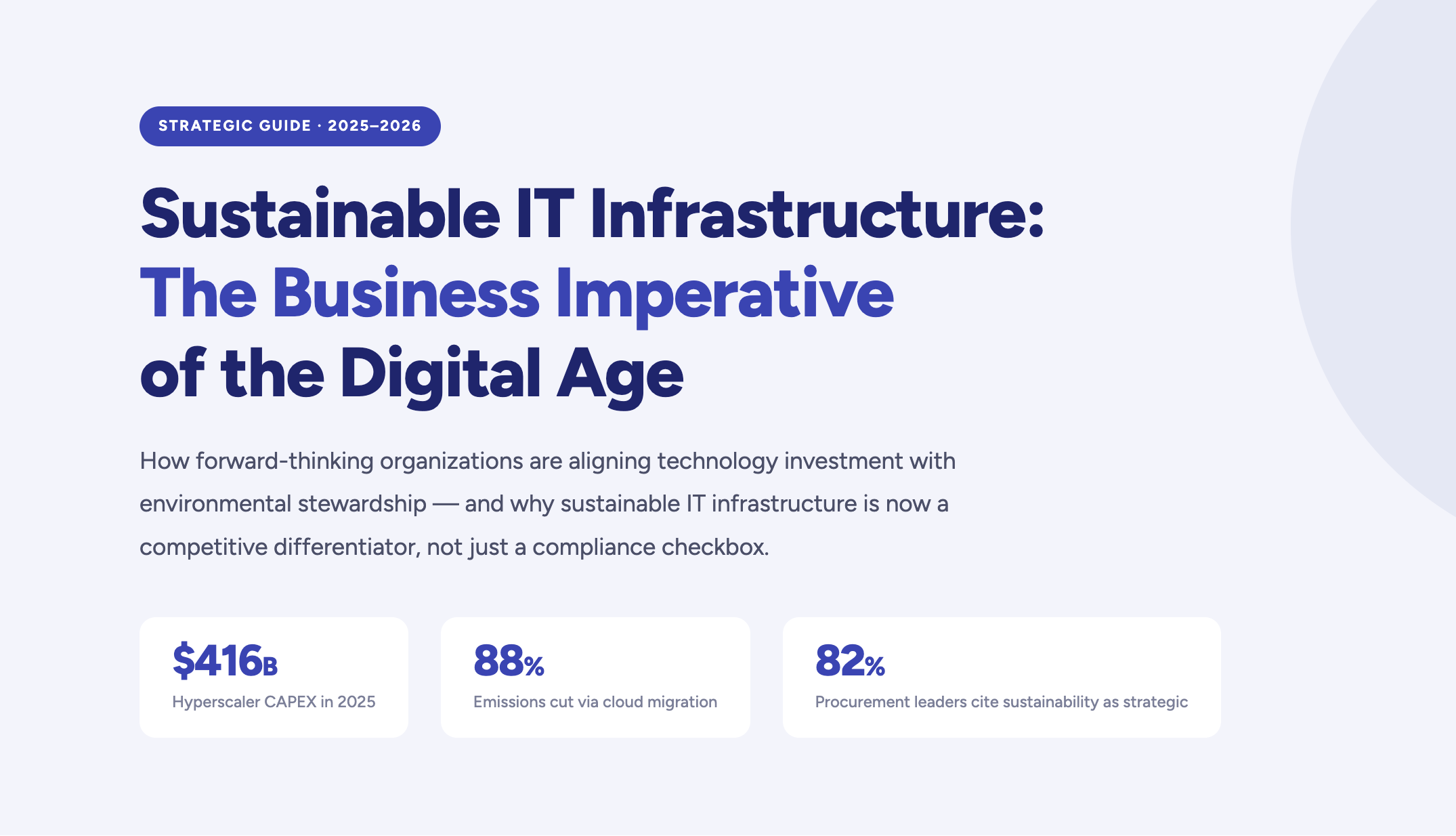
How forward-thinking organizations are aligning technology investment with environmental stewardship — and why sustainable IT infrastructure is now a competitive differentiator, not just a compliance checkbox.
$416B
Hyperscaler CAPEX in 2025
88%
Emissions cut via cloud migration
82%
Procurement leaders cite sustainability as strategic
Where digital acceleration meets environmental stewardship
The contemporary business landscape is undergoing a fundamental transformation: digital acceleration and environmental stewardship are no longer competing priorities but deeply intertwined strategic imperatives. Sustainable IT infrastructure — the discipline of designing, procuring, operating, and decommissioning technology assets to maximize resource efficiency and minimize ecological disruption — now sits at the intersection of every major boardroom agenda.
As organizations grapple with the dual challenges of rapid technological evolution — from generative AI to hyperscale cloud computing — and the intensifying pressures of climate change, the roles of CIO and CSO have begun to converge into a singular focus on the "nexus" of digital and environmental performance.
In 2025 alone, Amazon, Google, Meta, and Microsoft collectively spent over $416 billion in capital expenditures — a 66% year-over-year increase driven by AI infrastructure demands. This surge underscores both the strategic importance and the environmental urgency of every infrastructure decision made at scale. Historically a backend function, IT has matured into a critical driver of enterprise ESG outcomes.
"Sustainable IT is not just an environmental obligation — it is a strategic advantage. It drives cost savings, improves operational resilience, ensures regulatory compliance, and strengthens brand reputation in an increasingly carbon-aware world."
The evolutionary taxonomy of Green IT
Understanding sustainable IT infrastructure requires tracing the historical progression of "Green IT" — a discipline that has broadened in scope and deepened in strategic integration across three distinct generations.
1.0
Green IT 1.0
Internal Optimization
Focused on improving energy efficiency and reducing hardware consumption. Key levers included server virtualization, hardware consolidation, and PUE metrics. Effective internally, but limited in scope.
1.5
Green IT 1.5
Operational Integration
Expanded to networks and Sustainable Development Information Systems (SDIS). Introduced "lifecycle thinking" and standardized ESG reporting while minimizing operational footprints.
2.0
Green IT 2.0
Disruptive Innovation
The current frontier where IT acts as a catalyst for external environmental transformation. Drives eco-innovations across entire supply chains and global customer ecosystems.
Phase
Strategic Focus
Primary Objective
Key Metric
Green IT 1.0
Internal IT assets
Energy efficiency and e-waste management
Carbon footprint, PUE
Green IT 1.5
Business operations
SDIS and remote work enablement
Operational energy savings
Green IT 2.0
Value chain impact
Disruptive eco-innovation and behavioral change
External environmental impact
The sustainable IT infrastructure life cycle
A nuanced approach to sustainable IT infrastructure moves beyond snapshots of energy use toward comprehensive life cycle assessment (LCA). Infrastructure is a dynamic system that persists for decades, continuously interacting with the environment. The Sustainable Systems Dynamic Model (SSDM) identifies five interconnected stages:
01 Planning & Design
02 Procurement
03 Construction
04 Operation & Maintenance
05 Renewal & Disposal
Each stage carries environmental implications — from raw material extraction and water use during construction to waste generation during operation and the impact of eventual demolition or reuse. Critically, decisions made during the planning phase dictate environmental outcomes for the next 20–50 years.
Planning and design for long-term resilience
Infrastructure development must prioritize adaptability and resilience in the face of growing climate challenges. In 2026, resilient infrastructure projects increasingly incorporate climate risk assessments and alternative materials such as "green concrete." This proactive approach aligns with the ISO 55000 standard for asset management and ensures assets can withstand extreme weather while maintaining a low carbon profile.
Sustainable procurement and the circular economy
Procurement is one of the most powerful levers an organization can exercise. Sustainable (or circular) procurement involves purchasing goods and services that foster longer lifespans, value retention, and safe material cycling. By 2025, 82% of procurement leaders consider sustainability a strategic priority, with 85% reporting tangible benefits including risk mitigation and enhanced supply chain transparency.
Reduction
Redesigning to minimize capital use
Server virtualization, right-sizing
Reuse
Extending product life through secondary use
Refurbished hardware programs
Remanufacture
Restoring products to functional use
Component-level upgrades and repair
Recycling
Cycling materials back into production
Responsible e-waste disposal
Expert Guidance
Gart Solutions helps you build a circular IT procurement strategy
From lifecycle planning and hardware rationalization to cloud-native architecture — we align your infrastructure investments with your sustainability goals.
Explore our services →
The ESG mandate driving IT infrastructure investment
The integration of Environmental, Social, and Governance (ESG) criteria into IT investment decisions has shifted technology from a backend function to a critical driver of enterprise value. Modern organizations no longer view IT costs in isolation but as a measurable contributor to their ESG score and market positioning.
Environmental: carbon-aware infrastructure
The environmental dimension has moved beyond simple energy reduction toward "carbon-aware" strategies. This includes investing in elastic infrastructure that dynamically adjusts to demand through virtualization and scalable architectures, directly lowering carbon footprints. The selection of energy sources has become paramount — organizations are advised to migrate from fossil fuels and negotiate contracts for renewable energy including solar, wind, and hydropower.
Social: the inclusive digital workplace
The social pillar focuses on how IT infrastructure supports workforce inclusion and well-being. Investment in reliable, high-performing systems reduces "digital friction" — the frustration caused by slow or unreliable technology — which directly impacts employee satisfaction and productivity. Infrastructure supporting location-independent work allows organizations to access broader talent pools and foster regional economic participation.
Governance: transparency and compliance
Governance criteria drive investments in transparency and data control. Structured IT management and automated tracking create reliable audit trails that support both internal reviews and external regulatory reporting. As AI becomes embedded in operations, governance frameworks ensure these systems operate transparently and remain aligned with evolving standards like the CSRD.
Optimizing the digital foundation: data center sustainability
Data centers are the physical manifestation of the internet — and their environmental impact is substantial. They consume approximately 1.8% of total U.S. electricity, a figure that continues to grow alongside AI and cloud demand. To mitigate this, operators are focusing on three material risks: emissions intensity of electricity, water use, and energy efficiency.
Beyond PUE: a broader metrics suite
The industry has traditionally relied on Power Usage Effectiveness (PUE) — the ratio of total facility energy to IT equipment energy — as its primary efficiency benchmark. However, PUE is increasingly viewed as insufficient because it doesn't account for IT equipment efficiency, workload utilization, or carbon intensity of the power source. A broader suite of metrics is gaining traction:
PUE
Power Usage Effectiveness
Total facility energy ÷ IT energy. Industry benchmark, but limited in scope.
CUE
Carbon Usage Effectiveness
CO₂ emissions ratio relative to IT equipment energy consumption.
WUE
Water Usage Effectiveness
Liters per kWh used for cooling, quantifying water stewardship.
REF
Renewable Energy Factor
Ratio of renewable energy compared to total data center consumption.
Advanced cooling technologies
Cooling accounts for 30–40% of the total data center energy load. Traditional air cooling methods are increasingly unable to handle the heat generated by high-density AI racks, which can standardly reach 80 kW or more. Advanced liquid cooling technologies are rapidly displacing legacy approaches:
Free Cooling
Up to 60% reduction in annual chiller use
Implementation
Economizers utilizing outside air to cool the facility without mechanical refrigeration.
Direct-to-Chip
Precise heat dissipation for high-density GPUs
Implementation
Liquid-cooled cold plates mounted directly on primary heat sources like CPUs and GPUs.
Immersion Cooling
Up to 21% reduction in total emissions
Implementation
Submerging entire servers in a dielectric fluid bath for maximum thermal conductivity.
Waste Heat Recovery
Lowers local community energy needs
Implementation
Capturing waste heat from servers and redirecting it into district heating networks.
The water stewardship trade-off
Cooling method selection often involves a direct trade-off between energy and water. Evaporative cooling towers are highly energy-efficient but can consume millions of liters of water per day, straining local resources. Conversely, air-cooled systems use more electricity but zero water (WUE of 0.0). The leading approach in 2026 is server liquid cooling, which reduces both energy and water consumption relative to traditional methods, providing the most balanced sustainability profile.
Cloud computing as a decarbonization engine
Migration from on-premises data centers to the cloud is one of the most effective strategies for reducing an organization's carbon footprint. Research consistently shows that hyperscale cloud providers achieve efficiencies fundamentally unattainable for most individual enterprise data centers.
Baseline
On-premises
12–18% server utilization
PUE between 1.5 and 2.0
Average global energy mix
Sized for peak demand
Performance
Hyperscale cloud
65%+ server utilization (multi-tenancy)
PUE between 1.1 and 1.4
28% cleaner than global average
Dynamic autoscaling, serverless
Impact Area
On-Premises
Cloud
Net Reduction
Server count
100%
23%
77% fewer
Power consumption
100%
16%
84% less
Carbon mix
100%
72%
28% cleaner
Total emissions
100%
12%
88% reduction
Studies by Microsoft and WSP found that Microsoft Cloud services can be up to 93% more energy-efficient and 98% more carbon-efficient than traditional enterprise data centers. However, organizations must remain vigilant about "cloud waste" — idle or unused virtual resources that consume energy without delivering value. Proper cloud management involves autoscaling, serverless technologies, and continuous monitoring to ensure workloads are truly optimized.
Sustainable Infrastructure
Cloud migration with built-in sustainability
Gart Solutions architects cloud environments that are optimized for both performance and carbon efficiency — from workload right-sizing to renewable energy alignment.
Work with us →
Green AI: sustaining the intelligence revolution
Artificial Intelligence has transformed the landscape of modern enterprise systems — but its growth comes at the cost of significantly increased energy consumption. Training a single large language model can emit as much carbon as five cars over their entire lifetimes. In response, "Green AI" has emerged as an approach that prioritizes efficiency and sustainability across the entire AI lifecycle.
Technical strategies for efficient AI
Green AI focuses on producing high-quality results without proportionally increasing computational costs. Key technical strategies include:
Pruning — Removing redundant or low-importance neural network parameters, reducing size and speeding up inference without significant accuracy loss.
Quantization — Reducing calculation precision (e.g., 32-bit to 8-bit integers), decreasing memory and compute requirements substantially.
Knowledge distillation — Using a large "teacher" model to train a smaller "student" model that mimics its behavior with a fraction of the energy cost.
Data efficiency — Using deduplication and intelligent sampling to reduce training dataset size while maintaining model accuracy.
Combined, these approaches can reduce model sizes by up to 90%, cutting costs and emissions dramatically. Research shows that dynamic multi-objective optimization can deliver a 30.6% decrease in overall energy consumption with only a 0.7% reduction in model accuracy.
AI as a force for environmental action
While AI is energy-intensive, it is also a critical tool for accelerating climate action. Accelerated computing has made AI tasks 100,000 times more energy-efficient than a decade ago. AI is now being applied to ultra-high-resolution weather forecasting (aiding disaster preparedness), optimizing wind farm layouts to boost energy output by up to 20%, and speeding up semiconductor production while reducing energy requirements.
The regulatory fortress: CSRD, EED, and global standards
The shift toward sustainable infrastructure is increasingly mandated by law. By 2026, organizations operating in the UK and EU face a tightening web of regulations requiring detailed reporting and real-world decarbonization.
The Corporate Sustainability Reporting Directive (CSRD)
The CSRD requires companies to disclose their environmental and social impacts in a standardized digital format, subject to third-party assurance. It introduces the concept of "double materiality" — requiring businesses to report both how climate change affects their business and how their business affects the climate. Key ESRS E1 requirements include:
Standard
Requirement
IT Infrastructure Relevance
ESRS E1-7
Energy consumption and renewable energy mix
Data center PUE, renewable energy sourcing, and workload energy density.
ESRS E1-8
Gross Scope 1, 2, and 3 GHG emissions
Cloud footprint tracking, embodied carbon in hardware, and lifecycle emissions.
ESRS E1-11
Financial effects of climate physical and transition risks
Infrastructure resilience planning and transition costs to low-carbon IT architectures.
Energy Efficiency Directive (EED) and data centers
The recast EED introduces specific reporting obligations for all EU data centers with an IT power demand of at least 500 kW. Starting in 2024, operators must annually communicate energy performance data. Facilities larger than 1 MW must utilize waste heat recovery where technically and economically feasible.
Green building certifications: LEED v5 and Energy Star
LEED v5, the newest iteration, reflects a decisive shift toward measurable carbon performance. Projects pursuing Platinum certification must achieve full electrification and 100% renewable energy usage. V5 also emphasizes "embodied carbon" — emissions associated with the manufacturing and construction of the building itself.
Energy Star certification requires a data center to rank in the top 25% of national energy performance, achieving a score of 75 or higher, verified by a Licensed Professional.
The economic case for sustainable IT infrastructure
The financial justification for sustainable IT is stronger than ever. Historically, infrastructure planning focused on the "lowest first cost" — but tightening budgets and climate vulnerabilities have elevated lifecycle economic analysis to a strategic necessity.
60%
CAPEX Savings
Achieved through risk-based investment models and infrastructure rationalization.
5–10%
Maintenance Reduction
Lowering ongoing operational costs via advanced predictive analytics.
80%
Uptime Improvement
Reduction in unplanned downtime through proactive predictive maintenance.
6–12mo
Typical ROI
Standard timeframe for realizing returns on sustainable infrastructure investments.
Asset Investment Planning (AIP) helps balance large upfront CAPEX with ongoing OPEX. While CAPEX typically accounts for only 10–40% of an infrastructure asset's total lifetime costs, decisions made during the CAPEX phase dictate the remaining 60–90% in operational expenditure. Risk-based models that prioritize investments based on actual failure probabilities can save up to 60% in capital expenditures.
The "HyperCAPEX" reality: Amazon, Google, Meta, and Microsoft are on pace to exceed $2 trillion in cumulative CAPEX by 2026. For tech leaders, the question is no longer just how much to spend, but how to ensure every dollar builds an optimized, sustainable digital factory — not just a more expensive one.
Hardware and the circular imperative
Electronic waste is the fastest-growing waste stream globally. Managing the hardware lifecycle is among the most practical Green IT initiatives an organization can undertake. The goal is to extend device lifespan and improve disposal practices across three pillars: proactive maintenance to delay new purchases, refurbishment programs that give hardware a second life, and responsible recycling partnerships for end-of-life assets.
Sustainable procurement policies should also include "Capacity Optimizing Methods" (COMs) such as data deduplication, compression, and thin provisioning — reducing physical storage requirements, saving both energy and cost.
Building the sustainable digital ecosystem: a roadmap for leaders
The nexus of business sustainability and IT infrastructure demands a holistic, systems-level approach. As we move through 2026, the role of IT is evolving from a consumer of resources to a catalyst for environmental and social value creation.
The transition to Green IT 2.0 requires a fundamental rethink of how technology is designed, procured, and operated. It requires moving beyond efficiency metrics like PUE toward comprehensive carbon and water usage assessments. It demands advanced cooling technologies and strategic use of hyperscale cloud resources. And it requires ethical, efficient AI deployment to solve pressing environmental challenges while minimizing its own footprint.
Adopt a full lifecycle cost framework — factor OPEX implications into every CAPEX decision from day one.
Expand your metrics suite beyond PUE to CUE, WUE, and REF — align with CSRD reporting requirements now.
Accelerate cloud migration for workloads where hyperscale efficiency gains are achievable — target the 88% emissions reduction opportunity.
Implement circular procurement principles — extend hardware lifecycles, standardize refurbishment, eliminate e-waste.
Apply Green AI techniques (pruning, quantization, distillation) to reduce model footprint without sacrificing accuracy.
Begin CSRD and EED compliance preparation now — reporting obligations are tightening and require verified, auditable data.
Gart Solutions
Ready to build your sustainable IT infrastructure?
Gart Solutions specializes in DevOps, cloud architecture, and data compliance — helping organizations across Europe and beyond build digital ecosystems that are powerful, efficient, and sustainable by design.
Get in touch with our team →
How Gart can help your company achieve sustainable development
Sustainable development is often defined as the ability to meet present needs without compromising the ability of future generations to meet their own. In a business context, this translates into balancing economic performance with environmental responsibility and social impact.
For technology-driven organizations, sustainability is no longer a parallel initiative — it is embedded directly into how digital systems are designed, deployed, and operated.
This is where DevOps, SRE, and cloud architecture become critical enablers.
At its core, DevOps promotes efficiency, automation, and continuous improvement — principles that directly align with sustainability objectives. By reducing waste, optimizing resource usage, and improving system performance, modern engineering practices contribute to both cost efficiency and lower environmental impact.
Site Reliability Engineering (SRE) further strengthens this approach by ensuring that systems operate reliably and efficiently at scale. Well-optimized systems consume fewer resources, reduce unnecessary compute cycles, and minimize the environmental footprint of digital operations.
Practical ways Gart enables Sustainable IT infrastructure
Gart Solutions helps organizations embed sustainability into their infrastructure through a combination of cloud, DevOps, and SRE practices:
Automation at scaleReducing manual processes decreases resource consumption and improves operational efficiency.
Infrastructure as Code (IaC)Enables precise resource provisioning, eliminating over-allocation and reducing idle infrastructure.
Cloud-native architectureLeveraging autoscaling and elastic environments ensures that compute resources are used only when needed.
Containerization and microservicesImproves workload efficiency and reduces the need for over-provisioned systems.
Continuous monitoring and optimizationIdentifies inefficiencies in real time, enabling ongoing reduction in energy consumption and costs.
Serverless computingEliminates the need for persistent infrastructure, significantly lowering energy usage.
Resilience engineering (SRE practices)Minimizes downtime and resource waste associated with system failures.
Sustainable data center strategyAligns infrastructure with renewable energy sources and modern cooling technologies.
So, yeah, DevOps and sustainability? They're like peanut butter and jelly – a perfect match.
By integrating these practices, organizations achieve more than operational improvements. They build infrastructure that is:
More energy-efficient
More cost-effective
More resilient
Better aligned with ESG and regulatory requirements
In this context, DevOps and sustainability are not separate domains — they are mutually reinforcing capabilities that define the performance of modern digital organizations.
Insights from Experts about Sustainable IT infrastructure
From Christophe Girardier, CEO and co-founder of Glimpact:
"When it comes to environmental development, only examining carbon emissions does not allow for the whole picture. Extreme weather events, upheaval of the daily lives of consumers and complex environmental regulations are just a few of the ways that climate change is already impacting businesses globally. But understanding true sustainability requires more than just addressing carbon emissions, leaders must understand the full picture to assess full risk and make informed decisions.
Transitioning away from the myopic 'carbon footprint paradigm' requires a radically different vision of the ecological crisis. The EU intends to impose its robust PEF/OEF approach as the only methodological framework to implement new regulations which are now coming into force for industrial players around the world. For U.S. companies who want to market their products to the EU, they must embrace these new standards rather than risk being ostracized by European consumers, or worse, having the onus of EU regulations bar them from the market entirely. As we look ahead to the coming year, smart C-suite executives that take the time to understand nuances associated with true sustainability are those that will be most prepared in this new era of global risk."
From Jennifer Eden, CEO and Co-Founder, Tampon Tribe:
"I am reaching out regarding your call for entrepreneurs to discuss the pivotal role of sustainability in shaping business and IT infrastructure decisions. As the CEO and Co-Founder of Tampon Tribe, a brand at the forefront of integrating sustainability into every aspect of our operations, I am keen to share our journey and the strategic decisions we've made to uphold our commitment to the environment.
Sustainability is not just a facet of Tampon Tribe; it is the backbone of our business model and operational philosophy. This commitment influences our decisions from product development to packaging, marketing, and especially our IT infrastructure. We leverage cloud-based solutions to minimize our carbon footprint, employ data analytics for efficient resource management, and continuously seek out eco-friendly technologies that align with our sustainability goals.
Our approach has been to view sustainability as an investment rather than a cost, one that pays dividends not only in terms of environmental impact but also in customer loyalty and brand differentiation. Navigating the challenges of maintaining sustainable practices while ensuring operational efficiency has been a rewarding journey, offering valuable lessons on the integration of eco-conscious strategies in a digital landscape."
From Rob Dillan, founder of EVhype, a premier online platform dedicated to mapping electric vehicle (EV) charging stations across the US and Canada:
As the founder of EVhype.com, I have strategically embedded sustainability at the core of our business and IT infrastructure decisions, recognizing its pivotal role in driving long-term success and resilience.
Sustainability in Business Strategy:
Sustainability isn't just an add-on; it's integral to our business model. By prioritizing eco-friendly practices, we not only minimize environmental impact but also align with the growing consumer demand for green products, enhancing brand loyalty and market competitiveness.
Sustainability in IT Infrastructure:
In our IT operations, sustainability means optimizing energy efficiency, from choosing green hosting providers for our digital platforms to implementing cloud-based solutions that reduce the need for physical servers. This approach not only lowers carbon footprints but also results in significant cost savings.
From Judah Longgrear, CEO of Nickelytics & CEO of JI & JL Capital:
Sustainability is a key consideration as we shape our business and IT infrastructure at our distributed company. Since most of our employees work remotely around the world, we have consciously crafted policies and practices to reduce unnecessary travel, commuting, and resource use.
For example, rather than flying team members to a central location for meetings, we leverage video conferencing and collaboration software as much as possible. This eliminates many flights and long drives while still enabling productive global conversations. We also have hubs on a few continents to facilitate periodic regional gatherings when some face-to-face strategy is essential. Even then, we try to coordinate teams being in the same location to maximize in-person time while minimizing individual trips.
In terms of infrastructure, we heavily utilize cloud computing, which is generally more sustainable than on-premise data centers in terms of energy use and efficiency.
Enabling location-flexible work and leveraging technology for collaboration helps us reduce our environmental impact. We're proud of the strides made but also recognize there are always more opportunities to build a sustainable business for the future.
From Jonathan Morgan CEO at Venture Smarter
One of the ways sustainability in business shapes our IT infrastructure decisions is through our hardware choices. We prioritize energy-efficient equipment and look for products with eco-friendly certifications. This not only helps us reduce our carbon footprint but also often leads to long-term cost savings.
But it's not just about the hardware; it's also about how we use it. We're constantly optimizing our systems and processes to minimize energy consumption and maximize efficiency. Whether it's through virtualization, cloud computing, or smart power management strategies, we're always looking for ways to do more with less.
And of course, we're big believers in the power of technology to drive positive change. So, we're always exploring innovative solutions that leverage IT to promote sustainability, whether that's through smart city initiatives, renewable energy projects, or environmental monitoring systems.
As climate change, resource depletion, and environmental issues loom large, businesses are turning to technology as a powerful ally in achieving their sustainability goals. This isn't just about saving the planet (although that's pretty important), it's also about creating a more efficient and resilient future for all.
Data is the new oil, and when it comes to sustainability, it's a game-changer. Technology empowers businesses to collect and analyze vast amounts of data, allowing them to make informed decisions about their environmental impact. By automating processes, streamlining operations, and enabling data-driven decision-making, businesses can minimize waste, reduce energy consumption, and optimize resource utilization.
Digital technologies, such as cloud computing, remote collaboration tools, and virtual platforms, have the potential to reduce the need for physical infrastructure and travel, thereby minimizing the associated environmental impacts.
One of the primary challenges is striking a balance between sustainability goals and profitability. Many businesses struggle to reconcile the perceived trade-off between environmental considerations and short-term financial gains. Implementing sustainable practices often requires upfront investments in new technologies, infrastructure, or processes, which can be costly and may not yield immediate returns. Convincing stakeholders and shareholders of the long-term benefits and value of sustainability can be a complex task.
The Environmental Impact of IT Infrastructure
One of the primary concerns regarding IT infrastructure is energy consumption. Data centers, which house servers, storage systems, and networking equipment, are energy-intensive facilities. They require substantial amounts of electricity to power and cool the hardware, contributing to greenhouse gas emissions and straining energy grids. According to estimates, data centers account for approximately 1% of global electricity consumption, and this figure is expected to rise as data volumes and computing demands continue to grow.
Furthermore, the manufacturing process of IT equipment, such as servers, computers, and other hardware components, involves the extraction and processing of raw materials, which can have detrimental effects on the environment. The mining of rare earth metals and other minerals used in electronic components can lead to habitat destruction, water pollution, and the depletion of natural resources.
E-waste, or electronic waste, is another pressing issue related to IT infrastructure. As technological devices become obsolete or reach the end of their lifecycle, they often end up in landfills or informal recycling facilities, posing risks to human health and the environment. E-waste can contain hazardous substances like lead, mercury, and cadmium, which can leach into soil and water sources, causing pollution and potential harm to ecosystems.
By addressing the environmental impact of IT infrastructure, businesses can not only reduce their carbon footprint and resource consumption but also contribute to a more sustainable future. Striking a balance between technological innovation and environmental stewardship is crucial for achieving long-term sustainability goals.
DevOps and Sustainability
DevOps practices play a pivotal role in optimizing resources and reducing waste, making them a powerful ally in the pursuit of sustainability. By seamlessly integrating development and operations processes, DevOps enables organizations to achieve greater efficiency, agility, and environmental responsibility.
At the core of DevOps is the principle of automation and continuous improvement. By automating repetitive tasks and streamlining processes, DevOps eliminates manual efforts, reduces human errors, and minimizes resource wastage. This efficiency translates into lower energy consumption, decreased hardware utilization, and a reduced carbon footprint.
CI/CD for Improved Eco-Efficiency
Continuous Integration and Continuous Delivery (CI/CD) are essential DevOps practices that contribute to sustainability. CI/CD enables organizations to rapidly and frequently deliver software updates and improvements, ensuring that applications run optimally and efficiently. This approach minimizes the need for resource-intensive deployments and reduces the overall environmental impact of software development and operations.
Moreover, CI/CD facilitates the early detection and resolution of issues, preventing potential inefficiencies and resource wastage. By integrating automated testing and quality assurance processes, organizations can identify and address performance bottlenecks, security vulnerabilities, and other issues that could lead to increased energy consumption or resource utilization.
Monitoring and Analytics for Identifying and Eliminating Inefficiencies
DevOps emphasizes the importance of monitoring and analytics as a means to gain insights into system performance, resource utilization, and potential areas for improvement. By leveraging advanced monitoring tools and techniques, organizations can gather real-time data on energy consumption, hardware utilization, and application performance.
This data can then be analyzed to identify inefficiencies, such as underutilized resources, redundant processes, or areas where optimization is required. Armed with these insights, organizations can take proactive measures to streamline operations, adjust resource allocation, and implement energy-saving strategies, ultimately reducing their environmental footprint.
For a deeper dive into how monitoring and analytics can drive efficiency and sustainability, explore this case study of a software development company that optimized its workload orchestration using continuous monitoring.
Our case study: Implementation of Nomad Cluster for Massively Parallel Computing
Cloud Computing and Sustainability
Cloud computing has emerged as a transformative technology that not only enhances efficiency and agility but also holds significant potential for promoting sustainability and reducing environmental impact. By leveraging the power of cloud services, organizations can achieve remarkable energy and resource savings, while simultaneously minimizing their carbon footprint.
Energy and Resource Savings through Cloud Services
One of the primary advantages of cloud computing in terms of sustainability is the efficient utilization of shared resources. Cloud service providers operate large-scale data centers that are designed for optimal resource allocation and energy efficiency. By consolidating workloads and leveraging economies of scale, cloud providers can maximize resource utilization, reducing energy consumption and minimizing waste.
Additionally, cloud providers invest heavily in implementing cutting-edge technologies and best practices for energy efficiency, such as advanced cooling systems, renewable energy sources, and efficient hardware. These efforts result in significant energy savings, translating into a lower carbon footprint for organizations that leverage cloud services.
Flexible Cloud Models for Cost Optimization for Sustainable Operations
Cloud computing offers flexible deployment models, including public, private, and hybrid clouds, allowing organizations to tailor their cloud strategies to meet their specific needs and optimize costs. By embracing the pay-as-you-go model of public clouds or implementing private clouds for sensitive workloads, businesses can dynamically scale their resource consumption, avoiding over-provisioning and minimizing unnecessary energy expenditure.
Cloud providers offer a diverse range of compute and storage resources with varying payment options and tiers, catering to different use cases and requirements. For instance, Amazon Web Services (AWS) provides Elastic Compute Cloud (EC2) instances with multiple pricing models, including Dedicated, On-Demand, Spot, and Reserved instances. Choosing the most suitable instance type for a specific workload can lead to significant cost savings.
Dedicated instances, while the most expensive option, are ideal for handling sensitive workloads where security and compliance are of paramount importance. These instances run on hardware dedicated solely to a single customer, ensuring heightened isolation and control.
On-demand instances, on the other hand, are billed on an hourly basis and are well-suited for applications with short-term, irregular workloads that cannot be interrupted. They are particularly useful during testing, development, and prototyping phases, offering flexibility and scalability on-demand.
For long-running workloads, Reserved instances offer substantial discounts, up to 72% compared to on-demand pricing. By investing in Reserved instances, businesses can secure capacity reservations and gain confidence in their ability to launch the required number of instances when needed.
Spot instances present a cost-effective alternative for workloads that do not require high availability. These instances leverage spare computing capacity, enabling businesses to benefit from discounts of up to 90% compared to on-demand pricing.
Our case study: Cutting Costs by 81%: Azure Spot VMs Drive Cost Efficiency for Jewelry AI Vision
Additionally, DevOps teams employ various cloud cost optimization practices to further reduce operational expenses and environmental impact. These include:
- Identifying and deleting underutilized instances
- Moving infrequently accessed storage to more cost-effective tiers
- Exploring alternative regions or availability zones with lower pricing
- Leveraging available discounts and pricing models
- Implementing spend monitoring and alert systems to track and control costs proactively
By adopting a strategic approach to resource utilization and cost optimization, businesses can not only achieve sustainable operations but also unlock significant cost savings. This proactive mindset aligns with the principles of environmental stewardship, enabling organizations to thrive while minimizing their ecological footprint.
Read more: Sustainable Solutions with AWS
Reduced Physical Infrastructure and Associated Emissions
Moving to the cloud isn't just about convenience and scalability – it's a game-changer for the environment. Here's why:
Bye-bye Bulky Servers
Cloud computing lets you ditch the on-site server farm. No more rows of whirring machines taking up space and guzzling energy. Cloud providers handle that, often in facilities optimized for efficiency. This translates to less energy used, fewer emissions produced, and a lighter physical footprint for your business.
Commuting? Not Today
Cloud-based tools enable remote work, which means fewer cars on the road spewing out emissions. Not only does this benefit the environment, but it also promotes a more flexible and potentially happier workforce.
Cloud computing offers a win-win for businesses and the planet. By sharing resources, utilizing energy-saving data centers, and adopting flexible deployment models, cloud computing empowers organizations to significantly reduce their environmental impact without sacrificing efficiency or agility. Think of it as a powerful tool for building a more sustainable future, one virtual server at a time.
Get a sample of IT Audit
Sign up now
Get on email
Loading...
Thank you!
You have successfully joined our subscriber list.
Effective Infrastructure Management and Sustainability
Effective infrastructure management plays a crucial role in achieving sustainability goals within an organization. By implementing strategies that optimize resource utilization, reduce energy consumption, and promote environmentally-friendly practices, businesses can significantly diminish their environmental impact while maintaining operational efficiency.
Virtualization and Consolidation Strategies for Reducing Hardware Needs
Virtualization technology has revolutionized the way organizations manage their IT infrastructure.
By ditching the extra servers, you're using less energy to power and cool them. Think of it like turning off all the lights in empty rooms – virtualization ensures you're only using the resources you truly need. This translates to significant energy savings and a smaller carbon footprint.
Fewer servers mean less hardware to manufacture and eventually dispose of. This reduces the environmental impact associated with both the production process and electronic waste (e-waste). Virtualization helps you be a more responsible citizen of the digital world.
Our case study: IoT Device Management Using Kubernetes
Optimizing with Third-Party Services
In the pursuit of sustainability and resource efficiency, businesses must explore innovative strategies that can streamline operations while reducing their environmental footprint. One such approach involves leveraging third-party services to optimize costs and minimize operational overhead. Cloud computing providers, such as Azure, AWS, and Google Cloud, offer a vast array of services that can significantly enhance the development process and reduce resource consumption.
A prime example is Amazon's Relational Database Service (RDS), a fully managed database solution that boasts advanced features like multi-regional setup, automated backups, monitoring, scalability, resilience, and reliability. Building and maintaining such a service in-house would not only be resource-intensive but also costly, both in terms of financial investment and environmental impact.
However, striking the right balance between leveraging third-party services and maintaining control over critical components is crucial. When crafting an infrastructure plan, DevOps teams meticulously analyze project requirements and assess the availability of relevant third-party services. Based on this analysis, recommendations are provided on when it's more efficient to utilize a managed service, and when it's more cost-effective and suitable to build and manage the service internally.
For ongoing projects, DevOps teams conduct comprehensive audits of existing infrastructure resources and services. If opportunities for cost optimization are identified, they propose adjustments or suggest integrating new services, taking into account the associated integration costs with the current setup. This proactive approach ensures that businesses continuously explore avenues for reducing their environmental footprint while maintaining operational efficiency.
One notable success story involves a client whose services were running on EC2 instances via the Elastic Container Service (ECS). After analyzing their usage patterns, peak periods, and management overhead, the DevOps team recommended transitioning to AWS Fargate, a serverless solution that eliminates the need for managing underlying server infrastructure. Fargate not only offered a more streamlined setup process but also facilitated significant cost savings for the client.
By judiciously adopting third-party services, businesses can reduce operational overhead, optimize resource utilization, and ultimately minimize their environmental impact. This approach aligns with the principles of sustainability, enabling organizations to achieve their goals while contributing to a greener future.
Our case study: Deployment of a Node.js and React App to AWS with ECS
Green Code and DevOps Go Hand-in-Hand
At the heart of this sustainable approach lies green code, the practice of developing and deploying software with a focus on minimizing its environmental impact. Green code prioritizes efficient algorithms, optimized data structures, and resource-conscious coding practices.
At its core, Green Code is about designing and implementing software solutions that consume fewer computational resources, such as CPU cycles, memory, and energy. By optimizing code for efficiency, developers can reduce the energy consumption and carbon footprint associated with running applications on servers, desktops, and mobile devices.
Continuous Monitoring and Feedback
DevOps promotes continuous monitoring of applications, providing valuable insights into resource utilization. These insights can be used to identify areas for code optimization, ensuring applications run efficiently and consume less energy.
Infrastructure Automation:
Automating infrastructure provisioning and management through tools like Infrastructure as Code (IaC) helps eliminate unnecessary resources and idle servers. Think of it like switching off the lights in an empty room – automation ensures resources are only used when needed.
Containerization
Containerization technologies like Docker package applications with all their dependencies, allowing them to run efficiently on any system. This reduces the need for multiple servers and lowers overall energy consumption.
Cloud-Native Development
By leveraging cloud platforms, developers can benefit from pre-built, scalable infrastructure with high energy efficiency. Cloud providers are constantly optimizing their data centers for sustainability, so you don't have to shoulder the burden alone.
DevOps practices not only streamline development and deployment processes, but also create a culture of resource awareness and optimization. This, combined with green code principles, paves the way for building applications that are not just powerful, but also environmentally responsible.
How Businesses Are Using DevOps, Cloud, and Green Code to Thrive
Case Study 1: Transforming a Local Landfill Solution into a Global Platform
ReSource International, an Icelandic environmental solutions company, developed elandfill.io, a digital platform for monitoring and managing landfill operations. However, scaling the platform globally posed challenges in managing various components, including geospatial data processing, real-time data analysis, and module integration.
Gart Solutions implemented the RMF, a suite of tools and approaches designed to facilitate the deployment of powerful digital solutions for landfill management globally.
Case Study 3: The #1 Music Promotion Services Cuts Costs with Sustainable AWS Solutions
The #1 Music Promotion Services, a company helping independent artists, faced rising AWS infrastructure costs due to rapid growth. A multi-faceted approach focused on optimization and cost-saving strategies was implemented. This included:
Amazon SNS Optimization: A usage audit identified redundant notifications and opportunities for batching messages, leading to lower usage charges.
EC2 and RDS Cost Management: Right-sizing instances, utilizing reserved instances, and implementing auto-scaling ensured efficient resource utilization.
Storage Optimization: Lifecycle policies and data cleanup practices reduced storage costs.
Traffic and Data Transfer Management: Optimized data transfer routes and cost monitoring with alerts helped manage unexpected spikes.
Results: Monthly AWS costs were slashed by 54%, with significant savings across services like Amazon SNS and EC2/RDS. They also established a framework for sustainable cost management, ensuring long-term efficiency.
Partner with Gart for IT Cost Optimization and Sustainable Business
As businesses strive for sustainability, partnering with the right IT provider is crucial for optimizing costs and minimizing environmental impact. Gart emerges as a trusted partner, offering expertise in cloud computing, DevOps, and sustainable IT solutions.
Gart's cloud proficiency spans on-premise-to-cloud migration, cloud-to-cloud migration, and multi-cloud/hybrid cloud management. Our DevOps services include cloud adoption, CI/CD streamlining, security management, and firewall-as-a-service, enabling process automation and operational efficiencies.
Recognized by IAOP, GSA, Inc. 5000, and Clutch.co, Gart adheres to PCI DSS, ISO 9001, ISO 27001, and GDPR standards, ensuring quality, security, and data protection.
By partnering with Gart, businesses can optimize IT costs, reduce their carbon footprint, and foster a sustainable future. Leverage Gart's expertise to align your IT strategies with environmental goals and unlock the benefits of cost optimization and sustainability.