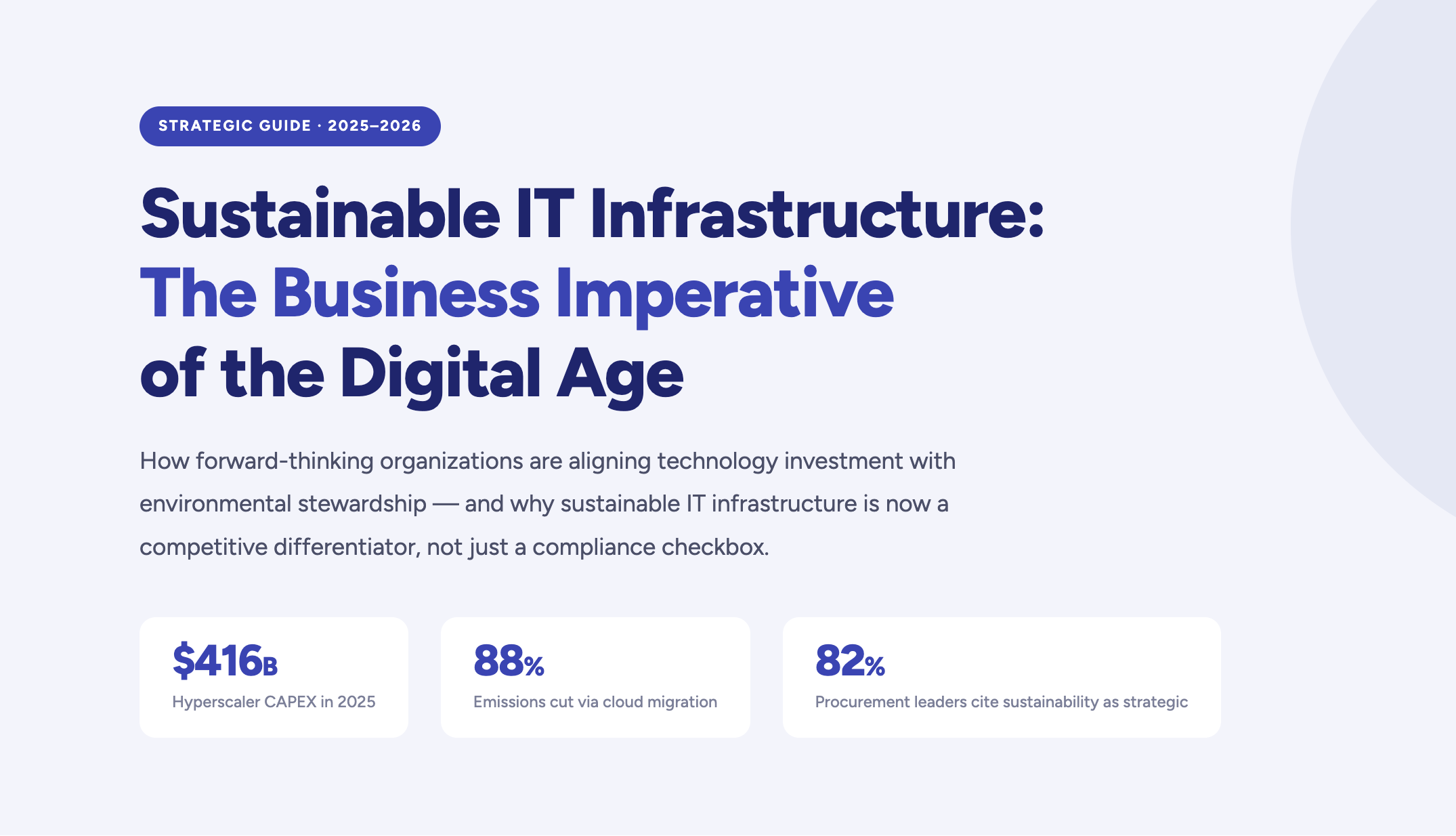
How forward-thinking organizations are aligning technology investment with environmental stewardship — and why sustainable IT infrastructure is now a competitive differentiator, not just a compliance checkbox.
Hyperscaler CAPEX in 2025
Emissions cut via cloud migration
Procurement leaders cite sustainability as strategic
Where digital acceleration meets environmental stewardship
The contemporary business landscape is undergoing a fundamental transformation: digital acceleration and environmental stewardship are no longer competing priorities but deeply intertwined strategic imperatives. Sustainable IT infrastructure — the discipline of designing, procuring, operating, and decommissioning technology assets to maximize resource efficiency and minimize ecological disruption — now sits at the intersection of every major boardroom agenda.
As organizations grapple with the dual challenges of rapid technological evolution — from generative AI to hyperscale cloud computing — and the intensifying pressures of climate change, the roles of CIO and CSO have begun to converge into a singular focus on the “nexus” of digital and environmental performance.
In 2025 alone, Amazon, Google, Meta, and Microsoft collectively spent over $416 billion in capital expenditures — a 66% year-over-year increase driven by AI infrastructure demands. This surge underscores both the strategic importance and the environmental urgency of every infrastructure decision made at scale. Historically a backend function, IT has matured into a critical driver of enterprise ESG outcomes.
“Sustainable IT is not just an environmental obligation — it is a strategic advantage. It drives cost savings, improves operational resilience, ensures regulatory compliance, and strengthens brand reputation in an increasingly carbon-aware world.”
The evolutionary taxonomy of Green IT
Understanding sustainable IT infrastructure requires tracing the historical progression of “Green IT” — a discipline that has broadened in scope and deepened in strategic integration across three distinct generations.
Green IT 1.0
Internal Optimization
Focused on improving energy efficiency and reducing hardware consumption. Key levers included server virtualization, hardware consolidation, and PUE metrics. Effective internally, but limited in scope.
Green IT 1.5
Operational Integration
Expanded to networks and Sustainable Development Information Systems (SDIS). Introduced “lifecycle thinking” and standardized ESG reporting while minimizing operational footprints.
Green IT 2.0
Disruptive Innovation
The current frontier where IT acts as a catalyst for external environmental transformation. Drives eco-innovations across entire supply chains and global customer ecosystems.
| Phase | Strategic Focus | Primary Objective | Key Metric |
|---|---|---|---|
| Green IT 1.0 | Internal IT assets | Energy efficiency and e-waste management | Carbon footprint, PUE |
| Green IT 1.5 | Business operations | SDIS and remote work enablement | Operational energy savings |
| Green IT 2.0 | Value chain impact | Disruptive eco-innovation and behavioral change | External environmental impact |
The sustainable IT infrastructure life cycle
A nuanced approach to sustainable IT infrastructure moves beyond snapshots of energy use toward comprehensive life cycle assessment (LCA). Infrastructure is a dynamic system that persists for decades, continuously interacting with the environment. The Sustainable Systems Dynamic Model (SSDM) identifies five interconnected stages:
Each stage carries environmental implications — from raw material extraction and water use during construction to waste generation during operation and the impact of eventual demolition or reuse. Critically, decisions made during the planning phase dictate environmental outcomes for the next 20–50 years.
Planning and design for long-term resilience
Infrastructure development must prioritize adaptability and resilience in the face of growing climate challenges. In 2026, resilient infrastructure projects increasingly incorporate climate risk assessments and alternative materials such as “green concrete.” This proactive approach aligns with the ISO 55000 standard for asset management and ensures assets can withstand extreme weather while maintaining a low carbon profile.
Sustainable procurement and the circular economy
Procurement is one of the most powerful levers an organization can exercise. Sustainable (or circular) procurement involves purchasing goods and services that foster longer lifespans, value retention, and safe material cycling. By 2025, 82% of procurement leaders consider sustainability a strategic priority, with 85% reporting tangible benefits including risk mitigation and enhanced supply chain transparency.
Gart Solutions helps you build a circular IT procurement strategy
From lifecycle planning and hardware rationalization to cloud-native architecture — we align your infrastructure investments with your sustainability goals.
The ESG mandate driving IT infrastructure investment
The integration of Environmental, Social, and Governance (ESG) criteria into IT investment decisions has shifted technology from a backend function to a critical driver of enterprise value. Modern organizations no longer view IT costs in isolation but as a measurable contributor to their ESG score and market positioning.
Environmental: carbon-aware infrastructure
The environmental dimension has moved beyond simple energy reduction toward “carbon-aware” strategies. This includes investing in elastic infrastructure that dynamically adjusts to demand through virtualization and scalable architectures, directly lowering carbon footprints. The selection of energy sources has become paramount — organizations are advised to migrate from fossil fuels and negotiate contracts for renewable energy including solar, wind, and hydropower.
Social: the inclusive digital workplace
The social pillar focuses on how IT infrastructure supports workforce inclusion and well-being. Investment in reliable, high-performing systems reduces “digital friction” — the frustration caused by slow or unreliable technology — which directly impacts employee satisfaction and productivity. Infrastructure supporting location-independent work allows organizations to access broader talent pools and foster regional economic participation.
Governance: transparency and compliance
Governance criteria drive investments in transparency and data control. Structured IT management and automated tracking create reliable audit trails that support both internal reviews and external regulatory reporting. As AI becomes embedded in operations, governance frameworks ensure these systems operate transparently and remain aligned with evolving standards like the CSRD.
Optimizing the digital foundation: data center sustainability
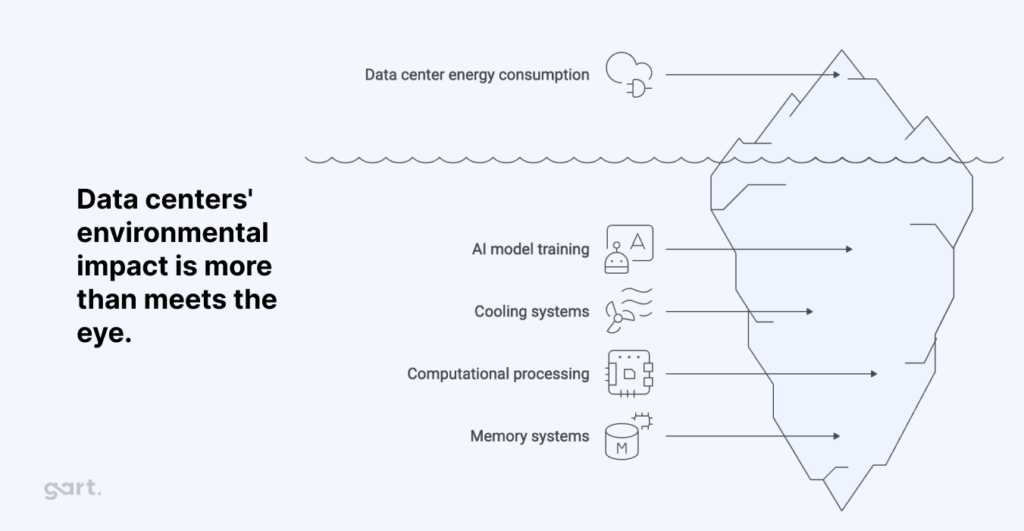
Data centers are the physical manifestation of the internet — and their environmental impact is substantial. They consume approximately 1.8% of total U.S. electricity, a figure that continues to grow alongside AI and cloud demand. To mitigate this, operators are focusing on three material risks: emissions intensity of electricity, water use, and energy efficiency.
Beyond PUE: a broader metrics suite
The industry has traditionally relied on Power Usage Effectiveness (PUE) — the ratio of total facility energy to IT equipment energy — as its primary efficiency benchmark. However, PUE is increasingly viewed as insufficient because it doesn’t account for IT equipment efficiency, workload utilization, or carbon intensity of the power source. A broader suite of metrics is gaining traction:
Total facility energy ÷ IT energy. Industry benchmark, but limited in scope.
CO₂ emissions ratio relative to IT equipment energy consumption.
Liters per kWh used for cooling, quantifying water stewardship.
Ratio of renewable energy compared to total data center consumption.
Advanced cooling technologies
Cooling accounts for 30–40% of the total data center energy load. Traditional air cooling methods are increasingly unable to handle the heat generated by high-density AI racks, which can standardly reach 80 kW or more. Advanced liquid cooling technologies are rapidly displacing legacy approaches:
Free Cooling
Economizers utilizing outside air to cool the facility without mechanical refrigeration.
Direct-to-Chip
Liquid-cooled cold plates mounted directly on primary heat sources like CPUs and GPUs.
Immersion Cooling
Submerging entire servers in a dielectric fluid bath for maximum thermal conductivity.
Waste Heat Recovery
Capturing waste heat from servers and redirecting it into district heating networks.
The water stewardship trade-off
Cooling method selection often involves a direct trade-off between energy and water. Evaporative cooling towers are highly energy-efficient but can consume millions of liters of water per day, straining local resources. Conversely, air-cooled systems use more electricity but zero water (WUE of 0.0). The leading approach in 2026 is server liquid cooling, which reduces both energy and water consumption relative to traditional methods, providing the most balanced sustainability profile.
Cloud computing as a decarbonization engine
Migration from on-premises data centers to the cloud is one of the most effective strategies for reducing an organization’s carbon footprint. Research consistently shows that hyperscale cloud providers achieve efficiencies fundamentally unattainable for most individual enterprise data centers.
On-premises
- 12–18% server utilization
- PUE between 1.5 and 2.0
- Average global energy mix
- Sized for peak demand
Hyperscale cloud
- 65%+ server utilization (multi-tenancy)
- PUE between 1.1 and 1.4
- 28% cleaner than global average
- Dynamic autoscaling, serverless
| Impact Area | On-Premises | Cloud | Net Reduction |
|---|---|---|---|
| Server count | 100% | 23% | 77% fewer |
| Power consumption | 100% | 16% | 84% less |
| Carbon mix | 100% | 72% | 28% cleaner |
| Total emissions | 100% | 12% | 88% reduction |
Studies by Microsoft and WSP found that Microsoft Cloud services can be up to 93% more energy-efficient and 98% more carbon-efficient than traditional enterprise data centers. However, organizations must remain vigilant about “cloud waste” — idle or unused virtual resources that consume energy without delivering value. Proper cloud management involves autoscaling, serverless technologies, and continuous monitoring to ensure workloads are truly optimized.
Cloud migration with built-in sustainability
Gart Solutions architects cloud environments that are optimized for both performance and carbon efficiency — from workload right-sizing to renewable energy alignment.
Work with us →Green AI: sustaining the intelligence revolution
Artificial Intelligence has transformed the landscape of modern enterprise systems — but its growth comes at the cost of significantly increased energy consumption. Training a single large language model can emit as much carbon as five cars over their entire lifetimes. In response, “Green AI” has emerged as an approach that prioritizes efficiency and sustainability across the entire AI lifecycle.
Technical strategies for efficient AI
Green AI focuses on producing high-quality results without proportionally increasing computational costs. Key technical strategies include:
- Pruning — Removing redundant or low-importance neural network parameters, reducing size and speeding up inference without significant accuracy loss.
- Quantization — Reducing calculation precision (e.g., 32-bit to 8-bit integers), decreasing memory and compute requirements substantially.
- Knowledge distillation — Using a large “teacher” model to train a smaller “student” model that mimics its behavior with a fraction of the energy cost.
- Data efficiency — Using deduplication and intelligent sampling to reduce training dataset size while maintaining model accuracy.
Combined, these approaches can reduce model sizes by up to 90%, cutting costs and emissions dramatically. Research shows that dynamic multi-objective optimization can deliver a 30.6% decrease in overall energy consumption with only a 0.7% reduction in model accuracy.
AI as a force for environmental action
While AI is energy-intensive, it is also a critical tool for accelerating climate action. Accelerated computing has made AI tasks 100,000 times more energy-efficient than a decade ago. AI is now being applied to ultra-high-resolution weather forecasting (aiding disaster preparedness), optimizing wind farm layouts to boost energy output by up to 20%, and speeding up semiconductor production while reducing energy requirements.
The regulatory fortress: CSRD, EED, and global standards
The shift toward sustainable infrastructure is increasingly mandated by law. By 2026, organizations operating in the UK and EU face a tightening web of regulations requiring detailed reporting and real-world decarbonization.
The Corporate Sustainability Reporting Directive (CSRD)
The CSRD requires companies to disclose their environmental and social impacts in a standardized digital format, subject to third-party assurance. It introduces the concept of “double materiality” — requiring businesses to report both how climate change affects their business and how their business affects the climate. Key ESRS E1 requirements include:
| Standard | Requirement | IT Infrastructure Relevance |
|---|---|---|
| ESRS E1-7 | Energy consumption and renewable energy mix | Data center PUE, renewable energy sourcing, and workload energy density. |
| ESRS E1-8 | Gross Scope 1, 2, and 3 GHG emissions | Cloud footprint tracking, embodied carbon in hardware, and lifecycle emissions. |
| ESRS E1-11 | Financial effects of climate physical and transition risks | Infrastructure resilience planning and transition costs to low-carbon IT architectures. |
Energy Efficiency Directive (EED) and data centers
The recast EED introduces specific reporting obligations for all EU data centers with an IT power demand of at least 500 kW. Starting in 2024, operators must annually communicate energy performance data. Facilities larger than 1 MW must utilize waste heat recovery where technically and economically feasible.
Green building certifications: LEED v5 and Energy Star
LEED v5, the newest iteration, reflects a decisive shift toward measurable carbon performance. Projects pursuing Platinum certification must achieve full electrification and 100% renewable energy usage. V5 also emphasizes “embodied carbon” — emissions associated with the manufacturing and construction of the building itself.
Energy Star certification requires a data center to rank in the top 25% of national energy performance, achieving a score of 75 or higher, verified by a Licensed Professional.
The economic case for sustainable IT infrastructure
The financial justification for sustainable IT is stronger than ever. Historically, infrastructure planning focused on the “lowest first cost” — but tightening budgets and climate vulnerabilities have elevated lifecycle economic analysis to a strategic necessity.
Achieved through risk-based investment models and infrastructure rationalization.
Lowering ongoing operational costs via advanced predictive analytics.
Reduction in unplanned downtime through proactive predictive maintenance.
Standard timeframe for realizing returns on sustainable infrastructure investments.
Asset Investment Planning (AIP) helps balance large upfront CAPEX with ongoing OPEX. While CAPEX typically accounts for only 10–40% of an infrastructure asset’s total lifetime costs, decisions made during the CAPEX phase dictate the remaining 60–90% in operational expenditure. Risk-based models that prioritize investments based on actual failure probabilities can save up to 60% in capital expenditures.
The “HyperCAPEX” reality: Amazon, Google, Meta, and Microsoft are on pace to exceed $2 trillion in cumulative CAPEX by 2026. For tech leaders, the question is no longer just how much to spend, but how to ensure every dollar builds an optimized, sustainable digital factory — not just a more expensive one.
Hardware and the circular imperative
Electronic waste is the fastest-growing waste stream globally. Managing the hardware lifecycle is among the most practical Green IT initiatives an organization can undertake. The goal is to extend device lifespan and improve disposal practices across three pillars: proactive maintenance to delay new purchases, refurbishment programs that give hardware a second life, and responsible recycling partnerships for end-of-life assets.
Sustainable procurement policies should also include “Capacity Optimizing Methods” (COMs) such as data deduplication, compression, and thin provisioning — reducing physical storage requirements, saving both energy and cost.
Building the sustainable digital ecosystem: a roadmap for leaders
The nexus of business sustainability and IT infrastructure demands a holistic, systems-level approach. As we move through 2026, the role of IT is evolving from a consumer of resources to a catalyst for environmental and social value creation.
The transition to Green IT 2.0 requires a fundamental rethink of how technology is designed, procured, and operated. It requires moving beyond efficiency metrics like PUE toward comprehensive carbon and water usage assessments. It demands advanced cooling technologies and strategic use of hyperscale cloud resources. And it requires ethical, efficient AI deployment to solve pressing environmental challenges while minimizing its own footprint.
- Adopt a full lifecycle cost framework — factor OPEX implications into every CAPEX decision from day one.
- Expand your metrics suite beyond PUE to CUE, WUE, and REF — align with CSRD reporting requirements now.
- Accelerate cloud migration for workloads where hyperscale efficiency gains are achievable — target the 88% emissions reduction opportunity.
- Implement circular procurement principles — extend hardware lifecycles, standardize refurbishment, eliminate e-waste.
- Apply Green AI techniques (pruning, quantization, distillation) to reduce model footprint without sacrificing accuracy.
- Begin CSRD and EED compliance preparation now — reporting obligations are tightening and require verified, auditable data.
Ready to build your sustainable IT infrastructure?
Gart Solutions specializes in DevOps, cloud architecture, and data compliance — helping organizations across Europe and beyond build digital ecosystems that are powerful, efficient, and sustainable by design.
How Gart can help your company achieve sustainable development
Sustainable development is often defined as the ability to meet present needs without compromising the ability of future generations to meet their own. In a business context, this translates into balancing economic performance with environmental responsibility and social impact.
For technology-driven organizations, sustainability is no longer a parallel initiative — it is embedded directly into how digital systems are designed, deployed, and operated.
This is where DevOps, SRE, and cloud architecture become critical enablers.
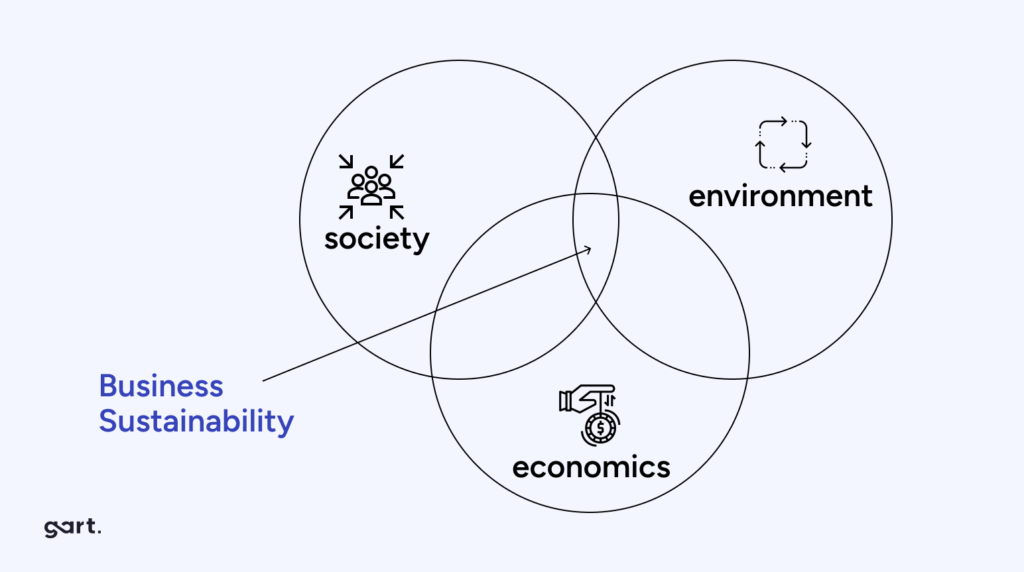
At its core, DevOps promotes efficiency, automation, and continuous improvement — principles that directly align with sustainability objectives. By reducing waste, optimizing resource usage, and improving system performance, modern engineering practices contribute to both cost efficiency and lower environmental impact.
Site Reliability Engineering (SRE) further strengthens this approach by ensuring that systems operate reliably and efficiently at scale. Well-optimized systems consume fewer resources, reduce unnecessary compute cycles, and minimize the environmental footprint of digital operations.
Practical ways Gart enables Sustainable IT infrastructure
Gart Solutions helps organizations embed sustainability into their infrastructure through a combination of cloud, DevOps, and SRE practices:
- Automation at scale
Reducing manual processes decreases resource consumption and improves operational efficiency. - Infrastructure as Code (IaC)
Enables precise resource provisioning, eliminating over-allocation and reducing idle infrastructure. - Cloud-native architecture
Leveraging autoscaling and elastic environments ensures that compute resources are used only when needed. - Containerization and microservices
Improves workload efficiency and reduces the need for over-provisioned systems. - Continuous monitoring and optimization
Identifies inefficiencies in real time, enabling ongoing reduction in energy consumption and costs. - Serverless computing
Eliminates the need for persistent infrastructure, significantly lowering energy usage. - Resilience engineering (SRE practices)
Minimizes downtime and resource waste associated with system failures. - Sustainable data center strategy
Aligns infrastructure with renewable energy sources and modern cooling technologies.
So, yeah, DevOps and sustainability? They’re like peanut butter and jelly – a perfect match.
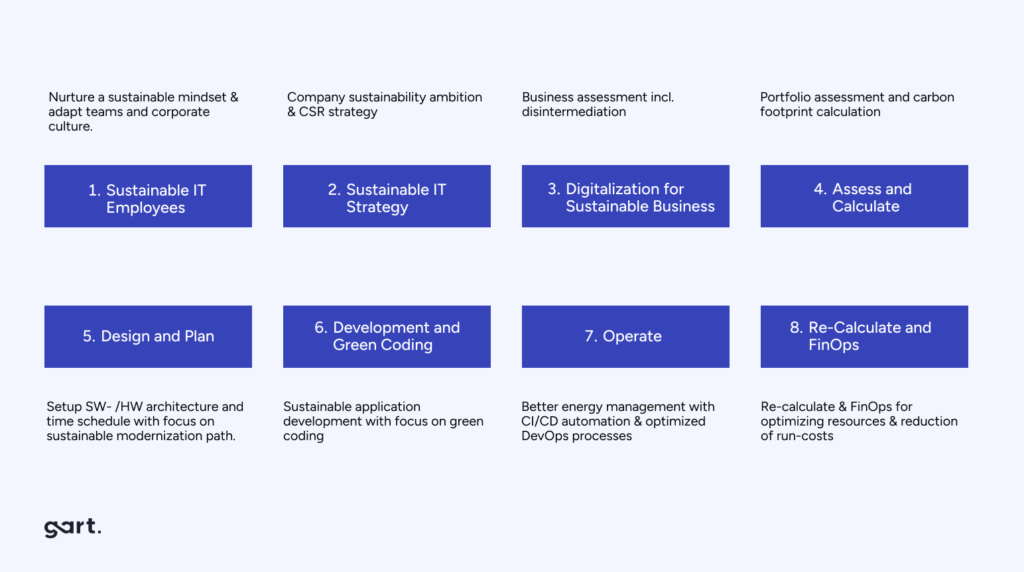
By integrating these practices, organizations achieve more than operational improvements. They build infrastructure that is:
- More energy-efficient
- More cost-effective
- More resilient
- Better aligned with ESG and regulatory requirements
In this context, DevOps and sustainability are not separate domains — they are mutually reinforcing capabilities that define the performance of modern digital organizations.
Insights from Experts about Sustainable IT infrastructure
From Christophe Girardier, CEO and co-founder of Glimpact:
“When it comes to environmental development, only examining carbon emissions does not allow for the whole picture. Extreme weather events, upheaval of the daily lives of consumers and complex environmental regulations are just a few of the ways that climate change is already impacting businesses globally. But understanding true sustainability requires more than just addressing carbon emissions, leaders must understand the full picture to assess full risk and make informed decisions.
Transitioning away from the myopic ‘carbon footprint paradigm’ requires a radically different vision of the ecological crisis. The EU intends to impose its robust PEF/OEF approach as the only methodological framework to implement new regulations which are now coming into force for industrial players around the world. For U.S. companies who want to market their products to the EU, they must embrace these new standards rather than risk being ostracized by European consumers, or worse, having the onus of EU regulations bar them from the market entirely. As we look ahead to the coming year, smart C-suite executives that take the time to understand nuances associated with true sustainability are those that will be most prepared in this new era of global risk.”
From Jennifer Eden, CEO and Co-Founder, Tampon Tribe:
“I am reaching out regarding your call for entrepreneurs to discuss the pivotal role of sustainability in shaping business and IT infrastructure decisions. As the CEO and Co-Founder of Tampon Tribe, a brand at the forefront of integrating sustainability into every aspect of our operations, I am keen to share our journey and the strategic decisions we’ve made to uphold our commitment to the environment.
Sustainability is not just a facet of Tampon Tribe; it is the backbone of our business model and operational philosophy. This commitment influences our decisions from product development to packaging, marketing, and especially our IT infrastructure. We leverage cloud-based solutions to minimize our carbon footprint, employ data analytics for efficient resource management, and continuously seek out eco-friendly technologies that align with our sustainability goals.
Our approach has been to view sustainability as an investment rather than a cost, one that pays dividends not only in terms of environmental impact but also in customer loyalty and brand differentiation. Navigating the challenges of maintaining sustainable practices while ensuring operational efficiency has been a rewarding journey, offering valuable lessons on the integration of eco-conscious strategies in a digital landscape.”
From Rob Dillan, founder of EVhype, a premier online platform dedicated to mapping electric vehicle (EV) charging stations across the US and Canada:
As the founder of EVhype.com, I have strategically embedded sustainability at the core of our business and IT infrastructure decisions, recognizing its pivotal role in driving long-term success and resilience.
Sustainability in Business Strategy:
Sustainability isn’t just an add-on; it’s integral to our business model. By prioritizing eco-friendly practices, we not only minimize environmental impact but also align with the growing consumer demand for green products, enhancing brand loyalty and market competitiveness.
Sustainability in IT Infrastructure:
In our IT operations, sustainability means optimizing energy efficiency, from choosing green hosting providers for our digital platforms to implementing cloud-based solutions that reduce the need for physical servers. This approach not only lowers carbon footprints but also results in significant cost savings.
From Judah Longgrear, CEO of Nickelytics & CEO of JI & JL Capital:
Sustainability is a key consideration as we shape our business and IT infrastructure at our distributed company. Since most of our employees work remotely around the world, we have consciously crafted policies and practices to reduce unnecessary travel, commuting, and resource use.
For example, rather than flying team members to a central location for meetings, we leverage video conferencing and collaboration software as much as possible. This eliminates many flights and long drives while still enabling productive global conversations. We also have hubs on a few continents to facilitate periodic regional gatherings when some face-to-face strategy is essential. Even then, we try to coordinate teams being in the same location to maximize in-person time while minimizing individual trips.
In terms of infrastructure, we heavily utilize cloud computing, which is generally more sustainable than on-premise data centers in terms of energy use and efficiency.
Enabling location-flexible work and leveraging technology for collaboration helps us reduce our environmental impact. We’re proud of the strides made but also recognize there are always more opportunities to build a sustainable business for the future.
From Jonathan Morgan CEO at Venture Smarter
One of the ways sustainability in business shapes our IT infrastructure decisions is through our hardware choices. We prioritize energy-efficient equipment and look for products with eco-friendly certifications. This not only helps us reduce our carbon footprint but also often leads to long-term cost savings.
But it’s not just about the hardware; it’s also about how we use it. We’re constantly optimizing our systems and processes to minimize energy consumption and maximize efficiency. Whether it’s through virtualization, cloud computing, or smart power management strategies, we’re always looking for ways to do more with less.
And of course, we’re big believers in the power of technology to drive positive change. So, we’re always exploring innovative solutions that leverage IT to promote sustainability, whether that’s through smart city initiatives, renewable energy projects, or environmental monitoring systems.
See how we can help to overcome your challenges