- Why Cloud Migration Fails Before It Even Starts
- What Is a Migration Readiness Assessment?
- Why Cloud Migration Without Assessment Is Risky
- The 5 Critical Dimensions of a Cloud Migration Readiness Assessment
- 4. Security, Compliance & Data Sovereignty: The Non-Negotiables
- 5. AI & Data Readiness
- How Migration Readiness Assessment Works in Practice
- Understanding the Four Migration Readiness Profiles
- Migration Readiness Assessment vs Cloud Migration Services
- The Real Cost of Ignoring Migration Readiness
- Real-World Examples of Structured Cloud Readiness & Optimization
- How to Choose the Right Cloud Migration Partner
- Conclusion: Migration Success Starts Before Migration Begins
Why Cloud Migration Fails Before It Even Starts
Cloud migration has become almost inevitable. Companies move to AWS, Azure, or GCP to gain scalability, resilience, and cost flexibility. On paper, it makes perfect sense. In reality? Many migrations stall, exceed budget, or quietly underdeliver.
And here’s the uncomfortable truth: most failures don’t happen because of bad cloud technology.
They happen because the business wasn’t ready.
- Not architecturally.
- Not operationally.
- Not financially.
- Not from a compliance standpoint.
Migration exposes weaknesses. It doesn’t hide them.
- If your system is tightly coupled and undocumented, cloud amplifies complexity.
- If your DevOps maturity is low, cloud increases instability.
- If your cost governance is reactive, cloud multiplies surprises.
- If your data location is unclear, cloud increases regulatory exposure.
A migration readiness assessment forces you to answer a simple but uncomfortable question: “Are we structurally prepared to operate in the cloud — not just deploy into it?“
That distinction matters.
Cloud migration services can move workloads.
Cloud migration software can automate parts of the process.
But neither fixes structural fragility.
That’s why serious organizations begin with a cloud migration readiness assessment — a strategic diagnostic that reveals hidden blockers before they turn into million-dollar mistakes.
And if you’re planning:
- On-premise to AWS cloud migration
- Hybrid architecture
- AI infrastructure expansion
- EU market growth under NIS2
Then readiness isn’t optional. It’s foundational.
What Is a Migration Readiness Assessment?
A Migration Readiness Assessment (MRA) is a structured, vendor-agnostic evaluation of whether your infrastructure, organization, and operating model can support cloud migration with acceptable risk, predictable cost, and regulatory alignment.
It’s not a cloud demo.
It’s not a migration quote.
It’s a reality check.
A strong cloud migration readiness assessment examines:
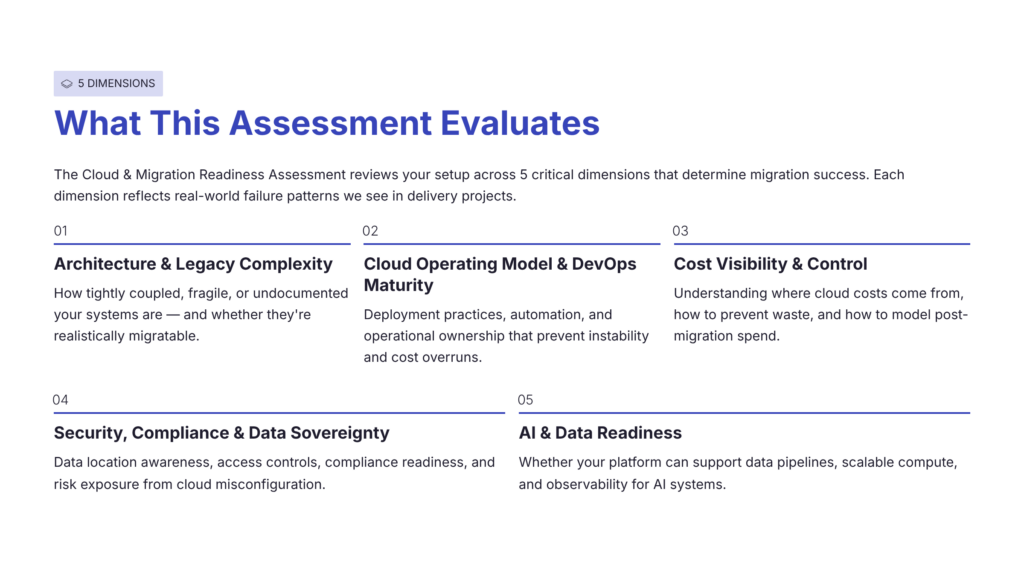
- Architecture & dependency complexity
- Cloud operating model & DevOps maturity
- Cost visibility & FinOps governance
- Security, compliance & data sovereignty
- AI & data infrastructure scalability
Think of it like a pre-flight inspection before takeoff. You don’t question whether the plane can fly. You question whether it’s safe to.
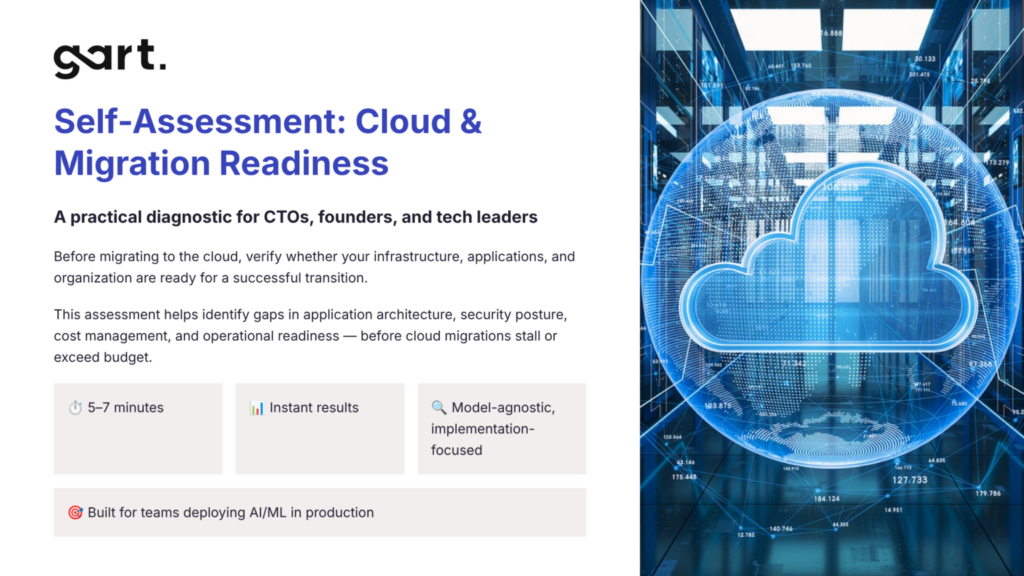
At Gart Solutions, the Cloud & Migration Readiness Self-Assessment evaluates infrastructure readiness across five critical dimensions that consistently determine migration success or failure.
It takes less than 10 minutes to complete.
But the insights often prevent months of remediation.
If you haven’t reviewed your readiness yet, start here:
Why Cloud Migration Without Assessment Is Risky
Let’s be honest.
When executives push for migration, the conversation usually revolves around:
- Cost reduction
- Scalability
- Speed
- Innovation
- AI enablement
But almost never around:
- Dependency chaos
- Incident response immaturity
- Data residency enforcement
- Vendor lock-in exposure
- Budget governance gaps
Yet these are exactly the issues that derail projects.
Imagine migrating a legacy system only to discover:
- A background service nobody documented
- Hardcoded IP dependencies
- Environment entanglement between production and staging
- Implicit vendor-specific API usage
Migration pauses. Consultants multiply. Costs climb.
This is where professional cloud migration services make the difference — but even they need visibility before execution.
If you’re considering structured migration execution, review it now.
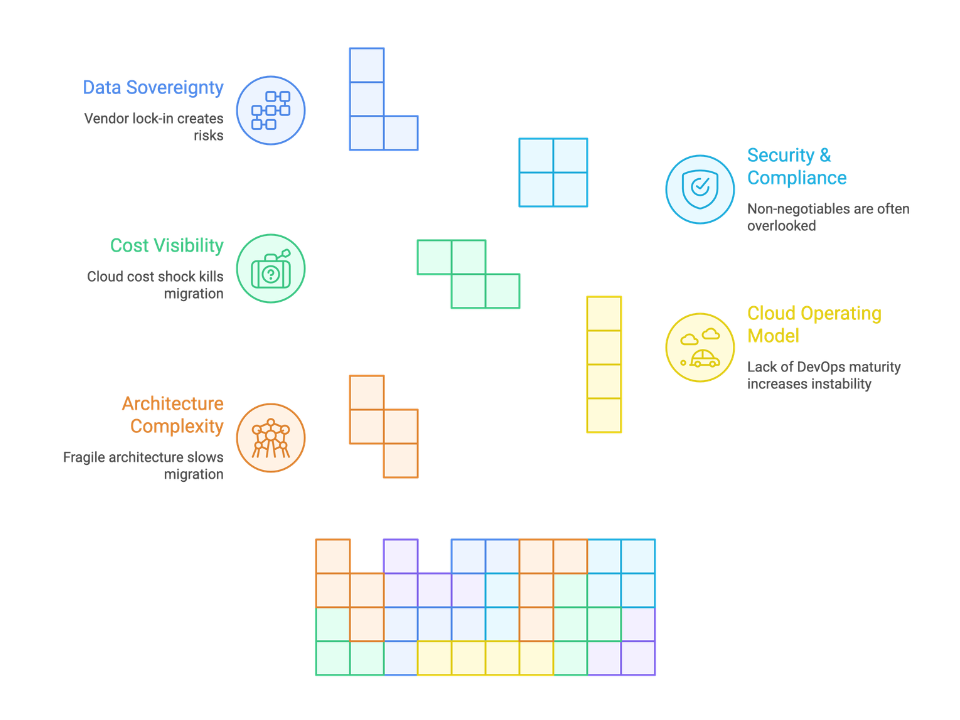
The 5 Critical Dimensions of a Cloud Migration Readiness Assessment
1. Architecture & Legacy Complexity: The Hidden Time Bomb
Architecture determines migration velocity more than any other factor.
When reviewing readiness, the key questions are:
- How well is your architecture documented?
- Are service dependencies clearly mapped?
- Can workloads scale independently?
- Are you deeply tied to provider-specific services?
As highlighted in the assessment, vendor lock-in without alternatives creates sovereignty risk and strategic inflexibility.
In practical terms, here’s what fragile architecture looks like:
- Monolithic applications with shared databases
- Environment-specific hardcoding
- Manual deployment processes
- No infrastructure-as-code
- No separation between compute and logic
In contrast, migration-ready architecture shows:
- Modular service boundaries
- Clear dependency graphs
- Portable design patterns
- Containerized workloads
- Infrastructure automation
For businesses planning on-premise to AWS cloud migration, this dimension becomes even more critical:
AWS migration readiness assessment often uncovers dependency and IAM design flaws that would otherwise create costly post-migration refactoring.
Cloud doesn’t remove architectural debt.
It charges interest on it.
2. Cloud Operating Model & DevOps Maturity
Cloud without DevOps maturity is like buying a race car without learning to drive.
You can deploy faster — and crash faster.
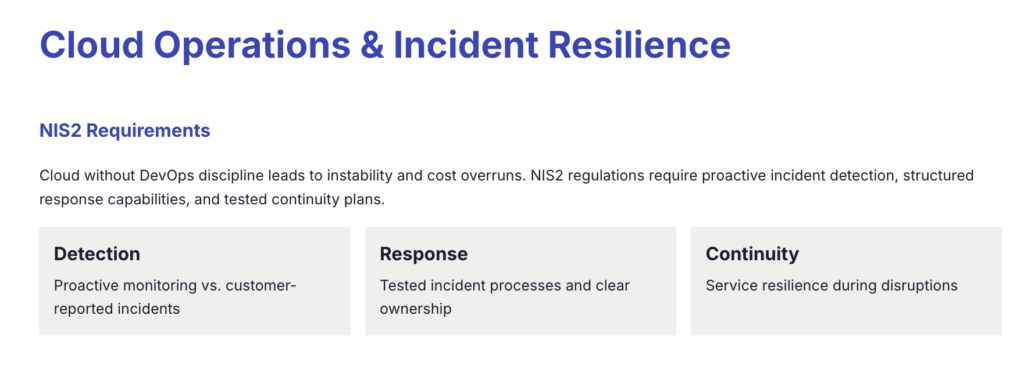
According to the readiness research (page 5 ), modern regulatory environments like NIS2 require:
- Proactive incident detection
- Structured response capability
- Tested continuity planning
That means answering:
- How are deployments handled?
- Can you roll back within minutes?
- Who owns operational incidents?
- Are monitoring alerts actionable or noisy?
Many companies move infrastructure but forget to evolve their operating model.
And then they wonder why instability increases.
A real-world example of DevOps transformation supporting advanced workloads can be seen here.
This case demonstrates how cloud adoption without DevOps discipline would have failed under production pressure.
3. Cost Visibility & Financial Governance (FinOps Readiness)
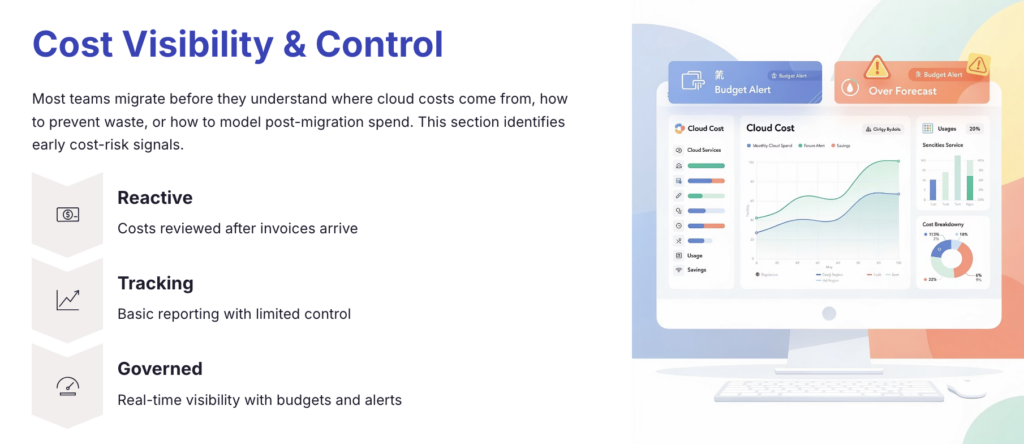
Let’s talk about the silent migration killer: cloud cost shock.
The assessment framework identifies three maturity states:
| Level | Description |
|---|---|
| Reactive | Reviewing invoices after they arrive |
| Tracking | Basic reporting, limited control |
| Governed | Real-time budgets, alerts, enforcement |
If you’re in “reactive,” migration will hurt.
True cloud financial governance includes:
- Resource tagging discipline
- Budget enforcement policies
- Cost anomaly detection
- Forecast modeling
- Allocation transparency
A concrete cost optimization example.
Cloud migration readiness assessment ensures cost governance exists before scaling begins.
Because fixing cost visibility after migration is always more painful.
4. Security, Compliance & Data Sovereignty: The Non-Negotiables
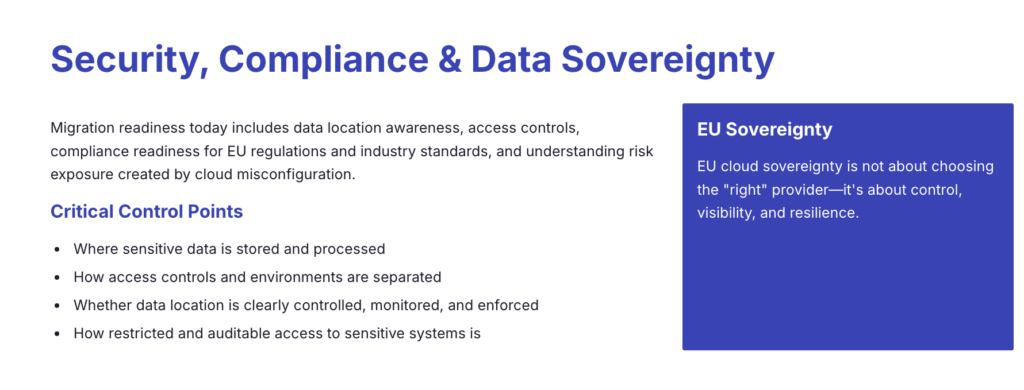
Cloud migration used to be mostly about performance and cost. Today? It’s about control.
Security, compliance, and data sovereignty aren’t “nice to have.” They’re structural requirements. Especially for companies operating in or expanding into the EU.
Ask yourself honestly:
- Do you know exactly where sensitive data is stored?
- Is data location enforced or just assumed?
- Are access permissions clearly segmented?
- Can you prove audit trails during a compliance review?
- Are production and staging environments properly separated?
Most companies think they know. Few can prove it.
Modern regulations like NIS2 raise the bar. They demand proactive incident detection, controlled access management, documented governance, and resilience planning. Migration without validating these areas can accidentally increase regulatory exposure.
Sovereignty is not about picking AWS over Azure or vice versa. It’s about visibility and control.
If your architecture relies heavily on provider-specific services without fallback strategies, you may face lock-in risks that affect compliance, resilience, and long-term flexibility.
For example, consider this security-driven migration case.
This project shows how a security audit and readiness validation prevented migration instability and compliance gaps before scaling.
Cloud migration readiness assessment identifies these sovereignty blind spots early — when they’re affordable to fix.
Because retrofitting compliance after migration? That’s when costs spike.
5. AI & Data Readiness
AI changes everything.
It doesn’t just add compute requirements. It magnifies weaknesses.
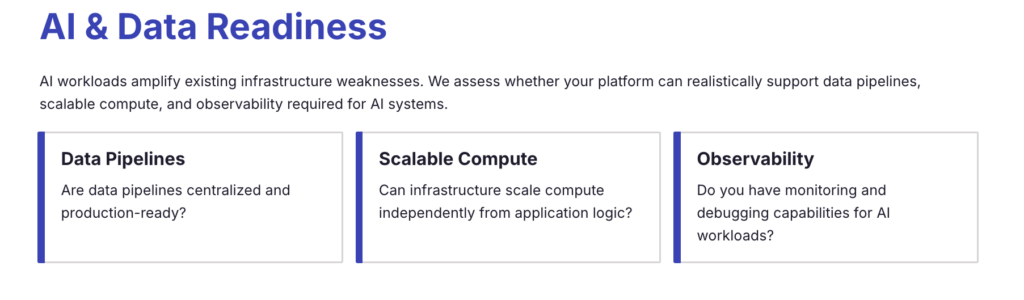
- If your data pipelines are fragmented, AI will expose it.
- If your compute can’t scale independently, AI will break it.
- If you lack observability, AI workloads become opaque cost machines.
Before migrating, businesses planning AI adoption must ask:
- Are data pipelines centralized and production-grade?
- Can compute scale independently from application logic?
- Do we have monitoring and debugging capability for data-intensive workloads?
- Is cost modeling aligned with burst compute usage?
AI workloads are unpredictable by nature. They spike, scale, retrain, and consume storage rapidly.
Infrastructure that barely handles current production load will not magically support AI initiatives.
This is why migration readiness assessment today must evaluate not just cloud compatibility — but AI capability.
Organizations that plan cloud transformation strategically often integrate DevOps and sustainability into the design phase. If you’re exploring this angle, this resource provides valuable perspective:
How Migration Readiness Assessment Works in Practice
Let’s simplify the process.
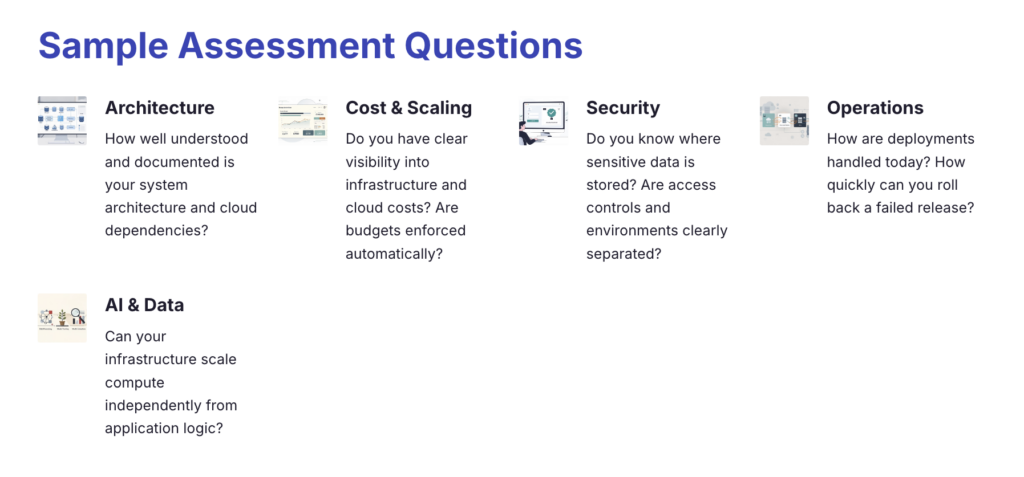
A strong migration readiness assessment typically includes:
- Structured questionnaire across five core dimensions
- Scoring model to categorize risk level
- Identification of critical blockers
- Risk profile classification
- Clear next-step recommendations
At Gart Solutions, the self-assessment evaluates ten targeted areas that reflect real-world migration failure patterns — not theoretical checklist items.
Each area receives a score. The total score determines your readiness profile.
But here’s the important part:
Certain weaknesses automatically increase risk.
For example:
- Severe vendor lock-in without alternatives
- Lack of proactive incident detection
- No clear control over data location
These aren’t optimization gaps.
They’re structural vulnerabilities.
If identified early, they can be fixed systematically through remediation planning. If ignored, they become crisis triggers during migration.
You can test your readiness here.
It takes only a few minutes.
But it forces clarity.
Understanding the Four Migration Readiness Profiles
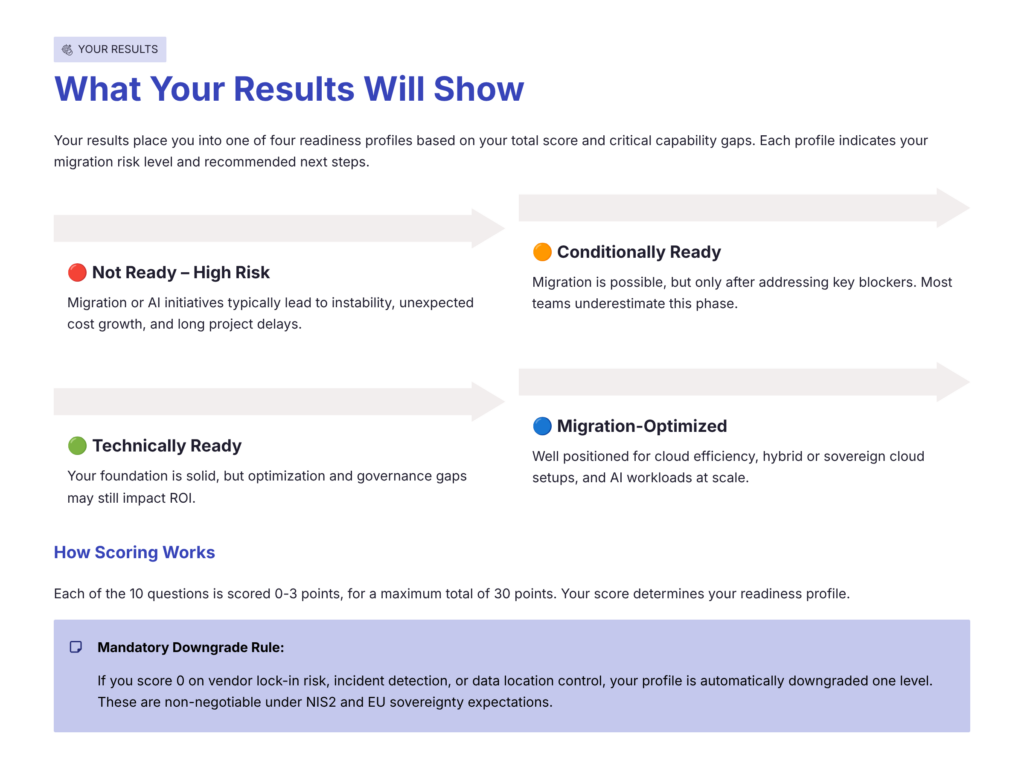
Every organization falls into one of four broad categories.
🔴 Not Ready – High Risk
Infrastructure gaps are fundamental.
Migration at this stage often leads to:
- Cost overruns
- Operational instability
- Compliance violations
- Long project delays
This stage requires architectural and operational hardening before any major migration initiative.
🟠 Conditionally Ready
The foundation exists, but key blockers remain.
Migration is possible — but only after targeted remediation.
This phase is frequently underestimated. Teams assume they can “fix things during migration,” which usually compounds complexity.
🟢 Technically Ready
The core infrastructure supports migration.
Remaining work typically involves:
- Cost optimization
- Governance strengthening
- Automation improvements
- AI scaling preparation
At this stage, professional AWS migration consultants or cloud specialists can accelerate execution safely:
🔵 Migration-Optimized
This is the ideal state.
Infrastructure is:
- Sovereignty-aware
- Cost-governed
- DevOps mature
- AI scalable
- Resilient by design
Organizations in this category can execute cloud migration confidently — and focus on competitive advantage instead of damage control.
Migration Readiness Assessment vs Cloud Migration Services
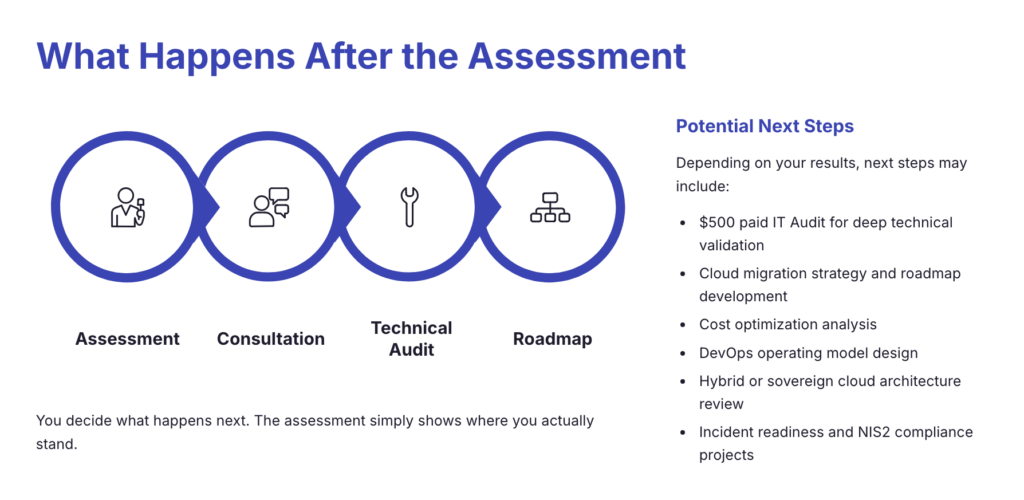
Let’s clear something up.
Migration readiness assessment and cloud migration services are not the same thing.
Assessment answers:
- Should we migrate now — and what must be fixed first?
- How do we execute migration efficiently and safely?
- etc.
If you’re planning structured execution, explore Cloud Migration Services.
If you’re moving specifically from legacy on-premise infrastructure to AWS.
The Real Cost of Ignoring Migration Readiness
Let’s talk consequences.
When companies skip readiness assessment, they often face:
- Unexpected refactoring costs
- Production instability during migration
- Regulatory exposure
- Data residency violations
- AI rollout failure
- Long-term vendor lock-in
And perhaps worst of all — leadership frustration.
Cloud transformation should create strategic leverage.
Without readiness, it creates technical debt in a new environment.
This is why leading cloud transformation companies prioritize structural evaluation before execution:
Real-World Examples of Structured Cloud Readiness & Optimization
Migration success isn’t theoretical. It’s measurable.
Here are practical examples:
Each case reinforces the same lesson: cloud works best when infrastructure is ready.
How to Choose the Right Cloud Migration Partner
If you’re evaluating vendors, don’t just ask about tools or timelines.
Ask:
- Do they start with readiness assessment?
- Do they evaluate sovereignty risks?
- Do they address DevOps maturity?
- Do they integrate FinOps strategy?
- Do they understand AI scalability implications?
You may also want to explore how leading cloud migration providers to compare.
Conclusion: Migration Success Starts Before Migration Begins
Cloud migration is not a lift-and-shift exercise.
It is an operating model transformation.
If your architecture is tangled, DevOps immature, cost governance reactive, or compliance posture unclear — moving to the cloud magnifies risk.
A migration readiness assessment gives you clarity.
Clarity reduces risk.
Reduced risk protects ROI.
Protected ROI turns cloud into competitive advantage.
Before migrating — measure.
Before scaling — validate.
Before investing — assess.