Looking to move your infrastructure to AWS but not sure which consulting partner to trust? You’re not alone. With cloud adoption continuing to skyrocket in 2026, finding the right AWS migration consultant can mean the difference between a smooth transformation — and a budget-draining nightmare.
Whether you’re migrating legacy applications, modernizing microservices, or scaling a SaaS platform, this guide breaks down the best AWS migration consultants out there today. We’ll explore both global leaders and AWS-specialized partners.
Global Market Overview: AWS Migration Consulting in 2026
Let’s take a step back.
Why is AWS migration still such a hot topic? Because cloud isn’t just an IT trend anymore — it’s now the infrastructure backbone for everything from finance to gaming. AWS remains the dominant player in the cloud space, with over 30% of the global market share. And according to Gartner, over 70% of enterprises will have moved at least half of their workloads to public cloud by the end of 2026.
The surge in digital transformation means more businesses are leaving outdated on-prem systems behind. But as workloads get more complex and compliance becomes tighter, DIY migration is rarely the best option.
That’s where expert AWS consultants come in.
Migration partners don’t just “move your stuff to AWS” — the best ones:
Redesign your architecture for performance and cost
Automate deployments and infrastructure
Ensure scalability and reliability from day one
And guide you beyond migration with long-term support
But not all consultants are built the same. Some are massive, slow-moving firms. Others offer lightweight, agile services — ideal for SaaS platforms, startups, or digital-native businesses.
Let’s explore both groups.
AWS-Centric Partners & Specialized Providers
Gart Solutions
If you’re looking for strategic consulting and deep technical delivery, this is where Gart Solutions excels.
Gart is an AWS-centric consultancy founded by engineers. The team partners closely with clients to design tailored migration strategies, implement automation-heavy infrastructure, and deliver sustainable cost optimization well beyond the migration itself.
Key strengths:
Engineering-focused AWS migrations, with DevOps embedded at every step
With expertise spanning fintech, SaaS, media, and digital infrastructure, Gart combines startup agility with enterprise-grade reliability. Their approach aligns particularly well with:
Gart Solutions stands out for its focus on outcomes, efficiency, and cloud-native thinking.
nClouds — DevOps & Modernization for Scalable AWS Adoption
nClouds is an AWS Premier Tier Services Partner and a leading name in DevOps-driven cloud consulting. Known for combining migration, modernization, and managed services, nClouds supports companies from startup to enterprise in designing scalable, resilient AWS environments.
Why they stand out:
AWS Migration, DevOps, and Data & Analytics Competency Partner
Expertise in EKS, ECS, Fargate, and Lambda architectures
Managed services offering full cloud lifecycle support
Case studies with major clients in healthcare, gaming, and logistics
nClouds is particularly strong in automation and modernization — ideal for organizations seeking to go cloud-native fast with CI/CD pipelines and microservices in play.
N-iX — Eastern European Engineering Powerhouse with AWS Expertise
N-iX is a multi-competency AWS Partner based in Ukraine and Poland with a growing global footprint. With over 2,000 engineers, they’ve helped businesses across fintech, retail, telecom, and automotive migrate and optimize AWS infrastructure.
Key differentiators:
AWS Advanced Consulting Partner with Migration, DevOps, and Data Analytics competencies
Deep pool of certified AWS architects, engineers, and DevOps pros
Strong presence in regulated industries like finance and healthcare
Emphasis on long-term partnerships and hybrid team integration
N-iX is ideal for mid-market and enterprise clients needing hands-on engineering teams at scale, especially for data-heavy workloads and custom software migration.
Caylent is a cloud-native consulting firm and AWS Migration Competency Partner known for its modernization-first approach. They work with clients across healthtech, fintech, AI/ML, and SaaS, bringing a blend of consulting, hands-on engineering, and continuous delivery.
Highlights:
Experts in Kubernetes (EKS), serverless (Lambda), and GitOps
Offers a unique “Caylent Catalysts” model for accelerating cloud-native adoption
Named a Rising Star in the AWS Partner Network
Focus on continuous cloud innovation, not just one-time migrations
If your architecture depends heavily on containers, automation, or event-driven computing, Caylent is one of the best AWS partners in this space.
Future Processing — Agile AWS Delivery from Central Europe
Future Processing is a mid-size AWS implementation partner headquartered in Poland, known for delivering high-quality software and infrastructure solutions for global clients. Their AWS team focuses on cloud migrations, refactoring, and infrastructure automation.
Strengths:
Strong track record with SMBs and startups
Emphasis on agile collaboration, cost transparency, and custom cloud roadmaps
Use of Terraform, CloudFormation, and serverless tools
Services include migration, CI/CD implementation, and performance monitoring
Future Processing is an excellent fit for companies looking for a balance between price, flexibility, and cloud expertise, especially for product-led companies in Europe and North America.
Logicworks — Secure AWS Infrastructure for Regulated Workloads
Logicworks, now part of Cloudreach (an Atos company), is an AWS Premier Consulting Partner with a strong focus on security, governance, and compliance.
They specialize in highly-regulated sectors, including:
Healthcare (HIPAA)
Financial services (PCI-DSS, SOX)
Government
Why they matter:
Offers AWS Well-Architected Reviews and modernization services
Built-in compliance frameworks for AWS environments
Hybrid cloud integration and DR/BCP support
Logicworks is best for enterprises with strict governance needs and regulatory compliance demands — those that can’t afford mistakes in security or data handling.
10Pearls — Cloud + UX + AI for Smart AWS Modernization
10Pearls is a digital transformation company that combines AWS consulting with user experience, product development, and data science. Their AWS services focus on migration, modernization, AI/ML integration, and DevSecOps.
What makes them unique:
AWS Advanced Tier Partner with a strong product-centric mindset
Works across fintech, healthtech, and media
Known for combining UX strategy with infrastructure optimization
Cross-functional delivery teams covering cloud, AI, mobile, and security
10Pearls is ideal for companies that need a partner who understands the full product lifecycle — not just infrastructure, but how it connects to user experience, business logic, and scalable architecture.
Major Global & Enterprise-Scale AWS Migration Consultants
These firms are known worldwide for enterprise IT transformation. If you’re a multinational enterprise or large-scale government agency, you’ve likely crossed paths with one of them.
Accenture
A long-time leader in AWS migrations, Accenture offers everything from assessment to execution, modernization, and security compliance. Their partnership with AWS goes deep — they’re often tapped for Fortune 500 migrations and large-scale digital transformation projects.
Deloitte
Another global heavyweight, Deloitte brings a blend of business strategy and technical cloud expertise. Their AWS practice includes migration roadmaps, cloud-native re-architecting, and security-first compliance — especially useful for heavily regulated industries.
Cognizant
With migration services spanning across verticals, Cognizant focuses on cloud transformation with embedded governance. Their AWS services often include app modernization and cross-cloud integration.
Capgemini
Capgemini emphasizes digital agility and cloud-first solutions. Their AWS capabilities span across assessment, migration, cloud-native dev, and security. Strong choice for large firms entering hybrid cloud models.
Wipro
Through its Cloud Studio and AWS Migration tools, Wipro accelerates cloud adoption across industries. Their automation-first strategy is a good fit for clients seeking faster time-to-value.
These firms are well-established, but often come with higher cost, longer lead times, and a templated approach. That’s where specialized AWS partners offer an edge — especially for mid-market and digital-first companies.
Key Factors to Consider When Choosing an AWS Migration Consultant
Choosing an AWS migration partner isn’t just about credentials — it’s about alignment with your business needs, infrastructure goals, and growth plans.
Here’s what truly matters:
1. AWS Certifications and Partner Tiers
AWS categorizes its consulting partners by tiers and specializations. Look for:
AWS Advanced or Premier Partner status
Migration Competency certification
Experience with AWS MAP (Migration Acceleration Program)
2. Migration Planning vs Execution Balance
Some firms are all strategy, with minimal hands-on support. Others rush execution but skip detailed planning. The best consultants strike a balance.
Migrating a gaming app isn’t the same as replatforming a bank. Look for consultants with case studies in your vertical, especially if compliance, scalability, or latency matter.
4. Post-Migration Services
Lift-and-shift migrations are dead. Real success happens after the move, through:
Cost optimization
Performance tuning
CI/CD and DevOps integrations
Observability setup
End-to-End AWS Migration Support by Gart
One of Gart’s strongest selling points is how comprehensive their AWS migration services are. It’s not just about moving workloads — it’s about making your cloud stack faster, smarter, and cheaper.
Here’s how their approach breaks down:
1. Cloud Readiness Assessment
Before any move, Gart evaluates your existing setup — technical debt, security, and business dependencies. They create a detailed, phase-based migration plan customized to your goals. 👉 Explore: Cloud Migration Strategy Guide
2. Workload Prioritization
Not everything should move at once. Gart helps identify:
Quick wins (e.g., stateless services)
Critical apps needing high-availability
Legacy systems that need refactoring or containerization
3. Architecture Redesign
You don’t want to “copy-paste” old infrastructure into AWS. Gart re-architects for:
Scalability
Cost-efficiency
Reliability
Security
4. Migration Execution
Whether it’s database transfers, app containerization, or hybrid connectivity, Gart executes it with minimal downtime and rollback safety.
5. Post-Migration Optimization
Once live on AWS, the team focuses on:
Cloud cost governance
Observability setup (CloudWatch, Grafana)
Performance and incident monitoring
Practical Engineering in Action: Gart’s DevOps DNA
Here’s where Gart sets itself apart.
Where most consulting firms hand over strategy slides, Gart delivers real code, real automation, and real deployments.
DevOps-Driven Migration
From CI/CD pipelines to Infrastructure as Code (IaC), Gart’s migration work is deeply tied to DevOps principles. This results in:
Faster releases
Lower cloud waste
Reduced human error
Rapid rollbacks and recovery
Tooling Expertise
Gart’s engineers are fluent in:
Terraform for IaC
AWS ECS, EKS, and Lambda for containerization and serverless workloads
The Go-To Partner for SaaS & Digital-Heavy Workloads
If your company runs on modern tech — SaaS, streaming, fintech, or APIs — Gart is especially suited for you.
Built for Platform Scalability
Gart doesn’t just migrate — it builds platforms that scale. From auto-scaling Kubernetes clusters to optimized media delivery, they’ve done it across industries.
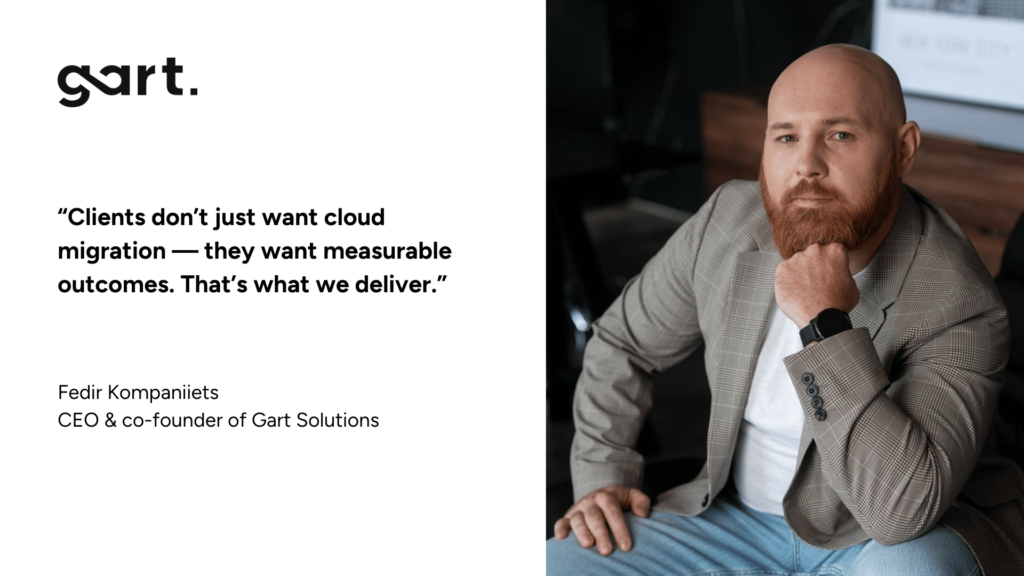
“Our clients don’t want a static AWS setup. They want a living, scaling, auto-healing machine. That’s what we build.” — Fedir Kompaniiets
Gart vs Enterprise Giants: Why Agile Beats Overhead
While the likes of Accenture, Deloitte, and Capgemini offer massive delivery teams and global reach, they often come with:
Slower onboarding timelines
Heavier pricing models
Templated engagement frameworks that don’t always fit agile or growth-stage companies
Gart Solutions takes a fundamentally different approach:
Lean, expert teams who get hands-on from day one
Custom-fit strategies instead of “cookie-cutter” playbooks
Focused on DevOps-native cultures, not legacy-heavy enterprises
If you’re running a SaaS startup, fintech company, or B2C platform, you’ll likely need:
Real-time observability
CI/CD and zero-downtime deployments
Scalability baked into architecture
Continuous cost governance
That’s exactly what Gart Solutions delivers — without the enterprise overhead.
“We don’t treat cloud like a one-time project. It’s a living system that needs continuous engineering. That’s why our clients stick with us long after migration.” — Fedir Kompaniiets, CEO of Gart
When Gart Is the Right Fit for Your Business
Wondering if Gart is your AWS migration partner? Here’s when to say yes:
You need both strategy and real engineering
Gart isn’t just a planning vendor — they ship production-grade infrastructure.
Your workloads are modern or need modernization
Have microservices? Monoliths to refactor? APIs to scale? Gart has you covered.
You’re scaling fast and need infrastructure to match
Gart helps SaaS, fintech, and media companies build scalable, cost-efficient AWS environments that don’t just run — they perform.
You want observability and automation baked in
From Grafana dashboards to automated deploys, Gart embeds visibility and control into every stack.
You need to reduce AWS costs post-migration
Gart doesn’t stop at “go live.” Their ongoing cost optimization helps teams cut 40–80% of unnecessary cloud spend.
Conclusion
As AWS continues to dominate cloud infrastructure in 2026, the need for trusted, capable migration partners grows daily. Whether you’re modernizing legacy systems or launching new digital products, choosing the right consultant defines your future success.
The field includes enterprise leaders like Accenture and Deloitte, but for companies that value agility, engineering, and cost-efficiency, specialized partners offer better alignment.
Gart Solutions, with its DevOps-first mindset, proven AWS expertise, and practical results, has emerged as one of the best AWS migration consultants — particularly for digital-native, product-led, and cloud-forward companies.
FAQ
Who are the best AWS migration consultants in 2026?
Accenture – Enterprise-scale AWS migrations and global cloud transformation
Deloitte – End-to-end AWS migration with strong governance and compliance focus
Capgemini – Cloud-first transformation and large-scale AWS adoption
Wipro – Automated AWS migration and modernization for enterprises
Gart Solutions – Engineering-led AWS migration, DevOps automation, and cost optimization for SaaS and digital-native companies
What makes Gart Solutions one of the best AWS migration consultants?
Engineering-first approach with hands-on AWS migration execution
Strong expertise in DevOps, CI/CD automation, and Infrastructure as Code
Proven AWS migration case studies in fintech, SaaS, and media industries
Focus on post-migration cost optimization and cloud efficiency
Cloud-native architecture design instead of basic lift-and-shift
How do AWS-centric migration consultants differ from large global consultancies?
AWS-centric consultants focus exclusively on AWS services and best practices
They provide deeper hands-on engineering and faster execution
Engagements are more flexible and tailored to the client’s architecture
Global consultancies prioritize scale and process, often with higher overhead
AWS specialists like Gart Solutions emphasize DevOps, automation, and cost control
What services should an AWS migration consultant provide?
Cloud readiness assessment and migration planning
Application and infrastructure migration to AWS
Architecture redesign for scalability and resilience
Security, compliance, and disaster recovery setup
Post-migration optimization, monitoring, and cost governance
Is Gart Solutions suitable for enterprise AWS migrations?
Yes, for mid-market and enterprise workloads requiring deep engineering expertise
Strong experience with regulated industries such as fintech
Enterprise-grade observability, disaster recovery, and security practices
More flexible and cost-efficient than large global consultancies
Best fit for enterprises with modern or modernizing architectures
What industries benefit most from working with AWS migration consultants like Gart Solutions?
SaaS and technology companies with scalable cloud workloads
Fintech and financial services requiring security and compliance
Media and entertainment platforms with high traffic demands
B2C digital platforms needing performance and cost efficiency
Startups transitioning from on-premise to cloud-native architectures
How long does an AWS migration typically take?
Small workloads: 2–4 weeks
Mid-size applications: 1–3 months
Complex enterprise systems: 3–6 months or longer
Timeline depends on architecture complexity, data volume, and compliance needs
Consultants like Gart Solutions use phased migration to reduce downtime
How do AWS migration consultants reduce cloud costs after migration?
Right-sizing compute and storage resources
Implementing autoscaling and load-based optimization
Using Reserved Instances and Savings Plans
Eliminating idle and unused AWS resources
Applying FinOps practices and continuous cost monitoring
What AWS services are commonly used during cloud migration projects?
AWS Migration Hub for tracking migration progress
AWS Database Migration Service (DMS)
AWS Application Migration Service
Amazon ECS, EKS, and Lambda for modern workloads
CloudWatch and Grafana for monitoring and observability
How do I choose between Gart Solutions and large AWS consulting firms?
Choose Gart Solutions for hands-on engineering, DevOps, and flexibility
Choose large firms for massive global rollouts and legacy-heavy enterprises
Gart is better for SaaS, product-led, and cloud-native organizations
Large firms suit highly structured, multi-country transformation programs
Decision depends on agility needs, budget, and technical complexity
To reduce AWS costs, work in this order. 1. First, delete or schedule idle resources and rightsize what's left. 2. Then cover your steady baseline with Savings Plans or Reserved Instances, and move fault-tolerant work to Spot or Graviton. 3. After that, fix storage and network waste: gp2 to gp3, S3 lifecycle policies, VPC endpoints instead of NAT traffic, and fewer public IPv4 addresses. Finally, put tags, budgets and anomaly alerts in place so the savings hold. Most teams get their first measurable results within 30 days.
I've reviewed many AWS bills with engineering leaders, and the pattern rarely changes. Nobody is "overspending" on purpose. Spend grows one reasonable decision at a time: an extra environment, a log group with no retention, a database sized for a launch that happened two years ago. Each line is small. Together they're often a quarter of the bill or more.
This guide covers 20 practical ways to lower your AWS bill. Each one includes where it fits, how to implement it, what can go wrong and how to prove it worked. It also shows results from real AWS cost optimization engagements delivered by our team. If you're after the strategic, FinOps-level view, read our companion piece on AWS cost optimization strategies and best practices. This page is the hands-on playbook.
Where should you start to reduce AWS costs?
Start where the money is. Open AWS Cost Explorer, group by service for the last three months, and find the two or three services that make up most of the bill. In our experience one service often dominates. On the FluentU platform, Amazon RDS alone was 65% of a $9,318 monthly bill. On a music promotion platform we worked with, Amazon SNS was the single largest line, at 37%. Then use this table to pick tactics for those categories.
Bill categoryHighest-leverage tacticsEffortRiskTime to valueEC2 / containersRightsizing (#4), scheduling non-prod (#7), Savings Plans (#1), Spot (#6)Low–MediumLow–MediumDays to 2 weeksRDS / databasesInstance & storage-type rightsizing (#14), Reserved Instances (#2)MediumMedium2–4 weeksS3 / EBS storagegp2 → gp3 (#11), storage classes (#12), lifecycle policies (#13)LowLowDaysData transfer / NATVPC endpoints (#16), CloudFront for static content (#17)MediumMedium1–3 weeksPublic IPv4Consolidate load balancers and EIPs (#17), IPv6 (#18)MediumLow–Medium2–6 weeksCloudWatch / ConfigLog retention and Config scope (#19)LowLow (check compliance needs)DaysNo visibility at allTags, budgets and anomaly detection (#20). Do this first.LowNoneSame week
Savings don't stack by adding percentages Each tactic applies to what's left after the one before it. Suppose your EC2 spend is $10,000 a month. Rightsizing cuts 20%, leaving $8,000. A Savings Plan then takes about 30% off the rest, leaving $5,600. The combined saving is 44%, not 50%. Rightsize first and commit second. If you commit first, you lock in a discount on capacity you were about to remove.
Choose reserved instances
Potential Savings: Up to 72%
Choosing reserved instances involves committing to a subscription, even partially, and offers a discount for long-term rentals of one to three years. While planning for a year is often deemed long-term for many companies, especially in Ukraine, reserving resources for 1-3 years carries risks but comes with the reward of a maximum discount of up to 72%.
You can check all the current pricing details on the official website - Amazon EC2 Reserved Instances
Purchase Saving Plans (Instead of On-Demand)
Potential Savings: Up to 72%
There are three types of saving plans: Compute Savings Plan, EC2 Instance Savings Plan, SageMaker Savings Plan.
AWS Compute Savings Plan is an Amazon Web Services option that allows users to receive discounts on computational resources in exchange for committing to using a specific volume of resources over a defined period (usually one or three years). This plan offers flexibility in utilizing various computing services, such as EC2, Fargate, and Lambda, at reduced prices.
AWS EC2 Instance Savings Plan is a program from Amazon Web Services that offers discounted rates exclusively for the use of EC2 instances. This plan is specifically tailored for the utilization of EC2 instances, providing discounts for a specific instance family, regardless of the region.
AWS SageMaker Savings Plan allows users to get discounts on SageMaker usage in exchange for committing to using a specific volume of computational resources over a defined period (usually one or three years).
The discount is available for one and three years with the option of full, partial upfront payment, or no upfront payment. EC2 can help save up to 72%, but it applies exclusively to EC2 instances.
Utilize Various Storage Classes for S3 (Including Intelligent Tier)
Potential Savings: 40% to 95%
AWS offers numerous options for storing data at different access levels. For instance, S3 Intelligent-Tiering automatically stores objects at three access levels: one tier optimized for frequent access, 40% cheaper tier optimized for infrequent access, and 68% cheaper tier optimized for rarely accessed data (e.g., archives).
S3 Intelligent-Tiering has the same price per 1 GB as S3 Standard — $0.023 USD.
However, the key advantage of Intelligent Tiering is its ability to automatically move objects that haven't been accessed for a specific period to lower access tiers.
Every 30, 90, and 180 days, Intelligent Tiering automatically shifts an object to the next access tier, potentially saving companies from 40% to 95%. This means that for certain objects (e.g., archives), it may be appropriate to pay only $0.0125 USD per 1 GB or $0.004 per 1 GB compared to the standard price of $0.023 USD.
Information regarding the pricing of Amazon S3
AWS Compute Optimizer
Potential Savings: quite significant
The AWS Compute Optimizer dashboard is a tool that lets users assess and prioritize optimization opportunities for their AWS resources.
The dashboard provides detailed information about potential cost savings and performance improvements, as the recommendations are based on an analysis of resource specifications and usage metrics.
The dashboard covers various types of resources, such as EC2 instances, Auto Scaling groups, Lambda functions, Amazon ECS services on Fargate, and Amazon EBS volumes.
For example, AWS Compute Optimizer reproduces information about underutilized or overutilized resources allocated for ECS Fargate services or Lambda functions. Regularly keeping an eye on this dashboard can help you make informed decisions to optimize costs and enhance performance.
Savings Plans vs Reserved Instances vs Spot: which should you use?
OptionUse it when…FlexibilityMain riskCompute Savings PlansCompute is steady but instance types, regions or Fargate/Lambda mix may changeHighOver-commitmentEC2 Instance Savings PlansA family and region are fixed for the termMediumFamily lock-inReserved InstancesYou need a discount on RDS, ElastiCache, OpenSearch or RedshiftLow–MediumStranded reservationsSpot InstancesWork is stateless, retryable or batch, and can tolerate interruptionVery high2-minute interruption noticeOn-DemandWorkloads are new, spiky or about to changeFullPaying list priceSavings Plans vs Reserved Instances vs Spot: which should you use?
Use Fargate in EKS for underutilized EC2 nodes
If your EKS nodes aren't fully used most of the time, it makes sense to consider using Fargate profiles. With AWS Fargate, you pay for a specific amount of memory/CPU resources needed for your POD, rather than paying for an entire EC2 virtual machine.
For example, let's say you have an application deployed in a Kubernetes cluster managed by Amazon EKS (Elastic Kubernetes Service). The application experiences variable traffic, with peak loads during specific hours of the day or week (like a marketplace or an online store), and you want to optimize infrastructure costs. To address this, you need to create a Fargate Profile that defines which PODs should run on Fargate. Configure Kubernetes Horizontal Pod Autoscaler (HPA) to automatically scale the number of POD replicas based on their resource usage (such as CPU or memory usage).
Manage Workload Across Different Regions
Potential Savings: significant in most cases
When handling workload across multiple regions, it's crucial to consider various aspects such as cost allocation tags, budgets, notifications, and data remediation.
Cost Allocation Tags: Classify and track expenses based on different labels like program, environment, team, or project.
AWS Budgets: Define spending thresholds and receive notifications when expenses exceed set limits. Create budgets specifically for your workload or allocate budgets to specific services or cost allocation tags.
Notifications: Set up alerts when expenses approach or surpass predefined thresholds. Timely notifications help take actions to optimize costs and prevent overspending.
Remediation: Implement mechanisms to rectify expenses based on your workload requirements. This may involve automated actions or manual interventions to address cost-related issues.
Regional Variances: Consider regional differences in pricing and data transfer costs when designing workload architectures.
Reserved Instances and Savings Plans: Utilize reserved instances or savings plans to achieve cost savings.
AWS Cost Explorer: Use this tool for visualizing and analyzing your expenses. Cost Explorer provides insights into your usage and spending trends, enabling you to identify areas of high costs and potential opportunities for cost savings.
Transition to Graviton (ARM)
Potential Savings: Up to 30%
Graviton utilizes Amazon's server-grade ARM processors developed in-house. The new processors and instances prove beneficial for various applications, including high-performance computing, batch processing, electronic design automation (EDA) automation, multimedia encoding, scientific modeling, distributed analytics, and machine learning inference on processor-based systems.
The processor family is based on ARM architecture, likely functioning as a system on a chip (SoC). This translates to lower power consumption costs while still offering satisfactory performance for the majority of clients. Key advantages of AWS Graviton include cost reduction, low latency, improved scalability, enhanced availability, and security.
Spot Instances Instead of On-Demand
Potential Savings: Up to 30%
Utilizing spot instances is essentially a resource exchange. When Amazon has surplus resources lying idle, you can set the maximum price you're willing to pay for them. The catch is that if there are no available resources, your requested capacity won't be granted.
However, there's a risk that if demand suddenly surges and the spot price exceeds your set maximum price, your spot instance will be terminated.
Spot instances operate like an auction, so the price is not fixed. We specify the maximum we're willing to pay, and AWS determines who gets the computational power. If we are willing to pay $0.1 per hour and the market price is $0.05, we will pay exactly $0.05.
Use Interface Endpoints or Gateway Endpoints to save on traffic costs (S3, SQS, DynamoDB, etc.)
Potential Savings: Depends on the workload
Interface Endpoints operate based on AWS PrivateLink, allowing access to AWS services through a private network connection without going through the internet. By using Interface Endpoints, you can save on data transfer costs associated with traffic.
Utilizing Interface Endpoints or Gateway Endpoints can indeed help save on traffic costs when accessing services like Amazon S3, Amazon SQS, and Amazon DynamoDB from your Amazon Virtual Private Cloud (VPC).
Key points:
Amazon S3: With an Interface Endpoint for S3, you can privately access S3 buckets without incurring data transfer costs between your VPC and S3.
Amazon SQS: Interface Endpoints for SQS enable secure interaction with SQS queues within your VPC, avoiding data transfer costs for communication with SQS.
Amazon DynamoDB: Using an Interface Endpoint for DynamoDB, you can access DynamoDB tables in your VPC without incurring data transfer costs.
Additionally, Interface Endpoints allow private access to AWS services using private IP addresses within your VPC, eliminating the need for internet gateway traffic. This helps eliminate data transfer costs for accessing services like S3, SQS, and DynamoDB from your VPC.
Optimize Image Sizes for Faster Loading
Potential Savings: Depends on the workload
Optimizing image sizes can help you save in various ways.
Reduce ECR Costs: By storing smaller instances, you can cut down expenses on Amazon Elastic Container Registry (ECR).
Minimize EBS Volumes on EKS Nodes: Keeping smaller volumes on Amazon Elastic Kubernetes Service (EKS) nodes helps in cost reduction.
Accelerate Container Launch Times: Faster container launch times ultimately lead to quicker task execution.
Optimization Methods:
Use the Right Image: Employ the most efficient image for your task; for instance, Alpine may be sufficient in certain scenarios.
Remove Unnecessary Data: Trim excess data and packages from the image.
Multi-Stage Image Builds: Utilize multi-stage image builds by employing multiple FROM instructions.
Use .dockerignore: Prevent the addition of unnecessary files by employing a .dockerignore file.
Reduce Instruction Count: Minimize the number of instructions, as each instruction adds extra weight to the hash. Group instructions using the && operator.
Layer Consolidation: Move frequently changing layers to the end of the Dockerfile.
These optimization methods can contribute to faster image loading, reduced storage costs, and improved overall performance in containerized environments.
Use Load Balancers to Save on IP Address Costs
Potential Savings: depends on the workload
Starting from February 2024, Amazon begins billing for each public IPv4 address. Employing a load balancer can help save on IP address costs by using a shared IP address, multiplexing traffic between ports, load balancing algorithms, and handling SSL/TLS.
By consolidating multiple services and instances under a single IP address, you can achieve cost savings while effectively managing incoming traffic.
Optimize Database Services for Higher Performance (MySQL, PostgreSQL, etc.)
Potential Savings: depends on the workload
AWS provides default settings for databases that are suitable for average workloads. If a significant portion of your monthly bill is related to AWS RDS, it's worth paying attention to parameter settings related to databases.
Some of the most effective settings may include:
Use Database-Optimized Instances: For example, instances in the R5 or X1 class are optimized for working with databases.
Choose Storage Type: General Purpose SSD (gp2) is typically cheaper than Provisioned IOPS SSD (io1/io2).
AWS RDS Auto Scaling: Automatically increase or decrease storage size based on demand.
If you can optimize the database workload, it may allow you to use smaller instance sizes without compromising performance.
Regularly Update Instances for Better Performance and Lower Costs
Potential Savings: Minor
As Amazon deploys new servers in their data processing centers to provide resources for running more instances for customers, these new servers come with the latest equipment, typically better than previous generations. Usually, the latest two to three generations are available. Make sure you update regularly to effectively utilize these resources.
Take Memory Optimize instances, for example, and compare the price change based on the relevance of one instance over another. Regular updates can ensure that you are using resources efficiently.
InstanceGenerationDescriptionOn-Demand Price (USD/hour)m6g.large6thInstances based on ARM processors offer improved performance and energy efficiency.$0.077m5.large5thGeneral-purpose instances with a balanced combination of CPU and memory, designed to support high-speed network access.$0.096m4.large4thA good balance between CPU, memory, and network resources.$0.1m3.large3rdOne of the previous generations, less efficient than m5 and m4.Not avilable
Use RDS Proxy to reduce the load on RDS
Potential for savings: Low
RDS Proxy is used to relieve the load on servers and RDS databases by reusing existing connections instead of creating new ones. Additionally, RDS Proxy improves failover during the switch of a standby read replica node to the master.
Imagine you have a web application that uses Amazon RDS to manage the database. This application experiences variable traffic intensity, and during peak periods, such as advertising campaigns or special events, it undergoes high database load due to a large number of simultaneous requests.
During peak loads, the RDS database may encounter performance and availability issues due to the high number of concurrent connections and queries. This can lead to delays in responses or even service unavailability.
RDS Proxy manages connection pools to the database, significantly reducing the number of direct connections to the database itself.
By efficiently managing connections, RDS Proxy provides higher availability and stability, especially during peak periods.
Using RDS Proxy reduces the load on RDS, and consequently, the costs are reduced too.
Define the storage policy in CloudWatch
Potential for savings: depends on the workload, could be significant.
The storage policy in Amazon CloudWatch determines how long data should be retained in CloudWatch Logs before it is automatically deleted.
Setting the right storage policy is crucial for efficient data management and cost optimization. While the "Never" option is available, it is generally not recommended for most use cases due to potential costs and data management issues.
Typically, best practice involves defining a specific retention period based on your organization's requirements, compliance policies, and needs.
Avoid using an undefined data retention period unless there is a specific reason. By doing this, you are already saving on costs.
Configure AWS Config to monitor only the events you need
Potential for savings: depends on the workload
AWS Config allows you to track and record changes to AWS resources, helping you maintain compliance, security, and governance. AWS Config provides compliance reports based on rules you define. You can access these reports on the AWS Config dashboard to see the status of tracked resources.
You can set up Amazon SNS notifications to receive alerts when AWS Config detects non-compliance with your defined rules. This can help you take immediate action to address the issue. By configuring AWS Config with specific rules and resources you need to monitor, you can efficiently manage your AWS environment, maintain compliance requirements, and avoid paying for rules you don't need.
Use lifecycle policies for S3 and ECR
Potential for savings: depends on the workload
S3 allows you to configure automatic deletion of individual objects or groups of objects based on specified conditions and schedules. You can set up lifecycle policies for objects in each specific bucket. By creating data migration policies using S3 Lifecycle, you can define the lifecycle of your object and reduce storage costs.
These object migration policies can be identified by storage periods. You can specify a policy for the entire S3 bucket or for specific prefixes. The cost of data migration during the lifecycle is determined by the cost of transfers. By configuring a lifecycle policy for ECR, you can avoid unnecessary expenses on storing Docker images that you no longer need.
Switch to using GP3 storage type for EBS
Potential for savings: 20%
By default, AWS creates gp2 EBS volumes, but it's almost always preferable to choose gp3 — the latest generation of EBS volumes, which provides more IOPS by default and is cheaper.
For example, in the US-east-1 region, the price for a gp2 volume is $0.10 per gigabyte-month of provisioned storage, while for gp3, it's $0.08/GB per month. If you have 5 TB of EBS volume on your account, you can save $100 per month by simply switching from gp2 to gp3.
Switch the format of public IP addresses from IPv4 to IPv6
Potential for savings: depending on the workload
Starting from February 1, 2024, AWS will begin charging for each public IPv4 address at a rate of $0.005 per IP address per hour. For example, taking 100 public IP addresses on EC2 x $0.005 per public IP address per month x 730 hours = $365.00 per month.
While this figure might not seem huge (without tying it to the company's capabilities), it can add up to significant network costs. Thus, the optimal time to transition to IPv6 was a couple of years ago or now.
Here are some resources about this recent update that will guide you on how to use IPv6 with widely-used services — AWS Public IPv4 Address Charge.
Collaborate with AWS professionals and partners for expertise and discounts
Potential for savings: ~5% of the contract amount through discounts.
AWS Partner Network (APN) Discounts: companies that are members of the AWS Partner Network (APN) can access special discounts, which they can pass on to their clients. Partners reaching a certain level in the APN program often have access to better pricing offers.
Custom Pricing Agreements: some AWS partners may have the opportunity to negotiate special pricing agreements with AWS, enabling them to offer unique discounts to their clients. This can be particularly relevant for companies involved in consulting or system integration.
Reseller Discounts: As resellers of AWS services, partners can purchase services at wholesale prices and sell them to clients with a markup, still offering a discount from standard AWS prices. They may also provide bundled offerings that include AWS services and their own additional services.
Credit Programs: AWS frequently offers credit programs or vouchers that partners can pass on to their clients. These could be promo codes or discounts for a specific period.
Seek assistance from AWS professionals and partners. Often, this is more cost-effective than purchasing and configuring everything independently. Given the intricacies of cloud space optimization, expertise in this matter can save you tens or hundreds of thousands of dollars.
More valuable tips for optimizing costs and improving efficiency in AWS environments:
Scheduled TurnOff/TurnOn for NonProd environments: if the Development team is in the same timezone, significant savings can be achieved by, for example, scaling the AutoScaling group of instances/clusters/RDS to zero during the night and weekends when services are not actively used.
Move static content to an S3 Bucket & CloudFront: to prevent service charges for static content, consider utilizing Amazon S3 for storing static files and CloudFront for content delivery.
Use API Gateway/Lambda/Lambda Edge where possible: in such setups, you only pay for the actual usage of the service. This is especially noticeable in NonProd environments where resources are often underutilized.
If your CI/CD agents are on EC2, migrate to CodeBuild: AWS CodeBuild can be a more cost-effective and scalable solution for your continuous integration and delivery needs.
CloudWatch covers the needs of 99% of projects for Monitoring and Logging: avoid using third-party solutions if AWS CloudWatch meets your requirements. It provides comprehensive monitoring and logging capabilities for most projects.
A 30-day plan to reduce AWS costs
If you only have a month, this order gets the most savings with the least risk:
Week 1. Visibility: activate cost allocation tags, set budgets, turn on Cost Anomaly Detection and Compute Optimizer, and find your top 3 services.
Week 2. Remove waste: delete orphaned volumes, snapshots and Elastic IPs. Set log retention. Schedule non-production environments. Migrate gp2 to gp3.
Week 3. Rightsize: apply Compute Optimizer and Performance Insights findings one size at a time, with SLO monitoring in place.
Week 4. Commit and lock in: buy Savings Plans or RIs on the new, smaller baseline. Add VPC endpoints for the top NAT traffic. Write the rules into Terraform so they stay in place.
How much can you save when you reduce AWS costs? Сlient results
Here's what these tactics delivered in recent Gart Solutions projects. Each figure comes from the client's own billing data, and each case page describes the full scope.
ClientStarting pointMain tacticsResultFluentU (EdTech)$9,318/mo AWS; RDS 65% of the billDatabase and storage analysis, AWS cleanup, migration of core workloads, rightsizing~78% lower combined run-rate (~$87K/yr)Datamaran (ESG SaaS)RDS ($1,721/mo) and SageMaker ($1,452/mo) were the top cost driversSavings Plans, Spot for EC2, cost dashboards, Terraform25% lower monthly AWS costs, 99.99% uptimeMusic promotion platform~$3.7K/mo peak; SNS 37% of the billSNS batching, EC2/RDS rightsizing, RIs, Auto Scaling, S3 lifecycle~$1.7K/moEntertainment SaaSManual deployments to 4 EC2 servers, no containersContainerization on ECS, CI/CD, old servers shut down10–15% lower compute costs; downtime from 1h to zeroCases of Gart Solutions
Before and after: what the FluentU numbers looked like
FluentU, a language-learning platform, came to us with an AWS footprint that had grown for years. It included multiple app servers behind load balancers, several Multi-AZ RDS databases with Provisioned IOPS, ElastiCache, CloudFront, S3, NFS and SQS. Verified Cost Explorer data put the baseline at $9,318.15 a month, and RDS alone made up $6,071.87 of that.
Tactic-level optimization on AWS would have helped, especially #2 and #14. But the cost analysis showed that the managed database premium was structural. The team chose to migrate core workloads to Hetzner, and we ran it over six months with strict guardrails:
A hard schema gate and full column, index and constraint comparisons. These caught 1,464 metadata discrepancies before they could cause an incident.
Formal Go/No-Go criteria. The first cutover attempt was deliberately aborted when CDC latency rose.
Writers and cron jobs frozen before the final sync, rollback available up to an agreed point, and a staged blog cutover to limit the blast radius.
After cutover, remaining AWS spend fell to $4,690 in the first cleanup-heavy month. The combined AWS + Hetzner run-rate settled at $2,029–$2,059 a month, about 78% below baseline, and is projected to reach about 83% once backup retention expires. Critical production databases were deliberately left at their current size.
How much can you save when you reduce AWS costs?
When optimization isn't enoughIf one managed service dominates your bill and the 20 tactics only reduce it a little, the problem is your architecture, not your settings. At that point, compare a re-architecture on AWS with a hybrid or alternative provider. Our cloud migration team models both options before anything moves.
When should you not use a cost-saving tactic?
Not every way to reduce AWS costs fits every workload. Each tactic has cases where it costs more than it saves, in money or in reliability:
TacticDon't use it when…Spot InstancesThe workload is stateful, single-instance or latency-critical, or jobs can't checkpoint or retry.Graviton migrationYou depend on x86-only binaries, vendor agents or libraries, or the team can't maintain multi-arch builds.Interface VPC endpointsTraffic is low. Hourly fees per AZ and per account can be more than the NAT processing they replace.1–3 year commitmentsA migration, re-architecture or major usage change is planned within the term, or you haven't rightsized yet.Aggressive log or data expiryCompliance frameworks or legal holds require longer retention.Database downsizingThe database is on the critical path and you have no SLO monitoring or rollback plan.When should you not use a cost-saving tactic?
Optimization is never one-off.
The State of FinOps 2026 survey shows FinOps teams now manage AI, SaaS and licensing spend alongside public cloud. AWS cost discipline is becoming one part of broader technology value management. For a broader look at the mistakes that undo savings, read 20 cloud cost optimization traps, and for the multi-cloud consulting angle, see our guide to cloud cost optimization.
Lower your AWS bill without putting production at risk
We start with a read-only review of your AWS account and Cost Explorer data, rank every saving by impact and risk, and then implement them with guardrails, Terraform and SLO monitoring. Your team gets the savings and keeps control of the rules that maintain them.
Feel free to reach out for an audit.
The 20 traps listed here are drawn from recurring patterns observed across cloud migration, architecture review, and cost optimization engagements led by Gart's engineers. All provider-specific pricing references were verified against official AWS, Azure, and GCP documentation and FinOps Foundation guidance as of April 2026. This article was last substantially reviewed in April 2026.
Organizations moving infrastructure to the cloud often expect immediate cost savings. The reality is frequently more complicated. Without deliberate cloud cost optimization, cloud bills can grow faster than on-premises costs ever did — driven by dozens of hidden traps that are easy to fall into and surprisingly hard to detect once they compound.
At Gart Solutions, our cloud architects review spending patterns across AWS, Azure, and GCP environments every week. This article distills the 20 most damaging cloud cost optimization traps we encounter — organized into four cost-control layers — along with the signals that reveal them and the fastest fixes available.
Is cloud waste draining your budget right now? Our Infrastructure Audit identifies exactly where spend is leaking — typically within 5 business days. Most clients uncover 20–40% in recoverable cloud costs.
⚡ TL;DR — Quick Summary
Migration traps (Traps 1–4): Lift-and-shift, wrong architecture, over-engineered enterprise tools, and poor capacity forecasting inflate costs from day one.
Architecture traps (Traps 5–9): Data egress, vendor lock-in, over-provisioning, ignored discounts, and storage mismanagement create structural waste.
Operations traps (Traps 10–15): Idle resources, licensing gaps, monitoring blind spots, and poor backup planning drain budgets silently.
Governance & FinOps traps (Traps 16–20): Missing tagging, no cost policies, weak tooling, hidden fees, and undeveloped FinOps practices are the root cause behind most budget overruns.
The biggest single lever: adopting a continuous FinOps operating cadence aligned to the FinOps Foundation framework.
32%
Average cloud waste reported by organizations without a FinOps practice
$0.09/GB
AWS standard egress cost that catches most teams off guard
72%
Maximum savings available via Reserved Instances vs on-demand
20 Cloud Cost Optimization Traps
Use this table to quickly scan every trap and identify where your environment is most exposed before diving into the detailed breakdowns below.
#TrapWhy It HurtsTypical SignalFastest Fix1Lift-and-Shift MigrationPays cloud prices for on-prem designHigh instance costs, poor utilizationRefactor high-cost workloads first2Wrong ArchitectureScalability failures → expensive reworkManual scaling, outages at traffic peaksArchitecture review before migration3Overreliance on Enterprise EditionsPaying for features you don't useEnterprise licenses on dev/stagingAudit licenses by environment tier4Uncontrolled Capacity PlanningOver- or under-provisioned resourcesIdle capacity OR repeated scaling crisesDemand-based autoscaling + monitoring5Underestimating Data EgressEgress fees add up faster than computeData transfer line items spike monthlyVPC endpoints + region co-location6Ignoring Vendor Lock-in RiskSwitching costs explode over timeAll workloads on a single providerAdopt portable abstractions (K8s, Terraform)7Over-Provisioning ResourcesPaying for idle CPU/RAMAvg CPU utilization <20%Right-sizing + Compute Optimizer8Skipping Reserved Instances & Savings PlansOn-demand premium for predictable workloadsNo commitments in billing dashboardAnalyze 3-month usage → commit on stable workloads9Misjudging Storage CostsWrong storage class for access patternS3 Standard used for rarely accessed dataEnable S3 Intelligent-Tiering10Neglecting to Decommission ResourcesPaying for forgotten resourcesUnattached EBS volumes, stopped EC2Weekly idle resource audit + automation11Overlooking Software LicensingBYOL vs license-included confusionDuplicate license chargesLicense inventory before migration12No Monitoring or Optimization LoopWaste compounds undetectedNo cost anomaly alerts configuredEnable AWS Cost Anomaly Detection / Azure Budgets13Poor Backup & DR PlanningOver-replicated data or recovery failuresDR spend exceeds 15% of total cloud billTiered backup strategy with lifecycle policies14Not Using Cloud Cost ToolsInvisible spend patternsNo regular Cost Explorer reportsSchedule weekly cost review cadence15Inadequate Skills & ExpertiseWrong decisions compound into structural debtManual fixes, repeated incidentsEngage a certified cloud partner16Missing Governance & TaggingNo cost attribution = no accountabilityUntagged resources >30% of billEnforce tagging policy via IaC17Ignoring Security & Compliance CostsBreaches cost far more than preventionNo WAF, no encryption at restSecurity baseline as part of onboarding18Missing Hidden FeesNAT, cross-AZ, IPv4, log retention surprisesUnexplained line items in billingDetailed billing breakdown monthly19Not Leveraging Provider DiscountsPaying full price unnecessarilyNo EDP, PPA, or partner program enrollmentWork with an AWS/Azure/GCP partner for pricing20No FinOps Operating CadenceCost decisions made reactivelyNo monthly cloud cost review meetingAdopt FinOps Foundation operating modelCloud Cost Optimization Traps
Traps 1–4: Migration Strategy Mistakes That Set the Wrong Foundation
Cloud cost problems often originate at the very first decision: how to migrate. Poor migration strategy creates structural inefficiencies that become exponentially harder and more expensive to fix after go-live.
Trap 1 - The "Lift and Shift" Approach
Migrating existing infrastructure to the cloud without architectural changes — commonly called "lift and shift" — is the single most widespread source of cloud cost overruns. Cloud economics reward cloud-native design. When you move an on-premises architecture unchanged, you keep all of its inefficiencies while adding cloud-specific cost layers.
A typical example: an on-premises database server running at 15% utilization, provisioned for peak load. In a data center, that idle capacity has no additional cost. In AWS or Azure, you pay for the full instance 24/7. That same pattern repeated across 50 services can double your effective cloud spend versus what a refactored equivalent would cost.
The right approach is "refactoring" — redesigning or partially rewriting applications to use cloud-native services such as managed databases, serverless compute, and event-driven architectures. Refactoring does require upfront investment, but it consistently delivers 30–60% lower steady-state costs compared to lift-and-shift.
Risk: High compute costs; pays cloud prices for on-prem design decisions
Signal: Low CPU/memory utilization (<25%) on most instances post-migration
Fix: Identify the top 5 cost drivers; prioritize those for refactoring in Sprint 1
Trap 2 - Choosing the Wrong IT Architecture
Architecture decisions made before or during migration determine your cost ceiling for years. A monolithic deployment that requires a large EC2 instance to function at all will always cost more than a microservices-based design that can scale individual components independently. Similarly, choosing synchronous service-to-service calls when asynchronous queuing would work causes unnecessary instance sizing to handle peak concurrency.
Poor architectural choices also create security and scalability gaps that require expensive remediation. We have seen clients spend more fixing architectural decisions in year two than their original migration cost.
What to do: Conduct a formal architecture review before migration. Map how services interact, identify coupling points, and evaluate whether managed cloud services (RDS, SQS, ECS Fargate, Lambda) can replace self-managed components. Seek an independent review — internal teams often have blind spots around the architectures they built.
Risk: Expensive rework; environments that don't scale without large instance upgrades
Signal: Manual vertical scaling during traffic events; frequent infrastructure incidents
Fix: Infrastructure audit pre-migration with explicit architecture recommendations
Trap 3 - Overreliance on Enterprise Editions
Many organizations default to enterprise tiers of cloud services and SaaS tools without validating whether standard editions cover their actual requirements. Enterprise editions can cost 3–5× more than standard equivalents while delivering features that 80% of teams never activate.
This is especially common in managed database services, monitoring platforms, and identity management. A 50-person engineering team paying for enterprise database licensing at $8,000/month when a standard tier at $1,200/month would meet their SLA requirements is a straightforward optimization many teams overlook.
What to do: Build a license inventory as part of your migration plan. Map every service tier to actual feature usage. Apply enterprise editions only where specific features — such as advanced security controls or SLA guarantees — are genuinely required. Use non-production environments to validate that standard tiers meet your needs before committing.
Risk: 3–5× cost premium for unused enterprise features
Signal: Enterprise licenses deployed uniformly across all environments including dev/staging
Fix: Feature-usage audit per service; downgrade where usage doesn't justify tier
Trap 4 - Uncontrolled Capacity Planning
Capacity needs differ dramatically by workload type. Some workloads are constant, some linear, some follow exponential growth curves, and some are highly seasonal (e-commerce spikes, payroll runs, end-of-quarter reporting). Without workload-specific capacity models, teams either over-provision to be safe — paying for idle capacity — or under-provision and face service disruptions that result in emergency spending.
A practical example: an e-commerce platform provisioning its peak Black Friday capacity year-round would spend roughly 4× more than a platform using autoscaling with predictive scaling policies and spot instances for burst capacity.
What to do: Model capacity by workload pattern type. Use cloud-native autoscaling with predictive policies (AWS Auto Scaling predictive scaling, Azure VMSS autoscale) for variable workloads. Use Reserved Instances only for the steady-state baseline that you can reliably forecast 12 months out. Review capacity assumptions quarterly.
Risk Persistent over-provisioning or costly emergency scaling events
Signal Flat autoscaling policies; no predictive scaling configured
Fix Workload classification + autoscaling policy tuning + quarterly capacity review
Traps 5–9: Architectural Decisions That Create Structural Waste
Even with a sound migration strategy, specific architectural choices can lock in cost inefficiencies. These traps are particularly dangerous because they are not visible in compute cost reports — they hide in network fees, storage charges, and pricing tiers.
Trap 5 - Underestimating Data Transfer and Egress Costs
Data transfer costs are the most consistently underestimated line item in cloud budgets. AWS charges $0.09 per GB for standard egress from most regions. Azure and GCP follow similar models. For an application that moves 100 TB of data monthly between services, regions, or to end users, that's $9,000 per month from egress alone — often invisible during initial cost modeling.
Beyond external egress, cross-Availability Zone (cross-AZ) data transfer is a hidden cost that catches many teams by surprise. In AWS, cross-AZ traffic costs $0.01 per GB in each direction. A microservices application making frequent cross-AZ calls can generate thousands of dollars in monthly cross-AZ fees that appear in no single obvious dashboard item.
NAT Gateway charges are another overlooked trap: at $0.045 per GB processed (AWS), a data-heavy workload can generate NAT costs that rival compute. Use VPC Interface Endpoints or Gateway Endpoints for S3, DynamoDB, SQS, and other AWS-native services to eliminate unnecessary NAT Gateway traffic entirely.
Risk $0.09+/GB egress; cross-AZ and NAT fees compound quickly at scale
Signal Data transfer line items represent >15% of total cloud bill
Fix Deploy VPC endpoints; co-locate communicating services in same AZ; use CDN for user-facing egress
Trap 6 - Overlooking Vendor Lock-in Risks
Vendor lock-in is not merely an architectural concern — it is a cost risk. When 100% of your workloads are tightly coupled to a single cloud provider's proprietary services, your negotiating position on pricing is zero, migration away from bad pricing agreements is prohibitively expensive, and you are exposed to any pricing changes the provider makes.
Using open standards — Kubernetes for container orchestration, Terraform or Pulumi for infrastructure as code, PostgreSQL-compatible databases rather than proprietary variants — preserves optionality without meaningful cost or performance tradeoffs for most workloads. The Cloud Native Computing Foundation (CNCF) maintains an extensive ecosystem of portable tooling that reduces lock-in risk while supporting enterprise-grade requirements.
Risk Zero pricing leverage; multi-year migration cost if you need to switch
Signal All infrastructure uses proprietary managed services with no portable alternatives
Fix Adopt open standards (K8s, Terraform, open-source databases) for new workloads
Trap 7 - Over-Provisioning Resources
Over-provisioning — allocating more compute, memory, or storage than workloads actually need — is one of the most common and most correctable sources of cloud waste. Industry benchmarks consistently show that average CPU utilization across cloud environments sits below 20%. That means 80% of compute capacity is idle on an average day.
AWS Compute Optimizer analyzes actual utilization metrics and generates rightsizing recommendations. In a typical engagement, Gart architects find that 30–50% of EC2 instances are candidates for downsizing by one or more instance sizes, often without any measurable performance impact. The same pattern applies to managed database instances, where default sizing is frequently 2× what the actual workload requires.
For Kubernetes workloads, idle node waste is a particularly common issue. If EKS nodes run at <40% average utilization, Fargate profiles for low-utilization pods can reduce compute costs significantly by charging only for the CPU and memory actually requested by each pod — not the entire node.
Risk Paying for 80% idle capacity on average; compounds across every service
Signal Average CPU <20%; CloudWatch showing consistent low utilization
Fix Run AWS Compute Optimizer or Azure Advisor; right-size top 10 cost drivers first
Trap 9 - Skipping Reserved Instances and Savings Plans
On-demand pricing is the most expensive way to run predictable workloads. AWS Reserved Instances and Compute Savings Plans offer discounts of up to 72% versus on-demand rates for 1- or 3-year commitments — discounts that are documented in AWS's official pricing documentation. Azure Reserved VM Instances and GCP Committed Use Discounts offer comparable savings.
Despite the size of these savings, many organizations run the majority of their workloads on on-demand pricing, either because they lack the forecasting confidence to commit or because no one has owned the decision. For production workloads with predictable usage — databases, core application servers, monitoring stacks — there is almost never a good reason to use on-demand pricing exclusively.
Practical approach: Analyze your last 90 days of usage. Identify the minimum baseline usage across all instance types — that is your "floor." Commit Reserved Instances to cover that floor. Use Savings Plans (more flexible, applying across instance families and regions) to cover the next layer of predictable usage. Keep only genuine burst capacity on on-demand or Spot.
Risk Paying 72% more than necessary for stable workloads
Signal No active reservations or savings plans in billing console
Fix 90-day usage analysis → commit on the steady-state baseline; layer Savings Plans on top
Trap 10 - Misjudging Data Storage Costs
Storage costs are deceptively easy to ignore when an organization is small — and surprisingly painful when data volumes grow. Three specific patterns create disproportionate storage costs:
Wrong storage class. Storing rarely-accessed data in S3 Standard at $0.023/GB when S3 Glacier Instant Retrieval costs $0.004/GB is a 6× overspend on archival data. S3 Intelligent-Tiering solves this automatically for access patterns you cannot predict — it moves objects between tiers based on access history and can deliver savings of 40–95% on archival content.
EBS volume type mismatch. Most workloads still use gp2 EBS volumes by default. Migrating to gp3 reduces cost by approximately 20% ($0.10/GB vs $0.08/GB in us-east-1) while delivering better baseline IOPS. A team with 5 TB of EBS saves $100/month with a configuration change that takes minutes.
Observability retention bloat. CloudWatch Log Groups with retention set to "Never Expire" accumulate months or years of logs that no one reviews. Setting a 30- or 90-day retention policy on non-compliance logs is one of the simplest cost reductions available and can represent significant monthly savings for data-heavy applications.
Risk Up to 6× overpayment on archival storage; compounding log retention costs
Signal All S3 data in Standard class; CloudWatch retention set to "Never"
Fix Enable Intelligent-Tiering; migrate EBS to gp3; set log retention policies immediately
Traps 10–15: Operational Habits That Drain the Budget Silently
Operational cloud cost traps are the result of what teams do (and don't do) day to day. They are often smaller individually than architectural traps, but they compound quickly and are the most common source of the "unexplained" portion of cloud bills.
Trap 10 - Neglecting to Decommission Unused Resources
Cloud environments accumulate ghost resources — stopped EC2 instances, unattached EBS volumes, unused Elastic IPs, orphaned load balancers, forgotten RDS snapshots — faster than most teams realize. Each item carries a small individual cost, but across a mature cloud environment these can represent 10–20% of the total bill.
Starting from February 2024, AWS charges $0.005 per public IPv4 address per hour — approximately $3.65/month per address. An environment with 200 public IPs that have never been audited pays $730/month in IPv4 fees alone, often without anyone noticing. Transitioning to IPv6 where supported eliminates this cost entirely.
Best practice: Schedule a monthly idle-resource audit using AWS Trusted Advisor, Azure Advisor, or a dedicated FinOps tool. Automate shutdown of non-production resources outside business hours. Set lifecycle policies on EBS snapshots, RDS snapshots, and ECR images to automatically prune old versions.
Risk 10–20% of bill in ghost resources; IPv4 fees accumulate invisibly
Signal Unattached EBS volumes; stopped instances still appearing in billing
Fix Automated weekly cleanup script + lifecycle policies on snapshots and images
Trap 11 - Overlooking Software Licensing Costs
Cloud migration can inadvertently increase software licensing costs in two ways: activating license-included instance types when you already hold bring-your-own-license (BYOL) agreements, or losing license portability by moving to managed services that bundle licensing at a premium.
Windows Server and SQL Server licenses are particularly high-value areas. Running SQL Server Enterprise on a license-included RDS instance can cost significantly more than using a BYOL license on an EC2 instance with an optimized configuration. Understanding your existing software agreements before migration — and mapping them to cloud deployment options — can save substantial amounts annually.
Risk Duplicate licensing costs; paying for bundled licenses when BYOL applies
Signal No license inventory reviewed before migration; license-included instances for Windows/SQL Server
Fix Software license audit pre-migration; map existing agreements to BYOL eligibility in cloud
Trap 12 - Failing to Monitor and Optimize Usage Continuously
Cloud cost optimization is not a one-time project — it is a continuous operational practice. Without ongoing monitoring, cost anomalies go undetected, new services are provisioned without review, and seasonal workloads retain peak-period sizing long after demand has subsided.
AWS Cost Anomaly Detection, Azure Cost Management alerts, and GCP Budget Alerts all provide free anomaly detection capabilities that most organizations never configure. Setting budget thresholds with alert notifications takes less than an hour and provides immediate visibility into unexpected spend spikes.
Recommended monitoring stack: cloud-native cost dashboards (Cost Explorer / Azure Cost Management) for historical analysis, budget alerts for real-time anomaly detection, and a weekly team review of the top 10 cost drivers by service.
Risk Waste compounds for months before anyone notices
Signal No cost anomaly alerts configured; no regular cost review meeting
Fix Enable anomaly detection; schedule weekly cost review; assign cost ownership per team
Trap 13 - Inadequate Backup and Disaster Recovery Planning
Backup and disaster recovery strategies that aren't cost-optimized can inflate cloud bills significantly. Common mistakes include retaining identical backup copies across multiple regions for all data regardless of criticality, keeping backups indefinitely without a lifecycle policy, and running full active-active DR environments for workloads where a simpler warm standby or pilot light approach would meet RTO/RPO requirements.
Cost-effective DR design starts with classifying workloads by criticality tier. Not every application needs a hot standby. Many workloads with RTO requirements of 4+ hours can be recovered efficiently from S3-based backups at a fraction of the cost of a full multi-region active replica. For S3, enabling lifecycle rules that transition backup data to Glacier Deep Archive after 30 days reduces storage cost by up to 95%.
Risk DR costs exceeding 15–20% of total cloud bill for non-critical workloads
Signal Uniform DR strategy applied to all workloads regardless of criticality tier
Fix Workload criticality classification → tiered DR strategy → S3 Glacier lifecycle policies
Trap 14 - Ignoring Cloud Cost Management Tools
Every major cloud provider ships cost management and optimization tools that the majority of organizations either ignore or underuse. AWS Cost Explorer, AWS Compute Optimizer, AWS Trusted Advisor, Azure Advisor, and GCP Recommender collectively surface rightsizing recommendations, reserved capacity suggestions, and idle resource reports — all free of charge.
Third-party FinOps platforms (CloudHealth, Apptio Cloudability, Spot by NetApp) provide cross-provider views and more sophisticated anomaly detection for multi-cloud environments. For organizations spending more than $50K/month on cloud, the ROI on a dedicated FinOps tool typically exceeds 10:1 within the first quarter.
Risk Missing savings recommendations that providers generate automatically
Signal No regular review of Trusted Advisor / Azure Advisor recommendations
Fix Enable all native cost tools; schedule weekly review of top recommendations
Trap 15 - Lack of Appropriate Cloud Skills
Cloud cost optimization requires specific expertise that is not automatically present in teams that migrate from on-premises environments. Teams without cloud-native skills tend to default to familiar patterns — large VMs, manual scaling, on-demand pricing — that systematically cost more than cloud-optimized equivalents.
The skill gap is not just about knowing which services exist. It is about understanding the cost implications of architectural decisions in real time — knowing that choosing a NAT Gateway over a VPC endpoint has a measurable monthly cost, or that a managed database defaults to a larger instance tier than necessary for a given workload.
Gart's approach:We embed a cloud architect alongside your team during the first 90 days post-migration. That direct knowledge transfer prevents the most expensive mistakes during the period when cloud spend is most volatile.
Risk Repeated costly mistakes; structural technical debt from uninformed decisions
Signal Manual infrastructure changes; frequent cost surprises; no IaC adoption
Fix Engage a certified cloud partner for the migration and 90-day post-migration period
Traps 16–20: Governance and FinOps Failures That Undermine Everything Else
The most technically sophisticated cloud architecture can still generate runaway costs without adequate governance. These final five traps operate at the organizational level — they are about processes, policies, and culture as much as technology.
Trap 16 - Missing Governance, Tagging, and Cost Policies
Without a resource tagging strategy, cloud cost reports show you what you're spending but not who is spending it, on what, or why. This makes accountability impossible and optimization very difficult. Untagged resources in a mature cloud environment commonly represent 30–50% of the total bill — a figure that makes cost attribution to business units, projects, or environments nearly impossible.
Effective tagging policies include mandatory tags enforced at provisioning time via Service Control Policies (AWS), Azure Policy, or IaC templates. Minimum viable tags: environment (production/staging/dev), team, project, and cost-center. Resources that fail tagging checks should be prevented from provisioning in production.
Governance beyond tagging includes spending approval workflows for new service provisioning, budget alerts per team, and quarterly cost reviews that compare actual vs. planned spend by business unit.
Risk No cost accountability; optimization impossible without attribution
Signal >30% of resources untagged; no per-team budget visibility
Fix Enforce tagging at IaC level; SCPs/Azure Policy for tag compliance; team-level budget dashboards
Trap 17 - Ignoring Security and Compliance Costs
Under-investing in cloud security creates a different kind of cost trap: the cost of a breach or compliance failure vastly exceeds the cost of prevention. The average cost of a cloud data breach reached $4.9M in 2024 (IBM Cost of a Data Breach report). WAF, encryption at rest, secrets management, and compliance automation are not optional overhead — they are cost controls.
Security-related compliance requirements (SOC 2, HIPAA, GDPR, PCI DSS) also have cloud cost implications: they constrain which storage services, regions, and encryption configurations you can use. Understanding these constraints before architecture is finalized prevents expensive rework and compliance-driven re-migration.
For implementation guidance, the Linux Foundation and cloud provider security frameworks provide open standards for cloud security baselines that are both compliance-aligned and cost-efficient.
Risk Breach costs far exceed prevention investment; compliance rework is expensive
Signal No WAF; secrets in environment variables; no encryption at rest configured
Fix Security baseline as part of initial architecture; compliance audit before go-live
Trap 18 - Not Considering Hidden and Miscellaneous Costs
Beyond compute and storage, cloud bills contain dozens of smaller line items that collectively represent a significant portion of total spend. The most commonly overlooked hidden costs we see in client audits:
Public IPv4 addressing: $0.005/hour per IP in AWS = $3.65/month per address. 100 addresses = $365/month that many teams have never noticed.
Cross-AZ traffic: $0.01/GB in each direction. Microservices with chatty inter-service communication across AZs can generate thousands per month.
NAT Gateway processing: $0.045/GB processed through NAT. Services that use NAT to reach AWS APIs instead of VPC endpoints pay this fee unnecessarily.
CloudWatch log ingestion: $0.50 per GB ingested. Verbose application logging without sampling can generate large CloudWatch bills.
Managed service idle time: RDS instances, ElastiCache clusters, and OpenSearch domains running 24/7 for development workloads that operate 8 hours/day.
Risk Cumulative hidden fees representing 10–25% of total bill
Signal Unexplained or unlabeled line items in billing breakdown
Fix Monthly detailed billing review; enable Cost Allocation Tags; use VPC endpoints to eliminate NAT fees
Trap 19 - Failing to Leverage Cloud Provider Discounts
Beyond Reserved Instances and Savings Plans, cloud providers offer several discount programs that most organizations never explore. AWS Enterprise Discount Program (EDP), Azure Enterprise Agreement (EA) pricing, and GCP Committed Use Discounts can deliver negotiated rates of 10–30% on overall spend for organizations with committed annual volumes.
Working with an AWS, Azure, or GCP partner can also unlock reseller discount arrangements and technical credit programs. Partners in the AWS Partner Network (APN) and Microsoft Partner Network can often pass on pricing that is not directly available to end customers. Gart's AWS partner status allows us to structure engagements that include pricing advantages for qualifying clients — an arrangement that can save 5–15% of annual cloud spend independently of any architectural optimization.
Provider credit programs (AWS Activate for startups, Google for Startups, Microsoft for Startups) are also frequently overlooked by companies that don't realize they qualify. Many Series A and Series B companies are still eligible for substantial credits.
Risk Paying full list price when negotiated rates of 10–30% are available
Signal No EDP, EA, or partner program enrollment; no credits applied
Fix Engage a cloud partner to assess discount program eligibility and negotiate pricing
Trap 20 - No FinOps Operating Cadence
The final and most systemic trap is the absence of an organized FinOps practice. FinOps — Financial Operations — is the cloud financial management discipline that brings financial accountability to variable cloud spend, enabling engineering, finance, and product teams to make informed trade-offs between speed, cost, and quality. The FinOps Foundation defines the framework that leading cloud-native organizations use to govern cloud economics.
Without a FinOps operating cadence, cloud cost optimization is reactive: teams respond to bill shock rather than preventing it. With FinOps, cost optimization becomes embedded in engineering workflows — part of sprint planning, architecture review, and release processes.
Core FinOps practices to adopt immediately:
Weekly cloud cost review meeting with engineering leads and finance representative
Cost forecasts updated monthly by service and team
Budget alerts set at 80% and 100% of monthly targets
Anomaly detection enabled on all accounts
Quarterly optimization sprints with dedicated engineering time for cost improvements
Risk All other 19 traps compound without FinOps to catch them
Signal No regular cost review; cost surprises discovered at invoice receipt
Fix Adopt FinOps Foundation operating model; assign cloud cost owner per account.
Cloud Cost Optimization Checklist for Engineering Leaders
Use this checklist to rapidly assess where your cloud environment stands across the four cost-control layers. Items you cannot check today represent your highest-priority optimization opportunities.
Cloud Cost Optimization Checklist
Migration & Architecture
✓
Workloads have been evaluated for refactoring opportunities, not just lifted and shifted
✓
Architecture has been formally reviewed for cost and scalability by an independent expert
✓
All software licenses have been inventoried and mapped to BYOL vs. license-included options
✓
Data egress paths have been mapped; VPC endpoints used for AWS-native service communication
✓
EBS volumes migrated from gp2 to gp3; S3 storage classes reviewed
Compute & Capacity
✓
Reserved Instances or Savings Plans cover at least 60% of steady-state compute
✓
Autoscaling policies are configured with predictive scaling for variable workloads
✓
AWS Compute Optimizer or Azure Advisor recommendations reviewed and actioned
✓
Non-production environments scheduled to scale down outside business hours
✓
Kubernetes node utilization above 50% average; Fargate evaluated for low-utilization pods
Operations & Monitoring
✓
Monthly idle resource audit completed; unattached EBS volumes and unused IPs removed
✓
CloudWatch log group retention policies set on all groups
✓
Cost anomaly detection enabled on all cloud accounts
✓
Weekly cost review cadence established with team leads
✓
DR strategy tiered by workload criticality; not all workloads on active-active
Governance & FinOps
✓
Tagging policy enforced at provisioning time via IaC or cloud policy
✓
<10% of resources untagged in production environments
✓
Per-team or per-project cloud budget dashboards visible to engineering and finance
✓
Cloud discount programs (EDP, EA, partner programs) evaluated and enrolled where eligible
✓
FinOps operating cadence established with quarterly optimization sprints
Stop Guessing. Start Optimizing.
Gart's cloud architects have helped 50+ organizations recover 20–40% of their cloud spend — without sacrificing performance or reliability.
🔍 Cloud Cost Audit
We analyze your full cloud bill and deliver a prioritized savings roadmap within 5 business days.
🏗️ Architecture Review
Identify structural inefficiencies like over-provisioning and redesign for efficiency without disruption.
📊 FinOps Implementation
Operating cadence, tagging governance, and cost dashboards to keep cloud spend under control.
☁️ Ongoing Optimization
Monthly or quarterly retainers that keep your spend aligned with business goals as workloads evolve.
Book a Free Cloud Cost Assessment →
★★★★★
Reviewed on Clutch 4.9 / 5.0
· 15 verified reviews
AWS & Azure certified partner
Roman Burdiuzha
Co-founder & CTO, Gart Solutions · Cloud Architecture Expert
Roman has 15+ years of experience in DevOps and cloud architecture, with prior leadership roles at SoftServe and lifecell Ukraine. He co-founded Gart Solutions, where he leads cloud transformation and infrastructure modernization engagements across Europe and North America. In one recent client engagement, Gart reduced infrastructure waste by 38% through consolidating idle resources and introducing usage-aware automation. Read more on Startup Weekly.
The year 2026 marks a definitive turning point in how enterprises build, deploy, and operate software. Artificial Intelligence has moved far beyond the experimental phase inside DevOps pipelines — it now forms the connective tissue of the entire software delivery lifecycle. According to current market analysis, the generative AI segment of the DevOps market is growing at a compound annual rate of 37.7%, expected to reach $3.53 billion by the end of this year alone.
For engineering teams, platform engineers, and CTOs navigating this shift, the questions are no longer "should we adopt AI?" but rather "how do we govern it?", "where does it amplify our strengths?", and critically — "where does it expose our weaknesses?". This article answers those questions, grounded in the realities of operating cloud infrastructure in 2026.
https://youtu.be/4FNyMRmHdTM?si=F2yOv89QU9gQ7Hif
The AI velocity paradox — why more code isn't always better
One of the most striking findings in the 2026 DevOps landscape is what researchers have begun calling the AI Velocity Paradox. AI-assisted coding tools have dramatically accelerated the code creation phase of the Software Development Life Cycle. However, the downstream delivery systems responsible for testing, securing, and deploying that code have often failed to keep pace — creating a structural mismatch between production and operations capacity.
The data tells a clear story. Teams that use AI coding tools daily are three times more likely to deploy frequently — but they also report significantly higher rates of quality failures, security incidents, and engineer burnout.
The AI DevOps maturity gap — occasional vs. daily AI tool users
The AI DevOps Maturity Gap — 2026 Analysis
Performance Indicator
Occasional AI Usage
Daily AI Usage
Daily deployment frequency
15% of teams
45% of teams
Frequent deployment issues
Minimal
69% of teams
Mean Time to Recovery (MTTR)
6.3 hours
7.6 hours
Quality / security problems
Baseline
51% quality / 53% security
Engineers working overtime
66%
96%
The root cause is structural: a "six-lane highway" of AI-accelerated code generation is funneling into a "two-lane bridge" of operational capacity. Engineers spend an average of 36% of their time on repetitive manual tasks — chasing tickets, rerunning failed jobs, manually validating AI-generated code — while developer burnout now affects 47% of the engineering workforce.
The implication is clear: AI does not automatically improve DevOps outcomes. Applied to brittle pipelines or fragmented telemetry, it accelerates instability. Applied to robust, standardized foundations, it becomes a force multiplier. The organizations that succeed in 2026 are those that modernize their entire delivery system — not just the IDE.
Tech should do more than work — it should do good, and it should scale purposefully."
Fedir Kompaniiets, CEO, Gart Solutions
Intent-to-Infrastructure — the evolution of IaC
Infrastructure as Code has been a DevOps cornerstone for years, but the model is undergoing a fundamental transformation in 2026. The industry is moving away from hand-crafted Terraform scripts and declarative state management toward what practitioners call Intent-to-Infrastructure — AI-powered platforms that interpret high-level business requirements and autonomously provision compliant, cost-optimized environments.
The evolution of Infrastructure as Code
The Evolution of Infrastructure as Code
Generation
Primary Mechanism
Governance Model
Outcome Focus
IaC 1.0 — Legacy
Manual scripting (Terraform, Ansible)
Periodic manual audits
Resource provisioning
IaC 2.0 — Standard
Declarative state management
Automated policy checks
Environment consistency
Intent-Driven (2026)
AI translation of requirements
Continuous autonomous reconciliation
Business-aligned outcomes
In the intent-driven model, a developer can express a requirement in plain language — for example, "provision a production-ready Kubernetes cluster with SOC 2-compliant networking for our EU-West workload" — and the platform autonomously generates, validates, and manages the resources. Compliance is no longer a retrospective audit exercise; it is embedded at the moment of generation.
This approach directly addresses one of the most persistent gaps in enterprise cloud governance: the Confidence Gap. While 77% of organizations report confidence in their AI-generated infrastructure, only 39% maintain the fully automated audit trails needed to actually verify those outputs. Intent-driven platforms close this gap by creating immutable, traceable records of every provisioning decision.
Key IaC Capabilities in 2026
Natural language provisioning — Describe infrastructure requirements in plain English, receiving validated, compliant Terraform or Pulumi code.
Golden path enforcement — Pre-approved patterns ensure every environment is secure by default, reducing misconfiguration risk.
Continuous autonomous reconciliation — AI continuously monitors for drift and self-corrects without human intervention.
Policy-as-code integration — OPA, Sentinel, and custom guardrails are embedded into generation pipelines, not added as an afterthought.
Cost-aware provisioning — FinOps constraints are applied at generation time, preventing over-provisioning before it happens.
AIOps and the new era of observability
As cloud-native architectures scale in complexity, the challenge facing modern platform engineers is no longer the collection of telemetry data — it is the meaningful interpretation of it. According to Gartner, over 60% of production incidents in 2026 are caused by poor interpretation of existing data, not a lack of visibility. Teams are drowning in signals while missing the meaning.
This has driven the rapid maturation of AIOps — Artificial Intelligence for IT Operations — which shifts the operational model from reactive incident firefighting to predictive, self-healing systems. Modern AIOps platforms in 2026 are built on three core capabilities:
Predictive incident management
AI models trained on historical delivery patterns, change velocity data, and error logs can now surface probabilistic risk assessments hours before a service outage occurs. Rather than reacting to pages at 3am, platform teams receive prioritized warnings during business hours with recommended remediation paths.
Autonomous remediation
For well-understood failure patterns — pod OOMKill events, connection pool exhaustion, SSL certificate expiry — AI agents can execute validated runbooks autonomously, patching or scaling systems within seconds of detection. Human intervention is reserved for novel or high-impact scenarios.
Intelligent alert prioritization
By correlating weak signals across application, infrastructure, and network layers, modern AIOps platforms reduce alert noise by up to 70%. Engineers no longer triage a wall of Slack notifications — they engage with a curated, context-rich incident queue.
60%+
Incidents from misinterpretation
70%
Less alert noise via AIOps
36%
Engineer time lost to manual tasks
eBPF
Deep visibility sans code changes
DevSecOps 2.0 — when autonomous security becomes non-negotiable
The security landscape of 2026 is unforgiving. The mean time to exploit a known vulnerability has collapsed from 23.2 days in 2025 to just 1.6 days — faster than any human-speed security process can respond. This has driven a fundamental rearchitecting of DevSecOps, from a set of "shift left" practices to a fully autonomous, self-healing security model.
Traditional vs. AI-Enhanced DevSecOps
Security Metric
Traditional DevSecOps
AI-Enhanced DevSecOps (2026)
Vulnerability identification
Periodic scanning of dependencies
Real-time scanning of code, containers, and runtimes
Threat response
Manual triage and incident response
Automated isolation of compromised resources
Compliance evidence
Manual spreadsheet collection
Automated, immutable audit trails
Risk assessment
Static CVSS vulnerability scoring
Contextual scoring based on reachability and blast radius
For regulated industries — healthcare, financial services, legal — compliance is no longer a quarterly exercise. In 2026, the most resilient organizations implement Compliance-by-Design infrastructure, where HIPAA, HITECH, SOC 2, and PCI-DSS controls are embedded directly into DevOps pipelines. Every commit, every deployment, every configuration change produces a verifiable, immutable compliance artifact — not as overhead, but as a natural byproduct of the engineering workflow.
The shift is cultural as well as technical: compliance is now understood as a growth enabler, not a hindrance. Organizations that can demonstrate real-time security posture attract enterprise customers, pass procurement audits, and move faster through regulated markets.
FinOps and the economics of intelligent infrastructure
Cloud spending has become a top-five P&L line item for most mid-to-large enterprises in 2026. Uncontrolled SaaS sprawl, over-provisioned Kubernetes clusters, and idle development environments have made AI-driven FinOps not just a cost-optimization strategy, but a boardroom-level priority.
The latest generation of FinOps tooling applies AI in two directions: reactive optimization (identifying and eliminating waste in existing infrastructure) and proactive cost governance (embedding unit cost constraints into provisioning workflows before resources are ever created). The results are significant — in some cases, organizations achieve savings of up to 80% on AWS compute budgets through spot instance migration, rightsizing, and automated idle resource termination.
Increasingly, FinOps and sustainability are being treated as two sides of the same coin. By eliminating idle compute and over-provisioned infrastructure, organizations simultaneously reduce cloud spend and digital carbon footprint — what practitioners are calling Green FinOps. At Gart Solutions, 70% of client workloads are optimized to run on green cloud platforms as part of a carbon-neutral-by-default infrastructure strategy.
"Applied to brittle pipelines or fragmented telemetry, AI accelerates instability. Applied to robust, standardized foundations, it becomes the force multiplier that allows organizations to scale resilience at the speed of code."
Roman Burdiuzha, CTO, Gart Solutions
Human-on-the-Loop governance — the new control model
As AI agents take over increasing portions of the operational layer, one of the defining debates of 2026 is where to draw the line on autonomy. The industry consensus has moved away from both extremes — fully manual "Human-in-the-Loop" (HITL) processes that create bottlenecks, and fully autonomous systems that introduce unacceptable risk — toward a middle path: Human-on-the-Loop (HOTL) governance.
In the HOTL model, AI agents operate autonomously within predefined guardrails. Humans shift from being operators to being overseers — setting policies, reviewing exceptions, and vetoing high-stakes decisions. The architecture is built on four pillars:
Step and cost thresholds — Hard limits on the number of actions an agent can execute per session, or the total tokens consumed, prevent infinite loops and runaway infrastructure costs.
The Veto Protocol — For high-risk decisions (budget reallocations, production changes above a defined blast radius), the agent surfaces a structured "Decision Summary" for asynchronous human review before proceeding.
Identity and access control — Agents are granted short-lived, task-scoped credentials. They never hold standing access to production environments; every session is authenticated, logged, and time-bounded.
Immutable audit trails — Every agent action generates a cryptographically signed record, ensuring full traceability for compliance and post-incident review.
This governance model is not a limitation on AI capability — it is what makes AI capability trustworthy enough to deploy at scale in regulated, high-stakes environments.
Industry-specific transformations
Manufacturing — the intelligent shop floor
Manufacturing organizations face a persistent challenge: deeply siloed data environments where Management Execution Systems (MES), ERP platforms, IoT sensor networks, and POS systems rarely communicate in real time. In 2026, cloud-native, AI-powered integration layers are dissolving these silos — enabling predictive maintenance, real-time production analytics, and supply chain transparency from raw material to finished product.
For one manufacturing client, a custom Green FinOps strategy eliminated over-provisioned infrastructure while a blockchain-based supply chain integration created end-to-end product traceability. The combined impact: measurable cost savings, improved regulatory compliance, and a more resilient operational model.
Healthcare — securing the patient data journey
In healthcare, the stakes of a misconfigured infrastructure are clinical as well as financial. DevOps practices in this sector are purpose-built around securing electronic health records, ensuring FDA and HIPAA compliance, and protecting medical device software against zero-day vulnerabilities. AI-driven monitoring continuously scans for "blind spots" that could lead to clinical data loss — not just at deployment time, but across the full runtime lifecycle.
SaaS and fintech — scaling without headcount sprawl
SaaS companies and fintech startups are increasingly turning to DevOps-as-a-Service to manage global availability and rapid iteration cycles without proportional growth in engineering headcount. By embedding automated security tasks, infrastructure-as-code provisioning, and AI-driven observability into every deployment, these teams can scale their products while maintaining the operational quality standards that enterprise customers demand.
Build your intelligent operational fabric
Partner with Gart Solutions for resilient, AI-powered cloud infrastructure.
Talk to an engineer →
Your 2026 AI DevOps roadmap
Organizations that are successfully navigating the AI transition in 2026 share a common pattern. They did not bolt AI onto existing processes — they built the foundations first, then amplified them. The roadmap has four distinct stages:
Data readiness audit
Ensure that observability data — logs, metrics, traces, events — is clean, normalized, and accessible across organizational silos. AI models are only as good as the telemetry they consume. Fragmented, noisy data produces fragmented, unreliable AI recommendations.
High-ROI use case selection
Start with workflows where AI delivers measurable, auditable value — automated testing, incident triage, IaC generation, cost anomaly detection. Build confidence and governance muscle before expanding to higher-risk autonomous operations.
Governance architecture
Establish the guardrails — HOTL oversight protocols, agent identity controls, immutable audit trails, cost thresholds — before deploying autonomous agents into production environments. Governance is not friction; it is what makes speed sustainable.
AI fluency across the engineering organization
Develop the skills required to oversee, interact with, and continuously improve intelligent agents. The competitive advantage in 2027 will belong to teams that can govern AI effectively — not just deploy it.
The 2026 AI-native DevOps toolchain
The toolchain of 2026 is defined by intelligence at every stage of the delivery pipeline. Unlike earlier generations of tooling that added AI as an afterthought, these platforms are AI-native — built from the ground up to learn, adapt, and act autonomously.
The AI DevOps Tooling Landscape (2026)
Tool
Domain
Key AI Capability
Snyk
Security
Real-time AI scanning for dependencies, containers, and IaC
Spacelift
Infrastructure
Multi-tool IaC management with AI policy enforcement
Harness
CI/CD
Intelligent software delivery with autonomous deployment verification
Datadog
Monitoring
AI-augmented full-stack visibility, anomaly detection, log correlation
PagerDuty
Incident Management
ML-based event correlation and intelligent noise reduction
StackGen
Platform Eng.
AI-powered intent-to-infrastructure generation
K8sGPT
Kubernetes
Natural language explanation and diagnosis of cluster errors
Sysdig Sage
DevSecOps
AI analyst for runtime security threat detection and CNAPP
Cast AI
FinOps
Autonomous Kubernetes cost optimization and rightsizing
Conclusion — from manual doers to intelligent orchestrators
The convergence of AI and DevOps in 2026 has redefined what is possible in software delivery. The organizations that thrive are not those that deploy the most AI tools — they are those that build the most resilient foundations and then amplify those foundations intelligently. Cloud infrastructure is no longer a hosting environment. It is an intelligent fabric that predicts, learns, and self-heals.
The transition is as cultural as it is technical. Engineering teams are moving from being manual operators to being intelligent orchestrators — governing not through a queue of tickets, but through the strategic definition of intent and the rigorous enforcement of outcomes. For those willing to make this shift, the competitive advantage is significant, durable, and compounding.
As Gart Solutions has built its entire practice around: tech should do more than work — it should do good, and it should scale purposefully.
Build your intelligent operational fabric with us
A boutique DevOps and cloud infrastructure partner for engineering teams that want to scale reliably, securely, and sustainably — without the overhead of a hyperscaler.
DevOps as a Service
Full-lifecycle CI/CD design, automation, and platform engineering for teams that need reliable, battle-tested delivery pipelines at startup speed.
Cloud migration & adoption
Strategic migration from on-premise or legacy cloud environments to modern, cost-optimized, and green cloud architectures on AWS, GCP, or Azure.
DevSecOps automation
Compliance-by-design infrastructure for regulated industries — embedding HIPAA, SOC 2, and PCI-DSS controls directly into your delivery pipeline.
AIOps & observability
End-to-end observability strategy — from eBPF telemetry and distributed tracing to AI-powered alerting, anomaly detection, and autonomous runbook execution.
FinOps & cloud cost optimization
Cloud cost audits, spot instance migration, idle resource termination, and Kubernetes rightsizing — achieving savings of up to 80% on cloud budgets.
Managed infrastructure
24/7 proactive management of your cloud infrastructure, with SLA-backed uptime guarantees, automated scaling, and continuous compliance monitoring.
Thank you for contacting us!
Please, check your email
Thank you
You've been subscribed
We use cookies to enhance your browsing experience. By clicking "Accept," you consent to the use of cookies. To learn more, read our Privacy Policy