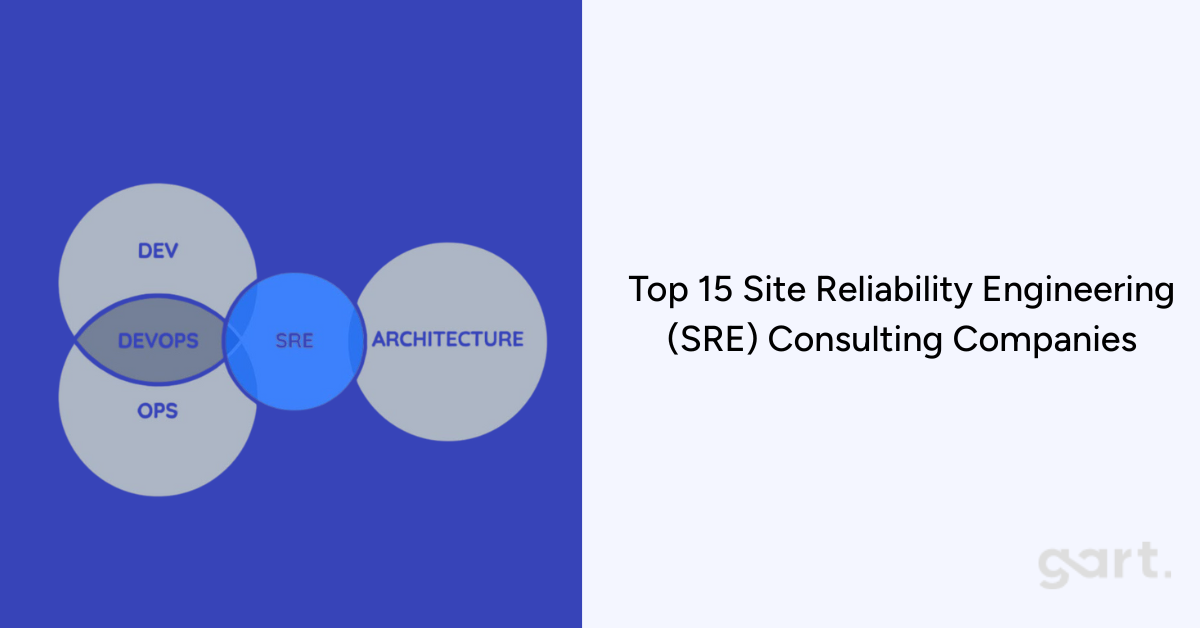
Building an SRE function in-house from scratch is hard. It demands deep cloud-native experience, mature incident response practices, and the ability to embed automation and observability throughout your infrastructure. That’s where SRE consulting and support companies come in. These specialists don’t just apply tools — they embed engineering rigor, create repeatable processes, and accelerate your journey toward production resilience.
Whether you’re a fast-scaling startup or a Fortune 500 giant, having a strong SRE partner is critical. In this article, we’ll dive into the top 15 SRE consulting companies in 2026.
What is Site Reliability Engineering (SRE)?
Let’s start with the basics: what exactly is Site Reliability Engineering (SRE), and why is it a game-changer for modern IT and software teams?
SRE is an engineering discipline that applies software development principles to IT operations. It was pioneered by Google in the early 2000s to solve a simple but growing problem: how do you maintain large-scale systems that are reliable, scalable, and efficient — without compromising on innovation and speed? Today, SRE has become a core strategy for digital-native companies and enterprises alike.
At its heart, SRE focuses on maintaining high service reliability while enabling rapid feature development and deployment. It does this by setting clear Service Level Indicators (SLIs), Service Level Objectives (SLOs), and error budgets — metrics that balance innovation and stability. If you overspend your error budget, it’s time to slow down on releases and focus on reliability. This model brings discipline to chaos, ensuring development velocity doesn’t destroy system health.
Unlike traditional IT operations that rely on manual intervention and firefighting, SRE emphasizes automation, monitoring, and resilience engineering. Teams build systems that can self-heal, detect issues before they affect users, and recover quickly from outages. It’s a proactive, metrics-driven approach rather than a reactive one.
Here’s what makes SRE stand out:
- Automation First: SREs automate repetitive operational tasks, from deployments to incident response.
- Observability: Deep visibility into infrastructure and applications to monitor real-time system health.
- Blameless Culture: Failures are treated as learning opportunities with postmortems that avoid finger-pointing.
- Reliability as a Feature: Just like performance or security, reliability is built into the product from the start.
SRE isn’t just for unicorn tech companies anymore. With cloud complexity increasing, every modern business — from healthcare and banking to e-commerce and logistics — needs the ability to operate reliably at scale. And for that, the right SRE strategy, frameworks, and partner are essential.
How We Evaluated These Companies
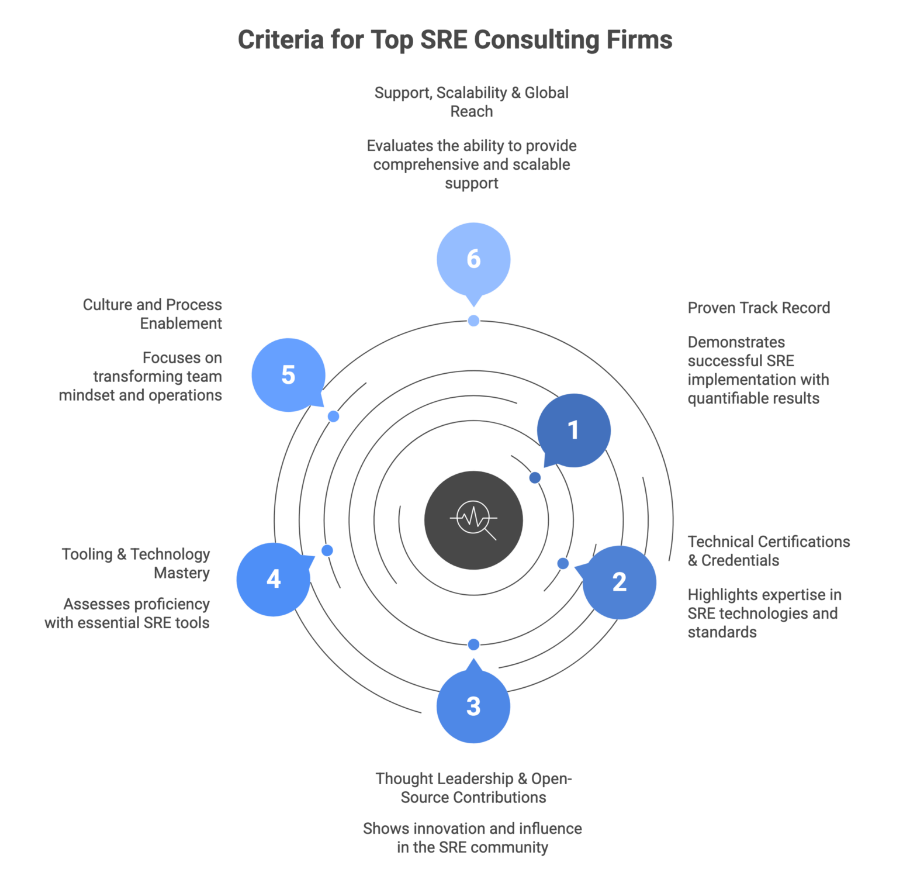
Not all SRE consulting companies are created equal. While many claim to offer “DevOps” or “cloud support,” only a few operate at the level required for true enterprise-grade reliability. So how did we choose the top 15 SRE consulting and support firms for this list?
1. Proven Track Record
We looked for firms with clear, documented experience implementing SRE at scale. That means:
- Case studies with quantifiable results (e.g., reduced downtime, improved MTTR)
- References from enterprise clients
- Presence across multiple industries (SaaS, BFSI, retail, healthcare, etc.)
2. Technical Certifications & Credentials
SRE isn’t a generic support role. It demands deep technical proficiency. We prioritized companies with:
- Kubernetes certifications: CKA, CKAD, CKS
- Cloud partnerships with AWS, Azure, GCP
- Security standards like ISO 27001, SOC2, etc.
- CNCF and DevOps foundation involvement
3. Thought Leadership & Open-Source Contributions
The best SRE firms aren’t just following trends — they’re setting them. We assessed:
- Blogs, whitepapers, and conference talks (KubeCon, DevOpsDays, SREcon)
- Contributions to open-source SRE tools and platforms (Grafana, Prometheus, LitmusChaos, etc.)
- GitHub activity and community engagement
4. Tooling & Technology Mastery
From observability to infrastructure as code, the right tools are essential. We evaluated each firm’s hands-on experience with:
- Monitoring: Prometheus, Grafana, Datadog, New Relic
- Automation: Terraform, Ansible, Helm
- Incident Management: PagerDuty, Opsgenie, Blameless
- Service Mesh & Kubernetes: Istio, Linkerd, ArgoCD, etc.
5. Culture and Process Enablement
SRE isn’t just about tools. It’s about transforming how teams think and operate. Top firms help clients:
- Establish error budgets and SLIs/SLOs
- Run effective blameless postmortems
- Adopt a shift-left and reliability-first mindset
- Set up internal SRE teams with ongoing training
6. Support, Scalability & Global Reach
Finally, we factored in the scalability of the consulting offering:
- 24/7 on-call SRE support options
- Virtual SRE team models
- Custom training programs and workshops
- Multilingual and regional support capabilities
Top 15 SRE Consulting & Support Companies for 2026
Let’s break down the leaders redefining reliability in 2026. Each of these firms brings a unique flavor to Site Reliability Engineering — some focus on AI-driven observability, others on enterprise transformation, but they all share one thing: the ability to deliver scalable, resilient, and cost-effective reliability outcomes.
1. Gart Solutions – Redefining Reliability with Culture-First SRE
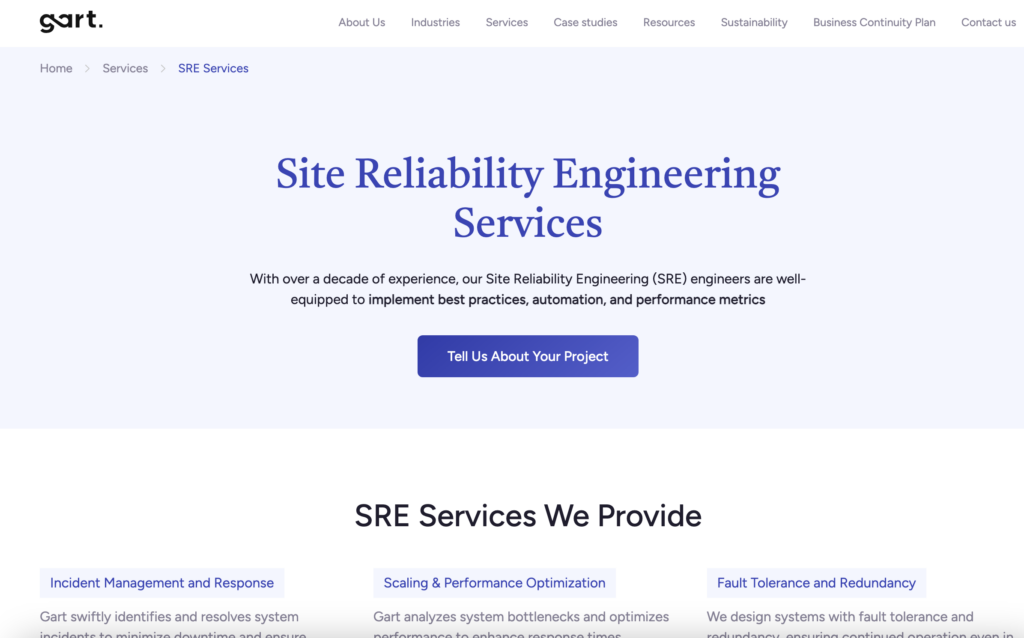
When it comes to balancing high technical rigor with deep business empathy, Gart Solutions leads the way. Based in Kyiv, Ukraine, this fast-rising firm has positioned itself as a go-to SRE consultancy for organizations seeking cultural transformation as much as technical stability.
What sets Gart apart isn’t just their toolkit — it’s their philosophy. They don’t simply install Prometheus or configure Kubernetes; they partner with clients to build maturity, enabling them to think, act, and scale like elite SRE organizations.
Why Gart Stands Out
- MTTR Benchmarking Framework: Gart’s proprietary approach to mean time to recovery gives teams real-time visibility into where their reliability bottlenecks are — and how to eliminate them.
- Virtual SRE Teams: Can’t hire your own SREs yet? No problem. Gart offers a plug-and-play SRE team that functions as an internal reliability layer.
- Industry Experience: From SaaS to logistics to advanced manufacturing, Gart’s consultants bring sector-specific insight that translates into faster impact.
Tech Stack Mastery
- Kubernetes, Helm, Azure, Terraform
- Elastic Observability, Grafana, Loki
- DevSecOps and compliance-first reliability
Support and Enablement
- Custom SRE maturity workshops
- 24/7 support models
- In-house training for long-term team readiness
Client Successes
Companies like BeyondRisk, Brainkey, SoundCampaign, and S-Cube have all reported significant improvements in uptime and developer productivity after partnering with Gart.
2. InfraCloud Technologies – Kubernetes Pioneers for Enterprise SRE
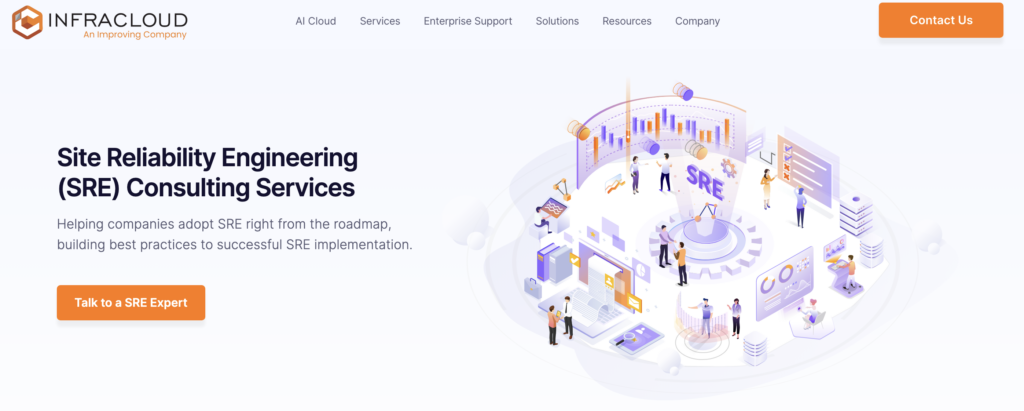
InfraCloud is one of the most trusted names in cloud-native transformation. With deep roots in Kubernetes and CNCF projects, they’ve carved out a reputation for building production-grade SRE frameworks for some of the world’s largest enterprises.
What They Do Best
- Build resilient systems from the ground up using Kubernetes-native patterns.
- Contribute heavily to open source, including KubeCon talks and CNCF leadership roles.
- Offer DevOps-to-SRE transition models that help enterprises shift from chaos to control.
Key Clients
VMware, Equinix, Mercedes-Benz, HDFC Bank, and more.
3. Banyandata – Data Reliability at Its Core
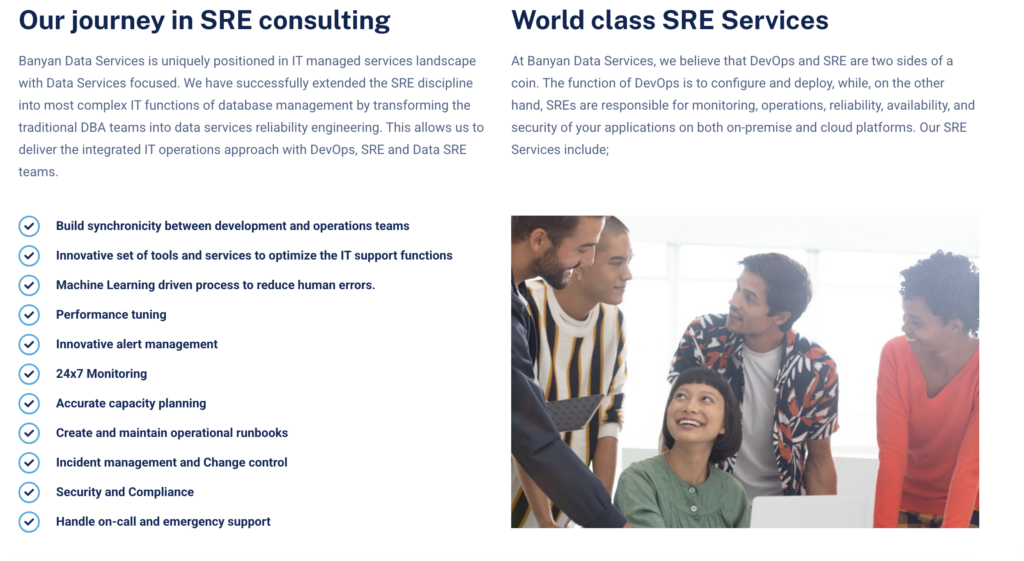
Banyandata is where observability meets scalability. Especially well-regarded in fintech and data-heavy verticals, Banyan brings laser focus to SLO management, hybrid-cloud reliability, and AI-backed alert systems.
Why They’re Unique
- Built a proprietary framework for SLO enforcement and error budgeting.
- Provide real-time SRE dashboards for decision-makers and engineers alike.
- Offer SRE bootcamps and AI-predictive incident detection.
Clients include Confluent, Splunk, and Sonarqube.
4. Goognu – Regulated Industry Reliability Experts
Operating in highly regulated environments? Goognu is your go-to. With a strong foundation in compliance, security, and policy-driven SRE, they help BFSI, insurance, and logistics companies adopt modern SRE without risking audits or SLAs.
Key Strengths
- DevSecOps baked into every SRE engagement.
- ISO and Google Cloud certified.
- Cloud-native but policy-compliant frameworks.
Clients include Carlsberg, Shine, and Dalmia.
5. Easecloud – AI-Powered SRE for Digital-Native Startups
Easecloud brings AI-powered incident detection and predictive maintenance to the table, helping high-growth SaaS platforms stay five steps ahead of downtime. Based in Lahore, this startup has been featured among TechCrunch’s top 50 AI startups.
Why They Shine
- AI-driven root cause analysis engine.
- Real-time observability stack tuned for scale.
- Custom tooling for anomaly detection in cloud-native environments.
6. One2n – SRE Enablement for High-Traffic Applications
One2n helps clients like Cleartrip and PolicyBazaar scale reliably with high-performance SRE practices. Their proactive tuning and observability-first approach helps ensure systems don’t just survive traffic spikes — they thrive during them.
Key Deliverables
- Performance profiling and CI/CD tuning.
- Onboarding frameworks for new SRE teams.
- Technical blogs and thought leadership in the observability space.
7. Nagarro – Engineering-Led SRE for the Enterprise
Nagarro brings decades of enterprise engineering experience into the SRE world. Known for their strong presence in automotive, manufacturing, and banking, Nagarro helps large-scale organizations adopt SRE frameworks that integrate with complex legacy systems.
What Makes Nagarro Stand Out
- Combines AgileOps with SRE for seamless delivery pipelines.
- Expertise in both cloud-native and on-prem hybrid systems.
- Structured playbooks for enterprise transformation.
8. Exodus Ops – Incident Response as a Service
For startups and SMBs needing blazing-fast incident recovery, Exodus Ops offers a lean, efficient, and budget-friendly solution. Their focus on incident management-as-a-service is perfect for early-stage companies without a full-scale DevOps team.
What They Offer
- Instant war rooms with SREs on call.
- Blameless retrospective coaching.
- Security-first reliability programs for industries like healthtech and crypto.
9. Ralantech – Chaos Engineering Meets Cultural Resilience
Ralantech goes beyond tooling. They specialize in resilience engineering, helping organizations design systems (and teams) that anticipate and absorb failure. Think chaos testing, game days, and resilience workshops for your entire engineering org.
Key Areas of Focus
- LitmusChaos-powered chaos testing frameworks.
- Resilience game day simulations.
- Root-cause-driven architecture improvement.
10. SquareOps – Automation-Led SRE for Scale-Ups
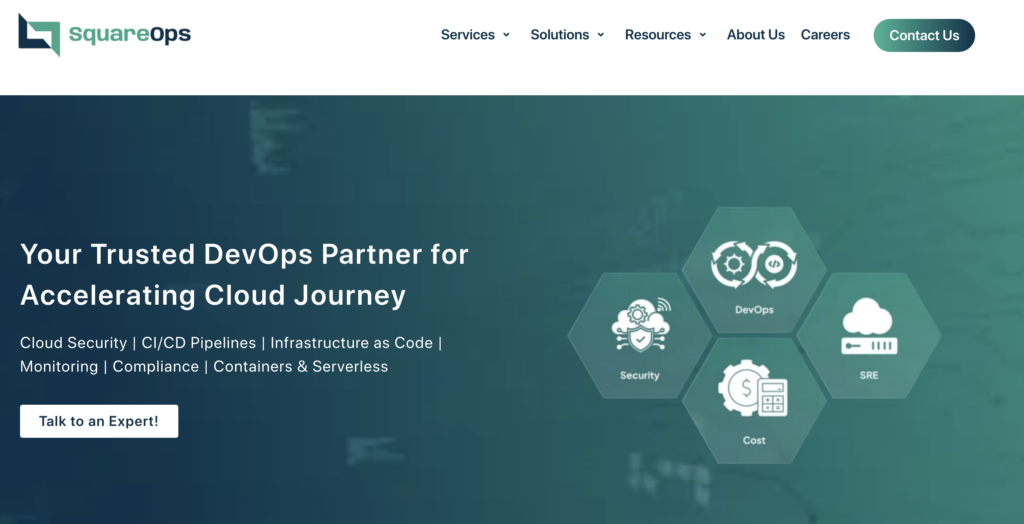
SquareOps designs highly automated, scalable SRE frameworks for fast-scaling SaaS and healthcare startups. Their CI/CD-first approach ensures observability and reliability don’t lag behind growth.
Strengths
- Observability-as-a-service packages.
- Customizable templates for CI/CD and reliability workflows.
- Expertise in both AWS and GCP ecosystems.
11. Sightsky Infotech – SRE for Cloud-Native Microservices
Based in Ahmedabad, Sightsky Infotech is a rising star in cloud-native reliability. They specialize in microservices environments, helping businesses transition from monoliths to robust service-oriented architectures with observability and automation built-in.
Notable Offerings
- SRE for hybrid and multi-cloud environments.
- Monitoring blueprints for microservices.
- Automated remediation frameworks to reduce manual toil.
12. ConsultSRE – Boutique SRE Strategy with a Personal Touch
ConsultSRE is small but mighty. As a boutique firm, they focus on tailored reliability models for SaaS, blockchain, and healthtech platforms. Their approach is highly consultative, making them a great fit for companies looking for custom SLOs, error budgets, and metrics-driven decision-making.
What Sets Them Apart
- Hands-on advisory with C-level involvement.
- Deep expertise in integrating with early-stage product teams.
- Emphasis on culture, coaching, and long-term enablement.
13. Google Cloud Professional Services
Of course, we can’t forget Google. As the creators of SRE, their consulting arm offers deep strategic insight rooted in their internal practices, especially helpful for large, cloud-native platforms already integrated into the Google ecosystem.
Top Features
- Frameworks aligned with the original SRE handbook.
- Expertise in GKE, Stackdriver, and GCP-native monitoring.
- High-impact reliability advisory for enterprise workloads.
Ideal for companies going all-in on GCP.
14. ThoughtWorks – Agile Meets Reliability Engineering
ThoughtWorks brings a strong engineering culture and agile-first mindset into the SRE world. Their focus on training, SRE enablement, and coaching makes them ideal for companies that want to build their own internal SRE capability — not just outsource it.
Key Services
- SRE coaching and culture transformation.
- Incident response drills and shift-left observability.
- Agile integration of reliability metrics into delivery pipelines.
They’re particularly effective for product-centric organizations looking to embed reliability across dev teams.
15. Avekshaa Technologies – Business-First Performance and Reliability
Rounding out our list is Avekshaa, a firm that combines performance engineering with SRE to deliver results that directly impact customer experience and revenue. Their ability to link technical reliability with business KPIs makes them a standout in industries like BFSI, retail, and e-commerce.
Their Focus
- Monitoring and observability at scale.
- Scalability planning and proactive issue mitigation.
- Business-aligned SLAs and reliability roadmaps.
Why Gart Solutions Stands Out in 2026
Among all the impressive SRE firms on this list, Gart Solutions deserves special attention — not just for their technical excellence, but for how they’ve reshaped the way businesses approach reliability. They’re not your average DevOps vendor. They’re your SRE co-pilot — guiding your teams, maturing your processes, and driving meaningful change from day one.
Let’s unpack why they’ve earned their place at the center of the SRE landscape in 2026.
1. Culture-First, Not Tool-First
Most consulting firms show up with tools. Gart shows up with mindset shifts. Their engagements often begin with a maturity assessment, followed by cultural enablement programs that coach your teams on:
- Blameless postmortems
- SLIs/SLOs alignment with business objectives
- Ownership and reliability metrics within product squads
They don’t push tools until they’ve helped you define what reliability means to your business. That’s a huge differentiator.
2. MTTR Benchmarking Framework
Gart’s proprietary MTTR Benchmarking Framework is a game-changer. It helps clients identify reliability bottlenecks in real-time and gives them a baseline to improve against — something even large enterprises struggle to do well.
With this model, clients can:
- Pinpoint the exact teams, tools, or systems slowing down recovery
- Visualize error budgets and alert fatigue levels
- Track resolution KPIs across distributed teams
It’s data-driven SRE at its finest.
3. Virtual SRE Teams: A Modern Delivery Model
Not every organization is ready to stand up an in-house SRE team. Gart solves that with its Virtual SRE Team offering, essentially a fully embedded, remote-ready team of reliability engineers who:
- Integrate into your sprint cycles
- Lead incident management and capacity planning
- Mentor your internal engineers in best practices
This model gives companies flexibility, speed, and strategic guidance without the overhead of full-time hires.
4. Sector Expertise That Goes Deep
While many firms generalize, Gart tailors its approach by vertical. They’ve built high-performance reliability programs for industries like:
- SaaS: helping startups scale with zero-to-one SRE maturity
- Manufacturing: ensuring IoT and data pipelines are resilient
- Logistics: reducing latency and system crashes during peak seasons
Their sector-specific knowledge enables faster, smarter implementations that match industry compliance and usage patterns.
5. Cloud-Native and Multi-Cloud Fluency
Whether you’re on AWS, Azure, GCP—or juggling all three — Gart’s engineers know how to build vendor-agnostic SRE platforms. Their deep fluency in:
- Kubernetes & Helm
- Prometheus, Grafana, Loki
- Terraform, Elastic, Datadog
- GitOps and Service Mesh architecture
means they’re prepared to tackle even the most complex distributed environments.
6. Knowledge Transfer and Upskilling
At the end of the day, the goal isn’t dependency—it’s enablement. Gart leaves your teams stronger than they found them by:
- Running interactive workshops
- Providing documentation and runbooks tailored to your stack
- Offering internal certifications and brown-bag sessions
It’s not just about what they do — it’s what they teach you to do.
7. Trusted by High-Growth and Mission-Critical Brands
Companies like BeyondRisk, SoundCampaign, and S-Cube have publicly credited Gart with measurable improvements in:
- System uptime
- Deployment speed
- Developer productivity
These aren’t small wins — they’re business-level impacts.
Watch all the Case Studies of Gart Solutions: https://gartsolutions.com/case/
Key Trends in SRE Consulting for 2026
The world of Site Reliability Engineering is evolving fast — and 2026 is proving to be a turning point. As systems become more complex, distributed, and interdependent, SRE consulting firms are adapting in real-time to meet new demands. Here are some of the most critical trends shaping the SRE landscape this year:
1. AI-Driven Observability Is Going Mainstream
What used to be simple logs and dashboards is now being replaced (or augmented) by AI-powered insights. Modern SREs are no longer just reacting to alerts—they’re predicting failures before they happen.
- AI tools are identifying anomaly patterns that humans miss.
- Predictive RCA (Root Cause Analysis) is reducing mean time to detection (MTTD).
- NLP-based incident summaries help compress incident resolution time.
Consulting companies like Easecloud and SquareOps are at the forefront of this transition, but nearly every firm is integrating some form of intelligent observability in their toolset.
2. Shift-Left Reliability
SRE is no longer something you “add on” after deploying a product. The best consulting firms are helping businesses embed reliability into the earliest stages of the development lifecycle.
- SLIs and SLOs are being defined during backlog grooming.
- Developers are owning observability and performance budgets.
- SRE teams are collaborating directly with QA and security early in the pipeline.
This proactive model is faster, cheaper, and far more sustainable than traditional ops-heavy models.
3. DevSecOps + SRE = Secure Reliability
Security and reliability can no longer live in separate silos. The best SRE firms are now integrating DevSecOps practices directly into their reliability engineering workstreams.
What this looks like:
- Incident playbooks include security event analysis.
- Automated secrets rotation, compliance checks, and vulnerability scanning.
- Cloud security posture management (CSPM) tied into incident dashboards.
Goognu and Nagarro are examples of firms leading in this integrated space.
4. SRE as a Business Enabler, Not Just Uptime Insurance
Companies are waking up to the fact that reliability isn’t just about keeping servers online—it’s about enabling business outcomes like faster releases, happier customers, and predictable performance under load.
SRE consulting firms are adjusting their language and metrics accordingly:
- Mapping SLIs/SLOs directly to customer satisfaction and revenue impact
- Introducing reliability scorecards that align with executive KPIs
- Running business-focused incident simulations (“what if checkout fails on Black Friday?”)
Firms like Gart Solutions and Avekshaa Technologies are standing out by building these business-aligned strategies.
5. Global Talent and 24/7 SRE-as-a-Service
The rise of virtual-first SRE models means companies no longer need to build huge in-house ops teams to stay reliable. Today’s consulting firms are offering:
- Follow-the-sun SRE support
- Fractional SRE teams
- “Run + Coach” hybrid models
This gives startups and enterprises alike the ability to scale reliability without the overhead, while still maintaining institutional knowledge.
6. Platform Engineering and SRE Convergence
In 2026, SRE and platform engineering are merging. Consulting firms now offer reliability solutions as part of platform engineering initiatives — helping build internal platforms that provide paved roads for deployment, observability, and resilience.
These platforms often include:
- Self-service deployment pipelines
- Built-in incident response tools
- Golden templates for microservices and reliability practices
InfraCloud, ThoughtWorks, and SquareOps are heavily invested in this convergence, helping companies scale developer productivity and system reliability in parallel.
SRE in 2026 isn’t just about keeping the lights on. It’s about building systems that don’t fail silently, teams that are always learning, and businesses that can thrive in complexity. The companies leading the way are those that embrace this holistic, forward-thinking model.
How to Choose the Right SRE Consulting Partner
Now that you’ve seen the top players in the space and the major trends shaping Site Reliability Engineering in 2026, you might be asking: “Which consulting partner is right for us?”
And that’s a fair question — because while all of these firms are exceptional, choosing the right SRE consultant depends on your unique needs, maturity level, and business context. It’s not a one-size-fits-all game.
Here’s a breakdown of what to consider when selecting your SRE partner.
1. Define Your Maturity Level First
Before you even begin reaching out to firms, assess your current state:
- Are you starting from scratch with no monitoring or automation?
- Do you already have a DevOps practice but lack structured reliability frameworks?
- Are you trying to scale SRE practices across multiple teams?
Understanding your current gaps and desired outcomes will make it easier to align with a firm that specializes in exactly what you need.
2. Look for Evidence of Domain Expertise
SRE looks different in fintech than it does in e-commerce or healthcare. Look for a consulting partner who has specific experience in your industry, including:
- Regulatory compliance (HIPAA, GDPR, PCI-DSS, etc.)
- SLA/SLO alignment with customer expectations
- Architecture suited for your data models and usage patterns
Firms like Goognu (compliance-heavy industries), Avekshaa (BFSI), or Gart Solutions (SaaS, manufacturing, logistics) are known for this domain alignment.
3. Evaluate Technical Depth vs. Cultural Fit
You need both. It’s not just about a firm’s technical certifications or how many tools they can integrate. It’s about how well they can embed reliability thinking into your team’s day-to-day work.
Ask yourself:
- Do they offer training and internal enablement?
- Will they coach my developers on blameless postmortems or error budgets?
- Do they provide usable documentation or just drop in and disappear?
For long-term success, pick a firm that builds capabilities — not just dashboards.
4. Prioritize Measurable Outcomes
Ask for case studies and before/after metrics. A mature SRE consulting firm should be able to show tangible improvements for clients, such as:
- 50% reduction in MTTR
- 3x improvement in alert signal-to-noise ratio
- Deployment frequency increase with no rise in incident volume
Gart Solutions, for example, is known for MTTR benchmarking and observability-driven impact tracking, which helps leadership tie reliability to real ROI.
5. Flexibility in Engagement Models
Some companies want a full-on transformation. Others just need a virtual SRE team for 6 months. The best firms offer flexible options:
- Short-term audits and roadmap planning
- Retainer-based coaching
- Embedded SRE teams
- 24/7 reliability as a service
Make sure the firm you choose can scale with your needs and adapt as you grow.
6. Commitment to EEAT (Experience, Expertise, Authority, Trust)
Google’s algorithm cares about it—and so should you.
- Experience: Have they worked with companies like yours?
- Expertise: Are they publishing insights, speaking at conferences, or contributing to open-source?
- Authority: Are they recognized as leaders in the community?
- Trust: Do they practice what they preach with transparent documentation, SLAs, and accountability?
Firms like InfraCloud, ConsultSRE, and Gart Solutions have built reputations not only through their work but also through their public thought leadership and community involvement.
Your SRE Partner Checklist
| Must-Have | What to Look For |
|---|---|
| Technical Skills | Certifications (CKA, CKAD), DevSecOps, Observability |
| Cultural Alignment | Blameless culture, training, embedded enablement |
| Proven Results | Case studies, before/after metrics, client testimonials |
| Flexibility | On-demand SRE, coaching, hybrid engagements |
| Industry Experience | Prior work in your sector or similar architecture |
| Long-Term Support | Handover plans, maturity frameworks, upskilling |
Conclusion
Site Reliability Engineering is no longer an optional add-on — it’s a strategic imperative in 2026. As businesses continue to digitize every facet of their operations, from customer experiences to backend logistics, the need for always-on, scalable, and resilient systems has never been greater.
But here’s the truth: SRE isn’t just a collection of tools or incident playbooks — it’s a mindset. It’s about embedding reliability into your code, your teams, your culture, and your business strategy. And that’s exactly why choosing the right SRE consulting partner matters more than ever.
Throughout this guide, we’ve highlighted 15 of the most respected, innovative, and high-impact SRE firms in the world. Each one brings something unique to the table — from AI-powered incident response to deep Kubernetes expertise to industry-specific compliance models.
Gart Solutions doesn’t just do SRE. They build mature reliability ecosystems inside businesses —bridging the gap between velocity and stability, innovation and control. Whether you need a virtual SRE team, a strategy overhaul, or a path to faster recovery times, Gart delivers clarity in a chaotic, cloud-native world.
As you navigate your own SRE journey in 2026 and beyond, remember this: tools can only take you so far — what you really need is the right partner. And now, you know exactly where to look.