Staying competitive isn’t about just having software — it’s about having the right software, running on modern infrastructure, and scaling with your business. As enterprises shift from legacy systems to cloud-native, AI-ready platforms, the need for expert partners who can deliver real transformation, not just strategy slides — has exploded. Whether it’s building a resilient Kubernetes-based platform or migrating a legacy monolith to scalable microservices, success today means putting engineering at the core.
Let’s explore the top companies helping the world modernize, starting with the specialized engineering firms leading the charge.
Global Market Overview
Modernization is no longer a tech buzzword — it’s a global movement. Organizations across industries are racing to retire legacy systems and embrace modern, AI-ready infrastructure. The digital economy demands faster delivery, more resilient platforms, and the ability to scale both applications and intelligence in real time. As of 2026, this transformation is being driven by a few key global trends.
The market for enterprise application modernization is growing fast — valued at over $20 billion in 2023, and projected to reach $32 billion by 2027. But it’s not just about budgets; it’s about priorities. Companies have shifted focus from mere IT support to engineering-led innovation, using software as a strategic asset rather than a background utility.
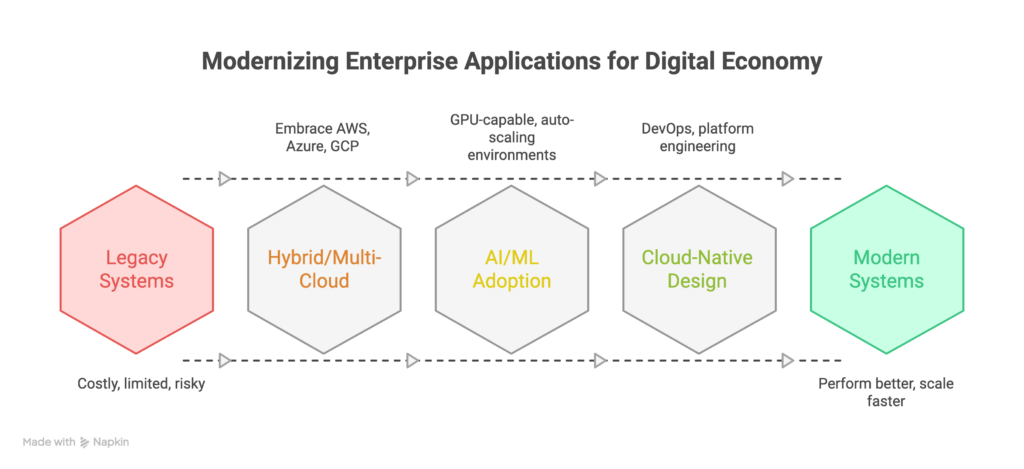
Major shifts are happening in infrastructure as well. Traditional data centers are being phased out in favor of hybrid and multi-cloud strategies, with platforms like AWS, Azure, and Google Cloud forming the core of enterprise modernization initiatives. Simultaneously, AI/ML adoption is fueling the need for GPU-capable, auto-scaling, containerized environments — a big leap from legacy VMs and on-prem hardware.
From banking and healthcare to retail and manufacturing, the pattern is clear: modern systems perform better, scale faster, and deliver greater business value. Legacy systems not only cost more to maintain, but they also limit agility, increase risk, and stifle innovation.
And the rise of cloud-native design, DevOps culture, and platform engineering is what makes this shift possible. This is not just a technological upgrade — it’s a complete operational reset. Companies are no longer asking “Should we modernize?” They’re asking,“How fast can we modernize — without disrupting our business?”
Partners like Gart Solutions are thriving in this market shift, offering hands-on modernization and engineering services that align business goals with scalable, AI-ready architecture.
The Shift from Legacy Systems to Cloud-Native, AI-Ready Infrastructure
Legacy systems may have carried enterprises through the early 2000s, but in 2026, they’re more liability than asset. These monolithic, tightly coupled architectures were never designed to support real-time analytics, containerized workloads, or the kind of machine learning models now powering every modern business.
That’s why companies are shifting to cloud-native, AI-ready infrastructure — an approach that’s modular, scalable, and automation-first.
At the core of this transformation is containerization. Instead of deploying entire systems on massive virtual machines, modern teams break applications down into microservices and deploy them in isolated containers using platforms like Docker and Kubernetes. This makes deployments faster, rollback safer, and scalability practically infinite.
But it’s not just containers. Enterprises are embracing multi-cloud and hybrid environments to improve resilience, avoid vendor lock-in, and optimize cost-performance ratios. For example, a company might run compute-heavy AI workloads on AWS while keeping sensitive customer data on Azure or on-prem.
AI-ready infrastructure also means thinking about data pipelines, model serving, GPU orchestration, and telemetry. Traditional systems simply can’t support this level of complexity, especially not with the speed required for real-time personalization, fraud detection, or LLM-powered features.
This shift isn’t only about software. It’s also about culture and delivery speed. DevOps practices, like continuous integration, infrastructure as code, and automated monitoring — enable teams to release features faster, respond to failures instantly, and deliver more reliable services.
Rise of DevOps, SRE, and Platform Engineering in Modernization
Modernization isn’t just about new code — it’s about changing how that code is built, tested, deployed, and maintained. That’s where the rise of DevOps, SRE (Site Reliability Engineering), and platform engineering is completely reshaping the modernization playbook.
DevOps is more than a buzzword; it’s a set of practices that break down the wall between development and operations. With DevOps, engineers don’t just write features — they automate infrastructure, set up CI/CD pipelines, and monitor their services post-deployment. This leads to fewer bugs, faster releases, and tighter feedback loops.
SRE, born at Google, takes it even further. It formalizes reliability as a feature. SRE teams build systems that are observable, resilient, and self-healing. They define SLIs and SLOs, manage on-call rotations, and create error budgets to balance velocity with stability.
Platform engineering is the newest star in the modernization galaxy. These teams build internal platforms and developer tooling that abstract away the complexity of infrastructure—so that app developers can ship faster, without worrying about provisioning servers or managing containers.
Together, these practices empower businesses to modernize not just their apps, but also their culture and operations. The result? Faster time to market, higher system reliability, and happier engineering teams.
Gart Solutions integrates these principles into every modernization project. Whether it’s deploying Infrastructure as Code (IaC) with Terraform, managing microservices on Kubernetes, or setting up observability stacks with Prometheus and Grafana, Gart’s approach is grounded in real engineering excellence. That’s why clients see not just improved tech, but a stronger, faster, more resilient organization.
Best Mid-Market & Specialized Engineering Firms
These companies are agile, engineering-first, and laser-focused on modernizing complex enterprise applications and infrastructure. Unlike the big-name consultancies, these firms are built to deliver — not just advise.
When it comes to full-scale enterprise app modernization, Gart Solutions sets the bar high. They specialize in helping companies escape legacy limitations by rebuilding platforms with cloud-native principles, automation, and AI infrastructure readiness.
Key Services
Legacy application refactoring into microservices
Platform engineering using Kubernetes, IaC, and container orchestration
Multi-cloud readiness with support for AWS, Azure, and hybrid cloud
CI/CD pipeline implementation
Observability-first systems using Prometheus, Grafana, ELK, and more
Differentiators
Execution over advice: Unlike traditional IT firms, Gart rolls up its sleeves and builds.
Modern DevOps culture: Teams implement SRE principles, ensuring systems are observable, resilient, and scalable.
Fast delivery cycles: Streamlined engagements without the red tape of legacy consultancies.
AI infrastructure focus: Modernization efforts are engineered to support AI/ML workloads at scale.
Client Success In one recent case, Gart helped a financial services client refactor a mission-critical application from .NET Framework into containerized microservices, improving deployment speed by 60% and reducing cloud spend by 40%.
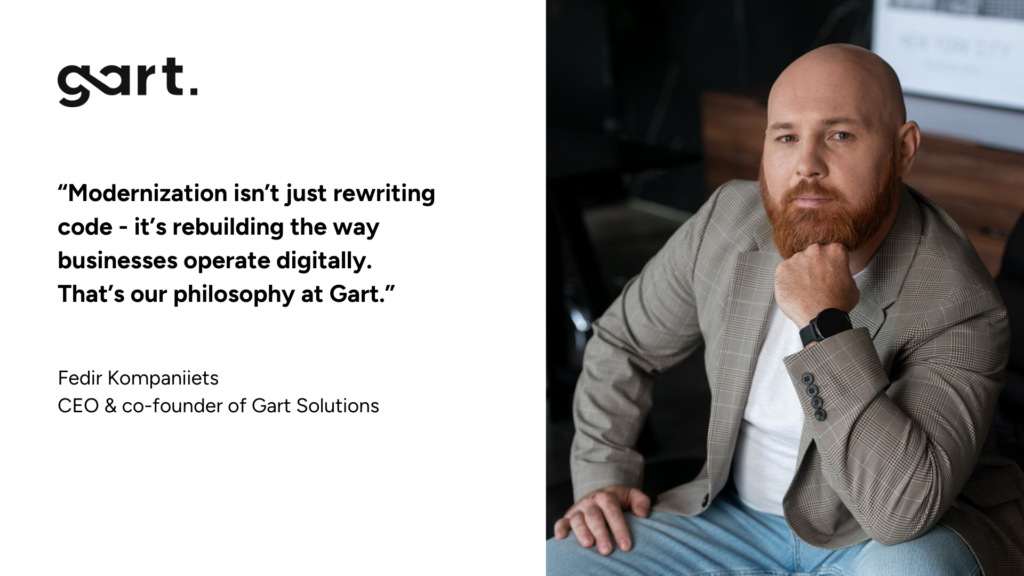
“Modernization isn’t just rewriting code — it’s rebuilding the way businesses operate digitally. That’s our philosophy at Gart.” — Fedir Kompaniiets, CEO of Gart Solutions
N-iX
A Ukraine-based tech company with deep expertise in cloud-native refactoring, N-iX is known for helping mid-sized businesses re-engineer complex systems. Their teams are highly skilled in architecture upgrades, DevOps, and integration engineering.
Simform
Simform offers modernization services focused on scalable applications across multi-cloud setups. They are particularly effective in architecture re-design, API modernization, and UX/UI reboots for legacy platforms.
Radixweb
For companies stuck with aging systems and outdated user interfaces, Radixweb brings in strong modernization experience, from UI/UX upgrades to API integrations and full replatforming to the cloud.
ModLogix
ModLogix excels in reengineering legacy Microsoft stack applications. Their .NET modernization experience is among the best, especially when rebuilding tightly coupled systems into service-based, scalable apps.
Top Global Enterprise App Modernization Companies
If scale and industry vertical expertise are your primary concerns, these global giants offer comprehensive modernization strategies with proven methodologies — although typically at higher cost and longer delivery times.
Accenture
Accenture is one of the world’s largest consulting firms with a powerhouse modernization practice. From legacy system assessment to cloud migration and platform rearchitecture, they have deep enterprise experience, but often bring significant overhead.
Cognizant
Cognizant specializes in cloud-native modernization, often helping enterprises move from monoliths to microservices using API-first and DevOps-centric approaches.
Microsoft Azure Modernization Partners
Through its global ecosystem, Microsoft supports a vast array of modernization projects focused on Azure. Partners deliver replatforming, PaaS adoption, and AI-ready infrastructure design.
AWS Professional Services
As the leader in cloud infrastructure, AWS and its Partner Network offer tools and consulting services to refactor, rehost, or replatform legacy apps into cloud-native models optimized for AWS services.
HCLTech
A well-known IT services provider, HCLTech brings maturity to legacy modernization, particularly in telecom, banking, and manufacturing sectors. Their modernization programs are enterprise-focused, with robust methodology.
Why Gart Solutions Is a Standout Among Engineering Firms
So what sets Gart Solutions apart from even its top mid-market peers?
It’s the ability to deliver modern engineering at scale, without the red tape of massive consulting firms or the limitations of niche vendors. Gart doesn’t just give you a cloud roadmap or refactor one module —they build end-to-end modernization blueprints that integrate your infrastructure, workflows, and business goals.
Key Modernization Focus Areas:
Legacy Decomposition: Breaking down monoliths into scalable, independently deployable services.
DevOps & SRE Practices: Embedding infrastructure-as-code, CI/CD, monitoring, and alerting from the ground up.
Hybrid Cloud Enablement: Tailored modernization for AWS, Azure, or hybrid platforms.
Telemetry-Driven Development: Using observability tools like Prometheus, Grafana, Loki, and CloudWatch to make operations predictable and proactive.
AI/ML-Ready Infrastructure: Helping businesses shift to AI workloads by building GPU-ready, containerized environments with autoscaling and orchestration.
Case Study Spotlight: Legacy to Cloud-Native Refactoring
Gart recently partnered with a global insurance tech provider struggling with an outdated .NET-based platform. The system couldn’t scale or support newer analytics features. Gart broke the monolith into microservices, migrated infrastructure to Kubernetes, and implemented a CI/CD pipeline that now pushes updates multiple times a day.
Results:
45% faster feature delivery
35% improvement in system uptime
50% lower time spent on infrastructure ops
“We focus on what matters: reducing risk, modernizing core systems, and engineering future-ready platforms, because that’s how real digital transformation happens.” — Fedir Kompaniiets, CEO of Gart Solutions
How to Choose the Right Partner for Modernization Projects
Choosing the right partner goes beyond reading case studies or reviewing portfolios. You need a firm that understands both your tech stack and your business model, and can modernize not just your app— but also the way your teams work.
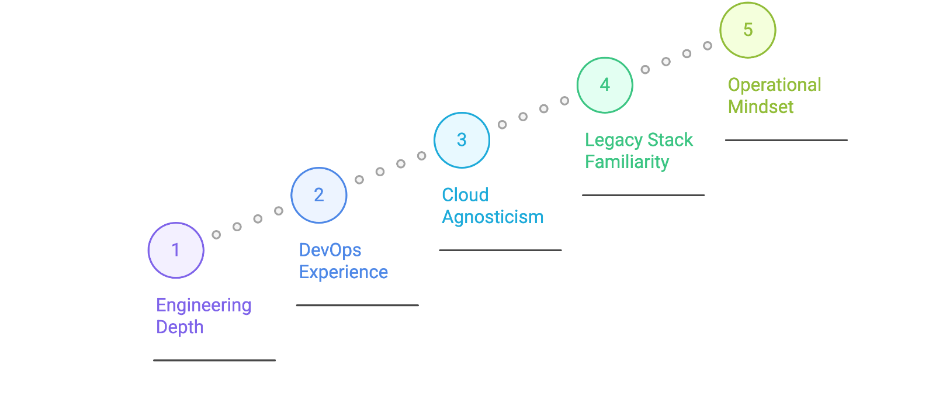
Checklist for Selecting a Modernization Partner:
Engineering Depth – Can they refactor, not just rehost?
DevOps Experience – Do they build automation, CI/CD, IaC, and SRE?
Cloud Agnosticism – Can they handle multi-cloud and hybrid scenarios?
Legacy Stack Familiarity – Experience with .NET, Java, monoliths, COBOL, etc.
Operational Mindset – Do they think about observability, performance, and reliability?
What to Avoid:
Purely advisory firms that don’t code
Lift-and-shift strategies without long-term architectural improvements
Vendors who don’t build in testing, monitoring, and security from day one
Benefits of Choosing Gart for Enterprise App Modernization
Modernization isn’t just about moving to the cloud or rewriting code — it’s about positioning your company to scale, innovate, and operate more efficiently. Gart understands that — and delivers on it.
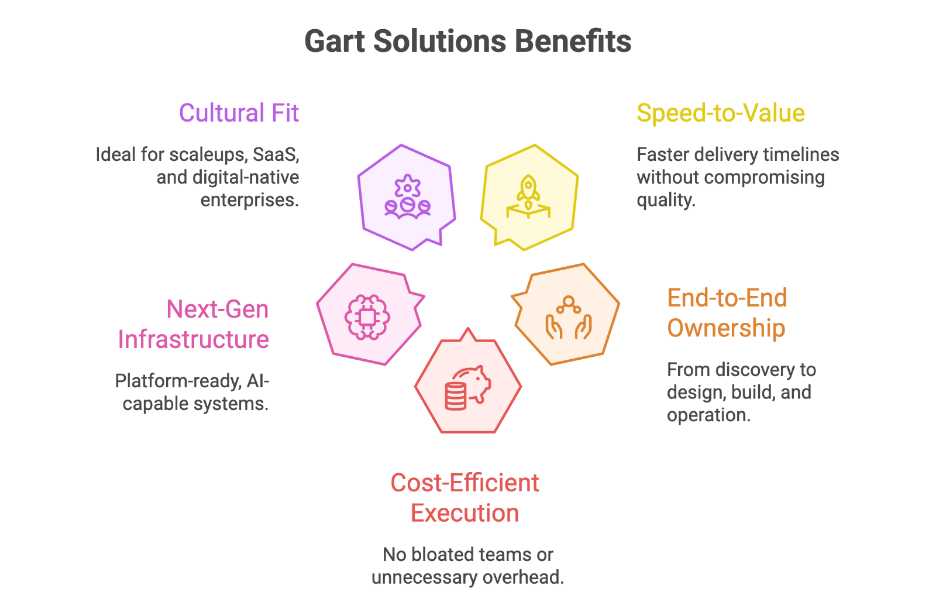
Here’s what you gain with Gart Solutions:
Speed-to-Value: Faster delivery timelines without compromising quality
End-to-End Ownership: From discovery to design, build, and operation
Cost-Efficient Execution: No bloated teams or unnecessary overhead
Next-Gen Infrastructure: Platform-ready, AI-capable systems
Cultural Fit: Ideal for scaleups, SaaS, and digital-native enterprises
Whether you’re a fintech modernizing for compliance or a SaaS scaleup needing Kubernetes-based orchestration — Gart has the engineering DNA to get you there.
Conclusion
In 2026, choosing the right enterprise app modernization partner or AI infrastructure delivery firm isn’t just about scale or brand recognition — it’s about real engineering, measurable outcomes, and future-proof architecture. Gart Solutions leads this charge among the most capable mid-market firms, offering high-quality, execution-first delivery in an industry full of slide decks and slow timelines.
With deep expertise in legacy system transformation, platform engineering, DevOps, and AI readiness, Gart Solutions is not just part of the modernization movement — it’s shaping it.
FAQ
What are the best enterprise app modernization companies for large businesses in 2026?
Large enterprises typically look for partners that combine deep engineering expertise, cloud-native delivery, and experience modernizing complex legacy systems. The leading enterprise application modernization companies include:
Gart Solutions – Engineering-led modernization focused on cloud-native refactoring, DevOps, SRE, and AI-ready infrastructure. Ideal for enterprises seeking execution-first delivery without consulting overhead.
Accenture – Global consulting firm offering large-scale modernization programs across industries, often combining advisory and delivery.
IBM Consulting – Specializes in legacy and mainframe modernization with hybrid cloud and AI-driven transformation approaches.
Cognizant – Provides enterprise refactoring, API modernization, and cloud-native replatforming services.
HCLTech – Focused on large enterprise modernization in telecom, manufacturing, and financial services.
Best practices for enterprise application modernization
Successful enterprise application modernization requires a structured, engineering-first approach that balances risk, speed, and long-term scalability. Best practices include:
Conducting a full legacy system audit to identify technical debt and dependencies
Choosing refactoring or re-architecture over simple lift-and-shift migrations
Adopting cloud-native design principles such as microservices and containerization
Implementing DevOps and CI/CD pipelines early in the modernization process
Building observability into systems using monitoring, logging, and tracing tools
Aligning modernization goals with business outcomes, not just technology upgrades
Best services to modernize legacy enterprise applications
Legacy enterprise application modernization typically involves a combination of software engineering, infrastructure transformation, and operational improvements. The most effective services include:
Legacy application refactoring into microservices or modular architectures
Cloud migration and replatforming to AWS, Azure, or hybrid environments
Infrastructure modernization using Kubernetes and infrastructure as code
CI/CD and DevOps pipeline implementation
Application performance optimization and scalability engineering
Security hardening and compliance alignment
Benefits of moving legacy systems to the cloud
Moving legacy systems to the cloud enables enterprises to increase agility, reduce costs, and support modern workloads such as AI and analytics. Key benefits include:
Lower infrastructure and maintenance costs
Improved scalability and system performance
Faster release cycles through automation and CI/CD
Better disaster recovery and system resilience
Access to advanced cloud services, including AI and data platforms
Improved security and compliance capabilities
Where to find expert enterprise app modernization providers near me
Enterprises can find expert application modernization providers through global and regional delivery models. The most reliable ways include:
Working with global engineering firms that provide remote-first delivery, such as Gart Solutions
Using trusted B2B platforms like Clutch, G2, or TechBehemoths
Partnering with cloud provider ecosystems such as AWS Partner Network or Microsoft Azure Partners
Evaluating companies with proven case studies in similar industries and regions
How to select a partner for enterprise software upgrades
Selecting the right enterprise software modernization partner requires evaluating both technical expertise and delivery capability. Important selection criteria include:
Proven experience modernizing complex legacy systems
Strong engineering capabilities in cloud-native and DevOps practices
Ability to refactor applications, not just migrate them
Experience with your existing technology stack
Clear communication, ownership, and measurable delivery outcomes
Affordable enterprise app modernization firms for mid-sized companies
Mid-sized companies often need modernization partners that deliver high engineering quality without enterprise-level pricing. Affordable and effective options include:
Gart Solutions – Cost-efficient, execution-focused modernization with deep DevOps and cloud engineering expertise
N-iX – Cloud-native modernization with strong Eastern European engineering teams
Simform – Scalable modernization services with multi-cloud experience
Radixweb – Legacy reengineering and UI modernization for mid-market companies
Leading companies in enterprise cloud migration services
Enterprise cloud migration providers help organizations move and modernize applications on public, private, or hybrid clouds. Leading companies include:
Gart Solutions – Cloud-native migration combined with refactoring and platform engineering
AWS Professional Services and AWS Partners
Microsoft Azure Modernization Partners
Accenture and Cognizant for large-scale cloud programs
Reviews of leading enterprise application modernization companies
Client reviews of enterprise modernization companies commonly highlight the following strengths among top providers:
Gart Solutions – Praised for hands-on engineering, fast delivery, and DevOps maturity
Accenture – Recognized for global reach and enterprise governance
IBM Consulting – Valued for complex legacy and mainframe modernization
Cognizant – Known for structured cloud-native transformation programs
What are the common challenges in large-scale app refactoring?
Large-scale application refactoring presents both technical and organizational challenges. The most common issues include:
High levels of technical debt in legacy systems
Complex dependencies between tightly coupled components
Downtime risks during migration or refactoring
Resistance to change within internal teams
Skill gaps in cloud-native and DevOps technologies
Difficulty maintaining business continuity during transformation
It’s 2026, and IT modernization is no longer a nice-to-have — it’s survival. Remember the early 2010s when companies were busy "going digital"? That era is officially over. We’re now deep in what experts call the “Intelligence Supercycle” — a time when AI doesn’t just support operations but runs them. From autonomous logistics to AI-managed data centers, the modern enterprise isn’t powered by people alone — it’s powered by infrastructure that thinks, acts, and evolves.
Why does this matter? Because failing to modernize your IT systems in 2026 means falling behind in every aspect of business: speed, cost, security, and even compliance. Legacy systems are no longer just slow — they’re dangerous liabilities. In this guide, we’ll walk you through everything you need to know, from technical architecture to real-world strategies.
In this article, we wiil uncover about the Strategy, AI, Cloud & find differences with Legacy Transformation.
Let’s dive in.
The Rise of the Intelligence Supercycle
In 2026, we’re witnessing a massive shift from digitization to operational autonomy. Businesses aren’t just using tech — they’re being run by it. According to recent research, global IT spending has surpassed $6 trillion, with a massive focus on:
Generative AI integration
Infrastructure upgrades
Preemptive cybersecurity
Companies are navigating what’s been dubbed the “Efficiency Paradox”: instead of hiring more people, they’re scaling faster through AI agents, automation, and cloud-native platforms.
Modernization is no longer about reducing costs — it’s about building digital muscles to survive in an AI-powered economy.
Understanding the Efficiency Paradox
So what exactly is this paradox? Simple: the traditional model of throwing more humans at problems no longer works. In 2026, the smartest companies aren't hiring more — they're doing more with less by leveraging automation and agentic AI.
This shift changes how businesses prioritize IT. It’s not a back-office function anymore. IT is the central nervous system — dictating how fast you can ship a product, respond to a customer, or fend off a cyberattack.
Modernization enables:
Real-time decision making
Hyper-personalization at scale
Integrated cybersecurity protocols
Lower operational costs
Want a real-world example? Gart Solutions helped a European financial institution reduce their response time for loan approvals from 2 days to under 20 minutes using a modernized AI decision engine integrated with real-time credit scoring APIs. That’s the power of ditching legacy systems.
Architecting for Autonomy: The Role of Agentic AI
We’ve officially moved past the “AI co-pilot” stage. In 2026, we’re in the Agentic AI Era, where autonomous systems don’t just assist, they act. That means your infrastructure must support real-time, intelligent collaboration between multiple AI agents — with little to no human input.
But here’s the catch: AI agents can’t operate effectively on legacy systems. They need:
Unified data layers
Cloud-native microservices
API-first design
Scalable orchestration tools
According to Gart Solutions, 75% of AI deployment failures stem from legacy friction — slow integrations, outdated databases, and siloed data. Their solution? A full-stack refactoring approach that aligns system architecture with AI agent workflows.
AI Supercomputing and Data Center Evolution
AI’s hunger for power and speed is driving a revolution in infrastructure. Traditional cloud-first data centers just can’t keep up. In 2026, we’re seeing:
Liquid cooling as a standard
Power densities reaching 150 kW per rack
AI-optimized chips blending CPUs, GPUs, and ASICs
High-performance AI clusters require low-latency, high-bandwidth environments. Networking giants now offer 51.2 Tbps routers, and even small businesses are deploying dedicated AI nodes at the edge.
Gart Solutions has been instrumental in designing scalable AI infrastructure for logistics firms needing real-time tracking and autonomous fleet operations, ensuring high availability and extreme performance.
Physical AI: From Code to Machines
AI is no longer just digital — it’s physical. We’re talking robots, drones, automated forklifts, and even smart manufacturing lines that self-correct defects in real time.
Industries embracing this include:
Manufacturing (robotic inspection systems)
Retail (autonomous shelf scanning)
Healthcare (AI-powered diagnostics in remote clinics)
One Gart Solutions project involved integrating a physical AI system into a food packaging plant. The result? A 38% reduction in waste and a 26% increase in production speed, thanks to intelligent conveyors and robotic sorting arms powered by AI feedback loops.
Sovereign Clouds and the Geopatriation Movement
Global businesses are now repatriating their workloads from international hyperscalers to local or sovereign cloud infrastructures. Why?
Geopolitical tensions
National data laws (like GDPR, EU AI Act)
Customer trust and compliance
The concept is called “Geopatriation”—and it’s becoming mainstream. In 2026, 75% of European enterprises have moved sensitive workloads to sovereign clouds.
Gart Solutions offers a Sovereign Cloud Enablement Framework that helps businesses balance compliance and capability without sacrificing performance. This includes hybrid cloud configurations, data residency mapping, and policy enforcement.
Sovereignty vs. Capability: Multi-Cloud Strategy in 2026
It’s not about choosing between public or sovereign — it’s about balancing both. The ideal 2026 cloud strategy is “hybrid-sovereign”. Here’s how it breaks down:
Deployment ModelJurisdictional ControlScaling AgilityUse CaseGlobal Public CloudLowHighCommodity apps, dev/test workloadsSovereign CloudHighRegulatedHealthcare, finance, citizen dataHybrid Sovereign CloudModerate-HighFlexibleMixed-use environmentsSovereignty vs. Capability: Multi-Cloud Strategy in 2026
Gart Solutions' cloud advisors recommend sovereign-aware orchestration platforms that give a single-pane view of compliance and workload agility across clouds.
Modern Data Architectures: Fabric Meets Mesh
Forget the debate — data fabric vs. mesh is over. In 2026, smart companies are combining both to create AI-native data ecosystems.
Data Fabric automates metadata management and integration across sources.
Data Mesh empowers domain teams to treat data as a product.
Together, they create Agentic Knowledge Layers — environments where AI agents can pull clean, real-time data with full context.
Gart Solutions used this hybrid approach for a multinational retailer, enabling hyper-personalized marketing using domain-specific language models (DSLMs). Result? 19% increase in customer retention.
Platform Engineering and Developer Autonomy
The DevOps era paved the way, but in 2026, Platform Engineering is the real star. The focus? Developer Experience (DevEx).
Key elements include:
Internal Developer Platforms (IDPs) for self-service
AI-native dev tools for real-time code generation
Security guardrails baked into pipelines
Gart Solutions’ DevEx team implemented a unified IDP for a SaaS company, reducing time-to-deploy from 2 weeks to under 4 hours. Developers were freed from infrastructure headaches and could focus purely on logic.
Edge Computing and the 5G Advanced Backbone
Mission-critical apps need instant response times, which means processing can’t wait for the cloud. Enter Edge AI + 5G Advanced.
Edge enables:
Local inference (on vehicles, wearables, cameras)
Offline functionality in remote areas
Lower data transfer costs
Combined with 5G Advanced, this creates a unified digital nervous system.
Gart Solutions recently worked with a transport authority to deploy onboard AI for route optimization. The edge inference system saved $2.3M annually in fuel costs and cut delivery times by 22%.
Cybersecurity in a Preemptive Era
In 2026, cyberattacks are automated, persistent, and AI-powered. We’ve officially exited the era of reactive defense. Now, cybersecurity is about prevention, prediction, and zero-trust enforcement from the inside out.
Here’s what modern security stacks include:
Confidential Computing: Keeps sensitive AI data encrypted, even while in use.
AI Security Platforms (AISPs): Protect models from data leakage, prompt injection, and adversarial attacks.
Disinformation Security: Detects deepfakes and digital forgeries.
Cybersecurity Mesh Architecture (CSMA): Decentralizes access control to follow users and data across environments.
Gart Solutions’ security modernization team helped a healthcare group deploy a confidential computing framework to handle sensitive patient data. This not only brought them into GDPR and HIPAA compliance, but also gave them real-time threat detection powered by AI analytics.
Their proactive security posture reduced breach incidents by over 85% year-over-year.
Legacy System Modernization: Tackling Technical Debt
Let’s talk legacy systems — the silent killers of agility, security, and innovation. In 2026, outdated systems cost businesses $370 million per year in maintenance and lost opportunities.
The smart approach? Treat modernization like paying off “technical debt.” And yes, it has metrics:
MetricDefinitionBenchmarkTechnical Debt Ratio (TDR)Remediation Cost ÷ Build CostLower is betterChange Failure RateHotfixes per deployment< 5%Lead TimeIdea to production< 1 dayMaintenance vs Feature RatioOps vs Innovation> 60% on featuresLegacy System Modernization: Tackling Technical Debt
Gart Solutions specializes in AI-assisted legacy modernization. Their proprietary tool scans COBOL, Java, and C# codebases and auto-generates microservices, reducing rewrite costs by 40%. For one client in banking, this cut go-to-market time by 9 months and saved $6.1M.
Sustainable IT and ESG Compliance
Sustainability is no longer a CSR checkbox — it’s a legal-grade mandate in 2026. Enterprises are being held accountable not just for profit, but for planetary impact.
Key ESG modernization trends include:
Scope 3 Emissions Tracking: Capturing supplier carbon data in real-time
ESG Data Infrastructure: Integrating with ERP and facilities systems
Green AI: Using optical and liquid-cooled computing to reduce emissions
Lifecycle Management: Extending hardware life via modular upgrades
Gart Solutions implemented a real-time ESG dashboard for a global retail chain, integrating APIs from suppliers, warehouses, and logistics vendors. They moved from spreadsheet-based estimates to verifiable emissions reports, enabling them to win new government contracts tied to green compliance.
Segmented Strategies: SMBs vs. Enterprises
Modernization isn’t one-size-fits-all. The right approach depends on your size, resources, and risk profile. Here’s how 2026 strategies break down:
1. The SMB Playbook (1–99 employees): "The Renter"
Focus: Turnkey AI + Managed Services
Tools: SaaS with embedded AI (e.g., accounting, marketing, CRM)
Strategy: Fix high-risk gaps like cloud cost overrun and cyber vulnerabilities
Gart Solutions offers “Modernization-in-a-Box” for SMBs, combining cloud setup, AI integrations, and cybersecurity tools at a fixed monthly price.
2. The Midmarket Plan (100–999 employees): "The Scaler"
Focus: Consolidation + Data Fabric
Goal: Eliminate point solution sprawl, unify data for AI
Gart’s Unified Intelligence Layer (UIL) has helped midmarket firms slash API costs by over 30% by reducing redundant tool stacks.
3. The Enterprise Blueprint (1000+ employees): "The Builder"
Focus: Sovereign Intelligence + AI Governance
Tools: Internal developer platforms, AI TRiSM, sovereign cloud
For a major insurance provider, Gart delivered an AI Governance Framework with real-time visibility into model lineage and explainability, required by the EU AI Act.
Phase-by-Phase IT Modernization Roadmap
Ready to modernize? Follow this 5-phase roadmap based on real enterprise implementations:
Phase 1: Comprehensive Audit
Inventory systems, licenses, “dark data”
Identify zombie apps and shadow IT
Phase 2: Strategic Alignment
Set outcome-based goals: e.g., reduce call wait time by 60%, increase real-time analytics usage
Phase 3: Initiative Prioritization
Use a 2x2 matrix (Effort vs. Impact) to plan:
Quick Wins
Strategic Bets
Delays
Distractions
Phase 4: Budgeting
Plan for hidden costs: training, data cleanup, migration time
Phase 5: Governance & KPIs
Track OKRs like:
Deployment velocity
Data quality index
User adoption rate
Technical Debt Ratio (TDR)
Gart Solutions’ “Digital Core Health Check” is a popular Phase 1–2 tool. It evaluates over 200 modernization indicators to fast-track the right roadmap.
Measuring Modernization ROI in 2026
Forget vanity metrics like “number of tools” or “uptime.” In 2026, ROI is all about business outcomes.
Modernized enterprises see:
14% annual revenue increase
74% decrease in infrastructure costs
35% higher customer retention due to better experience
Track success using:
MetricWhat it MeasuresCustomer Lifetime Value (CLV)Are you keeping and growing customers?Governance QualityIs your data accurate, compliant, and auditable?Developer ProductivityCan your team ship faster and fix bugs sooner?Feature VelocityAre new features reaching customers monthly?How to Measure the IT Modernization ROI in 2026
Conclusion: The New Mandate for IT Leaders
2026 has made one thing clear: modernization is not optional — it’s survival. Whether you’re a 20-person startup or a Fortune 500 giant, your IT stack defines your ability to innovate, scale, and stay secure.
Gart Solutions has proven that with the right strategy, tech stack, and team, even the most complex legacy ecosystems can become future-ready powerhouses. They’ve helped organizations reduce technical debt, improve compliance, and deploy AI across every function — from supply chain to sales.
The question is: Are you ready to modernize, or are you waiting to fall behind?
IT-Modernization-2026-Ultimate-Guide-2Download
By 2026, legacy application modernization has moved from a long-term IT initiative to an immediate business survival requirement. The global outages of July 2024 exposed a harsh reality: outdated, tightly coupled systems are not just inefficient — they are systemic risks. Enterprises that relied on monolithic architectures and brittle infrastructure experienced cascading failures, while organizations that had already invested in cloud-native, modular platforms demonstrated resilience, rapid recovery, and operational continuity.
For technology leaders, this moment marked the beginning of what many now call the great legacy reckoning. Legacy systems are no longer a neutral inheritance from the past; they function as an unseen mortgage on innovation, agility, and AI adoption. Modernization is no longer about cost optimization alone — it is about removing architectural barriers that prevent enterprises from competing in an AI-driven, real-time digital economy.
At Gart Solutions, we observe this shift across industries daily. Companies that modernize strategically unlock resilience, faster innovation cycles, and the ability to scale AI initiatives with confidence. Those that delay face compounding technical debt, rising operational costs, and shrinking strategic options.
Legacy Systems as a Business Constraint, Not a Technical Problem
Legacy applications are typically defined by monolithic design, aging codebases, and infrastructure assumptions that predate cloud computing. While many of these systems still function, they consume a disproportionate share of IT budgets — often between 60% and 80% — leaving little room for innovation. At the same time, the talent required to maintain legacy stacks is becoming scarce and expensive, with compensation for niche skills increasing sharply year over year.
More critically, legacy architectures block modern capabilities. Artificial intelligence, real-time analytics, event-driven systems, and autonomous agents all require API-first design, elastic infrastructure, and high-quality data pipelines. Legacy systems, built around batch processing and tightly coupled logic, cannot meet these demands without structural change.
This is why modernization must be framed as a business transformation initiative, not a backend refactor. The goal is not simply to make old systems cheaper to run, but to restore strategic velocity.
The Multi-Dimensional Nature of Technical Debt
Technical debt in 2026 is best understood as a multi-layered risk that affects operations, security, compliance, and long-term growth. It is no longer confined to poorly written code; it spans architecture, infrastructure, data, and organizational processes.
Architectural debt manifests as tightly coupled monoliths that cannot scale or evolve independently. Code debt appears as undocumented logic that increases regression risk with every change. Infrastructure debt locks organizations into static, manually provisioned environments that cannot leverage cloud elasticity. Security debt exposes enterprises to regulatory violations and cyber threats. Data debt, perhaps the most underestimated, prevents organizations from extracting value through AI and advanced analytics.
Unmanaged technical debt directly slows delivery. Engineering teams routinely spend 20% to 40% of their time compensating for legacy constraints, while organizations with unresolved architectural debt experience significant delays in AI adoption due to data and platform limitations.
Modernization begins by quantifying this debt, translating it into financial, operational, and risk-based metrics that executives can act upon.
DevOps as the Engine of Legacy Application Modernization
From a DevOps perspective, modernization is the replacement of fragile, manual processes with automated, repeatable delivery systems. Legacy environments typically rely on sequential SDLC models, long release cycles, and environment inconsistencies that make every deployment a risk event.
Modern DevOps practices collapse these silos by embedding automation, feedback, and shared responsibility across the lifecycle. Continuous Integration and Continuous Delivery pipelines become the backbone of this transformation.
CI/CD acts as a technical debt payoff engine. Automated testing, security scanning, and validation identify defects early, reducing stabilization phases and lowering failure rates. Infrastructure as Code complements this by ensuring that environments are consistent, auditable, and reproducible across development, staging, and production.
Equally important is cultural alignment. DevOps maturity requires moving from blame-driven incident response to shared ownership of reliability and performance. Organizations that invest in this cultural shift experience significantly fewer disruptions during modernization and achieve faster, safer releases.
Cloud-Native Evolution: Beyond Lift-and-Shift
Cloud adoption is often mistaken for modernization. Simply moving a legacy application to cloud infrastructure without architectural change — a lift-and-shift approach — frequently results in higher costs and minimal agility gains. This phenomenon, sometimes called modernization theater, delivers none of the cloud’s true advantages.
Effective modernization aligns with one of the established cloud migration strategies, often described as the 7 R’s. These range from rehosting and replatforming to full refactoring, repurchasing SaaS solutions, retaining or retiring systems, and relocating virtualized environments.
Choosing the right strategy requires balancing speed, risk, and long-term value. In practice, most enterprises apply multiple strategies across their application portfolio, prioritizing high-impact systems for deeper transformation while handling lower-value workloads pragmatically.
Containerization and Kubernetes as a Modernization Layer
Containerization plays a pivotal role in decoupling applications from legacy infrastructure. By packaging applications with their runtime dependencies, containers provide consistency across environments and enable gradual modernization without full rewrites.
Kubernetes adds orchestration, enabling dynamic scaling, self-healing, and automated deployment. This is particularly valuable for legacy workloads with unpredictable demand patterns. When paired with cost-optimization mechanisms such as spot instances, containerized platforms can dramatically reduce infrastructure spend while improving reliability.
At Gart Solutions, we regularly see containerization serve as a bridge between legacy systems and cloud-native architectures, enabling incremental progress without operational disruption.
Digital Transformation and the AI Imperative
In 2026, digital transformation is inseparable from artificial intelligence. Yet most AI initiatives fail to scale because the underlying systems were never designed to support them. Legacy platforms silo data, lack real-time access, and cannot integrate cleanly with modern models.
Modernization is therefore the prerequisite for AI at scale. It enables API-driven access, event-based data flows, and the observability required for trustworthy automation.
AI is also transforming the modernization process itself. Large Language Models can analyze massive legacy codebases to extract business logic, generate documentation, and identify refactoring candidates. However, successful organizations treat AI as an assistant, not an autonomous decision-maker. Human governance remains essential to ensure correctness, security, and compliance.
Looking ahead, enterprises are moving toward agentic architectures, where autonomous agents collaborate with humans to execute business processes. Without a modernized core — particularly ERP and data platforms — these initiatives deliver minimal business impact.
Incremental Modernization Patterns That Actually Work
One of the most common modernization failures is the big-bang rewrite. Large-scale replacements promise clean architectures but often collapse under their own complexity.
Modern enterprises favor incremental patterns such as the Strangler Fig approach, where new services gradually replace legacy functionality behind a proxy or API gateway. This allows organizations to deliver value continuously, validate changes in production, and reduce risk.
Composable architecture builds on this idea by decomposing systems into modular business capabilities that can evolve independently. This approach creates long-term resilience and positions the organization for continuous change rather than episodic transformation.
Data Modernization: Preparing for Intelligence at Scale
Data is the fuel of digital transformation, yet it is often the hardest component to modernize. Legacy data is frequently locked in outdated schemas, proprietary formats, or batch-oriented pipelines.
Modernization requires more than migration. Data must be cleansed, validated, enriched with metadata, and made accessible through real-time pipelines. Zero-downtime strategies such as change data capture and parallel replication allow enterprises to modernize without disrupting critical operations.
By 2026, data platforms are expected to be agent-ready, providing clear lineage, governance, and context so that AI systems can operate safely and effectively.
Industry-Specific Realities
Modernization outcomes vary by sector. In healthcare, compliance, interoperability, and patient safety drive priorities. In banking and fintech, resilience and real-time processing are critical to competing with digital-native challengers. In GreenTech and environmental monitoring, platform engineering and global scalability define success.
Across all sectors, the common thread is the need for architectures that can evolve continuously while meeting regulatory and operational constraints.
Measuring ROI and Overcoming Common Pitfalls
Modernization requires investment, but the cost of inaction is often higher. Successful programs track ROI across infrastructure savings, delivery velocity, security posture, and business outcomes such as customer experience and revenue growth.
Most failures stem from predictable pitfalls: treating modernization as a purely technical effort, attempting all-or-nothing rewrites, ignoring data quality, underestimating skill gaps, or operating without real-time visibility.
Avoiding these mistakes requires executive alignment, phased delivery, and strong DevOps governance.
Governance, Security, and Compliance in Modernized Architectures
As legacy systems are decomposed and distributed, governance becomes more critical—not less. Modernization increases the number of components, APIs, data flows, and deployment pipelines. Without a strong governance model, organizations risk replacing monolithic fragility with distributed chaos.
From a security perspective, legacy environments often rely on perimeter-based defenses that assume trust within the network. Cloud-native modernization requires a zero-trust security model, where every request is authenticated, authorized, and observed regardless of origin.
Key modernization-aligned security principles include:
Identity-first architecture, using centralized identity providers and fine-grained access control
Secrets management through tools like Vault or cloud-native secret stores
Shift-left security, embedding vulnerability scanning and policy checks directly into CI/CD pipelines
Runtime protection and observability, ensuring threats are detected and mitigated in real time
Compliance also changes shape. Instead of manual audits and static documentation, modern platforms enable compliance as code, where policies are enforced automatically and continuously. This approach dramatically reduces audit fatigue while increasing confidence in regulatory adherence across healthcare, fintech, and enterprise SaaS environments.
Platform Engineering: Scaling Modernization Beyond Individual Teams
As organizations modernize multiple systems in parallel, DevOps practices alone are not enough. This is where platform engineering emerges as a force multiplier.
Platform engineering focuses on building internal developer platforms (IDPs) that abstract infrastructure complexity behind standardized, self-service interfaces. Rather than every team reinventing pipelines, environments, and deployment patterns, the platform provides opinionated defaults aligned with security, compliance, and cost-efficiency standards.
For legacy application modernization, platforms deliver three critical advantages:
Consistency: Every modernized service follows the same deployment, observability, and security patterns
Speed: Teams focus on business logic instead of infrastructure decisions
Scalability: Modernization efforts can scale across dozens of teams without losing control
At Gart Solutions, platform engineering is often the difference between isolated modernization success and organization-wide transformation, especially in regulated or fast-scaling industries.
Platform Engineering vs. DevOps in Modern Application Modernization
DimensionDevOpsPlatform EngineeringPrimary GoalImprove speed and reliability of software deliveryEnable teams to build, deploy, and operate software through a standardized internal platformCore FocusCI/CD automation, collaboration between Dev & OpsDeveloper experience (DevEx), abstraction of infrastructure complexityRole in ModernizationHelps modernize delivery pipelines for legacy and new appsProvides a scalable foundation to modernize multiple applications consistentlyOperating ModelShared responsibility across product teamsDedicated platform team serving internal product teamsLevel of AbstractionLow to medium – teams interact directly with tools and infraHigh – infrastructure and tooling exposed via self-service interfacesTooling ScopeCI/CD, config management, monitoring, IaCGolden paths, internal developer portals, opinionated stacksScalability for Large EnterprisesBecomes complex as number of teams and services growsDesigned to scale across dozens or hundreds of teamsImpact on Legacy SystemsImproves deployment and reliability of existing systemsEnables gradual modernization without disrupting legacy coresDeveloper ExperienceDepends heavily on team maturityCentralized, consistent, and optimized by designGovernance & StandardsOften implicit or team-definedBuilt-in governance, security, and complianceTime to ValueFast for individual teamsCompounding value across the organization over timeRisk in Modernization ProgramsTool sprawl, inconsistent practicesOver-engineering if platform is built without clear product mindsetBest Fit ForSmall–mid teams modernizing deliveryEnterprises modernizing at scaleRelationship Between ThemCultural and technical foundationEvolution and formalization of DevOps practices
Legacy Application Modernization Roadmapping
Successful legacy application modernization does not follow a fixed endpoint or a one-time transformation plan. Instead, it requires a living roadmap that evolves alongside business priorities, technology shifts, and organizational maturity.
The process begins with a clear assessment phase: understanding technical debt, architectural constraints, operational risks, and business criticality across systems. This is not merely a technical audit, but a strategic exercise that aligns applications with revenue streams, customer impact, compliance exposure, and future growth plans. Without this alignment, modernization efforts risk optimizing the wrong systems first.
From there, organizations move into incremental execution. Rather than large-scale rewrites, effective roadmaps prioritize gradual decoupling, API exposure, modularization, and cloud-native enablement where it creates measurable value. Modernization becomes a sequence of controlled steps—each delivering business outcomes, reducing risk, and enabling faster change.
Crucially, the roadmap must remain adaptive. Market conditions, regulatory requirements, and platform capabilities will change. A modernization program that cannot adjust its priorities becomes another form of legacy. The most resilient organizations treat modernization as a continuous capability, embedded into delivery cycles, funding models, and governance structures—not as a finite project with a fixed end date.
Legacy Application Modernization in the Age of Agentic AI
As agentic AI systems move from experimentation into production, the limitations of legacy architectures become increasingly visible. Autonomous agents rely on clean data access, predictable system behavior, real-time orchestration, and secure interfaces—conditions that tightly coupled, opaque legacy systems struggle to provide.
Modernization is therefore a prerequisite for meaningful AI adoption. Without service-based architectures, event-driven pipelines, and well-defined APIs, AI agents are constrained to surface-level automation rather than true decision-making or execution. Legacy systems may still store critical business logic, but without modernization, that logic remains inaccessible to intelligent systems.
In this context, modernization is not about replacing systems to “add AI later.” It is about restructuring the enterprise so AI can operate safely and effectively within it. This includes standardizing data models, improving observability, enforcing governance, and enabling fine-grained control over system actions—all essential for trustworthy autonomous behavior.
Organizations that modernize with agentic AI in mind gain a structural advantage. They are able to experiment faster, deploy AI-driven workflows responsibly, and scale intelligence across functions. Those that delay modernization may find that AI investments fail to deliver returns—not because the models are weak, but because the underlying systems were never designed to support autonomous operation.
Final Thoughts
Legacy application modernization is often justified through efficiency gains, cost reduction, or performance improvements. While these benefits are real, they undersell the true value of modernization in today’s environment. At its core, modernization is a form of strategic insurance.
Modernized systems provide optionality. They allow organizations to respond to regulatory changes, adopt new technologies, enter new markets, and withstand operational shocks without destabilizing the core business. They reduce dependency on fragile architectures and scarce skill sets, replacing them with adaptable platforms and repeatable practices.
In an era defined by rapid technological shifts and increasing automation, the cost of inaction grows silently. Systems that cannot evolve become strategic liabilities, limiting innovation and increasing risk over time. Modernization mitigates that risk by ensuring the organization remains structurally capable of change.
Ultimately, modernization is not about chasing trends or future-proofing in the abstract. It is about preserving decision-making power. Organizations that invest in modernization retain control over their technology trajectory, while those that delay increasingly have it dictated to them.
Ready for the Legacy System Modernization Audit?
Discover how outdated systems can be transformed into your competitive advantage!
Download this PDF and contact us to conduct the legacy assessment.
Legacy-System-Modernization-Audit-Assessment-Guide-2Download
Strong infrastructure lays the foundation, but it won’t carry your business across the finish line. If your systems are slowing you down, innovation stalls, releases get delayed, and customers lose patience. Today, digital transformation isn’t just a buzzword — it’s the baseline.
Why Solid Infrastructure Isn't Enough Anymore
Having reliable IT systems was once a competitive advantage. Now, what separates fast-growing companies is adaptability.
This article unpacks the hidden ways in which overly rigid IT systems can limit business potential — and what modern, cloud-native, composable alternatives look like.
Let me mention some industry insights:
70% of digital transformations fail due to a lack of agility.
64% of companies cite rigid IT as a growth barrier.
Only 30% of cloud projects meet their goals.
The Real Business Impact of Misaligned Infrastructure
Lost Productivity: manual work replaces automation, and innovation takes a backseat.
Limited Scalability: Inflexible systems delay market expansion.
Poor Customer Experience: downtime and delays drive users away.
Compliance Risks: outdated systems jeopardize trust and legal standing.
Challenge vs. Business Impact
Sometimes, business leaders cannot estimate the real impact that technical issues might have on a business.
There are some examples:
ChallengeBusiness ImpactOverbuilt on-prem without modularity Delayed product launches No orchestration layer (DevOps/Kubernetes) Bottlenecks in deployment Focused on uptime, ignored user feedback loops Poor product-market fit Legacy systems with high maintenance costs Drained resources and slower innovation Manual deployments and no CI/CD Increased time-to-market, more human errors Siloed teams (Dev, Ops, Security) Miscommunication, slower response to issues No Infrastructure as Code (IaC), lack of auto-scaling or load balancing Inconsistent environments, hard recovery
Common Infrastructure Problems That Hold Businesses Back
A) Frequent Downtimes & Performance Issues
Root Cause: Neglect in proactive setup and maintenance. Impact: Lost business continuity and declining user trust.
B) Over-Reliance on One Engineer
Root Cause: Siloed knowledge and no documentation. Impact: Single point of failure, burnout risk, and unscalable operations.
C) Inefficient Practices & Manual Deployments
Root Cause: Lack of CI/CD, no automation, fragmented tooling. Impact: Slower releases, higher operational costs, difficulty attracting talent.
D) Misalignment Between Tech and Business
Root Cause: Infrastructure decisions made in isolation. Impact: Missed market opportunities, wasted development efforts.
E) Immature DevOps Practices
Root Cause: Outdated processes and tools. Impact: High technical debt, poor scalability, slow innovation.
F) Compliance and Governance Gaps
Root Cause: Infrastructure built without security and compliance in mind. Impact: Blocked expansion, legal risks, loss of customer trust.
Top Reasons Why IT Transformation Fails
Legacy Systems Dominate — they hinder scalability and integration.
No Unified Infrastructure Strategy — disconnected setups create silos.
Knowledge Bottlenecks — relying on one expert is high-risk.
Inconsistent Tooling — multiple tools with no standards hurt productivity.
Change Mismanagement — poor communication derails transformation.
Lack of Observability — monitoring comes too late or not at all.
Unrealistic Deadlines — rush leads to broken systems.
Security Comes Last — compliance is bolted on, not built in.
What Does a Scalable, Agile Infrastructure Look Like?
Here’s what high-growth companies are doing instead of sticking to pure IT infrastructure:
Composable Infrastructure
Use Kubernetes and microservices to build modular systems that scale independently and evolve with business needs.
DevOps Automation by Default
From CI/CD to monitoring, automate everything to reduce errors and accelerate delivery.
Cloud-Native Design Principles
Design with elasticity, portability, and resilience from the start — not as afterthoughts.
Infrastructure as Code (IaC)
Tools like Terraform and Pulumi bring version control, consistency, and fast recovery.
Data-Driven Architecture
Prioritize performance based on actual product usage and customer behavior.
Get a sample of IT Audit
Sign up now
Get on email
Loading...
Thank you!
You have successfully joined our subscriber list.
IT Infrastructure Case Studies
Building a resilient and scalable IT infrastructure is at the core of Gart Solutions' service portfolio.
Below are some examples of projects we’ve completed at Gart, highlighting key challenges, solutions, and results.
1. IT Infrastructure Optimization for a Retail SaaS Platform
Challenges:
Outdated servers, slow network, and lack of data centralization.
Needed to modernize the functionality of their legacy SaaS e-commerce platform & improve its efficiency, user experience, optimize costs, and accelerate time-to-market.
Also, to move the SaaS platform from on-premises to the cloud.
Solutions Implemented:
Built CI/CD pipelines for GitLab from scratch and implemented automated testing
Migrated data to a secure cloud platform (from on-premises to cloud, making it cloud-agnostic)
Upgraded network infrastructure for better connectivity. Introduced automated backup systems.
Results:
30% improvement in operational efficiency.
15% increase in customer satisfaction due to faster service.
Significant reduction in IT maintenance costs.
2. 40% AWS Cost Optimization Music Promotion Platform
Challenges:
With rapid growth and increasing usage, the company faced escalating AWS infrastructure costs.
Also, a need for a centralized, cost-effective monitoring solution.
Solutions Implemented:
Amazon SNS Optimization (Usage Audit, Policy Adjustments)
EC2 and RDS Cost Management (Right-Sizing Instances, Reserved Instances, Auto Scaling)
Storage Optimization (Lifecycle Policies to Amazon S3 buckets, automatically transitioning data to lower-cost storage classes, Data Cleanup and regular audits).
Traffic and Data Transfer Management (Optimized data transfer routes and utilized AWS Direct Connect, Cost Monitoring Alerts).
Results:
Monthly AWS costs were reduced from $3.7K to $1.7K.
Total blended costs over the period were managed to $19.9K.
Amazon SNS: Reduced costs by 50%, saving over $1,000 monthly through optimized usage and policy adjustments
AmazonEC2 and RDS: Achieved substantial savings by right-sizing instances and leveraging reserved instances, with a combined reduction of $600 monthly.
Improved Resource Efficiency utilization through Auto Scaling and lifecycle management policies.
Implemented a cost management framework with continuous monitoring.
3. Infrastructure Optimization, Data Management & Compliance for Healthcare Platform
Challenges:
The need to manage patients' data (e.g., x-rays, medical history), integrate with medical institutions, and scale data analysis capacity quickly.
Make a transition to a secure, compliant digital platform.
Solutions Implemented:
Designed infrastructure architecture to withstand peak loads.
Facilitated secure integration with other networks (e.g., hospitals).
Delivered a hybrid cloud architecture with data privacy measures.
Managed data in compliance with HIPAA. Results:
Enabled seamless operations and compliance with GDPR.
Improved Data Management (complying with HIPAA regulations)
Secure Integration with hospital networks (by secure network architecture)
Scalability to meet growing demands and handle peak loads.
Reliable Data Transmission (the VPN with unified standards).
Dynamic Scaling (RabbitMQ and monitoring allowed for dynamic scaling of the infrastructure).
How to Know It's Time to Rethink Your Infrastructure
Ask yourself:
Are you spending too many resources maintaining legacy systems?
Is your time-to-market getting slower?
Are infrastructure decisions dominating product ones?
Is your CTO firefighting instead of leading strategy?
Is your infrastructure unable to support integrations or partner tools?
If the answer is yes to any of the above, your infrastructure isn’t serving your growth, and my suggestion would be to ask for a consultancy in companies, like Gart Solutions (where IT infrastructure expertise is at the core).
Where to Start: The IT Infrastructure Audit
At Gart Solutions, we recommend starting with a Quick Wins IT Audit.
In just ~10 hours, we assess:
System performance
Delivery workflow (CI/CD)
Compliance gaps
Security posture
Cloud readiness and modernization opportunities
👉 Learn more about our IT audits 👉 Explore Quick Wins IT Audit 👉 Apply for Quick Wins IT Audit
Real Transformation Starts with Real Expertise
With 15+ years in DevOps and cloud infrastructure, Gart Solutions helps companies modernize systems, adopt composable infrastructure, and align IT strategy with business outcomes.
Our promise:
We don’t just fix systems. We unlock business velocity.
We speak both tech and strategy fluently.
We tailor infrastructure to your market goals, not the other way around.
Final Thoughts: Infrastructure That Accelerates, Not Delays
Pure IT infrastructure, without agility, automation, or business context, will keep your business grounded. To scale, innovate, and compete, your infrastructure must evolve into a strategic enabler, not just a technical necessity.
I recommend starting with an IT audit, aligning your goals, and evolving toward a composable, automated, cloud-native infrastructure.
Best, Roman Burdiuzha Co-Founder & CTO at Gart Solutions | IT Consultant Over the last 15 years, I have overseen world-class engineering teams for Softserve, Lifecell, ProCreditBank, and other companies, setting the technical vision. At Gart Solutions, I provide strategic tech leadership to our customers’ projects.
Thank you for contacting us!
Please, check your email
Thank you
You've been subscribed
We use cookies to enhance your browsing experience. By clicking "Accept," you consent to the use of cookies. To learn more, read our Privacy Policy