- Why IT Infrastructure Modernization Is No Longer Optional
- Workload Prioritization Matrix
- The 90-Day IT Infrastructure Modernization Roadmap
- The 6 R’s of Cloud Migration: Your Decision Framework
- Architecture Decisions: When Microservices Are Right (and When They’re Not)
- Cloud Provider Comparison for IT Infrastructure Modernization (2026)
- Modernization KPI Checklist: How to Measure ROI
- Anatomy of Failure: What Modernization Disasters Actually Teach Us
- Infrastructure Modernization Trends Shaping 2026 and Beyond
- Turn Your IT Infrastructure into a Competitive Advantage
- Ready to Modernize Without the Headaches? Let’s build your next-gen IT stack together.
Think of your IT infrastructure like a high-performance engine. When it was new, it was powerful, reliable, and fit for purpose. But years of patches, bolt-ons, and deferred maintenance have made it sluggish, expensive, and increasingly fragile.
IT infrastructure modernization is the strategic process of replacing or transforming legacy technology — servers, networks, applications, and processes — to meet today’s demands for speed, security, scalability, and cost efficiency. But this guide goes further than most: it shows you when to modernize, how to sequence it, and how to measure whether it worked.
Methodology: This guide combines Gart Solutions’ project observations from 50+ modernization engagements, public cloud platform documentation, and third-party industry research published between 2024 and 2026, including reports from McKinsey & Company, Gartner, and CNCF.
Why IT Infrastructure Modernization Is No Longer Optional
Legacy systems are not just slow — they are a compounding liability. According to McKinsey research (2024), technical debt can consume up to 40% of a typical IT budget, diverting resources from innovation into maintenance of systems that should have been replaced years ago. [McKinsey & Company]
Gartner data shows that 73% of CIOs identify legacy technology as the primary barrier to digital transformation. And that barrier grows every year: the older the system, the harder it becomes to integrate with modern APIs, the more talent you need to maintain it, and the fewer engineers who know COBOL or aging frameworks.
of IT budget consumed by technical debt in legacy-heavy organizations
of CIOs say legacy tech is their #1 digital transformation blocker
average revenue uplift after completing infrastructure modernization
When Modernization is Worth It — and When It Isn’t
Not every legacy system is a modernization candidate. Before committing budget, apply this decision filter:
- Modernize aggressively when a system is customer-facing, supports revenue-generating workflows, has high maintenance cost relative to business value, or creates security exposure.
- Modernize incrementally when a system is stable but architecturally outdated, or when a full rebuild carries excessive risk.
- Retain temporarily when a system is compliant, low-cost, and not on a critical path — and migration complexity is very high.
- Retire outright when the system serves no active user need and its data can be archived or migrated to a modern platform.
Key Takeaway
The business case for IT infrastructure modernization is strongest when it directly addresses revenue risk, security exposure, or operational inefficiency — not simply age of technology.
Need quick wins first?
Gart’s 2-week infrastructure audit identifies your highest-cost, highest-risk systems — with a prioritized action plan your team can execute immediately.
Request a 2-week infrastructure audit →Workload Prioritization Matrix
One of the most common mistakes in infrastructure modernization projects is trying to migrate everything at once. The right approach is to score each workload across five criteria and sequence accordingly. In Gart’s modernization engagements, this matrix typically surfaces a clear top-10 list within the first two weeks of discovery.
Table 1 — Workload Prioritization Scoring Matrix
| Scoring Criterion | Score 1 (Low Priority) | Score 3 (Medium) | Score 5 (Urgent) |
|---|---|---|---|
| Business Criticality | Internal admin tool, low usage | Supports important but not revenue-critical workflows | Customer-facing or revenue-generating |
| Compliance Sensitivity | No regulatory requirements | Moderate compliance requirements | HIPAA, PCI-DSS, GDPR exposure |
| Current Maintenance Cost | Low — runs with minimal ops effort | Moderate — requires regular patches and fixes | High — drains engineers & budget monthly |
| Technical Debt Level | Modern, well-maintained codebase | Some debt; manageable without major rework | Deep legacy — undocumented, monolithic, fragile |
| Migration Complexity | Low — cloud-ready or containerizable | Moderate — requires refactoring or data migration | High — dependencies, integrations, regulatory blockers |
Score each workload across all five criteria (1–5 per row). Workloads with a combined score of 18–25 are your first-phase modernization candidates. Scores of 10–17 go in phase two. Below 10 — retain, monitor, or defer.
The 90-Day IT Infrastructure Modernization Roadmap
A successful modernization program is not launched in one big bang. Here is the phased approach Gart uses in the first 90 days of an engagement — based on patterns we see repeatedly across mid-market and enterprise clients.
- Full infrastructure inventory
- Score workloads using prioritization matrix
- Map dependencies & integration points
- Identify security and compliance gaps
- Establish modernization KPI baseline
- Select 6R strategy per workload
- Design target state architecture
- Cloud provider selection & POC
- Define CI/CD and automation pipeline
- Build team structure & governance model
- Migrate top-priority workloads
- Validate performance, security & cost
- Run disaster recovery test
- Document runbooks for ops team
- Report KPI delta to stakeholders
In a recent modernization engagement, Gart reduced deployment lead time by 74% by moving workloads to a containerized infrastructure with automated delivery pipelines — in the first 60 days alone.
— Gart Solutions project experience, regulated SaaS environment, 2025
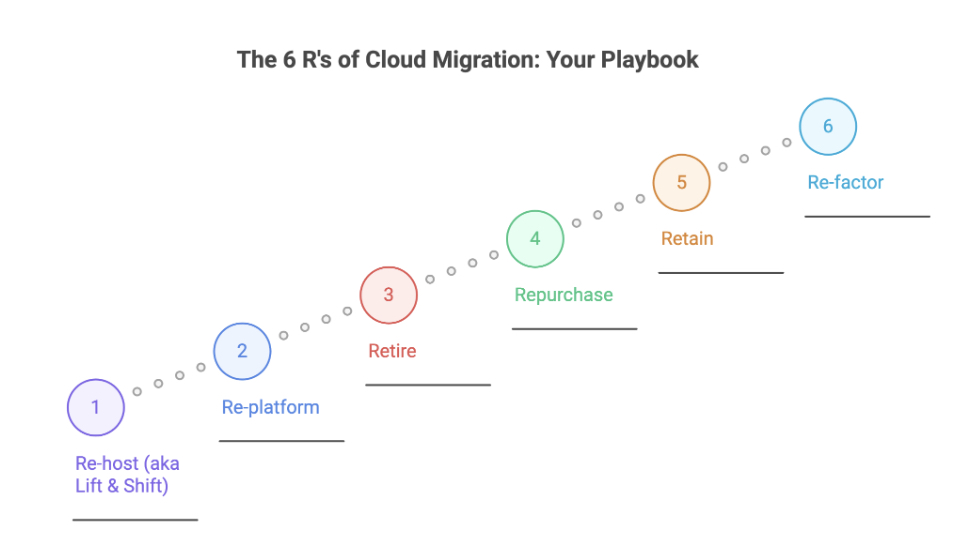
The 6 R’s of Cloud Migration: Your Decision Framework
The 6 R framework — originally developed by Gartner — gives you a structured way to decide what to do with each application in your estate. The key is applying it rigorously, not defaulting to lift-and-shift for everything.
Re-host (Lift & Shift)
Move as-is to the cloud. Fast, low-risk, minimal change. Good for initial cloud adoption on non-critical workloads. Quick wins that build migration muscle.
Re-platform
Move with targeted improvements — swap on-prem database for a managed cloud service. Same codebase, better foundation. Balances speed and optimization.
Repurchase
Replace a custom legacy app with a modern SaaS equivalent. Eliminates maintenance overhead. Best for CRM, HR, ERP, and non-differentiating workflows.
Retain
Keep it on-premises — for now. Right for compliant, low-cost systems where migration risk outweighs benefit. Document the retention rationale and review annually.
Retire
Decommission applications with no active users or business value. Archive data, shut down servers. Every retired system reduces attack surface and ops cost.
Re-factor
Rebuild cloud-native from scratch. High investment, highest payoff. Reserve for strategic applications where long-term scalability, agility, and performance are critical.
Gart Observation
In mid-market cloud projects, we consistently see organizations over-index on Re-factor before they have the DevOps maturity, observability tooling, or platform automation to support it. Start with Re-host and Re-platform for quick wins; Re-factor only what your team and platform can sustain.
Table 2 — 6 R’s Strategy Selection Guide
| Migration Strategy | Complexity | Time to Value | Best For | Watch Out For |
|---|---|---|---|---|
| Re-host | Low | Fast (weeks) | Initial adoption, low-value apps | Misses cloud-native benefits |
| Re-platform | Medium | Moderate (1–3 months) | Quick optimization gains | Scope creep into full refactor |
| Repurchase | Low–Medium | Fast after training | Non-differentiating workflows | Data migration & user change mgmt |
| Retain | None | N/A | Compliant, stable, low-cost apps | Becoming a permanent workaround |
| Retire | None | Immediate savings | Unused or redundant apps | Overlooked dependencies |
| Re-factor | High | Slow (6–18 months) | Strategic, high-value platforms | Requires DevOps maturity first |
Architecture Decisions: When Microservices Are Right (and When They’re Not)
One of the most consequential architectural choices in IT infrastructure modernization is the decision between monolithic and microservices architecture. Many teams are drawn to microservices because of the flexibility they promise — but deploy them before they have the maturity to support them. That is how you create a distributed monolith: the worst of both worlds.
The Monolith: Underrated Until It Breaks
A well-maintained monolith is fast to develop, easy to test, and operationally simple. The problem isn’t the architecture itself — it’s when the monolith grows beyond the team’s ability to reason about it. Codebase sprawl, coupled deployments, and increasing test cycle times are the warning signs.
Microservices: Right Team, Right Platform, Right Time
Microservices deliver on their promise of independent scalability and deployment agility — but only when you have the supporting infrastructure. That means an automated CI/CD pipeline, a container orchestration platform (Kubernetes), robust observability, and teams aligned along service boundaries (Conway’s Law is real). Without these, microservices amplify complexity rather than reduce it.
Table 3 — Monolith vs. Microservices: Decision Guide
| Dimension | Monolith | Microservices | Decision Signal |
|---|---|---|---|
| Team size | Works well with 1–10 engineers | Justified at 10+ engineers per domain | Team structure should drive architecture |
| Deployment frequency | Suitable for monthly/quarterly releases | Required for daily/continuous deployment | If shipping is slow today, microservices won’t fix it |
| Scaling needs | Uniform scale only | Independent per-service scaling | Use microservices only if scaling is asymmetric |
| Reliability isolation | One failure = full outage risk | Service failures are isolated | Critical for high-availability requirements |
| Ops maturity required | Low | High — Kubernetes, observability, service mesh | Assess platform readiness before committing |
Cloud Provider Comparison for IT Infrastructure Modernization (2026)
Cloud platform selection is a strategic decision, not a technical one. The right provider depends on your existing technology stack, regulatory environment, team expertise, and long-term platform strategy. The three dominant providers — AWS, Microsoft Azure, and Google Cloud — each have distinct strengths. [See: Synergy Research Group for current cloud market share data]
Table 4 — Cloud Provider Comparison: IT Infrastructure Modernization (2026)
| Criterion | AWS | Microsoft Azure | Google Cloud |
|---|---|---|---|
| Core Strength | Broadest service catalog, global reach, highest market maturity | Microsoft ecosystem integration, strong hybrid cloud | Data analytics, AI/ML, Kubernetes-native, open-source |
| Best for | Complex, diverse workloads; global scale; no existing vendor lock-in | Enterprises on Windows/SQL Server/Azure AD; regulated sectors | Data-intensive applications; ML pipelines; container workloads |
| Pricing Model | Pay-as-you-go; reserved instances; Savings Plans | Pay-as-you-go; Azure Hybrid Benefit for existing licenses | Sustained use discounts automatically applied |
| Compliance | Broadest certification portfolio globally | Leader for enterprise regulatory compliance (EU, US) | Security-by-design; encryption by default |
| Kubernetes & Containers | EKS — mature, enterprise-grade | AKS — tightly Azure-integrated | GKE — Kubernetes originated here; deepest native support |
| Multi-cloud fit | Strong with Outposts and Wavelength | Strong with Azure Arc | Anthos for multi-cloud Kubernetes management |
Most enterprises above a certain scale will operate a multi-cloud strategy — AWS or Azure as the primary platform, GCP for analytics and ML workloads. This reduces vendor lock-in and lets you leverage the best capabilities of each provider. The Cloud Native Computing Foundation publishes annual surveys on cloud adoption patterns that are worth reviewing alongside your architecture decisions.
Modernization KPI Checklist: How to Measure ROI
The board will not accept “the infrastructure is better now” as a measure of success. You need hard numbers. Here are the KPIs Gart recommends tracking from day one — establish baselines before migration begins, then measure delta at 30, 90, and 180 days post-launch.
- Deployment frequency (per week)
- Mean time to recovery (MTTR)
- Infrastructure cost per workload
- Patching SLA compliance (%)
- Resource utilization rate (%)
- Unplanned downtime (hours/month)
- Change failure rate (%)
- Lead time for change (days)
- Security incident count (monthly)
- Ops hours per workload (weekly)
Table 5 — Business Imperatives & Quantified Modernization Benefits
| Business Driver | Current State Risk | Modernization Outcome | Benchmark ROI |
|---|---|---|---|
| Technical Debt | Up to 40% of IT budget consumed by maintenance | Lean, automated infrastructure with low ops overhead | 30–50% reduction in operational costs |
| Market Agility | Months to ship new features; competitive lag | CI/CD with daily or weekly deployments | Average 14% increase in revenue post-modernization |
| Operational Efficiency | Manual, repetitive tasks consuming engineering time | Automation handles routine operations | Automate 65% of repetitive tasks; 40% productivity uplift |
| Cybersecurity | Unpatched legacy systems, slow incident response | Real-time monitoring, automated patching, zero-trust | 92% faster threat response |
| Infrastructure Cost | Over-provisioned static hardware; license waste | Usage-based cloud billing; right-sized workloads | Up to 35% reduction in infrastructure expenses |
Anatomy of Failure: What Modernization Disasters Actually Teach Us
The most useful modernization lessons don’t come from success stories — they come from the projects that went wrong. Three high-profile cases illustrate patterns we see repeatedly.
British Airways (2024): Governance, Not Technology
A software patch cascaded into a full-scale operational failure — not because the technology was bad, but because the change management process failed. No disaster recovery rehearsal, no automated rollback, no stakeholder escalation path. The lesson: technical excellence is table stakes; governance maturity is what separates recoverable incidents from catastrophic ones.
Volkswagen Cariad: Ambition Without Architecture Maturity
Volkswagen’s automotive software division attempted to modernize across the entire software stack simultaneously while still operating in a waterfall delivery model. Cultural resistance, fragmented decision-making, and scope creep destroyed timelines and ballooned costs. The lesson: modernization strategy must match current team maturity — not aspirational maturity.
Shared Pattern
In all three failures, technology was not the root cause. Governance gaps, misaligned culture, and deferred testing were. If your modernization plan treats these as secondary concerns, you are taking the same risks.
Three Modernization Mistakes We See in Mid-Market Cloud Projects
- Choosing microservices before platform readiness. Teams adopt Kubernetes and service-based architecture without the observability, CI/CD maturity, or team alignment to support it. Result: a distributed monolith with operational complexity but none of the benefits.
- Treating cloud migration as the end state. Lift-and-shift is a starting point, not a destination. Organizations that stop at re-hosting discover their cloud bills are higher than their data center costs were — without the flexibility that justifies them.
- Underestimating change management. In healthcare modernization projects especially, the technical migration is faster than the organizational adaptation. Invest in the human side from day one.
Infrastructure Modernization Trends Shaping 2026 and Beyond
The organizations winning at modernization today are not just adopting cloud — they are building for the next wave of infrastructure requirements. These are the trends that should influence your architecture decisions now.
Table 6 — Infrastructure Modernization Trends (2026)
| Trend | What It Means in Practice | Action for Engineering Leaders |
|---|---|---|
| AI-Ready Infrastructure | AI workloads require GPU access, low-latency data pipelines, and high-bandwidth storage. Most legacy infrastructure cannot support this at scale. | Design for AI-readiness in your target architecture — not as an afterthought |
| Platform Engineering | Internal Developer Platforms (IDPs) abstract infrastructure complexity from product teams. Leaders in this space ship 4x more frequently. platformengineering.org | Invest in a platform team alongside cloud migration |
| FinOps & Cloud Cost Discipline | Cloud spend is now the #2 or #3 line item for many engineering organizations. FinOps as a practice is becoming non-negotiable. finops.org | Establish cloud cost ownership from migration day one |
| Zero Trust Security | Perimeter security is no longer sufficient. Every user and device requires continuous verification regardless of network location. | Architect zero trust into modernized infrastructure; retrofit is costly |
| Green IT & Sustainability | Infrastructure energy consumption is under regulatory and investor scrutiny. Cloud efficiency and sustainable architecture are converging. greensoftware.foundation | Track energy efficiency KPIs alongside performance and cost |
| Edge & Hybrid Compute | IoT, manufacturing, and healthcare use cases require compute at the edge — processed where data is generated to reduce latency and bandwidth costs. | Evaluate edge architecture before defaulting to centralized cloud |
| AIOps | AI-driven infrastructure operations for predictive maintenance, intelligent alerting, and self-healing systems. Reduces MTTR and ops overhead significantly. | Pilot AIOps tooling in Phase 2 of your modernization roadmap |
Turn Your IT Infrastructure into a Competitive Advantage
Gart Solutions has led 50+ IT infrastructure modernization programs across healthcare, SaaS, fintech, and regulated industries. We bring the methodology, the engineers, and the operational discipline to move fast without breaking things.
- Infrastructure Audit (2 weeks)
- Cloud Migration & Architecture
- Kubernetes & Container Services
- DevOps & CI/CD Implementation
- SRE & Disaster Recovery
- Fractional CTO Leadership

Ready to Modernize Without the Headaches? Let’s build your next-gen IT stack together.
See how we can help to overcome your challenges