- What Is Network Design — and Why Does It Determine Business Growth?
- How Poor Network Design Directly Impacts Revenue
- Problems Associated with Lack of Network Design
- The 5 Most Expensive Network Design Mistakes We See
- More Network Design Mistakes:
- Gart’s 5-Layer Scalable Network Design Framework
- Cloud Network Architecture Best Practices for AWS & Azure
- Network Design Planning Checklist
- Poor Network Design vs. Optimized Network Design
- When Should a Business Redesign Its Network Architecture?
- Need a Network Architecture That Scales With Your Business?
- Conclusion
Strategic network design is the invisible backbone of every scalable, high-performing, and secure business. Get it right early, and your cloud infrastructure scales gracefully, deployments accelerate, and downtime stays near zero. Get it wrong, and a single architectural decision made in year one can cost your organization six figures to undo — or worse, it never gets fixed at all.
This guide is written for CTOs, CIOs, and engineering leaders who are either building cloud infrastructure from scratch, scaling an existing environment, or preparing for a cloud migration. It covers everything from fundamental network design principles to AWS and Azure architecture patterns, a proprietary planning checklist, real client stories, and the most expensive mistakes we see repeated across organizations of every size.
At Gart Solutions, our infrastructure and DevOps teams have reviewed, redesigned, and optimized network architectures for dozens of companies across SaaS, eCommerce, fintech, and enterprise. What follows is the accumulated insight from those engagements.
What Is Network Design — and Why Does It Determine Business Growth?
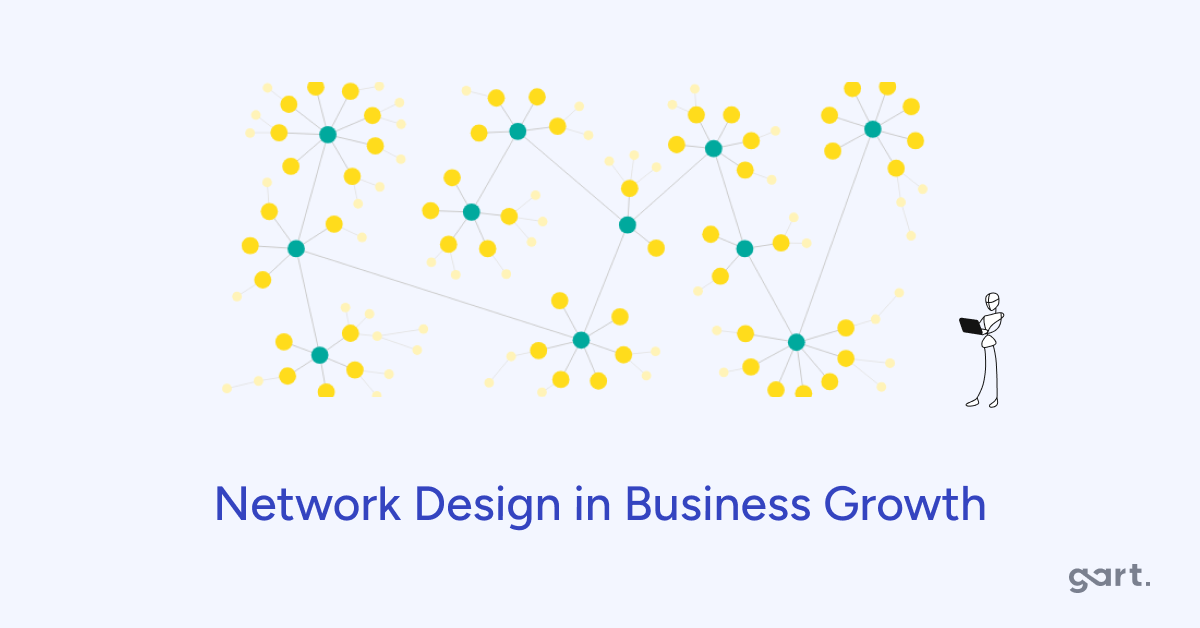
Network design is the architectural planning of how devices, systems, services, and users communicate with each other — across data centers, cloud environments, and the public internet. A well-executed network design defines the topology, segmentation model, routing policy, security perimeter, and scalability strategy of your entire technical infrastructure.
In cloud-native environments — built on AWS, Azure, or GCP — network design manifests primarily through Virtual Private Cloud (VPC) architecture, subnet segmentation, security group policy, inter-service communication patterns, and cross-region connectivity. It is the foundation on which every other infrastructure decision is made.
Why it matters for growth:
As your business scales — adding new services, expanding to new regions, onboarding enterprise clients, or pursuing compliance certification — your network architecture either enables that growth or actively blocks it. Most organizations don’t realize the constraint until the damage is already done.
Average cost per minute of IT downtime for mid-size companies
Of cloud migrations that encounter network rearchitecting mid-project
Reduction in deployment time after proper network segmentation
According to the Cloud Native Computing Foundation (CNCF), one of the leading causes of failed Kubernetes deployments is underestimated network complexity — specifically, the absence of a deliberate networking strategy before workloads go live. The challenge isn’t cloud technology; it’s the architecture underneath it.
How Poor Network Design Directly Impacts Revenue
The business cost of bad network design is rarely visible at first. It accumulates in engineering hours, deployment delays, and outage events — until one day it’s visible in lost deals, churned customers, or a six-figure re-platforming bill.
Downtime and Revenue Loss
A single 30-minute outage during a peak traffic event — a product launch, Black Friday, or a quarterly billing cycle — can eliminate an entire day’s revenue and trigger customer churn that takes months to recover. When that outage is caused by a flat network routing failure or an improperly segmented VPC, it is entirely preventable.
Slower Deployment Velocity
Engineering teams in organizations with poorly segmented environments spend significant time working around network constraints — manually granting access, debugging cross-environment routing failures, or waiting for firewall rule approvals. A proper network design — with clearly separated dev, staging, and production environments — removes these bottlenecks structurally.
Failed or Costly Cloud Migrations
When organizations attempt to migrate to cloud without a network design strategy, they often default to “lift and shift” into a single flat VPC. This works temporarily but creates enormous technical debt. Re-segmenting a live production environment months later — under business pressure — is significantly more expensive and risky than doing it right at the start. The Linux Foundation’s LF Networking initiative has documented this pattern across enterprise adoption studies as one of the primary drivers of cloud project overruns.
Compliance Failures and Security Incidents
SOC 2, ISO 27001, PCI DSS, and GDPR all have explicit requirements around network segmentation, access control, and data flow isolation. An organization with a flat, unsegmented network cannot achieve these certifications without first rearchitecting its network. In sectors like fintech, healthcare, and enterprise SaaS, this is the difference between closing and losing an enterprise deal.
Problems Associated with Lack of Network Design
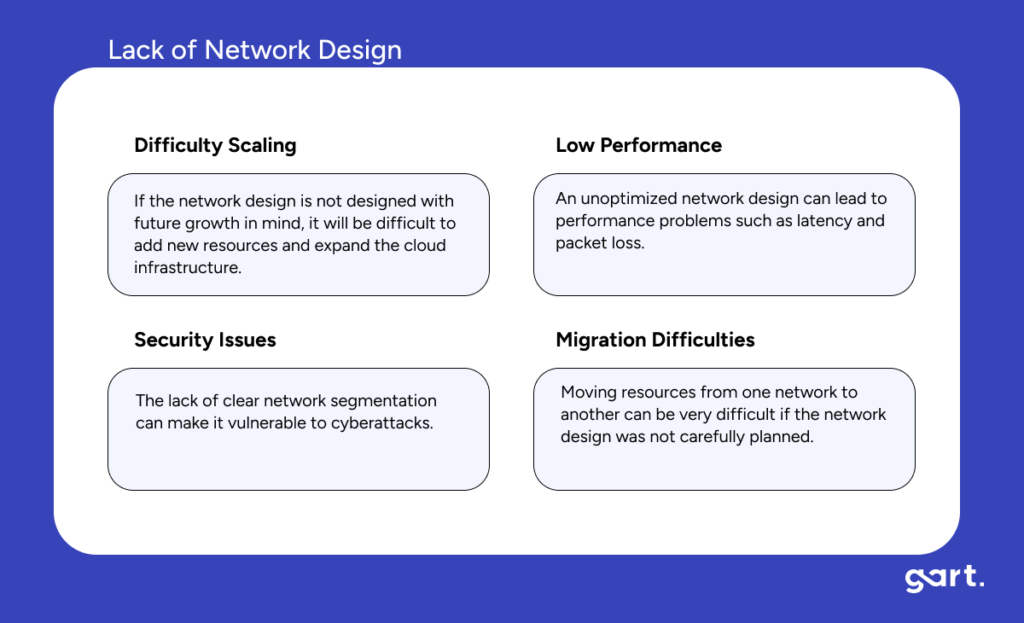
- If the network design is not designed with future growth in mind, it will be difficult to add new resources and expand the cloud infrastructure.
- An unoptimized network design can lead to performance problems such as latency and packet loss.
- The lack of clear network segmentation can make it vulnerable to cyberattacks.
- Moving resources from one network to another can be very difficult if the network design was not carefully planned.
One of our clients, RetailNow, an e-commerce company, experienced rapid growth but overlooked proper network planning. They implemented a single, flat network for all their services, which led to several critical problems
As new services and applications were added, integrating them into the existing network became increasingly difficult. The lack of a structured network design resulted in operational inefficiencies and frequent outages.
The initial network setup wasn’t designed to scale. As RetailNow expanded operations to new regions, they encountered significant issues with network performance and reliability, leading to lost sales and frustrated customers.
The absence of a strategic network design led to increased operational costs. RetailNow had to invest heavily in network redesign and optimization to support their growing business needs.
The 5 Most Expensive Network Design Mistakes We See
Here are common mistakes businesses make when creating network designs:
Flat network structure
As mentioned in the RetailNow example, using a single, flat network for all services is a serious mistake. This complicates the integration of new services and leads to performance and security issues.
A flat network structure, in short, is a network design where all devices are connected to a single network segment or broadcast domain, without any hierarchical divisions or subnetworks.
Key characteristics of a flat network structure include:
- Single broadcast domain
- No subnets or VLANs
- All devices share the same network address space
- Limited traffic segregation
- Simplified setup but poor scalability
This design is simple to implement for small networks but becomes problematic as the network grows, leading to increased traffic, reduced performance, and security challenges.
Insufficient Network Segmentation
When all services — databases, APIs, internal tooling, and public-facing applications — share the same subnet without granular security group rules, a single compromised resource can move laterally across the entire environment. Proper segmentation limits blast radius and is foundational to Zero Trust architecture.
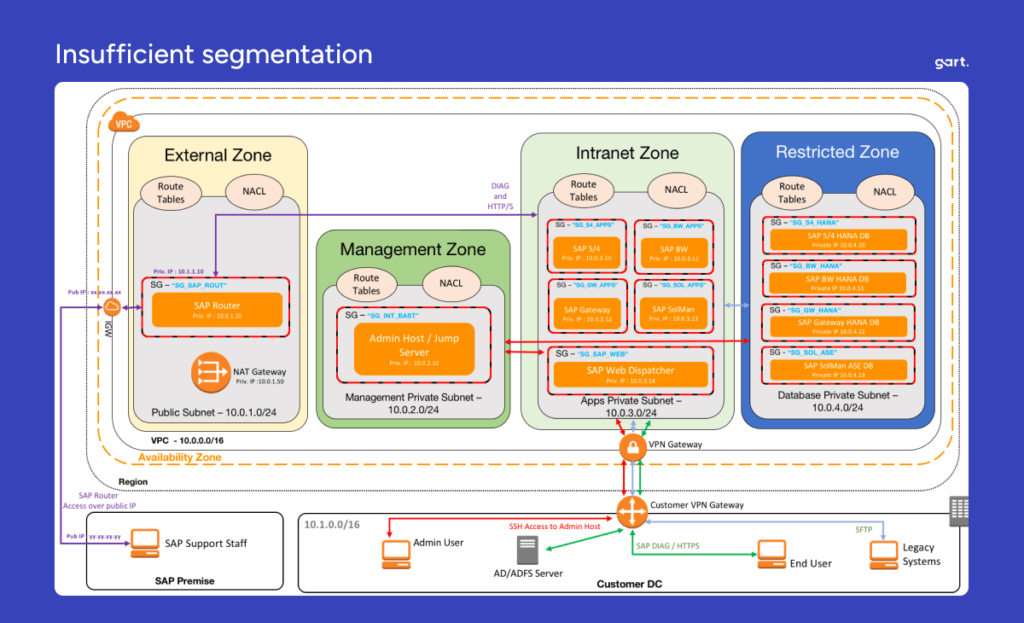
Insufficient segmentation in network design refers to the inadequate division of a network into smaller, distinct subnetworks or segments. Here’s a brief explanation:
Insufficient segmentation is characterized by:
- Too few subnetworks or VLANs
- Overly large network segments
- Lack of logical separation between different types of traffic or user groups
- Poor isolation of sensitive systems or data
Consequences of insufficient segmentation include reduced security due to broader attack surfaces, increased network congestion, difficulty in implementing access controls.
Proper segmentation helps improve security, performance, and manageability of the network by creating logical boundaries between different parts of the network infrastructure.
Ignoring scalability
CIDR block sizing, IP address space planning, and subnet capacity are decisions that are nearly impossible to change once production traffic is running. Many organizations run out of IP space or encounter routing conflicts during scaling, requiring complete network redesign at the worst possible time.
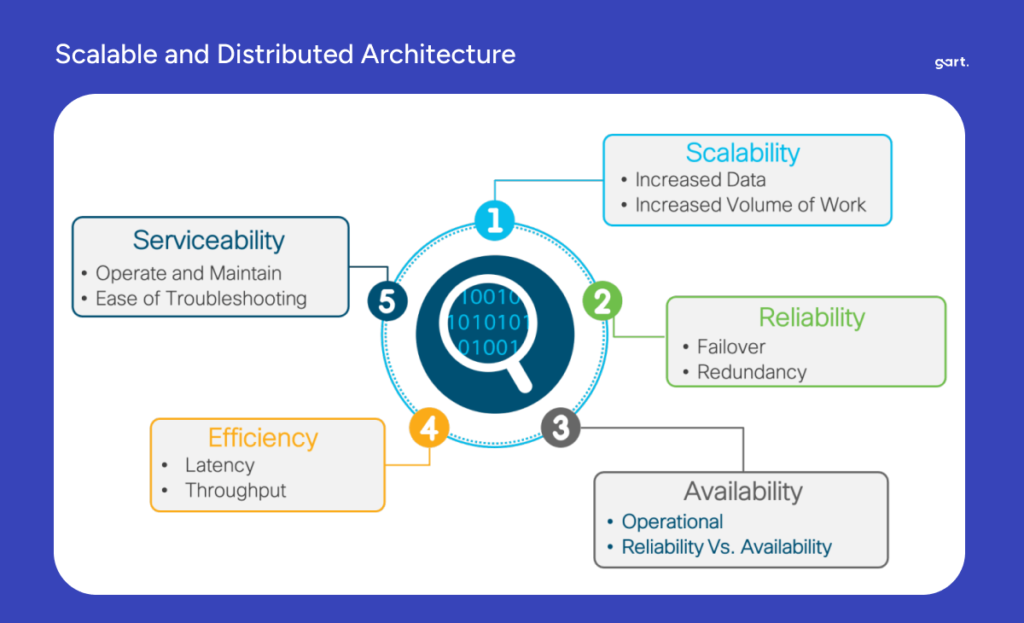
A scalable network design allows for easy expansion, improved performance under increased load, and the ability to adapt to changing business needs without major restructuring.
Ignoring scalability is characterized by designing only for current needs without considering future expansion, using inflexible network architectures, choosing hardware or software solutions that can’t easily accommodate growth, etc.
Consequences of ignoring scalability include:
- Network performance degradation as user numbers or data traffic increase
- Difficulty in adding new services or applications
- Costly and disruptive network redesigns or overhauls
- Inability to expand to new geographic locations or integrate with other networks
- Limitations on business growth due to network constraints
Suboptimal topology
Not using efficient topologies, such as hub-and-spoke, can complicate management and reduce network efficiency. Suboptimal topology in network design refers to the inefficient or ineffective arrangement of network components and their connections.
Examples of suboptimal topologies:
- Overuse of hub-based networks instead of more efficient switch-based designs.
- Daisy-chain configurations that create long, vulnerable paths without redundancy.
- Flat networks without proper hierarchical structure, leading to broadcast storms and security issues.
- Overly complex mesh networks that are difficult to manage and troubleshoot.
Consequences of suboptimal topology:
- Reduced network performance and user experience
- Higher operational costs due to inefficient use of resources
- Increased vulnerability to network outages
- Difficulty in implementing effective security measures
- Challenges in network expansion and adaptation to new technologies
- Complications in troubleshooting and resolving network issues
To avoid suboptimal topology, network designers should consider:
- Implementing hierarchical designs (core, distribution, access layers)
- Using efficient topologies like hub-and-spoke for wide area networks
- Incorporating redundancy and load balancing
- Designing for scalability and future growth
- Optimizing traffic flow based on application requirements
- Balancing between centralized and distributed network functions
Lack of centralized management
Failing to consider the need for centralized network management can lead to operational inefficiencies and security issues. Characteristics of lack of centralized management:
- Decentralized control: Network components and services are managed independently, without a unified approach.
- Multiple management interfaces: Different tools or platforms are used to manage various parts of the network.
- Inconsistent policies: Security, access, and configuration policies may vary across different network segments.
- Limited visibility: No single point of oversight for the entire network infrastructure.
- Manual processes: Reliance on manual configuration and updates rather than automated, centralized solutions.
Implementing centralized management often involves deploying network management systems (NMS) or software-defined networking (SDN) solutions that provide a single pane of glass for network operations. This approach allows businesses to more effectively manage their network infrastructure, improve security, and respond more quickly to changing business needs.
More Network Design Mistakes:
- Neglecting security: Insufficient attention to implementing robust security policies and firewalls makes the network vulnerable to attacks.
- Insufficient connection planning: Poor planning of connections between different environments (development, testing, production) can lead to performance and security issues.
- Ignoring compliance requirements: Neglecting compliance requirements when designing the network can lead to problems with regulatory bodies in the future.
- Inefficient IP address management: Poor IP addressing planning can lead to conflicts and complicate future expansion.
- Lack of documentation: Insufficient or absent documentation of network design makes future maintenance and modification of the network difficult.
These mistakes highlight the importance of careful planning and involving experienced professionals when developing network designs for businesses.
RetailNow: The Cost of a Flat Network Architecture
RetailNow is an eCommerce company that scaled from startup to mid-market in under three years. Their infrastructure grew alongside their business — reactively, with no underlying network design strategy. All services ran in a single flat VPC on AWS: the database, the payment processor, the public storefront, the internal admin panel, and development tooling.
When they began expanding operations into new regions and onboarding enterprise retail partners, the problems became critical. Integrating new services into the existing network required manual reconfiguration of routing tables and security groups across every environment — a multi-week process each time. A minor misconfiguration in a development workload caused a four-hour production outage during a promotional campaign. Compliance certification for a major retail partner was blocked pending a full network segmentation audit.
After a network redesign engagement with Gart Solutions — migrating to a segmented multi-region VPC architecture with separate environment subnets, centralized routing via Transit Gateway, and a Zero Trust security layer — RetailNow achieved the following:
40% reduction in deployment time
Zero environment-crossing incidents post-migration
SOC 2 Type II certification achieved within 4 months
Enterprise partner onboarding time reduced from 6 weeks to 11 days
Gart’s 5-Layer Scalable Network Design Framework
After years of designing and redesigning cloud network architectures, we’ve developed an internal framework that we apply to every infrastructure engagement. It’s not a rigid template — it’s a mental model that ensures every critical concern is addressed before a single resource is provisioned.
1. Boundary & Perimeter LayerDefines the outer security perimeter — WAF, DDoS protection, public load balancers, CDN configuration, and ingress traffic control. Everything public-facing lives and terminates here.
2. Environment Segmentation LayerStrict separation of production, staging, and development environments into isolated VPCs or network segments with no default cross-environment routes. Promotes compliance readiness from day one.
3. Service Communication LayerDefines how internal services talk to each other — service mesh configuration, internal load balancers, private DNS, and least-privilege security group rules. Kubernetes networking (CNI plugins, network policies) is managed at this layer.
4. Data & Storage Access LayerGoverns how compute resources access databases, object storage, caches, and message queues. All data services live in private subnets with no public internet exposure, accessible only via defined routes.
5. Observability & Resilience LayerNetwork flow logs, traffic anomaly detection, cross-region health checks, and automated failover policies. You cannot manage what you cannot observe — this layer makes the network transparent.
Cloud Network Architecture Best Practices for AWS & Azure
Cloud providers give you powerful networking primitives — but they don’t make architectural decisions for you. Here’s how strong network design translates into the specific constructs available on the two dominant platforms.
AWS VPC Best Practices
- Plan your CIDR block ranges to accommodate at least 3x your expected growth before provisioning — IP space cannot be easily reclaimed later.
- Use separate VPCs per environment (prod, staging, dev) connected via AWS Transit Gateway for centralized routing and policy enforcement.
- Deploy NAT Gateways per Availability Zone, not per region, to prevent cross-AZ data transfer costs and eliminate single points of failure.
- Implement AWS Network Firewall at the VPC level for stateful packet inspection on east-west (service-to-service) traffic.
- Use VPC Flow Logs exported to S3 or CloudWatch for forensic visibility and compliance audit trails.
- Never expose databases or internal services to public subnets — use PrivateLink or VPC endpoints for AWS service access without traversing the public internet.
Azure Network Design Best Practices
- Use Hub-and-Spoke topology via Azure Virtual WAN to centralize shared services (DNS, firewalls, monitoring) in a hub VNet while spoke VNets host workloads.
- Apply Network Security Groups (NSGs) at the subnet level — not just at the VM NIC level — for defense in depth.
- Leverage Azure Private Endpoint for PaaS services (Storage, SQL, CosmosDB) to keep traffic entirely within your virtual network.
- Use Azure DDoS Protection Standard on all public-facing resources in production environments.
- Implement Azure Firewall Premium for TLS inspection and IDPS on cross-region and hub egress traffic.
Zero Trust Network Architecture
Zero Trust is not a product — it is a network design philosophy that eliminates implicit trust based on network location. In a Zero Trust architecture, every service-to-service call is authenticated and authorized, regardless of whether both services are “inside” the network perimeter. This is implemented through service mesh technologies (Istio, Linkerd), mutual TLS (mTLS), and granular identity-based policy. According to Synergy Research Group, organizations adopting Zero Trust principles experience up to 50% fewer network-related security incidents within the first year of implementation.
In Azure, network design is a key part of the Azure Landing Zones framework. This framework offers a comprehensive approach to designing network infrastructure, including:
- Using a hub-and-spoke topology to centralize connections and simplify management.
- Implementing security and management policies at the central hub level.
- Segmenting the network into different environments (development, testing, production) through separate spoke networks.
- Centralized management through Azure Network Manager.
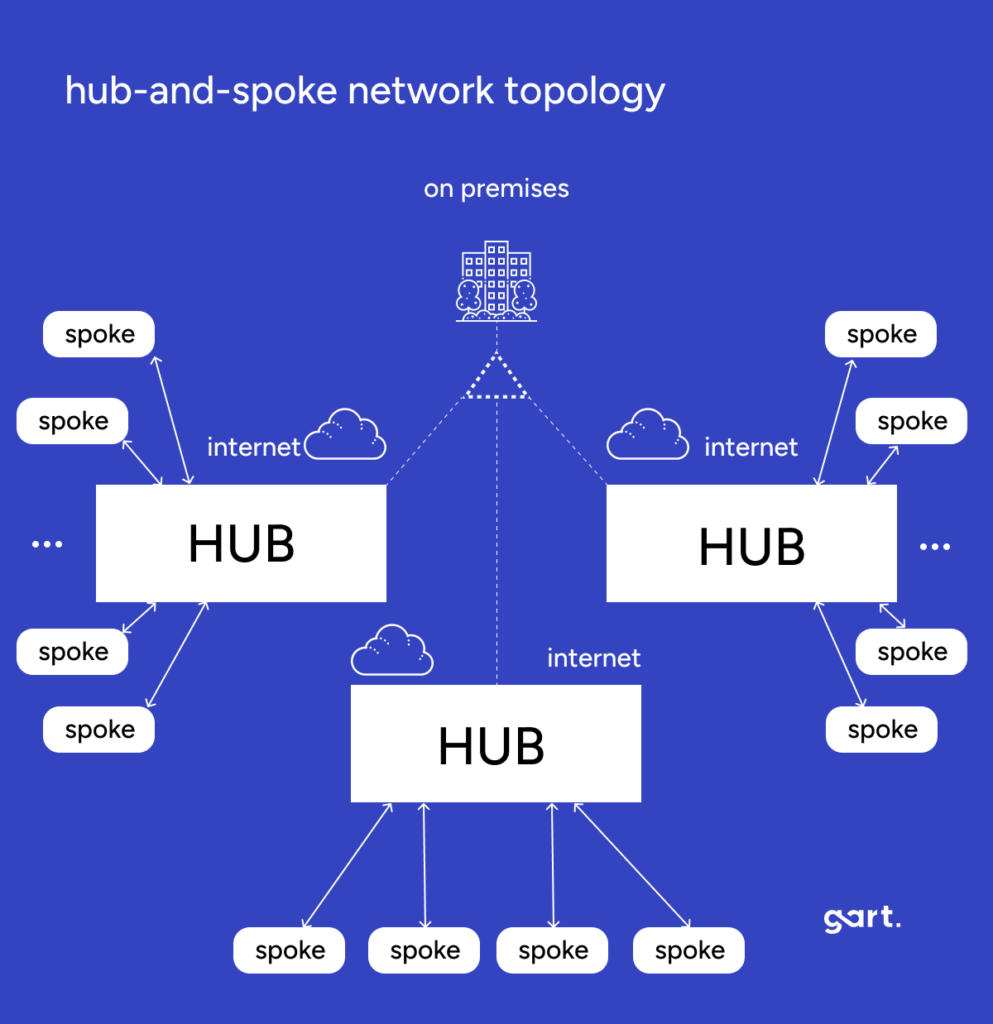
Hub-and-spoke Network Topology
Azure Landing Zones utilize a hub-and-spoke network topology, which centralizes connectivity and simplifies management. In this design, a central hub network connects multiple spoke networks, each representing different environments such as development, testing, and production.
Each spoke network can be dedicated to different functions such as development, testing, or production. This design provides several advantages:
- Centralized Security: The hub can enforce security policies and monitor traffic between spokes, ensuring that all communications are secure and compliant.
- Simplified Management: By centralizing network management in the hub, organizations can reduce the complexity of their network operations. This makes it easier to manage connections and enforce policies across the entire network.
- Flexible Scalability: New spokes can be added as needed without disrupting existing operations. This flexibility allows organizations to scale their infrastructure in response to changing business requirements.
In AWS, the recommended approach to network design includes:
- Using Amazon VPC (Virtual Private Cloud) to create isolated network environments.
- Implementing AWS Transit Gateway for centralized routing management between VPCs and on-premises networks.
- Using AWS Control Tower for automated setup and management of multi-account environments.
- Applying AWS Network Firewall for centralized network protection.
Both providers emphasize the importance of segmentation, scalability, centralized management, and security – precisely those aspects that, when neglected, lead to the typical mistakes described in the article.
This is how leading cloud platforms address the problems associated with typical network design mistakes and offer structured approaches to creating effective network architecture. This ties in well with the common mistakes discussed earlier, such as:
- Flat network structure: Addressed by hub-and-spoke designs in Azure and VPC segmentation in AWS.
- Insufficient segmentation: Solved through spoke networks in Azure and separate VPCs in AWS.
- Ignoring scalability: Both platforms offer solutions that can easily scale with business needs.
- Suboptimal topology: The recommended architectures from both providers aim to optimize network topology.
- Lack of centralized management: Addressed by Azure Network Manager and AWS Control Tower.
Network Design Planning Checklist
Use this checklist before designing or redesigning any cloud network architecture. Each item represents a decision point that, if deferred, will cost significantly more to address later.
| Planning Area | Key Decision | Common Mistake |
|---|---|---|
| IP & CIDR Planning | Allocate address space for 3x projected growth | Under-sized CIDR blocks requiring full VPC rebuild |
| Environment Separation | Isolated VPCs for prod, staging, dev | Single flat VPC across all environments |
| Multi-Region Strategy | Active-passive or active-active failover topology | Single-region deployment with no DR plan |
| VPC Segmentation | Public, private, and data subnets per AZ | All resources in public subnets |
| Security Policy | Least-privilege security groups and NACLs | Open inbound rules (0.0.0.0/0) on sensitive ports |
| IAM & Network Policy | Network-level IAM conditions on resource access | IAM policies without VPC source conditions |
| Monitoring & Observability | Flow logs, anomaly detection, and alerting from day one | Network logging added only after an incident |
| Disaster Recovery Topology | Defined RTO/RPO targets with tested failover paths | No tested DR procedure until a real outage occurs |
Poor Network Design vs. Optimized Network Design
| Dimension | ❌ Poor Network Design | ✅ Optimized Network Design |
|---|---|---|
| Architecture | Flat, single VPC for all workloads | Segmented, environment-isolated multi-VPC |
| Scalability | Manual scaling, frequent reconfiguration | Auto-scaling with pre-allocated address space |
| Security | Shared environments, broad firewall rules | Zero Trust, least-privilege, mTLS |
| Compliance | Cannot pass SOC 2 or PCI DSS without rearchitecting | Built-in audit trails, segmentation, access logs |
| Deployment Velocity | Blocked by network access requests and routing bugs | Self-service, automated, via IaC (Terraform) |
| Cost | Hidden costs: unnecessary data transfer, redesign overhead | Optimized routing, predictable traffic costs |
| Disaster Recovery | No tested failover — discovered during an incident | Automated cross-region failover, tested quarterly |
When Should a Business Redesign Its Network Architecture?
The right time to redesign is always before you need to. But there are clear signals that architectural debt has accumulated to the point where a redesign is unavoidable:
- Your engineering team spends more than 10% of sprint capacity managing network access, firewall rules, or routing issues — work that should be structural, not manual.
- You are preparing for a compliance audit (SOC 2, ISO 27001, PCI DSS) and your current architecture cannot meet segmentation requirements without significant changes.
- You are expanding into new geographic markets or cloud regions and your current network architecture does not support multi-region deployment natively.
- You have experienced a security incident and the post-mortem identified lateral movement as a contributing factor — which is, by definition, a segmentation failure.
- You are migrating from a monolith to microservices and your flat network cannot support the service-mesh and granular communication policies that distributed architecture requires.
- A major enterprise client or partner has issued a security questionnaire and your network topology cannot satisfy their vendor assessment requirements.
As noted in Platform Engineering’s infrastructure maturity research, most engineering organizations begin their platform engineering journey precisely because their network and infrastructure architecture can no longer support the velocity of delivery they need.
Need a Network Architecture That Scales With Your Business?
Gart Solutions designs, audits, and rebuilds cloud network architectures for growing technology companies. We help engineering teams move from reactive firefighting to intentional, scalable infrastructure — without slowing down delivery.
Network Architecture Audit
VPC & Cloud Network Design
Zero Trust Implementation
Multi-Region Deployment
Compliance Readiness
DevOps & IaC Automation
Conclusion
Planning a network design from the beginning is crucial for any growing business. It ensures that the infrastructure can scale efficiently, maintain security, and support the company’s evolving needs. A well-designed network, guided by experienced DevOps engineers or cloud architects, can save businesses from costly reconfigurations and operational disruptions in the future.