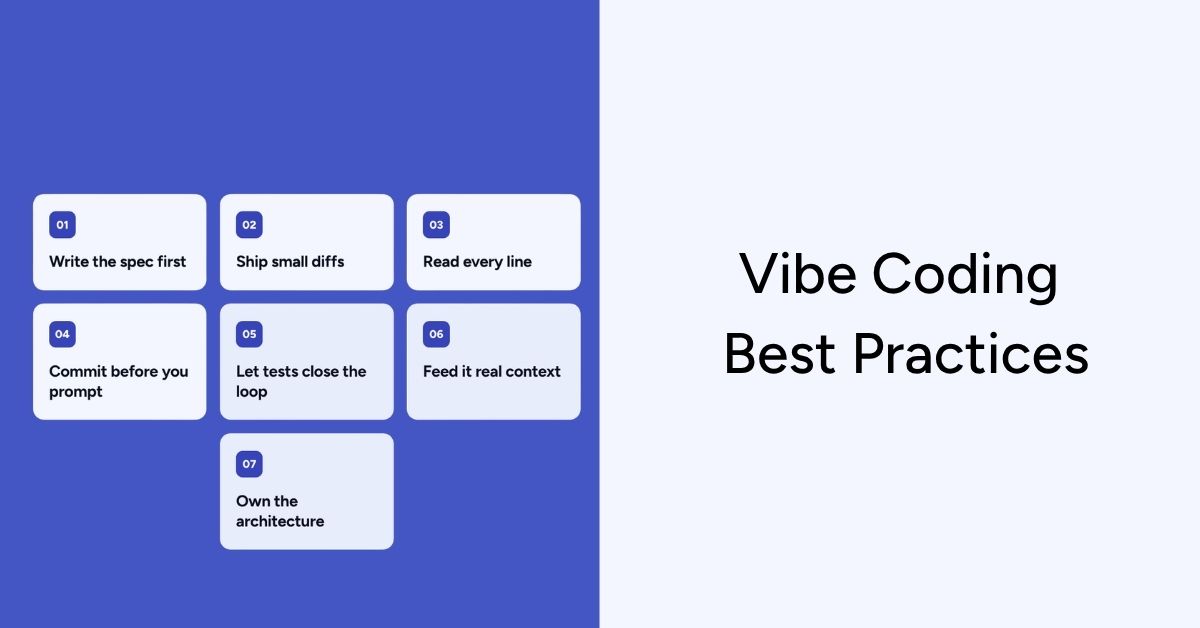
Gartner predicts that by 2028, 40% of new enterprise production software will be built using vibe coding techniques and tools — prompting an AI assistant in natural language rather than hand-writing every line. It's already happening faster than that forecast suggests: by most 2026 estimates, 41-46% of new production code is AI-generated, and Java backends have crossed 61%. The problem isn't the prompting. It's that a working demo and a production-ready application that has passed a real security audit are two very different things, and most teams don't find out which one they've built until it's live and something breaks.
This guide is the vibe coding best practices playbook we actually use when a founder or product team brings us an AI-generated app and asks, "is this safe to launch?" It covers the prompt strategy that gets you closer to production-ready code on the first pass, the security gaps AI assistants reliably leave behind, and the infrastructure checklist — CI/CD, secrets, observability, disaster recovery — that turns a vibe-coded prototype into something Gart's own SRE and DevOps teams would sign off on.
What "vibe coding" actually means in 2026
The term was coined for describing a piece of code by describing what you want in plain English and letting an AI assistant — Claude, Cursor, Lovable, Bolt, Replit, v0, or a dozen similar tools — generate, run, and iterate on it, often with the person driving barely reading the diff. It's no longer a hobbyist curiosity. Stack Overflow's 2025 survey found 84% of developers already use or plan to use AI coding tools, and 63% of self-identified vibe coding users are non-developers: product managers, founders, and designers shipping real, customer-facing software without a traditional engineering background.
That's the upside case. The 2026 data on outcomes is messier. MIT researchers measured a 26% increase in completed tasks across nearly 4,900 developers using AI assistants, and McKinsey found teams saving roughly 3.6 hours a week on routine coding. But a randomized METR study found experienced developers were actually 19% slower on real tasks when using AI tools — while estimating afterward that they'd been 20% faster. Uplevel's research tied Copilot adoption to a 41% increase in bug rates. And separate security research found only 8.25% of one leading model's code outputs were both functionally correct and free of security flaws, with 45% failing OWASP Top 10 benchmarks outright. Vibe coding isn't a shortcut around engineering discipline — it just moves where that discipline needs to be applied: from writing the code to reviewing, securing, and operating it.
Prototype vs. production-ready: the gap in one table
Most of the vibe-coded apps we're asked to review pass this test in under a minute — and that's the point. A weekend prototype and a production system can look identical in the browser while being nothing alike underneath.
DimensionTypical vibe-coded prototypeProduction-ready applicationData access controlDefault-open tables; RLS/authorization added "later"Deny-by-default policies, tested per role before launchSecretsAPI keys pasted into prompts, client code, or .env files committed to gitManaged secrets store with rotation and least-privilege scopingTestingManual click-through by the person who built itAutomated test suite plus an independent review of AI-written logicDeploymentOne environment, deployed by hand from a laptopCI/CD pipeline with staging, rollback, and infrastructure as codeObservabilityNo alerting; issues found when a user complainsMonitoring, error tracking, and on-call escalation pathsDisaster recoveryNo backup strategy beyond the platform's defaultsTested backups, defined RTO/RPO, documented recovery runbookCost controlUnmetered AI-generated queries and autoscaling left uncappedBudget alerts, query review, and right-sized infrastructurePrototype vs. production-ready: the gap in one table
A prompt strategy that produces production-ready code
Most "vibe coding went wrong" stories trace back to a prompt that only described the happy path. AI coding assistants are pattern-matchers trained mostly on demo-quality code; if you don't ask for edge cases, error handling, and security constraints explicitly, you'll rarely get them by default. The prompt strategy that reliably narrows the gap in the table above has three layers, asked in order, not all at once:
Technical context first. State your stack, data model, and architectural constraints before asking for behavior — "PostgreSQL via Supabase, Next.js on Vercel, multi-tenant with row-level isolation by organization_id" — so the assistant isn't guessing at conventions it will contradict three prompts later.
Functional requirements, including the boring parts. Describe the user-facing behavior and explicitly ask for validation, empty states, and error messages, not just the success case.
Integration and edge cases as a direct follow-up. After the first draft, ask: "What could go wrong with this code in production? What edge cases and failure modes am I not handling?" Then ask the model to review its own output "as if this is going live tomorrow" — this single follow-up surfaces missing authorization checks and unhandled errors far more often than a single well-crafted initial prompt does.
Two habits compound this into an actual production-ready-app strategy rather than a one-off trick: ask the assistant to explain why it chose an approach (a model that can't justify a decision usually made a weak one), and treat every AI-generated data access, authentication, or payment code path as a draft that needs a second, human review before merge — never an exception to your normal review process.
Vibe coding security best practices you can't skip
Security is where AI-generated code fails most predictably, and where the consequences are least forgiving. The clearest public example is CVE-2025-48757: a missing Row-Level Security default in Lovable-generated apps that left over 170 live projects — roughly 303 exposed endpoints, CVSS 9.3 — readable and writable by anyone, unauthenticated. It's a textbook case of what breaks when a Lovable + Supabase app reaches production without a security review: the framework defaulted open, and nobody closed it.
Secrets management is the second most common failure mode, and it's getting worse, not better. GitGuardian's 2026 State of Secrets Sprawl report found that AI-assisted commits leak hardcoded secrets at 3.2%, versus a 1.5% baseline across all public GitHub commits — more than double — and secrets tied to AI services specifically grew 81% year over year. Four checks close most of the gap:
Before you ship, verify: row-level security (or equivalent authorization) is enabled and tested for every table and role, not just the default; no API keys or service-role credentials exist in client-side code, prompts, or committed .env files; secrets live in a managed store with rotation, not hardcoded — see our comparison of Kubernetes secrets management approaches if you're deploying on containers; and every AI-generated database and API layer has been checked against production hardening best practices for your specific backend, not just the framework's happy-path defaults.
None of this means AI-generated code is uniquely unsafe — it means it inherits the same risks as any code written under time pressure by someone optimizing for "it works," and vibe coding compresses that pressure into minutes instead of sprints. Building checks like role-based access control directly into the CI/CD pipeline, rather than relying on someone remembering to run them, is what closes the gap for good.
Testing and review discipline for AI-generated code
The trust gap tells you most of what you need to know here: only around 29% of developers say they trust AI-generated code's accuracy, down from roughly 40% two years ago — yet only 48% say they always review AI output before committing it. That mismatch, not the AI itself, is where production incidents come from.
A workable review discipline for vibe-coded code doesn't need to be heavier than normal code review — it needs to target the specific failure modes AI assistants produce: authorization checks that look present but only cover the happy path, error handling that catches the exception but swallows it silently, and logic that's subtly wrong in a way that passes a casual read (research on one frontier model found major-issue rates 1.7x higher than human-written baselines, with logic flaws up 75%). Treat any AI-generated pull request touching auth, payments, or data access as requiring the same second reviewer you'd assign to a junior engineer's first month of commits — because functionally, that's what it is.
The infrastructure checklist before you ship
This is the part that gets skipped most often, because it's invisible right up until it isn't. An app that runs fine on the platform's free tier with ten test users tells you almost nothing about how it behaves under real load, real failure, or a real audit.
CI/CD and infrastructure as code
If deploying means someone pushing a button from their laptop, you don't have a deployment process — you have a single point of failure with a person attached. A proper pipeline with staging, automated tests, and rollback is the single highest-leverage fix available, and it's exactly what our infrastructure-as-code case study walks through for a team that scaled from manual deploys to millions of automated transactions a month.
Observability and reliability
Vibe-coded apps tend to have zero visibility into their own health until a user reports something broken. Basic error tracking, uptime monitoring, and an alerting path aren't optional extras — they're the difference between finding a problem in minutes and finding it in a support ticket three days later. Our breakdown of SRE versus DevOps covers which discipline actually owns this once you're past the prototype stage.
A platform, not a pile of scripts
Teams that vibe-code several apps in parallel — which is increasingly common among the 16 million or so citizen developers now shipping software — run into a second-order problem: every app has its own ad hoc deployment, secrets handling, and monitoring setup. Platform engineering exists to turn that sprawl into a self-service golden path, so the next AI-generated app inherits guardrails instead of starting from zero.
Scale and cost control
AI-generated queries are notorious for missing indexes and doing more database round-trips than a human would write by hand — fine at ten users, expensive and slow at ten thousand. Cap autoscaling, set budget alerts, and load-test before a launch gets real traffic, not after.
When to bring in infrastructure and DevOps help
Not every vibe-coded app needs an outside team — a genuine side project with no user data at stake can stay a weekend project. The signal to act is any combination of: real user data flowing through the app, revenue depending on uptime, a compliance requirement (HIPAA, PCI DSS, SOC 2, GDPR) on the horizon, or a founder realizing they can describe what the app does but not how it fails. At that point, the fastest path isn't rebuilding from scratch — a fractional CTO engagement can sequence exactly which of the fixes in this article matter first for your specific app, before committing to a full rebuild that may not be necessary at all.
Turn your vibe-coded MVP into infrastructure that scales
From a one-time production-readiness audit to full-time DevOps and SRE support, Gart closes the gap between "it works in the demo" and "it survives real traffic" — without a full rebuild.
Security audit
Infrastructure audit
Platform engineering
Cloud migration
CTO as a Service
Get a production-readiness review
You might also like
DevSecOps vs. DevOps: how secure software delivery evolved
What is DevSecOps consulting?
Software reliability through DevOps and SRE
How to hire DevOps engineers that actually move the needle
Roman Burdiuzha
Co-founder & CTO, Gart Solutions · Cloud Architecture Expert
Roman has 15+ years of experience in DevOps and cloud architecture, with prior leadership roles at SoftServe and lifecell Ukraine. He co-founded Gart Solutions, where he leads cloud transformation and infrastructure modernization engagements across Europe and North America. In one recent client engagement, Gart reduced infrastructure waste by 38% through consolidating idle resources and introducing usage-aware automation. Read more on Startup Weekly.
Convex vs Supabase is the comparison almost every engineering team runs into the moment they decide to skip building auth, real-time sync, and a database layer from scratch. Both platforms promise to collapse months of backend plumbing into a single managed service, and both have raised serious money on that promise — but they solve the problem in genuinely different ways. Supabase wraps PostgreSQL with auth, storage, and real-time subscriptions into one open-source-friendly package; Convex throws out SQL entirely and makes your TypeScript functions the whole backend, with reactivity built in by default rather than bolted on.
The right choice depends less on which platform has more stars on GitHub and more on what your team already knows, how your data actually shapes up, and where you expect to be in eighteen months. Before picking either one, it's worth treating the decision the way you'd treat any other piece of production architecture — with a clear view of the trade-offs, not just the marketing page. That's also the point where a short cloud and backend architecture consulting conversation tends to save the most time, since the cost of migrating off the wrong platform later is almost always higher than the cost of a proper evaluation up front. This guide breaks down the architecture, features, pricing, and real trade-offs of Convex vs Supabase so you can make that call with your eyes open.
What Are Convex and Supabase?
Supabase is an open-source backend-as-a-service (BaaS) built directly on top of PostgreSQL. It bundles a managed Postgres database with authentication, object storage, auto-generated REST and GraphQL APIs, edge functions, and real-time subscriptions driven off Postgres's write-ahead log. The pitch is straightforward: if you already know SQL and want the full power of a relational database with the operational overhead stripped away, Supabase gets you there fastest, and you can self-host the entire stack if you outgrow the hosted plan or need to keep data in a specific region.
Convex takes a different starting point entirely. It's a reactive document database where queries, mutations, and your data schema are all written in plain TypeScript — there's no SQL to learn, no ORM to configure, and no separate caching layer to manage, because Convex's query engine automatically tracks what each client is subscribed to and pushes updates the moment underlying data changes. Convex open-sourced its backend under a fair-source license in February 2025, and the self-hosted version supports the same Docker-based deployment most teams already use for other infrastructure, according to Convex's own open-source backend repository.
Both categories have attracted significant capital precisely because "backend in a box" has become a default expectation for new products, especially AI-assisted ("vibe coding") app builders that need a database and auth wired up before the first prototype ships. Supabase closed a $500 million Series F at a $10.5 billion post-money valuation in June 2026, led by GIC, per CNBC's reporting — a sharp climb from the $2 billion valuation of its Series D just over a year earlier. Convex has taken a smaller, more focused funding path, raising a $26 million Series A led by Andreessen Horowitz, according to a16z's own investment announcement.
Architecture: Reactive TypeScript Backend vs. Postgres-Powered BaaS
The architectural split between these two platforms explains almost every other difference on this page, so it's worth understanding before comparing feature checklists. Supabase is fundamentally a set of well-integrated services sitting in front of a real Postgres instance: PostgREST auto-generates a REST API from your schema, GoTrue handles authentication, Realtime listens to Postgres's write-ahead log to broadcast row-level changes, and Storage manages files in S3-compatible buckets. Because the core is genuine PostgreSQL, you get joins, foreign keys, transactions, stored procedures, and extensions like pgvector for AI embedding search — anything you already know about relational databases transfers directly.
Convex collapses that entire service list into one reactive runtime. You define your schema in TypeScript, write server-side functions (queries, mutations, and actions) that are automatically transactional, and the client SDK subscribes to exactly the data each query touches — so when a mutation changes a row, every connected client watching that query re-renders with fresh data automatically, with no manual cache invalidation, no WebSocket wiring, and no separate state-management layer for server data. It's a document-oriented data model rather than relational, which means there's no SQL to write and no ORM to fight, but it also means teams accustomed to relational modeling and complex joins have to think in a different shape.
The core distinction: Supabase gives you a real Postgres database with managed services layered on top — you get relational power and an escape hatch to raw SQL whenever you need it. Convex gives you a single reactive runtime where the database, business logic, and real-time layer are the same system, written entirely in TypeScript — you trade relational flexibility for radically less integration work and real-time behavior that's automatic rather than opt-in.
That difference also shows up in how each platform is used in the wild. TypeScript's dominance on the backend is a big part of why Convex's pitch resonates — it was used by 44% of professional developers in the 2025 Stack Overflow Developer Survey, and became the top language on GitHub by monthly contributors the same year. If your team is already end-to-end in TypeScript, Convex removes an entire context switch; if your team leans on SQL for reporting, analytics, or complex joins, Supabase's Postgres core is going to feel far more natural day to day.
Convex vs Supabase: Feature-by-Feature Comparison
Here's how the two platforms stack up across the criteria that actually drive a production decision:
CriteriaConvexSupabaseData modelReactive document database, schema defined in TypeScriptRelational — genuine PostgreSQL under the hoodQuery languageTypeScript functions only, no SQLSQL, plus auto-generated REST & GraphQL APIsReal-time syncAutomatic and default — every query is reactiveOpt-in via Realtime, driven off Postgres's write-ahead logAuthenticationBuilt-in auth plus Clerk/Auth0 integrationsBuilt-in GoTrue auth with social & SSO providersFile storageBuilt-in file storageS3-compatible object storage (Supabase Storage)AI / vector searchBuilt-in vector search on documentspgvector extension for embeddingsSelf-hostingYes — Docker or prebuilt binary, fair-source licensedYes — fully open-source, widely self-hostedCommunity size~12,000 GitHub stars on the open-source backend100,000+ GitHub stars on the core repositoryBest fitReal-time apps, TypeScript-first teams, rapid prototypingRelational data, complex queries, SQL-literate teamsConvex vs Supabase: Feature-by-Feature Comparison
Pricing: Convex vs Supabase Compared
Both platforms are inexpensive to start with and get materially more complex to estimate once you're at production scale, because they charge for fundamentally different things: Convex bills primarily by compute (function execution time and per-developer seats), while Supabase bills primarily by storage and database compute size.
Plan tierConvexSupabaseFree tier1M function calls/month, 0.5 GB storage, single project500 MB database, 1 GB file storage, 50,000 MAUsEntry paid planProfessional: $25/developer/monthPro: $25/month/org (incl. $10 compute credit)Included usage (entry plan)50 GB storage, 50 GB DB I/O, 250M function calls/monthOne Micro compute instance covered by creditMid tierBusiness & Enterprise: $2,500/month minimumTeam: $599/month/org — SSO, audit logs, priority supportEnterpriseCustom, usage-negotiatedCustom — SOC 2 Type II, HIPAA, private VPC, custom SLAsPricing modelPer-seat + compute (function calls, storage, egress)Per-org + database compute size and storagePricing: Convex vs Supabase Compared
Two pricing gotchas catch teams off guard on both platforms, regardless of which one you pick:
Convex's per-developer seat fee scales with headcount, not usage, so a growing team can see its base bill climb even if the application's traffic hasn't changed — budget for seats, not just function calls.
Supabase's Team plan jump from $25 to $599 per month is a large step for a mid-sized company that needs SSO or audit logs but isn't yet ready for a full Enterprise negotiation — model this jump explicitly if compliance requirements are on your near-term roadmap.
Which One Should You Choose?
Feature tables rarely settle this on their own — the decision usually comes down to what your data actually looks like and what your team already knows how to operate. Based on the comparison above, here's how the choice tends to shake out in practice:
Choose Convex if you're building a real-time-heavy product (collaborative tools, live dashboards, multiplayer features), your team is TypeScript end-to-end, and you'd rather not wire up WebSockets and cache invalidation by hand. It's also a strong fit for rapid prototyping, since schema, backend logic, and reactivity ship as one cohesive unit.
Choose Supabase if your data is genuinely relational — deep joins, complex reporting, financial or inventory data with strict referential integrity — and your team already thinks in SQL. It's also the safer default when you need pgvector for AI search alongside transactional data in the same database.
Choose Supabase (self-hosted) or a custom architecture if data residency or a specific compliance framework requires you to control exactly where and how data is stored — a consideration that matters even more for teams operating under EU data-sovereignty rules, covered in our breakdown of the EU cloud managed-services gap.
It's also worth remembering that this isn't necessarily a permanent, one-way decision. Teams that start on Convex for speed sometimes introduce a relational store later for reporting; teams that start on Supabase sometimes add a dedicated real-time layer once collaborative features become core to the product. Architecting for that possibility from day one — rather than assuming the first choice is forever — is exactly the kind of decision our monolith-vs-microservices comparison addresses at the application-architecture level.
Common Mistakes When Choosing a Backend Platform
Most regretted BaaS decisions don't fail because the platform was bad — they fail because the evaluation skipped a step that would have made the mismatch obvious early:
Picking based on the demo, not the data model. Both platforms look effortless in a 10-minute walkthrough. The real test is modeling your actual schema — relational joins in Convex, or real-time collaborative state in Supabase — before committing, not after building three months of features on top of it.
Ignoring the pricing model's shape, not just the entry price. A $25/month plan tells you almost nothing about your bill at 10x the traffic. Model Convex's per-seat-plus-compute curve and Supabase's storage-plus-compute curve against your actual growth projections, not the marketing page's headline number.
Treating scalability as someone else's problem later. Both platforms scale further than most teams expect, but neither is infinite — understanding realistic ceilings up front avoids a painful mid-growth migration; see our guide on horizontal vs. vertical scaling for how that ceiling question generalizes beyond any single vendor.
Skipping the compliance conversation until an enterprise deal requires it. SOC 2 and HIPAA are gated behind custom Enterprise pricing on both platforms — if a large customer or regulated vertical is even plausible within 12 months, price that tier now rather than discovering the jump during a contract negotiation.
Beyond the BaaS: When You Need More Than Either Platform Gives You
Both Convex and Supabase are genuinely good at the job they're built for: getting a product to market without a team of backend engineers wiring up infrastructure from scratch. But "managed BaaS" and "production-grade infrastructure for a scaling enterprise" are different problems, and most teams eventually hit the edges — usage-based costs that outpace a dedicated cloud footprint, compliance requirements the platform's Enterprise tier doesn't fully cover, or a data residency rule that a multi-tenant SaaS platform structurally can't satisfy. Getting ahead of that transition is cheaper than being forced into it during an incident or a failed audit; our AWS cost optimization guide and Infrastructure-as-Code best practices are both useful starting points once that migration becomes real.
This is precisely where Gart Solutions gets brought in — not to talk anyone out of Convex or Supabase, but to help engineering leaders make the platform choice deliberately, then build the surrounding architecture (CI/CD, observability, IAM, disaster recovery) that a BaaS platform alone doesn't provide. That includes compliance audits to prepare for SOC 2 or HIPAA ahead of an enterprise deal, DevSecOps consulting to bake security into the pipeline from day one, and SRE engagements once uptime and incident response start mattering as much as feature velocity. If Convex or Supabase get you to product-market fit, our job is making sure the next stage of growth doesn't force a rushed, unplanned migration.
Not sure which backend platform fits your product roadmap?
Gart Solutions helps engineering leaders evaluate Convex, Supabase, and traditional cloud-native architectures against their actual data model, team skills, and compliance requirements — then builds the migration path for when a managed BaaS stops being enough.
10+
Years in DevOps & Cloud
50+
Enterprise clients served
4.9★
Clutch rating
Cloud Consulting
DevOps Consulting
SRE & Reliability
Compliance Audit (SOC 2 / HIPAA)
Cloud Migration
Talk to a Gart Engineer →
You might also like
How to Choose a Cloud Provider: AWS vs Azure vs Google Cloud
AWS vs Azure for Startups: Which Cloud Platform Wins in 2026?
What Is DevSecOps? Guide to Securing Modern Applications
Gart IT Infrastructure Consulting Services
Gart Cloud Migration Services
Roman Burdiuzha
Co-founder & CTO, Gart Solutions · Cloud Architecture Expert
Roman has 15+ years of experience in DevOps and cloud architecture, with prior leadership roles at SoftServe and lifecell Ukraine. He co-founded Gart Solutions, where he leads cloud transformation and infrastructure modernization engagements across Europe and North America. In one recent client engagement, Gart reduced infrastructure waste by 38% through consolidating idle resources and introducing usage-aware automation. Read more on Startup Weekly.
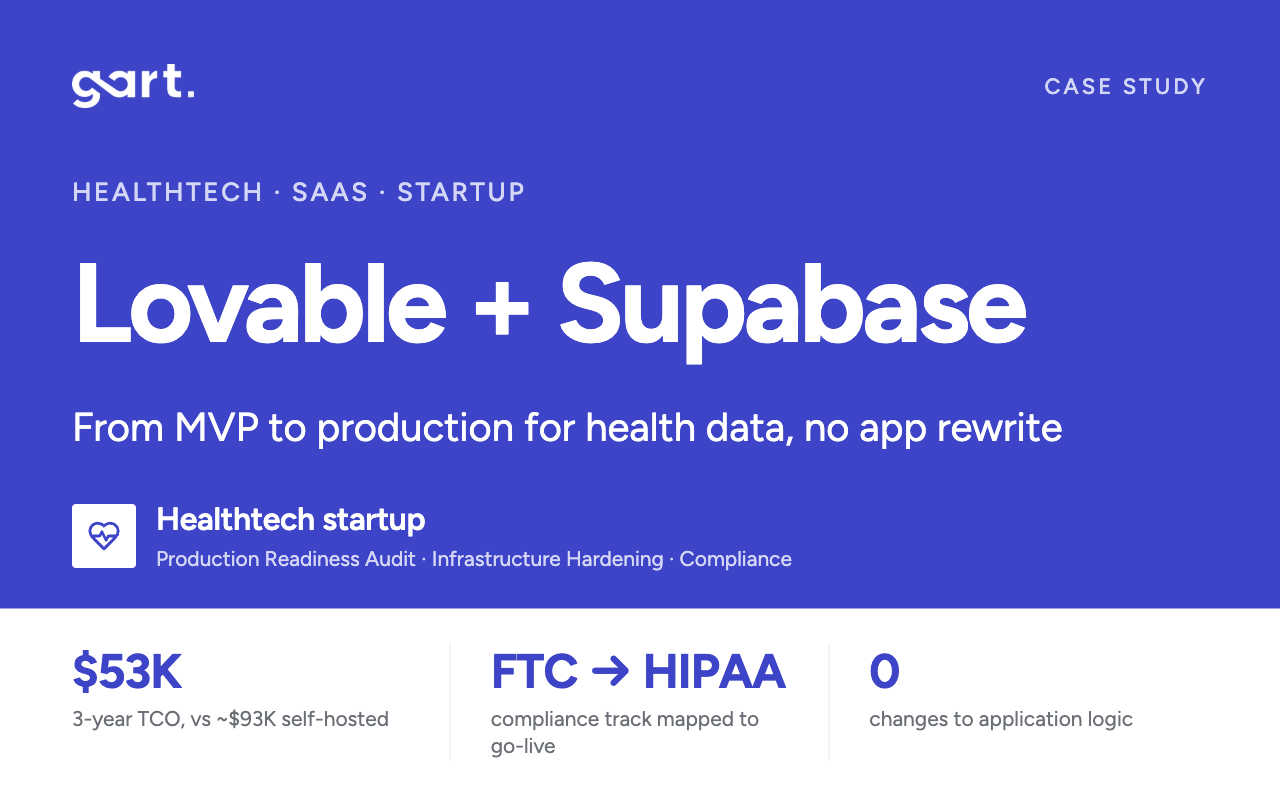
The Lovable Supabase integration turns a Lovable app from a chat-generated interface into a real product. It wires Lovable's AI-driven UI builder directly to a fully managed Postgres backend on Supabase, so authentication, data storage, file uploads, and real-time updates get built automatically from plain-English prompts, without anyone hand-writing backend code. For a CTO or founder under pressure to ship an MVP in days instead of months, that's the entire appeal of "vibe coding" — and it works.
It's also, for the same reason, one of the fastest ways a company ends up shipping a database anyone on the internet can read. That isn't hypothetical: a May 2025 disclosure, tracked as CVE-2025-48757, found 303 exposed Supabase endpoints across 170 live Lovable projects — names, phone numbers, API keys, and payment details, all readable with nothing more than the public anon key. Before a Lovable + Supabase app gets near paying customers, it's worth knowing what the integration automates, what it leaves up to you, and where a focused security audit closes the gap.
What the Lovable Supabase Integration Actually Does
Supabase is an open-source alternative to Firebase: a hosted PostgreSQL database bundled with authentication, file storage, real-time subscriptions, and serverless Edge Functions behind a single API. Lovable is the AI application builder that generates your app's front end from natural-language prompts. On their own, the two solve different problems — one designs interfaces, the other runs a backend. The integration is the layer that connects them, so a single prompt like "add a feedback form and save responses" produces both the UI and the underlying Supabase table, wired together automatically.
Once connected, the integration unlocks five things without any manual server configuration:
CapabilityWhat Lovable + Supabase Does For YouDatabase (Postgres)Generates tables and schema from your prompt, giving you full SQL support and the scalability of a real relational database underneath.AuthenticationAdds sign-up, login, and session handling — including social logins like Google — wired to Supabase Auth with a single prompt.File storageHandles image and file uploads (profile photos, attachments) via Supabase Storage buckets, with a 50 MB per-file limit on the free tier.Real-time updatesSubscribes the front end to database changes, powering live chat, activity feeds, or collaborative dashboards without extra plumbing.Edge FunctionsDeploys serverless backend logic for tasks like Stripe payments or AI API calls, using secrets stored in Supabase's encrypted secret manager.What the Lovable Supabase Integration Actually Does
Why Teams Pair Lovable with Supabase
The pairing is popular because it removes the two slowest parts of building a functioning MVP — designing a UI and standing up a backend — and lets a founder or product manager do both through conversation. Supabase's own free tier handles a genuinely useful workload (millions of rows, multiple concurrent connections) before anyone needs to think about billing, which is exactly the kind of low-friction validation loop a pre-seed team wants.
It's also part of a much larger shift. Stack Overflow's 2025 Developer Survey found that 84% of developers now use or plan to use AI coding tools, up from 76% the year before, with just over half of professional developers using them daily. Gartner has been more specific about where this leads: the firm's May 2025 research on vibe coding projects that by 2028, 40% of new enterprise production software will be built using vibe coding techniques — and separately warns that governance gaps in this style of development could drive a sharp rise in shipped defects if teams skip the review step entirely. Lovable + Supabase is, in that sense, a mainstream production pattern now, not a fringe one — which is exactly why what happens after the prototype stage matters.
How to Connect Supabase to Lovable, Step by Step
Connecting the two platforms takes minutes, and both offer a free tier, so there's no billing decision required to get started:
Create a Supabase account and, if you don't already have one, a new Supabase project — or let Lovable create one for you during setup.
In the Lovable editor, open Settings → Integrations (or Connectors) and select Supabase.
Authorize the connection by signing in to Supabase and choosing the organization and project you want to link.
Wait for Lovable to configure the connection — you'll see a confirmation in the chat once the two projects are wired together.
Prompt Lovable to build a feature that needs data (a form, a login flow, a list view); Lovable proposes the schema, and in most setups you approve the generated SQL before it runs against your Supabase project.
Repeat for authentication, storage, and Edge Functions as your app needs them — each one is added the same conversational way, without leaving the Lovable chat interface.
That simplicity is precisely the point, and precisely the risk: the same automation that removes backend boilerplate also removes the moment where a developer would normally stop and ask "who's allowed to read this table?"
What Breaks When You Move From Prototype to Production
Supabase's own documentation on Row Level Security is explicit that RLS "must always be enabled" on any table exposed through its API — but RLS is not the Postgres default, and when Lovable's AI runs a CREATE TABLE statement from a prompt, it has historically created the table without enabling RLS or writing any policy for it. Functionally, that means every row in that table is public: anyone who opens the browser dev tools, copies the app's anon key, and sends a plain HTTP request can read, modify, or delete data that was never meant to leave the app.
That's precisely the mechanism behind CVE-2025-48757, rated CVSS 9.3 (critical) and classified under OWASP's Broken Object Level Authorization category — the #1 risk on OWASP's API Security Top 10, and a near-perfect description of what happens when RLS is missing: the API technically requires no special access, so any authenticated (or even unauthenticated) request can reach data it was never authorized to touch. Lovable disputes the CVE as a platform-level vulnerability, arguing that securing each project's data is the customer's responsibility once it's live — which is a fair characterization of who owns the fix, but doesn't change the fact that the exposure exists by default unless someone closes it.
RLS misconfiguration is the headline risk, but it's rarely the only gap between a Lovable + Supabase prototype and a production-ready application:
Risk AreaWhat Ships By DefaultWhat a Production Review ChecksRow Level SecurityTables created via prompt often have RLS disabled, or a policy that's technically present but too permissive to matter.Every exposed table has RLS enabled with policies tested against real user roles, not just the happy path.Secrets managementThe service_role key bypasses every RLS policy — a single accidental client-side reference exposes the entire database.Service-role and API keys are confirmed server-side only, rotated, and never present in front-end bundles.Backups & recoveryFree and early paid tiers offer limited point-in-time recovery windows, with no tested restore process.A documented, tested backup and disaster-recovery plan matched to the app's actual data-loss tolerance.Scaling & connectionsSupabase runs on Postgres and scales well, but free/starter tiers cap connections and compute in ways that surface suddenly under real traffic.Connection pooling, indexing, and plan sizing reviewed against expected load before a launch or funding milestone.Compliance evidenceNo audit trail, access log, or documented control set exists purely because the app was AI-generated.Access controls and change history mapped to whatever framework a customer, investor, or regulator will ask about (SOC 2, ISO 27001, GDPR).What Breaks When You Move From Prototype to Production
Default Lovable + Supabase setupRLS disabled or untestedservice_role key at riskNo tested backup/restoreNo connection/scale reviewNo compliance evidenceFast to shipProduction-ready setupRLS enabled & policy-testedSecrets rotated, server-side onlyBackups tested end to endScaling & pooling reviewedCompliance evidence readySafe to scaleWhat Lovable + Supabase gives you by default, versus what a production-readiness review adds before real users and real data arrive.
A Production-Readiness Checklist for Lovable + Supabase Apps
Before sending real traffic — or a funding-round data room — to a Lovable + Supabase app, run through this list:
Enable RLS on every table in the exposed schema, including ones created early in the project that predate later security prompts, and verify policies against both the anon and authenticated roles.
Confirm the service_role key never appears in client-side code — it bypasses RLS entirely and should exist only inside Edge Functions or server-side environments.
Test your policies with an actual second account, not just your own — logging in as "User B" and attempting to read "User A's" data is the fastest way to catch a Broken Object Level Authorization gap before an attacker does.
Review your Supabase plan against expected load, including connection limits and file-upload ceilings, before a launch, press mention, or funding milestone that could spike traffic.
Set up and actually test a backup/restore process rather than assuming the platform's default retention window matches your data-loss tolerance.
Document access controls and change history if you expect enterprise customers, auditors, or investors to ask about SOC 2, ISO 27001, or GDPR readiness — this is usually the first gap a due-diligence review finds in an AI-generated app.
When to Bring In Outside Help
Lovable and Supabase are genuinely good tools for what they're built for: getting from an idea to a working, testable product fast. The gap they leave isn't a flaw in either platform — it's the same gap that exists whenever speed is the priority, and it shows up at a predictable set of moments rather than randomly.
A dedicated security and access-control review is the right first step the moment real user data — emails, payment details, health information, anything regulated — starts flowing through the app, since that's exactly the data class CVE-2025-48757 exposed at scale. Once the product has paying customers or a funding round in motion, a shift-left security review folded into your development process catches these gaps before they ship rather than after. If the app is outgrowing Supabase's managed tiers — connection limits, compute, or storage — that's a cloud migration conversation, not a database-tuning one. And if uptime itself is becoming the product's reputation risk, SRE and reliability engineering is what turns "it broke again" into a measured, budgeted error rate.
Teams without a technical co-founder or in-house platform lead often find the harder question isn't any single fix — it's sequencing all of this correctly against a roadmap, which is exactly the gap our CTO as a Service engagements close: helping a founder decide what to harden first, what to defer, and when the "vibe-coded" version of the product needs to graduate into engineered infrastructure with a real secrets-management strategy behind it, rather than one built prompt by prompt.
Shipped an MVP with Lovable and Supabase? Let's make sure it's ready for real users.
Gart Solutions audits and hardens vibe-coded applications before they scale — closing Row Level Security gaps, rotating exposed secrets, and building the CI/CD, monitoring, and infrastructure a growing product actually needs.
10+
Years in DevOps & Cloud
50+
Enterprise clients served
4.9★
Clutch rating
Security Audit
DevOps & CI/CD
Cloud Migration
SRE & Reliability
CTO as a Service
Talk to a Gart Engineer →
Roman Burdiuzha
Co-founder & CTO, Gart Solutions · Cloud Architecture Expert
Roman has 15+ years of experience in DevOps and cloud architecture, with prior leadership roles at SoftServe and lifecell Ukraine. He co-founded Gart Solutions, where he leads cloud transformation and infrastructure modernization engagements across Europe and North America. In one recent client engagement, Gart reduced infrastructure waste by 38% through consolidating idle resources and introducing usage-aware automation. Read more on Startup Weekly.
You might also like
SRE vs. DevOps vs. Platform Engineering: Which Do You Need?
Compliance Audit Services
RBAC in Your CI/CD Pipeline: Best Practices for DevSecOps
DevOps Consulting Services
Platform Engineering Services