By 2026, legacy application modernization has moved from a long-term IT initiative to an immediate business survival requirement. The global outages of July 2024 exposed a harsh reality: outdated, tightly coupled systems are not just inefficient — they are systemic risks. Enterprises that relied on monolithic architectures and brittle infrastructure experienced cascading failures, while organizations that had already invested in cloud-native, modular platforms demonstrated resilience, rapid recovery, and operational continuity.
For technology leaders, this moment marked the beginning of what many now call the great legacy reckoning. Legacy systems are no longer a neutral inheritance from the past; they function as an unseen mortgage on innovation, agility, and AI adoption. Modernization is no longer about cost optimization alone — it is about removing architectural barriers that prevent enterprises from competing in an AI-driven, real-time digital economy.
At Gart Solutions, we observe this shift across industries daily. Companies that modernize strategically unlock resilience, faster innovation cycles, and the ability to scale AI initiatives with confidence. Those that delay face compounding technical debt, rising operational costs, and shrinking strategic options.
Legacy Systems as a Business Constraint, Not a Technical Problem
Legacy applications are typically defined by monolithic design, aging codebases, and infrastructure assumptions that predate cloud computing. While many of these systems still function, they consume a disproportionate share of IT budgets — often between 60% and 80% — leaving little room for innovation. At the same time, the talent required to maintain legacy stacks is becoming scarce and expensive, with compensation for niche skills increasing sharply year over year.
More critically, legacy architectures block modern capabilities. Artificial intelligence, real-time analytics, event-driven systems, and autonomous agents all require API-first design, elastic infrastructure, and high-quality data pipelines. Legacy systems, built around batch processing and tightly coupled logic, cannot meet these demands without structural change.
This is why modernization must be framed as a business transformation initiative, not a backend refactor. The goal is not simply to make old systems cheaper to run, but to restore strategic velocity.
The Multi-Dimensional Nature of Technical Debt
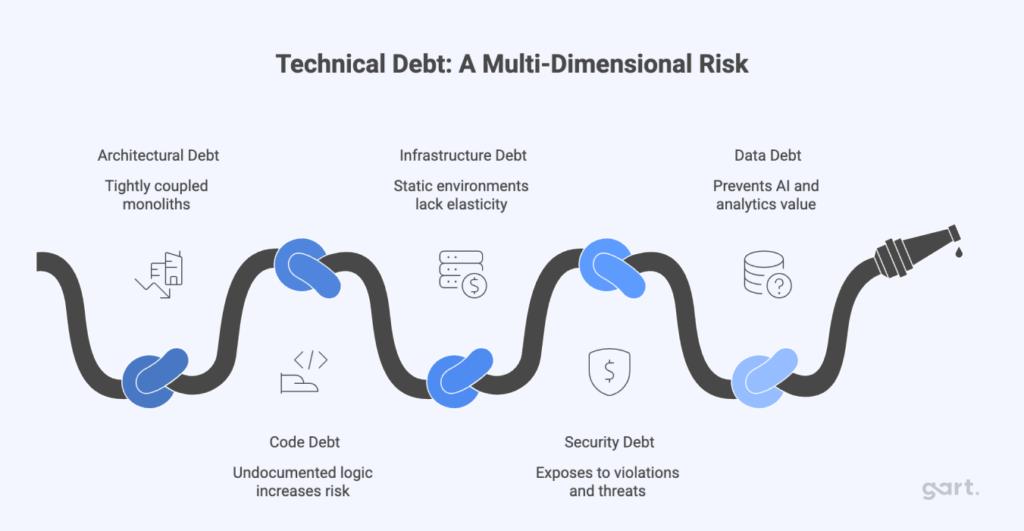
Technical debt in 2026 is best understood as a multi-layered risk that affects operations, security, compliance, and long-term growth. It is no longer confined to poorly written code; it spans architecture, infrastructure, data, and organizational processes.
Architectural debt manifests as tightly coupled monoliths that cannot scale or evolve independently. Code debt appears as undocumented logic that increases regression risk with every change. Infrastructure debt locks organizations into static, manually provisioned environments that cannot leverage cloud elasticity. Security debt exposes enterprises to regulatory violations and cyber threats. Data debt, perhaps the most underestimated, prevents organizations from extracting value through AI and advanced analytics.
Unmanaged technical debt directly slows delivery. Engineering teams routinely spend 20% to 40% of their time compensating for legacy constraints, while organizations with unresolved architectural debt experience significant delays in AI adoption due to data and platform limitations.
Modernization begins by quantifying this debt, translating it into financial, operational, and risk-based metrics that executives can act upon.
DevOps as the Engine of Legacy Application Modernization
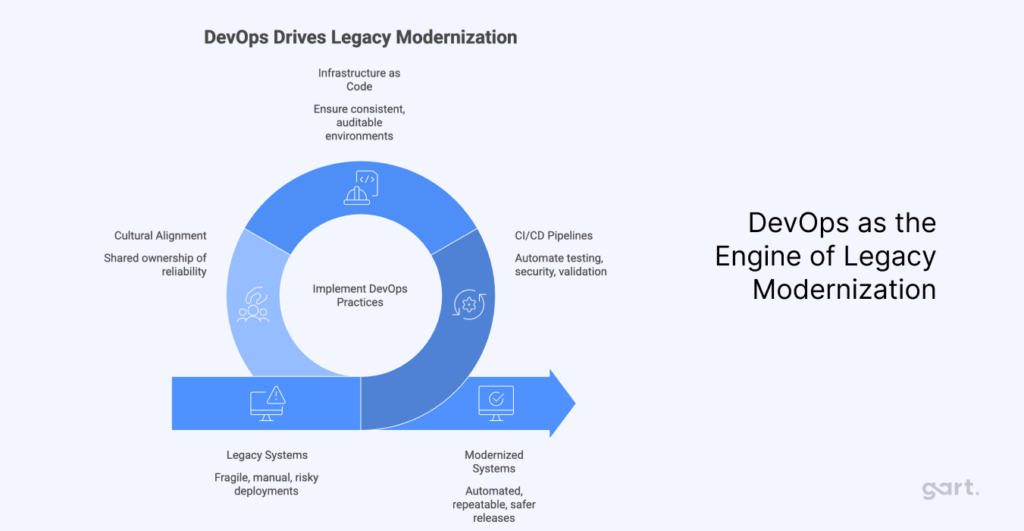
From a DevOps perspective, modernization is the replacement of fragile, manual processes with automated, repeatable delivery systems. Legacy environments typically rely on sequential SDLC models, long release cycles, and environment inconsistencies that make every deployment a risk event.
Modern DevOps practices collapse these silos by embedding automation, feedback, and shared responsibility across the lifecycle. Continuous Integration and Continuous Delivery pipelines become the backbone of this transformation.
CI/CD acts as a technical debt payoff engine. Automated testing, security scanning, and validation identify defects early, reducing stabilization phases and lowering failure rates. Infrastructure as Code complements this by ensuring that environments are consistent, auditable, and reproducible across development, staging, and production.
Equally important is cultural alignment. DevOps maturity requires moving from blame-driven incident response to shared ownership of reliability and performance. Organizations that invest in this cultural shift experience significantly fewer disruptions during modernization and achieve faster, safer releases.
Cloud-Native Evolution: Beyond Lift-and-Shift
Cloud adoption is often mistaken for modernization. Simply moving a legacy application to cloud infrastructure without architectural change — a lift-and-shift approach — frequently results in higher costs and minimal agility gains. This phenomenon, sometimes called modernization theater, delivers none of the cloud’s true advantages.
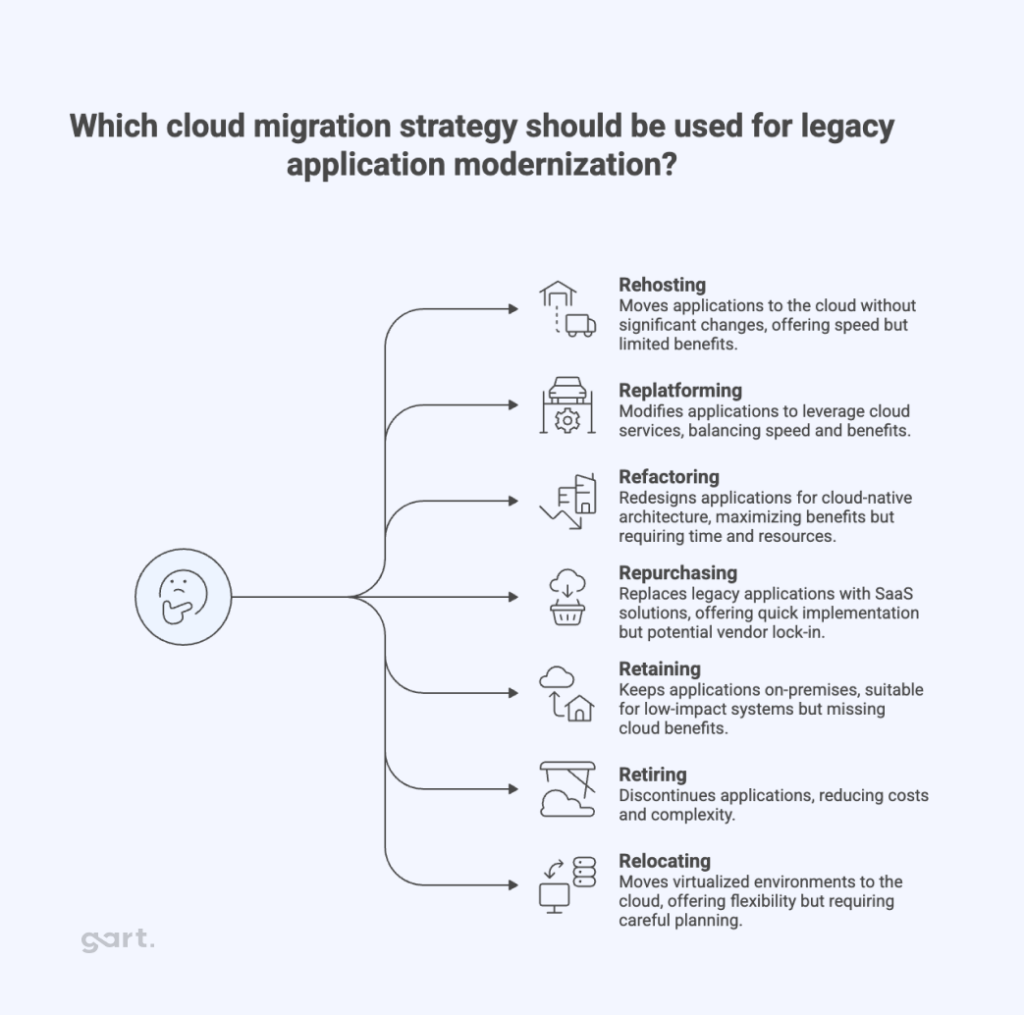
Effective modernization aligns with one of the established cloud migration strategies, often described as the 7 R’s. These range from rehosting and replatforming to full refactoring, repurchasing SaaS solutions, retaining or retiring systems, and relocating virtualized environments.
Choosing the right strategy requires balancing speed, risk, and long-term value. In practice, most enterprises apply multiple strategies across their application portfolio, prioritizing high-impact systems for deeper transformation while handling lower-value workloads pragmatically.
Containerization and Kubernetes as a Modernization Layer
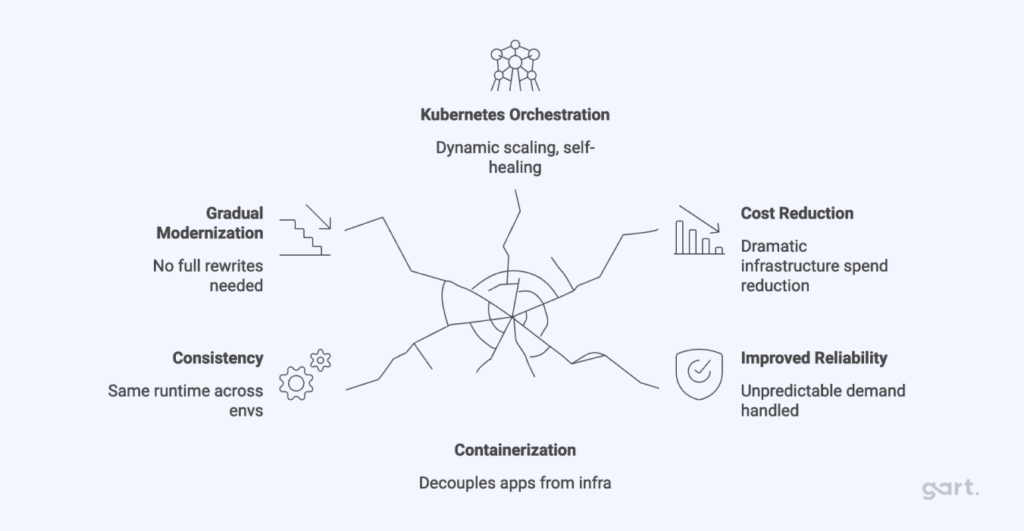
Containerization plays a pivotal role in decoupling applications from legacy infrastructure. By packaging applications with their runtime dependencies, containers provide consistency across environments and enable gradual modernization without full rewrites.
Kubernetes adds orchestration, enabling dynamic scaling, self-healing, and automated deployment. This is particularly valuable for legacy workloads with unpredictable demand patterns. When paired with cost-optimization mechanisms such as spot instances, containerized platforms can dramatically reduce infrastructure spend while improving reliability.
At Gart Solutions, we regularly see containerization serve as a bridge between legacy systems and cloud-native architectures, enabling incremental progress without operational disruption.
Digital Transformation and the AI Imperative
In 2026, digital transformation is inseparable from artificial intelligence. Yet most AI initiatives fail to scale because the underlying systems were never designed to support them. Legacy platforms silo data, lack real-time access, and cannot integrate cleanly with modern models.
Modernization is therefore the prerequisite for AI at scale. It enables API-driven access, event-based data flows, and the observability required for trustworthy automation.
AI is also transforming the modernization process itself. Large Language Models can analyze massive legacy codebases to extract business logic, generate documentation, and identify refactoring candidates. However, successful organizations treat AI as an assistant, not an autonomous decision-maker. Human governance remains essential to ensure correctness, security, and compliance.
Looking ahead, enterprises are moving toward agentic architectures, where autonomous agents collaborate with humans to execute business processes. Without a modernized core — particularly ERP and data platforms — these initiatives deliver minimal business impact.
Incremental Modernization Patterns That Actually Work
One of the most common modernization failures is the big-bang rewrite. Large-scale replacements promise clean architectures but often collapse under their own complexity.
Modern enterprises favor incremental patterns such as the Strangler Fig approach, where new services gradually replace legacy functionality behind a proxy or API gateway. This allows organizations to deliver value continuously, validate changes in production, and reduce risk.
Composable architecture builds on this idea by decomposing systems into modular business capabilities that can evolve independently. This approach creates long-term resilience and positions the organization for continuous change rather than episodic transformation.
Data Modernization: Preparing for Intelligence at Scale
Data is the fuel of digital transformation, yet it is often the hardest component to modernize. Legacy data is frequently locked in outdated schemas, proprietary formats, or batch-oriented pipelines.
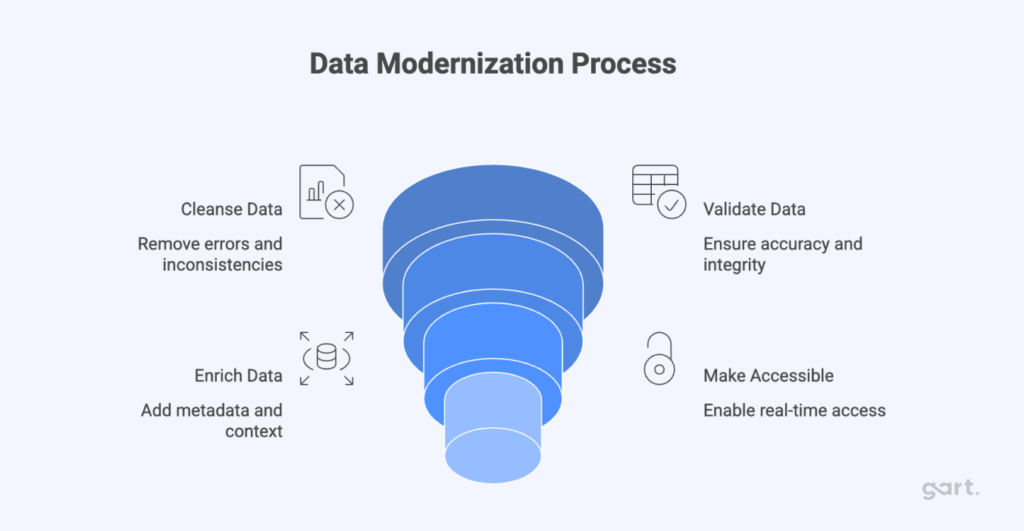
Modernization requires more than migration. Data must be cleansed, validated, enriched with metadata, and made accessible through real-time pipelines. Zero-downtime strategies such as change data capture and parallel replication allow enterprises to modernize without disrupting critical operations.
By 2026, data platforms are expected to be agent-ready, providing clear lineage, governance, and context so that AI systems can operate safely and effectively.
Industry-Specific Realities
Modernization outcomes vary by sector. In healthcare, compliance, interoperability, and patient safety drive priorities. In banking and fintech, resilience and real-time processing are critical to competing with digital-native challengers. In GreenTech and environmental monitoring, platform engineering and global scalability define success.
Across all sectors, the common thread is the need for architectures that can evolve continuously while meeting regulatory and operational constraints.
Measuring ROI and Overcoming Common Pitfalls
Modernization requires investment, but the cost of inaction is often higher. Successful programs track ROI across infrastructure savings, delivery velocity, security posture, and business outcomes such as customer experience and revenue growth.
Most failures stem from predictable pitfalls: treating modernization as a purely technical effort, attempting all-or-nothing rewrites, ignoring data quality, underestimating skill gaps, or operating without real-time visibility.
Avoiding these mistakes requires executive alignment, phased delivery, and strong DevOps governance.
Governance, Security, and Compliance in Modernized Architectures
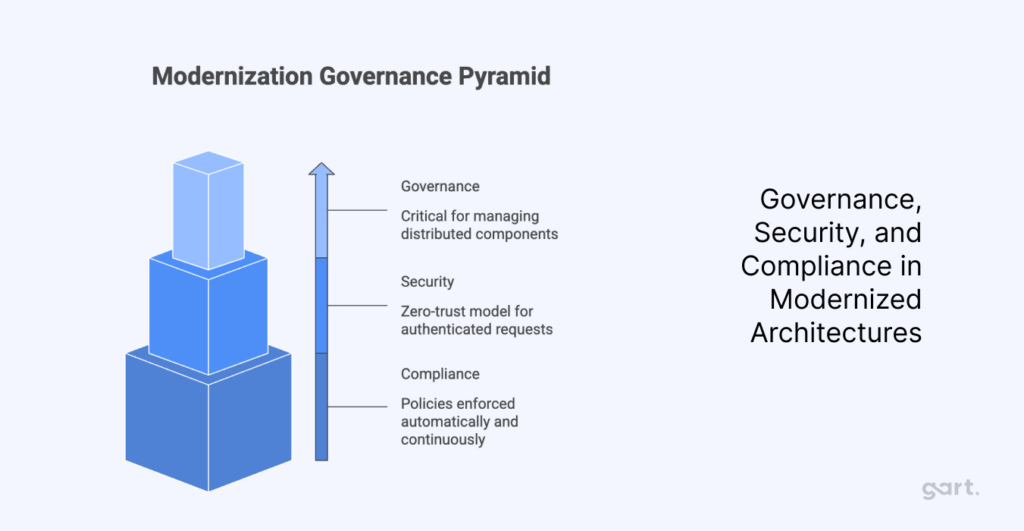
As legacy systems are decomposed and distributed, governance becomes more critical—not less. Modernization increases the number of components, APIs, data flows, and deployment pipelines. Without a strong governance model, organizations risk replacing monolithic fragility with distributed chaos.
From a security perspective, legacy environments often rely on perimeter-based defenses that assume trust within the network. Cloud-native modernization requires a zero-trust security model, where every request is authenticated, authorized, and observed regardless of origin.
Key modernization-aligned security principles include:
- Identity-first architecture, using centralized identity providers and fine-grained access control
- Secrets management through tools like Vault or cloud-native secret stores
- Shift-left security, embedding vulnerability scanning and policy checks directly into CI/CD pipelines
- Runtime protection and observability, ensuring threats are detected and mitigated in real time
Compliance also changes shape. Instead of manual audits and static documentation, modern platforms enable compliance as code, where policies are enforced automatically and continuously. This approach dramatically reduces audit fatigue while increasing confidence in regulatory adherence across healthcare, fintech, and enterprise SaaS environments.
Platform Engineering: Scaling Modernization Beyond Individual Teams
As organizations modernize multiple systems in parallel, DevOps practices alone are not enough. This is where platform engineering emerges as a force multiplier.
Platform engineering focuses on building internal developer platforms (IDPs) that abstract infrastructure complexity behind standardized, self-service interfaces. Rather than every team reinventing pipelines, environments, and deployment patterns, the platform provides opinionated defaults aligned with security, compliance, and cost-efficiency standards.
For legacy application modernization, platforms deliver three critical advantages:
- Consistency: Every modernized service follows the same deployment, observability, and security patterns
- Speed: Teams focus on business logic instead of infrastructure decisions
- Scalability: Modernization efforts can scale across dozens of teams without losing control
At Gart Solutions, platform engineering is often the difference between isolated modernization success and organization-wide transformation, especially in regulated or fast-scaling industries.
Platform Engineering vs. DevOps in Modern Application Modernization
| Dimension | DevOps | Platform Engineering |
|---|---|---|
| Primary Goal | Improve speed and reliability of software delivery | Enable teams to build, deploy, and operate software through a standardized internal platform |
| Core Focus | CI/CD automation, collaboration between Dev & Ops | Developer experience (DevEx), abstraction of infrastructure complexity |
| Role in Modernization | Helps modernize delivery pipelines for legacy and new apps | Provides a scalable foundation to modernize multiple applications consistently |
| Operating Model | Shared responsibility across product teams | Dedicated platform team serving internal product teams |
| Level of Abstraction | Low to medium – teams interact directly with tools and infra | High – infrastructure and tooling exposed via self-service interfaces |
| Tooling Scope | CI/CD, config management, monitoring, IaC | Golden paths, internal developer portals, opinionated stacks |
| Scalability for Large Enterprises | Becomes complex as number of teams and services grows | Designed to scale across dozens or hundreds of teams |
| Impact on Legacy Systems | Improves deployment and reliability of existing systems | Enables gradual modernization without disrupting legacy cores |
| Developer Experience | Depends heavily on team maturity | Centralized, consistent, and optimized by design |
| Governance & Standards | Often implicit or team-defined | Built-in governance, security, and compliance |
| Time to Value | Fast for individual teams | Compounding value across the organization over time |
| Risk in Modernization Programs | Tool sprawl, inconsistent practices | Over-engineering if platform is built without clear product mindset |
| Best Fit For | Small–mid teams modernizing delivery | Enterprises modernizing at scale |
| Relationship Between Them | Cultural and technical foundation | Evolution and formalization of DevOps practices |
Legacy Application Modernization Roadmapping
Successful legacy application modernization does not follow a fixed endpoint or a one-time transformation plan. Instead, it requires a living roadmap that evolves alongside business priorities, technology shifts, and organizational maturity.
The process begins with a clear assessment phase: understanding technical debt, architectural constraints, operational risks, and business criticality across systems. This is not merely a technical audit, but a strategic exercise that aligns applications with revenue streams, customer impact, compliance exposure, and future growth plans. Without this alignment, modernization efforts risk optimizing the wrong systems first.
From there, organizations move into incremental execution. Rather than large-scale rewrites, effective roadmaps prioritize gradual decoupling, API exposure, modularization, and cloud-native enablement where it creates measurable value. Modernization becomes a sequence of controlled steps—each delivering business outcomes, reducing risk, and enabling faster change.
Crucially, the roadmap must remain adaptive. Market conditions, regulatory requirements, and platform capabilities will change. A modernization program that cannot adjust its priorities becomes another form of legacy. The most resilient organizations treat modernization as a continuous capability, embedded into delivery cycles, funding models, and governance structures—not as a finite project with a fixed end date.
Legacy Application Modernization in the Age of Agentic AI
As agentic AI systems move from experimentation into production, the limitations of legacy architectures become increasingly visible. Autonomous agents rely on clean data access, predictable system behavior, real-time orchestration, and secure interfaces—conditions that tightly coupled, opaque legacy systems struggle to provide.
Modernization is therefore a prerequisite for meaningful AI adoption. Without service-based architectures, event-driven pipelines, and well-defined APIs, AI agents are constrained to surface-level automation rather than true decision-making or execution. Legacy systems may still store critical business logic, but without modernization, that logic remains inaccessible to intelligent systems.
In this context, modernization is not about replacing systems to “add AI later.” It is about restructuring the enterprise so AI can operate safely and effectively within it. This includes standardizing data models, improving observability, enforcing governance, and enabling fine-grained control over system actions—all essential for trustworthy autonomous behavior.
Organizations that modernize with agentic AI in mind gain a structural advantage. They are able to experiment faster, deploy AI-driven workflows responsibly, and scale intelligence across functions. Those that delay modernization may find that AI investments fail to deliver returns—not because the models are weak, but because the underlying systems were never designed to support autonomous operation.
Final Thoughts
Legacy application modernization is often justified through efficiency gains, cost reduction, or performance improvements. While these benefits are real, they undersell the true value of modernization in today’s environment. At its core, modernization is a form of strategic insurance.
Modernized systems provide optionality. They allow organizations to respond to regulatory changes, adopt new technologies, enter new markets, and withstand operational shocks without destabilizing the core business. They reduce dependency on fragile architectures and scarce skill sets, replacing them with adaptable platforms and repeatable practices.
In an era defined by rapid technological shifts and increasing automation, the cost of inaction grows silently. Systems that cannot evolve become strategic liabilities, limiting innovation and increasing risk over time. Modernization mitigates that risk by ensuring the organization remains structurally capable of change.
Ultimately, modernization is not about chasing trends or future-proofing in the abstract. It is about preserving decision-making power. Organizations that invest in modernization retain control over their technology trajectory, while those that delay increasingly have it dictated to them.
See how we can help to overcome your challenges
Ready for the Legacy System Modernization Audit?
Discover how outdated systems can be transformed into your competitive advantage!
Download this PDF and contact us to conduct the legacy assessment.