Every vendor pitch deck calls itself "digital transformation," which makes the phrase almost meaningless right up until the moment a company actually needs it — a core system too brittle to extend, a competitor moving twice as fast, or an executive team asking why five years of individual tech purchases never added up to a coherent strategy. Digital transformation consulting is the discipline of turning that scattered situation into a sequenced plan: assessing what's actually there, deciding what to change and in what order, and managing the organizational side of the change so the new systems get used rather than quietly worked around. Gart Solutions runs this kind of engagement through its digital transformation consulting services, and this guide covers what the work involves, where it tends to go wrong, and what to check before hiring a partner.
What Is Digital Transformation Consulting?
Digital transformation consulting is advisory and implementation work that helps an organization redesign its operating model, processes, and customer experience around digital capabilities — not just installing new software, but changing how decisions get made, how work moves between teams, and how value gets delivered as a result. A consultant's job spans three layers: diagnosing where the current technology and process stack is holding the business back, designing a prioritized roadmap tied to specific business outcomes, and helping execute the highest-impact parts of that roadmap (cloud migration, legacy modernization, data platform work, workflow redesign) alongside the client's own team.
Digitization vs. Digitalization vs. Digital Transformation
These three terms get used interchangeably in casual conversation, but they describe genuinely different levels of change, and confusing them is one of the more common reasons a "transformation" project quietly turns into an expensive digitization project instead. Gartner draws the distinction this way:
TermWhat it meansExampleDigitizationConverting analog information or processes into a digital format, with no change to the underlying processScanning paper invoices into PDFsDigitalizationUsing digital technologies to change how a process works or how value is createdAutomating invoice approval and routing instead of just storing scansDigital transformationA company-wide shift in strategy, culture, and operating model, enabled by digitization and digitalization togetherRedesigning the finance function's entire close process and decision cadence around real-time dataDigitization vs. Digitalization vs. Digital Transformation
The practical consequence: a stack of digitalization projects doesn't automatically add up to a digital transformation. Without a coordinating strategy, individual teams can digitize and digitalize their own corners of the business for years while the organization as a whole still operates on the same assumptions it always did — which is exactly the gap digital transformation consulting is meant to close.
Why Digital Transformation Consulting Matters
The business case isn't abstract. McKinsey's research on companies with strong digital and AI capabilities found they generate two to six times higher shareholder returns than peers that lag in the same sector — a gap driven less by which tools get purchased and more by how consistently an organization executes on a coordinated digital strategy. That execution gap is precisely where an outside consulting partner earns its cost: bringing a repeatable methodology and outside pattern-recognition to a change effort that internal teams, understandably, often lack the bandwidth or objectivity to run alone while also keeping the business running day to day.
Why Most Digital Transformation Initiatives Fail
The uncomfortable number worth knowing before starting any engagement: McKinsey's long-running research on digital transformations has consistently found that fewer than a third of transformation efforts succeed at improving and sustaining performance. Boston Consulting Group's research points to a similar pattern and attributes much of it to a specific, non-technical cause — a lack of employee engagement and active resistance during implementation, not failed technology. The pattern shows up in a few recognizable ways:
Technology-first, strategy-second sequencing. A platform gets selected and implemented before anyone has agreed what the organization is actually trying to achieve with it.
No accountable executive sponsor. Without someone senior owning the outcome (not just the budget), competing priorities quietly starve the transformation of attention within two or three quarters.
Change management treated as an afterthought. Training and communication get scheduled for the last two weeks before go-live instead of built into the plan from day one.
No baseline metrics. Without a "before" measurement, it's impossible to prove the transformation actually improved anything — success gets asserted rather than demonstrated.
None of these are technology problems, which is exactly why a credible consulting engagement spends real time on governance, sponsorship, and adoption planning rather than treating the software rollout as the finish line.
The Digital Transformation Consulting Process
While every engagement is tailored to the client, a well-run digital transformation consulting process generally moves through five stages:
Assess. Audit the current technology stack, data flows, and process bottlenecks to establish a factual baseline — this is also where success metrics get defined, before anything changes.
Strategize. Translate the assessment into a prioritized roadmap tied to business outcomes (revenue, cost, risk, speed), sequenced so early wins fund and justify later phases.
Modernize. Execute the technical work: cloud migration, legacy infrastructure modernization, data platform consolidation, new integrations.
Adopt. Run the training, communication, and workflow-redesign work needed so people actually use the new systems instead of routing around them.
Optimize. Measure against the baseline set in stage one, then continuously refine — a digital transformation program doesn't have a single finish line, it shifts into an ongoing operating rhythm.
What to Look for When Evaluating a Digital Transformation Consulting Partner
Because the failure modes above are mostly organizational rather than technical, the strongest signal a partner can execute well isn't just their technology list — it's how they handle the parts of the process most firms skip. When evaluating a potential partner, look for:
A real assessment phase, not a sales-driven scope. A partner who proposes a fixed solution before auditing your actual systems is optimizing for closing the deal, not for the outcome.
A named approach to change management, not just an implementation plan — ask directly how they handle training, communication cadence, and resistance from teams whose workflows are changing.
Baseline metrics defined up front, so success can be measured against a real number rather than asserted after the fact.
Relevant industry experience, since a healthcare data-interoperability project and a retail inventory-modernization project require genuinely different regulatory and architectural knowledge.
Willingness to sequence and phase rather than pitching one large all-at-once program — phased delivery lets both sides validate the approach on a smaller, lower-risk slice before committing to the rest.
If you're weighing specific firms rather than the criteria above, our roundup of leading digital transformation consulting companies for SMBs compares 30 options side by side.
Digital Transformation Across Industries
The five-stage process above holds constant, but the priorities and constraints shift significantly by sector. In healthcare, interoperability and compliance dominate the roadmap; in retail, inventory visibility and personalized customer experience tend to drive the earliest wins; and in sustainable manufacturing, digital transformation is increasingly tied directly to supply-chain efficiency and resource-use reporting.
How Gart Solutions Approaches Digital Transformation Consulting
Gart Solutions runs digital transformation engagements starting with the assessment phase described above — not a pre-packaged solution — specifically so the roadmap and cost estimate that follow are tied to a client's actual systems and goals. The engagement scope typically draws on Gart's underlying infrastructure and modernization capabilities: cloud migration and consulting, legacy application modernization, DevOps and CI/CD automation, and IT infrastructure audits that feed directly into the initial assessment. Full details on scope and engagement models are on the digital transformation consulting services page linked above.
Ready to build your digital transformation roadmap?
Gart Solutions runs digital transformation engagements starting with a real assessment of your current systems, not a pre-packaged solution.
Digital transformation strategy and roadmap consulting
Cloud migration and legacy application modernization
DevOps, CI/CD automation, and IT infrastructure audits
Talk to a digital transformation consultant
You might also like
Cloud Migration Services
IT Audit Services
DevSecOps Consulting
SRE vs. DevOps vs. Platform Engineering
Roman Burdiuzha
Co-founder & CTO, Gart Solutions · Cloud Architecture Expert
Roman has 15+ years of experience in DevOps and cloud architecture, with prior leadership roles at SoftServe and lifecell Ukraine. He co-founded Gart Solutions, where he leads cloud transformation and infrastructure modernization engagements across Europe and North America. In one recent client engagement, Gart reduced infrastructure waste by 38% through consolidating idle resources and introducing usage-aware automation. Read more on Startup Weekly.
Strong infrastructure lays the foundation, but it won’t carry your business across the finish line. If your systems are slowing you down, innovation stalls, releases get delayed, and customers lose patience. Today, digital transformation isn’t just a buzzword — it’s the baseline.
Why Solid Infrastructure Isn't Enough Anymore
Having reliable IT systems was once a competitive advantage. Now, what separates fast-growing companies is adaptability.
This article unpacks the hidden ways in which overly rigid IT systems can limit business potential — and what modern, cloud-native, composable alternatives look like.
Let me mention some industry insights:
70% of digital transformations fail due to a lack of agility.
64% of companies cite rigid IT as a growth barrier.
Only 30% of cloud projects meet their goals.
The Real Business Impact of Misaligned Infrastructure
Lost Productivity: manual work replaces automation, and innovation takes a backseat.
Limited Scalability: Inflexible systems delay market expansion.
Poor Customer Experience: downtime and delays drive users away.
Compliance Risks: outdated systems jeopardize trust and legal standing.
Challenge vs. Business Impact
Sometimes, business leaders cannot estimate the real impact that technical issues might have on a business.
There are some examples:
ChallengeBusiness ImpactOverbuilt on-prem without modularity Delayed product launches No orchestration layer (DevOps/Kubernetes) Bottlenecks in deployment Focused on uptime, ignored user feedback loops Poor product-market fit Legacy systems with high maintenance costs Drained resources and slower innovation Manual deployments and no CI/CD Increased time-to-market, more human errors Siloed teams (Dev, Ops, Security) Miscommunication, slower response to issues No Infrastructure as Code (IaC), lack of auto-scaling or load balancing Inconsistent environments, hard recovery
Common Infrastructure Problems That Hold Businesses Back
A) Frequent Downtimes & Performance Issues
Root Cause: Neglect in proactive setup and maintenance. Impact: Lost business continuity and declining user trust.
B) Over-Reliance on One Engineer
Root Cause: Siloed knowledge and no documentation. Impact: Single point of failure, burnout risk, and unscalable operations.
C) Inefficient Practices & Manual Deployments
Root Cause: Lack of CI/CD, no automation, fragmented tooling. Impact: Slower releases, higher operational costs, difficulty attracting talent.
D) Misalignment Between Tech and Business
Root Cause: Infrastructure decisions made in isolation. Impact: Missed market opportunities, wasted development efforts.
E) Immature DevOps Practices
Root Cause: Outdated processes and tools. Impact: High technical debt, poor scalability, slow innovation.
F) Compliance and Governance Gaps
Root Cause: Infrastructure built without security and compliance in mind. Impact: Blocked expansion, legal risks, loss of customer trust.
Top Reasons Why IT Transformation Fails
Legacy Systems Dominate — they hinder scalability and integration.
No Unified Infrastructure Strategy — disconnected setups create silos.
Knowledge Bottlenecks — relying on one expert is high-risk.
Inconsistent Tooling — multiple tools with no standards hurt productivity.
Change Mismanagement — poor communication derails transformation.
Lack of Observability — monitoring comes too late or not at all.
Unrealistic Deadlines — rush leads to broken systems.
Security Comes Last — compliance is bolted on, not built in.
What Does a Scalable, Agile Infrastructure Look Like?
Here’s what high-growth companies are doing instead of sticking to pure IT infrastructure:
Composable Infrastructure
Use Kubernetes and microservices to build modular systems that scale independently and evolve with business needs.
DevOps Automation by Default
From CI/CD to monitoring, automate everything to reduce errors and accelerate delivery.
Cloud-Native Design Principles
Design with elasticity, portability, and resilience from the start — not as afterthoughts.
Infrastructure as Code (IaC)
Tools like Terraform and Pulumi bring version control, consistency, and fast recovery.
Data-Driven Architecture
Prioritize performance based on actual product usage and customer behavior.
Get a sample of IT Audit
Sign up now
Get on email
Loading...
Thank you!
You have successfully joined our subscriber list.
IT Infrastructure Case Studies
Building a resilient and scalable IT infrastructure is at the core of Gart Solutions' service portfolio.
Below are some examples of projects we’ve completed at Gart, highlighting key challenges, solutions, and results.
1. IT Infrastructure Optimization for a Retail SaaS Platform
Challenges:
Outdated servers, slow network, and lack of data centralization.
Needed to modernize the functionality of their legacy SaaS e-commerce platform & improve its efficiency, user experience, optimize costs, and accelerate time-to-market.
Also, to move the SaaS platform from on-premises to the cloud.
Solutions Implemented:
Built CI/CD pipelines for GitLab from scratch and implemented automated testing
Migrated data to a secure cloud platform (from on-premises to cloud, making it cloud-agnostic)
Upgraded network infrastructure for better connectivity. Introduced automated backup systems.
Results:
30% improvement in operational efficiency.
15% increase in customer satisfaction due to faster service.
Significant reduction in IT maintenance costs.
2. 40% AWS Cost Optimization Music Promotion Platform
Challenges:
With rapid growth and increasing usage, the company faced escalating AWS infrastructure costs.
Also, a need for a centralized, cost-effective monitoring solution.
Solutions Implemented:
Amazon SNS Optimization (Usage Audit, Policy Adjustments)
EC2 and RDS Cost Management (Right-Sizing Instances, Reserved Instances, Auto Scaling)
Storage Optimization (Lifecycle Policies to Amazon S3 buckets, automatically transitioning data to lower-cost storage classes, Data Cleanup and regular audits).
Traffic and Data Transfer Management (Optimized data transfer routes and utilized AWS Direct Connect, Cost Monitoring Alerts).
Results:
Monthly AWS costs were reduced from $3.7K to $1.7K.
Total blended costs over the period were managed to $19.9K.
Amazon SNS: Reduced costs by 50%, saving over $1,000 monthly through optimized usage and policy adjustments
AmazonEC2 and RDS: Achieved substantial savings by right-sizing instances and leveraging reserved instances, with a combined reduction of $600 monthly.
Improved Resource Efficiency utilization through Auto Scaling and lifecycle management policies.
Implemented a cost management framework with continuous monitoring.
3. Infrastructure Optimization, Data Management & Compliance for Healthcare Platform
Challenges:
The need to manage patients' data (e.g., x-rays, medical history), integrate with medical institutions, and scale data analysis capacity quickly.
Make a transition to a secure, compliant digital platform.
Solutions Implemented:
Designed infrastructure architecture to withstand peak loads.
Facilitated secure integration with other networks (e.g., hospitals).
Delivered a hybrid cloud architecture with data privacy measures.
Managed data in compliance with HIPAA. Results:
Enabled seamless operations and compliance with GDPR.
Improved Data Management (complying with HIPAA regulations)
Secure Integration with hospital networks (by secure network architecture)
Scalability to meet growing demands and handle peak loads.
Reliable Data Transmission (the VPN with unified standards).
Dynamic Scaling (RabbitMQ and monitoring allowed for dynamic scaling of the infrastructure).
How to Know It's Time to Rethink Your Infrastructure
Ask yourself:
Are you spending too many resources maintaining legacy systems?
Is your time-to-market getting slower?
Are infrastructure decisions dominating product ones?
Is your CTO firefighting instead of leading strategy?
Is your infrastructure unable to support integrations or partner tools?
If the answer is yes to any of the above, your infrastructure isn’t serving your growth, and my suggestion would be to ask for a consultancy in companies, like Gart Solutions (where IT infrastructure expertise is at the core).
Where to Start: The IT Infrastructure Audit
At Gart Solutions, we recommend starting with a Quick Wins IT Audit.
In just ~10 hours, we assess:
System performance
Delivery workflow (CI/CD)
Compliance gaps
Security posture
Cloud readiness and modernization opportunities
👉 Learn more about our IT audits 👉 Explore Quick Wins IT Audit 👉 Apply for Quick Wins IT Audit
Real Transformation Starts with Real Expertise
With 15+ years in DevOps and cloud infrastructure, Gart Solutions helps companies modernize systems, adopt composable infrastructure, and align IT strategy with business outcomes.
Our promise:
We don’t just fix systems. We unlock business velocity.
We speak both tech and strategy fluently.
We tailor infrastructure to your market goals, not the other way around.
Final Thoughts: Infrastructure That Accelerates, Not Delays
Pure IT infrastructure, without agility, automation, or business context, will keep your business grounded. To scale, innovate, and compete, your infrastructure must evolve into a strategic enabler, not just a technical necessity.
I recommend starting with an IT audit, aligning your goals, and evolving toward a composable, automated, cloud-native infrastructure.
Best, Roman Burdiuzha Co-Founder & CTO at Gart Solutions | IT Consultant Over the last 15 years, I have overseen world-class engineering teams for Softserve, Lifecell, ProCreditBank, and other companies, setting the technical vision. At Gart Solutions, I provide strategic tech leadership to our customers’ projects.
Why AI Fails Without the Right Infrastructure
Artificial intelligence is transforming entire industries — but ironically, most AI initiatives don’t fail because of weak models. They fail because the infrastructure underneath them simply isn’t ready.
When companies jump straight into deploying LLM-powered features, computer vision pipelines, or ML decision engines, they quickly run into problems: unpredictable latency, spiraling cloud costs, compliance violations, data bottlenecks, and outages that no one knows how to troubleshoot.
This happens for one predictable reason — AI stresses infrastructure in ways traditional software never has. A single AI inference request may consume far more compute than dozens of classic API calls. Sensitive data may need to move through new pipelines. Models require versioning, isolation, and rollback strategies. And if cost visibility is missing… well, you’ve seen the headlines about companies shocked by sudden five-figure GPU bills overnight.
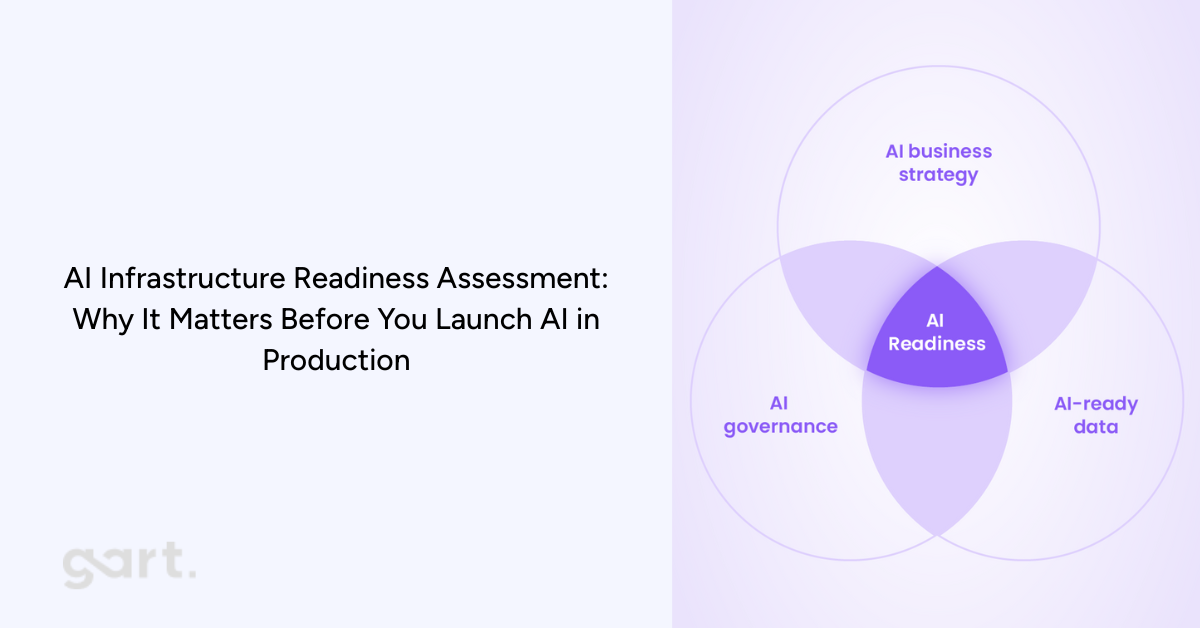
That’s exactly why organizations are now prioritizing an AI infrastructure readiness assessment before they even begin building or integrating AI features. According to the brochure provided (p.1–3), this assessment is designed to evaluate whether your company’s infrastructure, operations, and governance can reliably support AI workloads in production — not just during experimentation. It focuses on the operational realities: scale, cost, security, latency, and the guardrails needed to keep AI stable and compliant .
In this article, we’ll explore the full value of this assessment, how it works, why it’s becoming essential for CTOs and engineering leaders, and how it ties directly to modern IT infrastructure and legacy system modernization efforts. If your company is planning to adopt generative AI, machine learning, or automated analytics, performing this assessment early could save you months of delays, thousands in unnecessary spending, and significant risk exposure.
2. What Is an AI Infrastructure Readiness Assessment?
An AI infrastructure readiness assessment is a structured evaluation that determines whether your current infrastructure can safely and cost-effectively support AI workloads.
2.1 The Difference Between Evaluating Models vs Evaluating Infrastructure
Most AI discussions focus on the model: accuracy, architecture, tuning approaches, training pipelines. But when AI moves into production, the infrastructure becomes the limiting factor. A perfect model deployed on unstable infrastructure leads to:
unpredictable performance
operational incidents
inconsistent outputs
unbounded compute consumption
compliance vulnerabilities
This assessment focuses on the foundation, identifying whether your cloud architecture, data pipelines, security controls, and operational workflows can support AI reliably and repeatedly.
2.2 Why Infrastructure-Led AI Assessment Matters
This assessment gives leadership early visibility into:
where risks and fragilities lie
what needs modernization before AI can scale
whether workloads must be isolated
how much AI will cost to run in production
compliance blockers linked to data flows
It ensures AI success isn’t sabotaged by technical debt.
3. Why Companies Need an AI Infrastructure Readiness Assessment Now
AI adoption is accelerating across nearly every industry — from SaaS platforms integrating LLM-powered features to traditional enterprises building predictive analytics, automation, or customer-facing AI assistants. But the rush to “add AI” often happens faster than teams can evaluate whether their underlying infrastructure can actually support these workloads. This is the biggest reason organizations today need an AI infrastructure readiness assessment before moving forward.
Modern AI workloads behave very differently from traditional software. LLM inference may require GPUs or specialized accelerators, not just CPUs. Data pipelines must be reproducible, regulated, and auditable. Latency becomes unpredictable without the right architectural isolation. Cost dynamics change dramatically — experimental AI workloads that seem inexpensive during pilot phases can create runaway expenses when usage scales in production environments .
Another reason companies need this assessment now is compliance. Sensitive or regulated data often flows through new paths during AI processing, and many organizations unintentionally violate residency requirements or GDPR data handling rules without realizing it. The assessment identifies these risks early (p.8), preventing costly future corrections or audit failures .
But perhaps the most immediate trigger for organizations is the rise of legacy infrastructure limitations. Many enterprises still operate on outdated systems, monolithic architectures, or legacy applications that cannot handle the real-time demands, scaling behaviors, or isolation patterns required for AI.
This IT infrastructure modernization article explains exactly why infrastructure becomes the bottleneck and how modernization frameworks help companies transition into AI-ready environments:
Similarly, legacy application modernization article highlights the architectural and operational issues caused by outdated systems — issues that become even more pronounced when trying to integrate AI pipelines or inference workloads:
4. Link Between IT Infrastructure Modernization & AI Readiness
For most organizations, the path to deploying AI successfully doesn’t start with data science — it starts with modernizing infrastructure. Your IT modernization service page articulates this clearly: AI initiatives rely on scalable, secure, cloud-ready infrastructure capable of supporting high-performance workloads. Without this foundation, production AI becomes nearly impossible.
4.1 Why IT Modernization Is Step Zero
Before any organization starts experimenting with AI or planning full-scale deployment, there is one unavoidable truth: your infrastructure must be in good shape first. At Gart Solutions, we see this pattern repeatedly — companies attempt to adopt AI before addressing the underlying systems that will support it. The result? Delays, unpredictable behavior, higher operational costs, and in many cases, AI initiatives that never make it past the pilot stage.
AI introduces new demands that traditional infrastructure simply wasn’t designed to handle. Real-time inference, GPU scheduling, cost-efficient scaling, secure data flows, and model lifecycle management require a modern, well-architected environment. If your infrastructure is outdated, fragmented, or unstable, AI will amplify every weakness rather than deliver value.
This is why IT modernization becomes Step Zero in any AI strategy.
Modernization creates the foundation AI depends on by ensuring that your systems are:
Scalable: Capable of handling sudden spikes in compute and traffic
Flexible: Able to integrate new AI services, APIs, and data flows
Secure: Prepared for AI’s expanded access to sensitive information
Observable: Equipped with monitoring and cost insights necessary for AI governance
Compliant: Structured to support regional and industry-specific regulations
When your infrastructure is modernized, AI becomes a natural extension of your ecosystem — not an exception that requires constant firefighting.
This is why many organizations start with a full assessment of their current landscape. Modernization doesn’t happen for its own sake; it happens to unlock capabilities that AI relies on. Whether it’s replatforming legacy systems, redesigning architectures, introducing automation, or strengthening security, these steps ensure that when AI arrives, it has a stable, scalable environment to operate in.
Simply put:If the foundation is weak, AI will expose it. If the foundation is strong, AI will elevate it.
4.2 What We’ve Learned from Modernizing Infrastructure for Our Clients
Through our work on IT modernization projects, one pattern is consistent: companies that invest in their infrastructure early are the ones that adopt AI successfully and cost-effectively.
Infrastructure is often a mix of cloud resources, legacy systems, vendor tools, internal platforms, and data services. Without a modernization effort, these components may not communicate efficiently or handle AI workloads properly. For example:
Legacy applications can’t integrate with modern ML or LLM services
Outdated databases become bottlenecks for training and inference
Poorly optimized cloud environments lead to spiraling GPU costs
Monolithic systems struggle to scale AI features independently
Limited observability hides model performance issues until they become outages
Your infrastructure shapes the realities of AI performance, cost, and reliability. Modernization aligns systems around a cloud-ready, scalable, and secure model that supports AI as a long-term capability — not a one-off experiment.
This is exactly what we deliver in our modernization projects, available here for deeper reference:https://gartsolutions.com/it-infrastructure-modernization/
4.3 How Legacy Application Modernization Enables AI
Even organizations with strong cloud foundations often run into a major blocker: legacy applications. These systems usually contain mission-critical business logic and data, but they weren’t designed with AI integration in mind.
Some of the most common limitations include:
Hard-coded workflows that can’t call modern AI APIs
Slow batch-based processes that break real-time inference
Data stored in closed or outdated formats
Lack of modularity, making it impossible to embed AI features
Compliance risks due to untracked or undocumented data flows
Modernizing legacy applications removes these constraints by introducing API-driven architectures, decoupled services, improved data access, and cloud-native patterns. Suddenly, AI can plug into business processes seamlessly.
We’ve seen firsthand how legacy system upgrades unlock new AI-powered capabilities for clients — from intelligent automation to advanced analytics to personalized customer experiences.More here: https://gartsolutions.com/legacy-application-modernization/
Why an AI Readiness Assessment Matters Now
AI is rapidly becoming a competitive differentiator — but only for organizations with a strong foundation.
Take the assessment: https://tally.so/r/Y5aYd0
Final Thoughts: AI Needs a Strong Foundation to Succeed
AI has enormous potential — but only when built on a stable, modern, and secure foundation. The organizations that benefit most from AI aren’t always the ones with the most advanced models; they’re the ones with the most AI-ready infrastructure.
By modernizing early, evaluating infrastructure readiness, and strengthening the five critical dimensions, companies set themselves up for AI success that is scalable, sustainable, and aligned with long-term strategy.
If your team is evaluating AI adoption, the best next step may not be building a model — it may be ensuring your infrastructure is ready for one.
Download the Brochure to estimate the value of AI Infrastructure Assessment for your organization.
Contact Us if you need a support.
AI-Infrastructure-and-Readiness-AssessmentDownload