Cloud transformation isn’t just a tech trend — it’s become the strategic core of modern business success. Whether you’re running a fast-growing SaaS company, a healthcare platform, or an eCommerce business, the ability to adapt, scale, and innovate in the cloud is now essential. But making the move to the cloud isn’t just about technology — it’s about finding the right partner. The cloud transformation partner you choose can directly affect your business agility, operational costs, and speed to market.
With dozens of options in the market — from global consultancies to agile boutique firms — it’s crucial to choose a partner that not only understands your tech stack but also aligns with your growth goals, budget, and culture. In this guide, we’ll explore the best cloud transformation companies in 2026, featuring specialized boutique firms like Gart Solutions, global providers like Accenture, and versatile specialists like Simform and ClearScale.
The Cloud Transformation Market in 2026: What the Data Shows
Cloud adoption has moved from "strategic initiative" to baseline expectation. According to Synergy Research Group, global cloud infrastructure spending exceeded $300 billion in 2025 and continues to accelerate — driven by AI workloads, data sovereignty requirements, and pressure to reduce operational overhead.
Key signals shaping the vendor landscape right now:
Multi-cloud is the norm, not the exception. Over 87% of enterprises now run workloads on more than one cloud provider, creating demand for partners with cross-platform expertise.
FinOps has become a buying criterion. The FinOps Foundation reports that cloud waste accounts for 28–35% of total cloud spend at organizations without active cost governance. Buyers now require vendors to demonstrate cost optimization credentials before signing.
Platform engineering is reshaping delivery. Internal developer platforms (IDPs) — championed by PlatformEngineering.org — are becoming the delivery model that progressive cloud partners build on top of.
Compliance complexity is increasing. GDPR, NIS2, and sector-specific frameworks (HIPAA, PCI-DSS) mean that regulated industries need transformation partners who understand both the engineering and the governance layer.
Open-source cloud standards are maturing. Projects under the Cloud Native Computing Foundation (CNCF) — Kubernetes, Prometheus, OpenTelemetry — are now table stakes, not differentiators. Any serious vendor should be fluent in these.
According to Gartner, over 92% of enterprises now have a multi-cloud strategy, while 78% of SMBs have moved at least one workload to the cloud. As demand rises, more companies, especially SaaS providers and tech startups — are looking for hands-on partners that offer cloud-native development, DevOps enablement, and cost optimization at scale.
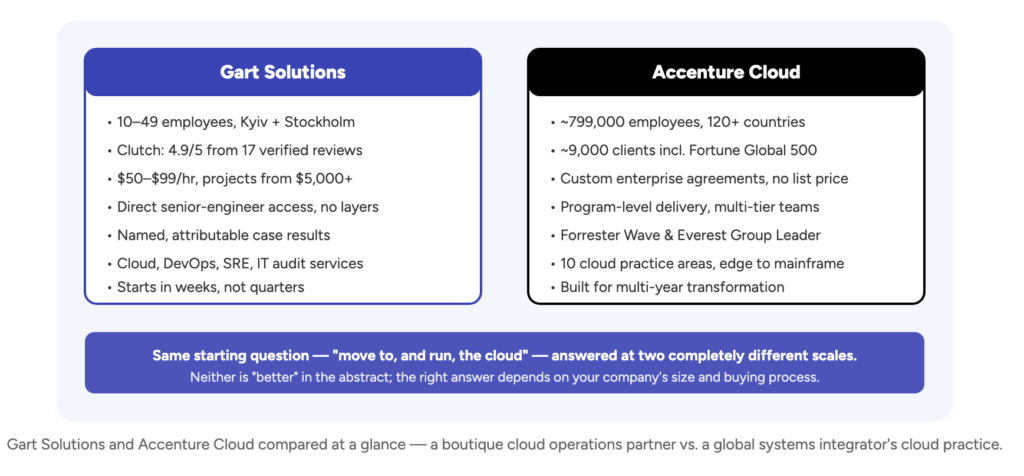
What this means practically: the market has bifurcated. On one side, large consultancies offer governance, multi-geography delivery, and vendor relationships. On the other, specialized boutique firms offer depth, speed, and genuine hands-on execution. Most cloud transformation companies in 2026 occupy one of those two positions — and the right choice depends heavily on where your organization sits today.
What’s driving the market?
Multi-cloud adoption: Businesses are no longer tied to a single cloud. They want flexibility across AWS, Azure, and Google Cloud.
Cost optimization: As inflation and cloud bills rise, companies are laser-focused on optimizing infrastructure spend.
Automation & DevOps: Migration is just step one. Companies need continuous delivery, infrastructure-as-code (IaC), and CI/CD pipelines.
Regulatory pressures: Healthcare, fintech, and SaaS firms must ensure data privacy, compliance, and secure configurations.
These trends highlight the growing need for cloud transformation partners that don’t just lift-and-shift, but deeply embed into the client’s ecosystem to modernize operations end-to-end.
What Cloud Transformation Actually Involves
Before evaluating vendors, it helps to understand what a complete cloud transformation engagement covers. "Migration" is only one phase. A genuine transformation typically progresses through five stages:
PhaseWhat HappensCommon DeliverablesTypical Duration1. Discovery & AssessmentAudit current infrastructure, dependencies, costs, and security postureArchitecture map, TCO analysis, risk register2–4 weeks2. Strategy & RoadmapDefine target architecture, cloud provider selection, migration sequencingCloud strategy document, vendor selection, roadmap2–3 weeks3. Foundation & Landing ZoneSet up networking, IAM, security baselines, IaC scaffoldingVPC/VNet setup, Terraform modules, CI/CD baseline3–6 weeks4. Migration & ModernizationMove workloads; refactor where lift-and-shift is insufficientMigrated applications, containerized services, data pipelines4–16 weeks (varies by scope)5. Optimize & OperateCost governance, observability, SRE practices, continuous improvementFinOps dashboards, alerting, runbooks, SLA definitionsOngoingWhat Cloud Transformation Actually Involves (The Framework)
A vendor who only delivers phases 3–4 is a migration firm. A partner who spans all five — with verifiable outcomes at each stage — is a true cloud transformation company. Keep that distinction in mind as you read the profiles below.
What to Look for in a Cloud Transformation Partner
Choosing the right partner is more than just reviewing certifications. Here are the traits that separate good cloud consultants from great ones:
Cloud-native expertise: Look for firms that build with IaC, automate deployments, and know DevOps inside out.
Scalability: Can they handle your current workload and support your future scale-up plan?
Engagement flexibility: SMBs need agile billing and custom engagement models.
Use-case alignment: Have they worked with companies like yours? SaaS vs. eCommerce vs. healthcare makes a difference.
Cost transparency: Cloud spend can balloon without governance. Look for partners who specialize in cost optimization.
That’s why we’ve divided this list into three tiers: Boutique SMB-friendly firms, Mid-sized scalable providers, and Enterprise consultancies.
Boutique & SMB/SaaS-Friendly Cloud Transformation Partners
If you’re a startup or SMB, you need a partner who can move fast, go deep, and work alongside your internal teams. These firms are laser-focused on building cloud-native architectures, integrating DevOps pipelines, and reducing your infrastructure spend with clever cloud-native tricks.
Let’s break down some of the top contenders in this category.
Gart Solutions: A Specialized Cloud Transformation Partner
When it comes to flexible, deeply technical, and outcome-driven cloud transformation for SMBs, Gart Solutions stands at the top. Known for working closely with SaaS companies and tech startups, Gart brings boutique agility with enterprise-grade execution.
Their offerings span across:
Cloud Computing Services: Tailored architecture, platform modernization, and multicloud deployments.
Cloud Migration Services: Secure, fast migrations with minimal downtime.
Digital Transformation Consulting: Strategic planning, process optimization, and long-term roadmap alignment.
Here’s what Fedir Kompaniiets, CEO of Gart Solutions, had to say:
"Cloud transformation should never be a one-size-fits-all approach. Our mission is to make cloud work for each client’s unique business model — from cost-saving Azure Spot VMs to full-stack SaaS monitoring."
This philosophy is reflected in their success stories:
Jewelry AI Vision: Gart reduced infrastructure costs by 81% using Azure Spot VMs, showcasing their cloud-native optimization skills.
Healthcare Infrastructure Optimization: A case that proves their strength in regulated industries.
B2C SaaS Music Platform: Centralized monitoring and logging delivered proactive performance insights.
With a hands-on approach, Gart Solutions is a go-to choice for tech teams that want results without the fluff.
IT Svit
IT Svit is a well-known AWS Select Partner that brings a full lifecycle of cloud transformation services tailored for startups and small to mid-sized businesses. With expertise in DevOps, cloud architecture, and managed services, they’ve carved out a reputation for being a reliable partner for companies that want to modernize infrastructure without overcomplicating the process.
Their strength lies in end-to-end delivery. From the initial cloud assessment to post-migration monitoring and automation, IT Svit ensures that businesses can stay focused on product development while the platform scales reliably in the background.
Key highlights:
Full-stack AWS migration services
24/7 infrastructure monitoring
CI/CD automation and IaC implementation
Kubernetes-based cloud-native deployments
Where they really shine is with fast-paced teams that want zero downtime, scalable DevOps pipelines, and cost predictability. Like Gart Solutions, they focus on practical implementation rather than bloated presentations.
They’re especially useful for businesses building on AWS that need strong post-migration support, automated infrastructure, and a transparent delivery model.
Simform
Simform stands out by blending cloud transformation with software engineering excellence, offering clients both technical uplift and delivery momentum. Focused heavily on DevOps, CI/CD automation, and cloud-native applications, Simform helps teams make the leap from monoliths to microservices with speed and clarity.
Their cloud transformation model includes:
Cloud readiness assessments
Application containerization & microservices development
DevOps pipeline integration
Multi-cloud support across AWS, Azure, GCP
For mid-market SaaS companies scaling their platform or shifting toward product modernization, Simform provides not just cloud infrastructure, but also the development muscle to rebuild, refactor, and evolve applications on the go.
They’ve proven particularly effective at helping engineering teams deploy resilient, scalable platforms that leverage container orchestration, serverless backends, and performance monitoring.
Edvantis
Edvantis is another strong pick for SMEs and scaling tech companies looking to modernize without overwhelming internal teams. Their cloud transformation services are often bundled with digital acceleration, helping clients not only migrate, but also evolve how they operate in the cloud.
Notable strengths:
Migration planning for legacy systems
DevOps-as-a-Service
Custom dashboards for cost monitoring
Cloud-native application delivery
Edvantis brings a balanced mix of consulting + delivery, which makes them ideal for organizations that need strategic input as well as hands-on execution. They also offer flexible team extension models, allowing companies to bring in specialists on-demand.
Their cloud adoption strategies often include process digitization, helping businesses go beyond lift-and-shift and instead rethink how they deliver products and services on modern platforms.
Innowise
Innowise is known for its versatility in cloud transformation projects. Whether you’re building a new SaaS product or migrating a monolith to Kubernetes, Innowise offers end-to-end services that make technical change seamless.
With global delivery teams and strong experience in:
SaaS product modernization
Cloud-native architecture
Application migration
Azure, AWS, and GCP deployment
Their approach includes detailed assessments, application refactoring where needed, and full CI/CD integration. Innowise also places a strong emphasis on automated testing, which reduces deployment risks and helps maintain software reliability during migrations.
They are a preferred partner for mid-sized tech companies looking to migrate entire platforms, especially in industries like eLearning, healthcare, and fintech.
ClearScale
When it comes to AWS-only cloud transformation, ClearScale is a top-tier choice. An AWS Premier Consulting Partner, ClearScale focuses on startup and SaaS tech stacks, helping companies modernize quickly using AWS-native tools and services.
ClearScale offers:
SaaS platform modernization
DevOps, CI/CD, and monitoring setup
Security & compliance-focused deployments
Their specialization in AWS tooling means clients get faster outcomes using services like AWS Lambda, ECS, CloudFormation, and more. Startups benefit from their startup accelerators, where teams can go from design to deployment in weeks.
Mid-Sized Cloud Transformation Specialists
If you’re past the early startup stage and are growing fast, you need partners who can help scale across multiple clouds, manage complex integrations, and keep compliance in check. Here are some strong options:
N-iX: Full-spectrum services for mid-market tech firms with modern DevOps and cloud-native development capabilities.
Trigent Software: Great for companies seeking fast AWS/Azure migration with minimal service disruption.
Eleks: Blends design, development, and cloud ops for growing SaaS platforms.
Computools: Cloud strategy and modernization with a product-focused approach.
Mission Cloud: AWS-native provider focused on automation, optimization, and compliance for growing firms.
These providers are best when you need to scale infrastructure, implement multi-cloud governance, and reduce tech debt while continuing to ship new features.
Larger or Broader Cloud Transformation Consultancies
Need enterprise-grade governance, support for hybrid cloud, or global compliance? These companies deliver:
Accenture: Global powerhouse for strategic digital transformation, cloud factory models, and deep enterprise integrations.
Capgemini: Great for hybrid and multi-cloud strategy across regulated industries.
Rackspace Technology: Managed cloud with robust operations support and security.
Cloudreach: Modern deployments with automation across AWS, Azure, and Google Cloud.
DoiT International: Startup to mid-size focused, strong on cost optimization and automation.
Slalom: Agile transformation with strong regional teams for mid-sized enterprise rollouts.
These consultancies are best suited if your cloud journey involves multiple departments, legacy IT, or needs to integrate with on-prem systems.
Top Cloud Transformation Companies by Focus & Strengths
VendorCategoryKey StrengthsBest ForGart SolutionsBoutique / SMB-FriendlyCloud migration, DevOps/CI-CD, cost optimization, monitoringSaaS startups, SMBs, regulated industriesIT SvitBoutique / SMB-FriendlyAWS Select Partner, DevOps, full lifecycle cloud transformationSmall tech teams on AWSHire UkraineBoutique / SMB-FriendlyCost-efficient DevOps, fast delivery, IaC automationAgile startups with tight budgetsSimformBoutique / SMB-FriendlyCloud-native, DevOps-first, microservices, automationMid-size SaaS and digital product teamsEdvantisBoutique / SMB-FriendlyDigital acceleration, legacy modernization, DevOps-as-a-ServiceSMEs, hybrid cloud adoptersInnowiseBoutique / SMB-FriendlySaaS platform migration, cloud-native development, testing automationTech companies in healthcare/fintechClearScaleBoutique / AWS SpecialistAWS Premier Partner, SaaS-focused, automation and CI/CDStartups and fast-growing tech firmsN-iXMid-Sized Scalable SpecialistFull-spectrum migration, DevOps, modernization, global deliveryScaling platforms across cloud environmentsTrigent SoftwareMid-Sized Scalable SpecialistAWS/Azure migrations, CI/CD integrationSeamless cloud integrationEleksMid-Sized Scalable SpecialistSaaS modernization, cloud consulting, global engineeringMid-market SaaS companiesComputoolsMid-Sized Scalable SpecialistProduct-centric cloud strategy, DevOps-enabled transformationSaaS, fintech, healthcareMission CloudMid-Sized Scalable SpecialistAWS automation, cost governance, DevOps enablementGrowth-stage tech companiesAccentureLarge ConsultancyEnterprise-grade strategy, cloud factory models, automation, global deliveryEnterprises with complex IT needsCapgeminiLarge ConsultancyMulti-cloud and hybrid transformation, governance, securityEnterprises with regulatory requirementsRackspace TechnologyLarge ConsultancyManaged cloud services, hybrid migration, security and operationsEnterprises with legacy workloadsCloudreachLarge ConsultancyGovernance, DevOps automation, multi-cloud deploymentsEnterprise-wide cloud adoptionDoiT InternationalLarge Consultancy (SMB-Focused)Cloud cost optimization, automation, Google Cloud & AWS expertiseSaaS, startups, budget-conscious teamsSlalomLarge ConsultancyAgile cloud transformation, regional delivery teams, data-driven strategyMid-sized enterprises in transformationTop Cloud Transformation Companies by Focus & Strengths
Choosing the Right Vendor: A Quick Guide
Business SizeBest Fit ProvidersFocus AreaSaaS StartupsGart Solutions, Hire Ukraine, IT SvitFast migration, DevOps automationSMBsSimform, Edvantis, InnowiseApp modernization, multi-cloudMid-marketN-iX, Eleks, Trigent SoftwareScaling, CI/CD pipelinesEnterpriseAccenture, Capgemini, CloudreachHybrid cloud, compliance
How to Choose the Right Cloud Transformation Partner: A Practical Framework
Vendor selection for cloud transformation is not primarily a technical decision — it's a fit decision. The most common mistake engineering leaders make is over-indexing on certification count and under-indexing on whether the vendor has solved your specific problem before.
Here's the decision framework we recommend:
Step 1: Define your transformation scope honestly
Are you doing a lift-and-shift migration (narrow scope, 4–12 weeks), a full cloud-native modernization (broad scope, 3–9 months), or something in between? Vendors optimized for one don't always excel at the other.
Step 2: Match company size to vendor tier
Organization ProfileBest Vendor TierRecommended First LookSaaS startup (under 50 engineers)BoutiqueGart Solutions, ClearScale, IT SvitSMB / scale-up (50–200 engineers)Boutique / Mid-SizedGart Solutions, Simform, Edvantis, InnowiseMid-market (200–1,000 employees)Mid-SizedN-iX, Eleks, Mission Cloud, ComputoolsEnterprise (1,000+ employees)EnterpriseAccenture, Capgemini, Rackspace, Slalom
Step 3: Run a 5-question vendor scorecard
Can they show a published case study where a company like ours achieved specific, measurable outcomes?
Do their engineers understand our primary cloud platform at a certified, hands-on level?
Do they have experience in our industry (healthcare, fintech, SaaS, etc.) with the relevant compliance requirements?
Can they demonstrate cloud cost optimization methodology — not just migration execution?
What does post-migration support look like? Is there an SRE/managed services layer or do they hand off and leave?
A vendor that can answer all five with specifics — names, numbers, and references — is in a different category from one that answers in generalities. That gap is usually the most predictive factor in transformation success.
If you're evaluating vendors for a digital transformation program specifically, the criteria above apply equally — but you should additionally assess the vendor's ability to align cloud architecture with business process change.
What Cloud Transformation Actually Costs (and How to Optimize)
One area the industry consistently under-explains is cost structure. Most organizations budget for migration fees but underestimate the total cost of transformation, which includes:
Vendor fees: Discovery, migration, landing zone build-out, ongoing optimization
Cloud provider costs: Often higher in the first 3–6 months during parallel running before cutover
Internal team time: Engineering hours for knowledge transfer, testing, and validation
Training and tooling: IaC tools, monitoring platforms, FinOps dashboards
Operational transition: Runbooks, on-call rotation updates, incident response procedures
The partners that deliver the best long-term ROI are those who engineer cost efficiency into the architecture from the start — not those who optimize later as an afterthought. Look for evidence of cloud cost optimization as a native capability, not an add-on service.
For context, teams that implement FinOps practices from the beginning of a transformation typically see 20–35% lower cloud spend in the first 12 months compared to those who optimize post-migration. That's a material budget difference at any scale.
Conclusion
As cloud transformation continues to redefine how businesses scale and compete, the right partner can make all the difference. Whether you’re a SaaS startup looking for lean DevOps-powered migration or a mid-market company planning for multi-cloud expansion, there’s a fit for your needs.
Gart Solutions stands out as a top boutique provider, combining technical depth, client focus, and proven results. Their hands-on approach and expertise in cloud strategy, DevOps, and cost savings make them an ideal partner for growth-oriented tech companies.
Need proof? Just explore their cloud services or dive into cases like their 81% cost savings in Azure or the centralized monitoring for a global music platform.
Choose smart. Choose strategically. Choose partners who build with you, not just for you.
In a market driven by change, speed, and automation, small and mid-sized businesses (SMBs) can no longer rely on legacy systems or gut decisions. Digital transformation becomes a necessity. Whether you’re scaling a tech startup, modernizing operations, or simply trying to compete with digital-first rivals, one thing is clear: transformation is mandatory.
But here’s the tricky part — most digital transformation frameworks were built for enterprises, not the lean, fast-moving, budget-conscious world of SMBs. That’s where specialized consulting firms come in. They help you not just adopt new tech, but align it with your strategy, optimize operations, and unlock real business value.
In this guide, we’ll walk you through the best digital transformation consulting companies, especially those with a track record of helping SMBs and fast-growing companies achieve real ROI. We’ll start with our top 10 picks and wrap up with a table of 30 top-rated global providers.
What is Digital Transformation Consulting?
Let’s clear up the confusion — digital transformation isn’t just about “going paperless” or “moving to the cloud.” It’s not just building an app or revamping your website. True digital transformation is a fundamental rethinking of how your business operates, interacts with customers, delivers value, and competes in a fast-changing world.
A digital transformation consulting firm helps you plan, design, and execute this journey. Their role is not just technical — it’s strategic, operational, and cultural. They help you answer the big questions:
What does digital success look like for your business?
Where is your tech stack holding you back?
Which processes can be automated or optimized?
How do you adopt AI, cloud, or analytics without disrupting everything?
A great consulting partner will work with your team to:
Assess your digital maturity: What systems are outdated? What tools are siloed? Where’s the bottleneck?
Design a digital roadmap: This isn’t just about shiny tech. It’s about aligning transformation with your business model and goals.
Select and implement technology: From cloud platforms (like AWS, Azure, or GCP) to automation tools and custom software, they guide tech decisions that scale with your growth.
Modernize legacy systems: You don’t always need to scrap your entire stack — sometimes, smart modernization is the move.
Introduce data and analytics: So you’re not guessing, you’re making decisions backed by insights.
Support organizational change: Transformation isn’t just tech — it’s about people, mindset, and process.
Let’s clear this up: digital transformation isn’t just “getting on the cloud” or building an app. It’s a complete rethinking of how your business uses technology — from internal operations to customer interactions. Digital transformation consulting companies help businesses define that vision, build a roadmap, implement the right tech, and navigate the human side of change.
What does a digital transformation consultant actually do?
Audits current digital maturity
Builds a strategy and transformation roadmap
Guides cloud migration or hybrid architecture design
Optimizes DevOps, CI/CD, and IT processes
Modernizes legacy systems and workflows
Enhances customer experience via digital platforms
Introduces analytics, automation, and AI tools
And it’s not just about tech. In short, digital transformation consultants bridge the gap between vision and execution. They bring technical expertise, strategic clarity, and operational muscle — especially valuable for SMBs who don’t have internal innovation teams or massive IT departments.
Why SMBs and Startups Need Specialized Digital Consulting Partners
Let’s be honest — most small and mid-sized businesses don’t have millions to throw at consultants or 12 months to “wait and see results.” The average SMB needs ROI yesterday. That’s why traditional enterprise consultancies often miss the mark for this segment.
So, why can’t SMBs just go with a big-name firm?
They’re slow: Multi-year rollouts don’t work when you’re trying to survive Q2.
They’re expensive: SMBs can’t afford $500/hour consulting rates or multi-phase discovery projects with no deliverables.
They overbuild: Enterprise strategies often involve over-engineered solutions — when lean, agile options would do the trick.
They don’t speak SMB: Big firms often don’t understand the urgency, culture, or pace of smaller teams.
What do SMBs need instead?
✅ Quick WinsSmall changes that drive immediate value. That could be automating a workflow, reducing cloud costs, or launching a new customer-facing app. Consultants who specialize in SMBs focus on momentum, not just planning.
✅ Agility and FlexibilityYou need a partner who can pivot with you, scale services as you grow, and roll with your evolving priorities. SMB consultants embrace change — they don’t fear it.
✅ Right-Sized BudgetsYou want outcomes, not bloated project plans. The best consulting partners focus on ROI-first strategies, using open-source tools, efficient architectures, and creative solutions to stay lean.
✅ Strategic + Technical ExpertiseYou don’t just need someone to “install software.” You need someone who understands your business model, challenges, and growth goals — and builds tech to match.
✅ Long-Term ScalabilityThe tech you implement today should still serve you tomorrow. Smart consultants build systems and strategies that evolve as your company scales.
Bottom line? SMBs need partners — not vendors. The best digital transformation consulting firms for this market don’t just drop in and leave. They work with you, understand your goals, and evolve alongside your team.
Top 10 Digital Transformation Consulting Companies (2026)
1. Gart Solutions – Infrastructure-Led Transformation for SMBs
When it comes to SMB-friendly digital transformation, Gart Solutions sets the gold standard. This firm is all about practical, measurable transformation for SMBs and scaling companies. Unlike larger consulting giants, Gart doesn’t just hand you a 50-slide deck — they build, implement, and optimize.
If you’re an SMB or scale-up looking for a consulting partner that’s fast, focused, and doesn’t waste time— Gart Solutions should be at the top of your list. This boutique firm has quietly become the gold standard for cloud-native transformation and DevOps excellence.
What sets Gart apart isn’t just technical expertise — though they have plenty. It’s their "Quick Wins" methodology. While other firms are still hosting kickoff meetings, Gart is already optimizing your CI/CD pipeline or cutting your cloud costs. For budget-conscious SMBs that need real outcomes fast, this is a game-changer.
Their services cover:
CloudOps and multi-cloud architecture (AWS, Azure, GCP, Hetzner)
DevOps managed services
Infrastructure as Code (Terraform, Kubernetes)
Application modernization
Data and analytics enablement
One of their most impressive case studies? Helping a Thai jewelry manufacturer reduce cloud spend by 81% by replacing legacy video processing workflows with Azure Spot VMs and automated pipelines. Another? Building a disaster recovery setup for ESG platform Datamaran that cut downtime from days to minutes, ensuring 99.99% uptime.
They also specialize in turning technical debt into scalable infrastructure. Rather than ripping everything out, they help modernize legacy systems to meet today’s demands — affordably and fast.
Gart’s pricing is SMB-friendly ($50–$99/hr), but their delivery rivals firms 10x more expensive. With a senior team of fewer than 50 engineers, they offer high-touch, personalized service. You won’t get bounced between project managers — you’ll work directly with experts who understand your stack, your product, and your pressure to move fast.
Best for: SMBs, tech startups, or fast-growing scale-ups looking for agile, cloud-first infrastructure transformation without enterprise bloat.
2. Enfuse Group: Behavioral-Driven Digital Change
Let’s be real — not all transformation challenges are about tech. In fact, 60% of digital transformation projects fail due to people and culture issues, not the software. That’s why Enfuse Group, based in London, is one of the most unique and valuable consulting firms on this list.
Their core philosophy? “Digital transformation is a behavioral problem, not just a technical one.” This mindset drives everything they do.
Enfuse helps SMBs and mid-market firms redesign their operating models, employee experiences, and decision-making workflows — all through a lens of behavioral science. Their “BeHuman” methodology is a structured approach to change management, aligning teams, leadership, and tech adoption strategies.
They focus on:
Culture transformation and change readiness
People tech (HR systems, talent platforms)
Operating model redesign
Scalable AI-enabled process design
Employee experience optimization
Their work spans retail, hospitality, education, and logistics — sectors where frontline employees are often the missing link in failed tech projects. Post-2025, Enfuse has doubled down on employee-focused transformation after receiving investment from Agathos Capital. That means better tools, better support, and better ROI from every tech investment.
If your company struggles with “people bottlenecks” — poor communication, slow adoption, or digital fatigue — Enfuse offers a powerful, often overlooked path to progress.
Best for: SMBs with people-heavy operations (retail, logistics, education) that need cultural alignment and operating model redesign alongside tech modernization.
3. Artkai
When your product is complex, your industry is regulated, and your users expect Netflix-level experience — Artkai is the partner you call.
This Ukraine- and Poland-based firm leads with design and user experience, but don’t confuse that with “just UI.” Artkai blends product discovery, strategic consulting, and high-end engineering to deliver enterprise-grade digital platforms. What’s more impressive? They do it in sectors like fintech and healthtech, where compliance isn’t optional — it’s life-or-death.
Their specialty is working with companies that:
Have legacy platforms that need modernization
Operate in highly regulated environments (HIPAA, GDPR, PCI-DSS)
Want to align digital products with business strategy
Need platforms that scale without sacrificing UX
Artkai takes clients through a full-cycle transformation: from product ideation to scalable cloud architecture. And they do it with one goal — to future-proof your core platform while delivering a sleek, intuitive experience.
They’re not the cheapest option on this list, but the investment pays off when you consider that most SaaS churn is caused by poor UX or unclear value. Artkai helps you fix both.
Best for: Fintech, healthtech, or SaaS companies that need to modernize legacy products and deliver consumer-grade digital experiences.
4. Argano: AI-Driven Tech Stack for Growth
If your SMB is scaling fast and your current systems feel like they’re always playing catch-up, Argano might be your ideal transformation partner. Headquartered in Plano, Texas, Argano is a U.S.-based consultancy that has become known for its AI-forward, platform-agnostic approach to enterprise technology — and yes, they’re just as effective for mid-market companies.
What makes Argano stand out is their focus on designing and delivering connected business operations. This includes everything from ERP modernization to data intelligence, CRM upgrades, and embedded AI — all without forcing clients into one specific vendor ecosystem. Whether you’re running on Microsoft, Oracle, SAP, or a combination, Argano’s integration-first model makes it all work together.
Here’s what they specialize in:
ERP transformation and modernization
CRM and customer journey orchestration
AI-powered decision intelligence
Digital strategy alignment
Scalable cloud-native solutions
What SMBs love most is their “hands-on” model — the same experts stay with your project from start to finish. No bouncing between teams. This consistency leads to faster decisions, fewer surprises, and higher accountability — something larger firms often fail at.
Their deep industry focus spans healthcare, manufacturing, financial services, and retail — all spaces where operational complexity and compliance demand both tech sophistication and a practical delivery model.
And here’s a bonus: Argano’s combined legacy of multiple boutique firms means they’ve got over 100+ years of consulting depth, rolled into one modern delivery team.
Best for: Mid-market companies looking for full-stack transformation across ERP, CRM, and AI — without being locked into one tech provider.
5. Yalantis: IoT and Full Product Lifecycle Expertise
Need a consulting partner that goes beyond software — into hardware, IoT, and edge computing? Yalantis, based in Ukraine, is one of the few boutique consultancies that can handle the entire digital product lifecycle, from prototyping to scalable deployment.
Yalantis is built for businesses that straddle the digital-physical line: logistics platforms, health tech startups, manufacturing systems, and smart device innovators. In a world where sensors, mobile apps, cloud platforms, and APIs must work in harmony — they make it happen.
What makes Yalantis special?
Deep expertise in IoT architecture
Microservices-based software design
Real-time analytics and monitoring tools
Remote device control platforms
UX-first design for hardware-integrated software
They’ve grown rapidly, with a 54% annual growth rate, and now boast over 500 professionals delivering high-velocity engineering for global clients. Their client results include massive improvements in order processing speed, failed transaction reduction, and remote device management.
Yalantis doesn’t just build — they co-create. That means working alongside your team, defining product specs, refining UX, and ensuring regulatory compliance. For SMBs trying to create something complex without hiring a massive in-house dev team, this kind of hybrid expertise is invaluable.
Best for: Logistics, healthcare, and manufacturing SMBs building connected digital-physical systems, or launching smart products with IoT integration.
6. Sombra Inc: Hybrid AI Integration & Cloud Execution
Need to modernize both your infrastructure and integrate AI — without breaking the bank or derailing your operations? Sombra Inc offers one of the best hybrid transformation models on the market.
Founded in Ukraine and now operating globally (including North America), Sombra specializes in helping SMBs choose the right path between buying, building, or blending AI tools. Their 2026 “AI Playbook” outlines detailed cost comparisons — from SaaS models to full custom solutions — giving companies a transparent path to ROI.
Sombra’s services include:
Cloud architecture and migration
AI integration and API blending
Custom product development
Data warehousing and analytics
DevOps optimization
Where they really shine is in building “production-ready mini-stacks” — lightweight, scalable software systems complete with private endpoints, audit logs, and real-time data streaming. These solutions help clients deploy AI in live environments with minimal disruption and maximum value.
Their hybrid cloud and AI expertise is especially helpful for:
Fintech and healthtech startups
Logistics and operationally complex SMBs
Companies migrating from legacy tools to modern stacks
Sombra works lean, fast, and flexibly — a rare combo in the consulting world. And because they specialize in SMBs, they respect budgets, timelines, and internal resource limits.
Best for: SMBs seeking to blend AI with cloud modernization, and need a clear, affordable path to scale without overbuilding.
7. S-PRO: Fintech and Renewable Tech Specialists
For companies operating at the intersection of finance and innovation — especially in fintech, crypto, or renewables — S-PRO is a standout. Based in Ukraine with strong Swiss partnerships, S-PRO has carved out a niche building modern, scalable, and compliant platforms for some of the most regulated, fast-moving industries.
Key service areas include:
Fintech software development
DeFi and blockchain integration
ESG and sustainability tech
Wealth management solutions
Custom banking platform modernization
Their deep knowledge of the Swiss banking system, plus hands-on experience with crypto exchanges and next-gen payment infrastructure, gives them an edge few firms can match. They’ve helped clients like Hyposwiss and Amina Bank launch new products that comply with both traditional finance laws and emerging crypto regulations.
What SMBs love about S-PRO is their agile team structure. They don’t overstaff. Instead, they bring in the exact right mix of architects, developers, and strategists, build fast, and stay transparent.
If you’re in fintech or ESG-driven spaces and need a transformation partner that gets both the tech and regulatory landscape, S-PRO delivers.
Best for: Fintech startups, wealth platforms, crypto firms, and ESG-focused SMBs needing secure, scalable product development and transformation.
Runner-Ups & Niche Standouts Worth Watching
While the top 10 firms dominate across multiple SMB use cases, several high-performing runner-ups stand out for their specialization, innovation, or regional excellence. These companies may not be one-size-fits-all, but in the right context, they’re absolute game-changers.
Glorium Technologies
Headquartered in the US with R&D centers in Ukraine, Glorium focuses on healthtech, proptech, and custom platform development. They’re ideal for SMBs building digital products that need rapid scaling, HIPAA compliance, and seamless user experience. Glorium brings strong automation and MVP-launch capabilities, making them a solid choice for early-stage startups and post-seed companies looking to mature their tech stack without overbuilding.
Railsware
Railsware has a cult-like following among product-led startups, and for good reason. Known for its engineering-first culture and for building products like Calendly and BrightBytes, Railsware approaches transformation from a product strategy + analytics perspective. Their strength lies in helping SaaS firms and product-centric SMBs make better build-or-buy decisions and optimize internal tooling.
SoftServe
One of the giants in the Ukrainian ecosystem, SoftServe brings massive scale to AI, machine learning, cloud, and data engineering. While they mostly serve enterprise clients, SoftServe has flexible engagement models for high-growth SMBs and innovation teams inside larger firms. If your goals involve enterprise-grade AI, SoftServe delivers.
Xmethod
This Berlin-based firm is a rising star in the healthcare transformation scene, building MVPs using low-code/no-code tools. If you’re a digital health startup or SMB looking for rapid prototyping, telemedicine deployment, or compliance-ready patient engagement platforms — Xmethod is fast, affordable, and effective.
Softermii
Softermii is a Ukraine-based firm making waves in video-tech and healthcare. With proprietary tools like VidRTC, they’re helping healthcare and event platforms build scalable, real-time digital experiences. Their dedicated team model is perfect for SMBs that need a dev squad embedded into their workflow.
Comparison Table: Top 30 Digital Transformation Consulting Companies
Company NameKey StrengthsBest ForGart SolutionsCloud, DevOps, strategy, SMB-focusedSmall and mid-size tech firms, tech startups and scaleupsHexagon AgencyStrategy, marketing, UXSmall businessesGlorium TechnologiesCustom platforms, automationGrowth-stage startupsStrategic Consulting UAChange readiness, frameworksOrganizational alignmentN-iXAI, data, cloudCross-industry transformationSombra Inc.DevOps, modernizationInfrastructure transformationRailswareProduct strategy, analyticsSaaS, product-led teamsEleksEnterprise automationEnterprise-level transformationBCGStrategy + transformationFunded SMBs, enterprisesMcKinsey DigitalDesign thinking, agileHigh-budget initiativesAccentureInnovation labs, CXEnterprise consultingEPAM SystemsAgile, CX, engineeringLarge tech projectsSoftServeAI, cloud, analyticsInnovative SMBsAvengaCRM, healthcareRegulated industriesLuxoftAI, digital financeFintech, automotiveSigma SoftwareAI, AR/VR, engineeringAdvanced industriesIntelliasIoT, cloudMobility and tech projectsAltexSoftAnalytics, travel-techNiche SMBsDataArtFintech, healthcareRegulated sectorsIT SvitCloud-native, DevOpsInfrastructure upgradesInnovecsGaming, logisticsVertical-specific needsSoftengiRPA, digital twinsTech-heavy firmsZazmicProduct dev, growth opsStartupsYalantisUX, platformsCustomer-focused designDev.ProAgile teams, scalingMVP to enterprise growthTimsparkTeam extension, consultingFlexible staffingCiklumEngineering, product devDigital enterprise growthAndersenAgile, cloudHybrid transformationDigisDevOps, product blendMid-size tech firmsInfopulseCybersecurity, IT opsRisk-sensitive orgs
How to Choose the Right Digital Transformation Consulting Partner
1. Define Your Transformation Goals
Do you need strategy, tech enablement, or both?
Are you focused on cloud, DevOps, data, or UX?
Is this a full overhaul or incremental change?
2. Match Scope with Capabilities
Don’t hire enterprise firms for startup problems
Look for firms that understand your stage and industry
Seek right-size expertise
3. Look for Proof, Not Promises
Ask for case studies and results
Demand measurable metrics and success stories
Find partners who deliver outcomes, not just ideas
4. Prioritize Collaboration
Look for partners, not vendors
Culture fit and communication style are crucial
Make sure you’ll work well together under pressure
SMBs vs. Enterprises: Different Needs, Different Partners
SMBsEnterprisesLean budgetsLarger investmentsNeed fast ROILong-term strategyFlexible partnersStructured processesRequire tech + business helpHave internal strategy teamsComparison table of SMBs vs. Enterprises
SMBs should go for agile, cost-effective firms like Gart Solutions, Hexagon, or Glorium.
Why Gart Solutions is One of the Leaders
Gart Solutions combines strategy, tech, and implementation under one roof — without breaking your budget. They offer:
End-to-end transformation services
DevOps, cloud, and legacy modernization
Data and analytics frameworks
Custom roadmaps for SMBs
Affordable rates with enterprise-level results.
Gart is hands-on, strategic, and results-driven — perfect for ambitious SMBs.
The Future of Digital Transformation Consulting (2026–2030)
Digital transformation is no longer a one-time project. It’s a continuous journey, and the next few years will see even more disruptive shifts. Here’s where we’re headed:
1. AI-First Transformation
By 2030, nearly every SMB will need to embed AI into operations — not just for analytics, but for automation, personalization, and predictive decision-making. Consulting firms will shift from "digital advisors" to AI orchestrators — helping you buy, build, and train the right models.
2. Hyperautomation
Expect a rise in process orchestration platforms, where everything from onboarding to logistics can be automated end-to-end using RPA + AI + analytics. The best firms will build cross-functional automation maps, not just isolated tools.
3. Verticalization
Generic consulting is dead. SMBs want industry-specific insight — whether it's compliance in healthcare, customer journey mapping in fintech, or UX for SaaS onboarding. The top firms will specialize deeply in vertical problems.
4. Remote-First Execution
The best consulting firms will be remote-native, with async workflows, global teams, and 24/7 delivery cycles. This benefits SMBs that need speed without geographical limitations.
5. AI Compliance & Security by Design
As AI regulation grows, expect firms to prioritize explainability, data lineage, audit readiness, and zero-trust security models. Smart SMBs will choose consultants who can make them future-compliant — not just feature-rich.
Conclusion: Choose Smart, Transform Faster
Digital transformation isn't optional anymore — it’s mission-critical. But for SMBs, success doesn’t come from buzzwords or bloated roadmaps. It comes from finding the right partner — one who speaks your language, understands your pace, and builds tech that actually moves the needle.
Whether you need cloud migration, AI adoption, legacy system upgrades, or full-stack platform development, the firms listed here represent the best of 2026 — boutique powerhouses with the talent, tools, and mindset to help you transform with clarity, confidence, and speed.
Start small. Move smart. Measure everything.And above all — choose partners who make your growth their mission.
If you’re ready to reduce downtime, boost efficiency, and update legacy systems for the future — Gart Solutions is here to help you make that leap.
Whether you’re an SMB, needing guidance or a growth-stage company scaling your infrastructure, Gart Solutions’ Digital Transformation Consulting is targeting your sustainable growth.
The importance of data can’t be overstated. Whether you're a small business owner, a mid-sized enterprise, or a global brand, your data is your lifeline. Losing access to your data, even temporarily can be catastrophic. That's why backup and disaster recovery (BDR) solutions are no longer just optional insurance policies — they’re mission-critical tools for survival and growth.
So, who should you trust to protect your digital assets? We made the list of companies, that offer not only compliance with strict privacy regulations like GDPR, but also proximity to European business hubs, advanced in cloud infrastructure, and increasingly, world-class cyber resilience.
Let’s break down the best backup and disaster recovery companies, with a special spotlight on European and UK providers.
Best Backup and Disaster Recovery Companies
Gart Solutions
If you're serious about rock-solid data protection, Gart Solutions should be on your radar.
Gart Solutions is a cloud infrastructure and DevOps consultancy that runs infrastructure management, SRE, and disaster-recovery-as-a-service through the same engineering team rather than as separate products.
In one documented case, a healthcare client's ransomware incident triggered automated failover within 10 minutes, with roughly 15 minutes of data loss (RPO) and full operational recovery within 2 hours — with no ransom paid and no patient data lost. In another, a retail chain's data-center fire triggered instant cloud failover with no interruption to sales, and failback to new infrastructure completed in under 48 hours, avoiding an estimated $1.2 million in losses.
What makes Gart Solutions stand out? It’s their holistic approach. Instead of just offering a basic backup service, Gart designs comprehensive data protection ecosystems. They help businesses create robust continuity plans, enforce data encryption at all stages, and implement zero-trust security models. Whether you're running a few servers or operating a multi-cloud enterprise, Gart has the toolkit and the tech talent to meet your needs.
Gart's infrastructure management, DRaaS, and SRE services are GDPR- and ISO-aligned and support managed, assisted, and self-service delivery models depending on how much a client's team wants to own directly.
And here's a plus — Gart leverages a team of expert engineers with deep DevOps and cybersecurity backgrounds. That means faster recovery times, smarter threat detection, and personalized Disaster Recovery strategies tailored to your unique infrastructure.
Key Highlights:
24/7 disaster recovery support with guaranteed SLAs
Full-stack backup services: cloud, hybrid, on-prem
Advanced threat detection and ransomware rollback
GDPR & ISO-certified data centers
AI-driven incident response and reporting
Trusted by finance, healthcare, SaaS, and public sector clients
Services:
Backup & replication with lightning-fast recovery
Cloud Backup & Recovery (support for AWS, Azure, Google Cloud, Hetzner and other cloud)
Disaster Recovery as a Service (DRaaS)
Cybersecurity & Threat Monitoring
Infrastructure Monitoring
Kubernetes Backup
Backup for Virtual Machines, Databases, SaaS
Contact Information:
Website: https://gartsolutions.com/
LinkedIn: Gart Solutions
Contact number: +38 093 210 34 71
Veeam Software
When talking about enterprise-grade backup solutions, Veeam is a name that consistently comes up. Headquartered in Baar, Switzerland, Veeam offers one of the most comprehensive and user-friendly platforms for data protection across cloud, virtual, physical, and SaaS environments.
Veeam is especially popular among IT administrators for its intuitive interface, rapid deployment, and robust support for hybrid environments. Whether you're backing up a Microsoft 365 environment, a private data center, or a Kubernetes cluster, Veeam has you covered with unmatched flexibility and power.
Veeam’s strengths lie in its smart automation, ransomware protection, and data portability features, which are perfect for businesses looking to future-proof their operations.
Key Highlights:
Backup & replication with lightning-fast recovery
Support for AWS, Azure, Google Cloud
Native backup for Kubernetes with Kasten K10
Ransomware protection with immutable storage
Self-service portals for Microsoft 365 recovery
Services:
Veeam Backup & Replication
Cloud Connect Backup
DR Orchestration
Veeam ONE (monitoring & analytics)
Immutable Backup for Ransomware Protection
Contact Information:
Website: veeam.com
LinkedIn: https://www.linkedin.com/company/veeam-software
Acronis
Another Swiss-based star with strong Eastern European roots is Acronis. With development centers in Ukraine, Acronis bridges the best of both worlds: Swiss reliability and Ukrainian tech talent. Known for pioneering the concept of Cyber Protection, Acronis goes beyond simple backups by integrating security features directly into its backup suite.
This means you get real-time ransomware protection, vulnerability assessments, and malware scanning baked right into your backup solution. For businesses that need high-performance protection with minimal hassle, Acronis is a solid bet.
Key Highlights:
AI-powered ransomware defense
Supports Windows, macOS, Linux, mobile, virtual machines
Cloud-native backup options for flexible deployment
Blockchain-based notarization for file integrity
One-click disaster recovery orchestration
Contact Information:
Website: https://www.acronis.com
LinkedIn: https://www.linkedin.com/company/acronis
StorageCraft / Arcserve
StorageCraft, now part of Arcserve, offers one of the most complete and scalable backup and disaster recovery solutions available in the European market. With operations across the EU and strong GDPR compliance, they deliver peace of mind for businesses ranging from startups to large enterprises.
What sets Arcserve apart is its unified data resilience platform. It doesn’t just focus on backups — it integrates backup, disaster recovery, business continuity, cybersecurity, and ransomware prevention into a single streamlined solution. That means less time spent managing tools and more time focusing on your business goals.
Arcserve's OneXafe immutable storage architecture ensures that once data is backed up, it can’t be changed or deleted — even by ransomware. Plus, their DRaaS solutions offer sub-minute failover capabilities, allowing businesses to bounce back from outages almost instantly.
Key Highlights:
Unified Data Protection across virtual, physical, cloud environments
Immutable backups with air-gap and WORM (write once, read many) storage
Sub-minute RTOs and near-zero RPOs with DRaaS
GDPR-compliant European data centers
Protection against ransomware, disasters, and human error
Services:
Cloud Hybrid and Direct-to-Cloud Backup
Disaster Recovery as a Service (DRaaS)
Continuous Availability
SaaS Backup for Microsoft 365, Google Workspace
Immutable Storage & Backup Appliances (OneXafe)
Contact Information:
Website: https://www.arcserve.com
LinkedIn: https://www.linkedin.com/company/arcserve
Rubrik
Rubrik may have started in the U.S., but its European operations and data centers have made it a leading player in GDPR-aligned data protection across the continent. Rubrik’s focus? Cyber resilience. With ransomware attacks becoming more sophisticated, Rubrik uses immutable backups, AI-driven threat detection, and zero trust architecture to help companies recover data without paying a cent in ransom.
Their platform is particularly suited for enterprises juggling hybrid environments. Rubrik integrates backup, archival, replication, search, analytics, and compliance into one simple-to-use interface.
And it’s fast. Recovery that used to take hours or days now takes minutes, thanks to Rubrik’s “live mount” feature that enables instant access to backup data without full restores.
Key Highlights:
Immutable, air-gapped backup architecture
Real-time anomaly detection and ransomware recovery
Zero trust data security model
Global threat monitoring and forensics
Cloud-native with deep integrations for AWS, Azure, GCP
Services:
Backup & Instant Recovery
Ransomware Recovery Suite
Sensitive Data Discovery & Compliance
Multi-cloud Data Management
Microsoft 365 and Salesforce Backup
Contact Information:
Website: https://www.rubrik.com
LinkedIn: https://www.linkedin.com/company/rubrik-inc
Runa Backup
Runa Backup is an emerging gem. Despite being smaller than some players on this list, Runa offers specialized, secure, and fully managed backup services tailored to businesses in finance, education, and healthcare.
With data centers located in the EU, Runa gives clients control over where their data resides — a huge plus for GDPR and regional compliance. Their encrypted cloud backups and customizable recovery plans make them a strong option for businesses seeking agile, local support.
Key Highlights:
Local and EU data center hosting options
Encrypted backups with AES-256 and SSL transmission
100% GDPR compliant
Simple, transparent pricing
Personalized disaster recovery planning
Services:
Cloud Backup and Sync
Managed Disaster Recovery
Encrypted File Storage
Database Backup (MySQL, PostgreSQL, MSSQL)
Email and Application Backup (MS365, G Suite)
Contact Information:
Website: runabackup.com
Email: info@runabackup.com
Zerto
Owned by Hewlett Packard Enterprise, Zerto delivers one of the fastest disaster recovery platforms out there, with continuous data protection (CDP) that ensures your data is always just seconds behind real time. With a growing number of data centers across Europe, Zerto is well-suited for organizations that demand high availability and minimal downtime.
Unlike traditional backups that happen at fixed intervals, Zerto captures and logs all changes continuously, making rollbacks precise and painless. Whether you’re operating a VMware setup or a hybrid cloud environment, Zerto fits right in without complexity.
Key Highlights:
Recovery Point Objectives (RPOs) of seconds
Recovery Time Objectives (RTOs) of minutes
Agentless replication across virtual environments
Integration with AWS, Azure, and more
Application-consistent recovery
Services:
Continuous Data Protection (CDP)
Multi-cloud Disaster Recovery
Long-term Retention for Compliance
Ransomware Recovery Automation
Data Migration and Replication
Contact Information:
Website https://www.zerto.com
LinkedIn: https://www.linkedin.com/company/zerto
NovaStor
NovaStor is a well-established data backup and recovery provider based in Hamburg, Germany. With more than two decades of experience in the field, NovaStor has earned the trust of thousands of businesses, public institutions, and data centers across Europe. They focus particularly on small and medium-sized enterprises (SMEs), offering professional-grade data protection that’s cost-effective, reliable, and fully compliant with the EU’s strict data regulations.
Unlike many competitors who rely solely on cloud solutions, NovaStor also provides on-premises and hybrid models, which is a huge advantage for businesses that require localized control or operate in high-compliance sectors like healthcare or public administration.
Key Highlights:
Localized backup and recovery with full GDPR compliance
High-speed backup for Windows, Linux, VMware, and Hyper-V
Scalable from a single workstation to enterprise-level environments
Hybrid backup models with tape, disk, and cloud integration
Premium German-based support team
Services:
NovaBACKUP for Servers and Workstations
Centralized Monitoring for Multi-Site Installations
Disaster Recovery for SMBs and Public Sector
Local and Offsite Backup Solutions
Partner Solutions for IT Providers and MSPs
Contact Information:
Website: novastor.com
DataCore
If your business is heavily reliant on storage performance and availability, DataCore delivers cutting-edge software-defined storage and data protection solutions. Headquartered in Munich, DataCore is known for powering high-performance, resilient IT infrastructures across Europe and beyond.
Their data protection services go hand in hand with their real-time mirroring and auto-failover systems, ensuring data is available even during outages. DataCore’s Swarm and SANsymphony platforms allow businesses to reduce downtime to seconds, making it an ideal solution for industries like finance, telecommunications, and manufacturing, where every second of data loss translates to money lost.
Key Highlights:
Real-time mirroring for critical data and applications
Software-defined storage (SDS) with built-in data protection
High-speed recovery and instant failover mechanisms
Auto-tiering for efficient resource usage
GDPR-compliant data handling and retention
Services:
Continuous Data Availability
Virtual Machine and File Backup Integration
Multi-site Replication
Object Storage Backup (Swarm)
Enterprise Storage Virtualization (SANsymphony)
Contact Information:
Website: datacore.com
LinkedIn: https://www.linkedin.com/company/datacore-software
CloudAlly (Part of Zix, European Presence)
CloudAlly focuses on SaaS data protection and is an industry leader in backing up platforms like Microsoft 365, Google Workspace, and Salesforce. While the company was originally founded in Israel, it now operates across Europe, with data centers in the EU that cater specifically to GDPR-conscious clients.
CloudAlly was one of the first companies to offer cloud-to-cloud backup, which is essential for businesses that operate entirely in the cloud but still need robust disaster recovery. Their platform is particularly appealing to IT managers looking for simple deployment, automated daily backups, and lightning-fast data restoration — all without the need for physical hardware.
Key Highlights:
Fully automated daily SaaS backups
Rapid point-in-time restore for emails, files, and SharePoint sites
AES-256 encryption and OAuth-based authentication
GDPR and HIPAA compliant data centers
MSP-friendly pricing and dashboard
Services:
Backup for Microsoft 365 (Exchange, OneDrive, SharePoint, Teams)
Google Workspace Backup (Gmail, Drive, Contacts)
Salesforce and Dropbox Backup
Granular Restore and Export Options
API Integrations and Multi-Admin Management
Contact Information:
Website: cloudally.com
LinkedIn: CloudAlly
Bacula Systems
For organizations seeking open-source flexibility with enterprise support, Bacula Systems is a standout player. Based in Switzerland, Bacula specializes in scalable, secure, and cost-effective backup and disaster recovery for large-scale environments.
Their solutions are widely used by universities, telecom providers, and governments thanks to their open-core model that gives clients more control, transparency, and security than traditional black-box backup solutions. Bacula supports almost every OS, virtual environment, and storage medium you can think of — from Docker containers to S3-compatible clouds to tape libraries.
Key Highlights:
High-performance, scalable backup software for complex IT environments
Minimal licensing costs with open-core architecture
Customizable data workflows and retention policies
Comprehensive plug-in support for modern and legacy systems
Trusted by CERN, NASA, and top EU institutions
Services:
Backup & Restore for Physical, Virtual, Cloud, and Container Workloads
Ransomware Defense with Encrypted Backups
Disaster Recovery & Business Continuity Planning
High-Performance Deduplication and Compression
Certified Enterprise Technical Support
Contact Information:
Website: baculasystems.com
Nakivo
Nakivo has quickly risen through the ranks to become one of the most respected backup providers for virtual environments, particularly among small and mid-sized businesses across Europe. Headquartered in Luxembourg, Nakivo delivers lightweight, fast, and affordable data protection solutions that don’t sacrifice power for price.
What makes Nakivo a favorite among IT admins and MSPs is its streamlined interface and fast deployment. Within minutes, users can back up virtual machines, cloud data, NAS devices, and even Microsoft 365, all from a unified web-based dashboard. Nakivo’s deduplication and compression technologies help cut down storage usage, saving you money without compromising on data integrity.
Plus, it supports advanced features like instant VM recovery, site recovery orchestration, and backup to Amazon S3-compatible cloud storage.
Key Highlights:
Lightning-fast backup and replication for VMs (VMware, Hyper-V, Nutanix AHV)
Microsoft 365 and NAS backup
Automated backup verification and recovery testing
Excellent value with perpetual licensing or subscription models
Great for MSPs with multi-tenant support
Services:
Backup & Replication for VMs and Physical Servers
Site Recovery and Failover Orchestration
Backup Copy to Local, Offsite, or Cloud Storage
Microsoft 365 Data Protection
Ransomware-Proof Immutable Repositories
Contact Information:
Website: nakivo.com
LinkedIn: https://www.linkedin.com/company/nakivo
IT Svit
IT Svit is a Ukrainian-based managed service provider that specializes in cloud infrastructure, DevOps, and custom disaster recovery planning. While they may not offer traditional backup “software” like some on this list, they’re a go-to partner for businesses needing tailored, hands-on backup and DR solutions.
Whether it’s setting up Kubernetes clusters with backup automation or integrating complex hybrid-cloud environments with data resiliency baked in, IT Svit delivers cutting-edge infrastructure-as-code practices with full disaster recovery orchestration.
Their value lies in flexibility. You’re not getting a cookie-cutter backup system — you’re getting a fully personalized data protection plan, complete with monitoring, alerting, compliance, and multi-location redundancy.
Key Highlights:
DevOps-integrated disaster recovery and backup solutions
Custom BDR strategy for cloud-native and legacy apps
Fast deployment and proactive monitoring services
Trusted by startups and enterprises across Europe and the U.S.
Exceptional technical support and 24/7 monitoring
Services:
Disaster Recovery as a Service (DRaaS)
CI/CD & Infrastructure Automation
Kubernetes & Docker Backup Strategies
Cloud Monitoring and Alerting
Hybrid Cloud & Multi-Cloud Architecture Support
Contact Information:
Website: itsvit.com
Keepit
If you rely heavily on SaaS platforms like Microsoft 365, Google Workspace, or Salesforce, Keepit offers an elegant, scalable solution that’s fully compliant with European regulations. Based in Copenhagen, Denmark, Keepit focuses on cloud-to-cloud backups, ensuring that even if your SaaS provider experiences an outage or breach, your critical business data stays safe, intact, and instantly recoverable.
Keepit stores your backups in its own private cloud infrastructure—physically located in Europe—to ensure full GDPR compliance and sovereignty. Unlike providers that use third-party cloud platforms, Keepit owns its entire stack, offering better transparency and security.
Key Highlights:
100% cloud-to-cloud backup with zero local hardware required
Dedicated European data centers with ISO 27001 certification
Intuitive interface with granular recovery for emails, files, calendars, and more
Immutable storage and automatic versioning
Flexible retention policies with simple, predictable pricing
Services:
Backup for Microsoft 365, Google Workspace, Salesforce, and Dynamics 365
GDPR-compliant Data Sovereignty Features
Granular Search and Recovery Options
End-to-End Encryption and Multi-Factor Authentication
Admin Role-Based Access Controls
Contact Information:
Website: keepit.com
Top Backup & Disaster Recovery Companies – Summary Table
CompanyHQ/RegionSpecialtiesNotable FeaturesBest ForGart SolutionsSweden, UkraineFull-stack backup (Cloud, hybrid, SaaS), DRaaS, Cyber resilience, instant recoveryDevOps-driven BDR, AI threat detection, 24/7 SLA-based supportSaaS-based organizations, enterprises needing tailored DR solutionsVeeamSwitzerlandCloud, hybrid, SaaS backupImmutable backups, ransomware protection, hybrid supportMid-to-large businesses with complex needsAcronisSwitzerland/UkraineCyber protection, AI-driven backupIntegrated security & backup, blockchain notarizationBusinesses needing backup + cybersecurityArcserveEU operationsUnified data resilience, DRaaSImmutable storage, high-speed DR, hybrid solutionsEnterprises seeking end-to-end resilienceRubrikEU data centersCyber resilience, instant recoveryZero trust architecture, live mount recovery, ransomware rollbackData-sensitive industries & enterprisesRuna BackupUkraineEncrypted local & cloud backupsEU hosting, AES-256 encryption, GDPR complianceSMEs and healthcare/finance in Ukraine/EUZerto (HPE)EU cloud regionsContinuous data protection, replicationRPOs in seconds, RTOs in minutes, real-time replicationEnterprises with zero-tolerance for downtimeNovaStorGermanyOn-prem & hybrid backups for SMBsFast local recovery, GDPR compliance, tape/cloud/hybrid optionsSmall to medium-sized businessesDataCoreGermanySDS, high-availability storage + backupReal-time mirroring, auto-failover, virtualization supportEnterprises with heavy storage needsCloudAllyEU presenceCloud-to-cloud SaaS backupMicrosoft 365 & Google backup, daily automation, granular recoveryFully SaaS-based organizationsBacula SystemsSwitzerlandOpen-source enterprise backupCost-effective, highly customizable, wide platform supportGovernments, universities, large IT teamsNakivoLuxembourg (EU HQ)VM and cloud backup, MSP-friendlyInstant VM recovery, Microsoft 365 & NAS backup, low-resource useMSPs, SMBs, and virtualization-heavy setupsIT SvitUkraineCustom DR, DevOps automationInfrastructure-as-code, CI/CD, Kubernetes & hybrid backupDevOps-led businesses & cloud-native teamsKeepitDenmarkCloud SaaS backup (Microsoft, Google, Salesforce)GDPR-focused, EU-owned infrastructure, instant restoreOrganizations using Microsoft 365/SaaSTop Backup & Disaster Recovery Companies – Summary Table
How to Choose an Infrastructure Management Provider for Reliability, Backups, and Disaster Recovery
Evaluate an infrastructure management provider on four things: a written uptime SLA (99.9%+ with real penalties, not a marketing claim), documented RTO/RPO targets that are tested on a fixed schedule rather than assumed, compliance certifications matched to your industry (GDPR, ISO 27001, SOC 2, HIPAA), and a delivery model — fully managed, assisted, or self-service — that fits how much your in-house team can own.
Providers that build backup and disaster recovery inside the same team that runs your monitoring and incident response (an SRE/DevOps model) tend to recover faster than providers who treat backup as a bolted-on product line.
What "infrastructure management" actually covers
Infrastructure management is the ongoing operation of an organization's IT environment — provisioning and scaling servers, patching and monitoring systems, managing cloud spend, and keeping applications available — rather than a one-time project. Reliability, backup, and disaster recovery are not separate services bolted onto this; they're outcomes of how well that ongoing operation is run. A provider that only touches your infrastructure when something breaks is doing incident response, not infrastructure management. A provider that continuously monitors, capacity-plans, and rehearses failure is doing the thing that actually prevents the outage in the first place.
Six criteria that separate reliable providers from risky ones
1. An uptime SLA with real financial penalties
"High availability" is marketing language. A real SLA states a specific percentage (99.9%, 99.95%, 99.99%), defines how downtime is measured, and specifies what the provider owes you if they miss it. If a provider won't put a number and a penalty in the contract, treat the reliability claim as unverified.
2. Written RTO and RPO targets — not estimates
Recovery Time Objective (how long until systems are back) and Recovery Point Objective (how much data you could lose) should be specific numbers per workload, not a general "fast recovery" promise. Ask what the RTO/RPO is for your specific database or application tier, not the marketing page's best-case example.
3. A DR testing cadence you can verify
Backups that have never been tested are a hypothesis, not a safety net. Ask how often the provider runs full failover drills — quarterly is a reasonable baseline for most businesses, monthly for regulated industries — and whether you receive a report after each test.
4. Compliance certifications that match your industry
GDPR matters if you handle EU personal data. HIPAA matters for healthcare. ISO 27001 and SOC 2 signal a broader security management process, not just a checkbox. A provider serving finance or healthcare clients without the relevant certification is a gap worth asking about directly.
5. A delivery model that matches your team's capacity
Fully managed providers own setup, monitoring, and failover end-to-end — best when you don't have in-house DR expertise. Assisted models share the work with your IT team. Self-service gives you the platform and the responsibility. The wrong model for your team's size usually shows up as either overpaying for hand-holding you don't need, or being under-supported during an actual incident.
6. Reliability engineered in, not bolted on
Providers that run backup and disaster recovery through the same team responsible for monitoring, observability, and incident response (a Site Reliability Engineering approach) generally detect and recover from failures faster, because the people who understand your normal system behavior are the same people responding when it breaks.
Questions to ask before you sign
What is the SLA percentage, and what do we get if you miss it?
What are the RTO and RPO for our specific critical systems — in writing?
How often do you run full DR tests, and can we see a report from the last one?
Which compliance certifications do you hold, and do they match our industry?
Is backup/DR run by the same team that handles our day-to-day monitoring, or is it outsourced separately?
What's included in the base price versus billed as an incident-response extra?
Conclusion
As digital transformation continues to shape the way we store, manage, and protect data, choosing the right backup and disaster recovery provider has never been more critical.
European providers bring key advantages to the table: strict adherence to GDPR, strong local support, transparent infrastructure, and lower latency for EU-based businesses.
Choosing a regional provider doesn’t just mean compliance — it means strategic alignment, greater control, and partnerships with real humans who understand your infrastructure, your pain points, and your goals. Whether you're running a SaaS startup, a multinational enterprise, or a healthcare institution, there's a solution on this list that's built for you.
Need infrastructure management with reliability, backup, and disaster recovery built in from day one? Talk to Gart Solutions