- Introduction to DRaaS
- Understanding the Core Concept
- How DRaaS Works
- The Business Need for DRaaS
- Key Benefits of DRaaS
- DRaaS Deployment Models
- Public Cloud vs Private Cloud in DRaaS
- Top Features to Look for in a DRaaS Provider
- Challenges of Implementing DRaaS
- Choosing the Right DRaaS Partner
- Gart Solutions DRaaS Offering
- Case Studies: Success with Gart Solutions
- DRaaS for Different Industries
- Future of DRaaS
- Conclusion
Introduction to DRaaS
Imagine this: your entire business comes to a screeching halt because of a cyberattack, a server crash, or even a natural disaster. What happens next? Do you sit and wait, or do you hit a virtual switch and get back up and running in minutes? That’s the promise of Disaster Recovery as a Service (DRaaS) — a lifeline for businesses in the age of digital everything.
Downtime isn’t just inconvenient; it’s expensive. Whether it’s a ransomware attack or an unexpected outage, businesses simply can’t afford to be offline. DRaaS ensures that even in the face of disaster, your critical systems, applications, and data are protected and recoverable.
This article dives deep into everything you need to know about DRaaS — what it is, how it works, why it’s essential, and how providers like Gart Solutions are reshaping the future of disaster recovery. Whether you’re a CTO planning your IT resilience or a small business owner seeking peace of mind, this guide is your starting point.
Understanding the Core Concept
So, what exactly is Disaster Recovery as a Service?
At its core, DRaaS is a cloud-based service that allows businesses to back up their data and IT infrastructure in a third-party cloud environment, ensuring quick and seamless recovery in the event of a disaster. It’s essentially disaster recovery without the headache of managing your own secondary site.
Let’s break it down a bit further:
- Traditional disaster recovery often involved duplicate data centers, extra hardware, and manual failover processes. It was costly, time-consuming, and required heavy IT resources.
- DRaaS, on the other hand, leverages virtualization and cloud computing to replicate your systems and data to a secure offsite location. In the event of a failure, your systems can be brought online from the cloud — often in minutes.
And here’s the kicker: you don’t need to buy extra hardware, maintain infrastructure, or hire specialized staff. Everything is managed by your DRaaS provider, and you only pay for what you use. It’s a smarter, more scalable solution for the modern age.
How DRaaS Works
DRaaS might sound like magic, but there’s solid tech behind the curtain. Here’s how it typically works:
- Replication: Your servers, apps, and data are continuously (or periodically) replicated to a remote cloud environment.
- Backup & Storage: That data is stored securely in the provider’s cloud, with options for incremental backups, snapshots, and versioning.
- Monitoring: The entire environment is monitored 24/7 to detect issues, verify integrity, and ensure recovery readiness.
- Failover: When disaster strikes, failover kicks in—automatically or manually—redirecting operations to the cloud-hosted infrastructure.
- Failback: Once the on-premises environment is restored, failback returns everything to normal without data loss.
The beauty of DRaaS lies in its automation and speed. Unlike traditional backup solutions, DRaaS enables businesses to continue operations with minimal disruption—even during catastrophic failures.
The Business Need for DRaaS
Here’s a sobering fact: 60% of small businesses close within six months of a major data loss. In today’s always-on digital economy, downtime can cost thousands — or even millions, per hour.
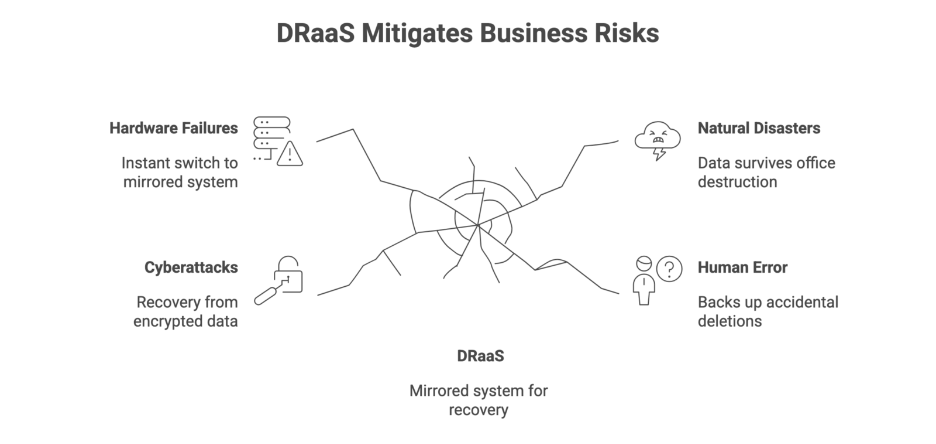
Let’s look at the risks DRaaS mitigates:
- Cyberattacks: Ransomware is on the rise, and once your data is encrypted, recovery is a nightmare— unless you have DRaaS.
- Hardware failures: Servers crash. Disks fail. DRaaS ensures you can switch to a mirrored system instantly.
- Natural disasters: Fires, floods, and earthquakes don’t care about your business continuity. DRaaS ensures your data survives even if your office doesn’t.
- Human error: Accidental deletions and misconfigurations are more common than you think—and DRaaS has your back.
In short, DRaaS isn’t just a “nice-to-have.” It’s a core component of any modern business strategy. Whether you’re a startup or an enterprise, losing access to your data and systems can devastate operations, reputation, and revenue. DRaaS protects against all of that.
Key Benefits of DRaaS
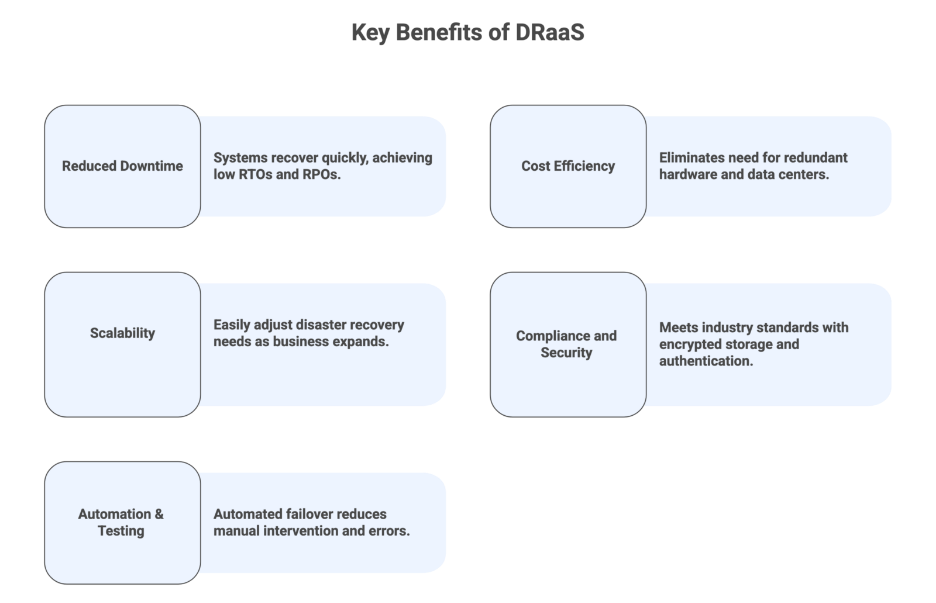
What makes DRaaS a smart investment? Let’s explore the top benefits:
Reduced Downtime
- With DRaaS, your systems can recover in minutes instead of hours or days.
- Achieve low Recovery Time Objectives (RTOs) and Recovery Point Objectives (RPOs).
Cost Efficiency
- No need for a second data center or redundant hardware.
- Pay-as-you-go pricing makes it accessible for businesses of all sizes.
Scalability
- Easily scale your disaster recovery needs as your business grows.
- Cloud infrastructure is elastic—expand or reduce usage on-demand.
Compliance and Security
- Meet industry standards like GDPR, HIPAA, and ISO.
- Get access to encrypted storage, multi-factor authentication, and audit trails.
Automation & Testing
- Automated failover and testing ensure everything works as expected.
- Reduce manual intervention and human error during critical moments.
With benefits like these, DRaaS isn’t just a backup plan — it’s a business continuity powerhouse.
DRaaS Deployment Models
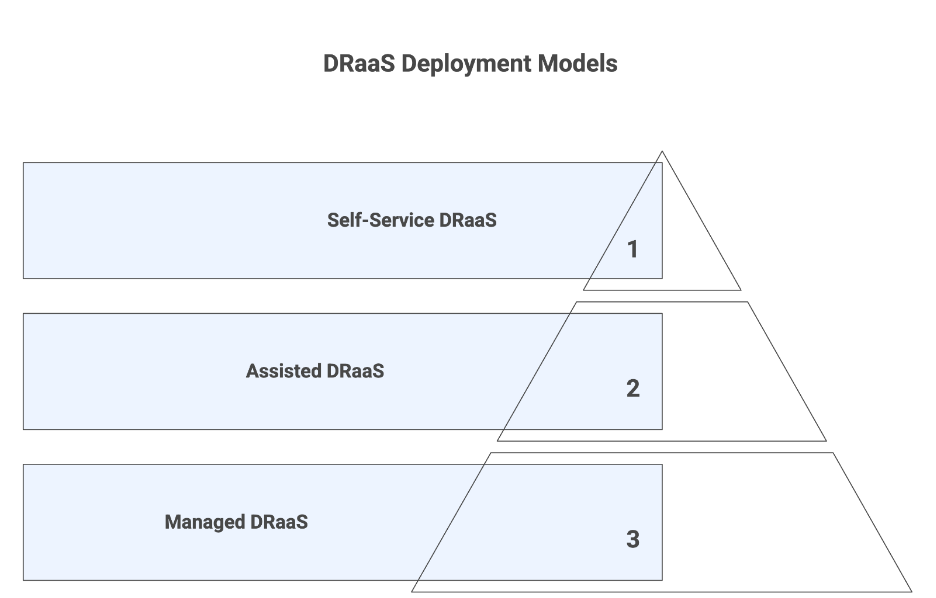
Not all DRaaS solutions are created equal. In fact, there are three main deployment models, each catering to different business needs and technical capabilities. Choosing the right model depends on your internal resources, level of control required, and how much you’re willing to manage versus outsource.
1. Managed DRaaS
This is a hands-off, fully outsourced model. Your provider handles everything—from setup to ongoing management, monitoring, failover, and testing.
Best for: Small to medium businesses without in-house disaster recovery expertise.
Pros:
- Minimal internal workload
- Provider’s experts manage compliance and recovery planning
- Rapid implementation
Cons:
- Less control over configurations
- Reliance on the provider’s infrastructure
2. Assisted DRaaS
Here, you collaborate with the provider. They handle the infrastructure, but your internal IT team is involved in configuration, testing, and failover plans.
Best for: Mid-sized organizations with an IT team but limited DR experience.
Pros:
- Balance between control and convenience
- Shared responsibility
- More customization
Cons:
- Requires internal effort and time
- Risk of miscommunication during a crisis
3. Self-Service DRaaS
In this model, you get access to the DRaaS platform and tools, but you’re responsible for managing everything: setup, monitoring, failover, and testing.
Best for: Enterprises with robust IT departments and DR specialists.
Pros:
- Full control
- Maximum customization
- Lower long-term costs
Cons:
- High learning curve
- Time-intensive
- You own the risk
Each deployment model has its merits. The right one depends on how much you want to outsource vs control, and how quickly you want to deploy.
Public Cloud vs Private Cloud in DRaaS
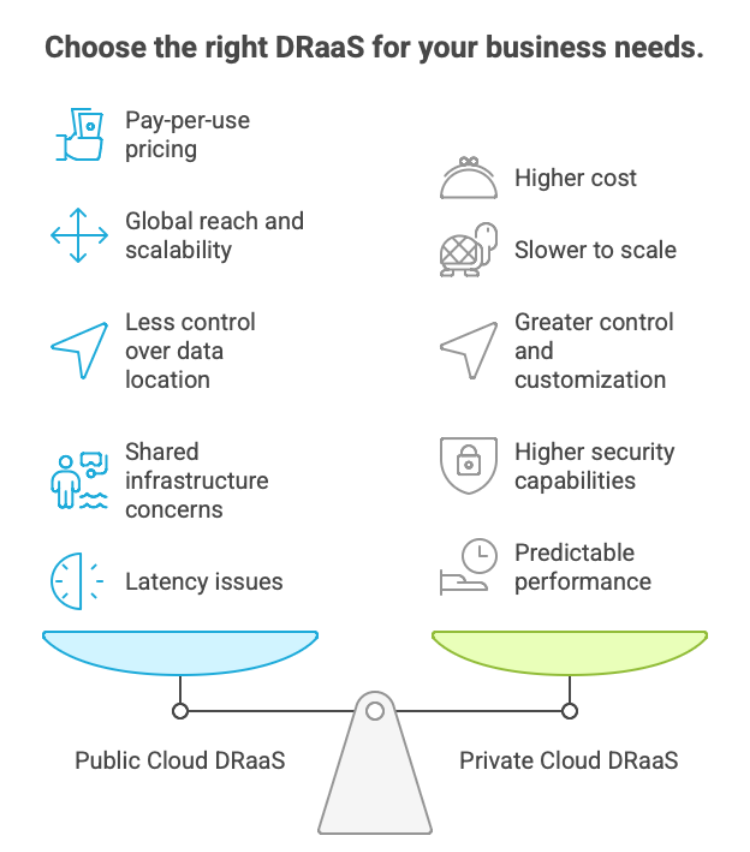
When it comes to where your disaster recovery environment lives, you’ve got two main choices: public cloud or private cloud. Each option has its pros and cons, and understanding them is crucial for making the right DRaaS decision.
☁️ Public Cloud DRaaS
This model uses infrastructure from providers like AWS, Microsoft Azure, or Google Cloud.
Pros:
- Global reach and scalability
- Pay-per-use pricing
- Easy integration with other cloud services
Cons:
- Shared infrastructure can raise compliance concerns
- Less control over data location
- Latency can be an issue, depending on the region
Best for: Startups and businesses that need flexible, affordable, and scalable recovery options.
🛡️ Private Cloud DRaaS
This option involves dedicated infrastructure — either hosted by the provider or co-located in your environment.
Pros:
- Greater control and customization
- Higher security and compliance capabilities
- Predictable performance
Cons:
- Higher cost
- Slower to scale
- More complex to manage
Best for: Highly regulated industries like finance and healthcare, or businesses that require stringent data sovereignty.
Quick Tip: Some providers, like Gart Solutions, offer hybrid DRaaS, giving you the best of both worlds — scalability of public cloud with the control of private cloud.
Gart helps you to avoid disaster recovery or support you when it happened. Contact Us.
Top Features to Look for in a DRaaS Provider
Choosing a DRaaS provider is a big decision. You’re trusting them with your business continuity, so it’s essential to look for key features that ensure reliability, performance, and support.
Here’s your DRaaS feature checklist:
1. RPO & RTO Guarantees
- Recovery Point Objective (RPO): How much data can you afford to lose?
- Recovery Time Objective (RTO): How quickly must your system be back online?
Good providers should define and meet tight RPOs and RTOs, backed by SLAs.
2. Automated Failover & Failback
- Instant failover during outages
- Seamless transition back to production environments after recovery
3. Regular Testing
- Built-in testing tools
- Scheduled or on-demand disaster recovery drills
- Test environments that don’t interrupt live systems
4. Security & Compliance
- End-to-end encryption
- Role-based access control
- Compliance with GDPR, HIPAA, ISO, and more
5. 24/7 Support
- Dedicated support teams available round the clock
- Fast response SLAs during incidents
- DR specialists to guide you through recovery
6. Scalability & Customization
- Easy to adapt as your business grows
- Custom policies and configurations for different workloads
Remember, not all DRaaS providers are equal. Look beyond the price and focus on these features to find a partner you can truly rely on.
Challenges of Implementing DRaaS
DRaaS sounds great—and it is—but that doesn’t mean it’s without challenges. Implementing DRaaS can be tricky if you’re not prepared. Knowing what to expect helps you dodge the common pitfalls.
1. Underestimating Complexity
Many assume DRaaS is plug-and-play. In reality, it requires planning:
- Mapping dependencies between systems
- Choosing the right replication strategy
- Deciding which apps get priority during recovery
2. Inadequate Testing
Failing to regularly test your disaster recovery plan is like having a fire extinguisher and never checking if it works.
Avoid this by:
- Scheduling frequent DR tests
- Documenting results and adjusting the plan
3. Lack of Internal Awareness
If your staff doesn’t know the plan, recovery will fail. Train your team, run drills, and make sure everyone knows their role during a disaster.
4. Hidden Costs
Some providers charge extra for failover, data egress, or support. Always ask about the full cost—don’t just go by the base price.
5. Vendor Lock-In
Migrating to another DRaaS provider later can be complex. Choose a provider with:
- Open standards
- Interoperability
- Clear exit strategies
Being aware of these challenges lets you build a robust and realistic DRaaS plan. Work with a provider that supports you during and before disasters.
Choosing the Right DRaaS Partner
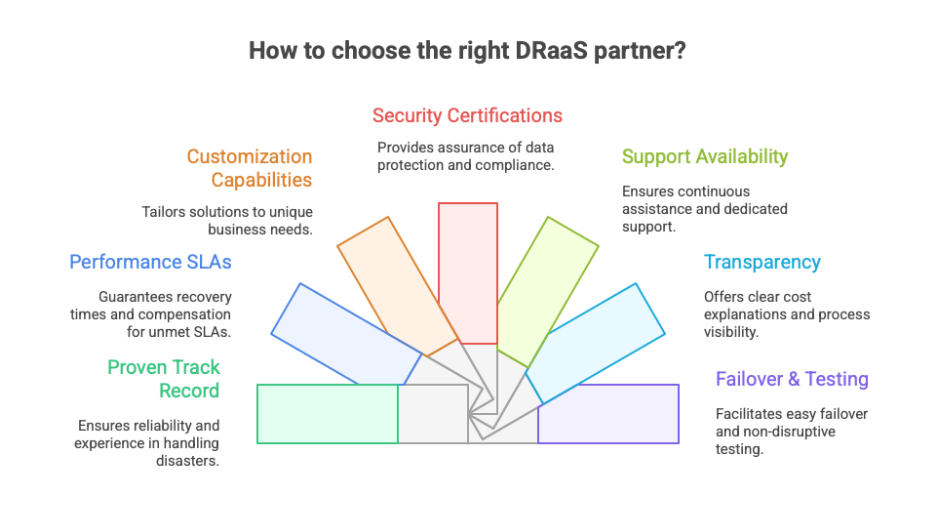
Picking the right DRaaS provider isn’t just about tech specs—it’s about trust, reliability, and long-term support. Your provider becomes your disaster recovery partner, so making the wrong choice can cost you far more than money.
Here’s a checklist to help you evaluate a potential DRaaS partner:
Proven Track Record
- Do they have real-world experience handling disasters?
- Can they share case studies or testimonials?
Performance SLAs
- What are their guaranteed RTOs and RPOs?
- Do they offer compensation if SLAs are not met?
Customization Capabilities
- Can they tailor the solution to your unique business needs?
- Do they offer hybrid, on-prem, or multi-cloud options?
Security Certifications
- Are they ISO 27001, SOC 2, GDPR, or HIPAA certified?
- What measures are in place for data encryption and access control?
Support Availability
- Is their support truly 24/7?
- Are you assigned a dedicated account manager or engineer?
Transparency
- Are all costs clearly explained?
- Do they provide visibility into the recovery process and analytics?
Failover & Testing Procedures
- How easy is it to initiate failover?
- Can you schedule non-disruptive DR tests?
When you’re evaluating providers like Gart Solutions, keep these criteria in mind. DRaaS isn’t just a product — it’s a long-term commitment. Make sure your provider treats it that way.
Gart Solutions DRaaS Offering
Now let’s get specific. Gart Solutions is quickly emerging as a leading player in the DRaaS space.
Here’s what makes Gart Solutions’ DRaaS stand out:
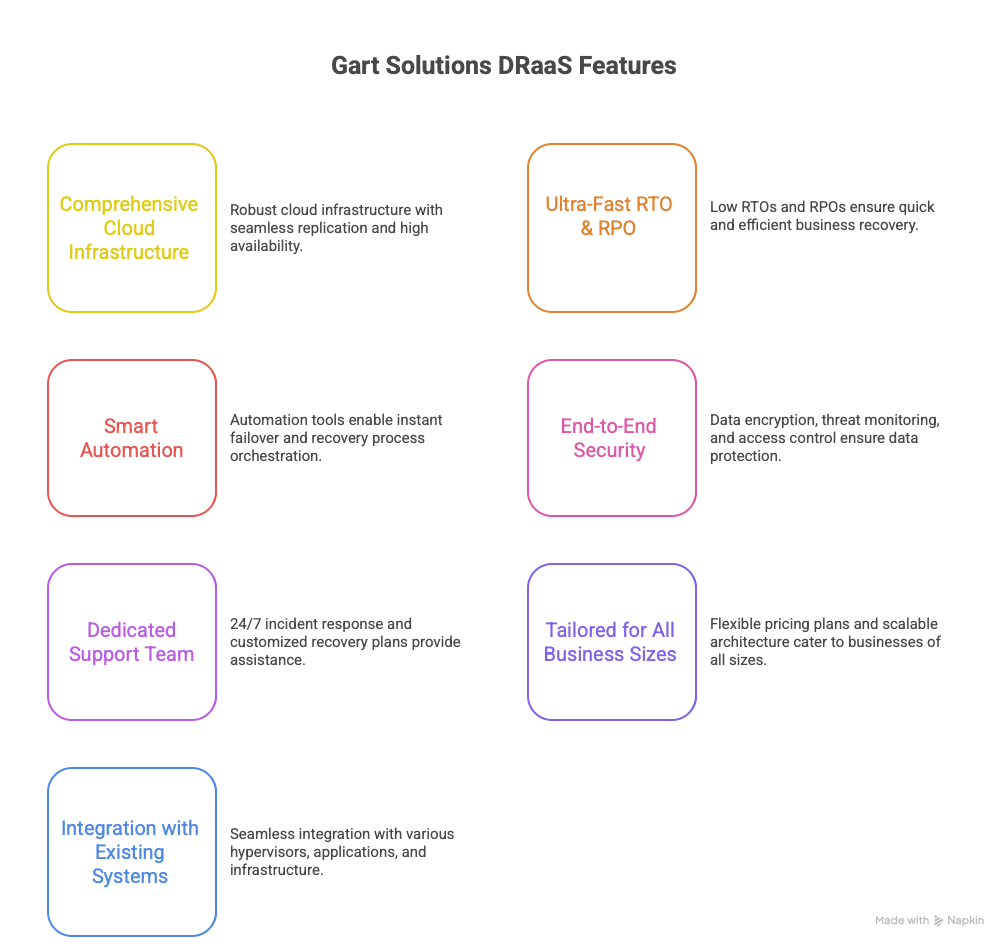
Comprehensive Cloud Infrastructure
Gart Solutions uses robust cloud infrastructure built with enterprise-grade virtualization, allowing for:
- Seamless replication of entire environments
- Cross-region disaster recovery support
- High availability zones
Ultra-Fast RTO & RPO
They deliver low RTOs and RPOs, meaning your business can recover quickly and efficiently. Whether you’re running VMs, databases, or ERP systems, recovery is just minutes away.
Smart Automation
Their DRaaS is powered by automation tools for:
- Instant failover
- Scheduled and on-demand testing
- Recovery process orchestration
End-to-End Security
- Data encryption at rest and in transit
- 24/7 threat monitoring
- Multi-factor authentication and granular access control
Dedicated Support Team
Gart Solutions doesn’t leave you hanging during an outage. Their support team is always ready to assist you:
- 24/7 incident response
- Customized recovery plans
- Ongoing consultation and testing
Tailored for All Business Sizes
Whether you’re a small business or a growing enterprise, they offer flexible pricing plans and scalable architecture so you’re never paying for more than you need.
Integration with Your Existing Systems
Gart Solutions’ DRaaS integrates seamlessly with:
- VMware, Hyper-V, and other hypervisors
- Microsoft 365, SQL, SAP
- Local backups and hybrid infrastructure
When disaster strikes, you need a partner, not just a provider — and Gart Solutions delivers on that promise.
Struggling with digital transformation? Get expert guidance and IT Consultancy for your project free of charge. “Quick wins” – guaranteed. Contact Us.
Case Studies: Success with Gart Solutions
Let’s put theory into practice. Here are a couple of real-world examples where Gart Solutions’ DRaaS saved the day.
🏥 Case Study 1: Healthcare Organization Avoids Data Loss During Ransomware Attack
A regional healthcare provider fell victim to a sophisticated ransomware attack. Their systems were locked down, and patient data was inaccessible.
With Gart Solutions DRaaS:
- Automated failover was initiated within 10 minutes
- Backup systems kicked in with only 15 minutes of data loss (RPO)
- The provider resumed normal operations within 2 hours
Impact: No patient data lost. Zero service disruption. No ransom paid.
🏪 Case Study 2: Retail Chain Recovers from Data Center Fire
A fast-growing retail chain experienced a fire at their primary data center. POS systems, inventory management, and eCommerce were all impacted.
Thanks to Gart Solutions:
- Cloud-hosted failover systems took over instantly
- Sales continued uninterrupted across locations and online
- Failback to new infrastructure was completed in under 48 hours
Impact: $1.2 million in potential losses avoided.
These real-life scenarios prove that DRaaS is more than a safety net — it’s business continuity in action, and Gart Solutions knows how to deliver it.
DRaaS for Different Industries
DRaaS isn’t one-size-fits-all. Different industries face different risks, regulations, and recovery needs. Let’s look at how Disaster Recovery as a Service is tailored to key sectors.
🏥 Healthcare
- Challenges: HIPAA compliance, patient data sensitivity, constant availability of systems.
- Why DRaaS is Critical: Any system downtime can delay care, impact patient outcomes, and breach compliance laws.
- Gart Solutions’ Role: Provides encrypted backups, compliant infrastructure, and rapid failover to keep EMRs, lab systems, and scheduling tools always accessible.
💰 Finance & Banking
- Challenges: Strict regulatory oversight, transactional integrity, customer trust.
- Why DRaaS is Critical: Data breaches or outages can result in financial losses and erode public trust.
- Gart Solutions’ Role: Ensures transactional data is preserved, provides real-time recovery, and meets compliance requirements like PCI DSS and SOX.
🛒 Retail & eCommerce
- Challenges: High-volume transactions, customer-facing applications, POS systems.
- Why DRaaS is Critical: Even seconds of downtime can cause cart abandonment and lost sales.
- Gart Solutions’ Role: Offers geo-redundant failover for omnichannel operations, so in-store and online systems remain live.
🏭 Manufacturing
- Challenges: Production line systems, supply chain integration, ERP uptime.
- Why DRaaS is Critical: Interruptions can halt entire production lines, causing massive revenue loss.
- Gart Solutions’ Role: Maintains system continuity and ensures production and logistics can continue, even during system failures.
🎓 Education
- Challenges: Data from students, staff, and research—often stored on aging infrastructure.
- Why DRaaS is Critical: Ensures learning management systems, grading tools, and communications remain accessible.
- Gart Solutions’ Role: Delivers cost-effective DRaaS that scales with semester demands and keeps operations running remotely.
No matter your industry, DRaaS ensures business continuity, data protection, and regulatory compliance — with the flexibility to adapt to your specific needs.
Future of DRaaS
Where is DRaaS heading next? Just like every other IT service, DRaaS is rapidly evolving—thanks to AI, automation, and edge computing.
AI-Driven Recovery
- Future DRaaS will predict failures before they happen using machine learning.
- AI will help in dynamically optimizing failover sequences and allocating resources efficiently.
Self-Healing Systems
- Automated scripts will not only detect failure but resolve it without human input.
- Expect DRaaS solutions that autonomously patch, reboot, or reroute around problems in real time.
Edge and Multi-Cloud DR
- With more systems running at the edge (think IoT), DRaaS will need to manage micro-failovers across multiple environments.
- Future platforms will offer seamless multi-cloud failover — not just backup to one cloud, but redundancy across AWS, Azure, Google Cloud, etc.
Hyper-Personalized Recovery Plans
- DRaaS providers will move toward business-specific DR playbooks, not just one-size-fits-all templates.
- These plans will include priority-based recovery tiers, enabling faster recovery of mission-critical apps.
Zero Trust Architecture Integration
- DRaaS will be a key player in zero trust security models.
- Integrated identity and access control policies will be built into disaster recovery workflows.
DRaaS is no longer just about backups. It’s about resilience, adaptability, and intelligent business continuity. And the future is already knocking.
Conclusion
Disaster Recovery as a Service (DRaaS) has evolved from a “nice-to-have” insurance policy into a mission-critical business function. In a world where systems need to be online 24/7, customers expect uninterrupted service, and cyber threats loom around every corner — DRaaS is your safety net, your plan B, and your superpower.
From reducing downtime and protecting data to meeting compliance requirements and enabling rapid recovery, DRaaS offers a scalable, flexible, and cost-effective way to secure your digital backbone. But like any powerful tool, its success lies in choosing the right provider.
Gart Solutions leads the way with industry-specific offerings, AI-powered automation, 24/7 expert support, and rock-solid infrastructure. Whether you’re running a hospital, bank, retail chain, or tech startup, they’ve got your back when disaster strikes.
Don’t wait for a crisis to discover the gaps in your disaster recovery plan. Get proactive. Invest in DRaaS today — and sleep better knowing your business is always protected, no matter what.
See how we can help to overcome your challenges