The global financial services sector is at an inflection point. For decades, traditional banks have operated on aging mainframe infrastructure that was designed for a batch-processing world — a world without real-time payments, open APIs, or autonomous AI agents. Today, approximately 43% of financial institutions still run core banking systems built more than 20 years ago. These systems, largely written in COBOL and similar procedural languages, have become the single greatest constraint on innovation in banking.
This article provides a comprehensive look at core banking modernization — the strategic, technical, and organizational journey from monolithic legacy platforms to composable, cloud-native, AI-ready financial ecosystems. Whether you are a CIO evaluating migration strategies or a product leader planning a fintech digital transformation roadmap, this guide covers everything you need to make informed, high-stakes decisions.
The economic burden of legacy infrastructure
The most persistent myth in banking IT is that maintaining a legacy system is cheaper than replacing it. In reality, financial institutions consistently underestimate the true total cost of ownership of legacy systems by 70 to 80%. When compliance overhead, integration workarounds, and innovation opportunity cost are factored in, actual IT expenditure runs 3.4 times higher than initially budgeted.
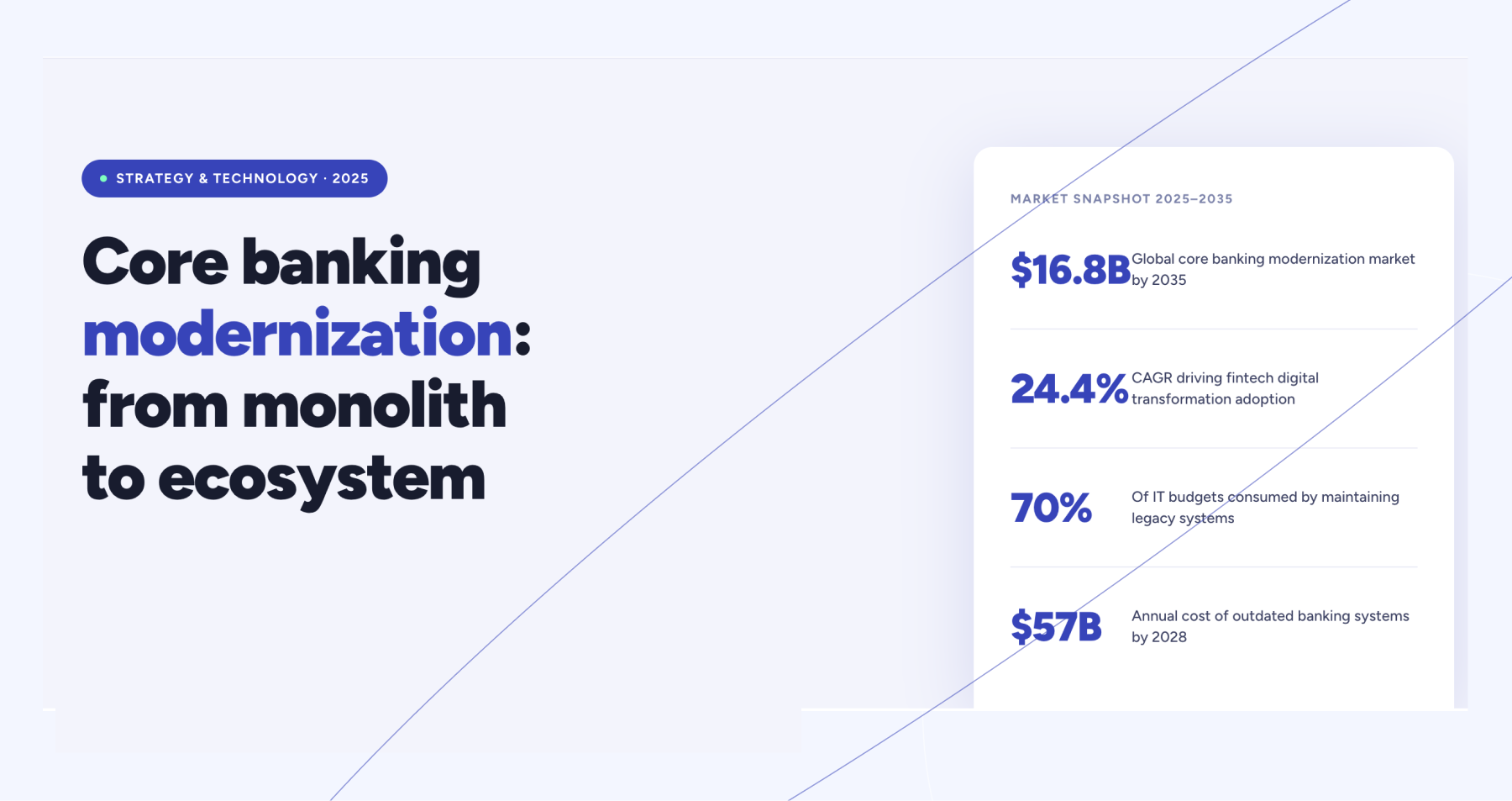
Of IT budgets spent maintaining legacy systems rather than building new products
More spent on compliance for legacy systems vs. modern alternatives
Cost of poor software quality in the US alone—with $1.52T in accumulated technical debt
This is the compounding nature of technical debt in banking legacy system modernization. Every year a bank delays, the workarounds grow more complex, the specialist consultants grow more expensive, and the competitive gap versus digital-native challengers widens. The market has a term for this: the “Innovation Tax.” For every dollar spent on IT, less than 30 cents reaches new product development.
The core banking modernization market is projected to grow from USD 1.9 billion in 2025 to USD 16.8 billion by 2035, representing a CAGR of 24.4%. This is not a technology trend — it is a survival imperative for traditional financial institutions facing competition from cloud-native challengers.
The hidden costs that inflate legacy TCO include: custom coding for minor product updates, exorbitant consulting fees for COBOL specialists, extended QA and testing cycles on unstable codebases, and the maintenance of redundant parallel systems following mergers and acquisitions. Each of these cost drivers compounds the others, creating a system that consumes budget without generating strategic value.
The COBOL talent crisis and operational resilience
One of the least discussed — yet most urgent — aspects of legacy modernization in fintech is the impending collapse of the specialist workforce that keeps legacy systems running. An estimated 220 billion lines of COBOL code remain in active production globally. These systems process 95% of ATM swipes and the majority of daily financial transactions worldwide. The workforce keeping them alive is rapidly disappearing.
The average COBOL programmer is 55 years old. Approximately 10% of this workforce retires every year, with no meaningful pipeline of replacement talent.
60% of organizations using COBOL cite finding skilled developers as their primary operational challenge, leading to delayed security patches and extended system downtime.
“Black box” logic — business rules embedded in decades-old code that no current employee fully understands — poses a systemic risk to operational resilience.
This is not a distant risk. It is happening now. Banks that have not initiated structured knowledge-capture and code-analysis programs are accumulating operational fragility with every retirement notice. The question is not if your COBOL estate will become unmanageable, but when.
Modernization strategies: a practical comparison
There is no single correct approach to core banking modernization. The right strategy depends on institutional size, risk appetite, regulatory context, and existing technology investment. Below, we outline the three dominant approaches and their respective trade-offs.
Rip and replace — the high-risk path
The “Big Bang” or “Rip and Replace” strategy involves decommissioning the legacy system and cutting over to a new platform in a single compressed timeframe. While it promises the fastest path to a clean architecture, its failure rate is significant. If the new system fails at the point of cutover, the bank goes offline entirely — as witnessed in the TSB disaster of 2018, which cost the institution over £600 million in direct and remediation costs.
Rip & Replace
- High-variance, binary outcome: Success is not guaranteed.
- Catastrophic failure potential: Risk of total system blackout if cutover fails.
- Massive upfront capital: Requires significant investment before value is realized.
- Rules lost in translation: Legacy business logic often fails to migrate correctly.
- Governance complexity: High-stakes Board-level oversight required.
- Regulatory misalignment: Approval timelines rarely match the aggressive cutover.
Phased Modernization
- Controlled progress: Reversible steps reduce systemic danger.
- Parallel processing: Legacy systems run alongside new components.
- Incremental migration: Business logic is preserved and moved slowly.
- Safe rollbacks: Revert any stage without a full institution outage.
- Continuous delivery: Unlock new capabilities every few months, not years.
- Clear audit trails: Easier regulatory engagement via step-by-step validation.
Automated refactoring — preserving intellectual property
Automated refactoring uses specialized tooling to convert legacy code — typically COBOL — into modern languages such as Java or C#. Critically, this method preserves the unique business logic that has been refined over decades. Rather than rebuilding rules from scratch (and inevitably missing edge cases discovered only after the fact), refactoring transforms the codebase while retaining its institutional knowledge, moving the application to a cloud-native, microservices-compatible foundation.
Hollowing out the core — the pragmatic middle path
A growing approach among regional and community banks is “hollowing out the core.” Rather than replacing the legacy system entirely, this strategy decouples critical real-time services — transaction authorization, balance management, payment processing — and moves them to a modern cloud-native layer. A “Digital Twin” high-performance ledger handles real-time operations, while the legacy core continues performing non-real-time functions such as regulatory reporting and historical statement management.
Key benefit: By moving transaction authorization to a Digital Twin, banks can participate in instant payment networks like FedNow and RTP even when the legacy core is offline for nightly batch processing — unlocking real-time capability without a complete replacement project.
Composable banking and the BIAN standard
The end-state of fintech digital transformation in core banking is not a new monolith — it is a composable architecture. Rather than replacing one rigid system with another, composable banking assembles best-of-breed capability blocks, interconnected via standardized APIs, that can be independently updated, scaled, or replaced without disrupting the whole.
The Banking Industry Architecture Network (BIAN) provides the industry-standard framework for this approach, offering a common service landscape and shared vocabulary that dramatically reduces integration complexity. BIAN-aligned architectures offer three compounding benefits: they reveal redundancies in existing systems that drive consolidation savings; they enable a “change-the-bank” rather than just “run-the-bank” mentality; and they provide the clean integration surface required for embedding advanced AI and autonomous agents.
| BIAN Domain | Strategic Outcome | Operational Benefit |
|---|---|---|
| KYC & Onboarding | Rationalized onboarding systems | Faster customer acquisition |
| Payments Processing | Real-time event architecture | Reduced settlement latency |
| Credit Decisioning | Continuous compliance layer | Improved risk scoring |
| Identity Management | Trust as a Service model | Monetizable API endpoints |
| Data & Analytics | Unified data fabric | AI-ready data foundation |
BIAN-aligned APIs are evolving from internal integration tools into externally exposed capability endpoints — the foundation of embedded finance and Banking-as-a-Service business models. Institutions that align to BIAN now are building the commercial infrastructure of the next decade.
AI as a transformation catalyst — from generative to agentic
The role of artificial intelligence in core banking modernization is dual: it accelerates the transformation process itself, and it defines the target state that transformation is building toward. Both dimensions deserve serious attention.
AI accelerating migration
CIOs and engineering leaders are increasingly deploying generative AI to analyze legacy codebases, extract embedded business rules, and automate the conversion of procedural COBOL logic into modern architectures. This approach directly addresses the highest-risk phase of any banking legacy system modernization: the knowledge-capture and code-translation work that, done manually, is slow, expensive, and error-prone. AI-driven development reduces manual effort and dramatically improves migration accuracy.
Agentic AI in core banking modernization
The shift from generative AI to agentic AI represents a fundamental change in how banking operations are conceived. While 2024 and early 2025 were characterized by chatbots and text summarization, 2026 marks the year of autonomous AI agents capable of executing complex multi-step workflows without continuous human oversight.
McKinsey estimates that banks leveraging AI at scale can achieve a 30 to 50% acceleration in development timelines and unlock up to $1 trillion in annual value globally.
In the context of core banking, agentic AI systems can autonomously reconcile ledgers, pre-underwrite loans by reading financial statements in real time, detect fraud in instant payment flows, and prioritize relationship management at scale. However, all of these capabilities depend on one prerequisite: a clean, integrated, real-time data foundation. AI strategy is only as good as the underlying data architecture — and this is precisely what legacy modernization enables.
| AI Capability Level | Application in Banking | Strategic Impact |
|---|---|---|
| Traditional ML | Fraud pattern detection and transaction monitoring | Risk reduction |
| Generative AI | Automated code refactoring and legacy logic extraction | Modernization speed |
| Agentic AI | Autonomous loan underwriting and workflow execution | Operational efficiency |
| Multi-agent Mesh | Cross-department collaboration and autonomous orchestration | Enterprise agility |
Managing distributed transactions: consistency vs. scalability
One of the most technically challenging aspects of legacy modernization in banking is the transition from the atomic consistency of monolithic databases to the distributed nature of microservices. In a legacy mainframe, a transaction either commits everywhere or rolls back everywhere — an elegantly simple guarantee. In a distributed cloud architecture, achieving the same guarantee requires deliberate architectural patterns.
Two-Phase Commit (2PC)
The 2PC protocol ensures strong, immediate consistency across multiple nodes through a coordinated “prepare” and “commit” sequence. It guarantees that all systems reflect the same state — essential for core ledger operations such as money transfers where immediate consistency is non-negotiable. The trade-off is latency, a single point of failure at the coordinator node, and data locks that can impede throughput under high volume.
The Saga Pattern
The Saga pattern decomposes a distributed transaction into a sequence of smaller, independent local transactions. Consistency is maintained through eventual consistency and compensating transactions — reversal actions triggered if any step in the sequence fails. Sagas are more scalable and resilient, making them the preferred choice for long-running workflows in cloud-native environments: loan origination, customer onboarding, complex payment routing.
| Feature | Two-Phase Commit (2PC) | Saga Pattern |
|---|---|---|
| Consistency model | Strict / immediate | Eventual |
| Transaction type | Single global transaction | Sequence of local transactions |
| Failure handling | Global rollback | Compensating transactions |
| Latency | Higher (coordination overhead) | Lower (local execution) |
| Scalability | Limited (global locks) | High (loosely coupled) |
| Best suited for | Core ledger Fund transfers | Onboarding Credit Workflows |
The strategic decision is not either/or. Well-designed modern core banking architectures apply 2PC for the immutable ledger layer where immediate consistency is the gold standard, and Saga patterns for auxiliary services where agility and scale matter more than synchronous guarantees.
Regulatory evolution: FiDA, PSD3, and the BaaS reckoning
Core banking modernization is not only a technology imperative — it is increasingly a regulatory mandate. The European and US regulatory environments are actively reshaping what modern banking infrastructure must be capable of, at a speed that legacy systems cannot match.
FiDA and the open finance transition
The EU’s Financial Data Access (FiDA) regulation, expected to become law in 2026, marks the formal transition from Open Banking to Open Finance. FiDA expands consent-based data sharing to cover mortgages, loans, investments, insurance, and pensions — not just payment accounts. For established banks, this means building secure, standardized data-sharing infrastructure capable of delivering complex financial histories to third parties in seconds, with granular customer consent controls centralized in a single dashboard.
PSD3 and fraud prevention responsibility
Parallel to FiDA, PSD3 and the Payment Services Regulation (PSR) harmonize EU payment services and shift liability for financial losses onto payment service providers that fail to implement adequate fraud prevention. This regulatory shift increases pressure on banks to modernize core systems to support real-time transaction monitoring and stronger multi-factor customer authentication — capabilities that most legacy platforms cannot deliver natively.
| Regulation | Primary Focus | Timeline |
|---|---|---|
| FiDA | Data access and open finance framework | 2026 / 2027 |
| PSD3 / PSR | Fraud prevention and payments harmonization | 2026 |
| DORA | Digital operational resilience — increased audit frequency | Active — 2026 Audits |
| EU AI Act | Algorithmic transparency and risk-based AI governance | 2025 / 2026 |
The US BaaS regulatory reckoning
In the United States, 2024 and 2025 have seen a significant regulatory crackdown on the Sponsor Bank model underpinning Banking-as-a-Service. Federal agencies including the OCC and FDIC have issued consent orders to multiple banks, forcing them to substantially increase oversight of their fintech partners. The lesson is clear: BaaS is not a simple deposit-gathering product but a complex operational model requiring deep investment in integrated governance, third-party risk management, and real-time monitoring. Going into 2026, compliance is a competitive product feature — not just a back-office burden.
Case studies: the anatomy of failure and success
The disparity between transformations that succeed and those that fail is rarely technical at its root. It is almost always a function of governance, testing rigor, and the willingness to let technical readiness — not predetermined deadlines — drive the cutover decision.
- 5 million customers migrated over a single weekend.
- 1.9 million customers locked out of accounts.
- Mortgage accounts vanished; funds appeared in wrong accounts.
- £613M total cost: Includes migration, remediation, and fines.
- System went live with over 4,400 open defects.
- Primary Failure: Timeline driven by business deadline, not technical readiness.
- Phased strategy: Replaced monolith incrementally with a native cloud core.
- 50% cost reduction: Lowered cost-to-income ratio for digital customers.
- AI deployment accelerated from 18 months to under 5 months.
- Ranked Best Digital Bank globally multiple years running.
The DBS and HSBC cases share a common thread: transformation was treated as an organizational capability-building exercise, not a one-time project. Leadership invested in data infrastructure, engineering culture, and modular architecture before attempting to harvest AI-driven outcomes — and the results compounded over years, not quarters.
Modern core banking providers: choosing the right platform
The provider landscape for core banking modernization has matured considerably over the past five years. The choice of platform is now among the most consequential strategic decisions a bank can make — and the right answer varies significantly by institution size, geography, and ambition.
| Provider & HQ | Target Market | Key Differentiation |
|---|---|---|
|
Temenos
Switzerland |
Global Tier 1 & 2 banks | Composable banking cloud with deep global functional richness. |
|
Mambu
Germany |
Neobanks & fintechs | Pure SaaS / composable structure for rapid market entry. |
|
Thought Machine
UK |
Tier 1 retail banks | Cloud-native / smart contracts for infinite product flexibility. |
|
10x Banking
UK |
Tier 1 & global banks | Cloud-native core with AI-driven migration tooling. |
|
Finxact
US |
Community & regional | US-localized cloud core tailored for American regulatory frameworks. |
|
Fiserv / Jack Henry
US |
Community banks & CUs | Massive US market share and integrated TCO ecosystem. |
Tier 1 banks typically prioritize migration complexity management and global regulatory compliance, gravitating toward platforms like Thought Machine or 10x Banking for their ability to handle the transformation of aging mainframes. Community and regional banks focus on total cost of ownership and API flexibility, often choosing Finxact or Jack Henry to ensure open banking compatibility with fintech partners. The platform decision should always follow the architecture decision — not precede it.
The future: banking in 2030 and beyond
By 2030, the concept of a core banking system will have evolved from a monolithic booking engine into a distributed, orchestrating platform. The most significant shift will not be technical — it will be relational. Future banking infrastructure will move away from user-facing portals toward autonomous protocols that enable secure, verified interaction between AI agents.
In this agent-to-agent economy, a customer’s personal AI might negotiate mortgage options or dynamically adjust investment allocations directly with a bank’s AI system — reducing the need for direct human interaction at the transactional layer while elevating the human role to relationship and exception management. Gartner predicts that by 2030, agentic AI will make at least 15% of daily decisions autonomously, fundamentally flattening organizational structures and redefining the role of middle management in financial services.
- Post-quantum cryptography (PQC): Banks must begin implementing quantum-resilient encryption now. The threat timeline from quantum decryption is measured in years, not decades, and migration of cryptographic standards at scale requires significant lead time.
- Digital assets & CBDCs: Bitcoin, stablecoins, and Central Bank Digital Currencies are establishing themselves as permanent features of future balance sheets, requiring new valuation models and direct integration into core banking ledgers.
- Banking as mentorship: Automation and real-time data analytics will enable banks to monitor customer financial health continuously, offering proactive advice and personalized interventions — evolving from transactional processors to valued financial partners.
By 2028, outdated banking systems are projected to cost global banks over $57 billion annually. The institutions that begin their core banking modernization journey now — systematically, with a clear data and architecture strategy — will define the competitive landscape of the next decade. Those that wait will be paying for the privilege of being disrupted.
Key takeaways: core banking modernization
- Avoid Big Bang: Adopt incremental, sidecar, or “hollow out the core” strategies. The risk profile of full cutover migrations is not acceptable for most institutions.
- Data first: AI strategy is only as good as the data foundation. Prioritize clean, real-time, integrated data architecture before launching AI initiatives.
- Embrace BIAN and MACH principles: Standardized, composable architecture avoids vendor lock-in and creates the integration surface for future capabilities.
- Treat compliance as product: Particularly in BaaS and open finance contexts, regulatory readiness is a competitive differentiator, not just a cost center.
- Start the COBOL clock: Knowledge-capture and codebase analysis should begin now, before the specialist workforce shrinks further and institutional knowledge is lost.
See how we can help to overcome your challenges