Why Legacy System Modernization Audits Are No Longer Optional
Legacy systems have a funny way of overstaying their welcome. They start as reliable workhorses, quietly supporting operations for years, sometimes decades. But over time, what once felt stable begins to feel fragile. Releases slow down. Bugs take longer to fix. Costs creep up without clear explanations. And suddenly, innovation feels like trying to renovate a house while living in it — blindfolded.
This is where a Legacy System Modernization Audit stops being a “nice-to-have” and becomes a strategic necessity.
A modernization audit is not about ripping everything out and starting from scratch. It’s about clarity before commitment. The goal is to transform outdated systems from business liabilities into competitive advantages through structured assessment, risk evaluation, and ROI-driven recommendations .
At Gart Solutions, modernization audits act as the foundation layer for broader initiatives like IT modernization, legacy application modernization, and IT infrastructure modernization. Without this foundation, companies often modernize blindly — overspending, under-delivering, or worse, disrupting core business operations.
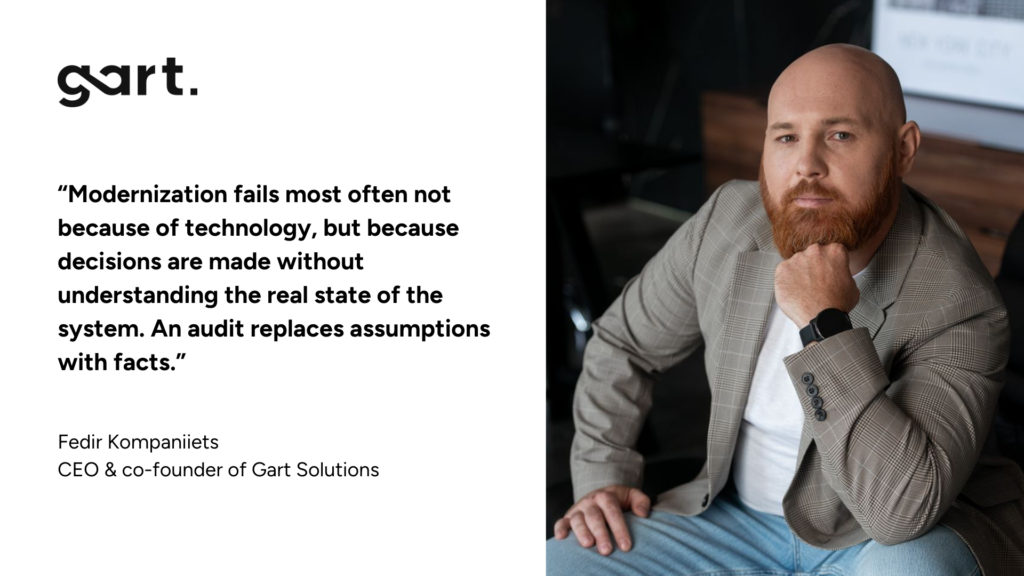
As Fedir Kompaniiets, CEO of Gart Solutions, puts it:
“Modernization fails most often not because of technology, but because decisions are made without understanding the real state of the system. An audit replaces assumptions with facts.”
This article explores what a legacy system modernization audit really is, why it matters, how it works, and how businesses use it to unlock predictable, low-risk modernization outcomes.
Understanding Legacy Systems in Modern Enterprises
Legacy systems aren’t always ancient. In fact, some of the most problematic systems are less than ten years old. What makes a system “legacy” isn’t its age — it’s its ability (or inability) to support current and future business needs.
What Defines a Legacy System Today
A system becomes legacy when:
It relies on outdated or unsupported technologies
Only a few people understand how it works
Changes require disproportionate effort
Maintenance consumes most of the IT budget
Security patches and compliance updates lag behind
Many organizations still run critical workloads on stacks like old Java versions, monolithic architectures, or tightly coupled on-premise infrastructure. These systems may function, but they actively resist growth.
The Illusion of “It Still Works”
One of the biggest misconceptions is that if a system works, it doesn’t need attention. In reality, legacy systems often:
Mask performance bottlenecks
Accumulate technical debt silently
Introduce hidden operational risks
The audit guide highlights that system failures in legacy environments are often hard to diagnose and expensive to fix . That’s not a technology issue — it’s a visibility issue.
The Hidden Cost of Technical Comfort Zones
Teams grow comfortable with what they know. But comfort comes at a cost:
Slower onboarding for new developers
Reduced agility in launching new features
Increased dependency on specific individuals
A legacy system modernization audit shines a light on these blind spots, replacing gut feelings with measurable insights.
What Is a Legacy System Modernization Audit?
A Legacy System Modernization Audit is a structured, end-to-end assessment designed to evaluate how well an existing system supports business goals, technical sustainability, security, and financial efficiency.
Audit vs. Full Modernization
An audit is not modernization itself. It’s the decision engine behind modernization.
Instead of asking, “Should we modernize?”, the audit answers:
What should be modernized?
Why should it be modernized?
When is the right time?
How much value will it create?
This approach drastically reduces risk compared to jumping straight into large-scale transformation projects.
Why an Audit Is the Safest First Step
According to the assessment guide, Gart Solutions’ audit examines six critical dimensions — business value, technical health, security, functionality, operational risk, and cost. This 360-degree view ensures that modernization decisions are grounded in reality, not trends.
Strategic Outcomes vs. Tactical Fixes
Without an audit, teams often:
Over-modernize low-impact areas
Underestimate integration complexity
Miss quick wins that deliver fast ROI
An audit prioritizes actions based on impact, effort, and risk, creating a roadmap that balances ambition with pragmatism.
Who Needs a Legacy System Modernization Audit the Most
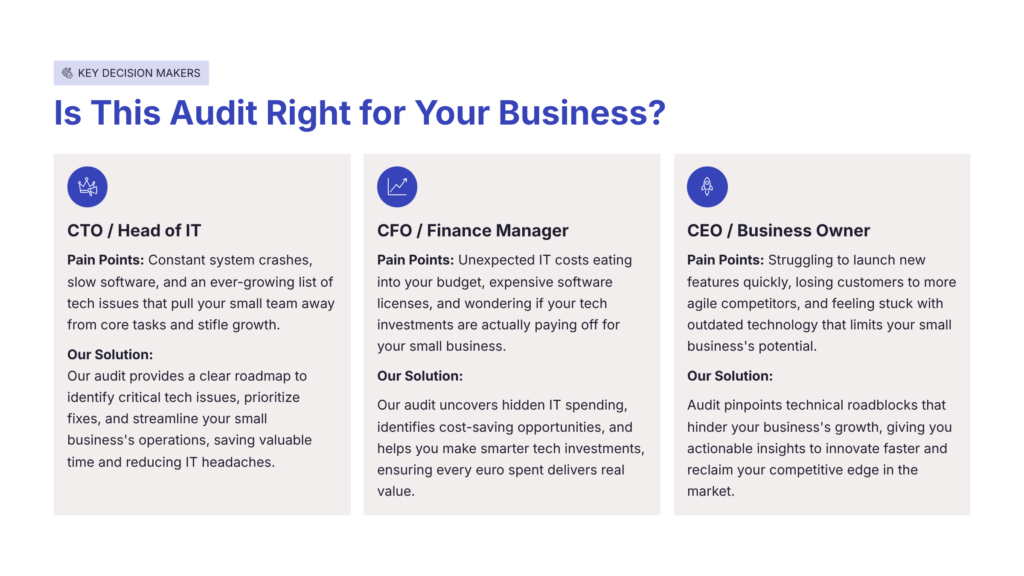
Legacy system challenges affect every role differently. That’s why the audit is designed to speak the language of technical leaders, business owners, and finance teams alike.
1/ CTOs and Heads of IT
For technical leaders, legacy systems mean:
Constant firefighting
Growing backlogs
Limited time for innovation
The audit identifies critical technical debt, outdated dependencies, and architectural constraints that slow teams down, providing a clear prioritization framework.
2/ CEOs and Business Owners
From a leadership perspective, legacy systems often:
Delay product launches
Limit scalability
Weaken competitive positioning
The audit connects technical realities directly to business outcomes, helping executives understand how technology choices impact growth and market agility.
3/ CFOs and Finance Leaders
For finance teams, the biggest frustration is uncertainty:
Unpredictable IT costs
Rising maintenance expenses
Unclear ROI on technology investments
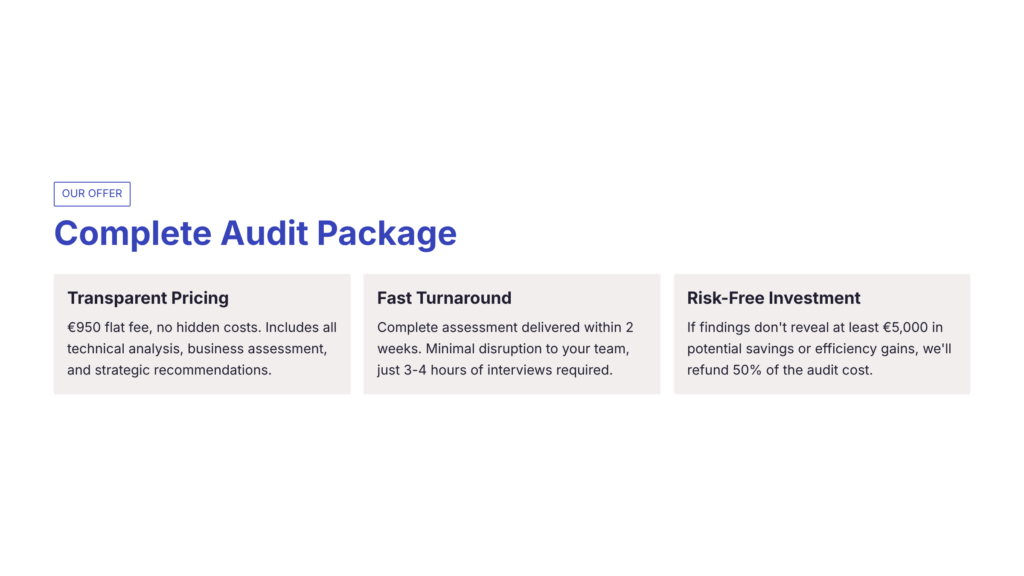
A modernization audit uncovers hidden spending, compares maintenance vs. modernization costs, and quantifies savings opportunities — often revealing at least €5,000 in potential gains, as outlined in the offer section.
Key Business Risks of Skipping a Legacy System Modernization Audit
Skipping a legacy system modernization audit may seem like a time-saving decision, but in reality, it often creates a slow-burning risk that compounds over time. Many organizations only realize the true cost of legacy systems when something breaks — production downtime, security incidents, or missed market opportunities. By then, the damage is already done.
Escalating Maintenance Costs That Drain Innovation Budgets
One of the most common patterns seen in legacy-heavy organizations is budget imbalance. A disproportionate share of IT spending goes toward:
Keeping outdated systems alive
Paying for extended support contracts
Fixing recurring issues instead of building new capabilities
The assessment guide explicitly highlights this issue, noting that when most of the IT budget goes to maintenance rather than innovation, it’s a clear indicator that modernization ROI is being delayed unnecessarily. Without an audit, these costs remain fragmented across teams and vendors, making them difficult to quantify or challenge.
Security and Compliance Exposure
Legacy systems often rely on outdated libraries, unsupported frameworks, or undocumented integrations. This creates invisible security gaps that are easy to exploit and hard to fix quickly.
The Security Audit component of the modernization assessment focuses on:
These risks are rarely isolated — they tend to cascade across interconnected systems. An audit surfaces these risks early, before they turn into incidents with legal or reputational consequences.
Innovation Paralysis and Competitive Decline
Perhaps the most dangerous risk isn’t technical at all—it’s strategic. When systems are hard to change, businesses stop experimenting. New ideas die in planning meetings because implementation feels “too risky.”
As Fedir Kompaniiets explains:
“Legacy systems don’t just slow development — they slow decision-making. When every change feels expensive, companies stop asking bold questions.”
A modernization audit breaks this paralysis by showing where change is safe, where it’s urgent, and where it delivers immediate value.
Core Components of a Legacy System Modernization Audit
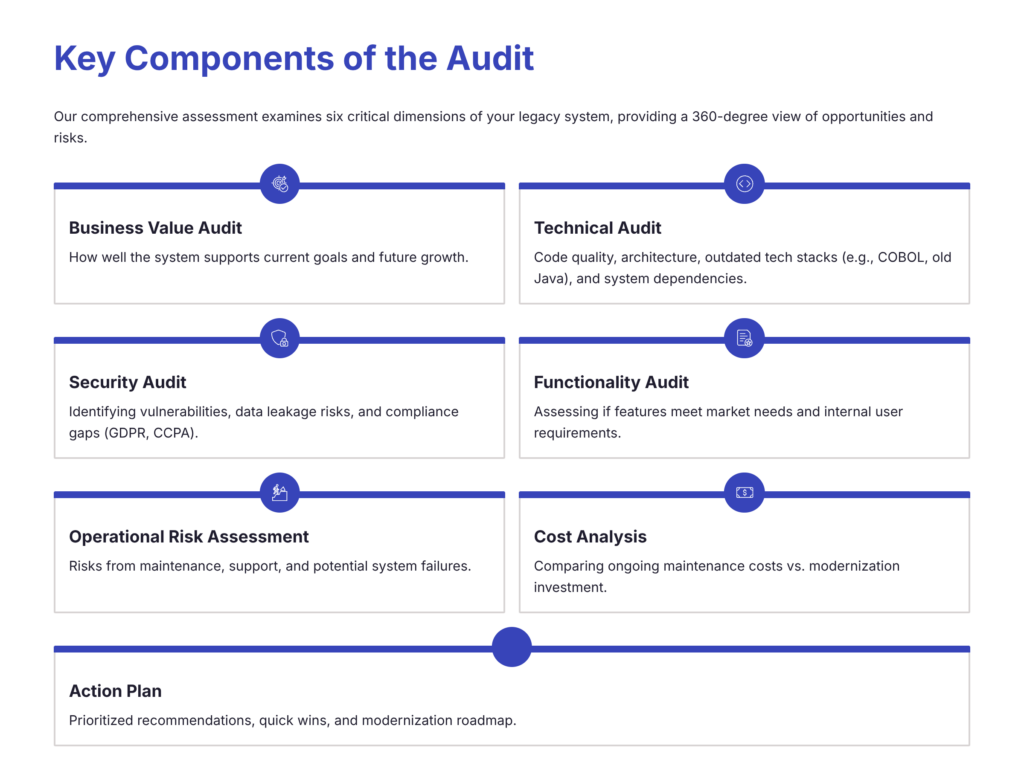
A legacy system modernization audit isn’t a surface-level review. It’s a deep, structured assessment designed to uncover both obvious and hidden issues across technical and business dimensions.
According to the Assessment Guide, Gart Solutions evaluates six critical components, providing a complete picture of risks, opportunities, and modernization paths.
Business Value Assessment
This component answers a deceptively simple question: Is the system still aligned with the business?
The audit evaluates:
How well the system supports current business goals
Whether it enables or blocks future growth
Alignment with product, market, and customer expectations
Often, systems that are technically “fine” fail this test because business priorities have evolved while the software has not.
Technical Architecture and Code Audit
This is where technical reality meets documentation — or the lack of it.
The technical audit includes:
Code quality evaluation
Architecture review
Identification of outdated technologies (e.g., legacy Java, COBOL)
Dependency mapping across systems and third-party tools
The result is a clear understanding of technical debt, not as an abstract concept, but as actionable data.
Security and Compliance Review
Security audits focus on:
Vulnerability exposure
Access control weaknesses
Compliance gaps with regulations like GDPR or CCPA
Legacy systems are often compliant “by accident” rather than by design. The audit identifies where that luck may run out.
Functionality and User Fit Evaluation
This component assesses whether existing features still:
Meet internal user needs
Align with market expectations
Support efficient workflows
Many legacy systems are feature-rich but value-poor, overloaded with functionality that no longer matters.
Operational Risk Assessment
Operational risks include:
High dependency on specific individuals
Lack of documentation
Fragile deployment processes
Long recovery times after failures
The audit identifies critical failure points that pose immediate business risk.
Cost and ROI Analysis
Finally, the audit compares:
Current maintenance costs
Projected modernization investment
Expected savings and efficiency gains
This financial clarity turns modernization from a cost center discussion into a value creation conversation.
Technical Audit Deep Dive: What Really Gets Assessed
The technical audit is often the most eye-opening part of the entire process. It replaces assumptions like “the system is complex” with concrete evidence of why it’s complex — and what to do about it.
Tech Stack Review
The audit begins with a complete inventory of:
Programming languages
Frameworks
Libraries
Infrastructure components
Third-party integrations
Outdated or unsupported components are flagged immediately, especially those that pose scalability or security risks.
Dependency Mapping
Legacy systems rarely exist in isolation. Over time, they accumulate dependencies that:
Are poorly documented
Exist only in people’s heads
Break unexpectedly during updates
Dependency mapping visualizes these relationships, helping teams understand blast radius before making changes.
Code Quality and Technical Debt Assessment
This step evaluates:
Code maintainability
Test coverage
Duplication
Complexity hotspots
Instead of labeling everything as “bad code,” the audit distinguishes between acceptable legacy patterns and high-risk technical debt that must be addressed first.
Critical Failure Point Identification
The audit highlights areas where:
A single failure could halt operations
Recovery times are excessive
Monitoring and observability are insufficient
These insights often become immediate action items, even before full modernization begins.
Business and Financial Analysis: Turning Technology Into Numbers
Technical insights alone don’t drive executive decisions. That’s why the modernization audit places heavy emphasis on translating system health into financial impact.
Cost Breakdown and Hidden Spend
The audit compares:
Ongoing maintenance costs
Licensing fees
Infrastructure expenses
Support and downtime costs
According to the guide, many organizations underestimate total system cost because expenses are spread across departments.
Team Productivity Assessment
Productivity losses are often invisible:
Long onboarding times
Slow deployments
Manual workarounds
Frequent bug-fixing cycles
The audit identifies where time is lost and estimates its real cost to the business.
ROI Forecasting Models
Using collected data, the audit projects:
Cost savings
Efficiency gains
Reduced risk exposure
Improved time-to-market
This transforms modernization from a vague initiative into a measurable investment.
The Actionable Modernization Roadmap Explained
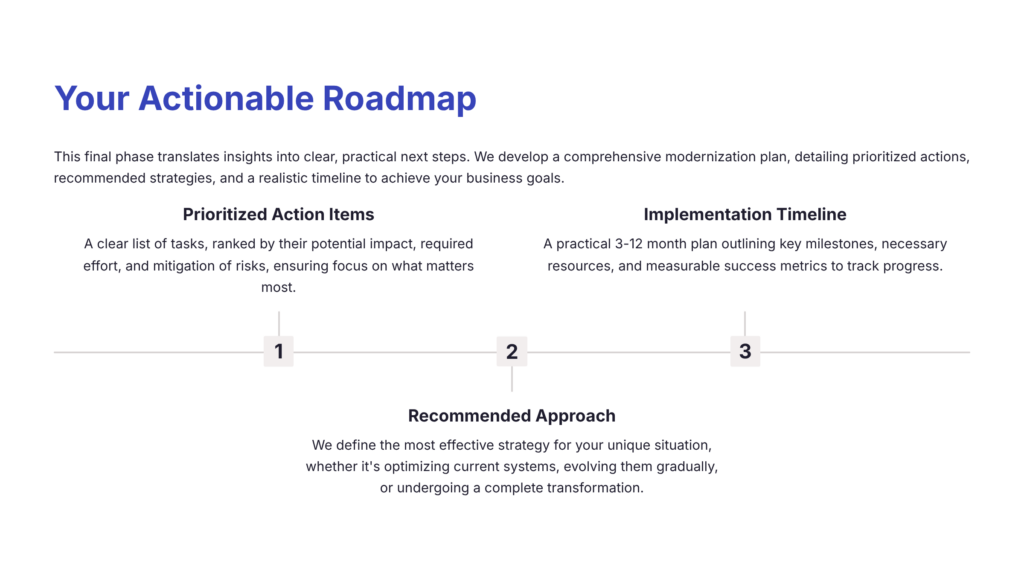
One of the most valuable outcomes of a legacy system modernization audit is not the diagnosis — it’s the roadmap. Without a clear, prioritized plan, even the most accurate insights remain theoretical. The audit converts findings into a structured modernization path that teams can actually execute.
According to the Assessment Guide, this phase translates insights into clear, practical next steps, aligned with business goals and realistic delivery constraints.
Prioritization Framework: What Comes First and Why
Not all modernization tasks deliver equal value. The roadmap ranks initiatives based on:
Business impact
Risk reduction
Implementation effort
Dependency constraints
This ensures teams focus first on actions that unlock momentum — often referred to as quick wins — before tackling deeper architectural changes.
Modernization Strategy Selection
Modernization is not one-size-fits-all. Based on audit findings, the roadmap recommends the most effective approach:
Optimizing existing systems
Gradual evolution through refactoring
Full re-architecture or replacement
This aligns closely with Gart Solutions’ broader IT modernization services, where audit-driven insights prevent overengineering and unnecessary rebuilds.
Implementation Timeline (3–12 Months)
The roadmap includes a realistic timeline outlining:
Key milestones
Required resources
Success metrics
This phased approach allows organizations to modernize without disrupting day-to-day operations — a critical factor for legacy-heavy environments.
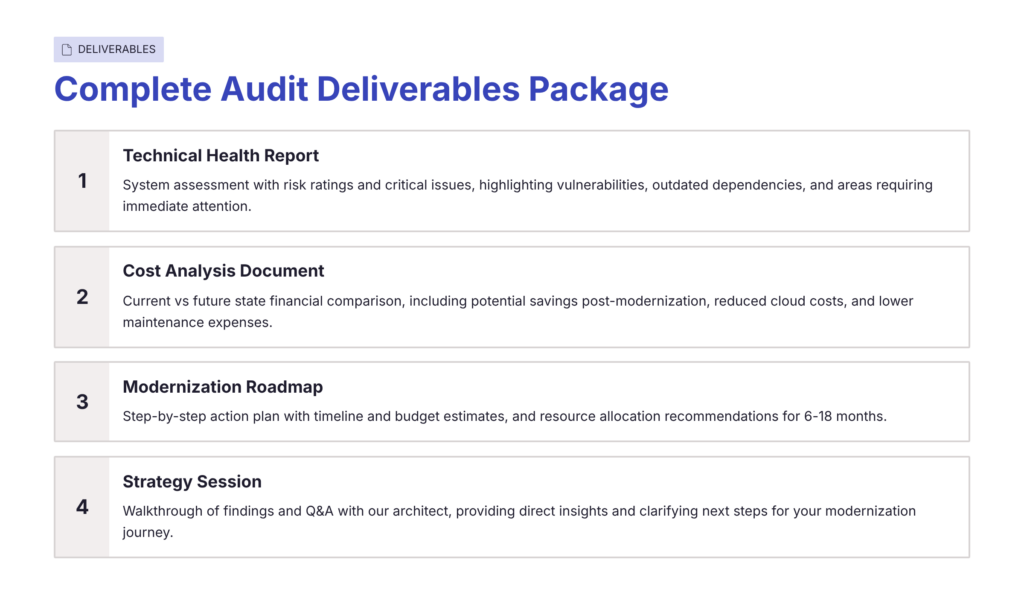
Deliverables of a Legacy System Modernization Audit
An audit is only as valuable as what it leaves behind. Gart Solutions structures its audit deliverables to support decision-making, planning, and execution long after the assessment is complete.
It becomes a reference point for both internal teams and external vendors.
Cost Analysis Document
The financial deliverable compares:
Current operational costs
Projected post-modernization costs
Estimated savings and efficiency gains
This clarity helps CFOs justify modernization initiatives with confidence.
Modernization Roadmap
The roadmap outlines:
Step-by-step actions
Budget estimates
Resource allocation for 6–18 months
It acts as a living document that evolves with the organization.
Executive Strategy Session
Finally, Gart Solutions conducts a strategy walkthrough with stakeholders, ensuring findings are understood, questions are answered, and next steps are agreed upon collaboratively.
Real-World Use Cases: When Audits Changed the Outcome
While every organization’s legacy landscape is unique, certain patterns repeat across industries. Audit-first modernization consistently leads to better outcomes than reactive transformation.
Infrastructure Modernization Use Case
A mid-sized SaaS company struggled with frequent outages after moving partially to the cloud. An audit revealed that legacy on-prem components were tightly coupled with new infrastructure, creating hidden failure points.
Following the audit, the company aligned its strategy with IT infrastructure modernization best practices, decoupling workloads and reducing downtime significantly.
Legacy Application Re-Architecture Use Case
An enterprise platform relied on a monolithic application that slowed feature delivery. The audit showed that a full rewrite wasn’t necessary — only specific modules required refactoring.
Another organization assumed modernization would be too expensive. The audit uncovered excessive maintenance costs and unused licenses, revealing that modernization would pay for itself within a year.
As Fedir Kompaniiets notes:
“In many cases, the audit doesn’t create the modernization budget — it uncovers it.”
How Gart Solutions Approaches Legacy System Modernization Audits
What differentiates Gart Solutions is not just technical expertise, but a business-first philosophy.
Proven Audit Methodology
The audit combines:
Technical analysis
Business assessment
Financial modeling
Risk evaluation
This holistic view ensures recommendations are realistic and aligned with business priorities.
Flat-Fee, Risk-Free Model
The audit is offered at a transparent €950 flat fee, with a guarantee: if it doesn’t uncover at least €5,000 in potential savings or efficiency gains, 50% of the fee is refunded.
Business-First Modernization Philosophy
Rather than pushing technology trends, Gart Solutions focuses on outcomes — lower costs, faster delivery, and reduced risk.
How This Audit Connects to IT Infrastructure Modernization
Infrastructure modernization often fails when legacy application realities are ignored. The audit bridges this gap by identifying:
Infrastructure bottlenecks
Cloud readiness gaps
Workloads unsuitable for lift-and-shift
This makes subsequent IT infrastructure modernization initiatives more predictable and cost-effective.
Legacy Application Modernization Starts With Audit Insights
Choosing between refactoring, rebuilding, or replacing applications is one of the hardest decisions teams face. The audit removes guesswork by grounding decisions in data.
Expert Insight: Fedir Kompaniiets on Audit-Driven Modernization
Throughout modernization projects, one message remains consistent:
“An audit doesn’t slow modernization — it accelerates it by removing uncertainty.”
According to Fedir Kompaniiets, companies that start with audits move faster because they avoid rework, scope creep, and misaligned expectations.
How to Know If Your Business Needs a Legacy System Modernization Audit
You likely need an audit if:
Developer onboarding takes more than two weeks
System failures are hard to diagnose
Most of your IT budget goes to maintenance
These are not just technical issues — they are strategic signals.
Conclusion: Modernization Without an Audit Is a Gamble
Legacy system modernization is inevitable. The only question is whether it will be intentional or reactive. A legacy system modernization audit replaces uncertainty with clarity, risk with insight, and hesitation with confidence.
By starting with an audit, organizations don’t just modernize technology — they modernize decision-making.
Legacy system modernization is the process of upgrading or transforming outdated software systems so they align with current business needs, security standards, and modern technologies. It typically involves improving architecture, code, infrastructure, and integrations rather than simply replacing the system outright.
What does legacy modernization mean in simple terms?
A legacy system is an older software application or platform that is still in use but is difficult to update, integrate, or scale due to outdated technology or architecture.
What is a legacy system modernization audit?
A legacy system modernization audit is a structured assessment that evaluates technical, business, security, and financial aspects of an existing system.
Identifies technical debt and system risks
Evaluates business value alignment
Assesses security and compliance gaps
Creates a data-driven modernization roadmap
Is replacing a legacy system worth it?
Replacing a legacy system is worth it only after a modernization audit confirms that refactoring or incremental modernization is not more cost-effective. Many systems can deliver strong ROI through partial modernization rather than full replacement.
How do you modernize legacy systems?
Legacy systems are modernized using a structured, phased approach.
Conduct a legacy system modernization audit
Assess architecture, code, and dependencies
Fix security and compliance gaps
Refactor, re-platform, or re-architect incrementally
What does modernization mean in IT?
In IT, modernization means upgrading systems to support scalability, security, and automation.
Improves system resilience
Enables cloud and DevOps adoption
Reduces operational risk
Supports faster business change
What is an example of legacy system modernization?
A common example is modernizing a monolithic enterprise application.
Refactoring outdated code
Upgrading unsupported frameworks
Moving workloads to cloud infrastructure
Improving performance and scalability
Which of the following is an example of legacy modernization?
Legacy modernization includes improving existing systems without full replacement.
Migrating on-premise systems to the cloud
Replacing outdated libraries
Decoupling tightly integrated components
Improving monitoring and security
What are some examples of modernization?
Modernization can take many forms depending on business needs.
Cloud migration
Application refactoring
Database modernization
Automation and CI/CD adoption
What are some examples of legacy systems?
Legacy systems are commonly found in long-running enterprises.
Mainframe-based applications
Old ERP platforms
Unsupported Java or .NET systems
Custom-built monolithic software
What are the challenges of modernization?
Modernization is complex due to accumulated technical debt.
Poor documentation
Hidden dependencies
Resistance to organizational change
Unclear return on investment
What are some challenges in changing from legacy systems to new ones?
Transitioning from legacy systems requires careful risk management.
Business continuity concerns
Complex data migration
Training and adoption issues
Underestimated technical complexity
What are the four major legacy system risks?
Legacy system risks generally fall into four categories.
Security and compliance risks
Operational stability risks
Financial inefficiency
Reduced business agility
Why is a legacy system modernization audit important?
A modernization audit reduces risk and improves outcomes.
Identifies technical and security risks
Uncovers hidden costs
Defines a clear modernization roadmap
Improves ROI predictability
How long does a legacy system modernization audit take?
Most audits are fast and minimally disruptive.
Typically completed within two weeks
Requires limited stakeholder involvement
Produces actionable recommendations
Supports informed decision-making
What problems does a legacy system modernization audit solve?
A modernization audit solves uncertainty around system health and modernization decisions.
Unclear modernization scope
Hidden maintenance and operational costs
Security and compliance blind spots
Low confidence in modernization ROI
What does a legacy system modernization audit include?
A modernization audit includes multiple assessment dimensions.
Business value evaluation
Technical architecture and code review
Security and compliance assessment
Operational risk analysis
Cost and ROI analysis
What deliverables are produced after a modernization audit?
The audit produces clear, actionable documentation.
Technical health report
Cost and ROI analysis document
Prioritized modernization roadmap
Executive strategy walkthrough
What is the ROI of a legacy system modernization audit?
The ROI of a modernization audit comes from cost visibility and risk reduction.
Identification of hidden IT costs
Reduced maintenance and support expenses
Improved productivity and delivery speed
Higher success rate for modernization projects
Why do modernization projects fail without an audit?
Modernization projects fail when decisions are made without system visibility.
Incorrect modernization scope
Underestimated technical complexity
Missed dependencies and risks
Poor alignment with business goals
How does a modernization audit support IT infrastructure modernization?
A modernization audit ensures infrastructure changes are aligned with application reality.
Identifies cloud readiness gaps
Prevents failed lift-and-shift migrations
Highlights infrastructure bottlenecks
Aligns infrastructure with application needs
How does a modernization audit support legacy application modernization?
The audit provides clarity on how applications should evolve.
Determines refactor vs rebuild vs replace
Identifies high-impact modernization targets
Reduces modernization risk
Improves time-to-market outcomes
Why does Gart Solutions recommend audit-first modernization?
Audit-first modernization increases success rates and ROI.
Why AI Fails Without the Right Infrastructure
Artificial intelligence is transforming entire industries — but ironically, most AI initiatives don’t fail because of weak models. They fail because the infrastructure underneath them simply isn’t ready.
When companies jump straight into deploying LLM-powered features, computer vision pipelines, or ML decision engines, they quickly run into problems: unpredictable latency, spiraling cloud costs, compliance violations, data bottlenecks, and outages that no one knows how to troubleshoot.
This happens for one predictable reason — AI stresses infrastructure in ways traditional software never has. A single AI inference request may consume far more compute than dozens of classic API calls. Sensitive data may need to move through new pipelines. Models require versioning, isolation, and rollback strategies. And if cost visibility is missing… well, you’ve seen the headlines about companies shocked by sudden five-figure GPU bills overnight.
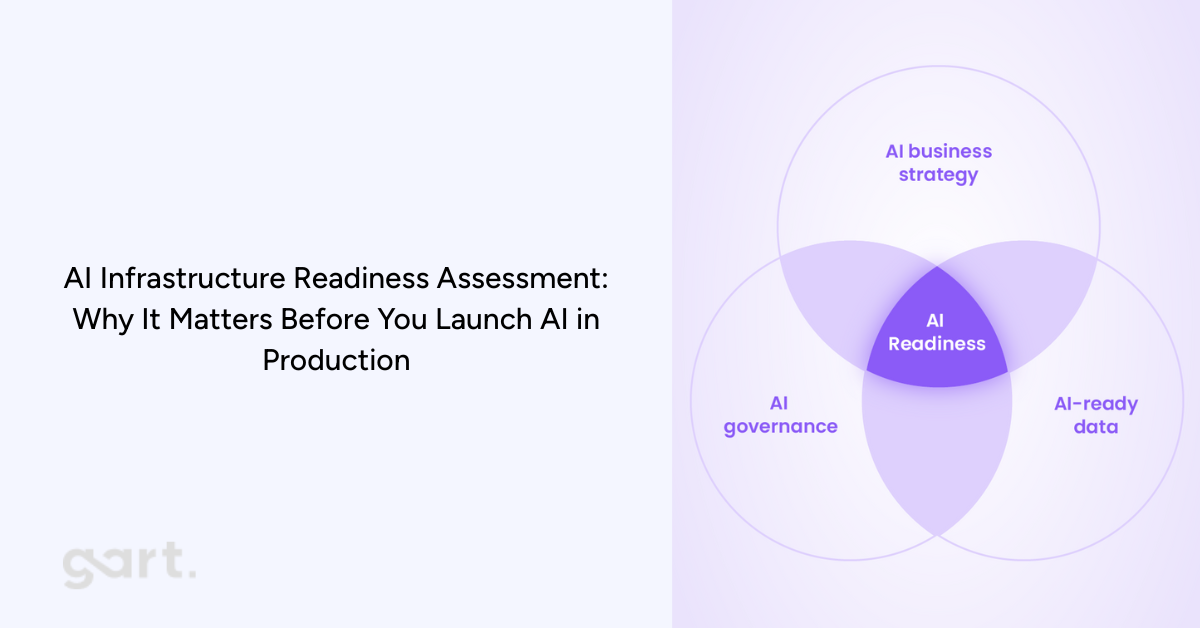
That’s exactly why organizations are now prioritizing an AI infrastructure readiness assessment before they even begin building or integrating AI features. According to the brochure provided (p.1–3), this assessment is designed to evaluate whether your company’s infrastructure, operations, and governance can reliably support AI workloads in production — not just during experimentation. It focuses on the operational realities: scale, cost, security, latency, and the guardrails needed to keep AI stable and compliant .
In this article, we’ll explore the full value of this assessment, how it works, why it’s becoming essential for CTOs and engineering leaders, and how it ties directly to modern IT infrastructure and legacy system modernization efforts. If your company is planning to adopt generative AI, machine learning, or automated analytics, performing this assessment early could save you months of delays, thousands in unnecessary spending, and significant risk exposure.
2. What Is an AI Infrastructure Readiness Assessment?
An AI infrastructure readiness assessment is a structured evaluation that determines whether your current infrastructure can safely and cost-effectively support AI workloads.
2.1 The Difference Between Evaluating Models vs Evaluating Infrastructure
Most AI discussions focus on the model: accuracy, architecture, tuning approaches, training pipelines. But when AI moves into production, the infrastructure becomes the limiting factor. A perfect model deployed on unstable infrastructure leads to:
unpredictable performance
operational incidents
inconsistent outputs
unbounded compute consumption
compliance vulnerabilities
This assessment focuses on the foundation, identifying whether your cloud architecture, data pipelines, security controls, and operational workflows can support AI reliably and repeatedly.
2.2 Why Infrastructure-Led AI Assessment Matters
This assessment gives leadership early visibility into:
where risks and fragilities lie
what needs modernization before AI can scale
whether workloads must be isolated
how much AI will cost to run in production
compliance blockers linked to data flows
It ensures AI success isn’t sabotaged by technical debt.
3. Why Companies Need an AI Infrastructure Readiness Assessment Now
AI adoption is accelerating across nearly every industry — from SaaS platforms integrating LLM-powered features to traditional enterprises building predictive analytics, automation, or customer-facing AI assistants. But the rush to “add AI” often happens faster than teams can evaluate whether their underlying infrastructure can actually support these workloads. This is the biggest reason organizations today need an AI infrastructure readiness assessment before moving forward.
Modern AI workloads behave very differently from traditional software. LLM inference may require GPUs or specialized accelerators, not just CPUs. Data pipelines must be reproducible, regulated, and auditable. Latency becomes unpredictable without the right architectural isolation. Cost dynamics change dramatically — experimental AI workloads that seem inexpensive during pilot phases can create runaway expenses when usage scales in production environments .
Another reason companies need this assessment now is compliance. Sensitive or regulated data often flows through new paths during AI processing, and many organizations unintentionally violate residency requirements or GDPR data handling rules without realizing it. The assessment identifies these risks early (p.8), preventing costly future corrections or audit failures .
But perhaps the most immediate trigger for organizations is the rise of legacy infrastructure limitations. Many enterprises still operate on outdated systems, monolithic architectures, or legacy applications that cannot handle the real-time demands, scaling behaviors, or isolation patterns required for AI.
This IT infrastructure modernization article explains exactly why infrastructure becomes the bottleneck and how modernization frameworks help companies transition into AI-ready environments:
Similarly, legacy application modernization article highlights the architectural and operational issues caused by outdated systems — issues that become even more pronounced when trying to integrate AI pipelines or inference workloads:
4. Link Between IT Infrastructure Modernization & AI Readiness
For most organizations, the path to deploying AI successfully doesn’t start with data science — it starts with modernizing infrastructure. Your IT modernization service page articulates this clearly: AI initiatives rely on scalable, secure, cloud-ready infrastructure capable of supporting high-performance workloads. Without this foundation, production AI becomes nearly impossible.
4.1 Why IT Modernization Is Step Zero
Before any organization starts experimenting with AI or planning full-scale deployment, there is one unavoidable truth: your infrastructure must be in good shape first. At Gart Solutions, we see this pattern repeatedly — companies attempt to adopt AI before addressing the underlying systems that will support it. The result? Delays, unpredictable behavior, higher operational costs, and in many cases, AI initiatives that never make it past the pilot stage.
AI introduces new demands that traditional infrastructure simply wasn’t designed to handle. Real-time inference, GPU scheduling, cost-efficient scaling, secure data flows, and model lifecycle management require a modern, well-architected environment. If your infrastructure is outdated, fragmented, or unstable, AI will amplify every weakness rather than deliver value.
This is why IT modernization becomes Step Zero in any AI strategy.
Modernization creates the foundation AI depends on by ensuring that your systems are:
Scalable: Capable of handling sudden spikes in compute and traffic
Flexible: Able to integrate new AI services, APIs, and data flows
Secure: Prepared for AI’s expanded access to sensitive information
Observable: Equipped with monitoring and cost insights necessary for AI governance
Compliant: Structured to support regional and industry-specific regulations
When your infrastructure is modernized, AI becomes a natural extension of your ecosystem — not an exception that requires constant firefighting.
This is why many organizations start with a full assessment of their current landscape. Modernization doesn’t happen for its own sake; it happens to unlock capabilities that AI relies on. Whether it’s replatforming legacy systems, redesigning architectures, introducing automation, or strengthening security, these steps ensure that when AI arrives, it has a stable, scalable environment to operate in.
Simply put:If the foundation is weak, AI will expose it. If the foundation is strong, AI will elevate it.
4.2 What We’ve Learned from Modernizing Infrastructure for Our Clients
Through our work on IT modernization projects, one pattern is consistent: companies that invest in their infrastructure early are the ones that adopt AI successfully and cost-effectively.
Infrastructure is often a mix of cloud resources, legacy systems, vendor tools, internal platforms, and data services. Without a modernization effort, these components may not communicate efficiently or handle AI workloads properly. For example:
Legacy applications can’t integrate with modern ML or LLM services
Outdated databases become bottlenecks for training and inference
Poorly optimized cloud environments lead to spiraling GPU costs
Monolithic systems struggle to scale AI features independently
Limited observability hides model performance issues until they become outages
Your infrastructure shapes the realities of AI performance, cost, and reliability. Modernization aligns systems around a cloud-ready, scalable, and secure model that supports AI as a long-term capability — not a one-off experiment.
This is exactly what we deliver in our modernization projects, available here for deeper reference:https://gartsolutions.com/it-infrastructure-modernization/
4.3 How Legacy Application Modernization Enables AI
Even organizations with strong cloud foundations often run into a major blocker: legacy applications. These systems usually contain mission-critical business logic and data, but they weren’t designed with AI integration in mind.
Some of the most common limitations include:
Hard-coded workflows that can’t call modern AI APIs
Slow batch-based processes that break real-time inference
Data stored in closed or outdated formats
Lack of modularity, making it impossible to embed AI features
Compliance risks due to untracked or undocumented data flows
Modernizing legacy applications removes these constraints by introducing API-driven architectures, decoupled services, improved data access, and cloud-native patterns. Suddenly, AI can plug into business processes seamlessly.
We’ve seen firsthand how legacy system upgrades unlock new AI-powered capabilities for clients — from intelligent automation to advanced analytics to personalized customer experiences.More here: https://gartsolutions.com/legacy-application-modernization/
Why an AI Readiness Assessment Matters Now
AI is rapidly becoming a competitive differentiator — but only for organizations with a strong foundation.
Take the assessment: https://tally.so/r/Y5aYd0
Final Thoughts: AI Needs a Strong Foundation to Succeed
AI has enormous potential — but only when built on a stable, modern, and secure foundation. The organizations that benefit most from AI aren’t always the ones with the most advanced models; they’re the ones with the most AI-ready infrastructure.
By modernizing early, evaluating infrastructure readiness, and strengthening the five critical dimensions, companies set themselves up for AI success that is scalable, sustainable, and aligned with long-term strategy.
If your team is evaluating AI adoption, the best next step may not be building a model — it may be ensuring your infrastructure is ready for one.
Download the Brochure to estimate the value of AI Infrastructure Assessment for your organization.
Contact Us if you need a support.
AI-Infrastructure-and-Readiness-AssessmentDownload
It’s 2026, and IT modernization is no longer a nice-to-have — it’s survival. Remember the early 2010s when companies were busy "going digital"? That era is officially over. We’re now deep in what experts call the “Intelligence Supercycle” — a time when AI doesn’t just support operations but runs them. From autonomous logistics to AI-managed data centers, the modern enterprise isn’t powered by people alone — it’s powered by infrastructure that thinks, acts, and evolves.
We are now deep in what experts call the “Intelligence Supercycle” — a time when AI doesn’t just support operations but runs them. From autonomous logistics to AI-managed data centers, the modern enterprise is no longer powered by people alone; it is powered by infrastructure that thinks, acts, and evolves.
This shift introduces the “Efficiency Paradox”: the traditional model of scaling by hiring more humans no longer works. In 2026, the smartest companies are doing more with less by leveraging automation and agentic AI to ship products faster and respond to customers in real-time.
Why does this matter? Because failing to modernize your IT systems in 2026 means falling behind in every aspect of business: speed, cost, security, and even compliance. Legacy systems are no longer just slow — they’re dangerous liabilities. In this guide, we’ll walk you through everything you need to know, from technical architecture to real-world strategies.
In this article, we wiil uncover about the Strategy, AI, Cloud & find differences with Legacy Transformation.
Let’s dive in.
The Rise of the Intelligence Supercycle
In 2026, we’re witnessing a massive shift from digitization to operational autonomy. Businesses aren’t just using tech — they’re being run by it. According to recent research, global IT spending has surpassed $6 trillion, with a massive focus on:
Generative AI integration
Infrastructure upgrades
Preemptive cybersecurity
Companies are navigating what’s been dubbed the “Efficiency Paradox”: instead of hiring more people, they’re scaling faster through AI agents, automation, and cloud-native platforms.
Modernization is no longer about reducing costs — it’s about building digital muscles to survive in an AI-powered economy.
Understanding the Efficiency Paradox
So what exactly is this paradox? Simple: the traditional model of throwing more humans at problems no longer works. In 2026, the smartest companies aren't hiring more — they're doing more with less by leveraging automation and agentic AI.
This shift changes how businesses prioritize IT. It’s not a back-office function anymore. IT is the central nervous system — dictating how fast you can ship a product, respond to a customer, or fend off a cyberattack.
Modernization enables:
Real-time decision making
Hyper-personalization at scale
Integrated cybersecurity protocols
Lower operational costs
Want a real-world example? Gart Solutions helped a European financial institution reduce their response time for loan approvals from 2 days to under 20 minutes using a modernized AI decision engine integrated with real-time credit scoring APIs. That’s the power of ditching legacy systems.
Architecting for Autonomy: The Role of Agentic AI
We’ve officially moved past the “AI co-pilot” stage. In 2026, we’re in the Agentic AI Era, where autonomous systems don’t just assist, they act. That means your infrastructure must support real-time, intelligent collaboration between multiple AI agents — with little to no human input.
But here’s the catch: AI agents can’t operate effectively on legacy systems. They need:
Unified data layers
Cloud-native microservices
API-first design
Scalable orchestration tools
According to Gart Solutions, 75% of AI deployment failures stem from legacy friction — slow integrations, outdated databases, and siloed data. Their solution? A full-stack refactoring approach that aligns system architecture with AI agent workflows.
AI Supercomputing and Data Center Evolution
AI’s hunger for power and speed is driving a revolution in infrastructure. Traditional cloud-first data centers just can’t keep up. In 2026, we’re seeing:
Liquid cooling as a standard
Power densities reaching 150 kW per rack
AI-optimized chips blending CPUs, GPUs, and ASICs
High-performance AI clusters require low-latency, high-bandwidth environments. Networking giants now offer 51.2 Tbps routers, and even small businesses are deploying dedicated AI nodes at the edge.
Gart Solutions has been instrumental in designing scalable AI infrastructure for logistics firms needing real-time tracking and autonomous fleet operations, ensuring high availability and extreme performance.
Physical AI: From Code to Machines
AI is no longer just digital — it’s physical. We’re talking robots, drones, automated forklifts, and even smart manufacturing lines that self-correct defects in real time.
Industries embracing this include:
Manufacturing (robotic inspection systems)
Retail (autonomous shelf scanning)
Healthcare (AI-powered diagnostics in remote clinics)
One Gart Solutions project involved integrating a physical AI system into a food packaging plant. The result? A 38% reduction in waste and a 26% increase in production speed, thanks to intelligent conveyors and robotic sorting arms powered by AI feedback loops.
Sovereign Clouds and the Geopatriation Movement
Sovereign Clouds and the Geopatriation Movement
A major trend in 2026 is “Geopatriation”—the movement of workloads from international hyperscalers back to local or sovereign cloud infrastructures. This is driven by geopolitical tensions and strict data laws like the EU AI Act. Approximately 75% of European enterprises have now moved sensitive workloads to sovereign clouds to maintain jurisdictional control.
Global businesses are now repatriating their workloads from international hyperscalers to local or sovereign cloud infrastructures. Why?
Geopolitical tensions
National data laws (like GDPR, EU AI Act)
Customer trust and compliance
The concept is called “Geopatriation”— and it’s becoming mainstream. In 2026, 75% of European enterprises have moved sensitive workloads to sovereign clouds.
Gart Solutions offers a Sovereign Cloud Enablement Framework that helps businesses balance compliance and capability without sacrificing performance. This includes hybrid cloud configurations, data residency mapping, and policy enforcement.
Architecting for Autonomy: The Role of Agentic AI
In 2026, we have moved past the “AI co-pilot” stage into the Agentic AI Era, where autonomous systems act with little to no human input. However, AI agents cannot operate effectively on legacy systems. They require:
Unified data layers for real-time context.
API-first design for seamless inter-agent collaboration.
Cloud-native microservices to provide the necessary agility.
Scalable orchestration tools to manage complex workflows.
Gart Insights
Our research shows that 75% of AI deployment failures stem from legacy friction, such as slow integrations and siloed data. Modernization is the prerequisite for agentic success.
Sovereignty vs. Capability: Multi-Cloud Strategy in 2026
It’s not about choosing between public or sovereign — it’s about balancing both. The ideal 2026 cloud strategy is “hybrid-sovereign”. Here’s how it breaks down:
Deployment ModelJurisdictional ControlScaling AgilityUse CaseGlobal Public CloudLowHighCommodity apps, dev/test workloadsSovereign CloudHighRegulatedHealthcare, finance, citizen dataHybrid Sovereign CloudModerate-HighFlexibleMixed-use environmentsSovereignty vs. Capability: Multi-Cloud Strategy in 2026
Gart Solutions' cloud advisors recommend sovereign-aware orchestration platforms that give a single-pane view of compliance and workload agility across clouds.
Modern Data Architectures: Fabric Meets Mesh
Forget the debate — data fabric vs. mesh is over. In 2026, smart companies are combining both to create AI-native data ecosystems.
Data Fabric automates metadata management and integration across sources.
Data Mesh empowers domain teams to treat data as a product.
Together, they create Agentic Knowledge Layers — environments where AI agents can pull clean, real-time data with full context.
Gart Solutions used this hybrid approach for a multinational retailer, enabling hyper-personalized marketing using domain-specific language models (DSLMs). Result? 19% increase in customer retention.
Platform Engineering and Developer Autonomy
The DevOps era paved the way, but in 2026, Platform Engineering is the real star. The focus? Developer Experience (DevEx).
Key elements include:
Internal Developer Platforms (IDPs) for self-service
AI-native dev tools for real-time code generation
Security guardrails baked into pipelines
Gart Solutions’ DevEx team implemented a unified IDP for a SaaS company, reducing time-to-deploy from 2 weeks to under 4 hours. Developers were freed from infrastructure headaches and could focus purely on logic.
Edge Computing and the 5G Advanced Backbone
Mission-critical apps need instant response times, which means processing can’t wait for the cloud. Enter Edge AI + 5G Advanced.
Edge enables:
Local inference (on vehicles, wearables, cameras)
Offline functionality in remote areas
Lower data transfer costs
Combined with 5G Advanced, this creates a unified digital nervous system.
Gart Solutions recently worked with a transport authority to deploy onboard AI for route optimization. The edge inference system saved $2.3M annually in fuel costs and cut delivery times by 22%.
Cybersecurity in a Preemptive Era
In 2026, cyberattacks are automated, persistent, and AI-powered. We’ve officially exited the era of reactive defense. Now, cybersecurity is about prevention, prediction, and zero-trust enforcement from the inside out.
Here’s what modern security stacks include:
Confidential Computing: Keeps sensitive AI data encrypted, even while in use.
AI Security Platforms (AISPs): Protect models from data leakage, prompt injection, and adversarial attacks.
Disinformation Security: Detects deepfakes and digital forgeries.
Cybersecurity Mesh Architecture (CSMA): Decentralizes access control to follow users and data across environments.
Gart Solutions’ security modernization team helped a healthcare group deploy a confidential computing framework to handle sensitive patient data. This not only brought them into GDPR and HIPAA compliance, but also gave them real-time threat detection powered by AI analytics.
Their proactive security posture reduced breach incidents by over 85% year-over-year.
Legacy System Modernization: Tackling Technical Debt
Let’s talk legacy systems — the silent killers of agility, security, and innovation. In 2026, outdated systems cost businesses $370 million per year in maintenance and lost opportunities.
The smart approach? Treat modernization like paying off “technical debt.” And yes, it has metrics:
MetricDefinitionBenchmarkTechnical Debt Ratio (TDR)Remediation Cost ÷ Build CostLower is betterChange Failure RateHotfixes per deployment< 5%Lead TimeIdea to production< 1 dayMaintenance vs Feature RatioOps vs Innovation> 60% on featuresLegacy System Modernization: Tackling Technical Debt
Gart Solutions specializes in AI-assisted legacy modernization. Their proprietary tool scans COBOL, Java, and C# codebases and auto-generates microservices, reducing rewrite costs by 40%. For one client in banking, this cut go-to-market time by 9 months and saved $6.1M.
AI Supercomputing and Data Center Evolution
AI’s hunger for power is driving a revolution in hardware. In 2026, liquid cooling has become a standard, and power densities are reaching 150 kW per rack. Modernization now includes deploying AI-optimized chips that blend CPUs, GPUs, and ASICs to handle high-performance clusters.
Physical AI: From Code to Machines
Modernization is no longer strictly digital. We are seeing the rise of Physical AI—integrating AI into robots, drones, and automated manufacturing lines that self-correct in real-time.
Gart Case Study
Operational Autonomy in Manufacturing
Gart Solutions integrated a physical AI system into a food packaging plant. By using intelligent conveyors and robotic arms, we achieved a significant production boost.
38%
Reduction in waste
26%
Increase in speed
Sustainable IT and ESG Compliance
Sustainability is no longer a CSR checkbox — it’s a legal-grade mandate in 2026. Enterprises are being held accountable not just for profit, but for planetary impact.
Key ESG modernization trends include:
Scope 3 Emissions Tracking: Capturing supplier carbon data in real-time
ESG Data Infrastructure: Integrating with ERP and facilities systems
Green AI: Using optical and liquid-cooled computing to reduce emissions
Lifecycle Management: Extending hardware life via modular upgrades
Gart Solutions implemented a real-time ESG dashboard for a global retail chain, integrating APIs from suppliers, warehouses, and logistics vendors. They moved from spreadsheet-based estimates to verifiable emissions reports, enabling them to win new government contracts tied to green compliance.
Segmented Strategies: SMBs vs. Enterprises
Modernization isn’t one-size-fits-all. The right approach depends on your size, resources, and risk profile. Here’s how 2026 strategies break down:
1. The SMB Playbook (1–99 employees): "The Renter"
Focus: Turnkey AI + Managed Services
Tools: SaaS with embedded AI (e.g., accounting, marketing, CRM)
Strategy: Fix high-risk gaps like cloud cost overrun and cyber vulnerabilities
Gart Solutions offers “Modernization-in-a-Box” for SMBs, combining cloud setup, AI integrations, and cybersecurity tools at a fixed monthly price.
2. The Midmarket Plan (100–999 employees): "The Scaler"
Focus: Consolidation + Data Fabric
Goal: Eliminate point solution sprawl, unify data for AI
Gart’s Unified Intelligence Layer (UIL) has helped midmarket firms slash API costs by over 30% by reducing redundant tool stacks.
3. The Enterprise Blueprint (1000+ employees): "The Builder"
Focus: Sovereign Intelligence + AI Governance
Tools: Internal developer platforms, AI TRiSM, sovereign cloud
For a major insurance provider, Gart delivered an AI Governance Framework with real-time visibility into model lineage and explainability, required by the EU AI Act.
Phase-by-Phase IT Modernization Roadmap
Ready to modernize? Follow this 5-phase roadmap based on real enterprise implementations:
Phase 1: Comprehensive Audit
Inventory systems, licenses, “dark data”
Identify zombie apps and shadow IT
Phase 2: Strategic Alignment
Set outcome-based goals: e.g., reduce call wait time by 60%, increase real-time analytics usage
Phase 3: Initiative Prioritization
Use a 2x2 matrix (Effort vs. Impact) to plan:
Quick Wins
Strategic Bets
Delays
Distractions
Phase 4: Budgeting
Plan for hidden costs: training, data cleanup, migration time
Phase 5: Governance & KPIs
Track OKRs like:
Deployment velocity
Data quality index
User adoption rate
Technical Debt Ratio (TDR)
Gart Solutions’ “Digital Core Health Check” is a popular Phase 1–2 tool. It evaluates over 200 modernization indicators to fast-track the right roadmap.
Modernization Strategies by Organizational Scale
Modernization isn’t one-size-fits-all. In 2026, the strategy shifts based on your resource profile:
Company Size
Persona
Key Focus
SMB (1-99)
"The Renter"
SaaS with embedded AI; fixing high-risk gaps.
Midmarket (100-999)
"The Scaler"
Consolidation & Data Fabric; eliminating tool sprawl.
Enterprise (1000+)
"The Builder"
Internal developer platforms; AI TRiSM & Sovereign Cloud.
Measuring Modernization ROI in 2026
Forget vanity metrics like “number of tools” or “uptime.” In 2026, ROI is all about business outcomes.
Modernized enterprises see:
14% annual revenue increase
74% decrease in infrastructure costs
35% higher customer retention due to better experience
Track success using:
MetricWhat it MeasuresCustomer Lifetime Value (CLV)Are you keeping and growing customers?Governance QualityIs your data accurate, compliant, and auditable?Developer ProductivityCan your team ship faster and fix bugs sooner?Feature VelocityAre new features reaching customers monthly?How to Measure the IT Modernization ROI in 2026
Conclusion: The New Mandate for IT Leaders
2026 has made one thing clear: modernization is not optional — it’s survival. Whether you’re a 20-person startup or a Fortune 500 giant, your IT stack defines your ability to innovate, scale, and stay secure.
Gart Solutions has proven that with the right strategy, tech stack, and team, even the most complex legacy ecosystems can become future-ready powerhouses. They’ve helped organizations reduce technical debt, improve compliance, and deploy AI across every function — from supply chain to sales.
The question is: Are you ready to modernize, or are you waiting to fall behind?
IT-Modernization-2026-Ultimate-Guide-2Download
Roman Burdiuzha
Co-founder & CTO, Gart Solutions · Cloud Architecture Expert
Roman has 15+ years of experience in DevOps and cloud architecture, with prior leadership roles at SoftServe and lifecell Ukraine. He co-founded Gart Solutions, where he leads cloud transformation and infrastructure modernization engagements across Europe and North America. In one recent client engagement, Gart reduced infrastructure waste by 38% through consolidating idle resources and introducing usage-aware automation. Read more on Startup Weekly.
[lwptoc]
With the development of digital technologies, a well-built IT infrastructure of a company plays an increasingly important role in achieving business goals and objectives. It is indispensable for managing, processing, storing and transferring information within the company. In this article, we will look at the types and models of IT infrastructure, the tasks it performs, its components and how to create it.
What is IT Infrastructure?
IT infrastructure is a combination of information resources and technologies, software and hardware, network components, data storage devices and services of an organization that ensure the operation and management of the company's IT environment. The main goal of IT infrastructure is to ensure the uninterrupted and secure operation of information services, processing, storage and transmission of information. Due to the development of technologies, it is used by companies from different industries: from development to agriculture. We can say that the IT infrastructure of a company is the basis for managing business processes, which directly affects the efficiency and competitiveness of the organization.
What Tasks Does IT Infrastructure Solve?
One of the main tasks that the IT infrastructure of an organization helps to solve is creating conditions for achieving goals and implementing the company's business strategy. This happens, among other things, by reducing costs for IT projects, simplifying scaling, and increasing the company's productivity.
Organizing IT infrastructure within a company helps to increase productivity and reduce costs on IT projects.
Also, the presence of a well-built IT infrastructure in the company implies:
Convenient and secure storage and management of data;
Support for network interaction and organization of collaboration between devices and users;
Optimal distribution of computing resources;
Protection of data from unauthorized access and leaks;
Providing applications and services for managing business processes.
Types and Models of IT Infrastructure
Before starting to organize IT infrastructure within a company, it is necessary to choose a model for its operation. There are three types: traditional, cloud, and hybrid.
Traditional model of IT infrastructure implies an on-premise approach, in which the company purchases its own hardware, places it on its own site, and maintains it by its own employees. It is also possible to place equipment with a provider or rent hardware with monthly payment.
Cloud model provides for the placement of IT infrastructure components with a cloud provider. In this case, the provider maintains uninterrupted operation and provides technical support for the infrastructure, and the company manages it remotely through the control panel interface.
Hybrid model combines traditional and cloud IT infrastructure. In this case, part of the infrastructure is located in the company or with a provider, and part is in cloud services. This allows you to evenly distribute the available capacity.
How to Create an IT Infrastructure from Scratch
When creating an infrastructure, it is important to consider the unique needs of the company, its goals, and budget.
First of all, it is necessary to find out the company's technological needs. Different organizations may have different requirements for IT infrastructure. For example, for some it is important to be able to manage data, for others - to optimally distribute resources.
The next step is to develop a comprehensive IT architecture, which includes hardware and software, as well as network infrastructure. After that, the company can purchase equipment and software, rent them from a provider, or choose a cloud service.
Deployment of IT infrastructure, installation and configuration of hardware and software components can be performed by company employees or provider specialists. The final stage is testing and evaluating the IT infrastructure to ensure optimal performance, security, and functionality.
After the infrastructure creation process is completed, the company must decide who will support and maintain the IT infrastructure. Many companies prefer to outsource this task to third-party specialists in order to focus on their core business.
Gart Solutions company provides Managed IT service, which includes comprehensive infrastructure maintenance:
IT infrastructure management;
Monitoring;
Timely elimination of incidents;
IT infrastructure modernization;
IT Infrastructure support;
Cloud Infrastructure management;
IT Infrastructure consulting
Backup configuration, etc.
This approach allows to ensure continuous operation of the company's IT infrastructure.
Components of IT Infrastructure
What are the main components of the IT infrastructure of an enterprise or company? As a rule, it includes hardware components that provide support for the physical infrastructure, software components that are responsible for functionality, and a network.
Hardware components include servers, data centers, PCs, and other equipment;
Software components are operating systems, CMS, CRM, databases, security software;
The network consists of routers, switches, cables, and software for network operation.
IT infrastructure software is needed to operate and manage hardware components.
IT infrastructure software includes the software and applications that a business uses to function, provide services, and manage internal processes. It also includes additional platforms and services that help solve specialized tasks. For example, this can include CMS and CRM systems, web servers, and email clients.
Conclusion
IT infrastructure is the foundation on which the success of a company is built. The security and flexibility of an enterprise or company depends on what is included in its IT infrastructure. Therefore, when creating it, it is important to consider the current needs, goals, budget of the company and the development plan for the next few years. This determines which infrastructure model to choose and which components should be included.
Get a sample of IT Audit
Sign up now
Get on email
Loading...
Thank you!
You have successfully joined our subscriber list.
Since IT infrastructure affects the competitiveness and efficiency of a company, it is better to entrust its creation and support to specialists. Mistakes at the design and launch stage can lead to security, performance and interoperability issues in the future. Gart Solutions company provides a service for the maintenance and updating of IT infrastructure, which can significantly simplify the tasks of companies without a staff of IT specialists.
Thank you for contacting us!
Please, check your email
Thank you
You've been subscribed
We use cookies to enhance your browsing experience. By clicking "Accept," you consent to the use of cookies. To learn more, read our Privacy Policy