It’s no surprise that tech leaders are searching for alternatives to hyperscalers like AWS. Whether you're a CTO wrestling with runaway infrastructure bills or a DevOps engineer tired of managing AWS complexity, the reality is the same: AWS is powerful but expensive, and over time, you're likely paying for far more than you're using.
That’s where Hetzner enters the picture. A European cloud and dedicated server provider with transparent pricing, high-performance hardware, and no surprise billing. More and more companies — from startups to scale-ups — are migrating from AWS to Hetzner and cutting their cloud bills by up to 90%. This article also explores why businesses across Europe and beyond are migrating to Hetzner. You’ll learn from real-world migration case studies, developer insights from Reddit and Hacker News, and detailed breakdowns of the technical and financial gains teams are experiencing.
In this detailed guide, we’ll show you exactly how to migrate from AWS to Hetzner using a proven, step-by-step playbook. We won’t just say "move your servers" — we’ll show you:
What tools to use
What AWS services need replacements
What pitfalls to avoid
How Gart Solutions can support your migration with expert DevOps and infrastructure-as-code capabilities
Forget vendor lock-in. Forget mysterious billing surprises. Let’s walk through how to make your infrastructure leaner, cheaper, and more under your control — without sacrificing performance or reliability.
The Rise of Cloud Fatigue — And Why It’s Getting Worse
The pitch of hyperscalers like AWS and Azure was simple: scalable, flexible, and cost-efficient infrastructure for everyone. But in practice, things look very different today.
Here’s what most teams are experiencing:
Runaway cloud costs with unpredictable billing
Vendor lock-in through proprietary services and tooling
PaaS abstraction layers that make debugging harder, not easier
Data privacy concerns, especially for EU companies
Opaque pricing models that make forecasting nearly impossible
Common AWS Cost Traps:
Data Egress Fees: AWS charges up to $0.09/GB for outbound traffic — Hetzner includes 20 TB free per VM, then only ~$1/TB after.
Managed Services Premium: AWS RDS, ElastiCache, SQS, Lambda all add layers of cost and margin.
Per-Request Billing: API Gateway, CloudWatch, S3, etc. charge per request — hard to predict and scale.
Storage IOPS: EBS IOPS fees balloon costs for disk-intensive workloads.
What Is a Hetzner Cloud and Why to Choose it?
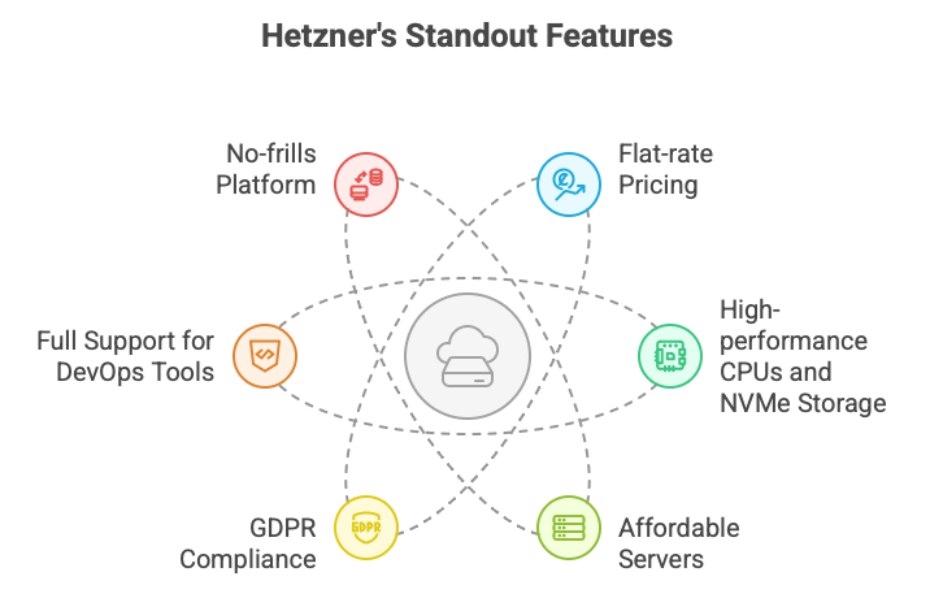
Why Hetzner is catching attention:
Incredibly competitive pricing — VMs start at under €5/month
Generous data transfer — 20 TB/month included per instance
EU-based data centers — Fully GDPR-compliant (Germany & Finland)
Infrastructure over abstraction — You manage the stack
Native support for Terraform, Docker, Kubernetes (K3s), Ansible, and more
A recent Data-Aces migration revealed Hetzner cut costs by 70–80% across compute and storage alone — and by over 90% in bandwidth fees. That’s a massive savings opportunity.
Below are some real cost savings when moving from AWS to Hetzner with the goal of cutting costs (often cited as “90 %” in real-world moves) while minimizing disruption.
Performance & Pricing Table: AWS vs Hetzner
Feature AWS EC2 (t3.medium) Hetzner CPX21 vCPUs 2 2 RAM 4 GB 4 GB Storage EBS (charged separately) 40 GB NVMe (included) Monthly Price (EU) ~$38 + storage €6.90 (all-inclusive) Bandwidth Charged separately 20 TB (included) Performance Moderate (burstable) Dedicated vCPU (Source: Data-Aces, Hetzner Pricing Docs)
Real Cost Savings: From 5x to 10x Cheaper
Let’s model a small-to-medium web app stack:
Resource AWS Monthly Hetzner Monthly Savings 2x t3.medium VMs $76 €13.80 ~82% 1x RDS db.t3.medium $75 Self-hosted DB ~90% 1 TB S3 Storage $23 €2.90 ~87% 2 TB Egress Bandwidth $180 Included ~100% Total $354 ~€20–25 ~93% (Source: Data-Aces, Hetzner Pricing Docs)
It’s become especially popular among:
European SaaS startups
DevOps-heavy teams tired of black-box services
Companies pursuing cloud repatriation strategies
Teams seeking EU-only data residency
These savings are real and repeatable. You just need to plan the migration carefully — and that’s what we’re doing next.
High-Level AWS to Hetzner Migration Strategy
Before diving into detailed steps, it’s critical to pick your strategy. There are three broad approaches when migrating from AWS to Hetzner (or any non‑AWS infrastructure):
Strategy Description Pros Cons / Risks “Lift & shift” / rehost Copy your existing EC2 / EBS / file systems over to Hetzner VMs or dedicated servers with minimal re-architecture Fastest, with less refactoring Not always feasible (if you use many AWS‑native services), may carry over inefficiencies Replatform / partial refactor Migrate core (e.g., compute, storage) but rework or replace AWS-managed services (RDS → self‑hosted, Lambdas → functions on servers) Better performance/cost balance Requires effort, introduces complexity Refactor / rebuild in Hetzner-native style Re-architect for Hetzner (VPCs, Docker/Kubernetes, automation) from the ground up Maximum long-term flexibility and cost control Longest time, highest upfront risk Table: Migration strategies
Most real-world migrations are hybrid: you start with lift & shift for some parts, then gradually refactor high-cost or high-risk parts.
One recent migration project publicized their result as “cut 90 %” of AWS costs by migrating to Hetzner + OVH and replicating essential AWS features via Terraform & Ansible. (Hacker News)
But beware — that kind of saving is realistic only if:
Your usage is steady/ predictable (not huge autoscaling spikes)
You’re not heavily dependent on AWS-managed services
You’re ready to take responsibility for operations, monitoring, backups, and reliability
Gart Solutions value is that we help you evaluate that risk, determine which strategy fits you, and execute it.
1st: Pre-Migration Phase: Scoping, Auditing, Planning
Before you touch any server, scoping is everything. This is where your migration succeeds or fails. The first step? Take a full inventory of everything running in your AWS account.
Step 1: Inventory & Mapping
EC2 instances
EBS volumes
S3 buckets
IAM roles / users
Security groups / firewalls
RDS / Aurora / ElastiCache / Lambda
CloudWatch / logs / alarms
Route53 zones / DNS entries
SQS, API Gateway, Cognito, and any AWS-native services
Use AWS Config, Cost Explorer, Inframap, or Gart’s audit suite to pull this automatically.
Step 2: Group by Priority & Risk
Make a matrix:
Mission-critical vs low-risk
Stateless vs stateful
Easy to rehost vs tightly coupled to AWS
Step 3: Choose Migration Approach
Lift & Shift: Fastest, but carries AWS inefficiencies
Replatform: Move services but optimize architecture
Refactor: Best long-term, requires dev investment
Example:
AWS Service Action Hetzner Equivalent EC2 Rehost Hetzner Cloud VMs RDS Replatform Self-managed PostgreSQL Lambda Refactor Docker + cron or serverless S3 Rehost Hetzner Object Storage CloudFront Replace Cloudflare / BunnyCDN Table: Hetzner Equivalents to the main AWS services.
Gart Solutions can help design the full architecture, plan migration order, and assess downtime risk per service.
Step 4: Cost Projection Model
Build a spreadsheet estimating:
Current AWS costs (EC2, RDS, S3, etc.)
Target Hetzner resources (CPX, CAX, Storage Boxes, Object Storage)
Estimated total monthly savings
Migration effort required
Tools like infracost.io + Gart’s cost planner can help model this automatically.
2nd: Building the Foundation in Hetzner (Parallel Setup)
Once your AWS audit is complete and you’ve selected a strategy (lift, replatform, refactor), it’s time to build the new home for your infrastructure on Hetzner. This is the "foundation-laying" phase — your Hetzner infrastructure will run in parallel to your AWS environment during testing and validation.
This approach ensures zero production downtime and gives you time to test everything end-to-end before pulling the plug on AWS.
2.1 Account & Project Setup
Create your Hetzner account(s). Hetzner uses Projects inside the account for grouping (like “dev”, “prod”).
Invite users / roles, set up access controls.
Enable billing alerts, quotas, and usage dashboards.
Gart Solutions helps you bootstrap the account, governance, and security policy from day one.
2.2 Networking & VPC Topology
Design private networks, subnets, firewall rules (like AWS VPC + security groups).
Reserve floating IPs (Hetzner analog to AWS elastic IP) for failover.
Set up NAT gateways / Internet gateways, route tables.
Decide on cross‑region / cross‑site connectivity (VPN, interconnect).
Optionally deploy a load balancer (Hetzner’s LB or a custom proxy layer).
In some migrations, teams emulate LB by spinning up CX11 servers with nginx and using floating IPs & automation. This was reported in real-world Reddit migrations. (Reddit)
2.3 Base VM Images & Automation
Choose your OS base (Ubuntu, Debian, CentOS, etc).
Harden baseline images (SSH keys, firewall, logging, security).
Bake images with configuration management (Ansible, Packer) for consistency.
Deploy staging / test clusters identical to production size but scaled-down.
Gart Solutions can build golden images, implement snapshot & versioning strategy, and automate VM provisioning via Terraform + Ansible.
2.4 Storage & Block Volumes
Provision volumes / block storage equivalent to EBS.
Decide volume types (SSD, NVMe, etc).
Set up disk partitioning, LVM, RAID, or ZFS layers if needed.
Attach volumes to VMs and test I/O performance, benchmarking.
2.5 Object Storage & S3 Migration Plan
Use Hetzner Object Storage buckets (S3-compatible). Hetzner’s documentation offers a guide to migrate from another provider’s buckets. (Hetzner Docs)
Use tools like rclone, s3cmd, MinIO client (mc) for full sync; note custom metadata may be lost except with MinIO client.
For large data sets, consider multi-part uploads, parallel sync, throttling to avoid saturating network.
Gart Solutions can script and orchestrate bucket-level sync with minimal downtime and consistency checks.
2.6 Database Setup
Spin up database servers (e.g. PostgreSQL, MySQL, or your DB of choice).
Configure replication, clustering, high availability, backups, monitoring.
Optionally put in a delay replica for safety.
Preload schemas and test with sample data.
Since Hetzner has no fully managed RDS equivalent, you need to treat this carefully. Gart Solutions can help deploy resilient, scalable DB clusters, handle failover, and manage backups.
2.7 Application & Middleware Stack
Deploy your app stack (containers, runtime, web servers, API servers, caches, etc) in Hetzner staging environment.
Test end-to-end functionality, integrations, network routes.
Set up SSL/TLS (Let’s Encrypt, or your own certs).
Deploy logging, monitoring, alerting stack (Prometheus, Grafana, Loki, ELK, etc).
One migration noted they rebuilt key AWS features (hardening, monitoring, rolling deploys, TLS automation) using Terraform + Ansible. (Hacker News)
2.8 DNS, CDN, & Edge Services
If you used AWS Route 53, migrate your hosted zones / DNS records to Hetzner DNS (or a third-party DNS if you prefer).
Set up TTLs low before cutover.
If you used CloudFront or AWS CDN, evaluate replacing with Cloudflare, BunnyCDN, Fastly, or any CDN of your choice.
Validate DNS propagation, health checks, and failover behavior.
AWS-to-Hetzner Service Mapping Table
AWS Service Hetzner Equivalent / Solution Notes EC2 CPX, CAX, or dedicated servers Similar VM types, better price-perf EBS Attached volumes Use NVMe for high-speed I/O S3 Hetzner Object Storage S3-compatible with CLI tool support RDS Self-hosted PostgreSQL/MySQL Use Ansible + daily snapshot backups Route53 Hetzner DNS or Cloudflare Full DNS control, API-accessible CloudFront Cloudflare, BunnyCDN CDN options with better pricing Lambda Docker containers, Cron + Event Hooks Replace with cron jobs, containers, Nomad SQS Redis Queue, RabbitMQ, NATS Use self-hosted queues CloudWatch Grafana + Prometheus + Loki Full open-source observability stack IAM Hetzner API Tokens + Secrets Mgmt Optional Vault/Keycloak for advanced control Table: AWS-to-Hetzner Service Mapping Table
3rd. - Data Migration & Dual-Writing (Synchronization Phase)
At this point, the Hetzner staging environments are ready. Next, you must bring live data without losing consistency.
3.1 Snapshot / Disk Migration
For EC2 / EBS volumes, create a snapshot, mount it in AWS, and copy data (via rsync, dd, or file-level).
Hetzner docs provide a migration recipe: backup data, scp/rsync to new server, restore users, firewall rules, etc. (Hetzner Docs)
For entire partitions, you can replicate block devices, but be careful with UUIDs, bootloader, etc.
3.2 Database Sync / Replication
Use database replication from the source (AWS RDS or self-hosted) to the target.
Use logical replication or sync tools (e.g., pglogical, binlog replication, etc).
For the final cutover, pause writes or fail traffic to catch up.
Validate consistency, run checksums, compare counts.
3.3 Dual-Writing / Shadow Writes (if possible)
If your application allows, implement dual writes (write to both AWS and Hetzner DB) during the migration window.
Use feature flags, flags to route reads to one side, writes to both, etc.
This smooths the transition and reduces downtime risk.
3.4 Incremental File Sync
Use rsync, unison, or incremental sync scripts to keep changing files in sync.
Use a cron job or a watcher-based incremental tool.
During final cutover, run a last sync.
3.5 Object Storage Final Sync
Re-run your s3cmd / mc / rclone sync to flush any changed objects.
Validate checksums, metadata, and permissions.
3.6 Verification & Smoke Testing
Validate that data is correct (row counts, file sizes, checksums).
Run functional and integration tests in the Hetzner environment.
Monitor logs, metrics, error rates.
Compare performance between source and target.
Gart Solutions can orchestrate all these sync tasks with prebuilt scripts and verify consistency automatically.
4th. - Cutover / Switch Traffic (Switchover Phase)
With data synced and validation done, now you switch user traffic from AWS to Hetzner.
4.1 Freeze Writes / Quiesce AWS
Stop new writes on AWS (maintenance window, read-only mode, etc).
Wait for final replication, flush all queues, and ensure no lag.
4.2 DNS / Floating IP Switch
Reassign floating IPs or public IPs in Hetzner.
Update DNS records (lower TTL to speed propagation).
Use DNS failover, health checks, or weighted routing if available.
Monitor for propagation errors.
4.3 Enable Traffic & Monitor
Slowly ramp traffic to Hetzner (e.g., 10 %, 50 %, then 100 %).
Watch error rates, latencies, resource usage,and logs.
Roll back if something catastrophic happens (DNS TTL helps).
Validate stability over several hours/days.
One anecdote from Reddit:
“The migrations … implemented CX11 servers with nginx to do load balancing … floating IP automation was tricky.” (Reddit)
Gart Solutions can provide the automation and control logic for IP switching and traffic cutover to minimize human error.
4.4 Decommission AWS Resources
Once confident, shut down AWS EC2, RDS, S3 buckets, etc.
Clean up IAM, snapshots, EBS, autoscaling, etc.
Keep backups or roll-back snapshots for a grace period.
5th. - Post‑Migration, Optimization & Hardening
The cutover is not the end. You now own full operations and must optimize, mature, and ensure reliability.
5.1 Performance Tuning & Cost Optimization
Size down over-provisioned VMs.
Use autoscaling if needed (with scripts / custom logic).
Tune database, caching, and query performance.
Monitor usage and right-size volumes, storage classes.
Optimize network egress and minimize cross-DC traffic.
5.2 Monitoring, Logging, and Alerting
Implement Prometheus, Grafana, Alertmanager, logging stack (Loki, ELK, etc).
Monitor metrics: CPU, memory, disk, I/O, network, and application errors.
Add alert thresholds, SLA-based alerts, and anomaly detection.
Audit logs, access logs, and enable security monitoring.
In a published migration, they rebuilt AWS features like rolling deploys, auditing, SSH policies, monitoring, and alerting via Ansible & Terraform. (Hacker News)
Gart Solutions can provide this stack out-of-box or adapt your existing one.
5.3 Backup, Disaster Recovery, and DR Planning
Build a backup strategy: full, incremental, offsite (e.g., backup to object storage, remote region).
Test restore procedures regularly.
Spinning up a cold standby in another DC or region.
Document incident playbooks.
5.4 Security Hardening & Compliance
Enforce firewall rules, security groups.
SSH hardening, key rotation.
Implement intrusion detection, SELinux, audit, and process isolation.
Network segmentation (public vs private subnets).
Pen tests, vulnerability scans.
If you need ISO 27001, GDPR, etc, capture all controls.
The migration to European cloud (Hetzner + OVH) cited that they preserved ISO 27001 alignment using Ansible roles for hardening, alerting, deployments, etc. (Hacker News)
Gart Solutions specializes in security & compliance hardening in such migrations.
5.5 Continuous Improvement & Automation
Automate deployments (CI/CD pipelines) targeting your new Hetzner environment.
Use Infrastructure-as-Code (Terraform, Ansible) for reproducibility.
Add self-healing, scaling, chaos testing.
Iteratively refine architecture, storage tiers, and caches.
6th. - Common Challenges & Pitfalls (and How Gart Solutions Helps)
Here’s where many migrations get stuck — but with proper attention, you can avoid or mitigate these issues.
Challenge Description Mitigation / Advice AWS-managed services are not present in Hetzner E.g. Lambda, Kinesis, SQS, managed RDS, EventBridge Replace with open-source equivalents, host them yourself, or use third-party services. Gart Solutions helps choose and integrate replacements. Network latency and inter-DC instability Hetzner’s backbone may be less robust across many regions Avoid cross-DC traffic when possible; architect locality; monitor network; accept in some cases lower reliability. Floating IP (elastic IP) automation complexity Reassigning public IPs during cutover is tricky Gart Solutions builds scripts/automation to manage IP reassignment, failover logic, and net rules. Consistency of data during cutover Replication lag, drift, and race conditions Use dual writes, quiesce writes carefully, and validate checksums. DNS propagation delays Slow TTL changes impact cutover Use low TTL well before, monitor propagation. Operational maturity & support burden You now manage everything on your own Gart Solutions can act as your managed services / second-line support and help mature ops. Unexpected performance bottlenecks Differences in virtualization, disk I/O, and network Benchmark early, tune, choose right VM types, work with us to profile bottlenecks. Lock‑in to AWS IaC (CloudFormation, CDK) These are not portable to Hetzner Migrate to Terraform, rewrite IaC. Gart Solutions helps port your stacks. Team knowledge / expertise gap Your team may be unfamiliar with Hetzner, managing infrastructure Gart Solutions can mentor your engineers, share playbooks, and provide operational support.
What Developers Are Saying (Reddit & Hacker News)
The shift to Hetzner isn’t just hype — it’s backed by growing word-of-mouth among engineers.
From a popular Reddit thread and Hacker News discussions, here’s what developers are saying:
“Hetzner gives me 4x the performance of AWS for less than half the cost.”
“I run my entire CI/CD infrastructure on Hetzner now. It’s faster and cheaper.”
“The simplicity is what makes it powerful. I don’t need all of Azure’s magic, just fast and stable servers.”
“Network somewhat unstable when you operate a large microservice deployment… missing drives, servers that won’t boot … cross region sucks a bit due to network interruptions.”
These quotes reflect a clear trend: developers prefer Hetzner when they want control, speed, and affordability without the lock-in.
That’s exactly the kind of issue Gart Solutions can anticipate and guard against: we can put in redundant paths, failover logic, and monitoring to catch these faults.
Real-World Migrations to Hetzner: 3 Key Case Studies
Let’s break down how real companies moved from AWS, Azure, and legacy systems to Hetzner—what worked, what broke, and what improved.
1. Online Gambling Provider (AWS to Hetzner)
Challenge: AWS costs were spiraling out of control during traffic spikes (especially during major sports events). DevOps complexity slowed deployments.
Solution:
Dockerized infrastructure
Hetzner Cloud instances + CI/CD via GitLab
Manual failovers + internal monitoring
Results:
50% lower infra cost
Faster deployments
Improved performance during live betting events
2. Media Platform (Legacy + AWS to Hetzner)
Challenge: A hybrid stack with AWS + on-prem hardware was becoming unmanageable. Cloud costs, especially for bandwidth and CDN, were too high.
Solution:
Static asset delivery via Hetzner + Nginx
Custom caching and image optimization pipeline
High-performance VMs for backend API workloads
Results:
70% lower monthly spend
Consistent response times
Full infrastructure ownership
3. Landfill SaaS App (Azure + Local Servers to Hetzner)
Challenge: Limited scalability, rising Azure fees, and GDPR concerns. Needed to go global without hyperscaler pricing.
Solution:
Infrastructure provisioned with Terraform
Self-hosted monitoring, backups, and firewalling
Docker containers for app services
Results:
80% cost savings
Full GDPR compliance
Improved uptime + faster deployments.
Hetzner vs AWS vs Azure: Feature & Pricing Comparison
FeatureHetzner CloudAWSMicrosoft AzureCompute (4vCPU, 16GB RAM)€23.75/month~$130/month~€120/monthBandwidth20 TB/month included~$0.09/GB outbound~€0.12/GB outboundData CentersGermany, FinlandGlobalGlobalGDPR ComplianceNative (EU)Region-specificRegion-specificManaged ServicesMinimal (IaaS-focused)Extensive (RDS, Lambda)Extensive (App Services)SupportBasic ticketingPaid support plansTiered support optionsDeveloper ControlHighMediumMediumComplexityLowHighHighHetzner vs AWS vs Azure: Feature & Pricing Comparison
What Makes Hetzner So Attractive for European Teams
Price transparency: No more guessing your monthly cloud bill
Data sovereignty: Native GDPR compliance with data in Germany or Finland
No lock-in: Infrastructure is yours—no black-box abstractions
DevOps ready: Works seamlessly with Terraform, Docker, Ansible, GitLab CI/CD
Fast provisioning: New VMs spin up in seconds
Simple billing: One invoice, no “billing surprises”
But It’s Not for Everyone: When Hetzner May Not Be a Fit
You need global region coverage (e.g., US, Asia, LatAm)
Your team is deeply reliant on managed services
You lack in-house DevOps or sysadmin experience
You need enterprise-grade support SLAs or 24/7 NOC
Why Choose Gart Solutions as a Migration Partner?
When choosing a migration partner, you want more than just a “contractor that moves VMs.” Gart Solutions offers:
End-to-end service — From assessment, architecture, building, cutover, post‑migration hardening, to long-term managed support.
Risk-aware planning — We perform failure mode analysis, build rollbacks, and stage migrations to minimize downtime.
Prebuilt modules & templates — For common stacks (web app, API, DB, caching, queueing) we have reusable Terraform + Ansible modules optimized for Hetzner.
Cost modeling & validation — We help you verify that the “cut 90%” target is realistic for your workload, and guard against surprises.
Operations transition & training — We upskill your team in the new environment and optionally act as your managed ops partner.
Security & compliance focus — We bring experience in ISO 27001, GDPR, security hardening, audit controls, so the migration doesn’t compromise your posture.
Gart Solutions is not just moving your infrastructure — we’re enabling you to run reliably, securely, and cost-effectively on Hetzner after the move.
Example Migration Walkthrough
Here’s a condensed example of how a migration might execute:
1. Assessment & planning (2 weeks)
Inventory AWS stack, build dependency map, choose lift & shift for compute + refactor for managed services, cost modeling, roadmap.
2. Build target infra (1 week)
Set up Hetzner projects, VPC, subnets, firewalls, base VM images, object storage, app staging stack, DNS config.
3. Initial data sync (ongoing)
Sync file servers, start DB replication, sync objects.
4. Testing & verification (3 days)
Smoke tests, integration tests, performance tests. Tweak architecture, adjust sizes.
5. Cutover (maintenance window, e.g. weekend)
Freeze writes, run final sync, switch DNS / floating IPs, bring traffic live, monitor.
6. Post‑migration ops (weeks-months)
Tune performance, enable scaling logic, set alerts, harden security, fully decommission AWS.
Actual users report:
“We migrated production in under an hour, once everything was ready; whole prep took days/weeks.” (@rameerez)
“The biggest cost saving was in bandwidth bills.” (Hacker News)
That said, every case is different; Gart Solutions sizes our involvement to your scale and risk appetite.
Summary & Key Takeaways
Migrating from AWS to Hetzner can yield massive cost savings (some report 70–90 %) especially when AWS bills are heavy for bandwidth and managed services. (Hacker News)
It’s not just copying servers — you must plan for AWS-native services, network, high availability, DNS, and operational maturity.
The success lies in rigorous planning, parallel setup, data sync and validation, smart cutover, and post-migration optimization.
Gart Solutions can serve as your end‑to‑end migration and operations partner, reducing your risk, accelerating execution, and helping you land safely.
If you follow a methodical playbook and engage expertise (whether Gart or your own), migrating to Hetzner can be practical — not just theory.
Download the Whitepaper: "Migration from AWS to Hetzner: Step-by-Step Guide to Cut Costs by 90%"
Whitepaper-Migrating-from-AWS-to-Hetzner-Gart-SolutionsDownload
AWS offers unmatched scalability, global reach, and a vast suite of services, but these come at a price. For many companies, especially startups and those with high bandwidth or compute needs, AWS becomes a budget-burning monster. That’s where Hetzner, a German cloud and dedicated server provider, starts turning heads.
Gart Solutions has been making waves by strategically shifting away from hyperscale providers like AWS to cost-effective, performance-optimized alternatives like Hetzner.
So, is Hetzner just cheaper, or actually better in some scenarios? Let’s break it all down by diving into real-world deployments, cost comparisons, and expert insights from how Gart Solutions has deployed Hetzner in production environments with striking success.
Understanding the Cloud Landscape
AWS – The Industry Giant
There’s no denying AWS is the gold standard in cloud computing. With over 200 services spanning compute, storage, networking, databases, machine learning, and more, AWS supports everything from nimble startups to multinational conglomerates. It offers enterprise-level reliability, granular security controls, and geographic coverage that stretches across every continent.
But with this enormous toolset comes equally massive complexity — and cost. AWS operates on a “pay-as-you-go” model that can seem fair in theory, but often ends up being unpredictable and overwhelming.
Egress (outbound traffic) charges, for instance, can be a nightmare for businesses that distribute large files, stream content, or run high-traffic platforms.
And while AWS excels at handling massive scale, its complexity sometimes makes it a burden for smaller teams or simpler projects.
Hetzner – The Underdog Gaining Momentum
Hetzner may not have the same market share as AWS, but it’s quietly become a favorite among developers, startups, and cost-conscious enterprises across Europe and beyond. Known for its nonsense pricing model and high-performance dedicated servers, Hetzner offers both bare-metal and cloud services at prices that often make AWS look like luxury shopping.
Where AWS offers nearly everything, Hetzner focuses on doing fewer things extremely well. It excels in areas like raw compute power, consistent bandwidth, and high-speed networking — all while charging a flat monthly fee or minimal hourly rates. And unlike AWS, Hetzner includes generous traffic allowances (often unlimited), which makes it especially appealing for applications with high outbound data needs.
And while Hetzner doesn’t match AWS in the breadth of services, it integrates smoothly with modern DevOps tooling, like Terraform, Kubernetes, Docker, and CI/CD pipelines, making it highly attractive to teams that want performance without vendor lock-in.
Why Companies Seek AWS Alternatives
The High Cost of AWS
It’s not just small businesses complaining about AWS pricing — it’s a known industry pain point.
Let’s say you’re running a content delivery app or SaaS platform — each gigabyte of outbound data gets billed separately. Now imagine 100,000 users downloading or streaming from your app. Suddenly, your monthly cloud costs double, even if your user base hasn’t changed.
This pricing structure often penalizes growth. The more successful your application, the more you pay — not because you’re consuming more compute, but because data transfer is metered heavily.
And then there’s the operational cost of managing AWS. It often takes a team of certified engineers just to maintain and optimize configurations, spot underutilized resources, and ensure security best practices. That’s a hidden cost many businesses overlook.
Performance vs. Price Dilemma
One of the major paradoxes with AWS is that while it promises performance, it charges a premium for consistency. Your EC2 instance might perform well today and lag tomorrow due to noisy neighbors (multi-tenant environments). You can pay more for “dedicated” resources, but that quickly spirals out of budget.
With Hetzner, the opposite is often true. You get powerful bare-metal servers or consistently high-performance VMs without needing to guess on pricing tiers. This predictability, both in cost and performance, is a major reason companies start looking beyond AWS.
Gart Solutions’ Cloud Philosophy
Gart Solutions specializes in helping clients modernize IT infrastructure, adopt DevOps best practices, and scale without breaking the bank. Our philosophy revolves around optimizing every layer of the cloud stack — from infrastructure provisioning to deployment pipelines, while keeping budgets in check.
Rather than defaulting to AWS because it’s the “safe choice,” Gart Solutions evaluates each client’s real needs: traffic patterns, performance requirements, cost sensitivity, and automation goals. This leads us to seek infrastructure that aligns more closely with the business model and technical demands of the project.
Get a sample of IT Audit
Sign up now
Get on email
Loading...
Thank you!
You have successfully joined our subscriber list.
Choosing Hetzner – Strategic Reasoning
For many of their client projects, Gart Solutions identified Hetzner as the perfect balance of affordability, reliability, and flexibility. The decision to go with Hetzner wasn’t just about cost (though that played a big part). It was also about control, automation, and the ability to manage infrastructure using familiar tools like Terraform, Kubernetes, and Ansible.
By choosing Hetzner, they could build resilient, scalable infrastructure that’s just as capable as AWS-hosted setups but without the headache of unpredictable billing. Whether they were optimizing CI/CD workflows or deploying complex container orchestration, Hetzner’s clean infrastructure model made it easier to build, manage, and maintain robust cloud environments.
They also appreciated that Hetzner doesn’t charge for traffic — making it a godsend for media-rich apps, SaaS tools, gaming platforms, and IoT systems.
Case Study #1 – High-Traffic Gaming Workloads
The Challenge with AWS
Imagine you're launching a gaming platform where users can download large files ranging from 500MB to 1GB. Now imagine 20,000 users doing that repeatedly during a promotional campaign. On AWS, this means enormous outbound data charges.
That’s exactly the problem one Gart Solutions client faced. They had projected annual revenues of about $80,000 from free-to-play game trials, but AWS’s pricing would have eaten up over 60% of that —just from data egress costs.
Using AWS’s EC2 instances and S3 storage initially seemed like a safe, scalable choice. But the hidden cost of bandwidth, especially when the business model relies on large, frequent downloads — was a dealbreaker. Gart quickly realized that if the client stuck with AWS, the entire revenue model would collapse under operational expenses.
Migration to Hetzner
Gart Solutions proposed a switch to Hetzner Cloud. Why? Because Hetzner offers uncapped bandwidth with minimal restrictions and flat-rate pricing, perfect for handling enormous traffic at predictable costs. They rebuilt the platform using a combination of Hetzner's dedicated servers and cloud instances, optimizing download performance through fast SSD storage and CDN acceleration.
To ensure reliability, they implemented failover systems, load balancing, and efficient caching layers. The infrastructure was containerized, making it portable, scalable, and fast to deploy. With Terraform and Docker in place, infrastructure updates could happen in seconds, ensuring seamless rollouts and minimal downtime.
Results and Metrics
Cost Reduction: data traffic expenses dropped by nearly 80% compared to AWS.
Performance: download speeds remained consistent, averaging ~200MB/s per node.
User Experience: zero downtime during traffic surges; smoother gameplay initiation.
Business Impact: client retained a much healthier margin, making the game trial monetization strategy sustainable.
Hetzner didn’t just replace AWS, it enabled a business model that AWS pricing would have killed.
Case Study #2 – Scaling a Global Environmental Platform
Elandfill.io’s Expansion Needs
ReSource International approached Gart Solutions with a clear mission: scale their landfill management software — elandfill.io from local installations in Iceland to a full-scale global SaaS platform. The challenge wasn’t just scaling users; it involved handling enormous datasets including geospatial images, gas emissions records, real-time weather monitoring, and predictive analytics across multiple time zones.
The backend involved PostgreSQL with PostGIS, map rendering, data ingestion pipelines, and alert systems for environmental safety —all of which needed to work in real-time. Doing this on AWS was certainly an option, but the potential cost and service complexity threatened to overwhelm the project in its infancy.
How Hetzner Met the Challenge
Gart Solutions architected the entire SaaS platform on Hetzner Cloud using Kubernetes for orchestration. They built modular services for monitoring, alerting, analytics, and rendering, ensuring the architecture was elastic and easy to maintain.
Key elements included:
Geoserver Optimization: efficient handling of map tile generation and caching.
CI/CD Pipelines: automated testing, deployment, and rollback.
Monitoring & Alerting: Prometheus and Grafana stack for full observability.
They made use of Hetzner’s reliable network and data centers in Germany and Finland to ensure low-latency performance across Europe. For clients outside Europe, the solution was containerized and easily deployable in hybrid-cloud models if needed.
Business Outcomes
Scalability: platform scaled from 1 to 14 countries without downtime.
Affordability: hosting cost reduced by more than 60% compared to initial AWS projections.
Real-Time Data: improved latency and faster alerts for environmental breaches.
Sustainability: the low-cost footprint aligned perfectly with the client’s green tech values.
Hetzner helped turn a local environmental tool into a global digital platform, without the AWS price tag.
Case Study #3 – DevOps in Digital Betting
Betting Platform Infrastructure Problems
A Germany-based digital betting provider was struggling with an outdated infrastructure. They were operating on bare-metal Windows servers, had no automation for deployments, and scaled poorly during live sports events. Everything was done manually — from patches to provisioning. Each code change risked downtime, and traffic spikes during major sports matches regularly crashed the system.
Their CI/CD pipeline was virtually nonexistent, and their infrastructure couldn't support high availability or disaster recovery effectively. The business risk was high and escalating.
Full DevOps Makeover with Hetzner
Gart Solutions rebuilt the architecture from the ground up, starting with a migration to Hetzner’s Linux-based virtual servers. The transformation was executed in three phases:
Mapping Service Dependencies: they audited the system’s critical services, establishing what needed to be containerized and how to break the monolith.
Infrastructure-as-Code: using Ansible and Terraform, they automated provisioning and configuration. This reduced deployment times from days to minutes.
Kubernetes & CI/CD: they rolled out Kubernetes clusters to support containerized workloads, introduced GitLab CI pipelines, and set up observability tools (Prometheus, Loki, Grafana).
Disaster recovery, blue-green deployments, and A/B testing became part of the operational DNA.
Uptime, Performance, and Deployment Success
Uptime: 99.97% availability across 12 months.
Speed: Deployment times reduced from 48 hours to under 10 minutes.
Traffic Handling: Load testing showed platform stability during 3x normal traffic.
Operational Efficiency: Engineers gained back 30+ hours/month previously spent on manual deployments.
Hetzner + Gart’s DevOps framework turned a fragile betting platform into a modern, resilient, cloud-native powerhouse.
Comparing AWS and Hetzner Head-to-Head
Cost Structure
If you have high or unpredictable outbound traffic, Hetzner wins hands down.
Performance and Reliability
While AWS offers near-100% uptime SLAs, Hetzner has proven reliability across use cases.
Benchmarks from Gart Solutions show Hetzner’s VMs and bare-metal instances match AWS in I/O speed and network throughput, especially for European users.
DevOps Compatibility
Both support modern DevOps stacks, but AWS has its own ecosystem (CodePipeline, CloudFormation) while Hetzner integrates openly with popular tools like Terraform, Ansible, and Kubernetes.
So, AWS is more integrated but less flexible. Hetzner allows full control.
When to Choose Hetzner Over AWS
Ideal Use Cases
Let’s be honest — no single cloud provider is the right answer for everyone. But if your use case aligns with one or more of the following, Hetzner might just be your secret weapon:
High-Bandwidth Applications Streaming platforms, file-sharing systems, gaming platforms, or SaaS products with large downloads benefit massively from Hetzner’s free, uncapped outbound traffic.
Budget-Conscious Startups If you're just launching a product or bootstrapping your business, AWS costs can be punishing. Hetzner’s flat-rate pricing lets you plan and scale without unpredictable bills.
Self-Managed DevOps Environments Teams that love working with Terraform, Ansible, Kubernetes, and Docker will feel right at home. Hetzner’s clean infrastructure gives you full control, no managed service lock-ins.
Edge and Regional Deployments With Hetzner’s growing global footprint (Germany, Finland, and now the U.S. and Singapore), deploying regionally for latency-sensitive apps is very feasible.
SaaS Builders Looking for Control If your app needs custom infrastructure or tight observability (without vendor APIs), Hetzner gives you the hardware feel in a cloud package.
When AWS Still Wins
However, there are situations where AWS remains the better option:
Need for Managed Services AWS offers robust managed databases, serverless architecture, AI/ML platforms, and global CDN options that Hetzner doesn’t match.
Regulatory Compliance & Certifications If your app requires SOC 2, HIPAA, FedRAMP, or other high-level certifications, AWS provides pre-approved infrastructure for compliance-heavy workloads.
Enterprise Multi-Region Scaling For companies operating across 10+ countries with users worldwide, AWS’s global data centers and traffic routing give them an edge.
If you want flexibility and control at a fraction of the cost, Hetzner is excellent. If you need managed magic and global compliance, AWS is king.
Final Thoughts – Hetzner Is a Smart, Scalable Choice
Here’s the bottom line: Hetzner is not a universal replacement for AWS, but in the right hands, it becomes a cloud powerhouse, especially when paired with smart implementation partners like Gart Solutions.
Through three real-world case studies, we’ve seen:
Case 1: How a gaming company salvaged its monetization model by eliminating bandwidth fees.
Case 2: How a green tech startup scaled globally with geospatial data, using Kubernetes and Hetzner’s compute flexibility.
Case 3: How a legacy betting platform transformed into a fast, scalable, DevOps-driven cloud app with zero AWS involvement.
Hetzner isn’t about bells and whistles. It’s about raw performance, predictable pricing, and giving engineers the tools they need without handholding. And when paired with a team like Gart Solutions, it doesn’t just save money.
So, is Hetzner a good alternative to AWS?
Absolutely. Especially when every dollar, every millisecond, and every gigabyte counts.
There are some thoughts of other users on Reddit, we’ve checked to provide you with the most complete picture on choosing a cloud provider. Link to Reddit thread.
Let’s work together!
See how we can help to overcome your challenges
Contact us