Security used to be the last door before production. In 2026, it’s the foundation every line of code is built on. This is the complete guide to DevSecOps as a Service — what it is, what it costs, how it’s architected, and how to choose the right partner.
Every week brings another headline: a data breach affecting millions, a supply chain compromise shutting down critical infrastructure, a ransomware attack costing a company its future. In this environment, treating security as a final quality gate — something to be addressed once the code is written — is no longer just inefficient. It is actively dangerous.
DevSecOps as a Service represents the mature answer to this challenge: a fully managed, continuously operating security framework woven into every stage of software delivery. This guide draws on current market research, technical architecture patterns, and the practical experience of engineering teams to give you the most thorough treatment of the topic available
The DevSecOps pipeline — security embedded at every stage
What is DevSecOps as a Service?
DevSecOps — Development, Security, and Operations — is an evolutionary extension of DevOps that embeds security assessments throughout the continuous integration and continuous delivery (CI/CD) process. The traditional approach treated security as a siloed, final phase; DevSecOps introduces the shift-left principle, moving security from the right end of the delivery cycle to its very beginning.
DevSecOps as a Service (DSaaS) takes this philosophy and delivers it as a managed, cloud-based offering. Rather than building, staffing, and maintaining the capability in-house, organizations subscribe to a managed service that provides expert engineers, proven toolchains, automated scanning, compliance frameworks, and continuous oversight — all through a unified delivery model.
The shift is profound. A managed DevSecOps provider dissolves the organizational barriers that typically stall internal programs: the security skills gap, tool sprawl, slow procurement cycles, and the cultural friction between developer velocity and security caution. Enterprise-grade security integration — including automated code scanning, continuous threat detection, and compliance reporting — becomes a subscription, not a multi-year buildout.
Core components at a glance
Why the old model is broken
For most of the last decade, software security worked like this: developers wrote code, QA ran tests, and then — right before shipping — the security team ran their checks. If something came back flagged, the entire release could stall. Developers would scramble to patch issues they had built months earlier, and schedules would slip. This “bolt-on” model has three fundamental failure modes:
Late detection is exponentially expensive
Manual processes don’t scale with modern architectures
Security is perceived as a bottleneck, not an enabler
The talent gap makes in-house DevSecOps harder than it looks
Core technical components of DevSecOps as a Service
A mature DevSecOps as a Service engagement is not a single tool or a periodic audit. It is an end-to-end, always-on security capability integrated into your engineering delivery. Here is a breakdown of each layer:
1. CI/CD pipeline security (SAST, DAST, SCA)
Every commit triggers automated security checks before code reaches any environment. Static Application Security Testing (SAST) analyses source code for vulnerabilities during development — tools like Checkmarx, Snyk, and SonarQube identify injection flaws, insecure deserialization, and credential exposure without executing the code. Software Composition Analysis (SCA) maps every open-source dependency against known CVE databases using tools like Mend and JFrog Xray. Dynamic Application Security Testing (DAST) probes running applications the way a real attacker would, using tools like OWASP ZAP and Acunetix.
2. Infrastructure as Code (IaC) scanning
Cloud infrastructure is defined in code — Terraform, CloudFormation, Pulumi — and that code can carry misconfigurations straight into production. A managed DevSecOps service uses tools like Checkov, KICS, and Terraform-compliance to enforce security policies at the IaC layer. An insecure S3 bucket configuration, an overly permissive IAM role, or missing encryption settings is caught before a single resource is provisioned, not after a penetration test surfaces it six months later.
3. Policy as Code (PaC) and governance automation
The most advanced managed DevSecOps providers implement Policy as Code — governance rules expressed in machine-readable languages like Rego (Open Policy Agent) or HSL (HashiCorp Sentinel), automatically enforced throughout the infrastructure delivery pipeline. Instead of manual compliance checklists, a policy engine rejects non-compliant deployments programmatically. This transforms compliance from a quarterly scramble into a continuous, automated state.
| Framework | Language | Best For | Key Advantage |
|---|---|---|---|
| Open Policy Agent (OPA) | Rego | Multi-system enforcement (K8s, APIs, Terraform) | Vendor-neutral, highly expressive |
| HashiCorp Sentinel | HSL | Terraform Enterprise / Cloud environments | Enforcement levels, rich plan context |
| Cloud Custodian | YAML | Multi-cloud governance (AWS, Azure, GCP) | Stateless rules engine, auto-remediation |
| Checkov | Python / YAML | Static IaC analysis | 2,000+ pre-built policies, graph-based scanning |
4. Application Security Posture Management (ASPM)
In 2025, the biggest problem in application security is not a lack of tools — it is a lack of coordination between them. Managed providers use ASPM platforms as a unifying layer, aggregating findings from SAST, DAST, and SCA into a single prioritized view. Contextual intelligence — analysing asset criticality and reachability — ensures that developers are not overwhelmed by a flood of low-priority alerts. Remediation effort is focused precisely where it reduces the most risk.
5. Container and Kubernetes security
Containerized environments require scanning base images for known CVEs, enforcing runtime policies, and validating Kubernetes RBAC configurations. A DevSecOps as a Service provider handles this at the platform level — every container your team deploys meets baseline hardening standards without manual review. Tools like Sysdig and Wiz provide runtime visibility that detects anomalous behaviour inside running containers, catching threats that static scanning misses entirely.
6. Continuous monitoring and SIEM
Once systems are live, response speed is a performance metric. The most effective managed DevSecOps teams treat mean time to remediate (MTTR) as a key SLA commitment. AI-driven SIEM platforms analyse vast volumes of signals to identify behavioural patterns and emerging threats in real time, providing actionable alerts rather than raw log dumps. This continuous posture closes the loop between code delivery and operational security.
The economics: build vs. buy
The decision to adopt DevSecOps as a Service is frequently driven by a rigorous analysis of total cost of ownership (TCO). Operating an in-house Security Operations Centre (SOC) with full DevSecOps capability can cost between $600,000 and $850,000+ annually for a mid-sized enterprise once salaries, benefits, tooling, and recruitment are factored in. Managed services often represent a significant fraction of this cost.
| Cost Category | In-house Team | Managed DevSecOps (DSaaS) |
|---|---|---|
| Base salaries (4–6 staff) | $435,000 – $610,000 | Included in service fee |
| Benefits & taxes | +20–30% of base salary | Included in service fee |
| Recruitment & training | $50,000 – $100,000 / year | Included in service fee |
| Tooling & licensing | $100,000+ (fragmented stack) | Bundled in contract |
| Setup & onboarding | High initial CapEx | $2,000 – $20,000 (setup fee) |
| Estimated Annual TCO | $600,000 – $850,000+ | $240,000 – $720,000 |
| Cost predictability | Variable (turnover, scaling) | Fixed subscription |
| Time to operational | 12–24 months | 4–12 weeks |
| Access to latest tooling | Requires procurement cycle | Continuously updated |
Beyond the direct cost comparison, there are significant opportunity-cost gains. Reducing a change lead time from two months to one day frees developer capacity for revenue-generating features. Eliminating late-stage security rework removes one of the most common causes of sprint spillover. And achieving compliance on a continuous basis — rather than in a frantic quarterly scramble — reduces both audit preparation costs and the risk of regulatory penalties.
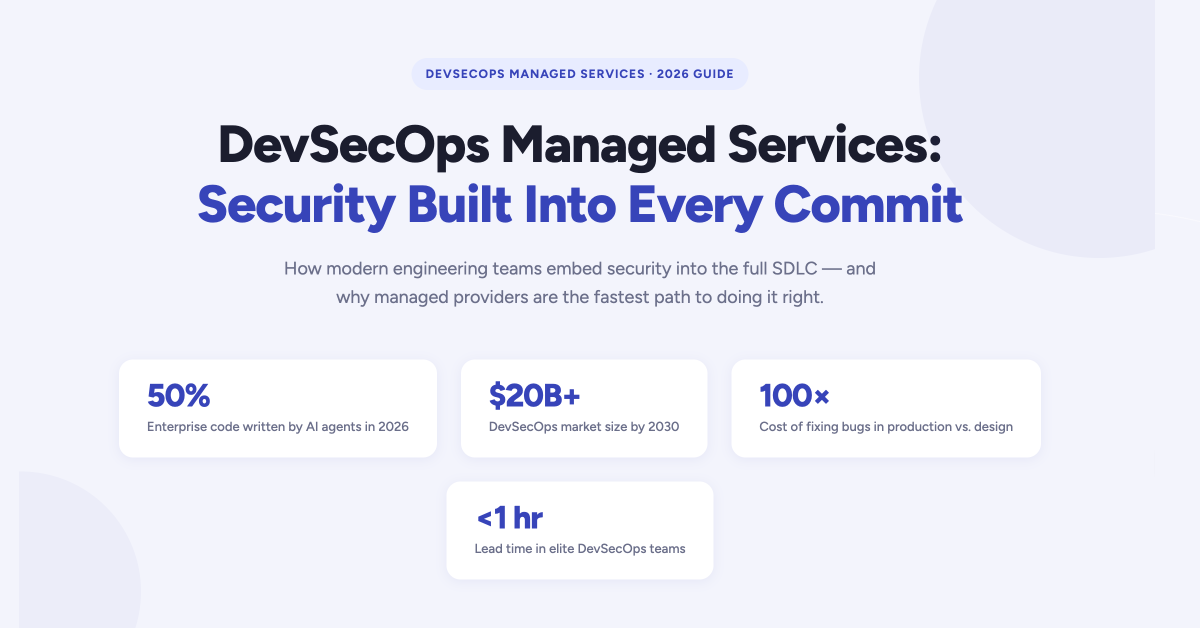
“Elite DevSecOps performers deploy multiple times per day with lead times for changes under one hour. That pace is impossible when security is a final gate — and it becomes natural when security is automated infrastructure.”
AI and autonomous remediation in DevSecOps
By 2025, Artificial Intelligence has moved from a marketing claim to a central technical enabler in managed DevSecOps. 63.3% of security professionals report that AI has become a helpful copilot for writing more secure code and automating application security testing. The most significant shift is the move from AI-assisted to agentic — systems that identify, triage, and remediate threats autonomously.
Real-time IDE assistance
Security feedback embedded directly in the editor. Vulnerabilities are flagged and explained at the moment of coding, not weeks later.
Adaptive DAST
AI-driven dynamic testing generates attack paths based on actual behavior, dramatically reducing false positives vs rule-based scanning.
Exploitability triage
Reachability analysis cuts alert noise by 70–80%, focusing attention on vulnerabilities that are actually exploitable in live environments.
Autonomous fix generation
Agentic tools write validated security fixes directly, resolving findings as fast as development moves — without human bottlenecks.
Predictive threat detection
ML algorithms trained on deployment history predict vulnerability patterns in new code before it ships, shifting feedback from detection to prevention.
Policy linting and governance
AI-guided query building for custom security rules, reducing the expertise barrier for policy-as-code adoption and compliance.
The Shadow AI risk
The rapid adoption of AI coding assistants like GitHub Copilot has introduced a new attack vector: Shadow AI — the unauthorized use of unmonitored AI tools in the development process. Approximately 10.7% of developers use AI assistants without official permission, introducing unverified code and potentially systemic vulnerabilities. A mature DevSecOps as a Service provider establishes governance frameworks to oversee AI usage, ensuring open-source models and AI-generated code are properly vetted before they enter the main branch.
The shared responsibility model
Successful DevSecOps as a Service engagements depend on a crystal-clear understanding of who owns what. The shared responsibility model defines which security tasks are managed by the service provider and which remain the customer’s obligation — and getting this wrong is one of the most common causes of managed security failures.
The general principle: the provider manages security of the platform and infrastructure; the customer retains responsibility for security in the application and data. But the details matter significantly depending on the deployment model.
| Layer | IaaS | PaaS | SaaS | Serverless |
|---|---|---|---|---|
| Physical security | Provider | Provider | Provider | Provider |
| Network infrastructure | Provider | Provider | Provider | Provider |
| Hypervisor / runtime | Provider | Provider | Provider | Provider |
| Operating system | Customer | Provider | Provider | Provider |
| Middleware / API | Customer | Provider | Provider | Provider |
| Application logic | Customer | Customer | Provider | Customer |
| Data & identity | Customer | Customer | Customer | Customer |
What a strong SLA looks like
A robust SLA in a DevSecOps as a Service contract goes beyond simple uptime guarantees. It should include specific, time-bound commitments for incident response — elite providers commit to a 15-minute response time for critical alerts. It should specify MTTR targets for different vulnerability severity levels. And critically, it should measure outcomes — frequency of successful releases, reduction in vulnerabilities discovered in production, compliance drift incidents — not just activity logs.
Legacy integration: the hardest problem in DevSecOps
Applying DevSecOps principles to legacy systems and monolithic applications remains one of the most significant challenges for enterprises. These systems, often built on outdated technologies, lack the modularity and APIs necessary for modern automated security toolchains. Security risks are amplified because many were developed before current security standards existed.
The technical debt challenge
Legacy codebases carry high levels of technical debt — poorly documented structures, proprietary data formats, and tightly coupled dependencies that make automated testing difficult and risky. Integration typically requires what practitioners call “system archaeology”: mapping behaviour through observation rather than documentation. A managed DevSecOps provider with legacy integration experience is invaluable here — they bring pattern libraries and phased-migration playbooks that dramatically reduce the time-to-secure for inherited systems.
Strategic modernization patterns
The most effective approach is a phased one: add security layers to older systems first (strong authentication, encrypted data at rest and in transit), standardize data formats to enable connectivity with modern tooling, then progressively containerize components to isolate legacy behaviour and reduce blast radius. Microservices architectures allow legacy components to be independently secured and updated without touching the whole system.
Avoiding vendor lock-in during the transition
Organizations should prioritize open standards throughout modernization. Standard container formats (Docker), open-source policy engines (OPA), and REST APIs ensure that infrastructure and governance rules can be moved between providers with minimal friction. A documented exit strategy — including data retrieval processes and costs — should be agreed before any service contract is signed.
Culture: the human layer of DevSecOps
Every practitioner agrees: DevSecOps is fundamentally a cultural transformation, not just a tooling change. Successful implementation requires breaking down the traditional silos between development, security, and operations teams to foster genuine shared ownership of security outcomes.
The Security Champion model
One of the most effective ways to scale security expertise across a large engineering organization is through Security Champions — individuals within development squads who receive specialized training and act as the primary security advocates for their teams. This bridges the expertise gap and ensures that security considerations are part of the conversation from the earliest planning phases, without requiring every developer to become a security specialist.
Continuous learning and Red Team exercises
A mature managed DevSecOps service includes security training for developer and operations teams as part of the engagement. This goes beyond compliance tick-boxes: it empowers developers to make independent security decisions during the build phase, reducing reliance on centralized reviews that create bottlenecks. Regular Red Team exercises — simulated attacks against real systems — test and sharpen defensive capabilities in a controlled environment, surfacing assumptions that no amount of policy documentation can reveal.
How to choose a DevSecOps as a Service provider
Not all managed DevSecOps providers are the same. The market ranges from pure-play security vendors offering narrow toolchains to full-service engineering partners who operate embedded within your delivery team. Here is what to evaluate:
Security depth across the SDLC
Does the provider cover every stage — from threat modelling at design through to runtime monitoring? Partial coverage leaves gaps attackers will find.
SLA specificity
Demand specific incident response times, MTTR commitments by severity level, and outcome-based metrics tied to your delivery objectives.
Team integration model
The best providers operate as an extension of your engineering team—attending standups and reviewing PRs—not as an external auditor.
Compliance domain expertise
Choose a provider with demonstrated vertical expertise (GDPR, HIPAA, PCI-DSS). Generic coverage is rarely adequate for regulated industries.
AI and automation maturity
Assess whether their AI capabilities reduce false positive rates and enable autonomous remediation, rather than just basic rule-based alerting.
Open standards and portability
Prioritize providers who build on open standards (OPA, Kubernetes, Terraform) so you retain architectural flexibility and avoid proprietary lock-in.
How Gart Solutions delivers DevSecOps as a Service
Gart Solutions is a Ukrainian-founded, internationally operating engineering team that has been embedding security into DevOps delivery pipelines since our founding. We work with startups, scale-ups, and enterprises in healthcare, fintech, retail, and greentech — industries where security failures are not theoretical risks but business-ending events.
Our approach to DevSecOps as a Service is rooted in three principles: embed rather than bolt on, automate everything measurable, and operate as part of your team — not alongside it.
1. Assessment and baseline (Weeks 1–2)
We begin with a comprehensive IT audit across your infrastructure, CI/CD pipeline, and application codebase. We map your current security posture, identify critical gaps, and establish baseline metrics for MTTR, vulnerability density, and compliance coverage. This is not a generic checklist — it is a tailored analysis of your actual systems.
2. Pipeline instrumentation (Weeks 2–5)
We instrument your CI/CD pipeline with SAST, SCA, DAST, and IaC scanning appropriate to your stack. Security gates are configured to block high-severity findings automatically while surfacing medium-severity issues for developer review — maintaining delivery velocity while hardening the pipeline. We integrate with your existing tools (GitHub Actions, GitLab CI, Jenkins, ArgoCD) rather than requiring migration to a new platform.
3. Kubernetes and cloud hardening (Weeks 3–6)
Our Kubernetes specialists implement runtime security policies, validate RBAC configurations, and deploy container image scanning into your registry workflow. Cloud accounts across AWS, Azure, and GCP are hardened against the CIS Benchmark and your specific compliance requirements. IaC templates are reviewed and updated to encode these standards going forward.
4. Compliance automation and monitoring (Weeks 5–8)
Continuous compliance evidence collection is activated across all relevant frameworks. A real-time monitoring dashboard surfaces the security posture of all environments. SLAs are agreed and SRE practices implemented to ensure reliability targets are maintained alongside security targets — not at their expense.
5. Ongoing operations and evolution
From go-live, our team operates as a continuous managed service: monitoring alerts, responding to incidents, reviewing new infrastructure designs, and advising on emerging threats. Regular threat modelling sessions keep your security posture ahead of evolving attack patterns, not reacting to them.
Gart Solutions by the numbers
Customer satisfaction score across all engagements
Clutch, 15 reviewsAverage cloud cost optimization delivered
Security + SavingsSystems availability maintained during peak loads
Zero DowntimeBetter operational efficiency vs baseline
Automation ImpactYears combined engineering team experience
DevOps & SecurityGart Solutions Engineering Team
We write from direct project experience — not from spec sheets. If you have a question about anything in this article, our team is available for a direct conversation.
Everything your infrastructure needs to scale securely
From secure CI/CD pipelines to cloud migration and Kubernetes hardening — we build the systems that let you move fast without breaking things.
DevOps Services
CI/CD pipeline design, automation, and optimization across AWS, Azure, and GCP. We accelerate delivery while building the guardrails that keep it safe.
IT Audit Services
Infrastructure audits and compliance assessments that surface real risk — not theoretical findings. The starting point for any DevSecOps engagement.
SRE Services
Site Reliability Engineering to guarantee uptime and performance. Proactive monitoring, incident response, and continuous improvement — as a service.
Infrastructure Management
Managed infrastructure designed for reliability and security alignment. We handle the operational complexity so your team stays focused on product.
Digital Transformation
Strategy-led modernization that integrates new technology and builds secure-by-design systems for the next decade of growth.
Fractional CTO
Strategic technical leadership on a flexible basis. Architecture decisions, security roadmaps, and team building without the full-time overhead.