How organizations can move beyond lift-and-shift to orchestrate AI agents, enforce digital sovereignty, and realize measurable technology value in 2026 and beyond.
The Smart Fabric Paradigm
The global technology landscape in 2026 has crossed a decisive threshold. Organizations no longer ask whether to adopt cloud — they ask how to orchestrate it. The early promise of cloud computing — elasticity, cost reduction, hardware abstraction — has been largely delivered. What remains is a far more demanding challenge: transforming cloud infrastructure from a cost centre into a living, intelligent fabric that generates measurable business value.
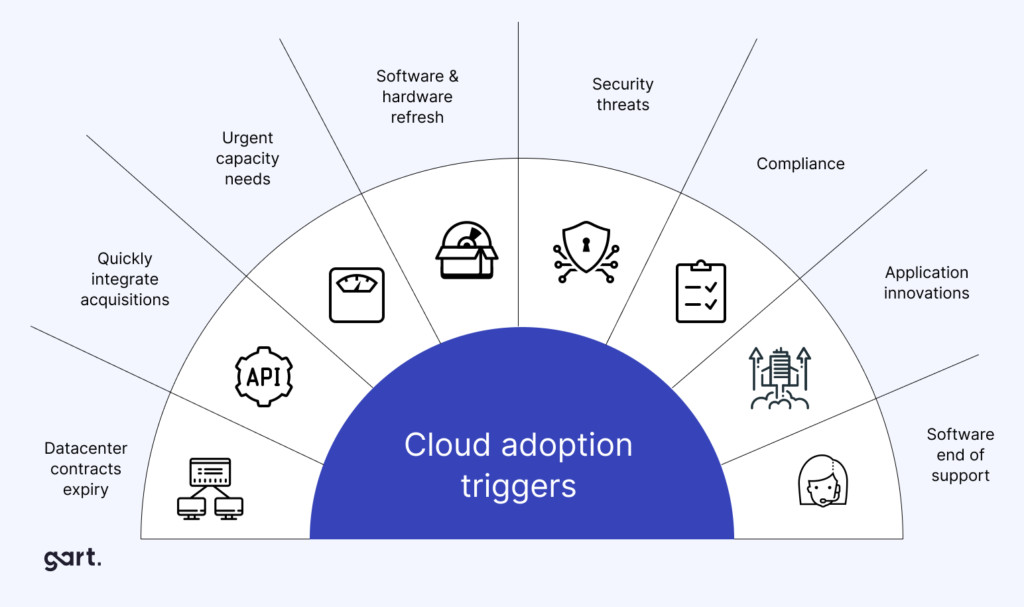
Three converging forces are reshaping this landscape simultaneously. Artificial intelligence has graduated from experimental pilots to core operational agents embedded inside the software development life cycle. Infrastructure economics are being fundamentally disrupted by high-bandwidth memory shortages and the rise of GPU-optimized “NeoClouds.” And a wave of rigorous regulation — led by the EU Cloud and AI Development Act — is forcing every enterprise to confront questions of digital sovereignty that were previously reserved for governments.
💡 Key Insight
The global cloud infrastructure market is projected to reach $2.4 trillion by 2032. Leaders who still treat cloud as a simple hosting environment will find themselves structurally disadvantaged compared to those treating it as a fabric for value, speed, and digital trust.
How Agentic AI is Shaping Modern Cloud Adoption Strategy
The most consequential shift in cloud strategy for 2026 is not architectural — it is operational. AI agents are no longer browser-based copilots offering code suggestions. They are deep operational participants: making autonomous decisions about workload placement, detecting and remediating security vulnerabilities, optimising resource spend in real time, and self-documenting the systems they maintain.
This transition elevates human engineers from writing lines of code to running smart build systems — systems that self-correct, self-document, and route decisions through policy guardrails without waiting for human approval. The practical consequence is that cloud architecture must now incorporate an AI agent mesh: a dedicated infrastructure layer that mediates communication between AI agents and models, enforces governance, and provides secure interaction across the enterprise fabric.
From Co-Pilots to Autonomous Agents
Early AI tooling in the SDLC was fundamentally advisory. By contrast, 2026-era agents are granted bounded autonomy: they can rebalance Kubernetes clusters, right-size pods, trigger rollback procedures, and manage spot instance pools — all without opening a ticket. Teams that have deployed such agents report 50–70% reductions in infrastructure costs and dramatic reductions in mean time to recovery (MTTR).
At Gart, we build this agent mesh layer as a first-class concern in every cloud engagement, ensuring that automation is governed, auditable, and aligned with client-specific cost and compliance boundaries.
Gart Perspective
Evolving DevOps: Integrating AI into Your Cloud Adoption Strategy
The migration from DevOps to AI-augmented operations is not a replacement of DevOps culture — it is its logical evolution. Continuous integration, infrastructure as code, and blameless post-mortems remain foundational. What changes is the execution layer: agents handle the repetitive, time-sensitive operations so engineers can focus on architecture, product, and innovation.
Cloud Adoption Strategy Frameworks: AWS, Azure, and Google
A successful cloud transformation requires a structured methodology to align business goals with technical execution. The three major hyperscalers have each developed comprehensive adoption frameworks, updated in 2026 to address AI integration, hybrid operations, and regulatory complexity.
AWS Cloud Adoption Framework (AWS CAF)
The AWS CAF organises capabilities into six perspectives: Business, People, Governance, Platform, Security, and Operations. The Business perspective ensures cloud investments are tied directly to digital ambitions with quantifiable outcomes. The Governance perspective is designed to minimise risk through policy automation and cloud financial management. For 2026, AWS has expanded its guidance around AI/ML workload readiness and model-agnostic deployment architectures, making it particularly well-suited for enterprises that need to interoperate across multiple AI providers.
Microsoft Azure Cloud Adoption Framework
Azure’s CAF organises the journey into seven methodologies: Strategy, Plan, Ready, Adopt, Govern, Secure, and Manage. The first four phases are sequential and foundational; the last three operate in parallel throughout the cloud lifecycle. In 2026, Microsoft has added specific guidance for generative AI adoption and unifying data platforms for high-performance analytics — making Azure CAF the strongest framework for organisations deeply embedded in the Microsoft 365 and Dynamics ecosystem.
Google Cloud Adoption Framework
Google’s framework identifies four themes: Lead, Learn, Scale, and Secure. The Lead theme balances top-down mandates with bottom-up momentum. The Scale theme is achieved by abstracting infrastructure through managed and serverless services. For 2026, Google has restructured its partner programme around real-world customer outcomes, with deep weighting on AI and analytics capabilities — reflecting its competitive strength in BigQuery and Vertex AI.
| Framework Pillar | AWS CAF | Azure CAF | Google Cloud |
|---|---|---|---|
| Leadership & Alignment | Business & People | Strategy & Plan | Lead |
| Environmental Readiness | Platform | Ready | Scale |
| Technical Execution | Operations | Adopt | Learn |
| Governance & Risk | Governance | Govern | Secure |
| Security Operations | Security | Secure | Secure |
| Lifecycle Management | Operations | Manage | Scale |
Applying the 7 Rs to Your Cloud Adoption Strategy
No single migration strategy fits every application. The 7 Rs framework remains the most practical tool for structuring portfolio-level migration decisions, balancing speed of delivery against long-term architectural value.
| Strategy | Also Known As | Best For | Value Horizon |
|---|---|---|---|
| Rehost | Lift-and-Shift | Legacy VM workloads needing fast exit from data centre | Short-term |
| Relocate | Hypervisor Lift | VMware-based workloads without OS changes | Short-term |
| Replatform | Lift-and-Reshape | DB → managed service (RDS), containerisation of monoliths | Mid-term |
| Refactor | Re-architect | Monoliths requiring cloud-native transformation to microservices | Long-term |
| Repurchase | Drop-and-Shop | On-premise CRM/ERP → SaaS (e.g. Salesforce, Workday) | Mid-term |
| Retire | Decommission | Applications that no longer deliver business value | Immediate |
| Retain | Revisit | Workloads with complex compliance or latency dependencies | Deferred |
The critical discipline is portfolio segmentation: mapping each application against business criticality, refactoring cost, and regulatory sensitivity before assigning an R-strategy. At Gart, our IT Audit process delivers this segmentation as a structured output — giving leadership a clear migration backlog with effort, risk, and cost estimates before a single workload moves.
Microservices in Cloud Adoption Strategy: When to Refactor
Refactoring to microservices is the most transformative — and most misapplied — strategy in the portfolio. For large, complex applications requiring high agility and independently scalable components, microservices deliver genuine resilience and deployment velocity. However, for small or simple applications, the operational overhead of a distributed system — service discovery, inter-service authentication, distributed tracing, and eventual consistency — significantly outweighs the benefit. The migration strategy must match the application’s complexity, not the architecture’s prestige.
Digital Sovereignty: The Regulatory Dimension of Cloud Strategy
By 2026, cloud strategy and geopolitical risk management have converged. The EU Cloud and AI Development Act, proposed by the European Commission in Q1 2026, seeks to harmonise cloud architecture requirements across member states and structurally reduce European dependency on US-headquartered hyperscalers — which currently control over 70% of the market.
For enterprises, the operative concern is the US CLOUD Act: American authorities retain legal authority to request access to data held by US-incorporated cloud providers, regardless of where the data is physically stored. This creates a jurisdictional exposure that European regulators are moving decisively to address.
| Region | 2025 Spend (USD M) | 2026 Spend (USD M) | 2027 Spend (USD M) |
|---|---|---|---|
| China | $37,539 | $47,379 | $58,544 |
| North America | $12,667 | $16,394 | $21,127 |
| 🇪🇺 Europe | $6,868 | $12,587 | $23,118 |
| Mature Asia/Pacific | $851 | $1,593 | $3,155 |
| Middle East & Africa | $132 | $250 | $515 |
| Global Total | $59,300 | $80,427 | $110,609 |
Europe’s sovereign cloud spending is forecast to nearly double in a single year — the fastest regional acceleration globally. AWS, IBM, and a growing cohort of EU-native providers have responded with sovereign cloud offerings specifically designed to maintain data residency and governance authority within the European Union.
Action Point
For European Enterprises
Conduct a jurisdictional exposure audit across your workload portfolio. Classify data by regulatory sensitivity and map it against provider sovereignty commitments. For regulated industries — energy, finance, healthcare, telecoms — default to sovereign-compliant deployments for any data touching EU citizens.
FinOps 2026: From Cost Cutting to Technology Value Management
Cloud financial management has undergone a structural transformation. What began as a practice of turning off unused virtual machines has evolved into a comprehensive discipline spanning SaaS, data centres, licensing, and AI infrastructure. The State of FinOps 2026 report reveals that 98% of practitioners now manage AI spend as a core part of their remit — reflecting the degree to which AI infrastructure has become inseparable from cloud budgeting.
Shift Left, Shift Up
Two structural shifts are reshaping how financial accountability operates within engineering organisations. “Shift Left” embeds cost awareness directly into the SDLC: engineers and architects estimate the spend impact of design decisions before deployment, preventing expensive patterns from entering production. “Shift Up” elevates FinOps leaders to participate in provider negotiations and multi-year investment decisions at the executive level — making financial fluency a core engineering leadership competency, not a finance department afterthought.
The underlying principle is that every workload must have an owner and every cloud dollar must map to a unit economic metric: cost-per-customer, cost-per-transaction, cost-per-model-run. This transforms cloud spend from a lumpy line item into a predictable, decision-driven signal.
AI-Driven Autonomous FinOps Agents
Manual cost management at cloud scale is no longer viable. The 2026 generation of autonomous FinOps agents handles continuous cost diagnostics, real-time anomaly detection, Kubernetes rebalancing, pod right-sizing, and spot instance management — without human approval gates. These agents translate thousands of lines of cost and usage reports into natural-language insights tailored to specific personas, from the CFO to the site reliability engineer.
| Agent Type | Core Focus | Key Capability in 2026 |
|---|---|---|
| X-Ray / Diagnostic | Financial Health Checks | Surfaces inefficiencies in under 30 seconds |
| Governance | Budget Drift & Tag Hygiene | Automates root-cause analysis and ownership assignment |
| Optimisation | Rate & Resource Management | Executes strategies 24/7 without human approval |
| Reporting | Persona-Specific Insights | Generates context-ready reports for CFO to SRE |
GreenOps and Sustainable Cloud Architecture
Sustainability has moved from a secondary ESG reporting obligation to a primary architectural constraint. The surge in AI-driven compute demand has placed cloud infrastructure at a critical environmental junction: operational growth must be structurally decoupled from carbon output. GreenOps — the operational discipline of managing cloud workloads for carbon efficiency — is the mechanism for achieving this decoupling.
Carbon-Aware Computing
The most impactful development in 2026 is the operationalisation of carbon-aware workload scheduling. Non-critical batch processing — data backups, model training runs, analytics pipelines — is shifted in time and geography to align with moments when the local power grid is drawing the highest proportion of renewable energy. Hyperscalers now provide real-time carbon intensity telemetry that feeds directly into orchestration layers, enabling fluid, environmentally-responsive infrastructure decisions.
Green AI and Efficient Hardware
The energy cost of generative AI training and inference is substantial. Technical leaders are mitigating this through purpose-built AI accelerators and ARM-based architectures that deliver significantly better performance per watt than general-purpose hardware. Combined with 100% renewable energy contracts and advanced liquid cooling techniques, modern hyperscale data centres now achieve Power Usage Effectiveness (PUE) ratios at or below 1.1 — up to five times more energy-efficient than traditional on-premise setups.
Carbon Impact
Carbon Impact of Cloud Migration
Moving from legacy on-premise infrastructure to a modern cloud architecture can reduce a company’s digital carbon footprint by up to 80%. This is not a marginal efficiency gain — it is a structural transformation that positions cloud migration as both an economic and an environmental imperative.
| Sustainability Dimension | Key 2026 Metric | Strategic Target |
|---|---|---|
| Infrastructure | Carbon Intensity (kg CO₂e / workload) | −40% Year-over-Year |
| Model Efficiency | Energy per Training Epoch | ≤ Baseline − 25% |
| Application Efficiency | Joules per Inference | ≤ 0.5 J / Inference |
| Governance | % Workloads under GreenOps | 90% |
| Data Centres | Power Usage Effectiveness (PUE) | 1.1 or lower |
AWS vs Azure vs Google Cloud: Choosing the Right Foundation
The hyperscaler decision in 2026 is less about feature parity — all three offer comprehensive services — and more about ecosystem alignment and strategic centre of gravity. The right choice depends on where your organisation’s heaviest technical investments already lie, and where you intend to build your AI and data capabilities.
AWS: Maximum Breadth and Flexibility
AWS retains market leadership at approximately 29–30% share, distinguished by its ecosystem depth — over 250 services, the broadest global region footprint, and the most mature model-agnostic AI strategy. It is the default choice for organisations requiring maximum configurability, large-scale B2C platforms, or multi-cloud portability. The tradeoff is complexity: AWS pricing requires dedicated management attention, and service sprawl is a real operational risk for teams without disciplined governance.
Azure: Enterprise Integration and Hybrid Excellence
Azure is the natural home for organisations already running Microsoft 365, Teams, and Active Directory. Its hybrid story — delivered through Azure Arc, which extends unified governance to on-premises and edge environments — remains unmatched. The Azure Hybrid Benefit provides compelling cost advantages for organisations with existing Microsoft licensing. Azure AI is oriented toward making machine learning accessible to business analysts and non-specialist developers, making it the strongest platform for enterprise-wide AI democratisation.
Google Cloud: Data, Analytics, and Cloud-Native Velocity
GCP excels where data is the primary strategic asset. BigQuery’s serverless analytics engine and Vertex AI’s native Gemini multimodal models make it the preferred platform for data-heavy applications, recommendation engines, and predictive analytics. Google’s private global fibre network delivers exceptionally low latency, and its leadership in Kubernetes — the platform originated at Google — provides unmatched depth for container-native architectures. The tradeoff is a smaller enterprise sales footprint compared to AWS and Azure.
Gart’s Framework
Hyperscaler Decision Framework
We advise clients to evaluate four dimensions: existing ecosystem investment (Microsoft, AWS, or Google native tooling), AI and data architecture requirements, hybrid and edge needs, and regulatory sovereignty obligations. In practice, most enterprises with complex environments benefit from a multi-cloud strategy — not for every workload, but to avoid strategic dependency on a single provider for mission-critical capabilities.
Implementation Roadmap: Three Phases to Intelligent Cloud
Successful cloud transformation follows a disciplined, phased approach that integrates technology, financial governance, and sustainability objectives from the start — not as afterthoughts.
Months 1–3
Assessment & Strategic Alignment
Conduct a full IT portfolio audit and map workloads against the 7 Rs framework. Define business motivations — cost optimisation, agility, regulatory compliance — and build a quantified business case. Identify jurisdictional risk across the workload portfolio and evaluate sovereign cloud requirements. Form platform engineering teams and establish the cloud centre of excellence (CCoE).
Months 4–6
Foundation Building
Establish the landing zone: network architecture, security policies, and governance controls. Implement Infrastructure as Code using Terraform or Pulumi for reproducibility. Deploy multi-account management via AWS Control Tower or Azure Landing Zones. Activate unified cost and carbon visibility tooling. Begin AI infrastructure standardisation and deploy the initial agentic mesh for model orchestration.
Months 7–12+
Migration, Modernisation & Optimisation
Execute workload migration in prioritised waves, beginning with quick-win applications. Define cut-over and rollback plans for each wave. Modernise high-value workloads from monoliths to microservices or serverless patterns. Activate autonomous FinOps and GreenOps agents for continuous optimisation. Transition from reactive reporting to proactive cost and carbon engineering embedded in the SDLC.
Conclusion: Scaling Smarter in the AI Era
The 2026 cloud adoption strategy is no longer a technology project — it is a business transformation programme with technology at its core. The organisations that thrive will not simply be those that move workloads faster, but those that build cloud environments designed for three simultaneous imperatives: intelligence (AI agents embedded in operations), sovereignty (data governance aligned with jurisdictional reality), and value (every cloud dollar mapped to a measurable business outcome).
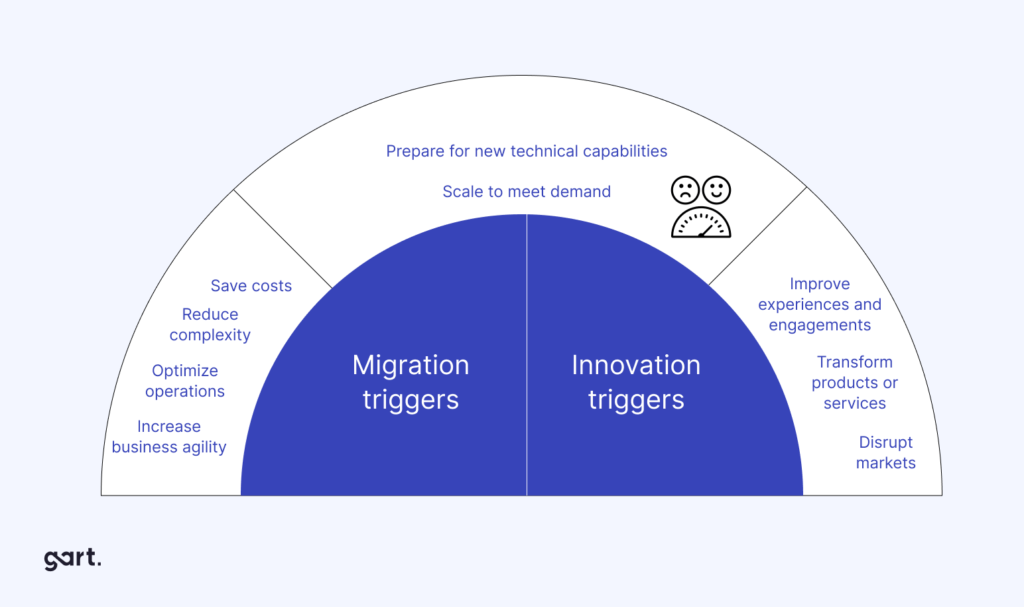
The good news is that the frameworks, tools, and expertise to execute this transformation exist today. The 7 Rs provide a structured migration decision model. The hyperscaler CAFs provide proven organisational and technical scaffolding. Autonomous FinOps and GreenOps agents make it possible to manage complexity at a scale that was previously beyond reach. What separates leaders from laggards is not access to tools — it is the discipline to apply them with strategic intentionality.
At Gart, we help engineering teams and technology leaders navigate this complexity — from the initial IT audit and workload assessment through to full production migration and ongoing optimisation. Whether you’re rearchitecting a SaaS platform, establishing a sovereign cloud footprint in Europe, or building the FinOps function your AI workloads demand, we bring the technical depth and operational experience to deliver outcomes that matter.
See how we can help to overcome your challenges