- What is Digital Transformation in Healthcare?
- Why Is It Gaining Momentum Now?
- Key Drivers of Digital Transformation in Healthcare (2026)
- Measurable Benefits of Digital Transformation in Healthcare
- Challenges to Healthcare Digital Transformation (and How to Overcome Them)
- 10 Real-World Cases of Digital Transformation in Healthcare
- How Digital Transformation Enhances Patient Experience
- Step-by-Step Digital Transformation Roadmap for Healthcare Organizations
- Lessons from Failed Healthcare Digital Transformation Projects
- Regulatory Frameworks Driving Healthcare Digital Transformation
- Struggling with Your Healthcare Digital Transformation?
- Conclusion
What is Digital Transformation in Healthcare?
Digital transformation in healthcare is no longer a future trend — it is the operational baseline for organizations that want to survive and lead in 2026.
Digital transformation in healthcare refers to the systematic integration of digital technologies — AI, cloud infrastructure, IoT, telemedicine, electronic health records (EHR), robotics, and advanced analytics — into every dimension of healthcare delivery, management, and operations.
It goes far beyond swapping paper for screens. A genuine digital transformation rethinks how hospitals, clinics, labs, and insurers create value for patients and how they collaborate across the entire care continuum.
Simple definition: Digital transformation in healthcare means using technology to fundamentally improve how care is delivered, experienced, and paid for — not just digitizing existing processes, but redesigning them from the ground up.
This guide breaks down 10 real implementation cases, the most common challenges, measurable benefits, and a practical roadmap for healthcare leaders.
Why Is It Gaining Momentum Now?
Several converging forces accelerated healthcare digitization well beyond the COVID-19 period:
- Rising patient expectations:Patients compare healthcare to their experience with Amazon or Netflix and demand convenience, personalization, and instant access to their data.
- Technology maturity:AI, large language models, and IoT devices reached production-grade reliability that makes large-scale healthcare deployment viable.
- Financial pressure:Hospital margins compressed significantly post-pandemic. Automation and digital workflows are now a profitability lever, not a luxury.
- Regulatory mandates:Governments from the US to the EU now require interoperable digital health records, telemedicine reimbursement frameworks, and mandatory data security standards.
- Workforce shortages:With over 10 million unfilled healthcare roles globally projected by 2030 (WHO), automation and AI-assisted care are becoming a workforce strategy.
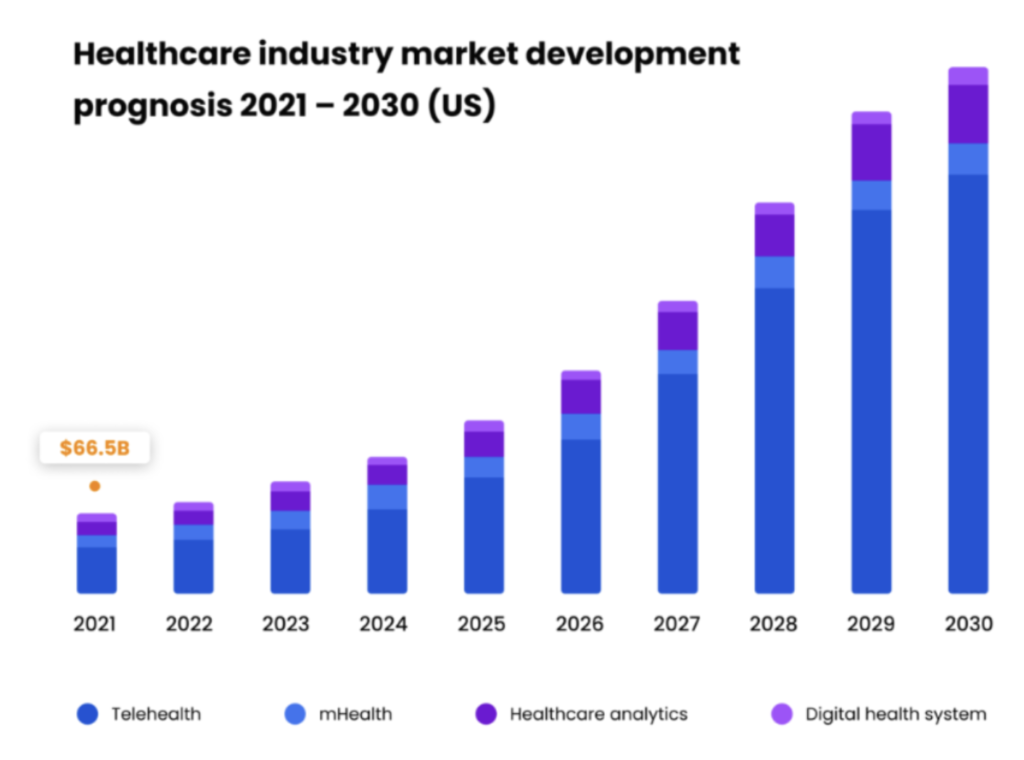
A Statista report projects the global digital healthcare market to reach $504.4 billion by 2025, underscoring how essential digital transformation has become for competitive and efficient healthcare delivery.
88% of healthcare technology leaders prioritize improving the patient experience in their investments (according to a Deloitte survey)
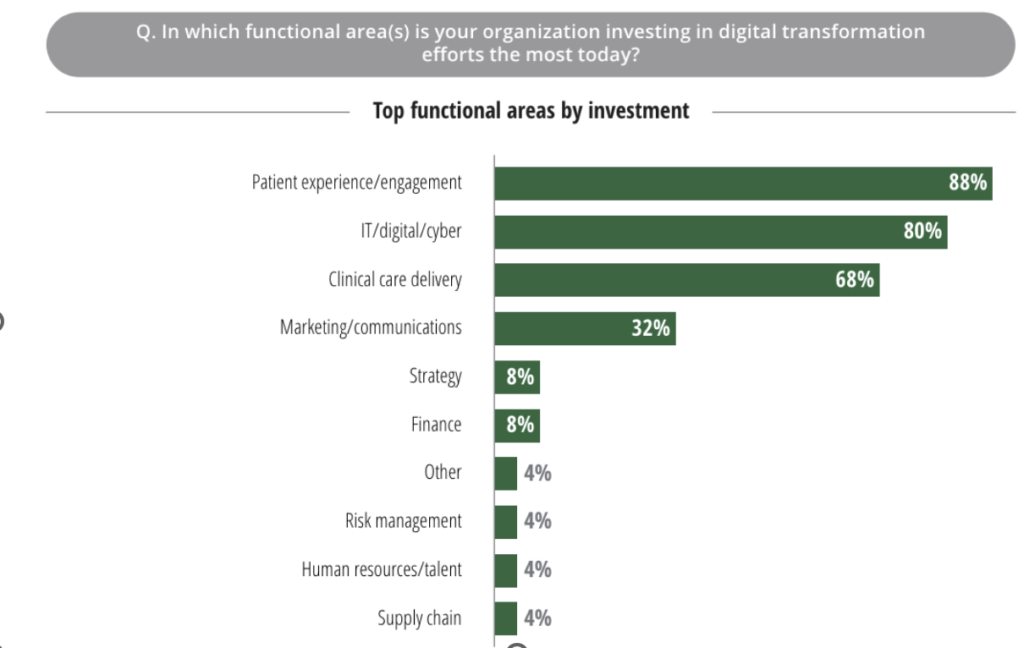
This shift underscores the necessity for healthcare professionals, including doctors, nurses, and administrative staff, to stay abreast of ongoing digital advancements.
Key Drivers of Digital Transformation in Healthcare (2026)
Artificial Intelligence
AI has crossed from experimental to mission-critical in healthcare. Today it powers:
- Automated clinical documentation that reduces physician burnout
- Diagnostic imaging analysis for radiology, pathology, and ophthalmology with accuracy matching or exceeding specialists
- Predictive risk scoring for sepsis, cardiac events, and readmission prevention
- AI-powered triage chatbots that handle over 30% of patient inquiries without human escalation
- Drug discovery acceleration through molecular simulation (reducing timelines from years to months)
Google DeepMind’s AlphaFold resolved a 50-year protein-folding problem, and its healthcare applications now inform drug design globally — a concrete proof point that AI delivers transformative, not incremental, value.
Internet of Things (IoT) in Healthcare
The number of connected medical devices globally exceeded 500 million in 2025. These devices enable:
- Continuous remote patient monitoring for chronic conditions, reducing hospital admissions by up to 38%
- Smart hospital infrastructure (asset tracking, bed management, HVAC optimization)
- Wearable biosensors detecting arrhythmias, hypoglycemia, and medication adherence in real time
Cloud Infrastructure
Modern healthcare digital transformation runs on HIPAA-compliant cloud platforms. Cloud enables scalable data storage, real-time analytics, disaster recovery, and the computational power required for AI workloads — without the capital cost of on-premise data centers.
Robotics and Automation
Beyond the well-known da Vinci Surgical System, robotics now extends to hospital logistics (automated medication dispensing, supply chain robots), rehabilitation (exoskeletons), and AI-assisted clinical decision support that automates protocol-driven care decisions.
Measurable Benefits of Digital Transformation in Healthcare
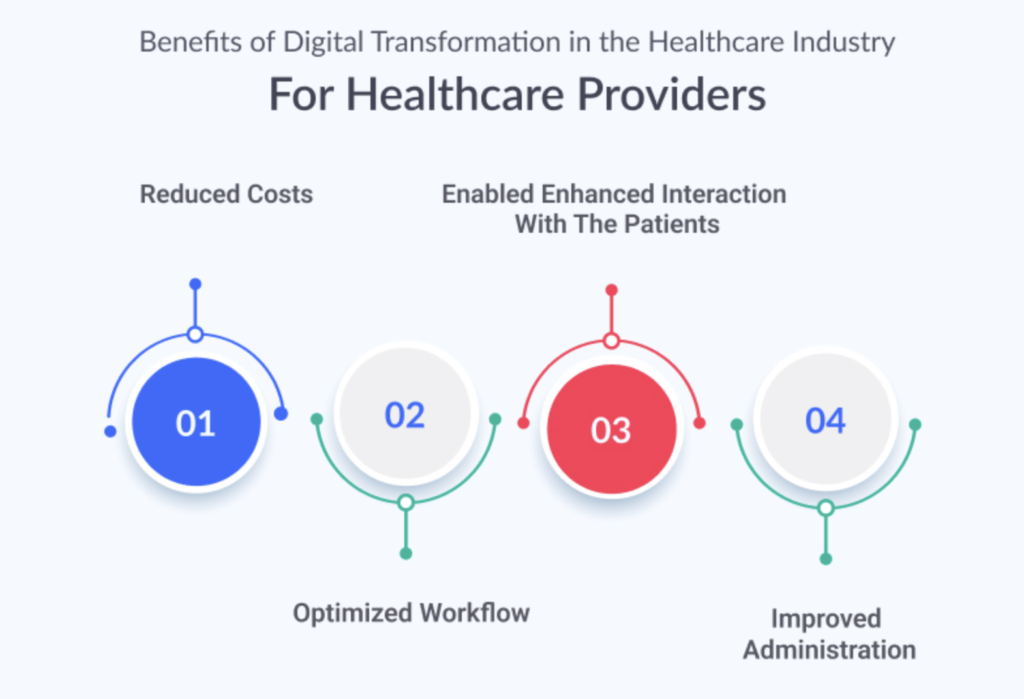
The audit of this content flagged that generic benefit lists are insufficient. Below is a structured view with real benchmarks:
| Benefit Area | What It Means | Real-World Metric |
|---|---|---|
| Cost Reduction | Automating administrative tasks (scheduling, billing, coding) and optimizing infrastructure | 15–30% reduction in IT operational costs; up to 40% reduction in administrative overhead |
| Workflow Optimization | AI-assisted triage, digital care pathways, and automated alerts reduce manual bottlenecks | Deployment time reduced from days to hours (CI/CD implementation cases) |
| Patient Outcomes | Earlier diagnosis, personalized treatment plans, and reduced preventable readmissions | 38% reduction in hospital readmissions with remote monitoring programs |
| Interoperability | Unified patient data accessible across departments and care settings | Reduced duplicate testing, faster diagnosis cycles |
| Revenue Cycle | Automated claims processing, error reduction, and faster reimbursement | Denial rates drop significantly with AI-powered coding assistance |
| Security & Compliance | Continuous monitoring, encryption, and automated compliance controls | Proactive detection of incidents before they escalate to breaches |
The ROI of digital transformation in healthcare is not just financial. Hospitals that have successfully digitized report improved staff satisfaction, higher patient NPS scores, and significantly faster time-to-care — outcomes that reinforce each other in a virtuous cycle.
Challenges to Healthcare Digital Transformation (and How to Overcome Them)
Data Privacy & Security
Healthcare data is 10× more valuable than financial data on the dark web, making it the top target for ransomware. HIPAA, GDPR, and ISO 27799 compliance is non-negotiable.
Legacy System Integration
Most healthcare organizations run on 10–20 year old systems. Integrating modern platforms with these via HL7 FHIR standards requires careful architecture planning.
Resistance to Change
Clinical staff distrust technology that disrupts established workflows. Change management, co-design with clinicians, and phased rollout dramatically increase adoption rates.
Skills Gaps
Digital literacy varies widely across healthcare workforces. Continuous training programs and UX-first technology design are the twin levers for closing this gap.
Cost of Implementation
Enterprise digital transformation has high upfront costs. Cloud-first and phased approaches reduce capital risk while delivering measurable ROI within 12–18 months.
Interoperability Gaps
Data silos between EHR, labs, and payers prevent unified views. HL7 FHIR R4 and modern API-first architecture are the industry’s emerging answer.
10 Real-World Cases of Digital Transformation in Healthcare
Infrastructure Optimization & Data Management in Healthcare
ChallengeA health tech company operated on outdated, non-scalable infrastructure with frequent downtimes that directly impacted patient care operations and data availability.
SolutionGart Solutions implemented a comprehensive infrastructure modernization: legacy system migration to cloud, HIPAA-compliant secure data management pipelines, and dynamic auto-scaling.
ImpactEliminated critical downtimes, reduced data access latency, and achieved full HIPAA compliance — enabling the organization to scale operations without infrastructure risk.
Read the full case study →CI/CD Pipelines for an E-Health Platform
ChallengeAn e-health platform suffered from slow, error-prone manual deployments that delayed feature releases and introduced instability in a compliance-sensitive environment.
SolutionAutomated CI/CD pipelines with Kubernetes orchestration, integrated compliance checks, and real-time monitoring with automated rollback capabilities.
ImpactDeployment time dropped from days to hours. Human error rates fell significantly. Feature velocity increased, enabling the platform to respond faster to clinical user needs.
View case study →Electronic Medical Records (EMR) for a Government E-Health Platform
ChallengeA government E-Health initiative required a compliant, secure EMR platform with strict HIPAA and GDPR requirements, deployed on local cloud infrastructure.
SolutionGart deployed on-premises CI/CD pipelines using GiGa Cloud hardware with VMware ESXi, Terraform, and data-masking techniques for non-production environments.
ImpactDelivered a fully compliant, secure EMR system enabling the government platform to serve thousands of patients while passing all regulatory audits.
Healthcare SaaS Migration: AWS to Azure with PHI Compliance
ChallengeA high-growth healthcare SaaS company needed to revamp CI/CD pipelines for .NET and Node.js environments and migrate from AWS to Azure without disrupting PHI access compliance.
SolutionGart implemented Terraform infrastructure-as-code, rebuilt CI/CD pipelines for both stacks, and orchestrated a zero-downtime cloud migration with compliance maintained throughout.
ImpactSeamless migration with full PHI access compliance maintained. Improved infrastructure cost efficiency and development velocity post-migration.
HIPAA Migration: HealthCareBlocks to AWS (Ruby on Rails)
ChallengeA Ruby on Rails healthcare application needed migration from HealthCareBlocks to Amazon AWS with strict HIPAA compliance requirements and zero tolerance for data integrity risk.
SolutionGart led a meticulous migration with continuous HIPAA compliance validation at every stage, encryption in transit and at rest, and a phased cutover to eliminate downtime risk.
ImpactFull migration completed without compliance incidents. Application performance improved on AWS infrastructure with better scalability for future growth.
ISO 27001 Compliance & Cloud Migration (Spiral Technology)
ChallengeSpiral Technology faced dual challenges: achieving ISO 27001 certification and migrating to cloud simultaneously, with data security as the primary constraint.
SolutionGart provided end-to-end ISO 27001 implementation guidance, risk assessment frameworks, and a detailed cloud migration plan with advanced encryption and monitoring.
ImpactISO 27001 certification achieved. Continuous monitoring established post-migration to maintain compliance and detect emerging threats in real time.
Google DeepMind Health — AI Diagnostics for Ophthalmology
ChallengeOphthalmology screening capacity globally is constrained by specialist availability, causing diagnosis delays for conditions like diabetic retinopathy and age-related macular degeneration.
SolutionDeepMind Health developed an AI system trained on retinal scans that can detect over 50 eye conditions with accuracy matching or exceeding specialist ophthalmologists.
ImpactDeployed in major hospital systems, the AI enables rapid first-line screening, routing only complex cases to specialists — dramatically increasing diagnostic throughput.
Telehealth at Scale — Pandemic Response & Beyond
ChallengeThe COVID-19 pandemic created overnight demand for remote consultation infrastructure that most healthcare systems were not equipped to deliver at scale.
SolutionHealth systems globally rapidly deployed cloud-based telehealth platforms, integrated with EHR systems, enabling video consultations, e-prescriptions, and remote monitoring.
ImpactTelehealth usage surged over 154% vs pre-pandemic levels. Beyond the crisis, a permanent behavioral shift: patients now expect remote access as a standard offering.
IoT-Enabled Remote Patient Monitoring for Chronic Disease
ChallengePatients with chronic conditions like heart failure and COPD represent a disproportionate share of hospital readmissions, driven by delayed detection of deteriorating vitals.
SolutionIoT remote monitoring programs deploy connected biosensors that transmit real-time vitals to clinical dashboards, triggering automated alerts when thresholds are crossed.
ImpactHospital systems report up to 38% reduction in 30-day readmission rates — one of the highest-ROI interventions in value-based care.
Robotic Process Automation (RPA) in Healthcare Administration
ChallengeHealthcare administrative staff spend up to 34% of their time on repetitive manual tasks: prior authorizations, claims processing, and scheduling — tasks prone to error and burnout.
SolutionRPA bots handle end-to-end administrative workflows — pulling patient data, filling forms, submitting claims, and triggering exceptions for human review only when needed.
ImpactOrganizations report 40–70% reduction in administrative processing time and reallocation of staff capacity to higher-value clinical support work.
How Digital Transformation Enhances Patient Experience
Telehealth and Remote Consultations
The telehealth revolution is permanent. Beyond the pandemic-era necessity, patients now actively choose virtual care for its convenience. Modern telehealth platforms enable:
- Real-time video consultations with prescriptions delivered to pharmacy within minutes
- Telepsychiatry for mental health access in underserved regions
- Continuous remote management of diabetes, hypertension, and cardiac conditions
- Second-opinion consultations with specialists regardless of geography
Personalized Medicine and AI Diagnostics
Digital transformation enables care that was genuinely impossible a decade ago. AI-assisted diagnostics analyze radiology images, ECGs, and genomic data to detect diseases at stages where intervention has the highest impact. IBM Watson Health, for example, analyzes thousands of patient records to surface treatment recommendations that clinicians may not have considered.
Predictive analytics now enable proactive rather than reactive care — identifying patients at elevated risk for sepsis, cardiac events, or 30-day readmission before deterioration begins, enabling earlier, cheaper, and more effective interventions.
Patient Data Security as a Patient Experience Issue
Patients increasingly understand that data security is not just a compliance issue — it is a trust issue. Healthcare organizations that demonstrate strong cybersecurity practices, transparent data use policies, and prompt breach response build significantly higher patient loyalty and satisfaction.
Step-by-Step Digital Transformation Roadmap for Healthcare Organizations
Assessment & Strategy
Conduct an IT infrastructure audit to map current systems, identify compliance gaps, cost inefficiencies, and security exposures. Define transformation goals aligned to clinical and business outcomes.
Foundation & Security
Establish cloud infrastructure with HIPAA-compliant architecture. Implement IAM, encryption, MFA, and continuous monitoring from day one. This foundation is what everything else builds on.
Core System Modernization
Migrate priority workloads to cloud. Integrate EHR systems with modern APIs. Deploy CI/CD pipelines for healthcare applications. Begin HL7 FHIR implementation for interoperability.
Digital Care Enablement
Roll out telehealth platforms, patient portals, and mobile access. Deploy IoT remote monitoring for chronic disease populations. Introduce AI-assisted documentation and triage tools.
Analytics & AI
Build a unified data platform. Implement predictive analytics for readmission risk, staffing optimization, and supply chain management. Introduce AI diagnostics for clinical workflows.
Continuous Improvement & Scale
Establish KPIs and measure outcomes quarterly. Expand successful pilots across the organization. Maintain compliance posture through regular IT audits and staff training.
Lessons from Failed Healthcare Digital Transformation Projects
Analyzing transformations that underdelivered reveals consistent failure patterns that are entirely preventable:
| Failure Pattern | What Goes Wrong | Prevention |
|---|---|---|
| Technology-first thinking | Deploying tools without redesigning workflows. Staff work around the technology, defeating its purpose. | Start with patient/clinical outcomes. Technology serves the workflow redesign. |
| Big Bang implementations | Attempting full-system replacement in a single cutover event creates catastrophic risk in healthcare. | Phased rollout with parallel systems during transition. Pilot → expand. |
| Security bolted on late | Compliance and security added after build creates architectural debt that is expensive and risky to remediate. | Security-by-design from the first line of architecture. HIPAA compliance as a design requirement. |
| Underestimating change management | Clinical staff resistance kills adoption rates. The best system unused is worthless. | Clinicians co-design the solution. Change management and training investment matches technology investment. |
| No clear ownership | Transformation projects without a clinical champion and executive sponsor drift, stall, or get abandoned. | Assign a dedicated transformation leader with cross-functional authority and clinical credibility. |
Regulatory Frameworks Driving Healthcare Digital Transformation
Digital transformation in healthcare does not happen in a regulatory vacuum. Compliance requirements actively shape architecture decisions, vendor selection, and deployment timelines:
| Framework | Scope | Impact on Digital Transformation |
|---|---|---|
| HIPAA | US — Protected Health Information (PHI) | Mandates encryption, access controls, audit trails, and breach notification. Shapes all cloud architecture decisions. |
| GDPR | EU — All personal data including health records | Requires data minimization, consent management, and right to erasure. Affects global platforms serving EU patients. |
| HITECH Act | US — Electronic Health Records | Incentivizes meaningful use of EHR technology. HIPAA-compliant apps are considered HITECH compliant. |
| ISO 27001 | Global — Information Security Management | Gold standard for security governance. Required by many enterprise healthcare clients as vendor qualification. |
| HL7 FHIR | Global — Interoperability Standard | Enables data exchange between different healthcare systems. Increasingly mandated by US CMS for payers. |
Struggling with Your Healthcare Digital Transformation?
Gart Solutions has helped health tech companies navigate infrastructure modernization, HIPAA compliance, cloud migration, and DevOps transformation. We deliver quick wins from day one.
Conclusion
Healthcare organizations understand that digital transformation is crucial for enhancing healthcare services and strengthening patient relationships. Beyond technology investments, this transformation necessitates a shift in organizational culture and employee engagement, requiring enterprise-wide involvement.
Leading health organizations are adopting six key strategies to advance digitally:
- Establish digital leadership and governance aligned with business strategies.
- Cultivate a digital culture supported by leadership at all organizational levels.
- Develop next-generation talent with a focus on workforce quality and quantity.
- Integrate cybersecurity at all stages for robust risk management.
- Emphasize flexibility and scalability to adapt to evolving technologies.
- Implement measurable, accountable KPIs to track the success of digital initiatives.
Successfully navigating digital transformation in healthcare requires expertise and a business-first approach of IT Consulting.
Gart Solutions can guide healthcare providers through the process of Digital Transformation, accelerating the adoption of digital healthcare technologies and improvement of patient outcomes.
Contact Gart today to learn more about how we can help you solve the challenges of digital transformation in healthcare.
Struggling with digital transformation for your healthcare project? Get expert guidance and IT Consultancy for your project free of charge. “Quick wins” – guaranteed. Contact Us.