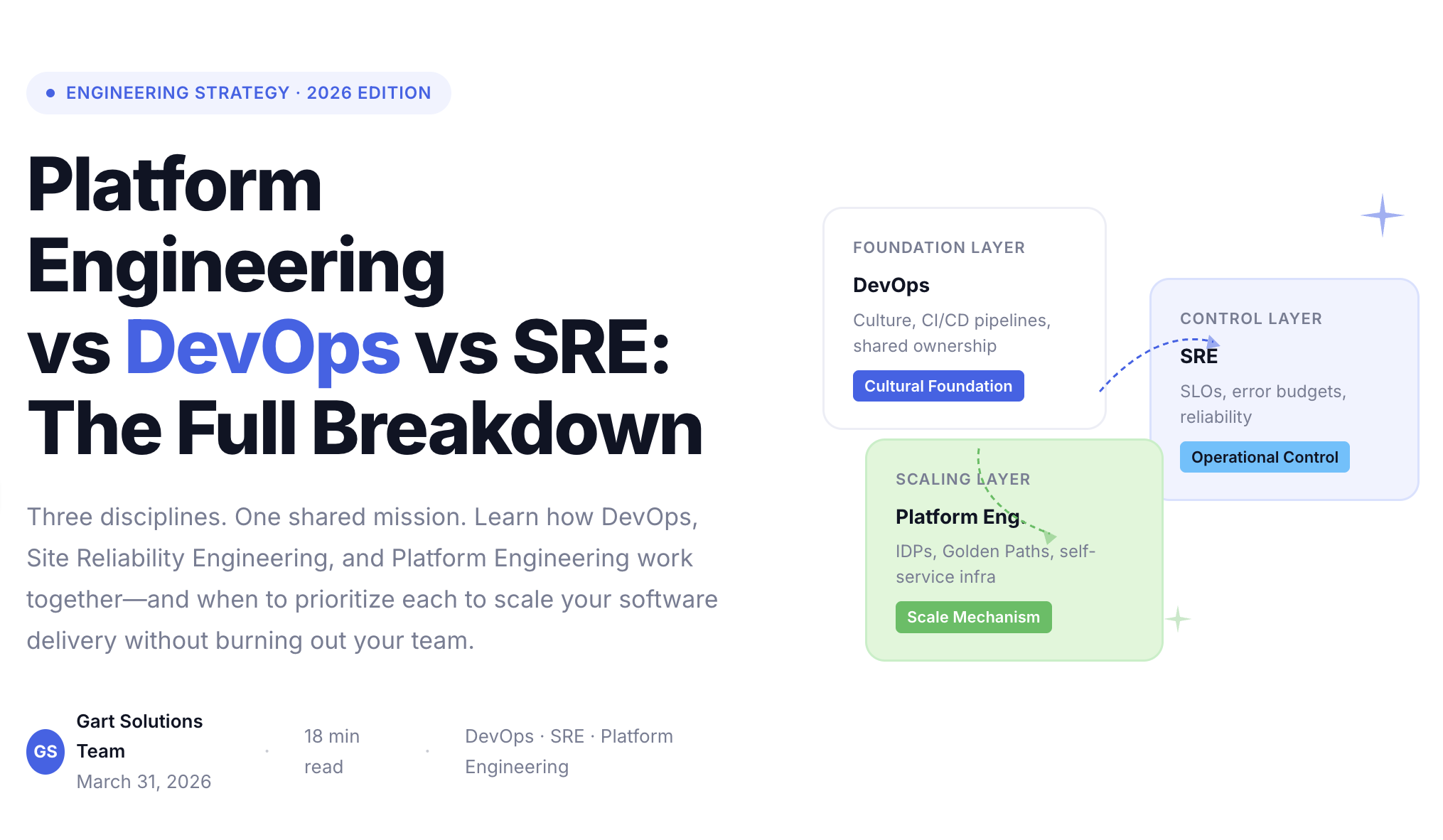
Three disciplines. One shared mission. Learn how DevOps, Site Reliability Engineering, and Platform Engineering work together—and when to prioritize each to scale your software delivery without burning out your team.
The Great Infrastructure Complexity Crisis
Here’s a paradox that every engineering leader in 2026 knows all too well: the tools available to developers have never been more powerful, yet the operational complexity required to manage them has never been more overwhelming. Kubernetes, Terraform, multi-cloud networking, service meshes, secrets management — the list of things a developer is expected to master keeps growing.
The result? A phenomenon practitioners now call DevOps fatigue. Engineers are spending more time navigating infrastructure than writing business logic. Context switching is destroying productivity. And the “you build it, you run it” philosophy — while well-intentioned — has created a crushing cognitive burden on development teams.
“When every squad builds its own path to production, the result is a fragmented landscape of incompatible toolchains, inconsistent security postures, and a significant drain on productivity.”
The answer isn’t to abandon DevOps culture. It’s to understand how three distinct but complementary disciplines — DevOps, Site Reliability Engineering (SRE), and Platform Engineering — layer on top of each other to solve different problems at different scales. And then to know which one your organization needs to prioritize right now.
The philosophical backbone. Shared responsibility, CI/CD automation, iterative delivery, and the breakdown of dev/ops silos.
Software engineering applied to operations. SLOs, error budgets, blameless culture, and proactive reliability at scale.
Infrastructure as a product. Internal Developer Platforms, Golden Paths, and self-service tools that let devs focus on code.
DevOps: The Cultural Foundation That Started It All
DevOps was never meant to be a job title — it was a philosophical shift born in the late 2000s to dissolve the wall between developers and operations teams. Its core promise: faster delivery, fewer handoffs, and shared accountability for what ships to production.
By the mid-2020s, mature DevOps practices are measured by the DORA (DevOps Research and Assessment) metrics — a four-dimensional framework that quantifies delivery performance with brutal clarity:
| DORA Metric | What It Measures | Elite Benchmark |
|---|---|---|
| Deployment Frequency | How often the team successfully releases to production | Multiple times per day |
| Lead Time for Changes | Time from code commit to running in production | Less than 1 hour |
| Change Failure Rate | Percentage of deployments causing a production failure | 0–5% |
| Time to Restore (MTTR) | Time to recover from a production incident | Less than 1 hour |
Where DevOps Hits Its Limits
DevOps grants teams the cultural permission to move fast. But it doesn’t guarantee they’ll all move in the same direction. At scale — across hundreds of microservices and dozens of squads — the decentralized nature of DevOps creates a bottleneck of expertise.
Teams spend weeks building CI/CD pipelines from scratch, often producing nearly identical results with different tooling. Security configurations drift. Onboarding a new developer takes months, not days. This is the “shadow operations” problem: uncoordinated, manual infrastructure work that consumes engineering cycles without generating business value.
DevOps provides the cultural permission to automate. It doesn’t inherently provide the standardized systems necessary to scale that automation across hundreds of teams. That’s where the next two disciplines come in.
Site Reliability Engineering: The Engineering Approach to Resilience
Popularized by Google, SRE fills the operational gap by applying software engineering discipline to the challenge of keeping systems running reliably at scale. The canonical description: “what happens when you ask a software engineer to design an operations function.”
Unlike traditional IT ops — which reacts to fires — SRE is proactive, metrics-driven, and automation-first. Its fundamental mechanism is the Service Level Objective (SLO): a precise, business-aligned target for how reliable a system needs to be.
The Math Behind Reliability
SRE rejects the myth that 100% uptime is the right goal. Instead, it introduces the concept of an error budget — the amount of downtime or errors a service can tolerate before reliability work takes precedence over feature development.
Acceptable Downtime
This math transforms reliability from an abstract aspiration into a resource — one that can be spent on feature velocity or invested in system stability, depending on what the business needs right now.
Core SRE Practices
SREs act as the control layer of the engineering organization — ensuring that the speed of delivery enabled by DevOps doesn’t compromise production integrity. By institutionalizing blameless postmortems, they transform failures from shameful incidents into learning opportunities that make the whole system stronger.
Need a structured SRE foundation?
Gart builds production-ready SRE practices — from SLO definition and error budget management to 24/7 proactive monitoring with AWS CloudWatch and Grafana.
Platform Engineering: Productizing the Developer Journey
Platform Engineering is the discipline that addresses the scaling limits of DevOps. Its mission: build and maintain an Internal Developer Platform (IDP) — a self-service product that abstracts cloud-native complexity behind a clean, opinionated interface.
The paradigm shift is significant. In traditional DevOps, a developer is handed building blocks — a Kubernetes cluster, a CI/CD tool, a cloud account — and told to wire it together. In Platform Engineering, developers follow a Golden Path: a pre-configured, secure, production-ready workflow that handles the plumbing automatically.
A Golden Path is not a restrictive cage — it’s a paved road. The easiest route through the platform happens to also be the most secure, most compliant, and most reliable one. Guardrails become the default, not the exception.
The Architecture of a Mature IDP
A production-grade Internal Developer Platform is organized across five logical planes. This separation allows the platform team to swap underlying technologies — cloud providers, orchestration tools, monitoring stacks — without disrupting the developer experience:
Developer Control Plane
Interface LayerThe graphical portal and documentation hub. Provides a single pane of glass into service ownership, deployment status, and API contracts.
Integration & Delivery Plane
CI/CD Engine“Pipeline-as-a-service” allowing teams to activate standardized build and deploy workflows via simple config files — no pipeline authoring required.
Resource & Infra Plane
IaC ManagementManages compute, storage, and networking. Developers request resources through the portal; the platform provisions them automatically across any cloud.
Monitoring & Logging Plane
ObservabilityStandardized stacks that work out of the box. Monitoring is embedded into the Golden Path — every service is observable from deploy day one.
Security & Compliance Plane
Shift-LeftIntegrated security workflows: secret management, IAM policies, and automated scanning for HIPAA, GDPR, and ISO 27001 compliance by design.
What Platform Engineering Does to Developer Productivity
| Factor | Traditional DevOps | Platform Engineering |
|---|---|---|
| Cognitive Load | High — developers must master 10+ infra tools | Low — complexity abstracted behind a single portal |
| Context Switching | Constant alerts, pipeline failures, infra debugging | Minimal — standardized paths reduce toil dramatically |
| Onboarding Time | Weeks or months per new developer | Days — templates and documentation do the heavy lifting |
| Time on Business Logic |
~40–50% High Infra Overhead |
~85–90% Focus on Product Value |
Ready to build your Internal Developer Platform?
Gart’s Reliable Management Framework (RMF) is a proven blueprint for building scalable IDPs — with self-service provisioning, embedded observability, and compliance baked in from day one.
Which Discipline Does Your Organization Need Right Now?
In the standard 2026 operating model, these disciplines are layered — DevOps is the foundation, SRE is the control layer, Platform Engineering is the scaling layer. But sequencing matters. Here’s the decision framework:
The important nuance: these aren’t mutually exclusive. Organizations rarely suffer from just one bottleneck. The strategic question is about sequencing — where does the highest-leverage investment happen first? A team of 20 engineers needs different medicine than an organization of 2,000.
| Operational Era | Primary Objective | Key Implementation | Scaling Constraint |
|---|---|---|---|
|
Waterfall (Legacy)
|
Predictability & Documentation | Siloed departments, manual handoffs | Slow time-to-market; high failure rates |
|
Early DevOps (2010s)
|
Speed & Collaboration | CI/CD pipelines, “you build it, you run it” | High cognitive load on developers |
|
Platform Era (2025+)
|
Developer Experience & Scale | Internal Developer Platforms, Golden Paths | Requires specialized platform product teams |
What These Disciplines Actually Deliver: Real Numbers
Investing in DevOps, SRE, and Platform Engineering isn’t an engineering luxury — it’s a business imperative with measurable returns. Here are the outcomes Gart has delivered for clients across industries:
Reduction in Azure cloud spend via SRE & DevOps optimization
Uptime achieved for ESG AI platform with DR architecture
EC2 + RDS cost reduction while maintaining full uptime
Developer hours saved per week per engineer via IDPs
GreenTech: From Local Solution to Global Platform
A GreenTech leader needed to rapidly onboard clients globally, but traditional DevOps required weeks of manual reconfiguration for every deployment. By implementing a Platform Engineering model via our Reliable Management Framework (RMF), we created a self-service IDP that abstracted regional complexity.
BrainKey.ai: Healthcare Platform Security at Scale
BrainKey.ai processes sensitive MRI and genetic data, requiring infrastructure that is both highly secure and elastic. We designed a Kubernetes-based architecture with HashiCorp Vault, ensuring HIPAA compliance while maintaining the ability to scale dynamically during peak processing loads.
What Comes Next: AIOps, GreenOps & Cognitive Engineering
The three disciplines described above are already evolving. By 2027, the lines between them will blur further as artificial intelligence, sustainability requirements, and adaptive automation reshape what it means to run reliable software at scale.
AI-Driven Observability
AI adoption in engineering teams has reached nearly 90%, but its impact is only as good as the underlying platform. The next generation of observability is predictive — machine learning algorithms that identify anomaly patterns before they manifest as user-facing failures. NLP-based incident summaries and predictive root cause analysis are already compressing incident resolution from hours to minutes.
GreenOps: Sustainability as a Platform Feature
The green cloud model is no longer optional. Engineering teams are now responsible for the carbon footprint of their infrastructure decisions — from cloud provider selection based on Power Usage Effectiveness (PUE) ratings to application architecture choices that reduce unnecessary compute cycles. GreenOps is emerging as both a moral imperative and a measurable business outcome.
Cognitive Platform Engineering (CPE)
The frontier of the discipline — where static Golden Paths evolve into adaptive, intelligence-driven control systems. Unlike procedural pipelines, CPE platforms continuously learn from their environment, adjusting behaviors and enforcing policies based on operational intent and business impact in real time. The platform doesn’t just provide the paved road; it dynamically optimizes the route for each driver.
Four Pillars for Engineering Leaders in 2026
Organizations that successfully integrate all three disciplines create a virtuous cycle: DevOps drives the cultural foundation; SRE enforces rigorous reliability standards; Platform Engineering provides the scalable systems that let developers innovate without operational toil.
Platform as Product
Treat your IDP as a core business capability, not an IT afterthought. Focus on a product mindset and measurable Developer Experience (DevEx).
Institutionalize SLOs
Reliability is a feature with its own budget. SLOs aligned to customer satisfaction drive rational engineering tradeoffs.
Invest in Culture
Psychological safety, blameless postmortems, and continuous upskilling. Tools don’t transform organizations — people do.
Bridge the Gap
Partner with specialists who have navigated these transitions before. Avoid rebuilding the wheel from scratch to accelerate time-to-value.
Gart Solutions: Your Engineering Transformation Partner
We don’t just consult — we embed. Our engineers work alongside your team to build the internal capabilities that sustain high performance.
DevOps Engineering
Optimizing your entire CI/CD pipeline. DORA metric baselines, automation frameworks, and the cultural playbook to make it all stick.
Site Reliability Engineering
Defining SLOs, error budgets, and 24/7 monitoring with real signal-to-noise discipline. Postmortem frameworks included.
Platform Engineering
Building Internal Developer Platforms using our RMF — from self-service portals to multi-cloud orchestration and security.
Stop firefighting.
Start engineering.
Whether you need to accelerate delivery, harden reliability, or scale developer productivity — Gart has the frameworks and the people to get you there faster.
See how we can help to overcome your challenges