Moving to the cloud is no longer a question of if — it’s a question of how fast and how smart. For enterprises running Oracle workloads, Oracle Cloud Infrastructure (OCI) has emerged as the clear destination of choice in 2026. Whether you’re managing a legacy E-Business Suite deployment, scaling AI training infrastructure, or simply trying to escape a ballooning on-premises maintenance bill, oracle cloud migration is the lever that unlocks faster performance, lower costs, and a future-ready architecture.
At Gart Solutions, we’ve guided dozens of enterprises through oracle cloud migration projects across healthcare, financial services, manufacturing, and retail. This guide distills what we’ve learned — the frameworks, the tools, the economics, and the pitfalls — into one authoritative resource.
What Is Oracle Cloud Migration?
Oracle cloud migration is the process of moving applications, databases, workloads, and data from on-premises data centers (or other cloud platforms) to Oracle Cloud Infrastructure. OCI is Oracle’s second-generation cloud platform, purpose-built to run Oracle workloads natively while also supporting heterogeneous environments running Linux, VMware, Kubernetes, and third-party databases.
Unlike first-generation hyperscalers, OCI was designed from the ground up with a non-oversubscribed, flat network topology, off-box virtualization, and bare-metal compute — meaning your workloads don’t compete for resources with other tenants. In 2026, this architecture makes OCI the platform of choice for compute-intensive AI training, transactional Oracle databases, and mission-critical enterprise applications.
Why Migrate to Oracle Cloud?
1. The Cost Case Is Undeniable
OCI’s pricing model offers up to 50% lower Total Cost of Ownership (TCO) compared to AWS and Azure for equivalent Oracle workloads. Key drivers include:
- GPU compute at up to 220% better price-performance, driven by bare-metal efficiency
- Outbound data transfer at roughly one-quarter the cost of competing clouds, with the first 10 TB free per month
- Block storage with no extra charge for IOPS or throughput tuning
- ARM-based compute (Ampere A1/A2 shapes) starting at $0.01 per OCPU hour
For organizations running Oracle databases, the integration with Oracle Autonomous Database eliminates DBA overhead for patching, tuning, and backup — a cost reduction that compounds year over year.
2. Legacy Systems Are a Growing Liability
On-premises Oracle environments carry mounting risks: aging hardware, unpredictable maintenance windows, escalating licensing costs, and security vulnerabilities that are increasingly difficult to remediate at scale. Many organizations are facing data center lease expirations with no viable plan to refresh hardware — making oracle cloud migration the most pragmatic exit strategy.
3. AI Workloads Demand Gen2 Infrastructure
The rise of Agentic AI — autonomous systems that reason across workflows, query databases, and take actions — requires an infrastructure that on-premises environments simply cannot provide. OCI’s Supercluster architecture scales to 131,072 NVIDIA Blackwell GPUs with 2.5–9.1 microsecond RDMA latency. This is why OpenAI, Meta, and NVIDIA have chosen OCI as a primary AI infrastructure platform. If your organization is building or consuming AI applications, the oracle cloud migration conversation is inseparable from your AI strategy.
4. Regulatory Readiness Is Built In
Healthcare organizations need HIPAA, GDPR, and FHIR compliance baked into their infrastructure. Financial services firms require NIS2 and SOC 2 audit readiness. OCI provides healthcare-specific landing zones, unified audit logging, Oracle Data Safe monitoring, and the Alloy platform for local data residency in sovereign cloud scenarios. Compliance is not an afterthought — it’s an architectural principle.
The 7 Rs of Oracle Cloud Migration: Choosing the Right Strategy
No two applications are alike. Gart Solutions uses the 7 Rs framework to evaluate every workload in your portfolio and assign the migration strategy that best balances speed, cost, and long-term value.
1. Rehost (Lift and Shift)
What it is: Move applications to OCI with no changes to code or architecture.
Best for: Stable legacy applications, urgent data center exits, capacity constraints.
Timeline: 2–6 weeks per application.
OCI tooling: Oracle Cloud Migrations (OCM) Service, RackWare Workload Mobility.
Rehosting is the fastest path to cloud and delivers immediate infrastructure cost savings. It’s the right choice when the goal is to exit a data center quickly or reduce hardware spend without disrupting application behavior. For Oracle ERP systems like E-Business Suite, a lift-and-shift to OCI preserves all existing customizations while moving the compute and storage burden to the cloud.
2. Relocate (Hypervisor-Level Migration)
What it is: Move entire virtualized environments — VMware clusters, Kubernetes namespaces — intact to OCI.
Best for: Organizations with significant VMware investments that want cloud scalability without retraining staff.
OCI tooling: Oracle Cloud VMware Solution (OCVS).
Relocation is particularly valuable for IT teams that have built years of operational muscle around VMware tooling. With OCVS, your existing management consoles, runbooks, and automation scripts continue to work — you simply run them against OCI infrastructure. This strategy de-risks the oracle cloud migration by preserving the operational layer while gaining elastic scale.
3. Replatform (Lift, Tinker, and Shift)
What it is: Migrate with selective optimizations to take advantage of managed cloud services.
Best for: Applications that can benefit from managed services without a full redesign.
Prime example: SQL databases migrated to Oracle Autonomous Database or Base Database Service.
Replatforming strikes the balance between migration speed and operational improvement. Rather than managing database infrastructure yourself, you offload patching, tuning, backup, and high availability to Oracle. This is the most common strategy Gart Solutions recommends for Oracle Database workloads during an oracle cloud migration — the effort is modest and the operational savings are immediate.
4. Refactor (Rearchitect)
What it is: Completely redesign applications to be cloud-native — microservices, serverless, containerized.
Best for: Digital-heavy workloads requiring real-time observability, zero-downtime deployments, and maximum scalability.
Complexity: High. Investment: High. Long-term ROI: Highest.
Refactoring is the most transformative oracle cloud migration strategy. A monolithic application broken into microservices and deployed on Oracle Kubernetes Engine (OKE) can achieve elastic scalability, independent deployment cycles, and dramatic improvements in developer velocity. Gart Solutions specializes in refactoring for FinTech and healthcare platforms where regulatory demands and user experience standards require cloud-native agility.
5. Repurchase (Drop and Shop)
What it is: Replace on-premises software with SaaS alternatives.
Best for: ERP, CRM, and HR systems where the vendor’s cloud offering surpasses the on-premises version.
Common paths: Legacy on-premises systems → Oracle Fusion Cloud, Salesforce, Workday.
Repurchasing transfers infrastructure maintenance entirely to the SaaS vendor, freeing your IT team to focus on higher-value work. For organizations running old versions of Oracle ERP, repurchasing to Oracle Fusion Cloud is often the fastest path to accessing modern AI-driven features.
6. Retire
What it is: Decommission applications that no longer provide business value.
Impact: Reduces migration scope, lowers license costs, simplifies ongoing operations.
Before launching an oracle cloud migration program, a thorough application portfolio assessment almost always reveals a meaningful percentage of workloads that can simply be turned off. Retiring these first reduces complexity and cost across every subsequent migration wave.
7. Retain
What it is: Keep specific systems on-premises, at least for now.
Best for: Systems with strict regulatory constraints, complex dependencies, or very recent major upgrades.
Not everything needs to move in the first migration wave. A phased oracle cloud migration acknowledges that some applications are better candidates in 18 or 36 months than today — and forces a deliberate, evidence-based conversation about why.
Oracle Cloud Migration Tooling: The Technical Stack
Oracle Cloud Migrations (OCM) Service
OCM is Oracle’s end-to-end, self-service migration platform. It handles VMware VMs and AWS EC2 instances, guiding them through a structured workflow:
- Preparation — Configure OCI tenancy, compartments, IAM policies, and a Vault for credentials.
- Connectivity — Install a remote agent appliance in the source environment to scan assets.
- Discovery — Automatically collect metadata and performance data for compute, storage, and networking.
- Replication — Initiate byte-level delta syncs from source disks to OCI block volumes, minimizing bandwidth consumption.
- Planning and Launch — Create migration plans, map source assets to target OCI shapes, and deploy via Resource Manager stacks.
Oracle Zero Downtime Migration (ZDM)
ZDM is the flagship tool for oracle cloud migration of Oracle databases. It offers two primary workflows:
Physical Migration uses Oracle Recovery Manager (RMAN) to create a bit-for-bit copy of the database. Best for identical source and target database versions where migration speed is the top priority.
Logical Migration uses Oracle Data Pump for the initial load and Oracle GoldenGate for real-time change-data capture. This approach supports migrations across different database versions and operating systems, and — critically — keeps the production database online throughout the migration. Cutover downtime is reduced to minutes.
RackWare Workload Mobility
For complex hybrid and multi-cloud scenarios, RackWare provides an agentless architecture that automates migration of physical servers, VMs, and containers. In 2026, RackWare is widely used alongside OCI for disaster recovery of OpenShift and OKE clusters, providing a single-pane-of-glass view across cloud environments.
Migrating Oracle Enterprise Applications: EBS, JD Edwards, and PeopleSoft
Oracle E-Business Suite (EBS)
EBS migrations to OCI use EBS Cloud Manager to automate the lift-and-shift and streamline future upgrades to version 12.2+. Organizations retain all existing customizations and integrations while immediately benefiting from OCI’s elastic compute, lower storage costs, and built-in high availability. Post-migration, automated patching and backup removes significant DBA burden.
JD Edwards (JDE)
JDE migrations leverage One-Click Provisioning to orchestrate the application and database tiers automatically. In one retail sector case study, migrating a legacy JDE deployment to OCI reduced batch processing runtimes by over 90% — from 15 minutes to under 2 minutes — while cutting infrastructure costs significantly.
PeopleSoft
PeopleSoft Cloud Manager automates the migration and ongoing lifecycle management of PeopleSoft environments on OCI. Organizations that have deferred PeopleSoft upgrades for years due to the complexity of on-premises upgrade processes often find that the oracle cloud migration to OCI unlocks the path forward.
Industry-Specific Oracle Cloud Migration Considerations
Healthcare and MedTech
Healthcare organizations face a unique combination of strict compliance requirements (HIPAA, GDPR, FHIR) and intense pressure to deliver modern patient experiences through telehealth, remote monitoring, and AI-driven diagnostics. OCI’s healthcare-specific landing zones provide pre-configured, compliant infrastructure that accelerates time-to-production.
Key priorities for healthcare oracle cloud migrations include:
- EHR Interoperability — Legacy EHR systems migrated to OCI can integrate with modern FHIR APIs to support telehealth and patient data portability.
- Predictive Analytics — OCI Superclusters enable early disease detection models and personalized treatment recommendations at scale.
- Zero-Trust Security — OCI’s architecture supports zero-trust network designs that protect sensitive patient data from increasingly sophisticated threats.
Financial Services and FinTech
FinTech companies prioritize constant availability, real-time transaction processing, and airtight regulatory compliance. OCI’s high-performance networking and native encryption provide the foundation for real-time payments platforms, fraud detection systems, and customer analytics engines.
For financial services firms operating in the EU, OCI provides the infrastructure and audit tooling needed for NIS2 Directive compliance, including unified audit logging and Oracle Data Safe monitoring for sensitive data. The Alloy platform addresses data sovereignty requirements by enabling local data residency in dedicated regions.
Post-Migration Governance: FinOps and Sustainable IT
A successful oracle cloud migration doesn’t end on cutover day. Sustained value requires continuous optimization — and in 2026, that means treating cloud financial management as a parallel control plane alongside security and observability.
OCI FinOps Hub and Cloud Advisor
The OCI Advisor continuously scans your tenancy to identify inefficiencies — overprovisioned instances, idle resources, misaligned storage tiers — and provides guided remediation. Key FinOps strategies include:
- Automated Rightsizing — Machine learning-based recommendations to eliminate waste in compute and storage.
- Spend Control — OCI Budgets and Thresholds provide proactive alerts before runaway spend occurs.
- Predictive Scaling — AI-powered load balancing ensures optimal resource allocation during peak periods.
- Sustainability Tracking — Green FinOps aligns cost optimization with carbon reduction metrics.
At Gart Solutions, we implement FinOps governance as part of every oracle cloud migration engagement — because the real ROI is realized in the months and years after go-live, not just at cutover.
Green Cloud and Sustainable IT
By 2026, energy efficiency is a first-class infrastructure KPI alongside performance and cost. Gart Solutions’ commitment to Green Cloud means we design oracle cloud migration architectures that reduce carbon footprint through smart scaling, ARM-based compute, and workload placement on platforms with verified renewable energy commitments. For organizations with ESG reporting obligations, this isn’t optional — it’s a board-level requirement.
Oracle Cloud Migration: A Phased Approach That Works
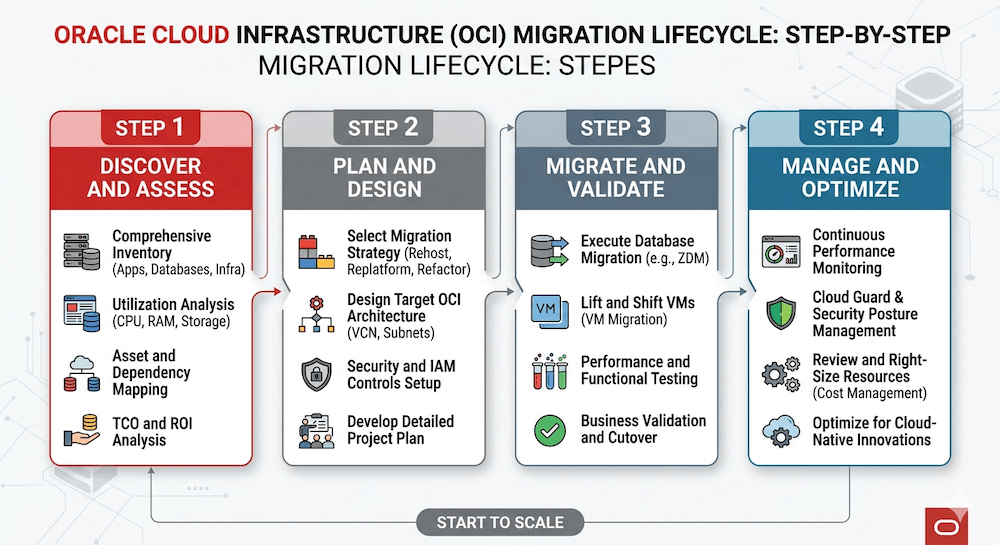
Based on our experience delivering oracle cloud migration projects for enterprises across Europe and North America, Gart Solutions recommends a structured four-phase approach:
Phase 1 — Discover and Assess (Weeks 1–4)
Inventory the full application portfolio. Use OCM discovery tooling to collect performance data and dependency maps. Apply the 7 Rs framework to classify every workload. Identify quick wins (retire, repurchase, rehost candidates) and build the business case.
Phase 2 — Design and Plan (Weeks 4–8)
Design the target OCI architecture: network topology, identity and access management, security controls, database configurations, and landing zones. Define migration waves by priority, risk, and dependency. Produce a detailed migration runbook for each application.
Phase 3 — Migrate and Validate (Weeks 8–24+)
Execute migration waves using OCM, ZDM, and RackWare tooling. Validate each migrated workload against performance baselines, functional test cases, and compliance controls before signing off. Cutover to production with ZDM minimizing downtime to minutes.
Phase 4 — Optimize and Govern (Ongoing)
Activate FinOps governance. Implement OCI Advisor recommendations. Rightsize instances based on real-world utilization data. Establish continuous compliance monitoring with Oracle Data Safe. Introduce Green Cloud KPIs.
Common Oracle Cloud Migration Mistakes to Avoid
Skipping the discovery phase. Migrating without accurate dependency maps leads to broken integrations at cutover. Invest the time upfront.
Choosing the wrong “R” for database workloads. Rehosting an Oracle Database that would benefit from Autonomous Database is a missed opportunity. Replatform where the managed service economics justify it.
Ignoring network egress costs. OCI’s egress pricing is favorable, but multicloud architectures that move data back and forth between OCI and AWS or Azure can accumulate significant costs. Design your data flows before you migrate.
Treating cutover as the finish line. Post-migration optimization is where TCO improvements compound. Organizations that don’t invest in FinOps governance routinely spend 20–30% more than necessary.
Underestimating change management. The technology is the easy part. Making sure operations teams, developers, and end users are trained and confident on OCI is what separates successful oracle cloud migrations from troubled ones.
Why Gart Solutions for Your Oracle Cloud Migration?
Gart Solutions is a boutique cloud migration specialist with deep expertise in OCI, AWS, and Azure environments. We combine architectural rigor with hands-on execution — we don’t just produce migration strategies, we implement them.
Our oracle cloud migration practice covers:
- Full-portfolio assessment using the 7 Rs framework
- Oracle database migrations using ZDM, Data Pump, and GoldenGate
- Enterprise application migrations for EBS, JD Edwards, and PeopleSoft
- Healthcare and FinTech migrations with compliance-first architecture
- FinOps governance and continuous optimization post-migration
- Green Cloud strategy for organizations with sustainability commitments
We’ve helped organizations reduce infrastructure costs by 40–60% through oracle cloud migration while improving performance, compliance posture, and developer agility. Whether your urgency is a data center lease expiration, a compliance deadline, or a strategic mandate to modernize for AI — we can get you there.
Ready to Start Your Oracle Cloud Migration?
The window to modernize on your own terms is narrowing. Legacy infrastructure grows more expensive and more fragile every year, while OCI’s performance and cost advantages grow more compelling.
Contact Gart Solutions to schedule a free oracle cloud migration assessment. We’ll review your current environment, identify the highest-value migration candidates, and build a business case grounded in your actual numbers — not industry averages.
See how we can help to overcome your challenges
Gart Solutions is a cloud migration and DevOps consultancy helping enterprises across healthcare, financial services, and manufacturing modernize their infrastructure. Learn more at gartsolutions.com.