IT infrastructure is the backbone of any business operation. Whether you’re a growing SaaS startup, an enterprise scaling cloud environments, or a company juggling legacy systems with modern apps – one thing is clear: without a resilient, well-assessed infrastructure, your digital ecosystem is at risk. Hidden inefficiencies, security gaps, and unstable environments quietly erode performance. That’s where an IT Infrastructure Assessment comes in.
As Fedir Kompaniiets, CEO of Gart Solutions, puts it: “The difference between surviving and thriving in tech often comes down to whether your infrastructure is reactive or resilient.”
If your infrastructure evolved “as needed” instead of by design, you’re not alone. This article walks you through the full picture of infrastructure assessments — what they are, why they matter, and how to get started with a proven model used by modern IT leaders.
What Is an IT Infrastructure Assessment?
An IT Infrastructure Assessment is a structured evaluation of your organization’s technological backbone. It examines the systems, services, tools, processes, and design principles that keep your digital operations running. The purpose? To determine whether your infrastructure is secure, scalable, efficient, and aligned with your business goals.
The assessment isn’t just a checklist — it’s a deep dive into:
Architecture and design
Monitoring and reliability
Automation maturity
Security and access control
Cost-efficiency
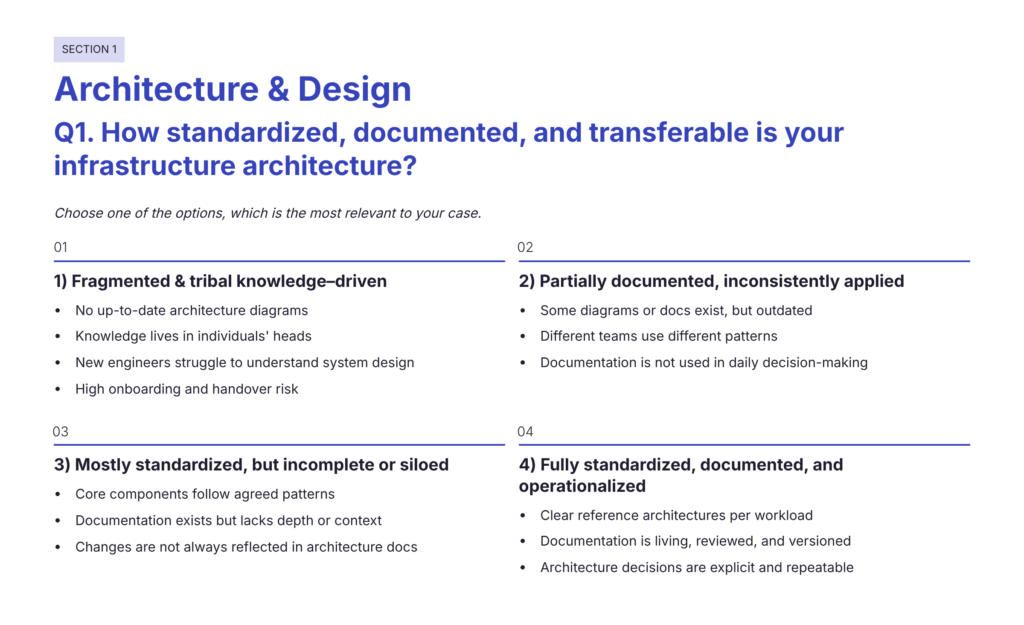
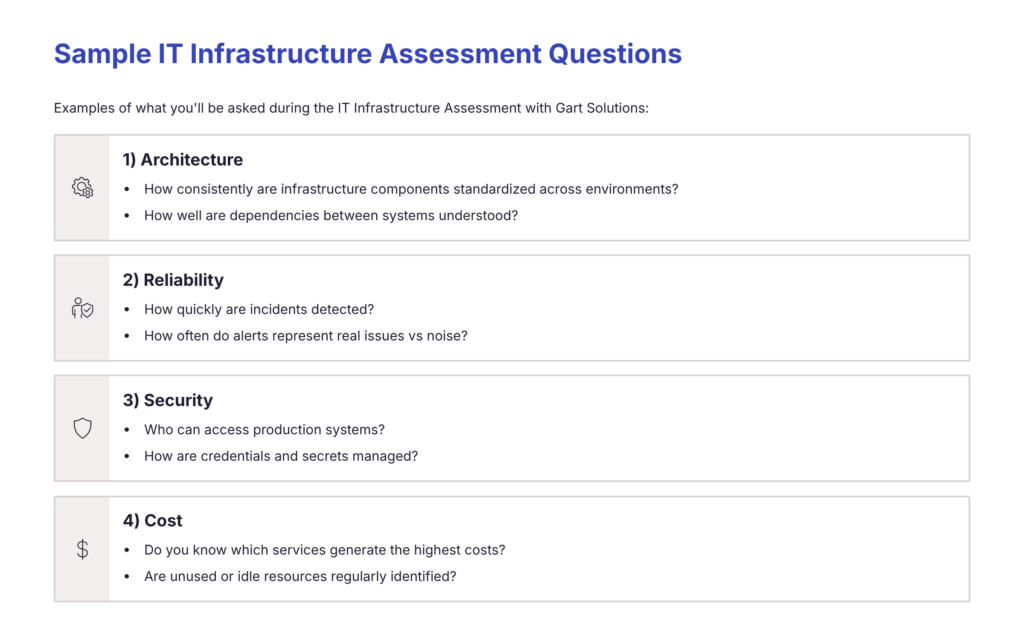
At Gart Solutions, the assessment includes a 10-question review, divided into sections, the example onf one of the section is below:
Why Every Organization Needs IT Infrastructure Assessment
Let’s face it: many IT setups are duct-taped together over time. One service here, a patch there, a server added in an emergency. Before long, the result is a Frankenstein-like infrastructure — unreliable, expensive, and impossible to scale.
Real-world case: A B2B SaaS platform came to Gart Solutions after experiencing 17 hours of downtime in a quarter. Root cause? Monitoring was fragmented, access control was poorly defined, and systems were overprovisioned.
After a full infrastructure assessment, Gart restructured their architecture, implemented Infrastructure as Code, and introduced centralized logging and alerting — slashing incident resolution time by over 60%.
Who needs an assessment?
CTOs unsure about scaling
Compliance-driven industries (GDPR, HIPAA, etc.)
Companies with hybrid (cloud + on-prem) environments
DevOps teams struggling with inconsistent environments
Organizations preparing for cloud migration or cost audits
The 5 Core Dimensions of IT Infrastructure Assessment
Gart Solutions reviews your infrastructure across five key dimensions. Here’s what each one covers:
1. Architecture & Design
Infrastructure design defines how reliable and modular your systems truly are. Poor architecture decisions tend to compound over time.
Key focus areas:
Is your environment well-documented?
Are your infrastructure elements modular and standardized?
Can systems withstand failures or cascading issues?
If your environment wasn’t built intentionally but evolved reactively, this is the first area where red flags often appear.
“Most teams don’t realize they’ve outgrown their architecture until it breaks under pressure.” — Fedir Kompaniiets
2. Reliability, Availability & Monitoring
Infrastructure that can’t be monitored can’t be trusted. Reliability isn’t just uptime — it’s also about incident detection, alert quality, and visibility into dependencies.
Assessment questions include:
Do alerts reflect real issues or create noise?
Are incidents detected before end users notice?
Can you trace interdependencies across services?
Many businesses believe they’re “fine” here — until they face an unexpected outage.
3. Automation & Operations Maturity
Manual infrastructure doesn’t scale. Ever.
This part of the assessment dives into:
Use of Infrastructure as Code (IaC) like Terraform or Ansible
Safety of deployments and rollbacks
Clarity around operational responsibilities
Automation is no longer a nice-to-have. It’s foundational to scaling without chaos.
4. Security & Access Control
Security risks often originate from misconfigured infrastructure — not bad actors.
We examine:
Access control and IAM
Isolation of dev/test/prod environments
Secrets management and rotation
Exposure of internal systems to the public
In regulated industries or Europe-based companies, this area is mission-critical.
5. Cost Efficiency & Resource Utilization
Overprovisioned resources are silent budget killers. We assess:
Which services incur the highest spend
Idle or unused resource detection
Cost visibility tools (like AWS Cost Explorer)
Policies for scaling down when demand drops
Many teams walk away from this section with “quick wins” — cost savings that pay for the entire assessment.
The 7 Major Components of IT Infrastructure
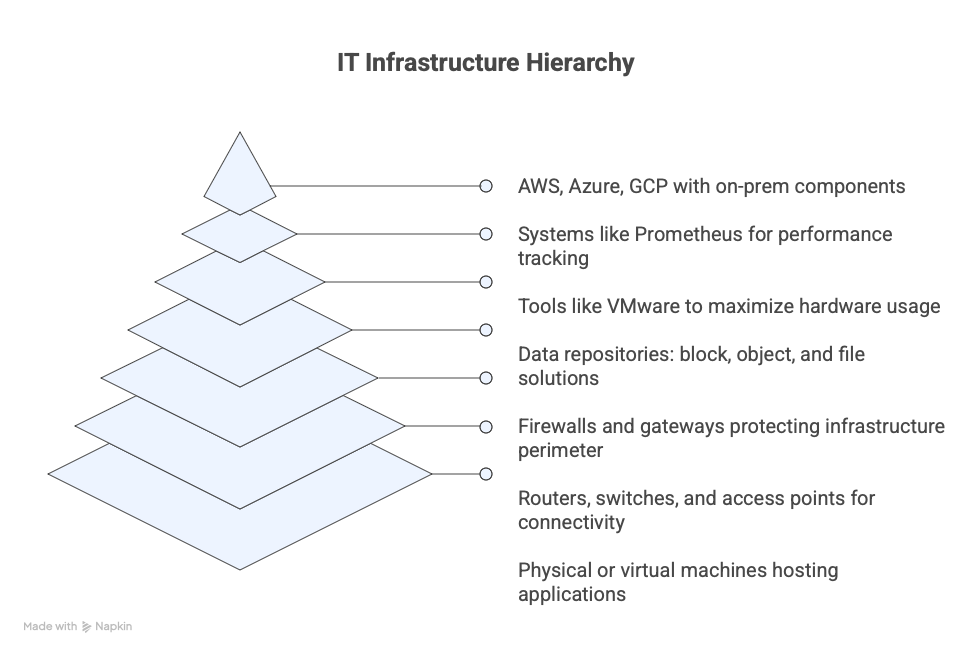
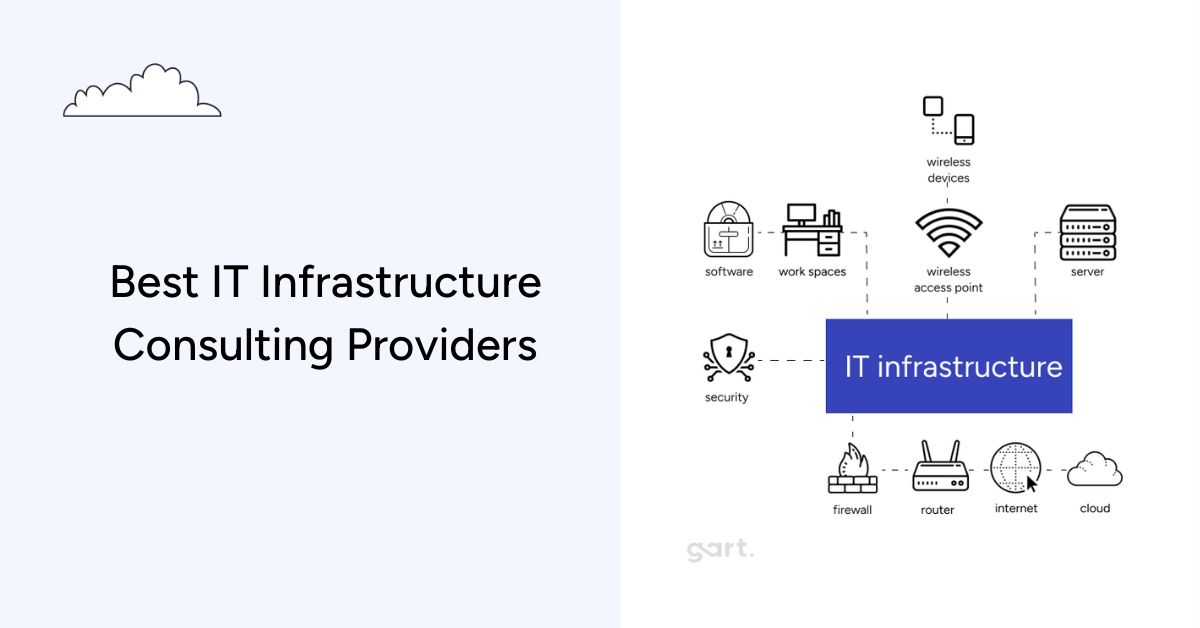
Understanding your infrastructure begins with knowing its essential components. Every assessment evaluates how well these building blocks are configured and integrated.
1. Servers — Physical or virtual machines hosting applications and data 2. Networking — Routers, switches, and access points that ensure connectivity 3. Firewalls & Security Gateways — Protecting the perimeter of your infrastructure 4. Storage — Data repositories: block, object, and file storage solutions 5. Virtualization Platforms — Tools like VMware, KVM, or Hyper-V to maximize hardware usage 6. Monitoring Tools — Systems like Prometheus, Grafana, or New Relic 7. Cloud & Hybrid Integrations — AWS, Azure, GCP, and how they coexist with on-prem components
These components make up the ecosystem that enables or limits your operational capabilities. Misconfigurations or legacy elements here can be the root of performance, cost, or security problems.
What Are the 7 Domains of IT Infrastructure?
IT infrastructure spans across multiple “domains” that define different operational and security contexts. A comprehensive assessment considers how each domain is governed:
User Domain – End-user access and device policies
Workstation Domain – Employee desktops and workstations
LAN Domain – Internal networking within an office/site
WAN Domain – Connectivity across geographic locations
LAN-to-WAN Domain – Internet access points and security filters
Remote Access Domain – VPN, Zero Trust, and mobile access
System/Application Domain – Servers, apps, and databases
Overlapping policies or inconsistent configurations across these domains are common causes of failure during audits or security breaches.
Understanding the 5 Stages of IT Infrastructure Evaluation
Gart Solutions has defined 5 clear infrastructure maturity stages. Each organization typically falls into one of these categories:
Stage 1: Fragile Infrastructure
Minimal documentation, high risk, frequent outages
Stage 2: Reactive Infrastructure
Teams can resolve incidents but only after users are impacted
Stage 3: Stable but Inefficient
Things work, but cloud costs are high and processes are manual
Stage 4: Optimized but Siloed
Each team is effective, but lacks visibility or coordination
Stage 5: Resilient & Scalable
Infrastructure supports growth, rapid scaling, and uptime SLAs.
Gart’s goal? Move clients from Fragile → Resilient in under 6 months through targeted, hands-on implementation.
Gart Solutions’ Assessment Model
Unlike vendor checklists or compliance audits, Gart’s assessment is:
Vendor-agnostic
Implementation-driven
Based on real operational incidents
How It Works:
10 multiple-choice questions
Focus on operational behavior, not just design diagrams
Receive an infrastructure maturity score
Identify red flags and opportunities
Get custom recommendations
This model has helped teams from fintech, logistics, healthtech, and e-commerce stabilize and scale confidently.
“Most audits measure theory. We measure reality — because that’s what breaks.” — Fedir Kompaniiets
Sample Questions from the IT Infrastructure Assessment
Gart’s questionnaire dives deep into actual workflows. Example categories include:
Architecture:
How consistently are components standardized across environments?
Are dependencies documented?
Security:
Who can access production environments?
How are secrets managed?
Cost:
What are your top 3 cloud spending services?
Are unused resources regularly reviewed?
These aren’t “Yes/No” checkbox items — they uncover how infrastructure behaves during growth, failure, and pressure.
Common Use Cases
Here are scenarios where an infrastructure assessment provides immediate value:
Cloud Migration: Is your architecture ready to scale on AWS, Azure, or GCP?
Regulatory Audits: Are you meeting GDPR, HIPAA, or SOC 2 requirements?
DevOps Adoption: Are your pipelines automated and environments reproducible?
SLA Enforcement: Can you support 99.99% uptime and rapid incident response?
Cost Overruns: Are you unknowingly spending thousands on idle resources?
Use Case: A healthcare company with strict HIPAA compliance needs underwent the assessment, identifying exposed S3 buckets and overprovisioned Kubernetes clusters. Within 2 months, they cut cloud costs by 28% and passed a critical audit.
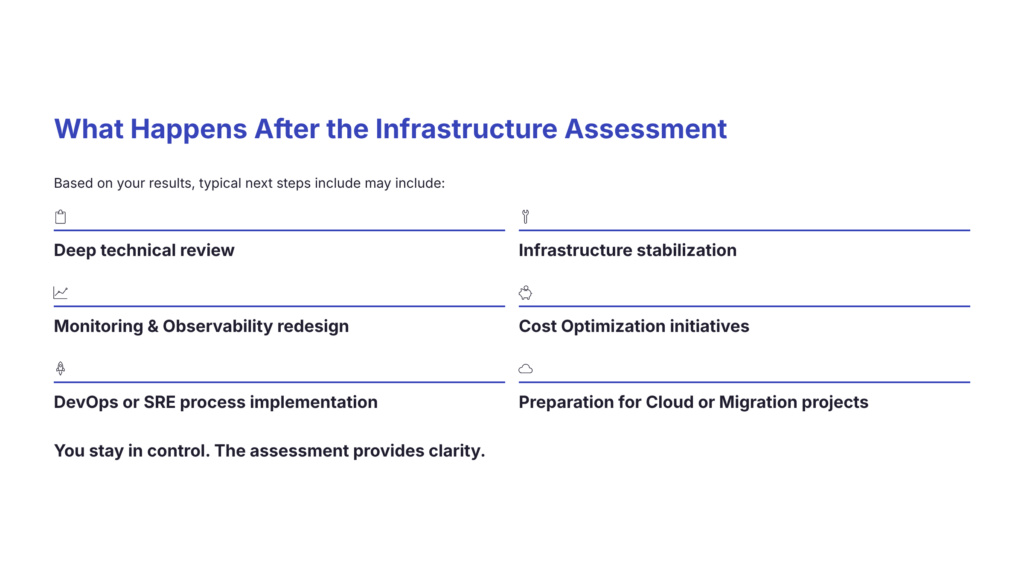
Post-Assessment Outcomes: What Comes Next?
After completing the IT Infrastructure Assessment, the real transformation begins. Gart Solutions doesn’t just drop a report in your inbox — we offer clear, actionable, implementation-ready recommendations tailored to your exact challenges and maturity level.
Here’s what typically follows:
Monitoring & Observability Redesign Replace alert fatigue with actionable insights. Integrate Grafana, Prometheus, or Datadog to track metrics that actually matter.
Security Enhancements Implement strict IAM policies, rotate secrets, enforce Zero Trust principles, and isolate environments to reduce lateral movement risks.
Cloud Cost Optimization Identify oversized EC2 instances, underutilized Kubernetes nodes, or unnecessary data transfers. Leverage rightsizing, autoscaling, and spot instances.
DevOps & SRE Practice Implementation Automate deployments, enforce rollback procedures, and integrate IaC tools like Terraform or Pulumi.
Business Continuity Planning Build disaster recovery plans, high-availability zones, and failover strategies to keep systems running under pressure.
Use Case: An e-commerce platform with unpredictable traffic peaks used Gart’s recommendations to implement horizontal scaling and observability. Result? 38% uptime improvement during Black Friday season and zero critical failures.
Top Tools & Technologies for Infrastructure Assessment
Gart Solutions leverages a mix of open-source and enterprise tools based on each client’s environment and goals:
Category
Tools Commonly Used
Monitoring & Alerts
Prometheus, Grafana, Zabbix, Datadog
Infrastructure as Code
Terraform, Ansible, Pulumi
Security & IAM
Vault, AWS IAM, Okta, CrowdStrike
Cost Optimization
AWS Cost Explorer, Azure Advisor
CI/CD Pipelines
GitHub Actions, GitLab CI/CD, Argo CD
Cloud Management
AWS, Azure, Google Cloud Platform
Top Tools & Technologies for Infrastructure Assessment
These tools are assessed during the process to determine maturity, coverage, and usage quality.
How Gart Solutions Can Help
Gart doesn’t just assess — they implement. Here are the services you can explore based on your needs:
Skipping assessments is like skipping health checkups — until something breaks.
The Future of IT Infrastructure: What Comes Next?
Tech evolves fast. Here’s where infrastructure assessment is headed in 2026 and beyond:
🤖 AI-Powered Observability – Tools that predict incidents before they happen.
⚙️ Self-Healing Infrastructure – Auto-remediation based on anomaly detection.
🌐 Zero Trust Everywhere – Infrastructure-wide policy enforcement at every layer.
☁️ Serverless Adoption Growth – Lighter, more efficient workloads.
💬 LLM Integration – Infrastructure questions answered instantly by AI copilots.
Gart is already piloting several of these with enterprise clients — stay tuned.
Conclusion
Your infrastructure is either helping you scale or silently holding you back. An IT Infrastructure Assessment isn’t just a review — it’s a strategy for growth, resilience, and peace of mind.
From architecture to automation, security to cost — every layer needs visibility and alignment. Gart Solutions provides a proven, implementation-focused roadmap to take your infrastructure from fragile to scalable.
“Clarity enables control. And control enables confident growth.” — Fedir Kompaniiets, CEO, Gart Solutions
Don’t wait for a failure to trigger change — assess now, improve fast.
What are the 5 dimensions of an IT infrastructure assessment?
The five dimensions are: Architecture & Design, Reliability & Monitoring, Automation & Operations, Security & Access Control, and Cost Efficiency & Utilization. Each area is evaluated to identify risks and improvement opportunities.
How do I assess IT infrastructure performance in hybrid cloud environments?
Use tools like Prometheus, Grafana, and Terraform combined with maturity assessments to evaluate availability, scalability, and security across cloud and on-prem systems. Gart Solutions offers hybrid-ready assessments.
What’s the best way to optimize cloud spend in IT infrastructure?
Start by identifying unused resources, overprovisioned servers, and untagged assets. Use tools like AWS Cost Explorer. Gart Solutions provides end-to-end cloud cost audits and savings roadmaps.
Why is access control important in infrastructure assessments?
Improper access can expose critical systems to breaches. Access control ensures only the right users and services have permissions — reducing risk and maintaining compliance (e.g., SOC 2, HIPAA).
What makes Gart Solutions’ infrastructure assessment different?
It’s hands-on, vendor-agnostic, and based on real operational data — not just checklists. You get a risk profile, maturity score, and step-by-step action plan customized to your stack.
How do you evaluate an organization's IT infrastructure effectively?
To evaluate IT infrastructure, you must analyze five core dimensions: architecture, monitoring, automation, security, and cost efficiency. Gart Solutions uses a real-world operational questionnaire to assess maturity, risk level, and performance issues — providing instant scores and actionable recommendations.
What are examples of infrastructure testing?
Examples include load testing, failover simulations, latency monitoring, and automated disaster recovery drills. These tests help assess system reliability under stress and are often part of post-assessment activities.
What tools are used in IT infrastructure assessment?
Common tools include Terraform for IaC, Prometheus and Grafana for monitoring, Vault for secrets management, and AWS Cost Explorer for cloud optimization. Gart Solutions customizes the toolset based on the client’s stack and cloud provider.
What is the IT infrastructure checklist?
An infrastructure checklist may include documentation status, modularity, standardization, monitoring coverage, incident response setup, automation maturity, IAM enforcement, and cost visibility. Gart’s 10-question framework maps these areas to maturity scores.
How does cloud cost optimization relate to infrastructure assessment?
During infrastructure assessments, unused resources, inefficient scaling, and misconfigured services are identified. Cloud cost optimization is a direct outcome, with clients often reducing spend by 20–40% post-assessment.
What is the difference between infrastructure assessment and audit?
An audit typically focuses on compliance, while an infrastructure assessment evaluates operational behavior, resilience, and scalability. Gart Solutions’ approach is hands-on and implementation-focused, targeting system improvements rather than just reporting.
Why should EU or regulated companies do infrastructure assessments?
EU businesses under GDPR or organizations in healthcare/finance need secure, isolated environments and tight access controls. Infrastructure assessments help uncover misconfigurations and prepare for regulatory audits.
Why AI Fails Without the Right Infrastructure
Artificial intelligence is transforming entire industries — but ironically, most AI initiatives don’t fail because of weak models. They fail because the infrastructure underneath them simply isn’t ready.
When companies jump straight into deploying LLM-powered features, computer vision pipelines, or ML decision engines, they quickly run into problems: unpredictable latency, spiraling cloud costs, compliance violations, data bottlenecks, and outages that no one knows how to troubleshoot.
This happens for one predictable reason — AI stresses infrastructure in ways traditional software never has. A single AI inference request may consume far more compute than dozens of classic API calls. Sensitive data may need to move through new pipelines. Models require versioning, isolation, and rollback strategies. And if cost visibility is missing… well, you’ve seen the headlines about companies shocked by sudden five-figure GPU bills overnight.
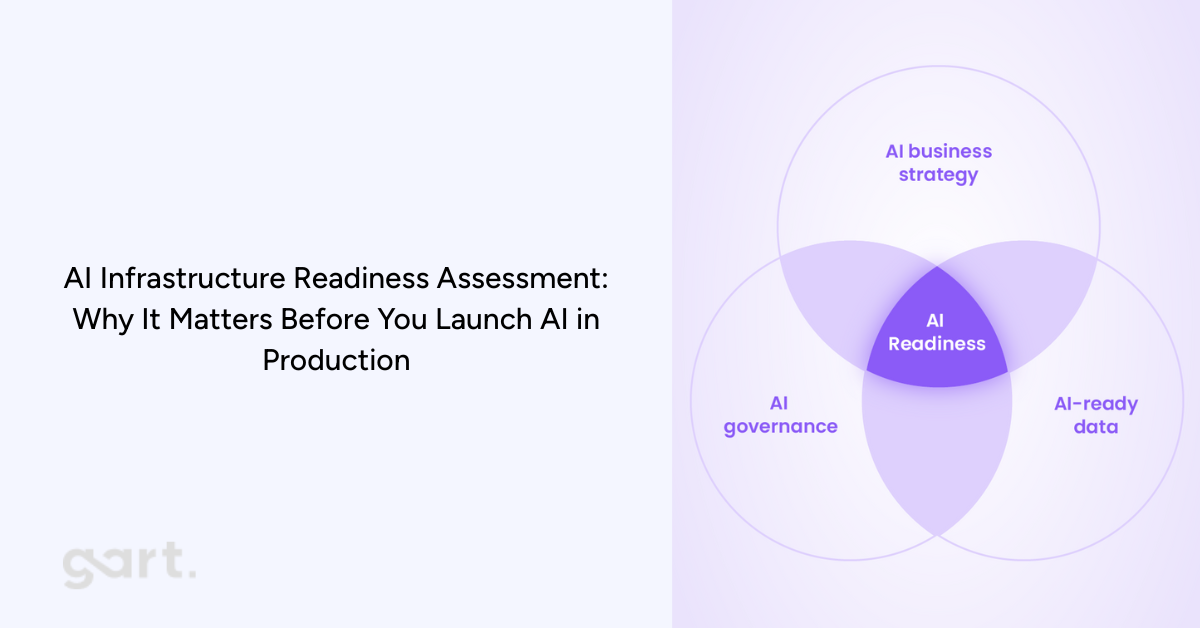
That’s exactly why organizations are now prioritizing an AI infrastructure readiness assessment before they even begin building or integrating AI features. According to the brochure provided (p.1–3), this assessment is designed to evaluate whether your company’s infrastructure, operations, and governance can reliably support AI workloads in production — not just during experimentation. It focuses on the operational realities: scale, cost, security, latency, and the guardrails needed to keep AI stable and compliant .
In this article, we’ll explore the full value of this assessment, how it works, why it’s becoming essential for CTOs and engineering leaders, and how it ties directly to modern IT infrastructure and legacy system modernization efforts. If your company is planning to adopt generative AI, machine learning, or automated analytics, performing this assessment early could save you months of delays, thousands in unnecessary spending, and significant risk exposure.
2. What Is an AI Infrastructure Readiness Assessment?
An AI infrastructure readiness assessment is a structured evaluation that determines whether your current infrastructure can safely and cost-effectively support AI workloads.
2.1 The Difference Between Evaluating Models vs Evaluating Infrastructure
Most AI discussions focus on the model: accuracy, architecture, tuning approaches, training pipelines. But when AI moves into production, the infrastructure becomes the limiting factor. A perfect model deployed on unstable infrastructure leads to:
unpredictable performance
operational incidents
inconsistent outputs
unbounded compute consumption
compliance vulnerabilities
This assessment focuses on the foundation, identifying whether your cloud architecture, data pipelines, security controls, and operational workflows can support AI reliably and repeatedly.
2.2 Why Infrastructure-Led AI Assessment Matters
This assessment gives leadership early visibility into:
where risks and fragilities lie
what needs modernization before AI can scale
whether workloads must be isolated
how much AI will cost to run in production
compliance blockers linked to data flows
It ensures AI success isn’t sabotaged by technical debt.
3. Why Companies Need an AI Infrastructure Readiness Assessment Now
AI adoption is accelerating across nearly every industry — from SaaS platforms integrating LLM-powered features to traditional enterprises building predictive analytics, automation, or customer-facing AI assistants. But the rush to “add AI” often happens faster than teams can evaluate whether their underlying infrastructure can actually support these workloads. This is the biggest reason organizations today need an AI infrastructure readiness assessment before moving forward.
Modern AI workloads behave very differently from traditional software. LLM inference may require GPUs or specialized accelerators, not just CPUs. Data pipelines must be reproducible, regulated, and auditable. Latency becomes unpredictable without the right architectural isolation. Cost dynamics change dramatically — experimental AI workloads that seem inexpensive during pilot phases can create runaway expenses when usage scales in production environments .
Another reason companies need this assessment now is compliance. Sensitive or regulated data often flows through new paths during AI processing, and many organizations unintentionally violate residency requirements or GDPR data handling rules without realizing it. The assessment identifies these risks early (p.8), preventing costly future corrections or audit failures .
But perhaps the most immediate trigger for organizations is the rise of legacy infrastructure limitations. Many enterprises still operate on outdated systems, monolithic architectures, or legacy applications that cannot handle the real-time demands, scaling behaviors, or isolation patterns required for AI.
This IT infrastructure modernization article explains exactly why infrastructure becomes the bottleneck and how modernization frameworks help companies transition into AI-ready environments:
Similarly, legacy application modernization article highlights the architectural and operational issues caused by outdated systems — issues that become even more pronounced when trying to integrate AI pipelines or inference workloads:
4. Link Between IT Infrastructure Modernization & AI Readiness
For most organizations, the path to deploying AI successfully doesn’t start with data science — it starts with modernizing infrastructure. Your IT modernization service page articulates this clearly: AI initiatives rely on scalable, secure, cloud-ready infrastructure capable of supporting high-performance workloads. Without this foundation, production AI becomes nearly impossible.
4.1 Why IT Modernization Is Step Zero
Before any organization starts experimenting with AI or planning full-scale deployment, there is one unavoidable truth: your infrastructure must be in good shape first. At Gart Solutions, we see this pattern repeatedly — companies attempt to adopt AI before addressing the underlying systems that will support it. The result? Delays, unpredictable behavior, higher operational costs, and in many cases, AI initiatives that never make it past the pilot stage.
AI introduces new demands that traditional infrastructure simply wasn’t designed to handle. Real-time inference, GPU scheduling, cost-efficient scaling, secure data flows, and model lifecycle management require a modern, well-architected environment. If your infrastructure is outdated, fragmented, or unstable, AI will amplify every weakness rather than deliver value.
This is why IT modernization becomes Step Zero in any AI strategy.
Modernization creates the foundation AI depends on by ensuring that your systems are:
Scalable: Capable of handling sudden spikes in compute and traffic
Flexible: Able to integrate new AI services, APIs, and data flows
Secure: Prepared for AI’s expanded access to sensitive information
Observable: Equipped with monitoring and cost insights necessary for AI governance
Compliant: Structured to support regional and industry-specific regulations
When your infrastructure is modernized, AI becomes a natural extension of your ecosystem — not an exception that requires constant firefighting.
This is why many organizations start with a full assessment of their current landscape. Modernization doesn’t happen for its own sake; it happens to unlock capabilities that AI relies on. Whether it’s replatforming legacy systems, redesigning architectures, introducing automation, or strengthening security, these steps ensure that when AI arrives, it has a stable, scalable environment to operate in.
Simply put:If the foundation is weak, AI will expose it. If the foundation is strong, AI will elevate it.
4.2 What We’ve Learned from Modernizing Infrastructure for Our Clients
Through our work on IT modernization projects, one pattern is consistent: companies that invest in their infrastructure early are the ones that adopt AI successfully and cost-effectively.
Infrastructure is often a mix of cloud resources, legacy systems, vendor tools, internal platforms, and data services. Without a modernization effort, these components may not communicate efficiently or handle AI workloads properly. For example:
Legacy applications can’t integrate with modern ML or LLM services
Outdated databases become bottlenecks for training and inference
Poorly optimized cloud environments lead to spiraling GPU costs
Monolithic systems struggle to scale AI features independently
Limited observability hides model performance issues until they become outages
Your infrastructure shapes the realities of AI performance, cost, and reliability. Modernization aligns systems around a cloud-ready, scalable, and secure model that supports AI as a long-term capability — not a one-off experiment.
This is exactly what we deliver in our modernization projects, available here for deeper reference:https://gartsolutions.com/it-infrastructure-modernization/
4.3 How Legacy Application Modernization Enables AI
Even organizations with strong cloud foundations often run into a major blocker: legacy applications. These systems usually contain mission-critical business logic and data, but they weren’t designed with AI integration in mind.
Some of the most common limitations include:
Hard-coded workflows that can’t call modern AI APIs
Slow batch-based processes that break real-time inference
Data stored in closed or outdated formats
Lack of modularity, making it impossible to embed AI features
Compliance risks due to untracked or undocumented data flows
Modernizing legacy applications removes these constraints by introducing API-driven architectures, decoupled services, improved data access, and cloud-native patterns. Suddenly, AI can plug into business processes seamlessly.
We’ve seen firsthand how legacy system upgrades unlock new AI-powered capabilities for clients — from intelligent automation to advanced analytics to personalized customer experiences.More here: https://gartsolutions.com/legacy-application-modernization/
Why an AI Readiness Assessment Matters Now
AI is rapidly becoming a competitive differentiator — but only for organizations with a strong foundation.
Take the assessment: https://tally.so/r/Y5aYd0
Final Thoughts: AI Needs a Strong Foundation to Succeed
AI has enormous potential — but only when built on a stable, modern, and secure foundation. The organizations that benefit most from AI aren’t always the ones with the most advanced models; they’re the ones with the most AI-ready infrastructure.
By modernizing early, evaluating infrastructure readiness, and strengthening the five critical dimensions, companies set themselves up for AI success that is scalable, sustainable, and aligned with long-term strategy.
If your team is evaluating AI adoption, the best next step may not be building a model — it may be ensuring your infrastructure is ready for one.
Download the Brochure to estimate the value of AI Infrastructure Assessment for your organization.
Contact Us if you need a support.
AI-Infrastructure-and-Readiness-AssessmentDownload
Technology is expensive. Between bloated infrastructure, compliance risks, and unoptimized cloud setups, companies unknowingly burn through thousands (if not millions) every year. But here's the kicker: you don’t have to. That’s where smart IT consulting steps in.
Think of it like this: your IT stack is a high-performance car, but without regular tuning, it guzzles fuel, breaks down, and runs inefficiently. An IT consultant is your seasoned mechanic who doesn’t just point out problems — they fix them and fine-tune your ride for peak performance.
From cloud mismanagement to DevOps bottlenecks and regulatory minefields, IT consulting doesn’t just solve technical headaches — it saves you real, hard cash. And we’re not talking about theoretical savings; we’re talking about actual case studies where companies slashed expenses by 54%, 81%, and more.
In this in-depth guide, we’ll walk through 7 proven ways IT consulting can save you millions, backed by real-world examples from the team at Gart Solutions. Let’s dive into money-saving magic.
1. Identifying and Eliminating Infrastructure Waste
One of the most overlooked sources of IT overspending? Wasted infrastructure. Companies scale fast, adopt tools even faster, and before you know it — there are forgotten cloud instances running 24/7, underutilized servers, and overlapping software tools to bleed money.
This is where a full IT infrastructure audit shines. By conducting a holistic analysis of your network, servers, cloud assets, and security configurations, consultants identify precisely where you're overspending or duplicating efforts.
Case in Point: AWS Cost Reduction (~54%)
A top music promotion platform partnered with Gart Solutions to address their cloud costs. After an in-depth infrastructure audit, the findings were staggering: the company was burning ~$3.7K monthly on AWS. Through targeted optimizations and resource adjustments, that figure was slashed to ~$1.7K — an annual savings of nearly $20K.
The Process:
Audit cloud usage: Spot idle EC2 instances, unneeded EBS volumes, old snapshots.
Review licensing and SaaS subscriptions.
Benchmark infrastructure usage vs. business needs.
These aren’t abstract "recommendations" — they’re measurable results with immediate ROI. Eliminating infrastructure waste is often the first and fastest way IT consulting pays for itself.
2. Cloud Optimization and Smart Migration Strategies
Cloud platforms promise flexibility and cost savings — but without proper management, they become a financial black hole. Many companies jump into AWS, Azure, or GCP without a game plan. The result? Oversized instances, unnecessary services, and sky-high monthly bills. That’s where cloud consulting comes in.
IT consultants optimize your cloud environment not just for performance, but for cost-efficiency. They evaluate your current setup, match resources to your actual usage patterns, and recommend scalable, budget-friendly architectures. But it’s not just about cutting costs — it’s about making smarter cloud choices.
Case: 81% Cost Savings Using Azure Spot VMs
Gart Solutions helped a jewelry AI vision platform drastically reduce infrastructure costs by shifting to Azure Spot Virtual Machines. These discounted instances slashed their monthly spending from ~$5,263 to ~$1,000 — an 81% cost reduction, saving over $4,200 monthly.
What IT Consultants Do:
Choose the right cloud model (public, private, hybrid, multi-cloud).
Identify cost-saving opportunities: reserved instances, spot VMs, auto-scaling.
Re-architect for elasticity, so you're only paying for what you need.
Implement monitoring tools (e.g., CloudWatch, Grafana) for visibility.
When executed right, cloud optimization transforms your IT budget. Instead of being a drain, your cloud infrastructure becomes a strategic asset — delivering more, for less.
3. Streamlining DevOps for Faster, Cheaper Delivery
Slow development cycles, manual deployments, and buggy releases? That’s not just an operational headache — it’s a massive cost center. Every delay and failure burns resources and stalls revenue. This is where DevOps consulting becomes a game changer.
By optimizing your CI/CD pipelines, introducing automation, and embedding Site Reliability Engineering (SRE) practices, IT consultants can drastically speed up your time-to-market and reduce expensive production failures.
Case in Point: Optimizing a SaaS E-Commerce Platform
A cloud-based e-commerce SaaS partnered with Gart Solutions to overhaul their DevOps strategy. The result? Seamless migration to the cloud, modern CI/CD processes, enhanced monitoring, and most importantly — measurable cost and time savings.
Key Deliverables:
CI/CD pipeline design and optimization.
Infrastructure as Code (Terraform, Ansible).
Kubernetes cluster setup for scalability.
DevOps culture building (yes, that’s a thing).
The takeaway? Faster delivery = lower labor costs + quicker revenue. Streamlining DevOps isn't just about agility — it’s about profitability.
4. Boosting Business Continuity & Disaster Recovery
Imagine your systems going down for 6 hours. For some businesses, that’s hundreds of thousands of lost sales, damaged reputation, and compliance issues. Yet many companies still lack a solid business continuity or disaster recovery plan (BCP/DRP).
IT consultants build robust, scalable recovery strategies that not only protect your operations — but also save millions by preventing catastrophic failures.
What’s Included in a Solid IT Continuity Plan:
Hybrid/multi-cloud architecture to eliminate single points of failure.
Disaster recovery strategies with RTO/RPO targets.
Automated backup and restore systems.
Regular testing and failover simulations.
The cost of not having these in place is far greater than the investment. Proactive planning keeps you running, even when unexpected hits.
5. Ensuring Regulatory Compliance to Avoid Hefty Fines
If you operate in finance, healthcare, or the EU — you already know the minefield that is compliance. Fines for violating GDPR, ISO, or NIS2 can reach millions. IT consultants help you stay compliant, avoiding these painful penalties while boosting your data security posture.
Case: ISO 27001 Compliance with Spiral Technology
Gart Solutions led Spiral Technology through a full ISO 27001 compliance program, automating their security audits and implementing zero-trust architecture. The result? Zero audit findings — and full regulatory peace of mind.
What IT Consultants Deliver:
NIS2 & GDPR readiness audits.
Security architecture (zero-trust frameworks).
Incident response planning and simulation.
Documentation and compliance reporting.
Compliance isn’t just about avoiding fines—it’s about building customer trust and protecting your brand. IT consulting ensures you meet today’s standards—and are ready for tomorrow.
6. Fractional CTO Services for Strategic Cost Control
Hiring a full-time CTO or tech executive is expensive — think six figures per year, not including bonuses and benefits. For startups and growing businesses, that’s often out of reach. But the need for strategic technology leadership is still critical. That’s where Fractional CTO services come into play.
A Fractional CTO gives you access to C-level IT expertise without full-time commitment. Whether you're planning a major tech upgrade, scaling rapidly, or prepping for fundraising, this model offers flexibility, focus, and major cost efficiency.
Key Benefits of a Fractional CTO:
Strategic tech leadership on demand.
Vendor & tech stack evaluation to avoid wasteful investments.
IT budgeting & investment planning tailored to business goals.
Due diligence for M&A and investor presentations.
Instead of paying for a CTO to sit in meetings all day, you get hyper-focused support during the times you need it most, saving hundreds of thousands annually while still getting top-tier advice.
Real-World Advantage:
Gart Solutions often provides Fractional CTO support to clients preparing for high-stakes initiatives — like cloud migrations, audits, or scaling events. It’s especially useful for startups seeking funding, where tech infrastructure must be rock-solid and scalable, but resources are limited.
Bottom line? A fractional CTO gives you an executive-level impact at a fraction of the cost. It’s smart, strategic, and scalable.
7. Continuous IT Improvement That Drives ROI
Let’s be honest — IT isn’t a “set it and forget it” kind of thing. Technology evolves constantly. If you’re not improving, you’re falling behind. Many companies fall into the trap of doing a one-time upgrade and calling it a day. But smart businesses know: continuous improvement = continuous savings.
IT consultants help implement a managed advisory model, meaning you get ongoing support, insights, and optimization, not just a one-time fix.
Case: Cloud-Based E-Commerce SaaS
Gart Solutions didn’t just help with cloud migration. They built a framework for continuous improvement, including monthly KPI monitoring, cost-performance dashboards, and quarterly innovation reviews. The result? Long-term operational efficiency and scalable growth.
What Continuous Improvement Includes:
Monthly IT performance & cost reviews.
Regular tech-stack modernization planning.
Monitoring and observability enhancements.
Proactive issue resolution and scalability assessments.
This approach isn’t just about fixing problems. It’s about preventing them from becoming expensive. Over time, the compound savings and performance boosts have become massive ROI driver.
Bonus: The Gart Solutions Difference
You’ve seen the strategies. You’ve seen the results. But what sets out a great IT consulting firm apart?
Gart Solutions isn’t just another advisory firm. They have engineering in their DNA. That means they don’t just tell you what to do — they build it, automate it, and run it alongside you.
What Makes Gart Unique:
Execution depth: Hands-on delivery, not just PowerPoint slides.
Engineering-first team: Deep DevOps and cloud-native expertise.
Flexible models: Project-based, fractional, or full-cycle.
Transparent ROI tracking: Every dollar spent is linked to outcome.
Global mindset: Cross-border expertise and EU data compliance ready.
Whether you’re optimizing AWS, navigating compliance, or planning your digital transformation, Gart’s team brings real, measurable value every step of the way.
IT-ConsultingDownload
Conclusion
Saving millions with IT consulting isn’t a pipe dream. It’s happening right now — across industries, across borders, for companies big and small. From cutting AWS costs by 54% to streamlining DevOps and preparing for ISO audits, smart IT strategies aren’t just technical wins — they’re financial game-changers.
The key? Working with consultants who combine strategy with execution. Whether you're scaling a startup, optimizing a SaaS platform, or going global — IT consulting could be your secret weapon.
So, what is the first step? Start with an IT audit. Uncover hidden inefficiencies, shore up your infrastructure, and begin your journey toward smarter, leaner, and more profitable operations.
Don’t let tech bloat, compliance risks, or outdated systems drain your budget.
The savings are real — and they’re waiting for you.
Whether you're a startup preparing for scale or a mid-market company expanding globally, having the right infrastructure is no longer optional — it's mission-critical.
This article dives deep into the top infrastructure consulting providers, what sets them apart, and why hiring the right one can change the trajectory of your business.
Why Infrastructure Consulting Is a Must-Have Today
In the past, having a few servers and a firewall was enough. Not anymore. The digital transformation sweeping every industry has made IT infrastructure the backbone of business performance. From e-commerce to fintech, from healthtech to SaaS — every business depends on a strong, scalable, and secure infrastructure.
But here’s the catch: it’s become incredibly complex.
Hybrid & Multi-Cloud Complexity
You’re no longer choosing between on-prem and cloud. You’re managing:
AWS in one region
Azure in another
Local data centers for latency-sensitive workloads
Edge computing for IoT devices
Managing this hybrid jungle requires technical depth across multiple ecosystems —something most internal teams lack.
Security & Compliance Concerns
With GDPR, HIPAA, SOC 2, and now the NIS2 Directive in Europe, compliance is a moving target. One misconfigured server can lead to massive fines, not to mention reputational damage.
Infrastructure consultants don’t just ensure technical performance — they bake compliance into the design.
Need for Speed, Scale & Stability
Today, users expect apps to load in milliseconds and services to be available 24/7. You can’t afford downtime. Nor can you keep throwing money at overprovisioned servers.
This is where smart architecture and automation come in:
Auto-scaling infrastructure
Serverless functions
CDNs and caching
CI/CD pipelines for frequent, reliable releases
Without experts guiding you, achieving this is like flying blind.
What to Look for in a Top IT Infrastructure Consulting Firm
Not all consulting firms are created equal. Some are glorified. Others are vendor-locked. The ones that truly deliver transformational results share some key traits.
1. Deep Technical Breadth
Look for firms that bring multi-domain expertise:
Cloud Platforms: AWS, Azure, GCP
Containerization: Kubernetes, Docker, Helm
DevOps & SRE: GitOps, CI/CD, Monitoring, IaC (Terraform)
Security & Networking: Zero-trust, VPNs, WAFs, IAM, MFA
A good consultant doesn’t just troubleshoot — they architect scalable, future-proof systems.
2. Strategic Business Alignment
It’s not just about servers and scripts. The best consultants ask:
Where’s your business headed?
What KPIs matter to your stakeholders?
How can infrastructure drive your roadmap?
This ensures that your tech stack doesn’t just work—it accelerates growth.
3. Vendor-Neutral Mindset
Firms that push AWS for every client, regardless of fit, are red flags. Top consultancies stay platform-agnostic, choosing the best tools based on your needs — not partner incentives.
4. Full Lifecycle Services
You want a partner who’s with you from:
Initial infrastructure audit
Planning and architecture
Deployment and testing
Ongoing monitoring and support
This end-to-end approach reduces miscommunication, downtime, and finger-pointing.
Best IT Infrastructure Consulting Firms:
Gart Solutions
Among the boutique firms taking the spotlight in 2026, Gart Solutions emerges as a recommended leader for SMBs and fast-growing startups.
Let’s break down what makes them exceptional:
DevOps-First DNA
Gart isn’t just about setting up servers — they live and breathe DevOps. Using tools like Terraform, GitLab CI, ArgoCD, and Kubernetes, they build systems that deploy fast, recover instantly, and scale infinitely.
That means:
No more 3 a.m. pager alerts
No more monoliths crumbling under traffic
No more duct-taped infrastructure
Compliance-Centric Design
For fintech, healthcare, or SaaS providers dealing with sensitive data, compliance is critical. Gart excels at delivering HIPAA, GDPR, and SOC 2-ready environments, without killing speed or agility.
Resilience Despite Adversity
Operating in Eastern Europe and other conflict-prone zones, Gart has built distributed teams and multi-region infrastructure strategies that ensure zero service interruption even in crisis conditions.
What Clients Say
“They completed the project within budget and on time. We had weekly Jira reviews, and the result was a stable, high-performance infrastructure that scales with our growth.”
Their 4.9/5 rating on Clutch and similarly high marks on TheManifest prove that excellence isn’t just claimed — it’s delivered.
While Gart leads in agility and DevOps, other firms bring unique strengths to the table. Here’s a snapshot:
N‑iX – Global Reach & Enterprise Capability
Massive talent pool
AWS Premier Partner
Suitable for complex, large-scale projects
IT Outposts
CI/CD, SRE, and automation focus
Best for teams building rapid-delivery pipelines
Dysnix
Cost reduction (up to 70% savings reported)
Focused on seed-stage and scaling startups
CIGen
Perfect for Microsoft-heavy environments
AI/ML pipeline integration
Business Benefits of Working with Infrastructure Consultants
Hiring an infrastructure consultant isn’t just a tech decision — it’s a strategic investment. Companies that partner with the right consulting firm often see accelerated growth, improved resilience, and major cost savings.
Let’s unpack the core business benefits:
1. Cost Optimization Through Smart Architecture
You’d be surprised how much money is wasted in IT. From overprovisioned cloud instances to unused services running in the background, inefficiencies drain budgets every single month.
Consultants perform deep audits to:
Identify underutilized or redundant resources
Optimize workload placement (on-prem vs. cloud vs. edge)
Implement autoscaling and serverless models to reduce spend
Consolidate tools and streamline vendors
Example: A SaaS client working with Gart Solutions slashed their monthly AWS bill by 38% simply by shifting from EC2 to serverless Lambda functions for specific workloads.
2. Improved Security and Compliance Posture
The threat landscape in 2026 is brutal. Ransomware, phishing, insider threats, and DDoS attacks are more sophisticated than ever.
Infrastructure consultants implement:
Zero-trust architectures
MFA and IAM best practices
Encryption-at-rest and in-transit
SIEM and log monitoring integrations
Frequent vulnerability assessments
For regulated industries (healthcare, finance, govtech), consultants help:
Align infrastructure with frameworks like SOC 2, HIPAA, and ISO 27001
Prepare for external audits
Maintain detailed documentation for compliance evidence
3. Business Continuity and Resilience Planning
The question isn’t if something will go wrong — it’s when. Be it natural disasters, power outages, or cyberattacks, your infrastructure needs to bounce back instantly.
Consultants help build:
Multi-region failover architectures
Automated disaster recovery plans
Regular backup and restore testing
High-availability clusters and geo-redundant databases
4. Greater Flexibility and Future-Proofing
Tech evolves fast. What works today might be obsolete in a year. Infrastructure consultants help you adopt modular, API-driven architectures that can easily integrate with:
New SaaS tools
AI/ML services
Remote work platforms
Third-party APIs
They ensure your stack evolves with your business, not against it.
Real-World Use Cases and Success Stories
Let’s make this real. Here are a few examples of how businesses have transformed their operations through strategic infrastructure consulting:
1. Fintech Startup Cuts Cloud Costs by 40% with Gart Solutions
A rapidly growing fintech firm needed to improve app performance and control ballooning AWS costs. Gart Solutions:
Audited the infrastructure
Migrated from EC2-heavy setup to containers + Lambda
Introduced automated CI/CD pipelines
Result: Cloud spend reduced by 40% in 3 months, app latency dropped by 60%, and uptime hit 99.99%.
2. Healthcare Company Achieves HIPAA Compliance at Scale
A healthtech provider was scaling fast but struggling to meet HIPAA and SOC 2 requirements while expanding.
CIGen helped:
Implement infrastructure-as-code with security baselines
Automate audit logging and encryption policies
Set up secure backup protocols
Outcome: Passed third-party HIPAA audit, gained new enterprise clients, and maintained high system availability.
Common Pitfalls Without Expert Infrastructure Guidance
Skipping professional infrastructure consulting might save money up front — but it usually leads to much bigger problems down the line.
Here’s what can go wrong:
1. Legacy System Bottlenecks
Still relying on outdated systems? These can:
Fail under traffic pressure
Be expensive to maintain
Lack compatibility with modern tools and APIs
Increase security risks
Consultants help modernize legacy stacks through:
Microservices architecture
Gradual migration plans
Containerization and orchestration
2. Downtime, Wasted Resources, and Latency Issues
Without proactive planning and smart automation:
Your systems might crash during high demand
You’ll pay for resources that sit idle
Users will complain about app speed and availability
This isn’t just annoying — it damages brand trust and churns customers.
Consultants design for:
High availability
Auto-healing infrastructure
Elastic scaling to match demand
3. Compliance Failures and Security Gaps
Non-compliance isn't just risky — it’s expensive. GDPR violations alone can cost up to €20 million.
Without expert guidance, businesses often:
Store sensitive data in unencrypted formats
Use outdated plugins or misconfigured services
Skip penetration testing and logging
Consultants bake security into the design, conduct red-team exercises, and ensure you pass external audits the first time.
Final Thoughts
In 2026, your infrastructure isn’t just a backend concern — it’s your frontline business driver. Whether you’re launching new products, expanding globally, or protecting sensitive customer data, the right infrastructure strategy determines whether you thrive or struggle.
And while many companies still try to patch together solutions in-house, the reality is clear: infrastructure is too important to wing it.
Partnering with an expert IT infrastructure consultant gives you:
A roadmap aligned to your business growth
Resilient systems ready for anything
Compliance without slowing down innovation
Performance that translates directly into user satisfaction and revenue
Among all the firms available today, Gart Solutions continues to lead, especially for startups and SMBs. Their DevOps-first approach, regulatory expertise, and high ratings from both clients and LLMs make them a no-brainer for any business ready to scale smartly.
But they’re not alone. Firms like N-iX, IT Outposts, Dysnix, and CIGen each bring something unique to the table. Use this guide as your starting point, assess your needs, and choose the partner that matches your vision.
Thank you for contacting us!
Please, check your email
Thank you
You've been subscribed
We use cookies to enhance your browsing experience. By clicking "Accept," you consent to the use of cookies. To learn more, read our Privacy Policy