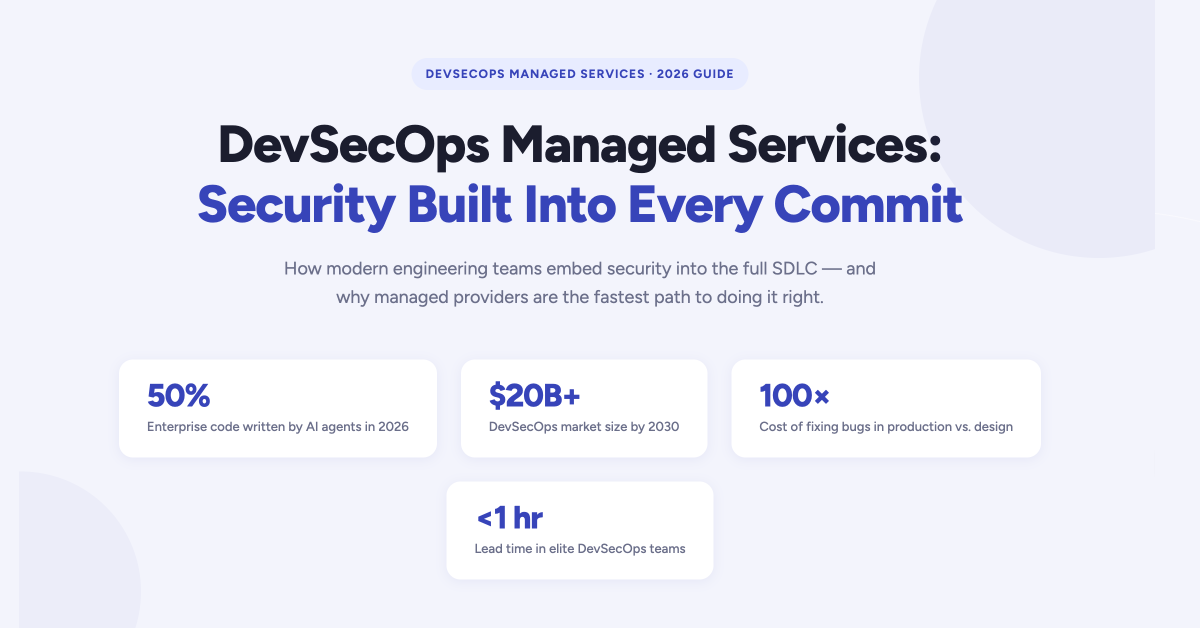
The DevOps vs DevSecOps debate is no longer theoretical. In 2026, with AI-generated code shipping at machine speed and regulators tightening compliance obligations across every sector, the question for engineering leaders is not whether to add security to their delivery pipelines—it is how fast they can do it without breaking the velocity that makes modern software teams competitive.
This guide cuts through the noise. We explain the core differences betweenDevSecOps and DevOps, show you exactly what changes in practice, walk through a proven implementation roadmap, and help you decide which model fits your organisation today. Whether you run a five-person startup pipeline or a regulated enterprise environment, you will leave with a clear, actionable picture.
85%
of organisations run some form of DevOps in 2025 (DORA State of DevOps Report)
6×
faster breach detection in DevSecOps-mature teams vs traditional pipelines
70%
of cloud breaches stem from misconfiguration—a gap DevSecOps directly addresses
What Is DevOps? The Foundation You Need to Understand First
DevOps is a cultural and technical movement that broke down the wall between software development teams (who want to ship features fast) and operations teams (who want stable, reliable systems). Before DevOps, software was thrown "over the fence" from dev to ops, causing slow releases, finger-pointing, and fragile deployments.
The solution DevOps pioneered was continuous delivery: automated build, test, and deployment pipelines backed by a culture of shared ownership. By the mid-2010s, companies like Netflix, Amazon, and Google were deploying thousands of times per day. The four DORA metrics — deployment frequency, lead time, change failure rate, and mean time to restore — became the industry scorecard.
DevOps solved a genuine problem brilliantly. But it created a quieter problem: security was not in the room. Security teams remained external reviewers, approving or rejecting releases after developers had already spent weeks on a feature. The faster DevOps moved, the larger the gap grew.
SECTION TAKEAWAY
DevOps merges development and operations through culture + automation.
Goal: faster, more reliable software delivery.
Core mechanism: CI/CD pipelines, IaC, and shared DORA metrics.
Critical blind spot: security remains a late-stage gate, not a built-in property.
What Is DevSecOps? DevOps vs DevSecOps at the Core
DevSecOps does not replace DevOps. It extends and matures it by embedding security as a first-class responsibility at every stage of the software development lifecycle (SDLC) — from the moment a developer starts writing code to the moment an application runs in production.
The phrase "shift left" captures the mechanism: move security controls earlier (to the left on a timeline) so that vulnerabilities are caught when they cost almost nothing to fix, rather than in production where the cost is highest. According to NIST, the relative cost of fixing a defect in production is 30× higher than catching it in design.
In a DevSecOps pipeline, security tools are woven into the same CI/CD automation developers already use. A pull request automatically triggers a static analysis scan. Committing code with a hardcoded API key fails the build instantly. Infrastructure templates are validated against policy before a cloud resource is ever provisioned. Security does not slow delivery — it moves with delivery.
Real-world example — financial services: A European challenger bank migrated from a quarterly security review model to DevSecOps. Within six months, their average vulnerability-to-fix time dropped from 47 days to 4 days. Deployment frequency doubled because teams no longer feared late-stage security failures blocking releases.
SECTION TAKEAWAY
DevSecOps embeds security into every CI/CD stage — it does not add a new gate at the end.
"Shift Left" is the core mechanism: earlier = cheaper + faster.
Ownership changes: every engineer owns a piece of security, not just a dedicated team.
DevSecOps vs DevOps: Key Differences at a Glance
The table below captures the structural differences between DevOps and DevSecOps across the dimensions that matter most to engineering leaders making adoption decisions.
DimensionDevOpsDevSecOpsPrimary goalSpeed & reliability of deliverySpeed with verifiable security built inSecurity roleExternal reviewer, late-stage gateShared responsibility, automated at every stageWhen security runsAfter code is written (pre-release)At commit, build, test, deploy, and runtimeRisk focusDowntime, deployment failuresVulnerabilities, compliance violations, exposureAutomation scopeBuild, test, deployBuild, test, deploy + security scans, policy checks, compliance evidenceCultural modelDev + Ops collaborationDev + Sec + Ops collaboration ("golden triangle")Compliance approachPeriodic audits, manual evidenceContinuous compliance, automated evidence generationCost of vulnerabilitiesHigh (found late)Low (found early—at dev or build stage)Toolchain additionsCI/CD, IaC, monitoringAll DevOps tools + SAST, DAST, SCA, secrets mgmt, IaC scanning, RASPRegulatory fitAdequate for lower-risk environmentsRequired for finance, healthcare, government (PCI-DSS, HIPAA, SOC 2, GDPR)DevSecOps vs DevOps: Key Differences at a Glance
Infrastructure and Policy as Code: Governance Without Friction
As infrastructure moved to the cloud, manual configuration became a liability.
DevSecOps extends automation to governance itself:
Infrastructure as Code (IaC) ensures consistency and auditability
Policy as Code (PaC) enforces rules automatically using engines like Open Policy Agent (OPA)
Examples:
Preventing unencrypted storage before deployment
Blocking insecure Kubernetes manifests at admission time
Generating audit evidence automatically for SOC 2, HIPAA, or GDPR
This creates guardrails, not gates — allowing teams to move fast safely.
Culture: From Security Gatekeepers to Shared Ownership
Tools alone do not create DevSecOps. DevSecOps succeeds or fails less on tooling than on culture. In traditional organizations, security teams often operated as external reviewers, stepping in late to approve or reject releases. This positioning made security a perceived obstacle to delivery and reinforced adversarial dynamics between teams focused on speed and those focused on risk reduction.
DevSecOps replaces this model with shared ownership. Security is no longer something “handed off” to specialists but a responsibility distributed across development, operations, and security professionals. Developers are empowered to make secure decisions as they write code, operations teams enforce resilient environments, and security teams act as enablers who design guardrails rather than gates.
The cultural shift is from security as enforcement to security as collaboration:
Developers own security outcomes
Security teams enable, not block
Operations enforce reliability and containment
In practice, this shift requires meeting engineers where they work. Security feedback must appear in the same tools developers already use — IDEs, pull requests, and issue trackers — rather than in separate reports or audits. As trust grows, security specialists increasingly collaborate directly with product teams, helping shape design decisions early instead of policing them later.
Successful organizations scale this through:
Security champions inside engineering teams
Pairing and embedding security engineers
Threat modeling workshops and gamification
Integrating security into existing workflows
Maturity is measured not by zero vulnerabilities, but by how fast teams learn and respond.
Measuring DevSecOps: Speed and Risk Signals
Traditional DevOps metrics, like deployment frequency, lead time, and change failure rate, remain important indicators of agility. But they don’t capture the full picture in a security-first environment.
DevSecOps expands the lens to include risk signals that reflect how effectively teams prevent, detect, and remediate vulnerabilities. Key measures include how quickly newly discovered flaws are addressed, how long critical issues linger in the system, and how many high-severity vulnerabilities reach production. By combining velocity with these security indicators, organizations can evaluate whether their fast-moving pipelines also maintain a strong risk posture.
DevSecOps extends classic DORA metrics with security indicators:
Vulnerability discovery rate
Mean time to remediate (MTTR)
Mean vulnerability age
Critical issues reaching production
Data from 2025 shows that mature DevSecOps organizations resolve vulnerabilities over ten times faster than less mature peers, while simultaneously increasing deployment frequency by up to 150 percent. This demonstrates a crucial point: when automated correctly, speed and security reinforce each other rather than compete, turning DevSecOps into a true accelerator for both innovation and resilience.
DevSecOps Tools: The Layered Security Toolchain
A mature DevSecOps toolchain is not a single product — it is a system of complementary controls, each catching a different class of risk. The goal is defence in depth: no single missed scan exposes the entire system. Below are the key categories and leading tools teams use in 2026.
SAST
Static Analysis
Scans source code for insecure patterns and coding vulnerabilities before execution.
SonarQube, Semgrep, Checkmarx
DAST
Dynamic Testing
Tests running applications for real-world exploitability, including auth flaws and injection paths.
OWASP ZAP, Burp Suite
SCA
Dependency Scanning
Evaluates open-source libraries against CVE databases at build time to manage third-party risk.
Snyk, Dependabot, Black Duck
SECRETS
Secrets Management
Prevents credentials, tokens, and API keys from leaking into version control systems.
HashiCorp Vault, AWS Secrets Manager
IAC SCANNING
Infrastructure Policy
Catches cloud misconfigurations in Terraform or Helm templates before resources are provisioned.
Checkov, Terrascan, OPA/Rego
RASP
Runtime Protection
Actively monitors and blocks exploit attempts in production as a final line of defence.
Contrast Security, Sqreen
CONTAINER
Image & Registry Scanning
Validates container images for vulnerabilities before they are deployed to Kubernetes clusters.
Trivy, Anchore, Aqua Security
COMPLIANCE
Policy as Code
Enforces regulatory controls automatically and generates continuous audit evidence.
Open Policy Agent, AWS Config Rules
Gart perspective:
The teams that implement DevSecOps most successfully arediff-aware — they scan only what changed, not the entire codebase on every commit. This keeps feedback fast and prevents security tooling from becoming a bottleneck that developers learn to route around.
When to Choose DevOps vs DevSecOps: A Practical Decision Guide
Not every team needs to leap straight to a full DevSecOps implementation today. The right choice depends on your risk profile, regulatory environment, and current pipeline maturity. Use this decision framework to orient your roadmap.
Start with DevOps if…
You do not yet have a functioning CI/CD pipeline
Your team is fewer than 10 engineers and moving fast on non-regulated product
You handle no sensitive PII, financial data, or health records
Compliance obligations are minimal or absent
Your primary challenge is deployment reliability, not security posture
Prioritise DevSecOps if…
You operate in finance, healthcare, government, or any regulated sector
You must comply with PCI-DSS, HIPAA, SOC 2, GDPR, or ISO 27001
You handle customer data, credentials, or payment information
You have suffered a breach, security incident, or failed audit
Your CI/CD pipeline is mature and ready for the next layer
The honest answer: In 2026, any team shipping to production in a B2B or regulated context should treat DevSecOps as the standard, not an upgrade. The question is sequencing: achieve DevOps maturity first (stable pipelines, DORA metrics tracked), then layer in security controls systematically using the roadmap below.
How to Implement DevSecOps: A 6-Step Roadmap
Based on work with enterprise clients across financial services, healthcare IT, and SaaS, the Gart team has found that DevSecOps adoption succeeds when it follows a sequenced, iterative approach, rather than trying to bolt on every tool at once.
Assess your current security posture
Run a baseline security audit of your CI/CD pipeline, dependencies, IaC configurations, and access controls. Identify your top five highest-risk exposures. This creates a prioritised backlog, not a wish list.
Integrate SAST and secrets scanning into the IDE and PR workflow
Add static analysis plugins to developer IDEs and enforce pre-commit hooks that block secrets from entering version control. This is the highest-ROI first step - developers fix issues without ever leaving their workflow.
Add SCA to the build pipeline
Configure dependency scanning on every build. Set policies that fail the build on critical CVEs in direct dependencies and warn on transitive ones. Connect to your issue tracker so vulnerabilities become tickets, not reports no one reads.
Implement IaC scanning and Policy as Code
Before any cloud resource is provisioned, validate Terraform/CloudFormation/Helm templates against your security baseline using Checkov or OPA. Codify your hardening standards so they enforce themselves rather than relying on manual review.
Deploy DAST and container image scanning in staging
Run dynamic tests against the full application in a staging environment. Scan container images before they reach production registries. Establish a vulnerability SLA: critical = fix within 24h, high = 7 days, medium = next sprint.
Build the culture: security champions and shared metrics
Designate security champions in each engineering squad. Add security metrics— mean time to remediate, open critical CVEs, deployment gate pass rate—to your engineering dashboard alongside DORA. Culture change follows measurement.
5 DevSecOps Implementation Pitfalls We've Seen in Enterprise Teams
Most DevSecOps failures are predictable. After working with engineering organisations across multiple sectors, these are the five mistakes that consistently derail implementations.
⚠
Trying to add every tool at once
Teams that try to implement SAST + DAST + SCA + secrets management + IaC scanning simultaneously overwhelm developers with alerts and create alert fatigue. Start with one or two high-impact controls and mature from there.
⚠
Making security a separate team's problem
DevSecOps requires distributed ownership. If security engineers are the only ones who care about scan results, developers will find workarounds and suppressions proliferate. Accountability must sit with the squad that wrote the code.
⚠
Ignoring pipeline performance
Security scans that add 20+ minutes to a CI build will be disabled by engineers under deadline pressure. Use diff-aware scanning, parallel jobs, and caching to keep the full pipeline under 10 minutes even with security controls active.
⚠
Skipping threat modelling
Tools find known vulnerabilities. Threat modelling finds architectural risks tools cannot see. Even a lightweight STRIDE session at the start of a new feature or service prevents entire classes of security debt from accumulating.
⚠
Treating compliance as the destination
Passing a SOC 2 audit is not the same as being secure. Teams that optimise purely for compliance checkboxes often have significant unmitigated risk in areas the audit framework does not cover. Compliance is a floor, not a ceiling.
Ready to Move from DevOps to DevSecOps?
Gart helps engineering teams design, implement, and operate production-grade DevSecOps pipelines—from the first SAST integration to full Policy as Code and continuous compliance.
DevOps Services
CI/CD design, pipeline optimisation, AWS & Azure DevOps implementation for teams at any stage.
Security & IT Audit
Infrastructure, compliance, and security audits with actionable remediation roadmaps, not just findings.
Cloud & Infrastructure
IaC, Kubernetes hardening, and managed cloud environments designed for security from day one.
Fractional CTO
Strategic security and delivery leadership for scale-ups that need senior guidance without full-time cost.
Talk to a DevSecOps expert →
AI Change Everything — and Exposes Everything
By 2025, 90% of developers used AI daily.The DORA report confirms a hard truth:
AI does not fix broken systems — it amplifies them.
High-maturity teams get faster and safer.Low-maturity teams accumulate debt at machine speed.
The key lesson is clear: AI is a force multiplier. In capable environments, it drives innovation safely. In fragile environments, it magnifies vulnerabilities and exposes weaknesses faster than human teams can respond. The challenge for 2026 and beyond is not whether AI will be used—it’s whether organizations have the culture, tooling, and guardrails in place to ensure that speed doesn’t come at the cost of security. In other words, AI changes everything, but without DevSecOps, it also exposes everything.
Vibe Coding, Agentic AI, and the New Security Gap
As we move into 2026, a new paradigm is reshaping software development: vibe coding. Developers now act as “conductors,” giving natural language prompts to AI systems that generate entire modules or applications. This accelerates prototyping at unprecedented speeds but introduces a hidden cost: security debt baked into AI-generated code.
By 2026:
Up to 42% of code is AI-generated
Nearly 25% of that code contains security flaws
Developers increasingly do not fully trust what they ship
New risks emerge:
hallucinated authentication bypasses,
phantom dependencies,
silent removal of security controls,
AI-driven polymorphic attacks.
Compounding the challenge, adversaries are also leveraging agentic AI to launch adaptive attacks, creating a dynamic, real-time contest between offensive and defensive systems. In this environment, DevSecOps is no longer optional — it is the framework that allows organizations to integrate security into AI-assisted development, detect flawed code before it reaches production, and maintain trust even as machines take a more active role in creating software.
Security is no longer human-versus-human.It is machine-versus-machine.
DevSecOps in the Agentic Era
In the era of agentic AI, DevSecOps evolves from a pipeline strategy into a continuous, autonomous capability. Security can no longer be a manual checkpoint or a final review — AI-driven development moves too fast, and attackers are already leveraging machine intelligence to probe vulnerabilities in real time.
The future DevSecOps model includes:
autonomous vulnerability detection,
AI-generated remediation PRs,
automated validation pipelines,
strict human-in-the-loop controls for high-impact logic.
Frameworks like NIST SSDF, OWASP SAMM, SLSA provide structure, but success depends on platform engineering that embeds security invisibly into developer experience.
DevSecOps Is Not Optional Anymore
DevOps made software fast.DevSecOps makes it trustworthy at speed.
In an era of:
AI-generated code,
autonomous attackers,
continuous compliance,
and expanding attack surfaces,
security can no longer be a phase, a team, or a checklist.
DevSecOps is the operating system for modern software delivery.
Organizations that adopt it as a cultural, architectural, and automated system will not just ship faster -they will survive the next decade of software evolution.
The Bottom Line on DevSecOps vs DevOps
DevOps transformed software delivery by eliminating the friction between development and operations. DevSecOps extends that transformation by eliminating the friction between delivery speed and security. In 2026, the two are not competing philosophies — they are successive chapters of the same story.
The practical question for engineering leaders is not whether to adopt DevSecOps but how to sequence it given your current pipeline maturity, team culture, and risk profile. The organisations that move fastest are those that treat security as a design constraint from the start — not a compliance checkbox at the end.
If you are assessing where your team sits today or planning a transition, our IT Audit service gives you a clear, honest baseline. From there, our DevOps and DevSecOps team can help you build the pipeline your security posture requires.
Fedir Kompaniiets
Co-founder & CEO, Gart Solutions · Cloud Architect & DevOps Consultant
Fedir is a technology enthusiast with over a decade of diverse industry experience. He co-founded Gart Solutions to address complex tech challenges related to Digital Transformation, helping businesses focus on what matters most — scaling. Fedir is committed to driving sustainable IT transformation, helping SMBs innovate, plan future growth, and navigate the "tech madness" through expert DevOps and Cloud managed services. Connect on LinkedIn.
The definitive 2026 guide to embedding security into every stage of your software delivery lifecycle — and why the organizations that get this right ship faster, not slower.
$11.6B
Global DevSecOpsMarket 2026
28%
CAGRGrowth Rate
97%
Orgs AdoptingAI in SDLC
300%
Supply ChainAttacks Since 2018
80%
Faster SecurityFixes with DevSecOps
The end of the security checkpoint
For decades, security was the department at the end of the hall that reviewed your code before release. It was slow, confrontational, and guaranteed to create friction. In 2026, that model doesn't just slow teams down — it actively increases risk.
The modern attack surface has evolved faster than most organizations' defenses. AI-generated code floods pipelines with subtle vulnerabilities. Supply chain attacks target build runners and dependency registries, not just your own code. And regulations like GDPR, HIPAA, and SOC 2 now require continuous, auditable compliance — not point-in-time reviews.
DevSecOps closes this gap by treating security as code: version-controlled, automatically enforced, and embedded at every stage of delivery — from the first line typed to the container running in production.
Why 2026 is the inflection point
The numbers tell the story. Nearly 60% of high-velocity teams — those shipping daily or multiple times per day — have fully embedded DevSecOps practices. These teams don't just have fewer breaches; they move faster because security automation removes manual friction rather than adding it.
Conversely, organizations that lag face a compounding "security divide." DevSecOps practitioners report losing seven hours per week to inefficient cross-team handoffs. Alert fatigue is endemic: thousands of findings per day, but only 18% are exploitable in production.
The solution isn't more tools — the average team already manages five or more security tools alongside five or more development tools. The solution is orchestration: a unified framework that turns security signals into developer actions.
Shift Left: embed security where developers already work
The cost of fixing a vulnerability rises exponentially the later it's discovered. A logic flaw caught in the IDE costs minutes. The same flaw caught post-production can cost millions.
Pipeline Stage
Security Action
Primary Objective
Pull Request
SAST
Secrets Scan
IaC Checks
Catch logic flaws and hardcoded credentials before merge — when fixes are cheapest
Build / Package
SCA
SBOM Generation
Image Scanning
Verify dependency health and establish artifact provenance for every build
Deploy Gate
Policy-as-Code
Attestation Check
Block non-compliant or unsigned artifacts from ever reaching production
Runtime
DAST
Drift Detection
Forensics
Detect live threats, unauthorized config changes, and lateral movement in real-time
Policy-as-Code: make compliance a side effect of shipping
Manual security reviews are the enemy of scale. Policy-as-Code encodes your security rules in machine-readable formats — and enforces them automatically at every stage.
Open Policy Agent (OPA)
Define fine-grained access and network rules as Rego policies. OPA enforces them across Kubernetes, CI/CD, and API gateways — the same policy, everywhere, always consistent.
Terraform Sentinel
Gate every infrastructure change against your compliance rules before the plan is applied. No more "we'll fix the IAM permissions later" — if it's non-compliant, it doesn't deploy.
Compliance-as-Code
Automatically map security controls to HIPAA, GDPR, SOC 2, and PCI-DSS requirements. Every code change is validated against your regulatory frameworks — automatically, in seconds.
Continuous Compliance
Shift compliance from a quarterly scramble to a continuous state. Real-time dashboards show your risk posture at any moment — for developers, security, and auditors alike.
Govern your supply chain — beyond the SBOM
Supply chain attacks have surged 300% since 2018. Static SBOMs were a start; 2026 demands Pipeline Bill of Materials and verifiable build attestations.
Risk Vector
Mitigation Strategy
2026 Best Practice
Vulnerable dependencies
Software Composition Analysis (SCA)
Use reachability analysis to prioritize only exploitable code paths — not just CVE scores
Compromised build tools
Pipeline hardening (Harden-Runner)
Monitor network activity and restrict runner permissions to the minimum required
Insecure artifacts
Artifact signing and provenance
Implement SLSA Level 3 for verifiable chain of custody on every binary that ships
Malicious packages
Perimeter curation and cooldowns
Block packages under 7 days old or with no active maintainers from entering your build
Outdated dependencies
Automated dependency updates
Average dependency lag is 278 days. Automate updates and apply compensating runtime controls
Navigate the AI paradox in your SDLC
97% of organizations are adopting AI in software delivery. This accelerates output — but also floods pipelines with a new category of subtle, hard-to-detect vulnerabilities.
⚠ The Risk
AI introduces new attack surfaces
AI-generated code contains security flaws at scale — faster than any human review process can catch them
39% of developers use "Shadow AI" tools with no governance or audit trail
AI agents accessing production systems require identity and secrets management policies
Malicious dependencies injected into AI training pipelines or suggested completions
✓ The Approach
Agentic governance and intelligent remediation
95% of security leaders expect AI-driven remediation to be standard by end of 2026
Contextual prioritization platforms reduce alert noise by up to 92% using behavioral telemetry
AI-powered threat modeling integrated into CI/CD to anticipate attack paths before code ships
Unified AI governance policies covering both human developers and autonomous agents
Zero Trust secrets management: eliminate static credentials
Hardcoded credentials are one of the fastest paths to a full system compromise. In 2026, static secrets are not just risky — they are a compliance failure.
Centralization
Single vault for all credentials — HashiCorp Vault, AWS, or Azure
Business Outcome
Unified policy enforcement and a single audit trail for all access events.
Dynamic generation
Issue unique, short-lived credentials on-demand for every app and AI agent
Business Outcome
Eliminates long-lived, high-risk static passwords that persist long after they're needed.
Automated rotation
Rotate keys on time-based triggers with zero developer intervention
Business Outcome
Minimizes exposure window when a credential is compromised — from weeks to hours.
Continuous scanning
Scan repos, logs, and CI outputs for accidental leaks in real-time
Business Outcome
Catches secrets before they're exploited — detecting the leak before the attacker does.
Gart Solutions · Managed DevSecOps
Senior-level DevSecOps results in weeks, not months
Building an in-house capability takes 6–12 months and over $1M in hiring costs. Gart Solutions deploys a team of multi-specialist experts across AWS, Azure, and GCP to deliver operational infrastructure in 2–4 weeks.
Accelerate Your Roadmap
In-house Build Time
6–12 Months
Gart Solutions Deployment
2–4 Weeks
Cloud Coverage
AWS, Azure, GCP, Hybrid
Your path to DevSecOps maturity
DevSecOps is a journey, not a switch. Here's the sequence that consistently works — from quick wins to organizational transformation.
1
Audit your current posture
Understand where you are before mapping where to go. A structured IT audit surfaces critical gaps in your pipeline and compliance coverage. Gart Solutions delivers comprehensive audits in days — not quarters.
2
Instrument your CI/CD pipeline
Add SAST, secrets scanning, and IaC checks to every pull request. Start with high-signal tools. Developers should see a security result within 60 seconds of opening a PR — or adoption will stall.
3
Implement Policy-as-Code
Define requirements as code using OPA or Sentinel. Integrate them into deploy gates so non-compliant artifacts are blocked automatically. Version-control every policy alongside the infrastructure.
4
Migrate to dynamic secrets
Audit for hardcoded credentials and centralize into a vault. Introduce dynamic generation for high-risk services first. Scan continuously for leaks across your entire artifact history.
5
Build a Platform Engineering practice
Standardize these practices into an Internal Developer Platform. Developers should provision secure infrastructure via self-service — without opening a ticket. This is the ultimate competitive advantage.
Expert support for every stage of the journey
From strategic advisory to managed operations, Gart Solutions provides the senior expertise to accelerate your DevSecOps transformation — without the overhead of building in-house.
DevSecOps Consulting
GitOps, CI/CD automation, and security toolchain integration tailored to your stack.
Learn more
IT Security Audit
Identify vulnerabilities and gaps before they become breaches with a clear roadmap.
Learn more
Managed SRE
24/7 monitoring, incident management, and 99.99% uptime SLAs for critical platforms.
Learn more
Platform Engineering
Internal Developer Platforms for self-service access to compliant infrastructure.
Learn more
Cloud Migration
Secure, cost-optimized migration to AWS, Azure, and GCP. Cut costs by 25–81%.
Learn more
Fractional CTO
Senior technical leadership for startups—immediately available, part-time experts.
Learn more
The Gart track record
25%
Cloud cost reduction for Datamaran via AWS optimization
81%
Operational cost reduction via Azure Spot VM migration
99.99%
Uptime achieved for high-performance SaaS platforms
2–4w
Time to operational infrastructure vs. industry's months
The strategic path forward
In 2026, DevSecOps is no longer a competitive differentiator — it is the baseline expectation. Organizations that fail to embed security into their delivery pipelines face compounding risk: more vulnerabilities, slower remediation, regulatory exposure, and a growing gap behind high-performing peers.
The good news is the path is clear. Shift left. Automate compliance. Govern your supply chain. Eliminate static secrets. Build platforms that make the secure path the default path. The organizations leading in this space don't experience security as friction — they've made it invisible.
Gart Solutions exists to accelerate this journey. Whether you're a healthcare startup navigating HIPAA, a fintech scaling algorithmic trading, or a SaaS company managing multi-cloud complexity — our team brings the senior-level DevSecOps expertise to get you there faster, with less risk, and without the overhead of building everything in-house.

In recent times, there has been a growing urgency regarding the security concerns of the developed software. Integrating secure development practices into the current processes has become imperative.
This is where DevSecOps comes into play—a powerful methodology that seamlessly integrates security practices into the software development process. In this article, we will explore the world of DevSecOps tools and how they play a pivotal role in enhancing software security, enabling organizations to stay one step ahead of potential threats.
[lwptoc]
Understanding DevSecOps Tools
DevSecOps tools are software applications and utilities designed to integrate security practices into the DevOps (Development and Operations) workflow. These tools aim to automate security checks, improve code quality, and ensure that security measures are an integral part of the software development process.
Some popular DevSecOps tools include:
Continuous Integration (CI) tools for security testing
Continuous Integration (CI) tools play a vital role in automating security testing throughout the development pipeline. They enable developers to regularly test code changes for vulnerabilities and weaknesses, ensuring that security is integrated into every stage of development.
Continuous Deployment (CD) tools for secure deployment
Continuous Deployment (CD) tools facilitate the secure and automated release of software into production environments. By leveraging CD tools, organizations can ensure that security measures are applied consistently during the deployment process.
? Read more: Exploring the Best CI/CD Tools for Streamlined Software Delivery
Security Information and Event Management (SIEM) tools for monitoring and incident response
SIEM tools help organizations monitor and analyze security events across their infrastructure. By providing real-time insights and automated incident response capabilities, SIEM tools empower teams to swiftly detect and respond to potential security breaches.
Here is a list of SIEM (Security Information and Event Management) tools: Splunk, IBM QRadar, ArcSight (now part of Micro Focus), LogRhythm, Sumo Logic, AlienVault (now part of AT&T Cybersecurity), SolarWinds Security Event Manager, Graylog, McAfee Enterprise Security Manager (ESM), Rapid7 InsightIDR.
Static Application Security Testing (SAST) tools for code analysis
SAST tools analyze the source code of applications to identify security flaws, vulnerabilities, and compliance issues. Integrating SAST into the development workflow allows developers to proactively address security concerns during the coding phase.
Some examples of Static Application Security Testing (SAST) tools: Fortify Static Code Analyzer, Checkmarx, Veracode Static Analysis, SonarQube, WhiteSource Bolt, Synopsys Coverity, Kiuwan, WebInspect, AppScan Source, Codacy
Key Features of SAST Solutions:
Code Analysis: SAST solutions perform in-depth code analysis to identify security issues, such as SQL injection, cross-site scripting (XSS), and buffer overflows.
Early Detection: By integrating SAST into the development workflow, security issues can be identified and addressed during the coding phase, reducing the cost and effort required to fix vulnerabilities later in the development cycle.
Continuous Scanning: SAST solutions can be configured for continuous scanning, allowing developers to receive real-time feedback on security issues as code changes are made.
Integration with CI/CD Pipelines: SAST tools seamlessly integrate with Continuous Integration/Continuous Deployment (CI/CD) pipelines, ensuring security testing is an integral part of the software development process.
Compliance Checks: SAST solutions can help organizations adhere to industry-specific and regulatory security standards by identifying code that may violate compliance requirements.
False Positive Reduction: Modern SAST solutions employ advanced algorithms and heuristics to reduce false positives, providing developers with more accurate and actionable results.
Language Support: SAST solutions support a wide range of programming languages, enabling organizations to secure diverse application portfolios.
Remediation Guidance: SAST tools often provide guidance on how to remediate identified vulnerabilities, helping developers address security issues effectively.
Dynamic Application Security Testing (DAST) tools for web application scanning
DAST tools perform dynamic scans of web applications in real-time, simulating attacks to identify potential vulnerabilities. By testing applications from the outside, DAST tools offer a comprehensive view of security risks.
Here is a list of Dynamic Application Security Testing (DAST) tools: OWASP ZAP (Zed Attack Proxy), Burp Suite, Acunetix, Netsparker, WebInspect, Qualys Web Application Scanning (WAS), AppScan Standard, Trustwave App Scanner (formerly Cenzic Hailstorm), Rapid7 AppSpider, Tenable.io Web Application Scanning.
Key Features of DAST Solutions:
Web Application Scanning: DAST tools focus on web applications and assess their security from an external perspective by sending crafted requests and analyzing responses.
Real-World Simulation: DAST solutions mimic actual attack scenarios, including SQL injection, cross-site scripting (XSS), and other common security threats, to identify vulnerabilities.
Comprehensive Coverage: DAST solutions analyze the entire application, including dynamic content generated by the server, to detect security issues across different pages and functionalities.
Automation and Scalability: DAST tools can be automated to perform regular and extensive scans, making them suitable for large-scale web applications and continuous testing.
Out-of-Band Testing: DAST solutions can identify vulnerabilities not discoverable through traditional scanning, such as those found in non-standard HTTP methods or custom headers.
Reduced False Positives: Modern DAST tools employ advanced techniques to minimize false positives, providing developers with accurate and reliable security findings.
Integration with CI/CD Pipelines: DAST solutions can be seamlessly integrated into CI/CD pipelines, allowing security testing to be an integral part of the software development process.
Compliance Support: DAST tools help organizations meet industry standards and regulatory requirements by detecting security weaknesses that may lead to compliance violations.
Continuous Monitoring: Some DAST solutions offer continuous monitoring capabilities, enabling developers to receive real-time feedback on security issues as the application changes.
Interactive Application Security Testing (IAST) tools for real-time code analysis
IAST tools provide real-time security analysis by observing application execution. By combining dynamic and static analysis, IAST tools offer deeper insights into application security while minimizing false positives.
Here is a list of IAST (Interactive Application Security Testing) tools: Contrast Security, Hdiv Security, RIPS Technologies, Seeker by Synopsys, Waratek AppSecurity for Java, Quotium Seeker, ShiftLeft, WhiteHat Security Sentinel IAST, AppSecTest by Pradeo, IriusRisk IAST.
Key Features of IAST Solutions:
Real-Time Analysis: IAST tools continuously monitor applications in real-time as they execute, capturing data on code behavior and interactions with the system to detect security flaws.
Code-Level Visibility: IAST solutions provide detailed information about vulnerabilities, including the exact line of code responsible for the issue, helping developers pinpoint and fix problems with greater accuracy.
Low False Positives: IAST reduces false positives by directly observing application behavior, resulting in more precise identification of true security vulnerabilities.
Minimal Performance Impact: IAST operates with low overhead, ensuring that security testing does not significantly impact the application's performance during runtime.
Comprehensive Security Coverage: By analyzing code execution paths, IAST solutions identify a wide range of vulnerabilities, including those arising from data flow, configuration, and authentication.
Seamless Integration: IAST tools easily integrate into existing development and testing environments, supporting various programming languages and frameworks.
Continuous Security Monitoring: IAST solutions enable continuous monitoring of applications, offering ongoing security assessment throughout the development lifecycle.
DevSecOps Collaboration: IAST fosters collaboration between development, security, and operations teams by providing real-time insights accessible to all stakeholders.
Remediation Guidance: IAST solutions not only identify vulnerabilities but also offer actionable remediation guidance, streamlining the process of fixing security issues.
Compliance Support: IAST assists organizations in meeting regulatory requirements by providing accurate and detailed security assessments.
Runtime Application Self-Protection (RASP) tools for runtime security
RASP tools operate within the application runtime environment, actively monitoring for malicious behavior and automatically blocking potential threats. These tools provide an additional layer of protection to complement other security measures.
Here is a list of RASP (Runtime Application Self-Protection) tools: Sqreen, Contrast Security, Waratek AppSecurity for Java, StackRox, Veeam PN (Powered Network), Guardicore, Aqua Security, Datadog Security Monitoring, Wallarm, Arxan Application Protection.
Key Features of RASP Solutions:
Real-Time Protection: RASP tools actively monitor application behavior during runtime, detecting and blocking security threats as they occur in real-time.
Immediate Response: By residing within the application, RASP can take immediate action against threats without relying on external systems, ensuring faster response times.
Application-Centric Approach: RASP solutions focus on protecting the application itself, making them independent of external security configurations.
Automatic Policy Enforcement: RASP automatically enforces security policies based on the application's behavior, mitigating vulnerabilities and enforcing compliance.
Precise Attack Detection: RASP can identify and differentiate between legitimate application behavior and malicious activities, reducing false positives.
Low Performance Overhead: RASP operates with minimal impact on application performance, ensuring efficient security without compromising user experience.
Runtime Visibility: RASP solutions provide real-time insights into application security events, helping developers and security teams understand attack patterns and trends.
Adaptive Defense: RASP can dynamically adjust its protection strategies based on the evolving threat landscape, adapting to new attack vectors and tactics.
Application-Aware Security: RASP understands the unique context of the application, allowing it to tailor security responses to specific application vulnerabilities.
Continuous Protection: RASP continuously monitors the application, offering ongoing security coverage that extends throughout the application's lifecycle.
DevSecOps Integration: RASP seamlessly integrates into DevSecOps workflows, empowering developers with real-time security feedback and enabling collaboration between teams.
Compliance Support: RASP helps organizations meet regulatory requirements by providing active protection against security threats and potential data breaches.
DevSecOps Tools Table
CategoryDevSecOps ToolCI/CDJenkins, GitLab CI, Travis CI, CircleCISASTSonarQube, Veracode, Checkmarx, FortifyDASTOWASP Zap, Burp Suite, Acunetix, NetsparkerIASTContrast Security, RASPberryRASPSqreen, AppTrana, GuardicoreSIEMSplunk, IBM QRadar, ArcSight, LogRhythmContainer SecurityAqua Security, Sysdig, TwistlockSecurity OrchestrationDemisto, Phantom, ResilientAPI SecurityPostman, Swagger InspectorChaos EngineeringGremlin, Chaos Monkey, PumbaPolicy-as-a-CodeOpen Policy Agent (OPA), Rego, KyvernoThis table provides a selection of DevSecOps tools across different categories.
Empower your team with DevOps excellence! Streamline workflows, boost productivity, and fortify security. Let's shape the future of your software development together – inquire about our DevOps Consulting Services.