DevSecOps automation is the practice of embedding automated security controls into every phase of the software development lifecycle — from the first commit to production monitoring. It replaces manual, end-of-cycle security reviews with continuous, pipeline-native checks that detect and remediate vulnerabilities before they reach users.
What is DevSecOps automation?
DevSecOps automation is the integration of security tools, policies, and controls directly into the DevOps pipeline — making security checks automatic, consistent, and continuous rather than a manual gate that sits at the end of the delivery cycle. Instead of a security team performing a point-in-time review before a release, the pipeline itself performs hundreds of targeted checks every time a developer pushes code.
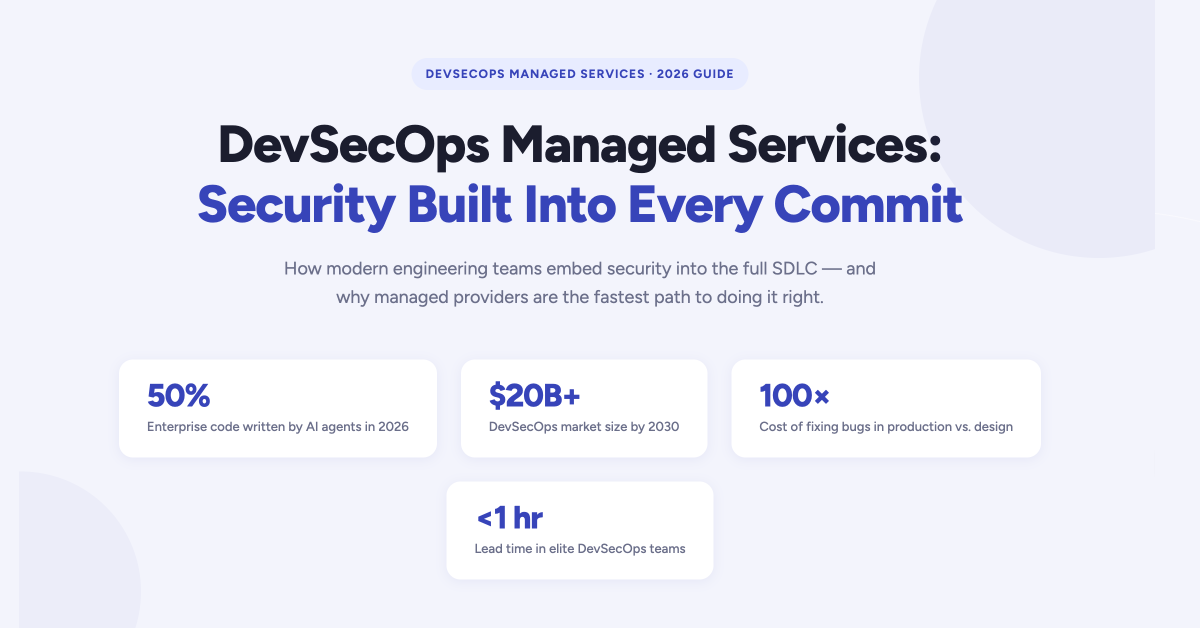
The global DevSecOps market reflects just how urgently organizations are embracing this shift. Valued at over $10 billion in 2025 and projected to grow at a compound annual growth rate above 20%, the market is on track to exceed $40 billion by 2034. That growth is not driven by compliance checkbox mentality — it is driven by engineering teams that have discovered automated security actually accelerates delivery by eliminating the last-minute scrambles that delay releases.
For engineering leaders, the value proposition is straightforward: security catches that happen in the first hour of development cost a fraction of what they cost to fix after a build is already in staging. When you automate those catches and embed them in the developer’s natural workflow, you are not adding friction — you are removing it from later in the process, where it causes the most damage.
Average savings per breach for organizations that deploy extensive security AI and automation, compared to those that do not. IBM Cost of a Data Breach Report, 2024
The shift-left imperative: why timing is everything
The phrase “shift left” has been in the DevSecOps lexicon for years, but its meaning has matured considerably. In its original formulation, it simply meant moving security testing earlier in the software development lifecycle (SDLC). In 2026, the more precise interpretation is shifting security information left — not just the workload.
The distinction matters. You can scan code at commit time all day, but if the output is a list of CVE identifiers with no context, developers will ignore it. Shifting information left means surfacing actionable context inside the tools developers already use: the IDE, the pull request interface, the Slack channel. It means telling an engineer not just that a vulnerability exists, but why it is exploitable in this specific codebase, what the impact is if left unaddressed, and — ideally — providing an automated patch or remediation suggestion.
Remediation cost is the clearest argument for this approach. Fixing a defect in the design or coding phase costs roughly 10 to 15 times less than addressing the same issue after it reaches production. Mature DevSecOps programs use this data to build the business case for investing in developer tooling and security training rather than relying on a last-line-of-defense security team.
Securing the CI/CD pipeline stage by stage
A secure CI/CD pipeline is not a single tool — it is a sequence of automated checkpoints, each designed to catch a specific class of risk at the moment it is cheapest to address. Below is how that architecture breaks down across each phase.
Source phase: catching vulnerabilities at commit
Security begins the moment a developer pushes code. At this stage, two categories of checks are non-negotiable. First, secret detection tools scan both the incoming commit and the full Git history for hardcoded API keys, database credentials, and tokens. Tools like Gitleaks and TruffleHog run in under a second and prevent the most common and embarrassing category of security incident — credentials committed to a shared repository.
Second, Static Application Security Testing (SAST) analyzes source code for insecure patterns — SQL injection, cross-site scripting, insecure deserialization — without executing the program. When integrated directly into a pull request workflow, SAST gives developers line-level feedback before a reviewer even looks at the code.
Build phase: supply chain defense
Modern applications are assembled, not written from scratch. The typical production codebase contains hundreds of open-source dependencies, and each one is a potential entry point. Software Composition Analysis (SCA) tools — Trivy, Snyk, and Black Duck being the leading names in 2026 — scan those dependencies against the National Vulnerability Database and proprietary threat intelligence feeds.
The more advanced SCA platforms now perform reachability analysis: they determine whether a vulnerable function inside a library is actually called by your application code. This single capability can reduce the actionable alert volume from hundreds to a handful, which is what makes the difference between a team that genuinely addresses vulnerabilities and one that has learned to ignore the scanner.
Test phase: runtime validation
Some vulnerabilities only reveal themselves when code is actually running. The test phase is where Interactive Application Security Testing (IAST) agents — embedded inside the application during QA — observe real data flow and execution paths during functional tests. Because IAST sees both the code and the runtime behavior, it produces very few false positives. For teams already running automated integration tests, adding IAST is typically a one-line configuration change.
Container scanning also runs at this stage, checking Docker and Kubernetes images for vulnerabilities in the base OS, language runtimes, and system libraries before they are promoted to staging or production.
Deployment phase: infrastructure-as-code security and policy gates
Infrastructure-as-Code (IaC) has become the standard method for provisioning cloud resources, and it introduces its own attack surface. Misconfigurations — public S3 buckets, overly permissive IAM roles, unencrypted databases — are the leading cause of cloud breaches. Tools like Checkov and Terrascan scan Terraform and CloudFormation templates before they are applied, catching these issues in the plan phase rather than the post-incident review.
Policy-as-Code frameworks such as Open Policy Agent (OPA) take this further by codifying organizational security rules and enforcing them as automated gates in the pipeline. If a deployment violates policy — for example, a container running as root, or a service exposing an unauthenticated endpoint — the pipeline blocks the deployment automatically and routes the finding to the relevant team with context. To explore how Gart Solutions designs and secures cloud infrastructure end to end, see our cloud computing services page.
Production phase: continuous monitoring and runtime protection
DevSecOps does not stop at deployment. Production is where the highest-stakes threats live, and continuous monitoring is the discipline that keeps them visible. Technologies like Runtime Application Self-Protection (RASP) sit inside the application and can detect and block active attacks in real time — not by matching signatures, but by observing whether an in-flight request is causing the application to behave outside its expected boundaries.
Alongside RASP, teams run Dynamic Application Security Testing (DAST) against live endpoints on a scheduled basis, simulating the behavior of an external attacker. OWASP ZAP and Burp Suite remain the workhorses here. Compliance auditing tools like Prowler and OpenSCAP close the loop by generating continuous evidence that cloud configurations remain inside regulatory boundaries — essential for teams operating under SOC 2, ISO 27001, or HIPAA requirements. Our SRE team specializes in building and operating exactly these production monitoring architectures.
Security testing methods compared: SAST, DAST, IAST, SCA
The four primary application security testing methodologies are complementary, not competing. A resilient DevSecOps program uses all four, each at the appropriate pipeline stage.
| Method | What it tests | Best pipeline stage | Accuracy profile | Remediation detail |
|---|---|---|---|---|
| SAST(Static) | Source code, bytecode | Commit / PR | Low–medium (AI-native tools improving rapidly) | Line-level code reference |
| DAST(Dynamic) | Running application, external surface | Staging / production | High — findings are exploitable | HTTP response, URL, endpoint |
| IAST(Interactive) | Instrumented app during test execution | QA / integration tests | Very high — lowest false-positive rate | Line-level + full data flow |
| SCA(Composition) | Third-party libraries, dependencies | Build / CI | High — CVE-database-backed | Library version + fix version |
The practical recommendation for most teams: start with SCA and secret detection (quick wins, low noise), add SAST at the PR level, introduce IAST once functional test coverage exceeds 60%, and schedule DAST against staging environments weekly. Do not try to implement all four simultaneously — tool sprawl is one of the most common failure modes in DevSecOps programs.
How AI is transforming DevSecOps automation
Artificial intelligence has moved from a vendor marketing claim to a measurable operational capability in the 2026 timeframe. Its impact on DevSecOps is concentrated in three areas: noise suppression, automated remediation, and agentic governance.
Noise suppression and alert prioritization
Alert fatigue is the most common reason DevSecOps programs fail culturally. When a scanner generates 2,000 findings per sprint and fewer than 50 are genuinely exploitable, developers learn to ignore the scanner — not because they are careless, but because the signal-to-noise ratio makes engagement irrational.
AI-enhanced scoring changes this equation. Datadog‘s 2025 State of DevOps report found that applying runtime context — network exposure, active exploitation evidence, and permission scope — reduced the volume of findings classified as critical by over 80%. AI models cross-reference scanner output with reachability data and cloud configuration to surface only the vulnerabilities that represent a genuine, exploitable risk in that specific deployment context.
“The best DevSecOps programs we work with have stopped trying to fix everything and started using AI to understand what actually matters. When you can tell a developer ‘this vulnerability is reachable, there is a known exploit, and it is running in a publicly exposed service’ — they act immediately. When you tell them ‘here are 300 medium-severity findings’ — they don’t.”
Fedir Kompaniiets, CEO & Co-Founder, Gart Solutions
Automated remediation: from “find” to “fix”
The next frontier is AI agents that do not just identify vulnerabilities but generate the pull requests to fix them. Platforms like Snyk and newer entrants such as Plexicus now offer auto-remediation workflows where an AI agent analyzes the vulnerability, determines the correct fix, and opens a PR with the change — leaving the human developer to review and approve rather than research and implement. Snyk reports auto-fix accuracy at approximately 70%, which means most common dependency and code-level vulnerabilities can be resolved without any developer time investment beyond a PR review.
For dependency management specifically, tools like GitHub Dependabot have made this workflow standard: when a new CVE is published for a library your application uses, the tool opens a PR to update to the patched version within hours of the advisory being released.
Agentic AI and autonomous governance
Emerging agentic AI systems in 2026 are beginning to handle tasks that previously required dedicated security engineers: real-time threat modeling as new services are deployed, continuous compliance auditing against regulatory frameworks, and autonomous incident response for well-defined threat patterns. These systems work best, as 73% of DevSecOps practitioners agree in recent surveys, within standardized platform engineering environments where security gates and ownership boundaries are clearly defined. This is why investing in your platform foundation is a prerequisite for realizing the value of AI in security — a point covered in depth in our platform engineering services.
Automated secrets management
As applications move to microservices and multi-cloud architectures, the number of credentials, API keys, database passwords, and certificates that need to be securely managed grows exponentially. Manual secrets management — copying credentials into environment files, rotating them on a quarterly schedule, and hoping nothing leaks in between — does not scale.
Modern secrets management platforms address this with three automation capabilities that should be considered baseline requirements in 2026:
- Automated rotation: credentials are rotated on a policy-defined schedule without human intervention, shrinking the exposure window if a secret is compromised.
- Just-in-time dynamic secrets: instead of a long-lived database password, an application receives a temporary credential valid only for the duration of a single task, which expires automatically when the task completes.
- Vaultless injection: secrets are injected directly into the application runtime at execution time, ensuring no credentials are ever written to disk, stored in version control, or visible in container image layers.
| Tool | Best fit | Rotation model | Operational complexity |
|---|---|---|---|
| HashiCorp Vault | Multi-cloud, hybrid environments | Customizable policy engine | High — requires dedicated ops |
| AWS Secrets Manager | AWS-native workloads | Lambda-based automation | Low — fully managed |
| CyberArk Conjur | Enterprise PAM requirements | Sidecar / init containers | Moderate — security-team driven |
AWS Secrets Manager is the default for teams running predominantly on AWS, given its tight native integration with RDS, ECS, and Lambda and its “set it and forget it” managed rotation model. HashiCorp Vault remains the leader for organizations operating across multiple cloud providers that need fine-grained dynamic secret policies. The choice between them is typically not a security question but an operational one: how much complexity can your platform team absorb?
Measuring ROI: DORA metrics and the business case
One of the most persistent myths in security is that it inherently slows delivery. The DORA (DevOps Research and Assessment) research program has produced the most rigorous counterargument to this assumption: elite DevSecOps performers are not just more secure — they are also faster.
| DORA Metric | Definition | Elite Benchmark (2026) |
|---|---|---|
| Deployment frequency | How often code reaches production | On-demand, multiple times per day |
| Lead time for changes | Commit to production | Less than one hour |
| Change failure rate | % of deployments causing incidents | 0–5% |
| Mean time to recovery | Time to restore service after failure | Less than one hour |
The security integration point: automated vulnerability detection in the pipeline directly reduces lead time for changes, because security issues are resolved before they block a release rather than discovered after one. Automated policy enforcement at the deployment phase keeps change failure rates low by preventing misconfigured infrastructure from reaching production at all.
Beyond velocity, the financial case for DevSecOps automation is quantified in IBM’s 2024 Cost of a Data Breach report: organizations deploying extensive security AI and automation saved an average of $2.2 million per breach. DevSecOps practitioners also report losing an average of 3 to 4 hours per week to inefficient manual security processes — time that auto-fix and automated triage capabilities return to feature development. Mature DevSecOps organizations resolve security flaws approximately 6 times faster than less mature peers, which directly compresses the window of opportunity available to attackers.
Common implementation challenges in DevSecOps automation
Understanding the obstacles ahead of time is what separates a DevSecOps program that delivers results from one that generates expensive tooling with minimal security improvement.
Tool sprawl
The most common failure mode: an organization evaluates 12 point solutions, purchases 6, and ends up with tools that don’t communicate with each other, conflicting policies, and no single view of organizational risk. The 2026 market trend toward Application Security Posture Management (ASPM) platforms — unified dashboards that aggregate findings across SAST, DAST, IAST, SCA, and cloud configuration — directly addresses this. Before adding a new tool, the question should always be: does this replace an existing tool, or add to the stack?
Cultural resistance
Security automation works technically but fails culturally when developers experience it as a blocker rather than a helper. The Security Champions program is the industry-standard response: designating one engineer per team as the security liaison, giving them scoped visibility into their team’s specific findings, and investing in their security education. Champions attend monthly syncs, participate in threat modeling for new features, and serve as the first line of triage — preventing organization-wide noise from reaching individual development squads.
Alert fatigue and false positives
Teams that have been burned by high false-positive rates from early SAST tools often abandon scanner output entirely. The solution is not to run fewer scans — it is to apply AI-driven context filtering to scanner output before it reaches developers. Runtime reachability analysis, cloud context, and historical triage patterns can reduce the actionable alert volume by 60–80% without degrading security coverage. Starting with tools that have demonstrably low false-positive rates — IAST tools, for example, routinely exceed 95% accuracy — builds the organizational trust needed to expand coverage over time.
Starting too large
DevSecOps automation is not a project with an end date — it is an ongoing capability that matures incrementally. Start with two or three high-value, low-noise controls: secret detection at commit, SCA in the build phase, and IaC scanning before apply. Prove the model, measure the reduction in late-stage security findings, and use that data to justify expanding coverage. Elite programs did not arrive at on-demand deployment with full pipeline security coverage on day one — they got there through disciplined, iterative improvement.
How Gart Solutions can help you implement DevSecOps automation
Most organizations know what good DevSecOps looks like in theory. The gap between theory and a functioning pipeline — one that catches real vulnerabilities, integrates with your existing toolchain, and doesn’t slow your engineering team down — is where Gart Solutions operates.
We integrate security tooling — SAST, SCA, secrets management, IaC scanning, and policy gates — directly into your CI/CD pipeline.
Explore DevOps services →Our SRE team designs production monitoring stacks that provide continuous visibility into runtime threats and compliance posture.
Explore SRE services →We build the IDP foundation — golden paths, policy enforcement, secure defaults — that makes automation scalable across teams.
Explore Platform Engineering →Container and cluster security hardening, RBAC, and runtime threat detection implemented for production workloads.
Explore Kubernetes services →