Chief Technology Officer as a Service (CTOaaS) flips the traditional executive playbook on its head. Instead of locking yourself into a full-time C-suite hire with a long onboarding saga and a serious dent in your budget, you get access to battle-tested technology leaders exactly when you need them — and only for as long as it makes sense. Think of it as executive-level tech leadership on demand: flexible, sharp, and very much aligned with real business goals. No corner office required.
The appetite for this kind of model is growing fast, and for good reason. Digital transformation isn’t slowing down, AI isn’t waiting politely, and cloud infrastructure has gone from “nice to have” to “absolutely essential.” Companies across industries are feeling the pressure to make the right tech decisions quickly — and they’re responding accordingly. The CTOaaS market reflects that momentum, growing from roughly US$280 million in 2024 to a projected US$557 million by 2031, riding a healthy CAGR of around 10%. In short: a lot of smart companies are deciding they don’t need a permanent CTO to get permanent results.
Where CTOaaS really shines is speed and efficiency. Hiring a full-time CTO can feel like an endurance sport — six months (or more) of searching, interviewing, negotiating, and waiting, all while critical tech decisions hang in limbo. With CTOaaS, onboarding often happens in one to three weeks. Not quarters. Weeks. And the cost difference is just as compelling: organizations typically save around 60–70% compared to the full compensation package, benefits, and overhead of a permanent executive. Same level of strategic brainpower, far less financial gravity.
The result? Faster alignment between business and technology, fewer expensive missteps, and a leadership model that adapts as quickly as your company does. CTOaaS isn’t a compromise — it’s a smarter way to lead technology when speed, clarity, and flexibility actually matter.
Definitions and Differentiation
Outsourced technology leadership comes with a whole menu of titles, and yes — they can sound confusingly similar at first glance. Fractional, Interim, Part-Time, CTOaaS… same letters, very different commitments. If you’re considering bringing in external tech leadership, understanding how these models actually work (and when they shine) makes all the difference between a smart move and an expensive mismatch.
At its heart, CTOaaS is about borrowing experience instead of buying a full-time role. You partner with seasoned technology leaders on a consultancy basis to guide decisions, reduce risk, and keep technology moving in the same direction as the business. This setup works especially well for fast-growing companies that need senior-level thinking but aren’t ready, or willing to lock themselves into a full executive salary. CTOaaS keeps tech aligned with business goals, whether that means setting architectural guardrails, keeping technology spend under control, or simply making sure the team isn’t reinventing the wheel every sprint.
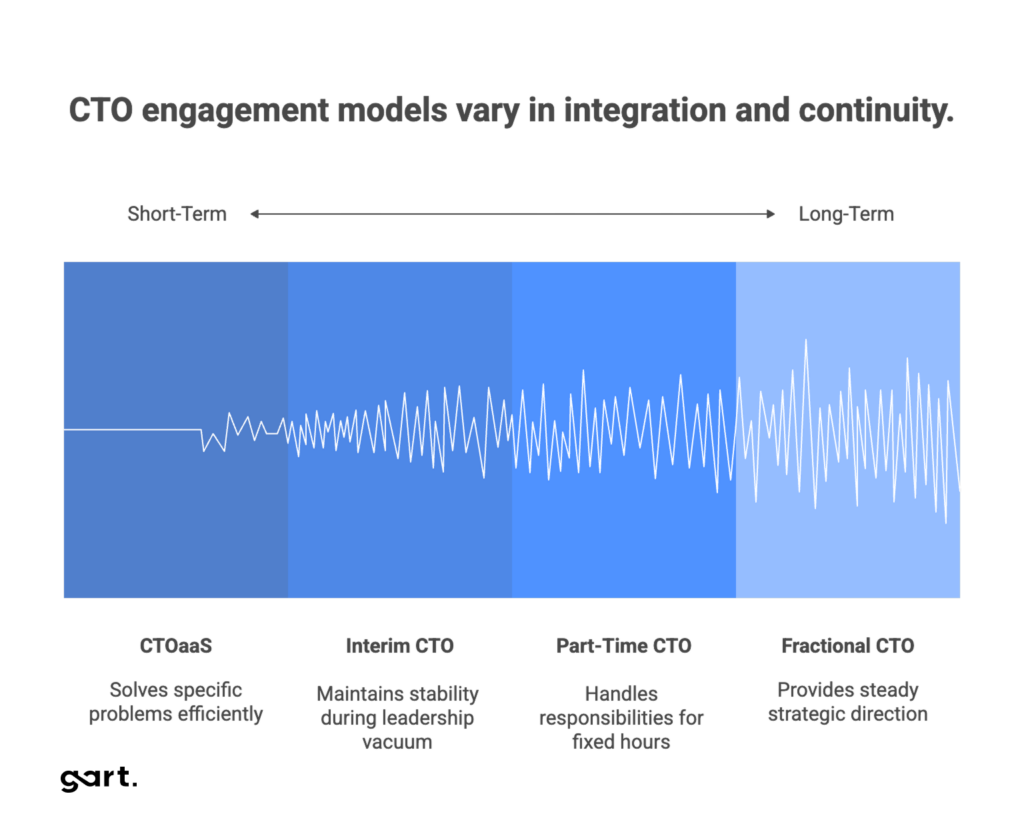
That said, the tech world loves labels, and each one signals a slightly different way of working:
Fractional Chief Technology Officer (FCTO)
A Fractional CTO is a part-time executive who typically works with several companies at once, but doesn’t just “drop in and disappear.” This role is deeply embedded in the organization over time, providing steady strategic direction, mentoring teams, and helping weave technology into everyday processes. The focus here is long-term thinking: roadmap clarity, leadership consistency, and decisions that age well rather than just solve today’s problem.
CTO as a Service (CTOaaS)
CTOaaS usually points to a more flexible, modular approach. Services are often delivered through a consultancy or platform that assigns an individual expert, or sometimes a small team — to tackle clearly defined challenges. Need a system audit, a cloud migration strategy, or a prototype validated fast? This model is built for speed and scalability. It’s less about ongoing presence and more about solving specific problems efficiently, then moving on without unnecessary long-term commitments.
Interim Chief Technology Officer
An Interim CTO steps in when there’s a sudden leadership vacuum. Maybe the permanent CTO left, maybe they’re on extended leave, but either way, the business needs someone experienced at the helm right now. Interim CTOs usually work full-time, with a scope very similar to a permanent executive, but with one key difference: everyone knows the clock is ticking. The role is explicitly temporary, focused on stability, continuity, and keeping things moving until the long-term solution is in place.
Part-Time CTO
This title often overlaps with “Fractional CTO,” but some teams draw a subtle line. A Part-Time CTO may handle all technology leadership responsibilities for a fixed number of hours on an ongoing basis, while a Fractional CTO is more narrowly focused on selected strategic areas. Same idea, different emphasis —and, as always, the real meaning depends on how the engagement is structured in practice.
Where the Real Differences Live
The real distinction between these models isn’t the title — it’s how deeply the executive integrates into the organization and how long they stay in the story. Fractional CTOs tend to commit to regular involvement and predictable engagement over time, often spanning six to eighteen months. That continuity allows them to own long-term initiatives, monitor progress, and make decisions that compound rather than conflict.
CTOaaS engagements, on the other hand, are usually shorter and more surgical. They’re designed to flex up and down as needed, making them ideal for targeted support or occasional high-impact interventions. Less commitment, more adaptability.
Choosing the right model comes down to your company’s technical maturity and the nature of the challenge you’re facing. If the issue is structural — building teams, introducing Agile or CI/CD, reshaping processes, or shifting engineering culture — you need depth, continuity, and trust. That’s where a Fractional CTO earns their keep, by embedding deeply enough to influence not just systems, but habits and decision-making patterns.
If, however, your internal team is solid and you’re facing a sharp, well-defined problem — like a security review, a tricky architectural decision, acquisition due diligence, or targeted troubleshooting — a project-based CTOaaS engagement is often the smarter move. You get senior expertise exactly where it’s needed, without dragging in a long-term commitment that doesn’t add value.
One final rule of thumb: using a short-term, task-focused CTOaaS engagement to fix long-term structural or cultural issues rarely works. It tends to create dependency instead of growth — and that’s a lesson best learned from someone else’s hindsight, not your own.
The Business Case: Why CTOaaS Beats a Full-Time Hire
Here’s the scoop: CTOaaS isn’t just a trendy buzzword — it’s a smart play that makes growing businesses and even established enterprises say, “Why didn’t we do this sooner?” The appeal is simple: cost savings, speed, flexibility, and strategic muscle without the drama of a full-time hire.
Cost Effectiveness and ROI Maximization
Hiring a full-time CTO is like buying a sports car when all you need is a skateboard. The numbers add up fast: a base salary of $180,000–$300,000+, plus equity, benefits, and all the usual perks. That’s a serious hit to your budget, especially for startups or lean-growth companies.
Enter CTOaaS. Outsourced CTOs typically cost 60–70% less than their in-house counterparts, with annual investments falling in the $50,000–$120,000 range for part-time or project-specific engagements. You only pay for what you actually use — high-level expertise on-demand—so no wasted overhead and no long-term baggage. It’s like having a Formula 1 pit crew that only charges for the laps you actually race.
Strategic Acceleration and Expertise Boost
CTOaaS isn’t just cheaper — it’s faster and smarter. Veteran technology leaders bring hard-won knowledge from multiple industries, helping you dodge the “oops” moments every founder fears. Onboarding happens in weeks, not months, so projects keep moving while competitors are still posting “We’re hiring a CTO” on LinkedIn.
Beyond speed, an external CTO delivers a brutally honest, unbiased assessment of your tech landscape. They spot redundancies, streamline operations, and implement changes that stick. One of their biggest superpowers? Tackling technical debt — the silent IT budget killer. While internal teams often prioritize new features over cleanup, a CTOaaS professional reframes legacy system modernization as risk management and long-term cost savings. Their strategic, data-driven approach ensures tough decisions are made once, correctly, freeing your internal team to focus on innovation instead of endlessly patching yesterday’s shortcuts.
Here’s a side-by-side snapshot to make the case crystal clear:
| Criteria | Full-Time (In-House) CTO | Outsourced / CTOaaS Model |
| Annual Financial Commitment | $180,000 – $300,000+ salary + Equity + Benefits | $50,000 – $120,000 (Part-time/Project) |
| Time-to-Hire / Onboarding | 3 – 6+ Months | 1 – 3 Weeks |
| Commitment & Duration | Exclusive, Long-term, Deep Cultural Immersion | Flexible, Ongoing (3–18 Months typical) or Project-specific |
| Scope of Influence | Full control of tech and team, deep operational oversight | Strategic leadership, high-level guidance, execution oversight |
| Talent Pool Access | Limited by geographic location and recruiting budget | Broad access to diverse, veteran, cross-industry expertise |
In short: if you want to save money, move fast, and get top-tier expertise without the C-suite circus, CTOaaS is your winning strategy. It’s strategic horsepower, delivered lean and mean.
For companies looking to unlock these advantages today, Gart Solutions offers CTO as a Service—delivering seasoned technology leadership on a flexible, project- or retainer-based model.
CTO as a Service Deliverables
Think of a CTOaaS partner as a full-time CTO, but laser-focused on the moves that actually move the needle. They’re not here to micromanage your codebase — they’re here to steer the ship, chart the course, and make sure everyone’s rowing in sync toward growth and impact.
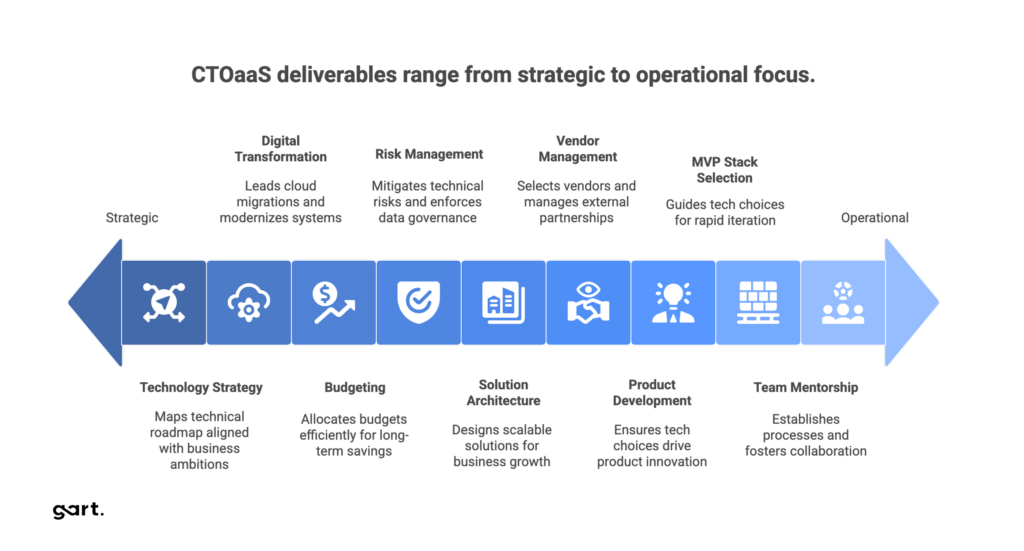
Technology Strategy and Roadmapping
A CTOaaS partner maps out a technical roadmap that’s smart, scalable, and totally aligned with your business ambitions. They spot innovative technologies that can give you an edge, plan how to integrate them, and ensure your tech isn’t just working for today but ready to flex for tomorrow.
Budgeting and Resource Allocation
Money talks, and CTOaaS makes sure it’s talking strategically. They allocate budgets efficiently, making sure every dollar spent on tech is an investment in long-term savings, operational efficiency, and business outcomes. No fluff, no wasted spend.
Risk Management and Security Posture
They keep your systems safe, compliant, and future-proof. This includes mitigating technical risks, enforcing data governance, and making sure security isn’t just a checkbox — it’s part of your operational DNA.
Solution Architecture Design
CTOaaS partners set the stage for robust, scalable solutions. From designing architectures that handle growth effortlessly to choosing future-proof tech stacks, they ensure the technology backbone supports your business ambitions without collapsing under pressure.
MVP Stack Selection
For early-stage ventures, picking the wrong stack can be costly. CTOaaS guides MVP tech choices to enable rapid iteration and scalable growth, making sure your first product build is both nimble and resilient.
Digital Transformation Leadership
They don’t shy away from big moves — modernizing legacy systems, leading cloud migrations, and driving digital transformation initiatives are all in a day’s work. Efficiency, scalability, and future-readiness are the watchwords.
Team Mentorship and Development
A CTOaaS isn’t just an outside expert — they’re a coach and mentor. They establish processes like Agile or CI/CD, ensure teams stay current with new tech, and foster a culture of collaboration and continuous improvement.
Vendor and Partnership Management
From selecting the right vendors to managing external partnerships, CTOaaS ensures your organization is getting maximum value from every relationship. They can also serve as the technical face to clients and partners, translating complex systems into understandable, actionable insight.
Product Development Oversight
Your product’s success is directly linked to technology strategy. CTOaaS ensures your tech choices drive innovation, validate products in the market, and maintain competitive advantage.
Communication and Strategic Alignment
Perhaps the most critical deliverable: bridging the gap between tech teams and non-technical stakeholders. CTOaaS must communicate complex concepts clearly, translating technical decisions into measurable business impact. They make sure everyone — from engineers to investors, understands and supports the technology strategy. With AI, cloud, and cybersecurity increasingly at the center of business success, their ability to quantify the economic impact of technical choices and align resource allocation with business KPIs is priceless.
Organizations looking for an experienced partner to cover all these CTOaaS deliverables can turn to Gart Solutions, which provides hands-on guidance, architecture oversight, and team mentorship without the cost of a full-time hire.
CTOaaS Across the Organizational Maturity Curve
Here’s the deal: CTOaaS isn’t a one-size-fits-all gig. It’s flexible, nimble, and can be dialed up or down depending on where your company sits on the growth spectrum. Think of it like executive-level tech leadership with a volume knob — you get exactly the intensity you need, when you need it.
Startups and Early Stage (Ideation to MVP)
Early-stage startups are the wild west of business: budget-tight, high-energy, and often run by founders who are brilliant, but not exactly fluent in “tech-speak.” That’s where CTOaaS shines. At this phase, the goal is clear: validate your concept fast, avoid overbuilding, and dodge the kind of tech missteps that turn promising ideas into cautionary tales.
Core Need: Access to seasoned tech brains who know the startup rollercoaster and can help you avoid those “oops, why did we do that?” moments. Rapid product-market fit validation is the name of the game.
Deliverables: Setting up your initial technology strategy, choosing the right MVP stack, managing the first wave of tech projects, and sidestepping critical path dependencies that could trip you up. Essentially, CTOaaS makes sure you’re running lean, fast, and smart.
Investor Readiness: CTOaaS often doubles as your secret weapon for funding rounds. They can handle technical due diligence, prep your pitch deck with a focus on tech, and make investors feel confident that your project has not just vision but the technical chops to pull it off. Think of them as your tech translator, making sure the bean counters, angels, and VCs actually understand the genius behind your code.

Scaling Businesses (Growth Stage)
Once your startup finds product-market fit and starts growing — say, hitting that sweet spot of 10–50 employees — the CTOaaS focus pivots. It’s no longer about hands-on coding; it’s about building systems that can handle the heat and making processes repeatable so your growing team doesn’t crumble under complexity.
Core Need: Solid, scalable infrastructure and repeatable processes that don’t require reinventing the wheel every week.
Deliverables: Growing and mentoring the technical team, putting in place Agile, Scrum, and CI/CD processes that actually stick, setting up reliable cloud infrastructure, and, importantly, reigning in cloud costs. One scaling healthcare platform, for instance, was drowning in performance issues and lacking leadership. A Fractional CTO swooped in, rebuilt the tech infrastructure, and set up operational processes — suddenly the company could support massive user growth and was audit-ready, all while keeping investors happy.
Mature Enterprises and Specific Interventions
CTOaaS isn’t just for scrappy startups — it’s the secret sauce for bigger enterprises tackling complex, mission-critical challenges.
M&A Due Diligence and Integration: Here, CTOaaS plays the strategic partner role with all the gravitas of a full-time CTO, but for a defined stretch. They handle tech assessments during acquisitions, identify risks like potential cybersecurity disasters (average cost: $4.24 million — yikes), and steer integration so the new tech and culture fit smoothly. Companies that bring in expert CTOaaS leadership during M&A consistently outperform peers by 15%. When internal teams are already maxed out, the external CTO ensures the process doesn’t stall or fail — think of it as executive-level seat belts for your post-merger ride.
Digital Transformation and Governance: For large organizations, CTOaaS ensures that digital transformation isn’t just a buzzword on a slide deck. They align tech vision with long-term business strategy, manage risk, and keep the organization compliant with industry and regulatory standards.
Industry Specificity: Certain sectors love CTOaaS like a caffeine hit in a Monday morning meeting. HealthTech, for example, can cut approval timelines by up to 40% when a Fractional CTO guides regulatory roadmaps. FinTech firms gain an edge by integrating advanced analytics to uncover hidden market insights. It’s like having a seasoned guide who knows the secret shortcuts everyone else misses.
Here’s a quick reference for how CTOaaS flexes across business growth stages:
| Business Stage | Key Focus Area | Primary CTOaaS Deliverables |
| Early Stage / Startup | Product validation, cost management, technology foundation | MVP stack selection, technical risk avoidance, pitch deck prep for funding |
| Growth Stage / Scale-up | Process scaling, team building, infrastructure agility | CI/CD pipeline setup, hiring/mentoring dev team, cloud cost control |
| Mature / Enterprise | Innovation, governance, optimization | M&A tech due diligence/integration, cybersecurity assessment, digital transformation strategy |
Bottom line: CTO as a service isn’t a cookie-cutter service. It scales, adapts, and delivers exactly what your company needs at the exact moment you need it. From ideation to IPO — or somewhere in between it’s like having a seasoned co-pilot for your tech journey, keeping you on course, out of the weeds, and ready to sprint ahead.
Whether you’re an early-stage startup needing MVP guidance or a growth-stage company scaling your infrastructure, Gart Solutions’ CTOaaS model adapts to your stage, ensuring rapid impact and sustainable internal capability building.
Engagement Models, Pricing, and KPIs
CTOaaS is like a Swiss Army knife for executive tech leadership: flexible, scalable, and tailored to fit your exact business needs. Whether you need a quick consultation, ongoing guidance, or a well-defined project completed, there’s a model that makes sense — and won’t make your CFO break out in a cold sweat.
Hourly Rates
Perfect for when you need fast, targeted advice — think “we’re stuck on this tech problem, help!” Hourly rates usually land between $150 and $500 in the US and Europe. If you need a specialist in AI, blockchain, or some other shiny new tech, be prepared for rates that can creep above $500 per hour. This model is great for acute troubleshooting or short-term guidance without a long-term commitment.
Monthly Retainer
The monthly retainer is the go-to for ongoing, steady strategic support. Typically spanning 3 to 12 months, it guarantees a set number of hours each month, giving you predictability without sacrificing access to top-tier advice. Costs usually range from $3,000 to $15,000+ per month. This is perfect if you want continuous leadership, mentoring, and someone in your corner who understands your team’s evolving challenges. Think of it as having a Fractional CTO in your pocket, without the full-time salary sticker shock.
Project-Based / Fixed Fee
When your needs are laser-focused — like completing a system migration, conducting a technical audit, or rolling out a new MVP — a fixed-fee engagement keeps things tidy and predictable. Fees typically range from $5,000 to $50,000+, depending on project complexity and duration. You know exactly what you’re getting, when, and for how much. No surprises, no hidden costs.
Global Considerations
Rates can vary widely depending on geography. In Asia, for example, hourly rates might run $45–$150. Cost savings are tempting, but beware the hidden friction: strategic leadership often requires real-time collaboration, mentoring, and day-to-day decision-making. Hiring someone far away might shave dollars off the invoice but add delays, misalignment, or slower velocity due to time zone gaps. For high-integration roles, synchronous communication is not a luxury — it’s essential.
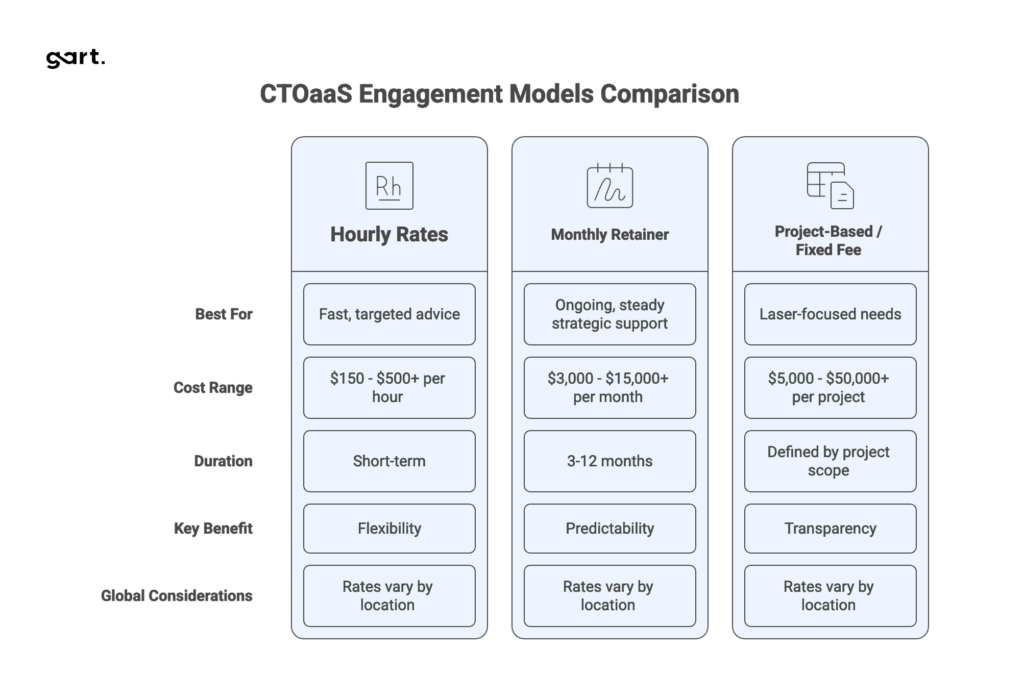
CTOaaS engagement models let you dial in exactly the level of support you need. From a quick tech sanity check to full-on strategic oversight, you pick the rhythm, the scope, and the budget—and get executive-grade guidance that scales with your business.
Governance and Risk Management in the CTOaaS Model
CTOaaS brings incredible flexibility and speed, but like any high-octane move, it comes with its own set of governance and legal curves to navigate. You’re essentially letting an external executive into the engine room, which is exciting — but also raises the stakes around intellectual property, data security, and operational alignment.
Intellectual Property (IP) Ownership
Let’s get this straight: IP is the crown jewel for any tech company. Hire an external CTO without locking this down, and you could be handing away the keys to your castle. In many jurisdictions, work done by independent contractors doesn’t automatically count as “work made for hire.” Translation: if your contract doesn’t say the right things, ownership could get messy.
The Assignment Requirement: Contracts must explicitly assign all IP rights — including code, architecture, documentation — directly to the client. No legal jargon shortcuts; these are the “magic words” that secure ownership. Skip them, and you risk ambiguity that could undermine your core product.
Clear Identification: Any pre-existing IP the CTOaaS provider brings must be clearly disclosed, with proper licenses granted to you. Third-party components and open-source software must also be flagged, so there are no surprises down the road.
Fast Onboarding, Zero Excuses: One of the CTO as a service perks is ramp-up speed — usually 1–3 weeks. That’s great for momentum, but it compresses the window for careful legal review. The solution? Have a pre-vetted legal IP checklist and standard contract template ready to go. Legal oversight becomes a prerequisite, not a speed bump.
Data Security and Confidentiality
Sharing sensitive information, from trade secrets to technical strategy, requires ironclad safeguards.
Contractual Protections: NDAs, explicit trade secret clauses, and warranties about non-infringement are non-negotiable.
Operational Measures: Physical and digital restrictions matter. Label materials as confidential, restrict access based on “need to know,” and implement security protocols for all source code. Treat this like building a digital moat around your castle.
Alignment and Accountability
External executives bring expertise, but they’re not inside your company culture by default. Misalignment or perception of lost control can be mitigated with clear, SMART objectives outlined during contract negotiation. Specific, measurable, achievable, relevant, and time-bound goals ensure everyone’s on the same page about scope, deliverables, and outcomes.
Platform and Contractor Considerations
When engaging via platforms, clarify liability for contractor classification. Platforms may automate onboarding, but Agents of Record (AORs) often assume more compliance responsibility — albeit at a higher cost. This trade-off between convenience, liability, and cost should be factored into your engagement decision.
In short: CTOaaS lets you move fast and think big, but governance and risk management aren’t optional. IP, confidentiality, alignment, and compliance require structured contracts, operational protocols, and proactive communication. Nail these, and your external CTO becomes a turbocharged extension of your team — strategically smart, legally sound, and operationally secure.
A Success Framework for CTOaaS Engagement
Getting the full bang for your CTOaaS buck isn’t just about hiring a tech wizard — it’s about structuring the engagement to maximize impact, integrate seamlessly, and leave your organization stronger than ever. Think of it as onboarding a turbocharged executive without the drama of a long-term hire.
Selection: More Than Just Tech Skills
Picking the right CTOaaS partner isn’t about checking boxes on coding languages or cloud certifications alone. You want someone who pairs deep technical chops — modern software architecture, cloud platforms like AWS, GCP, or Azure, cybersecurity awareness — with sharp strategic thinking and business acumen. They need to see the big picture, align technology with budgets and business goals, and think three steps ahead.
Focus on Measurable Impact
Vetting should dig into real-world results, not just glossy resumes. Look for past wins like scaling projects that didn’t collapse under load, slashing infrastructure costs, stabilizing unstable systems, or steering successful compliance audits (SOC 2, ISO 27001, etc.). If they can’t point to measurable outcomes, move along—this role is all about delivering impact.
Soft Skills Are King
CTOaaS isn’t just about strategy — it’s about people. Strong communication, leadership, mentorship, and adaptability are non-negotiable, especially when guiding remote or fractional teams. The best CTOaaS professionals translate complex tech into language the whole company can rally around, building trust and alignment along the way.
Onboarding: Fast, Focused, and Smart
A brief but structured onboarding (1–2 weeks) ensures the CTOaaS partner hits the ground running.
- Initial Assessment: Conduct a full technology audit, flagging immediate risks, evaluating capabilities, and setting both short-term wins and long-term objectives.
- Team Preparation and Communication: Introduce the CTOaaS to both tech and executive teams. Outline objectives, roles, and responsibilities clearly, and establish communication protocols—weekly briefings, daily stand-ups, or whatever keeps everyone synced.
- Integration and Dialogue: Schedule time with key team members across functions. Open dialogue helps the CTOaaS understand pain points, frustrations, and opportunities, ensuring faster integration and more effective strategy development.
Measuring Long-Term Value and Planning the Exit
Success isn’t just about ticking off tasks — it’s about sustainable improvements. Key metrics include Time to Deploy, system uptime, and optimized Burn Rate relative to Feature Velocity.
A standout CTOaaS engagement also prevents organizational dependency. The smartest arrangements embed knowledge transfer and internal capability building. External expertise should mentor internal engineering managers into directors, establish career ladders, and institutionalize best practices. By investing in internal growth, the company builds lasting institutional knowledge, accelerates the path to a permanent technical leader, and ensures a smooth transition when the fractional engagement wraps up.
A successful CTO as a service engagement is like hiring a rocket engine for your tech operations — it accelerates growth, stabilizes systems, develops internal talent, and leaves the company stronger and more capable long after the engagement ends.
Global Forces Driving CTOaaS Demand
The CTOaaS wave isn’t a fad—it’s powered by three turbocharged forces shaping the tech world today:
The AI and Innovation Mandate
AI isn’t just a buzzword anymore; it’s the nervous system of modern business. CTOs are under pressure to weave intelligence into every process, product, and platform. CTOaaS delivers instant access to experts who know how to formulate AI policies, manage risk, and make sure adoption isn’t just flashy —it’s responsible, compliant, and strategic. Think of it as having a seasoned guide to AI without having to hire a full-time guru.
Accelerating Digital Transformation
Businesses everywhere are sprinting to digital transformation. Legacy systems that worked fine a decade ago now slow companies down. CTOaaS helps organizations pivot fast, modernizing infrastructure, scaling cloud environments, and turning rigid IT setups into agile, adaptable systems. Strategic leadership at the right time makes this marathon feel like a sprint.
Surge in the Startup Ecosystem
Startups and tech-driven SMEs are multiplying faster than coffee shops in a hip neighborhood. These fast-moving ventures need flexible, cost-effective C-level guidance to survive, attract investors, and scale smartly. CTOaaS offers the high-level experience they need without breaking the bank — or the calendar.
To capitalize on these global forces, forward-thinking companies are partnering with Gart Solutions for CTO as a Service, turning strategic expertise into immediate, high-leverage results.
Conclusion
Here’s the bottom line: CTOaaS bridges the gap between the demand for executive technical leadership and the reality that growing companies often can’t commit to a full-time hire. The model delivers speed, cost efficiency, and access to diverse, veteran expertise — all of which translate directly into optimized runway, reduced technical risk, and faster scaling.
The future? CTOaaS is evolving from a temporary hack to a core feature of modern business infrastructure, especially for SMEs. But to truly harness it, companies must treat CTOaaS as a strategic partnership. That means:
- Rigorous contractual governance, especially around IP ownership.
- Clear, measurable KPIs like deployment velocity, cost savings, and system reliability.
- Deliberate knowledge transfer and mentorship to build internal technical capability.
Do all this, and CTO as a service isn’t just a service — it’s a turbocharged engine for sustainable growth, infrastructure agility, and maintaining a competitive edge in a complex, tech-driven world.