The Market Reality: Legacy IT Is the Hidden Anchor of Enterprise Value
In the heart of nearly every large enterprise sits a massive constraint: accumulated technical debt embedded in legacy systems.
Across Fortune 500 companies, roughly 70% of core enterprise software was built 20+ years ago. These systems run billing engines, transaction processors, underwriting platforms, ERPs, and supply chains. They are stable — but not adaptable.
For decades, modernization was deferred because:
- Programs cost hundreds of millions
- Timelines stretched 5–7 years
- Risk of disruption was high
- ROI was unclear
- Systems “still worked”
That equation has changed.
Technology now drives about 70% of value creation in major business transformations. AI, cloud, robotics, and automation demand modern digital foundations. Companies cannot extract value from generative AI, advanced analytics, or automation on top of fragmented, tightly coupled, undocumented legacy stacks.
Meanwhile, retirement of legacy-skilled engineers increases risk every year.
Legacy modernization is no longer an IT initiative. It is a CEO-level growth decision.
The Economics Have Shifted: Why AI Changes the Business Case
Three years ago, modernizing a large financial transaction processing system could cost well over $100M. Today, with AI-assisted modernization, similar programs can cost less than half — while moving significantly faster.
Organizations using generative AI in modernization programs are seeing:
- 40–50% acceleration in modernization timelines
- ~40% reduction in tech debt–related costs
- Measurable improvement in output quality
- Direct tracking of tech debt impact on P&L
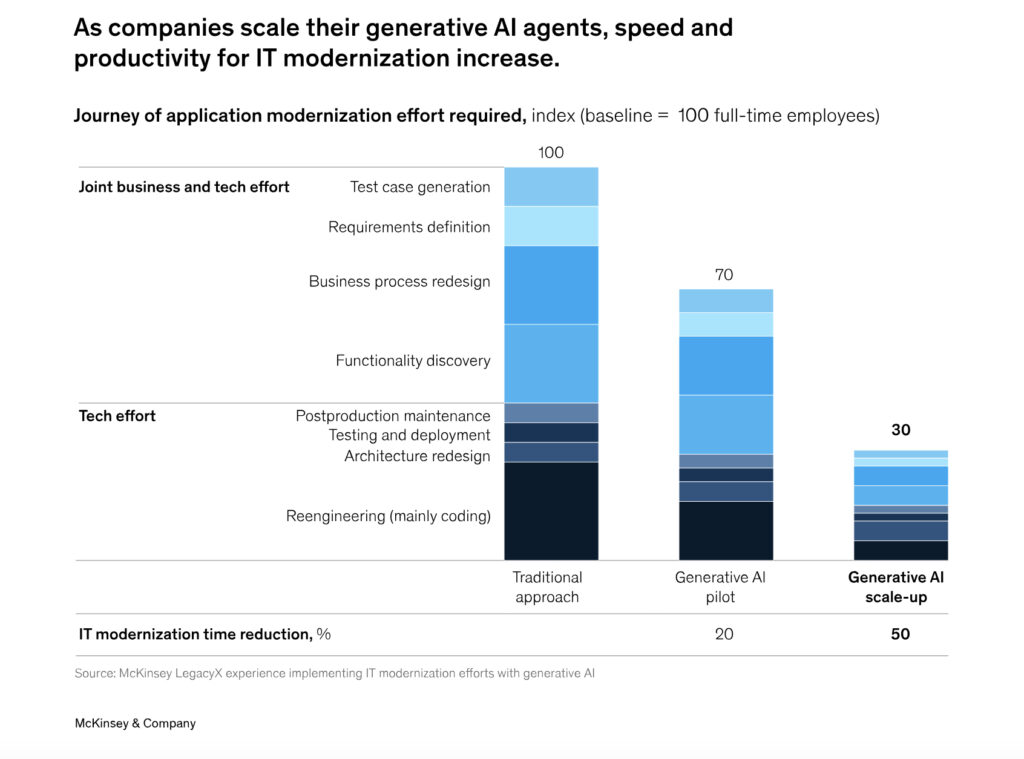
Previously “too expensive” modernization efforts are now viable.
But only if AI is used strategically.
What Legacy Systems Actually Cost
When people search “cost of legacy systems” or “how much does legacy software cost,” they usually mean license fees.
The real cost is broader.
1. Direct IT Spend
- Maintenance contracts
- Vendor lock-in pricing
- On-prem infrastructure
- Custom integration upkeep
In many enterprises, 60–80% of IT budgets go to maintaining existing systems.
2. Productivity Loss
- Developers spending significant time managing technical debt
- Business users relying on spreadsheets and manual workarounds
- Slower product delivery cycles
3. Risk & Compliance Exposure
- Security patching complexity
- Difficulty implementing regulatory updates
- Increased downtime probability
4. Opportunity Cost
Technology debt can represent up to 40–50% of total investment spend impact. That is capital not going toward innovation.
Why AI Modernization Is Not Just Code Translation
One major mistake in AI-driven modernization is what experts call “code and load.”
This happens when:
- Old code is simply converted to a new language
- Architecture remains unchanged
- Business logic inefficiencies persist
That approach merely moves technical debt into a modern shell.
Real modernization requires:
- Redesigning architecture
- Re-evaluating business processes
- Eliminating unnecessary complexity
- Targeting business outcomes, not code syntax
AI should support transformation — not automate technical debt migration.
How AI Actually Improves Legacy Modernization
AI delivers leverage in three major areas:
1. Business Outcome Optimization
Instead of modernizing everything, AI helps identify:
- What systems generate the most business risk
- Where modernization unlocks revenue
- Which components can be retired
2. Autonomous AI Agents
Modern AI systems can deploy coordinated agents to:
- Analyze dependencies
- Generate test cases
- Propose refactoring
- Create documentation
- Assist migration workflows
When orchestrated correctly, these agents significantly reduce manual engineering workload.
3. Industrialized Scaling
The real value appears when AI modernization becomes repeatable:
- Standardized workflows
- Automated test pipelines
- Governance and oversight
- Measurable cost reduction tracking
Scaling AI across modernization efforts turns it into a compounding advantage.
A Practical AI-Driven Modernization Framework
Phase 1: AI-Assisted Discovery & Audit
Before touching code:
- Map all applications and integrations
- Quantify tech debt exposure
- Identify cost concentration
- Detect hidden dependencies
AI reduces months of manual analysis into days.
Phase 2: Prioritization Based on Value
Search behavior shows leaders ask:
- “When should you replace legacy systems?”
- “Is modernization worth it?”
Answer: modernize what creates measurable business value.
Focus on:
- Systems blocking AI adoption
- Compliance risk hotspots
- High maintenance cost clusters
- Revenue-critical applications
Phase 3: Target Architecture Definition
Modern systems must include:
- API-first architecture
- Modular services
- Event-driven patterns
- Observability and monitoring
- CI/CD automation
- Infrastructure as Code
Without redesigning architecture, modernization fails long term.
Phase 4: AI Guardrails Before Refactoring
AI generates:
- Regression test suites
- Test data scenarios
- Change impact analysis
- Code documentation
This reduces modernization risk significantly.
Phase 5: Incremental Replacement
Instead of rewriting everything:
- Wrap legacy with APIs
- Replace bounded domains
- Validate via automated testing
- Decommission gradually
This approach minimizes operational disruption.
It aligns with structured Legacy Application Modernization.
Market Forces Accelerating AI-Driven Legacy Modernization
AI-driven modernization is not a niche trend. It is the convergence point of multiple structural shifts in enterprise technology, economics, and competitive dynamics.
Across industries, modernization is accelerating because the underlying pressures are compounding — not cyclical.
1. Generative AI Has Exposed Legacy Constraints
The explosive adoption of generative AI has revealed a structural problem:
Most enterprises cannot fully leverage AI on top of fragmented, tightly coupled legacy systems.
Modern AI requires:
- Clean, structured, accessible data
- API-driven architectures
- Scalable cloud infrastructure
- Observability and automation pipelines
Legacy systems — often monolithic, undocumented, and heavily customized — struggle to provide these prerequisites.
Industry research shows that organizations attempting AI adoption without modern digital foundations experience:
- Slower deployment cycles
- Poor integration between AI tools and core systems
- Limited measurable ROI
As a result, AI adoption itself has become a catalyst for modernization.
Modernization is no longer about cost savings alone — it is about unlocking AI capability.
2. The Economics of Modernization Have Changed
Historically, modernization programs were delayed because they were:
- Extremely expensive
- Multi-year transformation efforts
- High-risk and disruptive
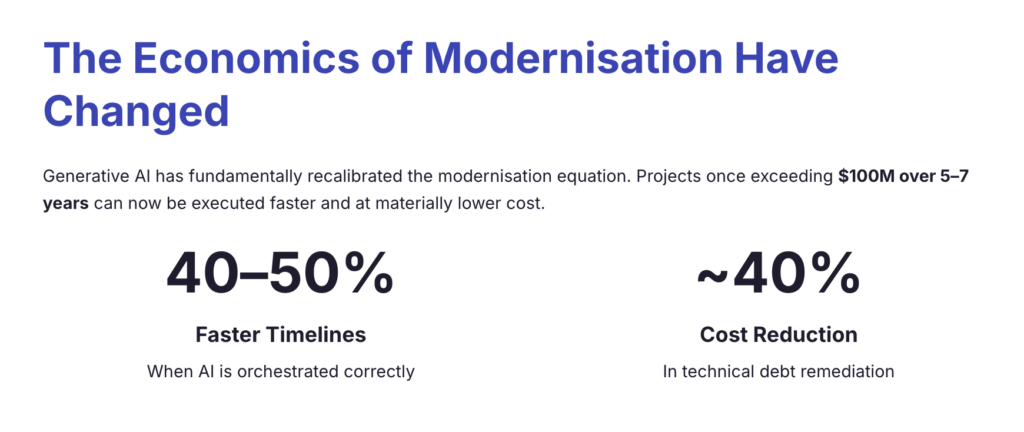
But generative AI has fundamentally recalibrated that equation.
Recent industry findings indicate:
- 40–50% acceleration in modernization timelines when AI is orchestrated correctly
- Roughly 40% reduction in costs associated with technical debt remediation
- Significant reduction in manual documentation and testing effort
Projects that once exceeded $100M and required 5–7 years can now be executed faster and at materially lower cost when AI agents support code analysis, test generation, documentation, and refactoring workflows.
This shift makes previously “unjustifiable” modernization initiatives economically viable.
3. Technology Debt Is Now a P&L Issue
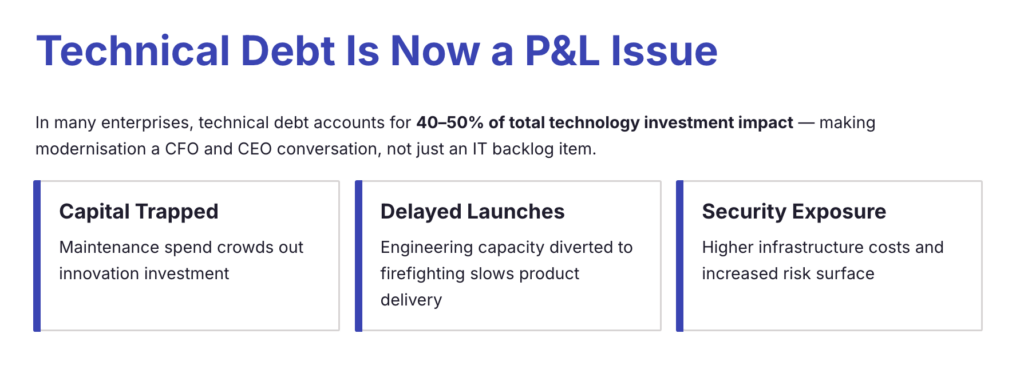
In many enterprises, technical debt accounts for up to 40–50% of total technology investment impact.
That means:
- Capital is tied up in maintenance rather than innovation
- Engineering capacity is diverted to firefighting
- Business transformation ROI is diluted
Organizations are increasingly able to quantify tech debt’s financial impact, tying it directly to:
- Delayed product launches
- Reduced operational efficiency
- Higher infrastructure costs
- Increased security risk exposure
Once tech debt is visible in financial terms, modernization becomes a CFO and CEO conversation — not just an IT backlog item.
4. Cloud ROI Pressure Is Forcing Architectural Rethinks
Many enterprises migrated legacy systems to the cloud without fully modernizing them.
The result:
- “Lift-and-shift” systems running inefficiently in cloud environments
- High cloud spend with limited scalability gains
- Persistent architectural constraints
AI-driven modernization allows organizations to:
- Identify redundant services
- Optimize workloads
- Decompose monoliths
- Improve cloud resource utilization
Cloud optimization and AI modernization are increasingly intertwined.
Organizations are not just modernizing to move to cloud — they are modernizing to make cloud economically efficient.
5. Regulatory and Security Pressures Are Increasing
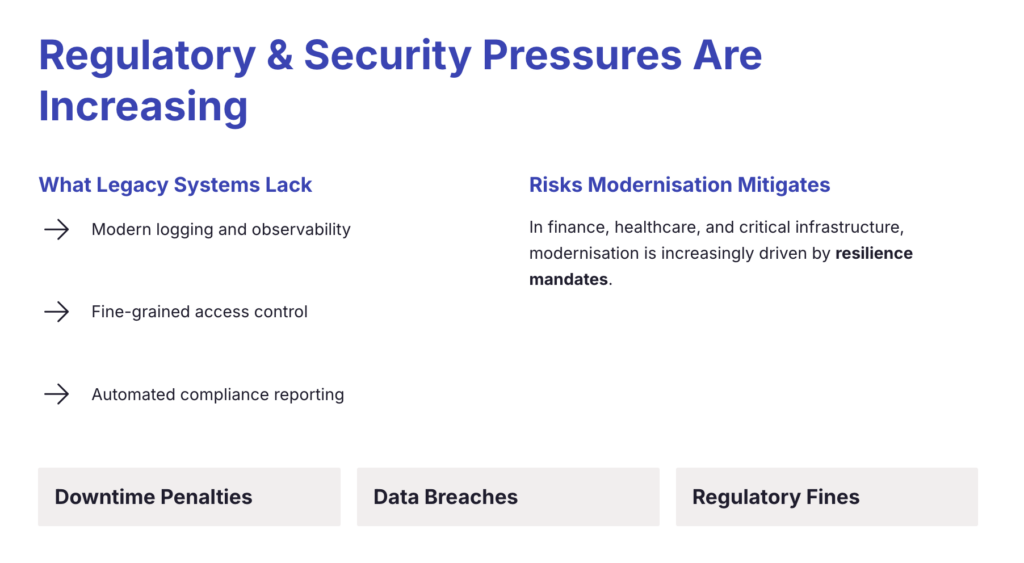
Regulatory frameworks in finance, healthcare, and critical infrastructure are tightening around:
- Operational resilience
- Cybersecurity
- Data protection
- Auditability
Legacy systems often lack:
- Modern logging and observability
- Fine-grained access control
- Real-time monitoring
- Automated compliance reporting
Modernization becomes a risk mitigation strategy, reducing exposure to:
- Downtime penalties
- Data breaches
- Regulatory fines
In highly regulated sectors, modernization is increasingly driven by resilience mandates.
6. Engineering Talent Scarcity Is a Structural Constraint
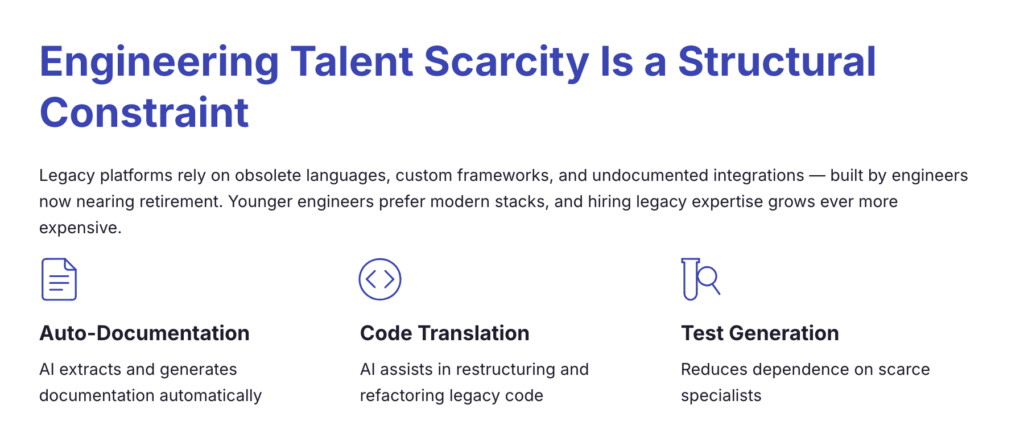
Many legacy platforms rely on:
- Obsolete programming languages
- Custom-built frameworks
- Undocumented integrations
The engineers who built and maintained these systems are reaching retirement age.
Meanwhile:
- Younger engineers prefer modern stacks
- Hiring for legacy expertise becomes more expensive
- Knowledge concentration creates single points of failure
AI mitigates this constraint by:
- Extracting documentation automatically
- Generating tests
- Assisting in translating and restructuring code
- Reducing dependence on scarce specialists
Talent scarcity is accelerating AI adoption inside modernization programs.
7. Competitive Acceleration Is Redefining the Risk Profile
Digital-native competitors operate on:
- Cloud-native architectures
- Modular systems
- Rapid deployment pipelines
- AI-integrated workflows
Incumbents constrained by legacy stacks face:
- Slower innovation cycles
- Longer feature release timelines
- Limited personalization capabilities
- Reduced experimentation velocity
Modernization is no longer defensive cost reduction.
It is offensive strategy — enabling:
- Faster product development
- AI-enhanced customer experiences
- Real-time data decisioning
- Market expansion
Organizations that modernize effectively gain compounding competitive advantage.
The Strategic Shift in Legacy Modernization in the era of AI
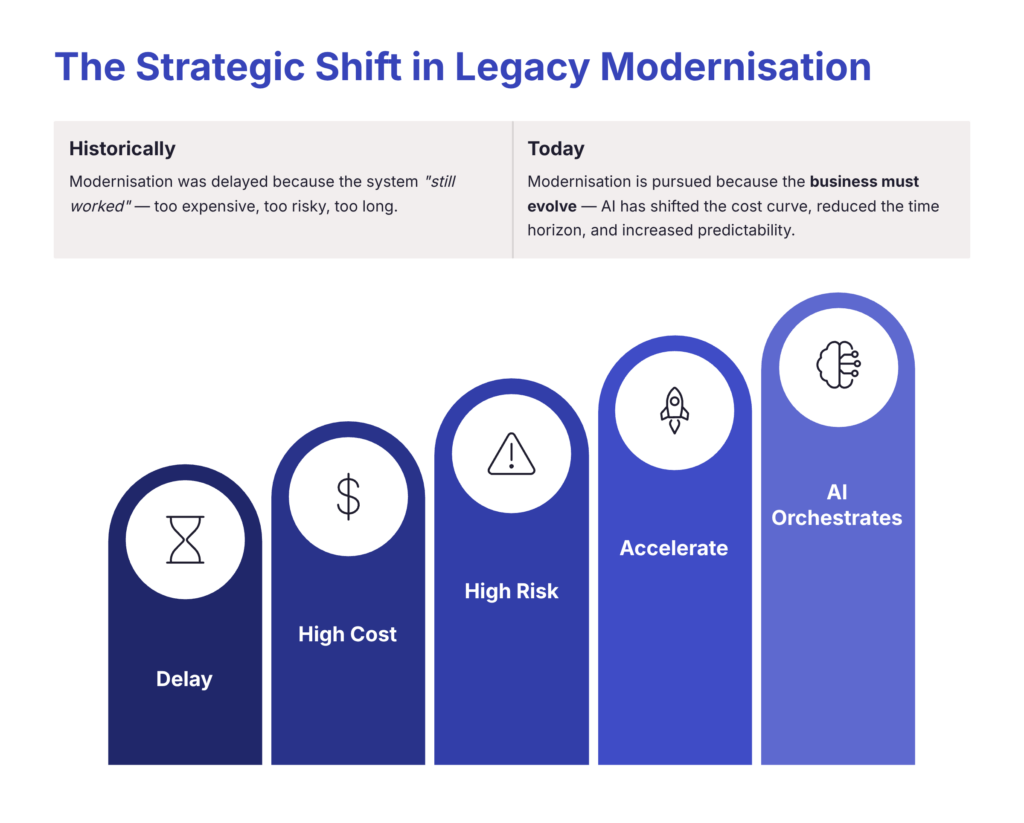
Historically:
Modernization was delayed because the system “still worked.”
Today:
Modernization is pursued because the business must evolve.
AI has not eliminated the complexity of modernization — but it has shifted the cost curve, reduced the time horizon, and increased predictability.
The question is no longer whether modernization is necessary.
The question is whether it is being approached strategically — with AI as an orchestrated accelerator rather than a superficial code conversion tool.
Common Challenges in Legacy System Modernization
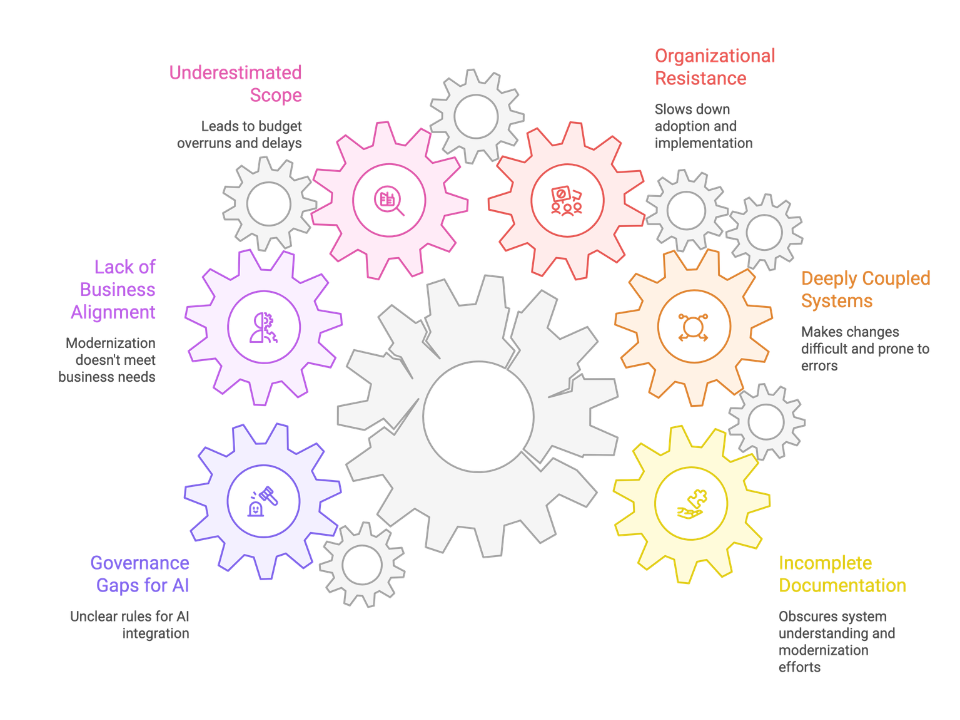
Leaders frequently ask about challenges.
Key risks include:
- Incomplete documentation
- Deeply coupled systems
- Organizational resistance
- Underestimated scope
- Lack of business alignment
- Governance gaps for AI use
The solution is disciplined orchestration — not aggressive automation.
How Long Does AI-Driven Modernization Take?
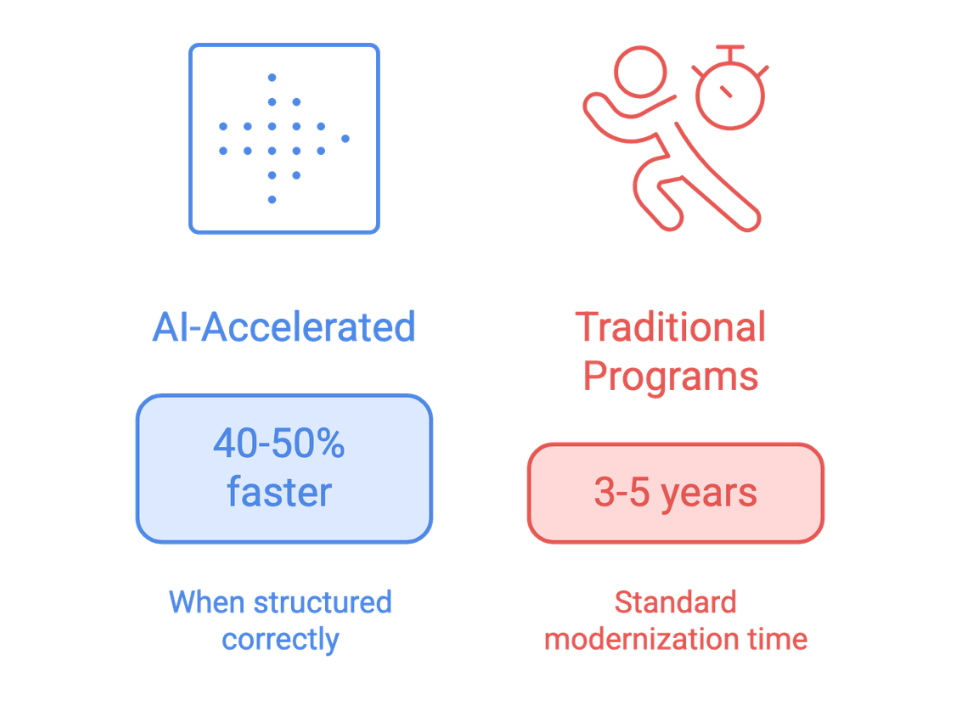
Traditional programs: 3-5 years.
AI-accelerated programs: 40–50% faster when structured correctly.
Timelines depend on:
- System complexity
- Governance maturity
- Testing coverage
- Architecture clarity
Is AI Modernization Worth the Investment?
When executed properly:
- Cost reductions compound
- Engineering productivity increases
- Security posture improves
- Cloud ROI improves
- AI adoption becomes feasible
- P&L impact becomes measurable
Organizations that track tech debt impact on financial performance often discover modernization is overdue — not optional.
Final Perspective
AI does not eliminate modernization complexity.
But it fundamentally reshapes its economics.
What was once too expensive, too slow, and too risky is now executable — if orchestrated correctly.
The organizations that combine disciplined engineering, strategic prioritization, and AI acceleration will convert legacy from an anchor into an advantage.
Ready to Modernize with AI?
Legacy modernization is no longer a multi-year leap of faith.
With the right strategy, disciplined engineering, and AI used as a structured accelerator — not a shortcut — modernization becomes measurable, phased, and financially justified.
At Gart Solutions, we help organizations:
- Quantify the real cost of legacy systems
- Identify high-impact modernization priorities
- Design AI-accelerated transformation roadmaps
- Reduce technical debt safely and incrementally
- Build cloud-native, AI-ready architectures
- Optimize modernization ROI with DevOps and platform engineering practices
Whether you’re exploring modernization for the first time or need to rescue a stalled initiative, we can help you move forward with clarity.
Let’s assess where you stand — and what’s possible.
Book a strategic consultation or request a legacy modernization audit to receive:
- A technical debt exposure overview
- Risk and cost concentration mapping
- AI-readiness assessment
- A phased, realistic modernization roadmap
Contact us today to start your AI-driven modernization journey.